1
WHAT STRUCTURAL ENGINEERS SHOULD KNOW ABOUT GLASS
Khaled Eid
Engineering Manager
Metro Performance Glass
ABSTRACT
The glass used in many structural applications in buildings has become more familiar with its unique
mechanical, optical and aesthetic properties. Currently there is a lack of design aids and comprehensive
standards to guide designers and engineers towards appropriate structural design for glass and glazing.
There have been many cases of structural glass failure due to poor design or construction that could be
avoided with some basic glass design knowledge.
This paper aims to provide basic introductory knowledge for what every structural engineer should know
about glass as a building material.
1 GLASS TYPES
There are mainly three types of glass; annealed
glass, heat-strengthened glass and toughened glass.
1.1 FLOAT GLASS OR ANNEALED GLASS
Produced by controlled cooling to prevent residual
stress in the glass. Float glass is high quality glass
like plate glass, with excellent optical clarity. Like
plate glass it can be cut, drilled, machined, edged,
bent and polished. Float glass is generally available
in the following thicknesses: 2, 3, 4, 5, 6, 8, 10, 12,
15, 19 and 25 mm (25 mm is not a readily available
product).
Structural glass behaves perfectly elastically until
the moment it fractures. There is no creep, and there
is no fatigue as in steel.
Temperature differences across the glass
resulting from shading can cause thermal stresses
that may exceed the strength of the glass, causing
breakage. This is known as thermal breakage and it
is likely to occur more in thicker glasses.
The main disadvantages of annealed glass are
shock resistance and low-tension capacity compared
to heat-treated glass. Annealed glass is not a safety
glass and cannot be used for human impact
applications.
1.2 HEAT-STRENGTHENED GLASS
Heat-strengthened glass (HS) is also known as
partially toughened or semi-tempered. Produced
using annealed glass, it is heated to approximately
650°C. It is then quenched by jets of cooled air. This
rapid cooling or quenching induces compression
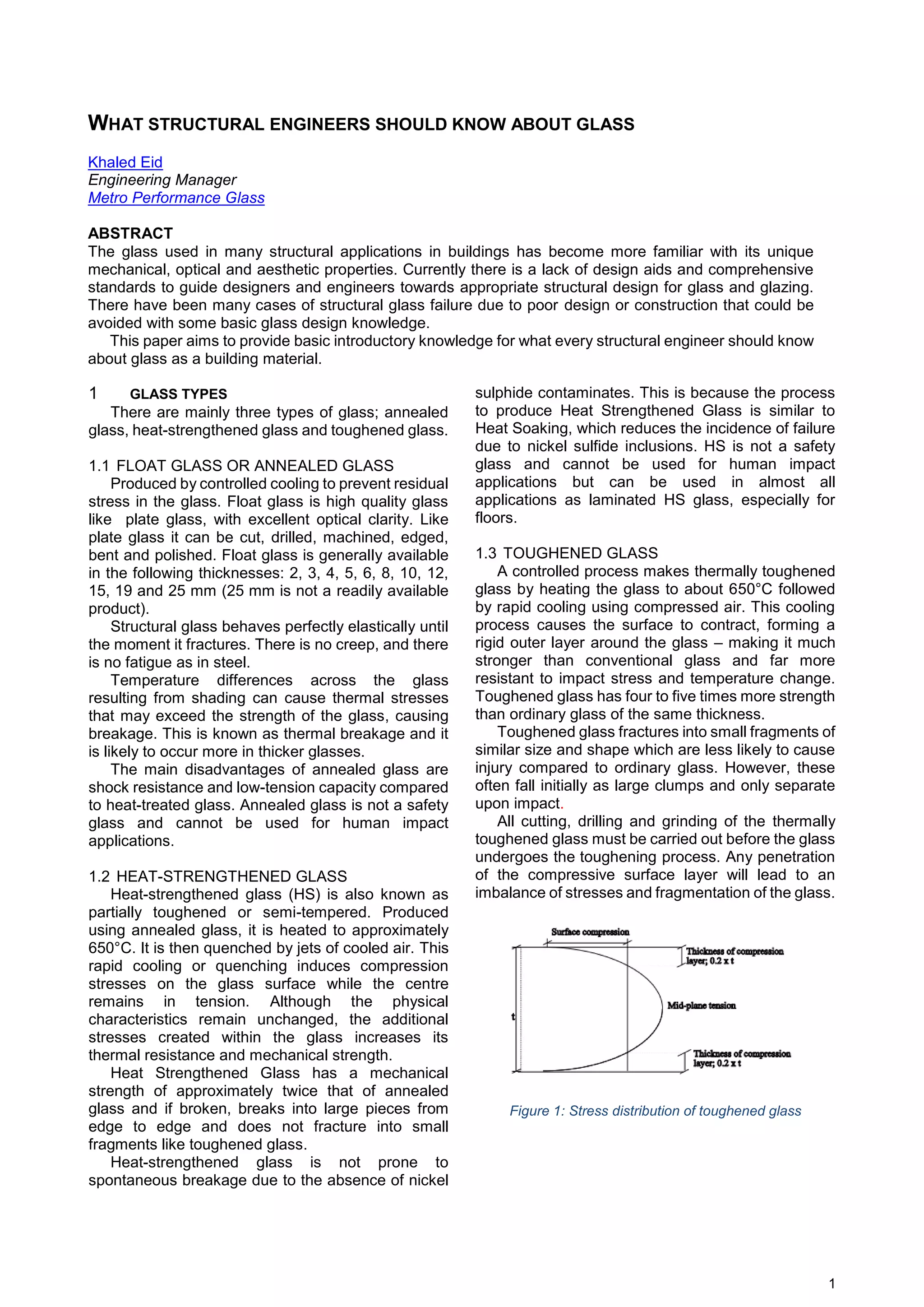
stresses on the glass surface while the centre
remains in tension. Although the physical
characteristics remain unchanged, the additional
stresses created within the glass increases its
thermal resistance and mechanical strength.
Heat Strengthened Glass has a mechanical
strength of approximately twice that of annealed
glass and if broken, breaks into large pieces from
edge to edge and does not fracture into small
fragments like toughened glass.
Heat-strengthened glass is not prone to
spontaneous breakage due to the absence of nickel
sulphide contaminates. This is because the process
to produce Heat Strengthened Glass is similar to
Heat Soaking, which reduces the incidence of failure
due to nickel sulfide inclusions. HS is not a safety
glass and cannot be used for human impact
applications but can be used in almost all
applications as laminated HS glass, especially for
floors.
1.3 TOUGHENED GLASS
A controlled process makes thermally toughened
glass by heating the glass to about 650°C followed
by rapid cooling using compressed air. This cooling
process causes the surface to contract, forming a
rigid outer layer around the glass – making it much
stronger than conventional glass and far more
resistant to impact stress and temperature change.
Toughened glass has four to five times more strength
than ordinary glass of the same thickness.
Toughened glass fractures into small fragments of
similar size and shape which are less likely to cause
injury compared to ordinary glass. However, these
often fall initially as large clumps and only separate
upon impact.
All cutting, drilling and grinding of the thermally
toughened glass must be carried out before the glass
undergoes the toughening process. Any penetration
of the compressive surface layer will lead to an
imbalance of stresses and fragmentation of the glass.
Figure 1: Stress distribution of toughened glass
2
1.4 HEAT SOAKED TOUGHENED GLASS
Heat soaking is undertaken by heating the
toughened glass to 290°C and holding it there for a
specified time before slowly cooling it. This process
accelerates the expansion of nickel sulphide and at
this temperature glass panels with NiS stones are
likely to shatter.
1.5 CHEMICALLY STRENGTHENED GLASS
Glass with a high sodium content can be
prestressed chemically by immersion in a hot
potassium salt bath. Sodium-ions are exchanged,
and the densification of the molecular structure
creates large compressive stresses in the surface.
The small depth of penetration of this effect still
leaves the glass highly susceptibility to surface
defects.
Chemically strengthened glass can be cut to a
limited extent and is not readily available locally
(usually requires importing). It is used mainly for very
thin glass, and is not considered safety glass.
1.6 LAMINATED GLASS
Like laminated veneer lumber in timber, laminated
glass is two (or more) layers of glass, separated by
an interlayer. The interlayers’ Ethylene Vinyl Acetate
(EVA) film or Polyvinyl Butyral (PVB) are commonly
used. Laminate may improve the sound insulation
and rating due to the damping effect of the interlayer.
The laminate interlayer modifies the structural
behavior of glass, both before and after breakage.
Moreover, the properties of laminated glass can now
be enhanced with stiff interlayer products.
Laminated glass is normally used when there is a
possibility of human impact or where the glass could
fall and cause injury if shattered. Overhead glazing
and glass floors use are common uses for laminated
glass.
Laminated glass can be any combination of glass
types, often made using where the properties of Heat
Strengthened or Toughened Glass are desired to be
combined.
1.7 INSULATING GLASS UNITS
An Insulating Glass Unit (IGU) consists
of two or more glass panes separated
by a spacer, filled with air or a gas such as argon or
krypton (both denser than air), and sealed to prevent
humid outside air from entering the unit.
IGU’s can help prevent condensation from
forming and can reduce conductive heat loss or gain
by more than 50% (in comparison to single glazing).
Adding a Low-E coating (allows light to enter while
also providing thermal insulation) to a surface of the
double-glazed unit will increase the energy efficiency,
as will adding a gas fill between the layers of glass.
2 GLASS PROPERTIES
Glass density is similar to concrete’s density of
2500kg/m3
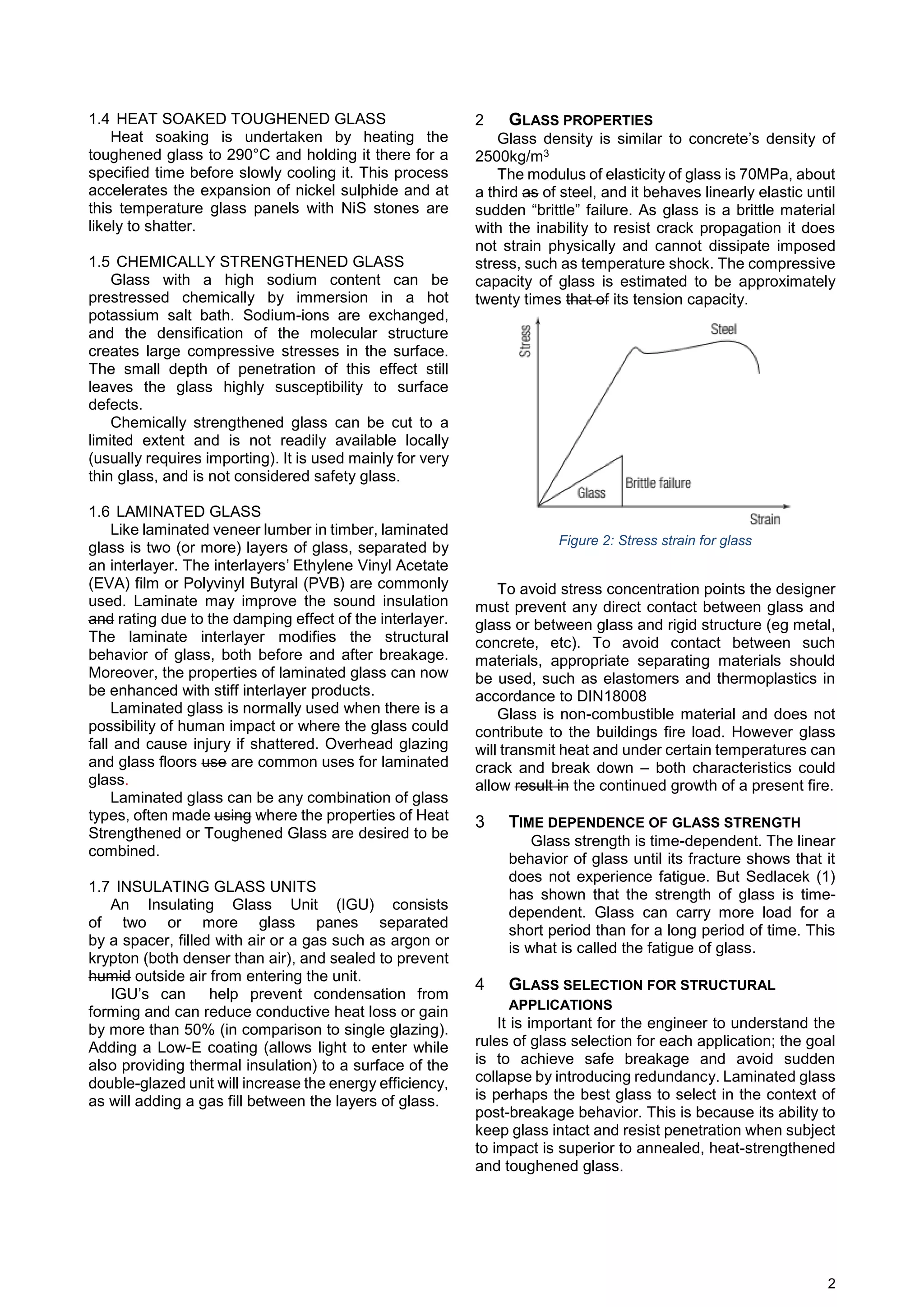
The modulus of elasticity of glass is 70MPa, about
a third as of steel, and it behaves linearly elastic until
sudden “brittle” failure. As glass is a brittle material
with the inability to resist crack propagation it does
not strain physically and cannot dissipate imposed
stress, such as temperature shock. The compressive
capacity of glass is estimated to be approximately
twenty times that of its tension capacity.
Figure 2: Stress strain for glass
To avoid stress concentration points the designer
must prevent any direct contact between glass and
glass or between glass and rigid structure (eg metal,
concrete, etc). To avoid contact between such
materials, appropriate separating materials should
be used, such as elastomers and thermoplastics in
accordance to DIN18008
Glass is non-combustible material and does not
contribute to the buildings fire load. However glass
will transmit heat and under certain temperatures can
crack and break down – both characteristics could
allow result in the continued growth of a present fire.
3 TIME DEPENDENCE OF GLASS STRENGTH
Glass strength is time-dependent. The linear
behavior of glass until its fracture shows that it
does not experience fatigue. But Sedlacek (1)
has shown that the strength of glass is time-
dependent. Glass can carry more load for a
short period than for a long period of time. This
is what is called the fatigue of glass.
4 GLASS SELECTION FOR STRUCTURAL
APPLICATIONS
It is important for the engineer to understand the
rules of glass selection for each application; the goal
is to achieve safe breakage and avoid sudden
collapse by introducing redundancy. Laminated glass
is perhaps the best glass to select in the context of
post-breakage behavior. This is because its ability to
keep glass intact and resist penetration when subject
to impact is superior to annealed, heat-strengthened
and toughened glass.
3
4.1 SLOPED AND OVERHEAD GLAZING
NZ Standards require all sloped overhead glazing
to be laminated safety glass, except if lower than 5
metres above floor level. In this situation toughened
glass may be used, but it is recommended that heat
soaked toughened glass be used for critical
applications.
Although the standards allow using toughened
glass if lower than 5 metres, it is recommended to
use laminated glass as shattered pieces of glass
falling from less than 5 metres can still cause some
serious injury. For trafficable canopy toughened
glass should not to be used, instead a laminated heat
strengthened glass would be a better option if there
are no penetration holes through the glass.
4.2 BALUSTRADE
When glass serves as a protective barrier from a
fall greater than falling above 1 metre, it serves
as structural balustrade in which should be
designed by a structural engineer. Balustrade
glass selection can be either toughened glass
(with interlinking rails, able to span between the
glass panes in case one pane is broken) or
laminated glass (optionally with a stiff interlayer
to provide post-failure protection). The latter
quality is introduced by MBIE, which require that
laminated glass be able to withstand a load and
remain standing after both panes of glass have
been broken.
The requirement is: 20kg load applied for 1
minute at 1m height above ground level.
Maximum allowable deflection is 250mm
When calculating the deflection of balustrades,
the designer should take note of the assembly
that fixes the balustrade to the base structure.
The deformation of the connection system used
can have a significant impact on the overall
deflection of the balustrade and must be
considered during its design to determine
acceptable deflection limits on the balustrade
under consideration.
4.3 POOL FENCE
Grade A toughened safety glass tested in
accordance with appendix D AS/NZS 2208:
1996 must be used in all pool fences. Min-height
is 1.2m and glass thickness is typically governed
by the site wind load.
4.4 GLASS FLOORS
Glass floors are commonly made of laminated
glass comprising of two or more (usually three) panes
of thick glass that provide a safer option in the case
of a single layer breakage. Both toughened and heat-
strengthened glass can be used in the laminate, but
not in monolithic form due to their breakage
characteristics.
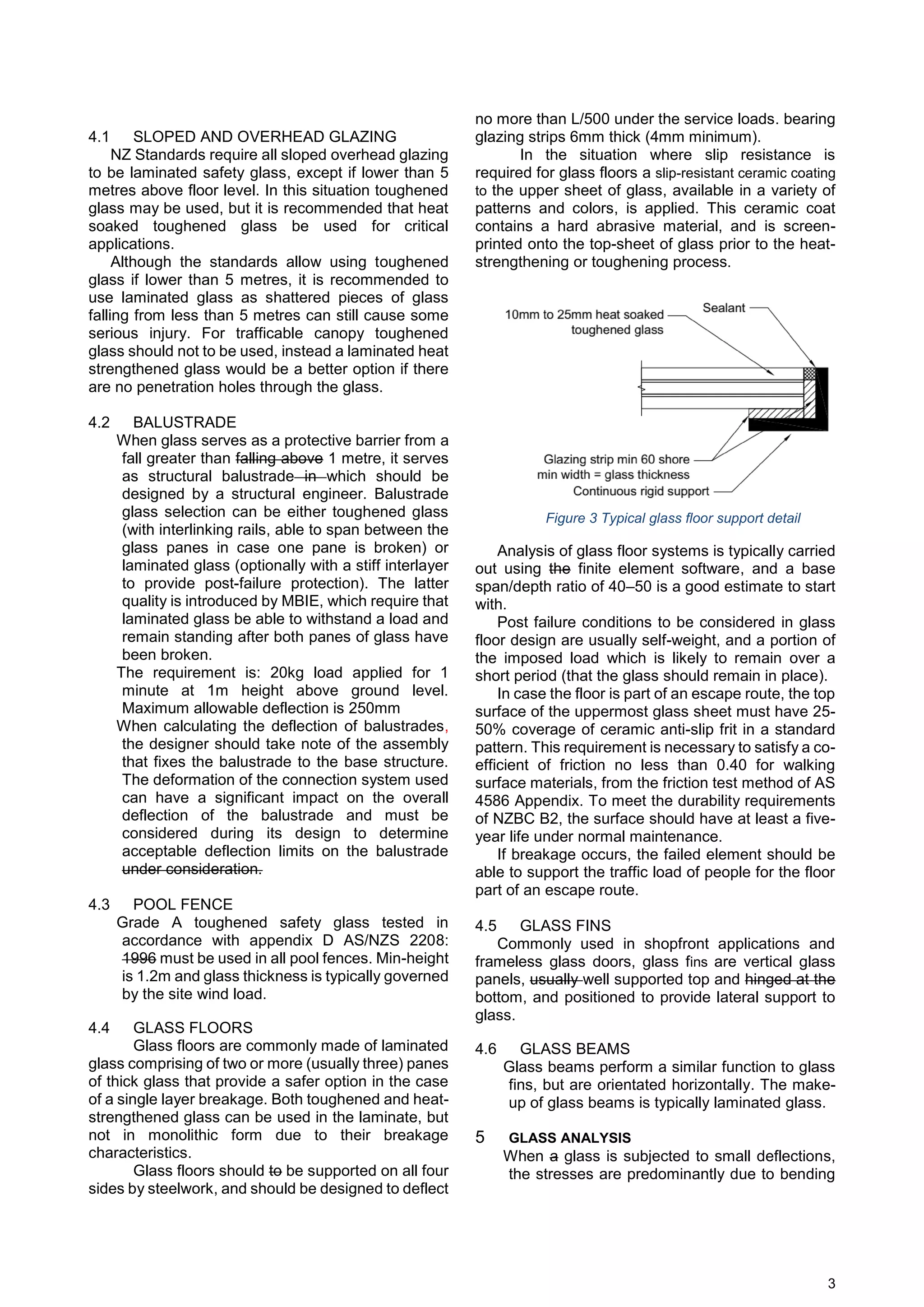
Glass floors should to be supported on all four
sides by steelwork, and should be designed to deflect
no more than L/500 under the service loads. bearing
glazing strips 6mm thick (4mm minimum).
In the situation where slip resistance is
required for glass floors a slip-resistant ceramic coating
to the upper sheet of glass, available in a variety of
patterns and colors, is applied. This ceramic coat
contains a hard abrasive material, and is screen-
printed onto the top-sheet of glass prior to the heat-
strengthening or toughening process.
Figure 3 Typical glass floor support detail
Analysis of glass floor systems is typically carried
out using the finite element software, and a base
span/depth ratio of 40–50 is a good estimate to start
with.
Post failure conditions to be considered in glass
floor design are usually self-weight, and a portion of
the imposed load which is likely to remain over a
short period (that the glass should remain in place).
In case the floor is part of an escape route, the top
surface of the uppermost glass sheet must have 25-
50% coverage of ceramic anti-slip frit in a standard
pattern. This requirement is necessary to satisfy a co-
efficient of friction no less than 0.40 for walking
surface materials, from the friction test method of AS
4586 Appendix. To meet the durability requirements
of NZBC B2, the surface should have at least a five-
year life under normal maintenance.
If breakage occurs, the failed element should be
able to support the traffic load of people for the floor
part of an escape route.
4.5 GLASS FINS
Commonly used in shopfront applications and
frameless glass doors, glass fins are vertical glass
panels, usually well supported top and hinged at the
bottom, and positioned to provide lateral support to
glass.
4.6 GLASS BEAMS
Glass beams perform a similar function to glass
fins, but are orientated horizontally. The make-
up of glass beams is typically laminated glass.
5 GLASS ANALYSIS
When a glass is subjected to small deflections,
the stresses are predominantly due to bending
4
and linear analysis is still adequate to reflect the
structural behavior of the glass.
When the deflection is greater than the
thickness, the membrane action (where
stresses along a plane are predominantly
tension) becomes essential and could be
dominant over the bending action. Because
linear analysis overestimates the stress in the
plane, In such a situation a nonlinear analysis
using finite element method would give a more
accurate result.
Glass behaves as an elastic material. This
means that the theory of elasticity is directly
applicable for determining stress and strain.
Typically for structural units of glass plates it is
that the thickness is small compared to the in-
plane dimensions. This may result in structural
complication when a glass plate is loaded
perpendicular to its plane, as there will be both
bending and membrane responses.
All finite element results should be double
checked using simple analytical methods. A
very good fit between numerical and analytical
results can be expected.
5.1 LAMINATED GLASS
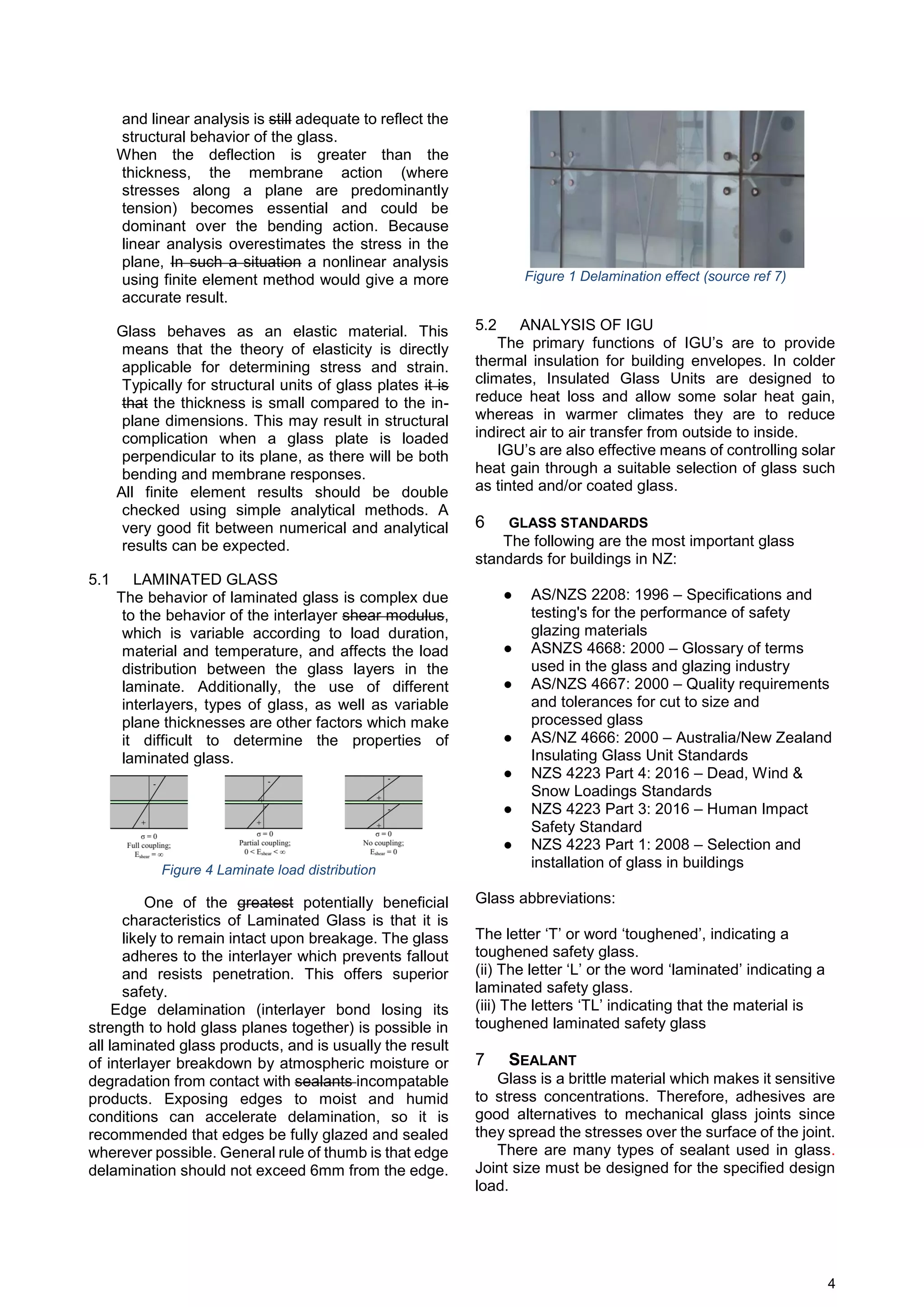
The behavior of laminated glass is complex due
to the behavior of the interlayer shear modulus,
which is variable according to load duration,
material and temperature, and affects the load
distribution between the glass layers in the
laminate. Additionally, the use of different
interlayers, types of glass, as well as variable
plane thicknesses are other factors which make
it difficult to determine the properties of
laminated glass.
Figure 4 Laminate load distribution
One of the greatest potentially beneficial
characteristics of Laminated Glass is that it is
likely to remain intact upon breakage. The glass
adheres to the interlayer which prevents fallout
and resists penetration. This offers superior
safety.
Edge delamination (interlayer bond losing its
strength to hold glass planes together) is possible in
all laminated glass products, and is usually the result
of interlayer breakdown by atmospheric moisture or
degradation from contact with sealants incompatable
products. Exposing edges to moist and humid
conditions can accelerate delamination, so it is
recommended that edges be fully glazed and sealed
wherever possible. General rule of thumb is that edge
delamination should not exceed 6mm from the edge.
Figure 1 Delamination effect (source ref 7)
5.2 ANALYSIS OF IGU
The primary functions of IGU’s are to provide
thermal insulation for building envelopes. In colder
climates, Insulated Glass Units are designed to
reduce heat loss and allow some solar heat gain,
whereas in warmer climates they are to reduce
indirect air to air transfer from outside to inside.
IGU’s are also effective means of controlling solar
heat gain through a suitable selection of glass such
as tinted and/or coated glass.
6 GLASS STANDARDS
The following are the most important glass
standards for buildings in NZ:
● AS/NZS 2208: 1996 – Specifications and
testing's for the performance of safety
glazing materials
● ASNZS 4668: 2000 – Glossary of terms
used in the glass and glazing industry
● AS/NZS 4667: 2000 – Quality requirements
and tolerances for cut to size and
processed glass
● AS/NZ 4666: 2000 – Australia/New Zealand
Insulating Glass Unit Standards
● NZS 4223 Part 4: 2016 – Dead, Wind &
Snow Loadings Standards
● NZS 4223 Part 3: 2016 – Human Impact
Safety Standard
● NZS 4223 Part 1: 2008 – Selection and
installation of glass in buildings
Glass abbreviations:
The letter ‘T’ or word ‘toughened’, indicating a
toughened safety glass.
(ii) The letter ‘L’ or the word ‘laminated’ indicating a
laminated safety glass.
(iii) The letters ‘TL’ indicating that the material is
toughened laminated safety glass
7 SEALANT
Glass is a brittle material which makes it sensitive
to stress concentrations. Therefore, adhesives are
good alternatives to mechanical glass joints since
they spread the stresses over the surface of the joint.
There are many types of sealant used in glass.
Joint size must be designed for the specified design
load.
5
The sealant bite can be calculated using the
equation in NZS4223:1, from the wind load and glass
span. The minimum sealant is 6mm and there are
many types of sealants depending on the usage and
application. Additionally, the structural sealant should
not be used for long term loads. The structural
silicone sealant must be tested for compatibility with
all materials to which it must adhere on a project-
specific basis. A compatibility test certificate for
sealant should be provided to confirm the
compatibility of sealant with all finishes and materials.
8 FIXING AND HARDWARE
Fixing and hardware is one of the most important
components in the glass design process. There are a
variety of fixing and hardware options which are
designed provide a secure connection between the
glass component and the support structure, and to
absorb forces when the glass flexes under load.
Countersunk fittings are one method we that can
be used to support our glass. A countersunk hole is
drilled through the glass panel to allow the secure
installation of fixings or hardware. When loads are
exerted onto the panel, they are transferred from the
glass through the countersunk point fixings and into
our the support structure.
There are also a wide range of proprietary fixing
systems that could be applied to secure the
performance of the glass as a barrier. These include;
Infill Frame or Sections (glass is wedged into the
channel in a frame), Infill Mechanical Fittings (glass
is fixed to metal cleats with countersunk fittings), Infill
Clamp Fittings (glass is clamped by clamp fittings
fixed to the frame) and Infill Spider Fittings (spider
connection system fitted to posts that allow for
vertical and horizontal adjustment).
It is important to provide the glass designer with
the point fixing relative movement due to differential
deflection of the supporting points
9 GLASS INSPECTION
Structural glass inspection shall consider the
following:
● Checking the manufacturer documents each
panel must be marked with:
o the name, registered trademark, or
code of the manufacturer or supplier
o the type of safety glazing material
(for example, T for toughened glass)
o the Standard to which the material
has been tested, such as AS/NZS
2208
o the classification for impact test
behaviour (for example, A for Grade
A).
● Check the installation with the design
documents and project specification
● The fixing location and bolt tightening.
Overtightening will cause local stress
concertation.
● Glass quality, poor edge polishing led to
stress concentration and cracking. (D.Honfi)
● Easy to be replaced
● For glass balustrade with interlinking rail,
checking it is connected to the structural
element
9.1 CRACK PATTERNS
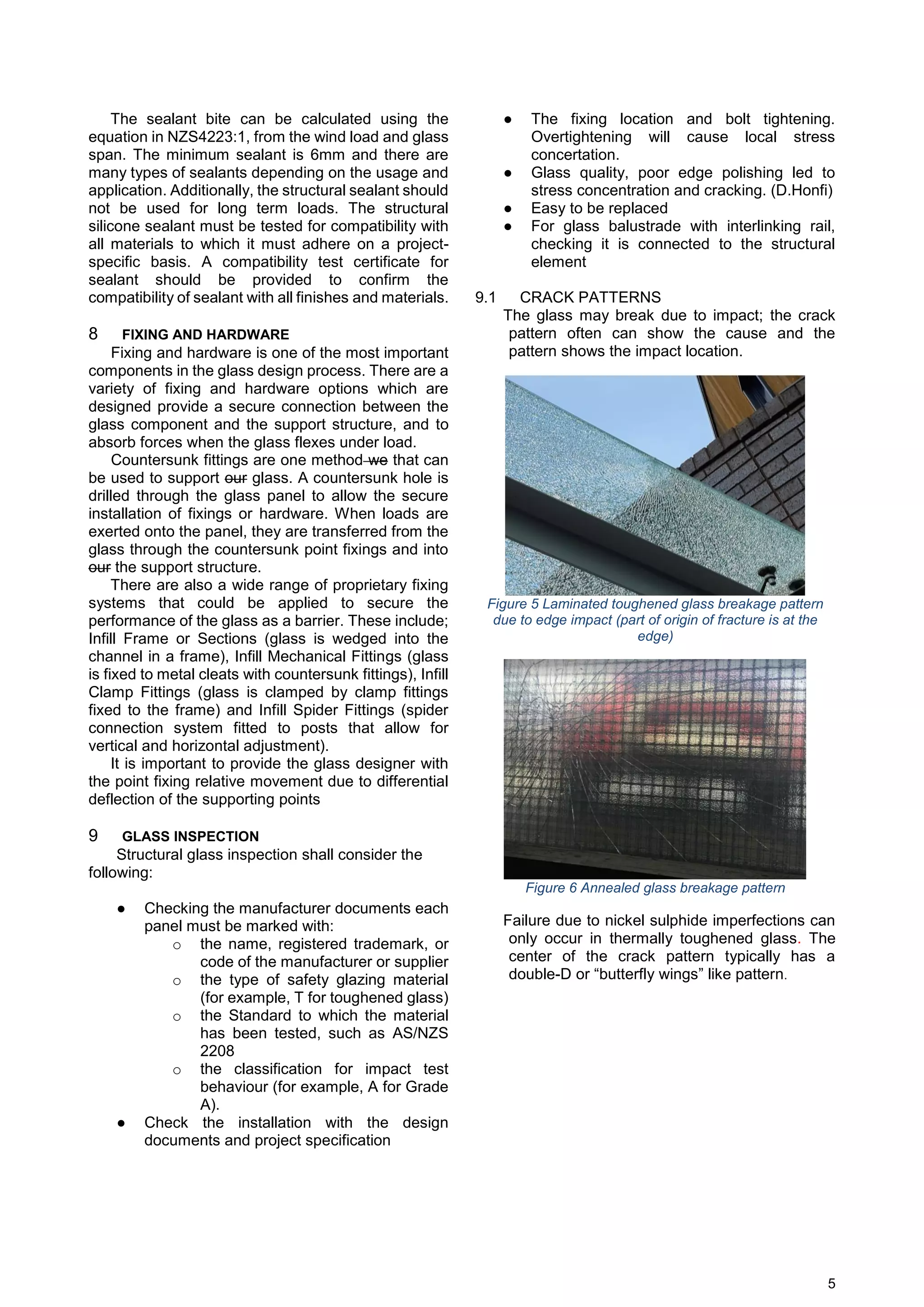
The glass may break due to impact; the crack
pattern often can show the cause and the
pattern shows the impact location.
Figure 5 Laminated toughened glass breakage pattern
due to edge impact (part of origin of fracture is at the
edge)
Figure 6 Annealed glass breakage pattern
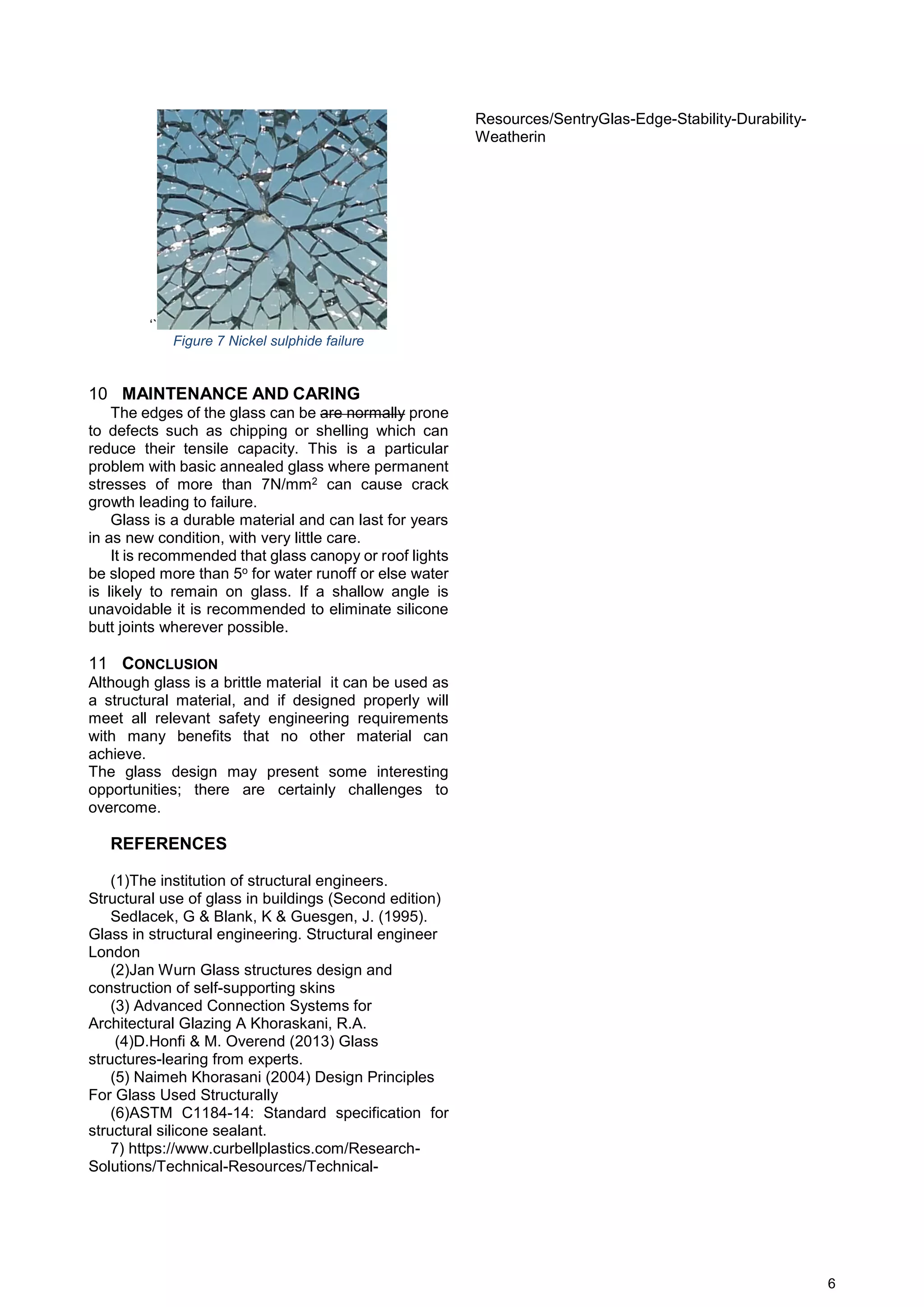
Failure due to nickel sulphide imperfections can
only occur in thermally toughened glass. The
center of the crack pattern typically has a
double-D or “butterfly wings” like pattern.
6
‘`
Figure 7 Nickel sulphide failure
10 MAINTENANCE AND CARING
The edges of the glass can be are normally prone
to defects such as chipping or shelling which can
reduce their tensile capacity. This is a particular
problem with basic annealed glass where permanent
stresses of more than 7N/mm2 can cause crack
growth leading to failure.
Glass is a durable material and can last for years
in as new condition, with very little care.
It is recommended that glass canopy or roof lights
be sloped more than 5o for water runoff or else water
is likely to remain on glass. If a shallow angle is
unavoidable it is recommended to eliminate silicone
butt joints wherever possible.
11 CONCLUSION
Although glass is a brittle material it can be used as
a structural material, and if designed properly will
meet all relevant safety engineering requirements
with many benefits that no other material can
achieve.
The glass design may present some interesting
opportunities; there are certainly challenges to
overcome.
REFERENCES
(1)The institution of structural engineers.
Structural use of glass in buildings (Second edition)
Sedlacek, G & Blank, K & Guesgen, J. (1995).
Glass in structural engineering. Structural engineer
London
(2)Jan Wurn Glass structures design and
construction of self-supporting skins
(3) Advanced Connection Systems for
Architectural Glazing A Khoraskani, R.A.
(4)D.Honfi & M. Overend (2013) Glass
structures-learing from experts.
(5) Naimeh Khorasani (2004) Design Principles
For Glass Used Structurally
(6)ASTM C1184-14: Standard specification for
structural silicone sealant.
7) https://www.curbellplastics.com/Research-
Solutions/Technical-Resources/Technical-
Resources/SentryGlas-Edge-Stability-Durability-
Weatherin

What every engineer should know

  • 1.
    1 WHAT STRUCTURAL ENGINEERSSHOULD KNOW ABOUT GLASS Khaled Eid Engineering Manager Metro Performance Glass ABSTRACT The glass used in many structural applications in buildings has become more familiar with its unique mechanical, optical and aesthetic properties. Currently there is a lack of design aids and comprehensive standards to guide designers and engineers towards appropriate structural design for glass and glazing. There have been many cases of structural glass failure due to poor design or construction that could be avoided with some basic glass design knowledge. This paper aims to provide basic introductory knowledge for what every structural engineer should know about glass as a building material. 1 GLASS TYPES There are mainly three types of glass; annealed glass, heat-strengthened glass and toughened glass. 1.1 FLOAT GLASS OR ANNEALED GLASS Produced by controlled cooling to prevent residual stress in the glass. Float glass is high quality glass like plate glass, with excellent optical clarity. Like plate glass it can be cut, drilled, machined, edged, bent and polished. Float glass is generally available in the following thicknesses: 2, 3, 4, 5, 6, 8, 10, 12, 15, 19 and 25 mm (25 mm is not a readily available product). Structural glass behaves perfectly elastically until the moment it fractures. There is no creep, and there is no fatigue as in steel. Temperature differences across the glass resulting from shading can cause thermal stresses that may exceed the strength of the glass, causing breakage. This is known as thermal breakage and it is likely to occur more in thicker glasses. The main disadvantages of annealed glass are shock resistance and low-tension capacity compared to heat-treated glass. Annealed glass is not a safety glass and cannot be used for human impact applications. 1.2 HEAT-STRENGTHENED GLASS Heat-strengthened glass (HS) is also known as partially toughened or semi-tempered. Produced using annealed glass, it is heated to approximately 650°C. It is then quenched by jets of cooled air. This rapid cooling or quenching induces compression stresses on the glass surface while the centre remains in tension. Although the physical characteristics remain unchanged, the additional stresses created within the glass increases its thermal resistance and mechanical strength. Heat Strengthened Glass has a mechanical strength of approximately twice that of annealed glass and if broken, breaks into large pieces from edge to edge and does not fracture into small fragments like toughened glass. Heat-strengthened glass is not prone to spontaneous breakage due to the absence of nickel sulphide contaminates. This is because the process to produce Heat Strengthened Glass is similar to Heat Soaking, which reduces the incidence of failure due to nickel sulfide inclusions. HS is not a safety glass and cannot be used for human impact applications but can be used in almost all applications as laminated HS glass, especially for floors. 1.3 TOUGHENED GLASS A controlled process makes thermally toughened glass by heating the glass to about 650°C followed by rapid cooling using compressed air. This cooling process causes the surface to contract, forming a rigid outer layer around the glass – making it much stronger than conventional glass and far more resistant to impact stress and temperature change. Toughened glass has four to five times more strength than ordinary glass of the same thickness. Toughened glass fractures into small fragments of similar size and shape which are less likely to cause injury compared to ordinary glass. However, these often fall initially as large clumps and only separate upon impact. All cutting, drilling and grinding of the thermally toughened glass must be carried out before the glass undergoes the toughening process. Any penetration of the compressive surface layer will lead to an imbalance of stresses and fragmentation of the glass. Figure 1: Stress distribution of toughened glass
  • 2.
    2 1.4 HEAT SOAKEDTOUGHENED GLASS Heat soaking is undertaken by heating the toughened glass to 290°C and holding it there for a specified time before slowly cooling it. This process accelerates the expansion of nickel sulphide and at this temperature glass panels with NiS stones are likely to shatter. 1.5 CHEMICALLY STRENGTHENED GLASS Glass with a high sodium content can be prestressed chemically by immersion in a hot potassium salt bath. Sodium-ions are exchanged, and the densification of the molecular structure creates large compressive stresses in the surface. The small depth of penetration of this effect still leaves the glass highly susceptibility to surface defects. Chemically strengthened glass can be cut to a limited extent and is not readily available locally (usually requires importing). It is used mainly for very thin glass, and is not considered safety glass. 1.6 LAMINATED GLASS Like laminated veneer lumber in timber, laminated glass is two (or more) layers of glass, separated by an interlayer. The interlayers’ Ethylene Vinyl Acetate (EVA) film or Polyvinyl Butyral (PVB) are commonly used. Laminate may improve the sound insulation and rating due to the damping effect of the interlayer. The laminate interlayer modifies the structural behavior of glass, both before and after breakage. Moreover, the properties of laminated glass can now be enhanced with stiff interlayer products. Laminated glass is normally used when there is a possibility of human impact or where the glass could fall and cause injury if shattered. Overhead glazing and glass floors use are common uses for laminated glass. Laminated glass can be any combination of glass types, often made using where the properties of Heat Strengthened or Toughened Glass are desired to be combined. 1.7 INSULATING GLASS UNITS An Insulating Glass Unit (IGU) consists of two or more glass panes separated by a spacer, filled with air or a gas such as argon or krypton (both denser than air), and sealed to prevent humid outside air from entering the unit. IGU’s can help prevent condensation from forming and can reduce conductive heat loss or gain by more than 50% (in comparison to single glazing). Adding a Low-E coating (allows light to enter while also providing thermal insulation) to a surface of the double-glazed unit will increase the energy efficiency, as will adding a gas fill between the layers of glass. 2 GLASS PROPERTIES Glass density is similar to concrete’s density of 2500kg/m3 The modulus of elasticity of glass is 70MPa, about a third as of steel, and it behaves linearly elastic until sudden “brittle” failure. As glass is a brittle material with the inability to resist crack propagation it does not strain physically and cannot dissipate imposed stress, such as temperature shock. The compressive capacity of glass is estimated to be approximately twenty times that of its tension capacity. Figure 2: Stress strain for glass To avoid stress concentration points the designer must prevent any direct contact between glass and glass or between glass and rigid structure (eg metal, concrete, etc). To avoid contact between such materials, appropriate separating materials should be used, such as elastomers and thermoplastics in accordance to DIN18008 Glass is non-combustible material and does not contribute to the buildings fire load. However glass will transmit heat and under certain temperatures can crack and break down – both characteristics could allow result in the continued growth of a present fire. 3 TIME DEPENDENCE OF GLASS STRENGTH Glass strength is time-dependent. The linear behavior of glass until its fracture shows that it does not experience fatigue. But Sedlacek (1) has shown that the strength of glass is time- dependent. Glass can carry more load for a short period than for a long period of time. This is what is called the fatigue of glass. 4 GLASS SELECTION FOR STRUCTURAL APPLICATIONS It is important for the engineer to understand the rules of glass selection for each application; the goal is to achieve safe breakage and avoid sudden collapse by introducing redundancy. Laminated glass is perhaps the best glass to select in the context of post-breakage behavior. This is because its ability to keep glass intact and resist penetration when subject to impact is superior to annealed, heat-strengthened and toughened glass.
  • 3.
    3 4.1 SLOPED ANDOVERHEAD GLAZING NZ Standards require all sloped overhead glazing to be laminated safety glass, except if lower than 5 metres above floor level. In this situation toughened glass may be used, but it is recommended that heat soaked toughened glass be used for critical applications. Although the standards allow using toughened glass if lower than 5 metres, it is recommended to use laminated glass as shattered pieces of glass falling from less than 5 metres can still cause some serious injury. For trafficable canopy toughened glass should not to be used, instead a laminated heat strengthened glass would be a better option if there are no penetration holes through the glass. 4.2 BALUSTRADE When glass serves as a protective barrier from a fall greater than falling above 1 metre, it serves as structural balustrade in which should be designed by a structural engineer. Balustrade glass selection can be either toughened glass (with interlinking rails, able to span between the glass panes in case one pane is broken) or laminated glass (optionally with a stiff interlayer to provide post-failure protection). The latter quality is introduced by MBIE, which require that laminated glass be able to withstand a load and remain standing after both panes of glass have been broken. The requirement is: 20kg load applied for 1 minute at 1m height above ground level. Maximum allowable deflection is 250mm When calculating the deflection of balustrades, the designer should take note of the assembly that fixes the balustrade to the base structure. The deformation of the connection system used can have a significant impact on the overall deflection of the balustrade and must be considered during its design to determine acceptable deflection limits on the balustrade under consideration. 4.3 POOL FENCE Grade A toughened safety glass tested in accordance with appendix D AS/NZS 2208: 1996 must be used in all pool fences. Min-height is 1.2m and glass thickness is typically governed by the site wind load. 4.4 GLASS FLOORS Glass floors are commonly made of laminated glass comprising of two or more (usually three) panes of thick glass that provide a safer option in the case of a single layer breakage. Both toughened and heat- strengthened glass can be used in the laminate, but not in monolithic form due to their breakage characteristics. Glass floors should to be supported on all four sides by steelwork, and should be designed to deflect no more than L/500 under the service loads. bearing glazing strips 6mm thick (4mm minimum). In the situation where slip resistance is required for glass floors a slip-resistant ceramic coating to the upper sheet of glass, available in a variety of patterns and colors, is applied. This ceramic coat contains a hard abrasive material, and is screen- printed onto the top-sheet of glass prior to the heat- strengthening or toughening process. Figure 3 Typical glass floor support detail Analysis of glass floor systems is typically carried out using the finite element software, and a base span/depth ratio of 40–50 is a good estimate to start with. Post failure conditions to be considered in glass floor design are usually self-weight, and a portion of the imposed load which is likely to remain over a short period (that the glass should remain in place). In case the floor is part of an escape route, the top surface of the uppermost glass sheet must have 25- 50% coverage of ceramic anti-slip frit in a standard pattern. This requirement is necessary to satisfy a co- efficient of friction no less than 0.40 for walking surface materials, from the friction test method of AS 4586 Appendix. To meet the durability requirements of NZBC B2, the surface should have at least a five- year life under normal maintenance. If breakage occurs, the failed element should be able to support the traffic load of people for the floor part of an escape route. 4.5 GLASS FINS Commonly used in shopfront applications and frameless glass doors, glass fins are vertical glass panels, usually well supported top and hinged at the bottom, and positioned to provide lateral support to glass. 4.6 GLASS BEAMS Glass beams perform a similar function to glass fins, but are orientated horizontally. The make- up of glass beams is typically laminated glass. 5 GLASS ANALYSIS When a glass is subjected to small deflections, the stresses are predominantly due to bending
  • 4.
    4 and linear analysisis still adequate to reflect the structural behavior of the glass. When the deflection is greater than the thickness, the membrane action (where stresses along a plane are predominantly tension) becomes essential and could be dominant over the bending action. Because linear analysis overestimates the stress in the plane, In such a situation a nonlinear analysis using finite element method would give a more accurate result. Glass behaves as an elastic material. This means that the theory of elasticity is directly applicable for determining stress and strain. Typically for structural units of glass plates it is that the thickness is small compared to the in- plane dimensions. This may result in structural complication when a glass plate is loaded perpendicular to its plane, as there will be both bending and membrane responses. All finite element results should be double checked using simple analytical methods. A very good fit between numerical and analytical results can be expected. 5.1 LAMINATED GLASS The behavior of laminated glass is complex due to the behavior of the interlayer shear modulus, which is variable according to load duration, material and temperature, and affects the load distribution between the glass layers in the laminate. Additionally, the use of different interlayers, types of glass, as well as variable plane thicknesses are other factors which make it difficult to determine the properties of laminated glass. Figure 4 Laminate load distribution One of the greatest potentially beneficial characteristics of Laminated Glass is that it is likely to remain intact upon breakage. The glass adheres to the interlayer which prevents fallout and resists penetration. This offers superior safety. Edge delamination (interlayer bond losing its strength to hold glass planes together) is possible in all laminated glass products, and is usually the result of interlayer breakdown by atmospheric moisture or degradation from contact with sealants incompatable products. Exposing edges to moist and humid conditions can accelerate delamination, so it is recommended that edges be fully glazed and sealed wherever possible. General rule of thumb is that edge delamination should not exceed 6mm from the edge. Figure 1 Delamination effect (source ref 7) 5.2 ANALYSIS OF IGU The primary functions of IGU’s are to provide thermal insulation for building envelopes. In colder climates, Insulated Glass Units are designed to reduce heat loss and allow some solar heat gain, whereas in warmer climates they are to reduce indirect air to air transfer from outside to inside. IGU’s are also effective means of controlling solar heat gain through a suitable selection of glass such as tinted and/or coated glass. 6 GLASS STANDARDS The following are the most important glass standards for buildings in NZ: ● AS/NZS 2208: 1996 – Specifications and testing's for the performance of safety glazing materials ● ASNZS 4668: 2000 – Glossary of terms used in the glass and glazing industry ● AS/NZS 4667: 2000 – Quality requirements and tolerances for cut to size and processed glass ● AS/NZ 4666: 2000 – Australia/New Zealand Insulating Glass Unit Standards ● NZS 4223 Part 4: 2016 – Dead, Wind & Snow Loadings Standards ● NZS 4223 Part 3: 2016 – Human Impact Safety Standard ● NZS 4223 Part 1: 2008 – Selection and installation of glass in buildings Glass abbreviations: The letter ‘T’ or word ‘toughened’, indicating a toughened safety glass. (ii) The letter ‘L’ or the word ‘laminated’ indicating a laminated safety glass. (iii) The letters ‘TL’ indicating that the material is toughened laminated safety glass 7 SEALANT Glass is a brittle material which makes it sensitive to stress concentrations. Therefore, adhesives are good alternatives to mechanical glass joints since they spread the stresses over the surface of the joint. There are many types of sealant used in glass. Joint size must be designed for the specified design load.
  • 5.
    5 The sealant bitecan be calculated using the equation in NZS4223:1, from the wind load and glass span. The minimum sealant is 6mm and there are many types of sealants depending on the usage and application. Additionally, the structural sealant should not be used for long term loads. The structural silicone sealant must be tested for compatibility with all materials to which it must adhere on a project- specific basis. A compatibility test certificate for sealant should be provided to confirm the compatibility of sealant with all finishes and materials. 8 FIXING AND HARDWARE Fixing and hardware is one of the most important components in the glass design process. There are a variety of fixing and hardware options which are designed provide a secure connection between the glass component and the support structure, and to absorb forces when the glass flexes under load. Countersunk fittings are one method we that can be used to support our glass. A countersunk hole is drilled through the glass panel to allow the secure installation of fixings or hardware. When loads are exerted onto the panel, they are transferred from the glass through the countersunk point fixings and into our the support structure. There are also a wide range of proprietary fixing systems that could be applied to secure the performance of the glass as a barrier. These include; Infill Frame or Sections (glass is wedged into the channel in a frame), Infill Mechanical Fittings (glass is fixed to metal cleats with countersunk fittings), Infill Clamp Fittings (glass is clamped by clamp fittings fixed to the frame) and Infill Spider Fittings (spider connection system fitted to posts that allow for vertical and horizontal adjustment). It is important to provide the glass designer with the point fixing relative movement due to differential deflection of the supporting points 9 GLASS INSPECTION Structural glass inspection shall consider the following: ● Checking the manufacturer documents each panel must be marked with: o the name, registered trademark, or code of the manufacturer or supplier o the type of safety glazing material (for example, T for toughened glass) o the Standard to which the material has been tested, such as AS/NZS 2208 o the classification for impact test behaviour (for example, A for Grade A). ● Check the installation with the design documents and project specification ● The fixing location and bolt tightening. Overtightening will cause local stress concertation. ● Glass quality, poor edge polishing led to stress concentration and cracking. (D.Honfi) ● Easy to be replaced ● For glass balustrade with interlinking rail, checking it is connected to the structural element 9.1 CRACK PATTERNS The glass may break due to impact; the crack pattern often can show the cause and the pattern shows the impact location. Figure 5 Laminated toughened glass breakage pattern due to edge impact (part of origin of fracture is at the edge) Figure 6 Annealed glass breakage pattern Failure due to nickel sulphide imperfections can only occur in thermally toughened glass. The center of the crack pattern typically has a double-D or “butterfly wings” like pattern.
  • 6.
    6 ‘` Figure 7 Nickelsulphide failure 10 MAINTENANCE AND CARING The edges of the glass can be are normally prone to defects such as chipping or shelling which can reduce their tensile capacity. This is a particular problem with basic annealed glass where permanent stresses of more than 7N/mm2 can cause crack growth leading to failure. Glass is a durable material and can last for years in as new condition, with very little care. It is recommended that glass canopy or roof lights be sloped more than 5o for water runoff or else water is likely to remain on glass. If a shallow angle is unavoidable it is recommended to eliminate silicone butt joints wherever possible. 11 CONCLUSION Although glass is a brittle material it can be used as a structural material, and if designed properly will meet all relevant safety engineering requirements with many benefits that no other material can achieve. The glass design may present some interesting opportunities; there are certainly challenges to overcome. REFERENCES (1)The institution of structural engineers. Structural use of glass in buildings (Second edition) Sedlacek, G & Blank, K & Guesgen, J. (1995). Glass in structural engineering. Structural engineer London (2)Jan Wurn Glass structures design and construction of self-supporting skins (3) Advanced Connection Systems for Architectural Glazing A Khoraskani, R.A. (4)D.Honfi & M. Overend (2013) Glass structures-learing from experts. (5) Naimeh Khorasani (2004) Design Principles For Glass Used Structurally (6)ASTM C1184-14: Standard specification for structural silicone sealant. 7) https://www.curbellplastics.com/Research- Solutions/Technical-Resources/Technical- Resources/SentryGlas-Edge-Stability-Durability- Weatherin