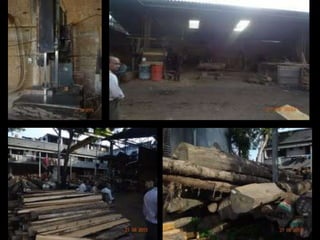
Tutorial Presentation (2013-14)
On

Timber as a Construction
Material

Department of Civil Engineering
Prepared By:
Paritosh Vyas (U11CE079)
Ganga Singh Chouhan(U11CE080)
Kaushal Kumawat(U11CE081)
Dharmesh Kaithwas(U11CE082)
Timber: The Preface
Timber refers to wood used for construction works. In
fact the word timber is derived from an old English
word ‘Timbrian’ which means ‘to build’. A tree that
yields good wood for construction is called ‘Standing
Timber.’ After felling a tree, its branches are cut and its
stem is roughly converted into pieces of suitable
length, so that it can be transported to timber yard. By
sawing, rough timber is converted into various
commercial sizes like planks, battens, posts, beams etc.
Such form of timber is known as converted timber.
Timber was used as building material even by primitive
man. Many ancient temples, palaces and bridges built
with timber can be seen even today.
U
S
E
S

Timber as a cast and
support for concrete
casting of ;
Beams
Columns
Slabs
Foundation
Source: Extension to EED, SVNIT

While Bamboo is used
for scaffolding in Asian
countries, Timber is
occasionally used in
scaffolds as platforms
and in shoring
Source: Extension to EED, SVNIT
U
S
E
S

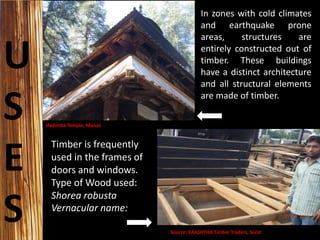
In zones with cold climates
and earthquake prone
areas,
structures
are
entirely constructed out of
timber. These buildings
have a distinct architecture
and all structural elements
are made of timber.
Hadimba Temple, Manali

Timber is frequently
used in the frames of
doors and windows.
Type of Wood used:
Shorea robusta
Vernacular name:
Source: KAASHTHA Timber Traders, Surat
Pragati Woodply, Icchanath, Surat
Source: KAASHTHA Timber Traders, Surat
Types of Timber
There are over 150 species of timber which are produced in India. Following are
the chief varieties of timber trees which are used for engineering purposes in
India:

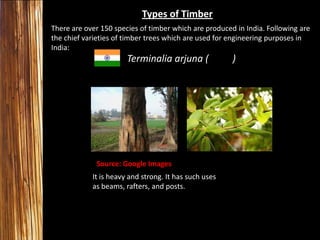
Terminalia arjuna (

Source: Google Images
It is heavy and strong. It has such uses
as beams, rafters, and posts.

)
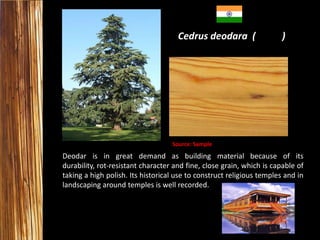
Cedrus deodara (

)

Source: Sample

Deodar is in great demand as building material because of its
durability, rot-resistant character and fine, close grain, which is capable of
taking a high polish. Its historical use to construct religious temples and in
landscaping around temples is well recorded.
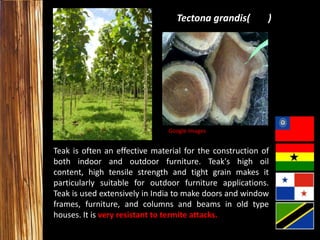
Tectona grandis(

)

Google Images

Teak is often an effective material for the construction of
both indoor and outdoor furniture. Teak's high oil
content, high tensile strength and tight grain makes it
particularly suitable for outdoor furniture applications.
Teak is used extensively in India to make doors and window
frames, furniture, and columns and beams in old type
houses. It is very resistant to termite attacks.
Market Analysis

 L Local Market Scenario
- In the local market, most of
the timber is imported.
Only inferior woods are
from domestic sources.
- This is due to a ban on tree
felling in India.
- Imported timber also
serves better quality.
- This material is generally
from African, South East
Asian or Latin American
countries.
- So high costs of importing
and processing makes
timber a lavish feature of
KAASHTHA Timber Mart, Nr. SOSYO Circle, Surat
construction.
Workshop works
- Once the material reaches
port. It is transferrred to
workshop by trucks (road
ways).
- EOT ( electric overhead
travelling ) crane lifts logs
from store to the working
zone.
- It travels over 2 rails on
which motion is controlled
by a powerful electric
motor.

KAASHTHA Timber Mart

EOT Crane
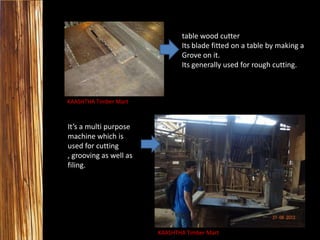
table wood cutter
Its blade fitted on a table by making a
Grove on it.
Its generally used for rough cutting.

KAASHTHA Timber Mart

It’s a multi purpose
machine which is
used for cutting
, grooving as well as
filing.

KAASHTHA Timber Mart
Cost Comparison
c
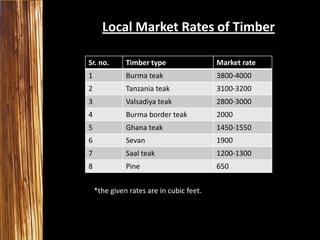
- The rate of timber in market is given in terms of cubic feet.
( varying from 650 to nearly 4000 )

- The cost of timber generally depends on the measure of
the white part in the woody brown color of sample. This is
a feature which is important for furniture wood.
- Its capability to bear compressive and tensile load.

- Resistance to the environmental conditions.
- Resistance to attack of insects.
- On the size of trunk of tree available.
- Non-uniformity in the internal texture of the timber.
Local Market Rates of Timber
Sr. no.

Timber type

Market rate

1

Burma teak

3800-4000

2

Tanzania teak

3100-3200

3

Valsadiya teak

2800-3000

4

Burma border teak

2000

5

Ghana teak

1450-1550

6

Sevan

1900

7

Saal teak

1200-1300

8

Pine

650

*the given rates are in cubic feet.
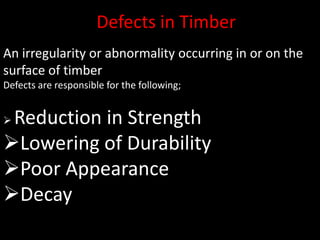
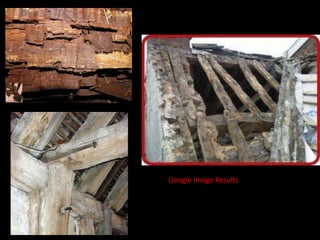
Defects in Timber
An irregularity or abnormality occurring in or on the
surface of timber
Defects are responsible for the following;

Reduction in Strength
Lowering of Durability
Poor Appearance
Decay

Google Image Results
Classification of Defects

Natural
Forces

Fungi
Insects

Seasoning
Conversion
Defects due to Natural Forces

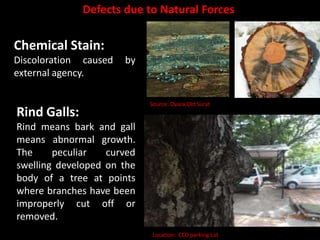
Chemical Stain:
Discoloration caused
external agency.

by

Rind Galls:

Source: Ovara,Old Surat

Rind means bark and gall
means abnormal growth.
The
peculiar
curved
swelling developed on the
body of a tree at points
where branches have been
improperly cut off or
removed.
Location: CED parking Lot
Defects due to Natural Forces
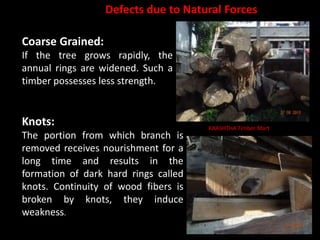
Coarse Grained:
If the tree grows rapidly, the
annual rings are widened. Such a
timber possesses less strength.

Knots:
The portion from which branch is
removed receives nourishment for a
long time and results in the
formation of dark hard rings called
knots. Continuity of wood fibers is
broken by knots, they induce
weakness.

KAASHTHA Timber Mart
Defects due to Natural Forces
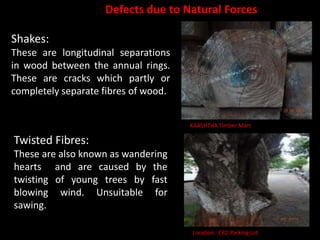
Shakes:
These are longitudinal separations
in wood between the annual rings.
These are cracks which partly or
completely separate fibres of wood.
KAASHTHA Timber Mart

Twisted Fibres:
These are also known as wandering
hearts and are caused by the
twisting of young trees by fast
blowing wind. Unsuitable for
sawing.
Location: CED Parking Lot
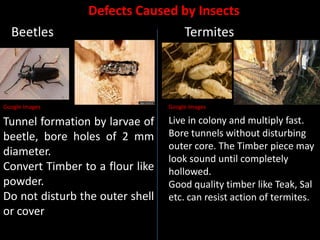
Beetles

Defects Caused by Insects
Termites

Google Images

Google Images

Tunnel formation by larvae of
beetle, bore holes of 2 mm
diameter.
Convert Timber to a flour like
powder.
Do not disturb the outer shell
or cover

Live in colony and multiply fast.
Bore tunnels without disturbing
outer core. The Timber piece may
look sound until completely
hollowed.
Good quality timber like Teak, Sal
etc. can resist action of termites.
Defects Due to Fungi
Wet Rot:

Dry Rot:

KAASHTHA Timber Mart
CHEMICAL DECOMPOSITIONGREYISH
BROWN
POWDER.-UNSEASONED
OR
IMPROPERLY SEASONED TIMBER EXPOSED
TO RAIN AND WIND
WELL SEASONED TIMBER USED FOR
EXTERIOR OR UNDERGROUND WORK COVERED BY TAR OR PAINT- PROTECTION
AGAINST MOISTURE

DRY POWDERFORM-NO FREE CIRCULATION OF
AIR SUCH AS IMPROPERLY VENTILATED
BASEMENTS,ROOMS
AND
DAMPED
SITUATIONLIKE KITCHEN TOILET ETC
-ABSENCE OF SUNLIGHT,DAMPNESS,PRESENCE
OF SAP,STAGNANT AIR AND WARMTH
- FREE FROM SAP- COPPER SULPHATE
Defects during Conversion
Chip Mark:
This defect is indicated by a mark
or sign placed on the finished
surface of timber. Formed by
Planing machine.
KAASHTHA Timber Mart

Diagonal Grain:
Formed due to improper Sawing of
timber
Indicated by diagonal marks on
straight grained surface of timber.
What If
Thank You.

Timber_ Presentation at SVNIT, Surat

  • 1.
    Tutorial Presentation (2013-14) On Timberas a Construction Material Department of Civil Engineering Prepared By: Paritosh Vyas (U11CE079) Ganga Singh Chouhan(U11CE080) Kaushal Kumawat(U11CE081) Dharmesh Kaithwas(U11CE082)
  • 2.
    Timber: The Preface Timberrefers to wood used for construction works. In fact the word timber is derived from an old English word ‘Timbrian’ which means ‘to build’. A tree that yields good wood for construction is called ‘Standing Timber.’ After felling a tree, its branches are cut and its stem is roughly converted into pieces of suitable length, so that it can be transported to timber yard. By sawing, rough timber is converted into various commercial sizes like planks, battens, posts, beams etc. Such form of timber is known as converted timber. Timber was used as building material even by primitive man. Many ancient temples, palaces and bridges built with timber can be seen even today.
  • 3.
    U S E S Timber as acast and support for concrete casting of ; Beams Columns Slabs Foundation Source: Extension to EED, SVNIT While Bamboo is used for scaffolding in Asian countries, Timber is occasionally used in scaffolds as platforms and in shoring Source: Extension to EED, SVNIT
  • 4.
    U S E S In zones withcold climates and earthquake prone areas, structures are entirely constructed out of timber. These buildings have a distinct architecture and all structural elements are made of timber. Hadimba Temple, Manali Timber is frequently used in the frames of doors and windows. Type of Wood used: Shorea robusta Vernacular name: Source: KAASHTHA Timber Traders, Surat
  • 5.
  • 6.
  • 7.
    Types of Timber Thereare over 150 species of timber which are produced in India. Following are the chief varieties of timber trees which are used for engineering purposes in India: Terminalia arjuna ( Source: Google Images It is heavy and strong. It has such uses as beams, rafters, and posts. )
  • 8.
    Cedrus deodara ( ) Source:Sample Deodar is in great demand as building material because of its durability, rot-resistant character and fine, close grain, which is capable of taking a high polish. Its historical use to construct religious temples and in landscaping around temples is well recorded.
  • 9.
    Tectona grandis( ) Google Images Teakis often an effective material for the construction of both indoor and outdoor furniture. Teak's high oil content, high tensile strength and tight grain makes it particularly suitable for outdoor furniture applications. Teak is used extensively in India to make doors and window frames, furniture, and columns and beams in old type houses. It is very resistant to termite attacks.
  • 10.
    Market Analysis  LLocal Market Scenario - In the local market, most of the timber is imported. Only inferior woods are from domestic sources. - This is due to a ban on tree felling in India. - Imported timber also serves better quality. - This material is generally from African, South East Asian or Latin American countries. - So high costs of importing and processing makes timber a lavish feature of KAASHTHA Timber Mart, Nr. SOSYO Circle, Surat construction.
  • 11.
    Workshop works - Oncethe material reaches port. It is transferrred to workshop by trucks (road ways). - EOT ( electric overhead travelling ) crane lifts logs from store to the working zone. - It travels over 2 rails on which motion is controlled by a powerful electric motor. KAASHTHA Timber Mart EOT Crane
  • 12.
    table wood cutter Itsblade fitted on a table by making a Grove on it. Its generally used for rough cutting. KAASHTHA Timber Mart It’s a multi purpose machine which is used for cutting , grooving as well as filing. KAASHTHA Timber Mart
  • 15.
    Cost Comparison c - Therate of timber in market is given in terms of cubic feet. ( varying from 650 to nearly 4000 ) - The cost of timber generally depends on the measure of the white part in the woody brown color of sample. This is a feature which is important for furniture wood. - Its capability to bear compressive and tensile load. - Resistance to the environmental conditions. - Resistance to attack of insects. - On the size of trunk of tree available. - Non-uniformity in the internal texture of the timber.
  • 16.
    Local Market Ratesof Timber Sr. no. Timber type Market rate 1 Burma teak 3800-4000 2 Tanzania teak 3100-3200 3 Valsadiya teak 2800-3000 4 Burma border teak 2000 5 Ghana teak 1450-1550 6 Sevan 1900 7 Saal teak 1200-1300 8 Pine 650 *the given rates are in cubic feet.
  • 17.
    Defects in Timber Anirregularity or abnormality occurring in or on the surface of timber Defects are responsible for the following; Reduction in Strength Lowering of Durability Poor Appearance Decay 
  • 18.
  • 19.
  • 20.
    Defects due toNatural Forces Chemical Stain: Discoloration caused external agency. by Rind Galls: Source: Ovara,Old Surat Rind means bark and gall means abnormal growth. The peculiar curved swelling developed on the body of a tree at points where branches have been improperly cut off or removed. Location: CED parking Lot
  • 21.
    Defects due toNatural Forces Coarse Grained: If the tree grows rapidly, the annual rings are widened. Such a timber possesses less strength. Knots: The portion from which branch is removed receives nourishment for a long time and results in the formation of dark hard rings called knots. Continuity of wood fibers is broken by knots, they induce weakness. KAASHTHA Timber Mart
  • 22.
    Defects due toNatural Forces Shakes: These are longitudinal separations in wood between the annual rings. These are cracks which partly or completely separate fibres of wood. KAASHTHA Timber Mart Twisted Fibres: These are also known as wandering hearts and are caused by the twisting of young trees by fast blowing wind. Unsuitable for sawing. Location: CED Parking Lot
  • 23.
    Beetles Defects Caused byInsects Termites Google Images Google Images Tunnel formation by larvae of beetle, bore holes of 2 mm diameter. Convert Timber to a flour like powder. Do not disturb the outer shell or cover Live in colony and multiply fast. Bore tunnels without disturbing outer core. The Timber piece may look sound until completely hollowed. Good quality timber like Teak, Sal etc. can resist action of termites.
  • 25.
    Defects Due toFungi Wet Rot: Dry Rot: KAASHTHA Timber Mart CHEMICAL DECOMPOSITIONGREYISH BROWN POWDER.-UNSEASONED OR IMPROPERLY SEASONED TIMBER EXPOSED TO RAIN AND WIND WELL SEASONED TIMBER USED FOR EXTERIOR OR UNDERGROUND WORK COVERED BY TAR OR PAINT- PROTECTION AGAINST MOISTURE DRY POWDERFORM-NO FREE CIRCULATION OF AIR SUCH AS IMPROPERLY VENTILATED BASEMENTS,ROOMS AND DAMPED SITUATIONLIKE KITCHEN TOILET ETC -ABSENCE OF SUNLIGHT,DAMPNESS,PRESENCE OF SAP,STAGNANT AIR AND WARMTH - FREE FROM SAP- COPPER SULPHATE
  • 26.
    Defects during Conversion ChipMark: This defect is indicated by a mark or sign placed on the finished surface of timber. Formed by Planing machine. KAASHTHA Timber Mart Diagonal Grain: Formed due to improper Sawing of timber Indicated by diagonal marks on straight grained surface of timber.
  • 27.
  • 28.