Department of Civil Engineering (CE)
Fall 2021
CE 531
Geographic Information System
(GIS)
Class Time
Course Plan
What is GIS? – Common Idea!
• What is your Idea on this tool/System?
• What is the common Idea?
• GIS is a computer tool for making maps
• GIS combines database and mapping technologies
• It's a map where every point, line, or polygon on the map can be
connected to a database
• GIS means spending time at the computer reviewing and
understanding data, querying data, and perhaps writing special
programs or classifying imagery.
• It's starting with raw data and using it to solve a problem with a
spatial component. Some of the sub-tasks can require hours, days,
even weeks of boring, repetitive clicking.
What is Information?
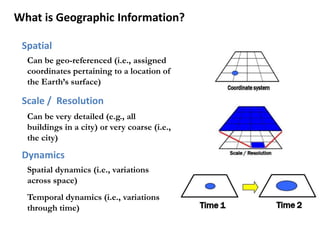
What is Geographic Information?
Scale / Resolution
Dynamics
Spatial
Can be geo-referenced (i.e., assigned
coordinates pertaining to a location of
the Earth’s surface)
Can be very detailed (e.g., all
buildings in a city) or very coarse (i.e.,
the city)
Spatial dynamics (i.e., variations
across space)
Temporal dynamics (i.e., variations
through time)
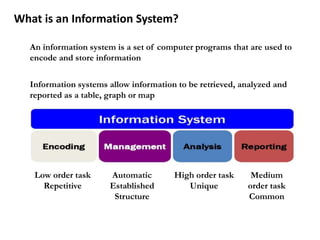
Information systems allow information to be retrieved, analyzed and
reported as a table, graph or map
An information system is a set of computer programs that are used to
encode and store information
What is an Information System?
Low order task
Repetitive
Automatic
Established
Structure
High order task
Unique
Medium
order task
Common
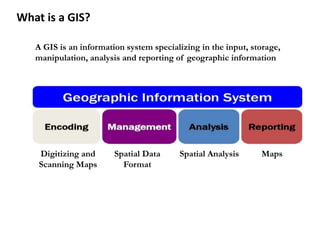
What is a GIS?
A GIS is an information system specializing in the input, storage,
manipulation, analysis and reporting of geographic information
Digitizing and
Scanning Maps
Spatial Data
Format
Spatial Analysis Maps
What is a GIS?
A GIS is a database application
All information in a GIS geo-referenced
Other databases may contain locational information
(street address, zip codes, etc.)
A GIS integrates technology
Definition
An Information System that is used to input, store ,
retrieve, manipulate, analyze and output geographically
referenced data or geospatial data, in order to support
decision making for planning and management of land
use, natural resources, environment, transportation,
urban facilities, and other administrative records
What is a GIS?
Components of GIS
• Key components of GIS are:
– Computer system,
geospatial data, and users
• Sources of geospatial data are:
– Digitized maps, aerial
photographs, satellite
images, statistical tables,
and other related
documents
Computer
System
Geospatial
Data
Users
Figure: Key components of GIS
Area of GIS Application
Major areas of GIS application can be grouped into five categories as follows:
 Facilities management
Large scale and precise maps and network analysis are used mainly for
utility management.
Example: Locating underground pipes & cables; planning facility maintenance;
telecommunication network service; energy use tracking & planning.
 Environment and Natural Resources Management
Medium or small scale maps and overlay techniques in combination with aerial
photographs and satellite images are used for management of natural resources
and environmental impact analysis.
Example: Suitable study for agricultural cropping; management of forests,
agricultural lands, water resources, wetlands etc.; environmental impact analysis;
disaster management and mitigation; waste facility site location.
 Street Network
Large or medium scale maps and spatial analysis are used for vehicle routing,
locating house and streets etc.
Example: car navigation (routing and scheduling); locating houses and streets;
site selection; ambulance services; transportation planning
 Planning and Engineering
Large or medium scale maps and engineering models are used mainly in civil
engineering.
Example: urban planning; regional planning; route location of highways;
development of public facilities
 Land Information System
Large scale cadastre maps or land parcel maps and spatial analysis are used for
cadastre administration, taxation etc.
Example: cadastre administration; taxation; zoning of land use; land acquisition.
Area of GIS Application
Disciplines & Technologies connected to GIS
• GIS is a convergence of technological fields and traditional
disciplines
• GIS is associated with other major following disciplines
• Geography
• Cartography
• Remote Sensing
• Photogrammetry
• Statistics
• Computer Science
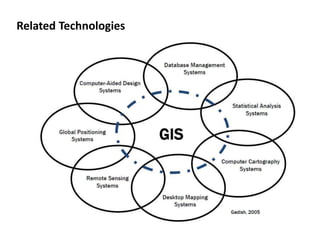
Related Technologies
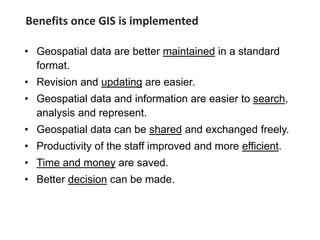
Benefits once GIS is implemented
• Geospatial data are better maintained in a standard
format.
• Revision and updating are easier.
• Geospatial data and information are easier to search,
analysis and represent.
• Geospatial data can be shared and exchanged freely.
• Productivity of the staff improved and more efficient.
• Time and money are saved.
• Better decision can be made.
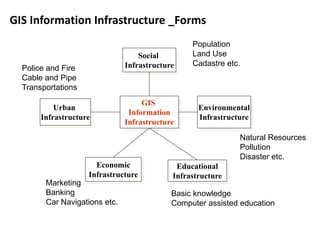
GIS Information Infrastructure _Forms
Social
Infrastructure
Urban
Infrastructure
GIS
Information
Infrastructure
Environmental
Infrastructure
Economic
Infrastructure
Educational
Infrastructure
Population
Land Use
Cadastre etc.
Natural Resources
Pollution
Disaster etc.
Marketing
Banking
Car Navigations etc.
Police and Fire
Cable and Pipe
Transportations
Basic knowledge
Computer assisted education
Function Sub-function
Data acquisition and processing
Digitizing, Editing, Topology Building
Projection Transformation, Format Conversion
Attribute Assignment etc.
Database Management
Data Archival, Hierarchical Modeling
Network Modeling, Relational Modeling
Attribute Query
Object-oriented Database, etc.
Spatial measurement and Analysis
Measurement Operations
Buffering, Overlay Operations
Connectivity Operations, etc.
Graphic Output and Visualization
Scale Transformation, Generalization
Topographic Map, Statistical Map
3D Bird's Eye View, etc.
Basic functions of GIS
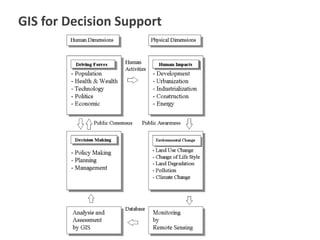
GIS for Decision Support
Expectation

Lecture 1_ Intro n Basics_GIS.pptx

  • 1.
    Department of CivilEngineering (CE) Fall 2021 CE 531 Geographic Information System (GIS)
  • 2.
  • 3.
  • 4.
    What is GIS?– Common Idea! • What is your Idea on this tool/System? • What is the common Idea? • GIS is a computer tool for making maps • GIS combines database and mapping technologies • It's a map where every point, line, or polygon on the map can be connected to a database • GIS means spending time at the computer reviewing and understanding data, querying data, and perhaps writing special programs or classifying imagery. • It's starting with raw data and using it to solve a problem with a spatial component. Some of the sub-tasks can require hours, days, even weeks of boring, repetitive clicking.
  • 5.
  • 6.
    What is GeographicInformation? Scale / Resolution Dynamics Spatial Can be geo-referenced (i.e., assigned coordinates pertaining to a location of the Earth’s surface) Can be very detailed (e.g., all buildings in a city) or very coarse (i.e., the city) Spatial dynamics (i.e., variations across space) Temporal dynamics (i.e., variations through time)
  • 7.
    Information systems allowinformation to be retrieved, analyzed and reported as a table, graph or map An information system is a set of computer programs that are used to encode and store information What is an Information System? Low order task Repetitive Automatic Established Structure High order task Unique Medium order task Common
  • 8.
    What is aGIS? A GIS is an information system specializing in the input, storage, manipulation, analysis and reporting of geographic information Digitizing and Scanning Maps Spatial Data Format Spatial Analysis Maps
  • 9.
    What is aGIS? A GIS is a database application All information in a GIS geo-referenced Other databases may contain locational information (street address, zip codes, etc.) A GIS integrates technology
  • 10.
    Definition An Information Systemthat is used to input, store , retrieve, manipulate, analyze and output geographically referenced data or geospatial data, in order to support decision making for planning and management of land use, natural resources, environment, transportation, urban facilities, and other administrative records What is a GIS?
  • 11.
    Components of GIS •Key components of GIS are: – Computer system, geospatial data, and users • Sources of geospatial data are: – Digitized maps, aerial photographs, satellite images, statistical tables, and other related documents Computer System Geospatial Data Users Figure: Key components of GIS
  • 12.
    Area of GISApplication Major areas of GIS application can be grouped into five categories as follows:  Facilities management Large scale and precise maps and network analysis are used mainly for utility management. Example: Locating underground pipes & cables; planning facility maintenance; telecommunication network service; energy use tracking & planning.  Environment and Natural Resources Management Medium or small scale maps and overlay techniques in combination with aerial photographs and satellite images are used for management of natural resources and environmental impact analysis. Example: Suitable study for agricultural cropping; management of forests, agricultural lands, water resources, wetlands etc.; environmental impact analysis; disaster management and mitigation; waste facility site location.
  • 13.
     Street Network Largeor medium scale maps and spatial analysis are used for vehicle routing, locating house and streets etc. Example: car navigation (routing and scheduling); locating houses and streets; site selection; ambulance services; transportation planning  Planning and Engineering Large or medium scale maps and engineering models are used mainly in civil engineering. Example: urban planning; regional planning; route location of highways; development of public facilities  Land Information System Large scale cadastre maps or land parcel maps and spatial analysis are used for cadastre administration, taxation etc. Example: cadastre administration; taxation; zoning of land use; land acquisition. Area of GIS Application
  • 14.
    Disciplines & Technologiesconnected to GIS • GIS is a convergence of technological fields and traditional disciplines • GIS is associated with other major following disciplines • Geography • Cartography • Remote Sensing • Photogrammetry • Statistics • Computer Science
  • 15.
  • 16.
    Benefits once GISis implemented • Geospatial data are better maintained in a standard format. • Revision and updating are easier. • Geospatial data and information are easier to search, analysis and represent. • Geospatial data can be shared and exchanged freely. • Productivity of the staff improved and more efficient. • Time and money are saved. • Better decision can be made.
  • 17.
    GIS Information Infrastructure_Forms Social Infrastructure Urban Infrastructure GIS Information Infrastructure Environmental Infrastructure Economic Infrastructure Educational Infrastructure Population Land Use Cadastre etc. Natural Resources Pollution Disaster etc. Marketing Banking Car Navigations etc. Police and Fire Cable and Pipe Transportations Basic knowledge Computer assisted education
  • 18.
    Function Sub-function Data acquisitionand processing Digitizing, Editing, Topology Building Projection Transformation, Format Conversion Attribute Assignment etc. Database Management Data Archival, Hierarchical Modeling Network Modeling, Relational Modeling Attribute Query Object-oriented Database, etc. Spatial measurement and Analysis Measurement Operations Buffering, Overlay Operations Connectivity Operations, etc. Graphic Output and Visualization Scale Transformation, Generalization Topographic Map, Statistical Map 3D Bird's Eye View, etc. Basic functions of GIS
  • 19.
  • 20.