

Introduction to
Design & Development
      Principles
   Based on Don Norman’s book
  “The Design of Everyday Things”
           Larry Luckom, Interaction Designer
       Michael Rawlins, Director, User Experience


                                                    1
Why us?
                  • We’re very curious individuals…
 Larry Luckom     • We understand multiple disciplines.
  Interaction
   Designer
                  • Bad user experiences bother us.
                  • We have passion for solving problems.
                  • We’re intrigued by how different
                    people think and see things…
Michael Rawlins
 Director, User
  Experience


                                                          2
Today’s talking points
• Everyone talks about code!
• What’s a design principle?
• How does development fit?
• Our predictions…


                               3
Some Inspiration…
• England and America are two countries
  divided by a common language.
                      - George Bernard Shaw (1856-1950)

• Programming today is a race between
  software engineers striving to build
  bigger and better idiot-proof programs,
  and the universe trying to build bigger
  and better idiots. So far, the universe
  is winning.
                      - Rick Cook


                                                     4
Development is Expensive…
• Many languages and frameworks
• Huge gains in making code more open,
  more accessible
• Fascinating technological advances -
  however, many projects still fail…
• Why?


                                         5
Poor Communication is Expensive…


                                   6
Design Principles
•   Visibility - can I see the interaction?
•   Feedback - what’s the object or device doing right now?
•   Affordance - how do I use it?
•   Mapping - where am I & where can I go?
•   Constraints - why can’t I do that?
•   Consistency - is this familiar?


                                                              7
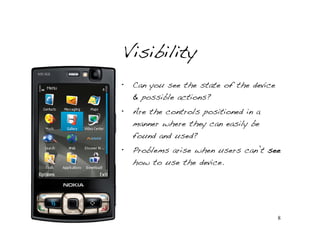
Visibility
•   Can you see the state of the device
    & possible actions?
•   Are the controls positioned in a
    manner where they can easily be
    found and used?
•   Problems arise when users can’t see
    how to use the device.


                                          8
Poor Visibility
  •   Which controls are ambiguous?
  •   How does this device turn off?
  •   Which controls have meanings that
      are unclear?.


                                          9
Better Visibility


                    10
Feedback
•   What is the device doing right now?
•   What action is being performed?


      Feedback is often multi-sensory
      (an audible click and a visual clue of interaction)


      How does this work?


                                                            11
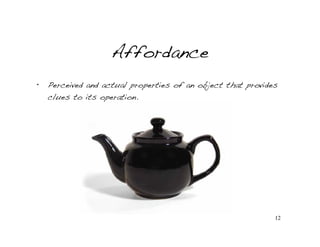
Affordance
•   Perceived and actual properties of an object that provides
    clues to its operation.


                                                             12
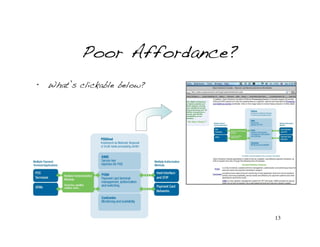
Poor Affordance?
•   What’s clickable below?


                              13
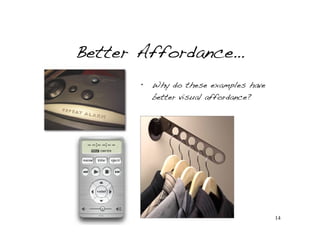
Better Affordance…
      •   Why do these examples have
          better visual affordance?


                                       14
Mapping
•   The relationship between controls and
    their effect.
•   Do these devices work with each
    other?


                                      15
Mapping
•   Problematic examples (what’s good and what’s bad?)


                                                         16
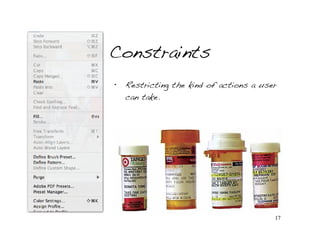
Constraints
•   Restricting the kind of actions a user
    can take.


                                         17
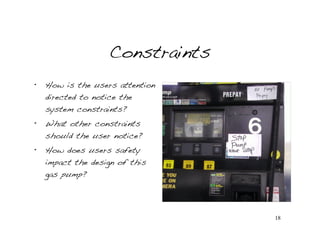
Constraints
•   How is the users attention
    directed to notice the
    system constraints?
•   What other constraints
    should the user notice?
•   How does users safety
    impact the design of this
    gas pump?


                                 18
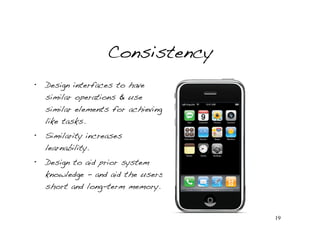
Consistency
•   Design interfaces to have
    similar operations & use
    similar elements for achieving
    like tasks.
•   Similarity increases
    learnability.
•   Design to aid prior system
    knowledge - and aid the users
    short and long-term memory.


                                     19
Consistency
Four types of consistency:
•   Aesthetic - style & appearance is repeated to enhance
    recognition.
•   Functional - meaning and action is consistent to reinforce
    learnability and understanding.
•   Internal - indicates a system is planned & well thought out
    (cultivates trust and user orientation).
•   External - establishing an ecosystem & consistency with
    other elements in the environment.


                                                              20
About the Future…
Key things to look out for:
• Simplicity viewed as good… Complexity considered
  as very bad.
• Clear, concise communication will be valued.
• Companies that know how to innovate will win
  and survive.
• Diverse skillsets will be valued.


                                                 21
Conclusion…
Design Principles are validated by usability methods:
•   Learnability - how easy is it to perform basic tasks upon the
    users first encounter with the device or interface.
•   Efficiency - once the users are familiar with the interface, how
    quickly and effectively can they perform tasks.
•   Memorability - when users return after not having used the
    system, how quickly can they reestablish proficiency?
•   Errors - how many errors do users make? How severe are the
    errors? Can the users easily recover from errors?
•   Satisfaction - how pleasant and effective is the user experience?


                                                                    22
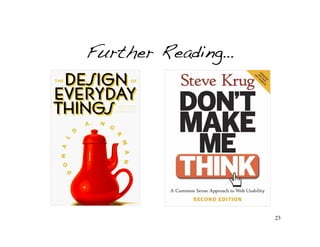
Further Reading…


                   23
Credit to Don Norman
•   A cognitive scientist and engineer who pioneered concepts
    related to user centered design.
•   Worked at Apple & HP. Now @ NNG (http://www.nngroup.com)
•   Examines everyday things as examples of problematic
    designs.
•   Established Design Principles as a framework for
    discussing and thinking about interaction problems.


                                                               24
Questions?


             25
Thank You…


  Credit to David Gelb   26

GHAMAS Design Principles

  • 1.
    Introduction to Design &Development Principles Based on Don Norman’s book “The Design of Everyday Things” Larry Luckom, Interaction Designer Michael Rawlins, Director, User Experience 1
  • 2.
    Why us? • We’re very curious individuals… Larry Luckom • We understand multiple disciplines. Interaction Designer • Bad user experiences bother us. • We have passion for solving problems. • We’re intrigued by how different people think and see things… Michael Rawlins Director, User Experience 2
  • 3.
    Today’s talking points •Everyone talks about code! • What’s a design principle? • How does development fit? • Our predictions… 3
  • 4.
    Some Inspiration… • Englandand America are two countries divided by a common language. - George Bernard Shaw (1856-1950) • Programming today is a race between software engineers striving to build bigger and better idiot-proof programs, and the universe trying to build bigger and better idiots. So far, the universe is winning. - Rick Cook 4
  • 5.
    Development is Expensive… •Many languages and frameworks • Huge gains in making code more open, more accessible • Fascinating technological advances - however, many projects still fail… • Why? 5
  • 6.
    Poor Communication isExpensive… 6
  • 7.
    Design Principles • Visibility - can I see the interaction? • Feedback - what’s the object or device doing right now? • Affordance - how do I use it? • Mapping - where am I & where can I go? • Constraints - why can’t I do that? • Consistency - is this familiar? 7
  • 8.
    Visibility • Can you see the state of the device & possible actions? • Are the controls positioned in a manner where they can easily be found and used? • Problems arise when users can’t see how to use the device. 8
  • 9.
    Poor Visibility • Which controls are ambiguous? • How does this device turn off? • Which controls have meanings that are unclear?. 9
  • 10.
  • 11.
    Feedback • What is the device doing right now? • What action is being performed? Feedback is often multi-sensory (an audible click and a visual clue of interaction) How does this work? 11
  • 12.
    Affordance • Perceived and actual properties of an object that provides clues to its operation. 12
  • 13.
    Poor Affordance? • What’s clickable below? 13
  • 14.
    Better Affordance… • Why do these examples have better visual affordance? 14
  • 15.
    Mapping • The relationship between controls and their effect. • Do these devices work with each other? 15
  • 16.
    Mapping • Problematic examples (what’s good and what’s bad?) 16
  • 17.
    Constraints • Restricting the kind of actions a user can take. 17
  • 18.
    Constraints • How is the users attention directed to notice the system constraints? • What other constraints should the user notice? • How does users safety impact the design of this gas pump? 18
  • 19.
    Consistency • Design interfaces to have similar operations & use similar elements for achieving like tasks. • Similarity increases learnability. • Design to aid prior system knowledge - and aid the users short and long-term memory. 19
  • 20.
    Consistency Four types ofconsistency: • Aesthetic - style & appearance is repeated to enhance recognition. • Functional - meaning and action is consistent to reinforce learnability and understanding. • Internal - indicates a system is planned & well thought out (cultivates trust and user orientation). • External - establishing an ecosystem & consistency with other elements in the environment. 20
  • 21.
    About the Future… Keythings to look out for: • Simplicity viewed as good… Complexity considered as very bad. • Clear, concise communication will be valued. • Companies that know how to innovate will win and survive. • Diverse skillsets will be valued. 21
  • 22.
    Conclusion… Design Principles arevalidated by usability methods: • Learnability - how easy is it to perform basic tasks upon the users first encounter with the device or interface. • Efficiency - once the users are familiar with the interface, how quickly and effectively can they perform tasks. • Memorability - when users return after not having used the system, how quickly can they reestablish proficiency? • Errors - how many errors do users make? How severe are the errors? Can the users easily recover from errors? • Satisfaction - how pleasant and effective is the user experience? 22
  • 23.
  • 24.
    Credit to DonNorman • A cognitive scientist and engineer who pioneered concepts related to user centered design. • Worked at Apple & HP. Now @ NNG (http://www.nngroup.com) • Examines everyday things as examples of problematic designs. • Established Design Principles as a framework for discussing and thinking about interaction problems. 24
  • 25.
  • 26.
    Thank You… Credit to David Gelb 26