Usability Training
                 UDSM, June 7
         Marko Teräs, Timo Nevalainen
Kick-Off Questions


Your thoughts on usability?

Your goals and wants for this session
Agenda
Definition of Usability

Why Usability?

User-centered design

User Experience

Usability evaluation

Usability testing
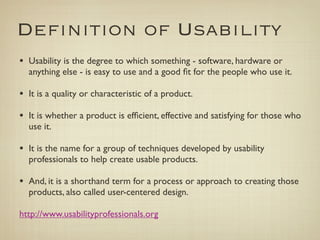
Definition of Usability
• Usability is the degree to which something - software, hardware or
  anything else - is easy to use and a good fit for the people who use it.

• It is a quality or characteristic of a product.
• It is whether a product is efficient, effective and satisfying for those who
  use it.

• It is the name for a group of techniques developed by usability
  professionals to help create usable products.

• And, it is a shorthand term for a process or approach to creating those
  products, also called user-centered design.
	

http://www.usabilityprofessionals.org
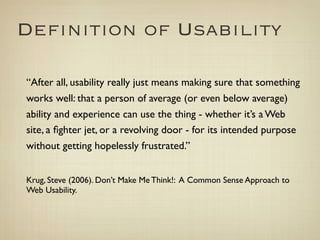
Definition of Usability


 “After all, usability really just means making sure that something
    works well: that a person of average (or even below average)
    ability and experience can use the thing - whether it’s a Web
    site, a fighter jet, or a revolving door - for its intended purpose
    without getting hopelessly frustrated.”


 Krug, Steve (2006). Don’t Make Me Think!: A Common Sense Approach to
    Web Usability.
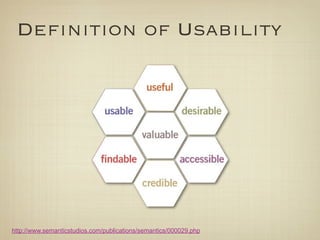
Definition of Usability


http://www.semanticstudios.com/publications/semantics/000029.php
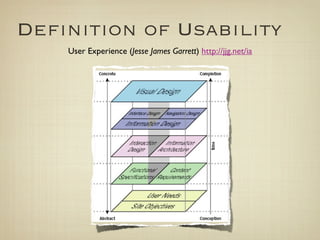
Definition of Usability
    User Experience (Jesse James Garrett) http://jjg.net/ia
Why Usability?
The economical point of view
 Claire Karat (1990):
 The investment ROI (return on investment) of usability is 1:3 - 1:100

 Excercise:
 300 workers in a middle sized company use a software for a certain task 30
 minutes per day.

 Because of the weak quality, doing the tasks takes 10 minutes longer than it would
 take if the usability had been better taken care of in the software development
 process.

 How much the company would’ve saved costs per year, if the worker’s pay is 10
 dollars per hour.

 Answer:
 300 users x (10,00 e x 1/6 h) x 200 work days = about 100 000 $ per year
 [Here is not counted the additional costs that may come from frustration and
 stress or from the weakening quality of work.]
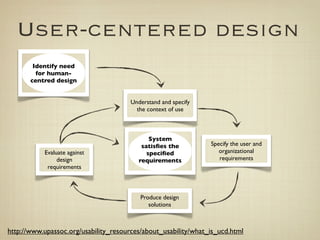
User-centered design
        Identify need
         for human-
       centred design


                                       Understand and specify
                                         the context of use


                                              System
                                           satisfies the         Specify the user and
           Evaluate against                  specified              organizational
                design                    requirements             requirements
            requirements


                                          Produce design
                                             solutions


http://www.upassoc.org/usability_resources/about_usability/what_is_ucd.html
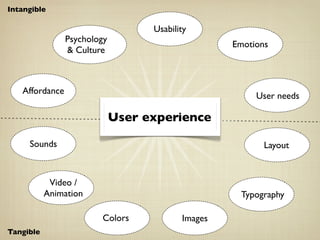
Intangible

                                   Usability
                Psychology
                                                   Emotions
                & Culture


   Affordance
                                                        User needs

                             User experience

     Sounds                                               Layout


            Video /
           Animation                                Typography

                        Colors            Images
Tangible
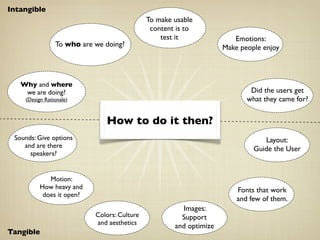
Intangible
                                             To make usable
                                              content is to
                                                 test it               Emotions:
                To who are we doing?                                Make people enjoy


   Why and where
    we are doing?                                                           Did the users get
    (Design Rationale)                                                     what they came for?


                              How to do it then?
 Sounds: Give options                                                           Layout:
    and are there                                                            Guide the User
      speakers?


             Motion:
          How heavy and                                                 Fonts that work
           does it open?
                                                                        and few of them.
                                                       Images:
                           Colors: Culture             Support
                           and aesthetics            and optimize
Tangible
User-centered design

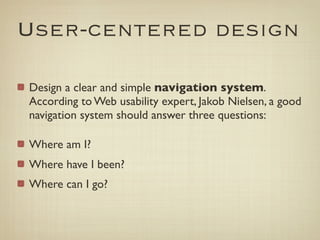
Design a clear and simple navigation system.
According to Web usability expert, Jakob Nielsen, a good
navigation system should answer three questions:

Where am I?
Where have I been?
Where can I go?
Usability evaluation
Jakob Nielsen’s Heuristics

   http://www.useit.com/papers/heuristic/heuristic_evaluation.html

   http://www.useit.com/papers/heuristic/

   http://www.useit.com/papers/heuristic/heuristic_list.html

   http://www.usabilitynet.org/management/b_design.htm


   Make your own.
Usability testing
Light-weight testing can be done more often

Light-weight testing is cheaper and easier to approve

Use real users, real tasks [scenarios]

Observe, don’t interfere/manipulate

Do no harm.
More Reading from…
Jakob Nielsen (http://www.useit.com)

Steve Krug (http://www.sensible.com)

“Ginny” Redish (http://www.redish.net)

JoAnn Hackos (http://www.comtech-serv.com)

Jesse James Garrett (http://blog.jjg.net)

Peter Morville (http://semanticstudios.com)

Lou Rosenfeld (http://louisrosenfeld.com)

Sinkkonen, Kuoppala, Parkkinen: Professional Psychology of Usability
Feedback us, please

How did you find this training session?


What did you learn?


How would you improve the session?

Usability Training - UDSM 06/2010

  • 1.
    Usability Training UDSM, June 7 Marko Teräs, Timo Nevalainen
  • 2.
    Kick-Off Questions Your thoughtson usability? Your goals and wants for this session
  • 3.
    Agenda Definition of Usability WhyUsability? User-centered design User Experience Usability evaluation Usability testing
  • 4.
    Definition of Usability •Usability is the degree to which something - software, hardware or anything else - is easy to use and a good fit for the people who use it. • It is a quality or characteristic of a product. • It is whether a product is efficient, effective and satisfying for those who use it. • It is the name for a group of techniques developed by usability professionals to help create usable products. • And, it is a shorthand term for a process or approach to creating those products, also called user-centered design. http://www.usabilityprofessionals.org
  • 5.
    Definition of Usability “After all, usability really just means making sure that something works well: that a person of average (or even below average) ability and experience can use the thing - whether it’s a Web site, a fighter jet, or a revolving door - for its intended purpose without getting hopelessly frustrated.” Krug, Steve (2006). Don’t Make Me Think!: A Common Sense Approach to Web Usability.
  • 6.
  • 7.
    Definition of Usability User Experience (Jesse James Garrett) http://jjg.net/ia
  • 8.
    Why Usability? The economicalpoint of view Claire Karat (1990): The investment ROI (return on investment) of usability is 1:3 - 1:100 Excercise: 300 workers in a middle sized company use a software for a certain task 30 minutes per day. Because of the weak quality, doing the tasks takes 10 minutes longer than it would take if the usability had been better taken care of in the software development process. How much the company would’ve saved costs per year, if the worker’s pay is 10 dollars per hour. Answer: 300 users x (10,00 e x 1/6 h) x 200 work days = about 100 000 $ per year [Here is not counted the additional costs that may come from frustration and stress or from the weakening quality of work.]
  • 9.
    User-centered design Identify need for human- centred design Understand and specify the context of use System satisfies the Specify the user and Evaluate against specified organizational design requirements requirements requirements Produce design solutions http://www.upassoc.org/usability_resources/about_usability/what_is_ucd.html
  • 10.
    Intangible Usability Psychology Emotions & Culture Affordance User needs User experience Sounds Layout Video / Animation Typography Colors Images Tangible
  • 11.
    Intangible To make usable content is to test it Emotions: To who are we doing? Make people enjoy Why and where we are doing? Did the users get (Design Rationale) what they came for? How to do it then? Sounds: Give options Layout: and are there Guide the User speakers? Motion: How heavy and Fonts that work does it open? and few of them. Images: Colors: Culture Support and aesthetics and optimize Tangible
  • 12.
    User-centered design Design aclear and simple navigation system. According to Web usability expert, Jakob Nielsen, a good navigation system should answer three questions: Where am I? Where have I been? Where can I go?
  • 13.
    Usability evaluation Jakob Nielsen’sHeuristics http://www.useit.com/papers/heuristic/heuristic_evaluation.html http://www.useit.com/papers/heuristic/ http://www.useit.com/papers/heuristic/heuristic_list.html http://www.usabilitynet.org/management/b_design.htm Make your own.
  • 14.
    Usability testing Light-weight testingcan be done more often Light-weight testing is cheaper and easier to approve Use real users, real tasks [scenarios] Observe, don’t interfere/manipulate Do no harm.
  • 15.
    More Reading from… JakobNielsen (http://www.useit.com) Steve Krug (http://www.sensible.com) “Ginny” Redish (http://www.redish.net) JoAnn Hackos (http://www.comtech-serv.com) Jesse James Garrett (http://blog.jjg.net) Peter Morville (http://semanticstudios.com) Lou Rosenfeld (http://louisrosenfeld.com) Sinkkonen, Kuoppala, Parkkinen: Professional Psychology of Usability
  • 16.
    Feedback us, please Howdid you find this training session? What did you learn? How would you improve the session?