© GfK 2016
GfK Media Measurement
PUTTING PEOPLE BACK INTO DATA
Putting people
back into data
How Time Inc. and GfK partnered to
maximize programmatic advertising
2© GfK 2016
GfK Media Measurement
PUTTING PEOPLE BACK INTO DATA
Today’s Connected Consumers are engaging with published content not only in print but online
through numerous devices – both desktop and mobile. Global publisher Time Inc., already a key
player in programmatic advertising, understands that in order to retain its premium credentials
in this area that it needs to leverage its understanding of the consumer. Working in partnership
with GfK in the UK and US, the publisher has been able to do just this, creating rounded “3D”
segmentations for more effective programmatic ad targeting. Taking this route, Time Inc. has been
able to “put people back into the data”, as we’ll discover.
Context: Where programmatic advertising is today
The opportunity to reach consumers through
magazine brands has been expanding as new
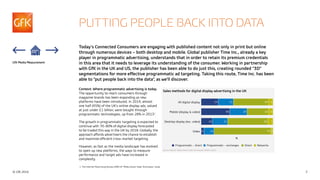
platforms have been introduced. In 2014, almost
one half (45%) of the UK’s online display ads, valued
at just under £1 billion, were bought through
programmatic technologies, up from 28% in 20131
.
The growth in programmatic targeting is expected to
continue with 70-80% of digital display forecasted
to be traded this way in the UK by 2018. Globally, the
approach affords advertisers the chance to establish
and maximize efficient cross-market targeting.
However, as fast as the media landscape has evolved
to open up new platforms, the ways to measure
performance and target ads have increased in
complexity.
1. The Internet Advertising Bureau (IAB) UK “Media Owner Sales Techniques” study
Sales methods for digital display advertising in the UK
NetworksDirectProgrammatic – exchangesProgrammatic – direct
Source: IAB UK ‘Media Owner Sales Techniques’ (MOST) 2014
%
6
6
7
3
49
30
56
79
21
24
21
14
24
40
16
4Video
Desktop display (exc. video)
Mobile (display & video)
All digital display
3
PUTTING PEOPLE BACK INTO DATA
© GfK 2016
GfK Media Measurement
Putting people back into data
One side effect of programmatic advertising is
that brands, advertising agencies and publishers
stop thinking about consumers and instead
replace people with data points. This isn’t a new
phenomenon – transactional metrics have always
been available to publishers. For example, the Audit
Bureau of Circulation (ABC) measures the number
of copies sold rather than the number of readers.
However, because there is so much more data being
collected in today’s digital world, it is perhaps now
even easier to replace real readers or viewers with
the number of impressions, sessions or searches
made by a consumer – or by a device.
Time Inc. (UK) believes there is a place for both
transactional and consumer-based metrics to work
simultaneously. As Marcus Rich, Time Inc. (UK) CEO,
has said: “We are a magazine brand business. The
platform is irrelevant. We should start from the
point of the audience, and the content. The platform
is only the best mechanism at that point for that
story.”
By combining consumer understanding and
traditional research techniques with programmatic
data segments based on online behavior, Time Inc.
can “put people back into data” and offer a fully-
rounded ad targeting solution.
PUTTING PEOPLE BACK INTO DATA
© GfK 2016
GfK Media Measurement
Case study: Mums
In August 2015, we fielded a survey using
our GfK Crossmedia Link panel in the
UK for Time Inc. that included multiple
psychographic and consumption based
questions. The objective was to increase
the amount of information per panelist
for enhanced segmentation. And because
a similar approach is already being
executed in the US by GfK MRI using
data from its Survey of the American
Consumer, there was the additional
advantage of comparative findings from
another market.
Our MRI’s Survey database provides multi-
dimensional profiling across almost 40,000
variables. It’s ideal for programmatic
advertising because it uses our 360
Precision Digital analytical process.
This means that we are able to attach
proprietary segments to the MRI database
so that they can be turned into cookies
available to DMP/DSPs and deployed
in digital and programmatic media
planning and evaluation. This provides a
seamless “best of both worlds” solution for
advertising that works across traditional,
digital and programmatic media.
To show how this approach could enhance
segmentation, we focused on one target
group: mums.
Our Crossmedia Link solution is a single-
source, cross-device measurement panel
of individuals in the UK using a range
of devices (i.e. PC, smartphone, tablet,
etc.). One third of the panelists are
tracked across multiple devices using
our LEOtrace®
technology. At the time
of the study there were 4,500 panelists,
resulting in 6,000 digital devices being
measured. The panel has since been
grown to consist of 7,000 individuals.
Surveys can also be used to add
demographics and other consumption-
based data.
5
PUTTING PEOPLE BACK INTO DATA
© GfK 2016
GfK Media Measurement
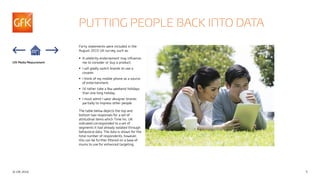
Forty statements were included in the
August 2015 UK survey, such as:
ƒ A celebrity endorsement may influence
me to consider or buy a product.
ƒ I will gladly switch brands to use a
coupon.
ƒ I think of my mobile phone as a source
of entertainment.
ƒ I’d rather take a few weekend holidays
than one long holiday.
ƒ I must admit I wear designer brands
partially to impress other people.
The table below depicts the top and
bottom two responses for a set of
attitudinal items which Time Inc. UK
indicated corresponded to a set of
segments it had already isolated through
behavioral data. The data is shown for the
total number of respondents, however,
this can be further filtered on a base of
mums to use for enhanced targeting.
PUTTING PEOPLE BACK INTO DATA
© GfK 2016
GfK Media Measurement
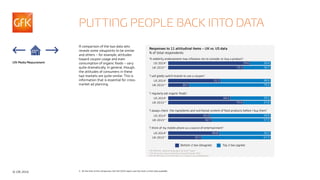
“A celebrity endorsement may influence me to consider or buy a product”.
“I will gladly switch brands to use a coupon”.
“I regularly eat organic foods”.
“I always check the ingredients and nutritional content of food products before I buy them”.
“I think of my mobile phone as a source of entertainment”.
op 2 box agreeottom 2 box disagree
Responses to 11 attitudinal items – UK vs. US data
of total respondents
f I ational tudy data all 20142 report
** f survey using rossmedia ink panel ummer 2015
† he f I data run for this item is on a base of “own mobile phone”.
20.4
2 .
4 .
.
.5
2 .0
5 .0
5 .
50.2
.
.
.
51.1
20.
0.5
.0
41.0
42.
4 . †
2.2015
2014
2015
2014
2015
2014
2015
2014
2015
2014
A comparison of the two data sets
reveals some viewpoints to be similar
and others – for example, attitudes
toward coupon usage and even
consumption of organic foods – vary
quite dramatically. In general, though,
the attitudes of consumers in these
two markets are quite similar. This is
information that is essential for cross-
market ad planning.
2. At the time of this comparison, the Fall 2014 report was the most current data available.
7
PUTTING PEOPLE BACK INTO DATA
© GfK 2016
GfK Media Measurement
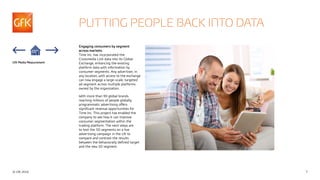
Engaging consumers by segment
across markets
Time Inc. has incorporated the
Crossmedia Link data into its Global
Exchange, enhancing the existing
platform data with information by
consumer segments. Any advertiser, in
any location, with access to the exchange
can now engage a large-scale, targeted
ad segment across multiple platforms
owned by the organization.
With more than 90 global brands
reaching millions of people globally,
programmatic advertising offers
significant revenue opportunities for
Time Inc. This project has enabled the
company to see how it can improve
consumer segmentation within the
trading platform. The next steps are
to test the 3D segments on a live
advertising campaign in the UK to
compare and contrast the results
between the behaviorally defined target
and the new 3D segment.
PUTTING PEOPLE BACK INTO DATA
© GfK 2016
GfK Media Measurement
For more information on how we can support your business please contact:
Michal Galin
Global Head of Published Media
michal.galin@gfk.com
OR visit
www.gfk.com/solutions/audience-measurement-and-insights
About GfK
GfK is the trusted source of relevant market and consumer information that enables its clients to make smarter decisions. More than 13,000 market
research experts combine their passion with GfK’s 80 years of data science experience. This allows GfK to deliver vital global insights matched with local
market intelligence from more than 100 countries. By using innovative technologies and data sciences, GfK turns big data into smart data, enabling its
clients to improve their competitive edge and enrich consumers’ experiences and choices.
www.gfk.com GfK. Growth from Knowledge

GFK Case study: Putting people back into data

  • 1.
    © GfK 2016 GfKMedia Measurement PUTTING PEOPLE BACK INTO DATA Putting people back into data How Time Inc. and GfK partnered to maximize programmatic advertising
  • 2.
    2© GfK 2016 GfKMedia Measurement PUTTING PEOPLE BACK INTO DATA Today’s Connected Consumers are engaging with published content not only in print but online through numerous devices – both desktop and mobile. Global publisher Time Inc., already a key player in programmatic advertising, understands that in order to retain its premium credentials in this area that it needs to leverage its understanding of the consumer. Working in partnership with GfK in the UK and US, the publisher has been able to do just this, creating rounded “3D” segmentations for more effective programmatic ad targeting. Taking this route, Time Inc. has been able to “put people back into the data”, as we’ll discover. Context: Where programmatic advertising is today The opportunity to reach consumers through magazine brands has been expanding as new platforms have been introduced. In 2014, almost one half (45%) of the UK’s online display ads, valued at just under £1 billion, were bought through programmatic technologies, up from 28% in 20131 . The growth in programmatic targeting is expected to continue with 70-80% of digital display forecasted to be traded this way in the UK by 2018. Globally, the approach affords advertisers the chance to establish and maximize efficient cross-market targeting. However, as fast as the media landscape has evolved to open up new platforms, the ways to measure performance and target ads have increased in complexity. 1. The Internet Advertising Bureau (IAB) UK “Media Owner Sales Techniques” study Sales methods for digital display advertising in the UK NetworksDirectProgrammatic – exchangesProgrammatic – direct Source: IAB UK ‘Media Owner Sales Techniques’ (MOST) 2014 % 6 6 7 3 49 30 56 79 21 24 21 14 24 40 16 4Video Desktop display (exc. video) Mobile (display & video) All digital display
  • 3.
    3 PUTTING PEOPLE BACKINTO DATA © GfK 2016 GfK Media Measurement Putting people back into data One side effect of programmatic advertising is that brands, advertising agencies and publishers stop thinking about consumers and instead replace people with data points. This isn’t a new phenomenon – transactional metrics have always been available to publishers. For example, the Audit Bureau of Circulation (ABC) measures the number of copies sold rather than the number of readers. However, because there is so much more data being collected in today’s digital world, it is perhaps now even easier to replace real readers or viewers with the number of impressions, sessions or searches made by a consumer – or by a device. Time Inc. (UK) believes there is a place for both transactional and consumer-based metrics to work simultaneously. As Marcus Rich, Time Inc. (UK) CEO, has said: “We are a magazine brand business. The platform is irrelevant. We should start from the point of the audience, and the content. The platform is only the best mechanism at that point for that story.” By combining consumer understanding and traditional research techniques with programmatic data segments based on online behavior, Time Inc. can “put people back into data” and offer a fully- rounded ad targeting solution.
  • 4.
    PUTTING PEOPLE BACKINTO DATA © GfK 2016 GfK Media Measurement Case study: Mums In August 2015, we fielded a survey using our GfK Crossmedia Link panel in the UK for Time Inc. that included multiple psychographic and consumption based questions. The objective was to increase the amount of information per panelist for enhanced segmentation. And because a similar approach is already being executed in the US by GfK MRI using data from its Survey of the American Consumer, there was the additional advantage of comparative findings from another market. Our MRI’s Survey database provides multi- dimensional profiling across almost 40,000 variables. It’s ideal for programmatic advertising because it uses our 360 Precision Digital analytical process. This means that we are able to attach proprietary segments to the MRI database so that they can be turned into cookies available to DMP/DSPs and deployed in digital and programmatic media planning and evaluation. This provides a seamless “best of both worlds” solution for advertising that works across traditional, digital and programmatic media. To show how this approach could enhance segmentation, we focused on one target group: mums. Our Crossmedia Link solution is a single- source, cross-device measurement panel of individuals in the UK using a range of devices (i.e. PC, smartphone, tablet, etc.). One third of the panelists are tracked across multiple devices using our LEOtrace® technology. At the time of the study there were 4,500 panelists, resulting in 6,000 digital devices being measured. The panel has since been grown to consist of 7,000 individuals. Surveys can also be used to add demographics and other consumption- based data.
  • 5.
    5 PUTTING PEOPLE BACKINTO DATA © GfK 2016 GfK Media Measurement Forty statements were included in the August 2015 UK survey, such as: ƒ A celebrity endorsement may influence me to consider or buy a product. ƒ I will gladly switch brands to use a coupon. ƒ I think of my mobile phone as a source of entertainment. ƒ I’d rather take a few weekend holidays than one long holiday. ƒ I must admit I wear designer brands partially to impress other people. The table below depicts the top and bottom two responses for a set of attitudinal items which Time Inc. UK indicated corresponded to a set of segments it had already isolated through behavioral data. The data is shown for the total number of respondents, however, this can be further filtered on a base of mums to use for enhanced targeting.
  • 6.
    PUTTING PEOPLE BACKINTO DATA © GfK 2016 GfK Media Measurement “A celebrity endorsement may influence me to consider or buy a product”. “I will gladly switch brands to use a coupon”. “I regularly eat organic foods”. “I always check the ingredients and nutritional content of food products before I buy them”. “I think of my mobile phone as a source of entertainment”. op 2 box agreeottom 2 box disagree Responses to 11 attitudinal items – UK vs. US data of total respondents f I ational tudy data all 20142 report ** f survey using rossmedia ink panel ummer 2015 † he f I data run for this item is on a base of “own mobile phone”. 20.4 2 . 4 . . .5 2 .0 5 .0 5 . 50.2 . . . 51.1 20. 0.5 .0 41.0 42. 4 . † 2.2015 2014 2015 2014 2015 2014 2015 2014 2015 2014 A comparison of the two data sets reveals some viewpoints to be similar and others – for example, attitudes toward coupon usage and even consumption of organic foods – vary quite dramatically. In general, though, the attitudes of consumers in these two markets are quite similar. This is information that is essential for cross- market ad planning. 2. At the time of this comparison, the Fall 2014 report was the most current data available.
  • 7.
    7 PUTTING PEOPLE BACKINTO DATA © GfK 2016 GfK Media Measurement Engaging consumers by segment across markets Time Inc. has incorporated the Crossmedia Link data into its Global Exchange, enhancing the existing platform data with information by consumer segments. Any advertiser, in any location, with access to the exchange can now engage a large-scale, targeted ad segment across multiple platforms owned by the organization. With more than 90 global brands reaching millions of people globally, programmatic advertising offers significant revenue opportunities for Time Inc. This project has enabled the company to see how it can improve consumer segmentation within the trading platform. The next steps are to test the 3D segments on a live advertising campaign in the UK to compare and contrast the results between the behaviorally defined target and the new 3D segment.
  • 8.
    PUTTING PEOPLE BACKINTO DATA © GfK 2016 GfK Media Measurement For more information on how we can support your business please contact: Michal Galin Global Head of Published Media michal.galin@gfk.com OR visit www.gfk.com/solutions/audience-measurement-and-insights About GfK GfK is the trusted source of relevant market and consumer information that enables its clients to make smarter decisions. More than 13,000 market research experts combine their passion with GfK’s 80 years of data science experience. This allows GfK to deliver vital global insights matched with local market intelligence from more than 100 countries. By using innovative technologies and data sciences, GfK turns big data into smart data, enabling its clients to improve their competitive edge and enrich consumers’ experiences and choices. www.gfk.com GfK. Growth from Knowledge