GOVT FIRST GRADE COLLEGE CHIKKABASUR
DEPARTMENT OF COMPUTER APPLICATIONS
CLASS : BA II YEAR
SUBJECT : COMPUTER APPLICATIONS II
TOPIC NAME : INTERNET EXPLORER
PRESENTED BY : PROF. SHRIDEVI S G
Dept of Computer Applications
INTERNET EXPLORER
• To open the Internet Explorer:
• Double click on the Internet Explorer icon on Desktop.
• Or, from Start  All Programs  Internet Explorer.
• If you were using a modem, the “Dial-up Networking” screen appears on your screen.
INTERNET EXPLORER WINDOW
• The main components of Internet Explorer:
• Title Bar
• Menu Bar
• Toolbar
• Address Bar
BROWSER ICONS
• Toolbar contains the following standard icons:
• Back
• Forward
• Stop
• Refresh
• Home
• Search
• Favorites
• History
• Mail
• Print
WEB ADDRESS
• Every page has its own unique address, known as URL (Uniform Resource Location) as shown
below:
• URL is made up of three components:
• http: the protocol used to access the Internet
• www World Wide Web.
• Domain Name: Location or area where the pages are stored.
• Top Level Domain: consists of two parts:
• The three letter code of a URL that indicates whether the type of the address.
• The two letter code that indicates the country.
WEB ADDRESS
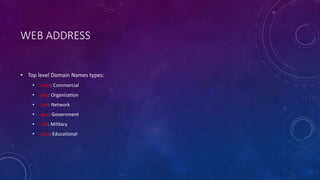
• Top level Domain Names types:
• .com: Commercial
• .org: Organization
• .net: Network
• .gov: Government
• .mil: Military
• .edu: Educational
USING THE BROWSER
• Most browsers allow you to access Web site directly by typing its Web address
(URL). To access a Web site, do the following:
• Click the address box so that the current address is highlighted
• Type the new address
• Press the Enter key, or press GO.
• If you are using Internet Explorer, there is no need to type http://, as this part
will be added automatically when you press the Enter key.
USING THE BROWSER
• Note that some texts appear underlined and in blue. If you
position the pointer into this text, it will change to a hand shape. If
you click it, an action will be performed.
Ex: www.yahoo.com
www.google.com
• To cancel downloading, click the Stop button.
• To reload a Web page, click Refresh.
CHANGING THE HOME PAGE
• A Home page: is the first Web page you will see every time you launch Internet Explorer. So, it is a good idea
to choose a page that contains information that is important to you.
• To change your home page, do the following:
• Go to the page you want to appear when you start Internet Explorer
• Select Internet Options from the Tools menu
• Click the General tab
• Under Home page, click Use Current button.
• Click Apply
• Click Ok
• Once you have changed your home page, you can quickly view it by clicking the Home button on the Standard
toolbar.
TOOLBARS
• The toolbars appear automatically when you start Internet
Explorer.
• The Standard toolbar includes the icons (Back, Forward, Stop,
Refresh, Home,..etc)
• The Address Bar displays the web address
• The Links Bar includes a few web pages that you use
frequently. Just click the link to display the page.
TOOLBARS
• To show or hide these tools, select Toolbars from the View menu. Clear the check mark next to the
toolbar to hide it.
CLOSING AND DISCONNECTING
• Click the Close button in the top right hand corner of the browser window.
• Click Disconnect in the Connected Window.
• To disconnect but leave the browser window: Double-click the connected icon on the status bar.
GFGC CHIKKABASUR (INTERNET EXPLORER)

GFGC CHIKKABASUR (INTERNET EXPLORER)

  • 1.
    GOVT FIRST GRADECOLLEGE CHIKKABASUR DEPARTMENT OF COMPUTER APPLICATIONS CLASS : BA II YEAR SUBJECT : COMPUTER APPLICATIONS II TOPIC NAME : INTERNET EXPLORER PRESENTED BY : PROF. SHRIDEVI S G Dept of Computer Applications
  • 2.
    INTERNET EXPLORER • Toopen the Internet Explorer: • Double click on the Internet Explorer icon on Desktop. • Or, from Start  All Programs  Internet Explorer. • If you were using a modem, the “Dial-up Networking” screen appears on your screen.
  • 3.
    INTERNET EXPLORER WINDOW •The main components of Internet Explorer: • Title Bar • Menu Bar • Toolbar • Address Bar
  • 4.
    BROWSER ICONS • Toolbarcontains the following standard icons: • Back • Forward • Stop • Refresh • Home • Search • Favorites • History • Mail • Print
  • 5.
    WEB ADDRESS • Everypage has its own unique address, known as URL (Uniform Resource Location) as shown below: • URL is made up of three components: • http: the protocol used to access the Internet • www World Wide Web. • Domain Name: Location or area where the pages are stored. • Top Level Domain: consists of two parts: • The three letter code of a URL that indicates whether the type of the address. • The two letter code that indicates the country.
  • 6.
    WEB ADDRESS • Toplevel Domain Names types: • .com: Commercial • .org: Organization • .net: Network • .gov: Government • .mil: Military • .edu: Educational
  • 7.
    USING THE BROWSER •Most browsers allow you to access Web site directly by typing its Web address (URL). To access a Web site, do the following: • Click the address box so that the current address is highlighted • Type the new address • Press the Enter key, or press GO. • If you are using Internet Explorer, there is no need to type http://, as this part will be added automatically when you press the Enter key.
  • 8.
    USING THE BROWSER •Note that some texts appear underlined and in blue. If you position the pointer into this text, it will change to a hand shape. If you click it, an action will be performed. Ex: www.yahoo.com www.google.com • To cancel downloading, click the Stop button. • To reload a Web page, click Refresh.
  • 9.
    CHANGING THE HOMEPAGE • A Home page: is the first Web page you will see every time you launch Internet Explorer. So, it is a good idea to choose a page that contains information that is important to you. • To change your home page, do the following: • Go to the page you want to appear when you start Internet Explorer • Select Internet Options from the Tools menu • Click the General tab • Under Home page, click Use Current button. • Click Apply • Click Ok • Once you have changed your home page, you can quickly view it by clicking the Home button on the Standard toolbar.
  • 10.
    TOOLBARS • The toolbarsappear automatically when you start Internet Explorer. • The Standard toolbar includes the icons (Back, Forward, Stop, Refresh, Home,..etc) • The Address Bar displays the web address • The Links Bar includes a few web pages that you use frequently. Just click the link to display the page.
  • 11.
    TOOLBARS • To showor hide these tools, select Toolbars from the View menu. Clear the check mark next to the toolbar to hide it.
  • 12.
    CLOSING AND DISCONNECTING •Click the Close button in the top right hand corner of the browser window. • Click Disconnect in the Connected Window. • To disconnect but leave the browser window: Double-click the connected icon on the status bar.