






Cecilia Cicolini
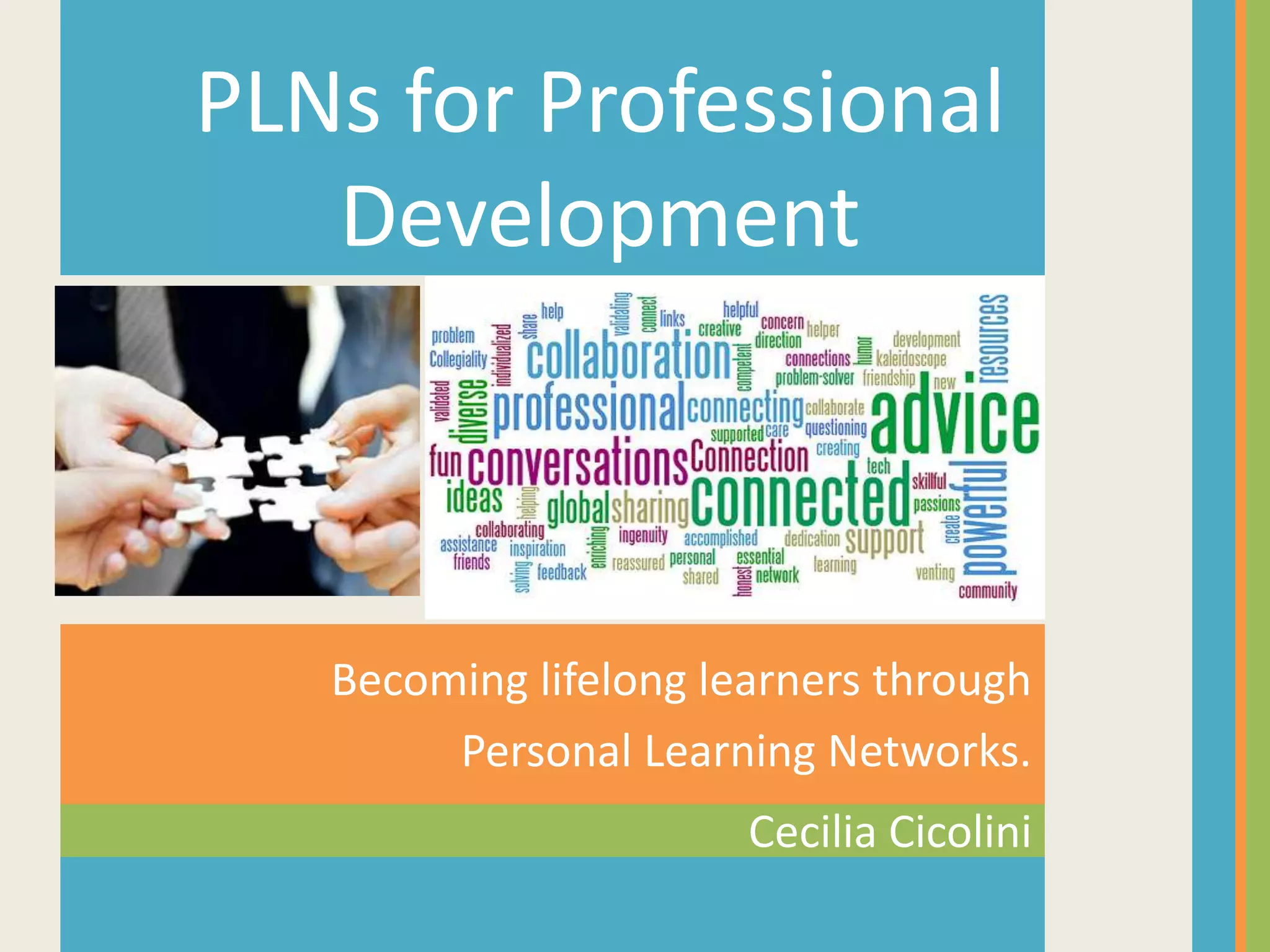
Becoming lifelong learners through
Personal Learning Networks.
PLNs for Professional
Development
To the memory of Ana Armendariz,
whose passionate teaching and love for
our profession shaped and inspired a
whole generation of teachers, including
myself.
Those we love don't go away,
They walk beside us every day,
Unseen, unheard, but always near,
Still loved, still missed and very dear.
Anonymous
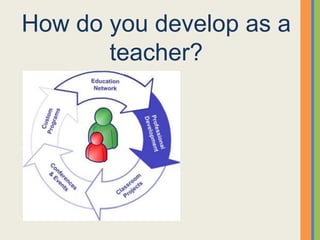
How do you develop as a
teacher?
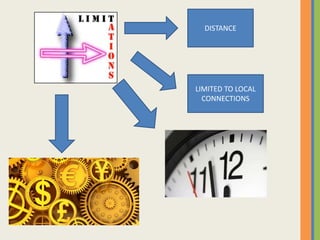
DISTANCE
LIMITED TO LOCAL
CONNECTIONS
Ho
21st Century Learning: Inspiring
Stories
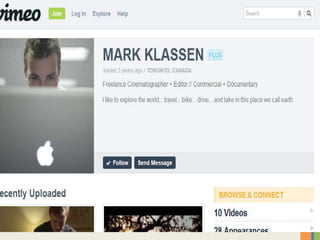
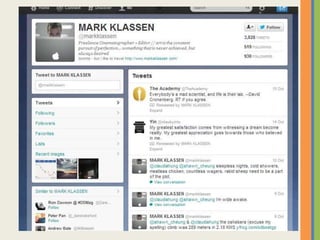
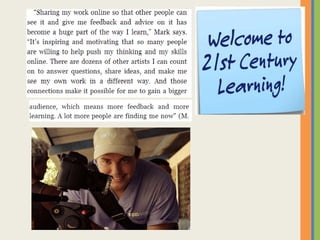
MARK KLASSEN
A cinematographer with a growing
reputation for creating beautiful videos. His
work shows a great sense of framing,
movement and perspective – all the qualities
on which compelling filmmaking is built.
He has won competitions, received awards
and has a growing list of clients who seek
out his skills.
Source: Will Richardson’s Personal Learning Networks.
Prediction: How old is Mark? How did he train as
film maker?
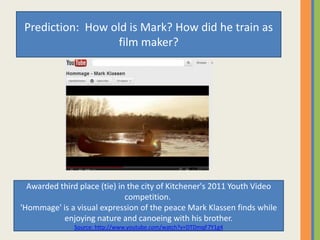
Awarded third place (tie) in the city of Kitchener's 2011 Youth Video
competition.
'Hommage' is a visual expression of the peace Mark Klassen finds while
enjoying nature and canoeing with his brother.
Source: http://www.youtube.com/watch?v=DTDmqF7Y1g4
•Mark is seventeen and he lives in Toronto.
• He has never had a minute of traditional
classroom instruction in his chosen craft.
• His education has been built on a healthy
mix of apprenticeship, experimentation and
self-direction.
•He has learnt much working with other
artists in the Toronto area through
volunteering and internships.
•He has also upgraded his skills with
people far away from Canada, people he
has never met face to face, never spoken
to and probably never will -people who
share his love of video and want to help
him become even better.
•Since 2009, he has become part of an
expanding global network of
cinematographers online with whom he
interacts in a regular basis.
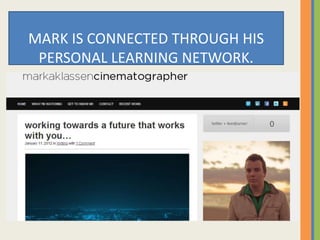
MARK IS CONNECTED THROUGH HIS
PERSONAL LEARNING NETWORK.
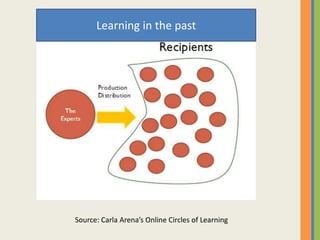
Source: Carla Arena’s Online Circles of Learning
Learning in the past
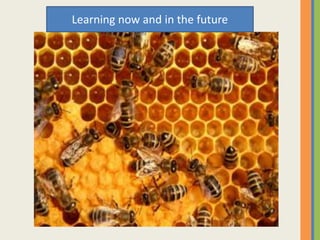
Learning now and in the future
Adapted from Will Richardson’s PLNs.
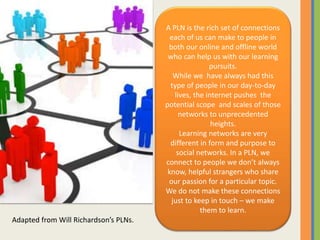
A PLN is the rich set of connections
each of us can make to people in
both our online and offline world
who can help us with our learning
pursuits.
While we have always had this
type of people in our day-to-day
lives, the internet pushes the
potential scope and scales of those
networks to unprecedented
heights.
Learning networks are very
different in form and purpose to
social networks. In a PLN, we
connect to people we don’t always
know, helpful strangers who share
our passion for a particular topic.
We do not make these connections
just to keep in touch – we make
them to learn.
In this new interactive Web world, I have become a nomadic
learner; I graze on knowledge. I find what I need when I need it.
There is no linear curriculum to my learning, no formal structure
other than the tools I use to connect to the people and sources
that point me to what I need to know and learn, the same tools I
use to then give back what I have discovered. I have become, at
long last, that lifelong learner my teachers always hoped I would
become. Unfortunately, it's about thirty years too late for them
to see it.
The good news for all of us is that today, anyone can become a
lifelong learner. (Yes, even you.) These technologies are user
friendly in a way that technologies have not been in the past.
Will Richardson
http://www.edutopia.org/new-face-learning
How
literate
do you
feel?
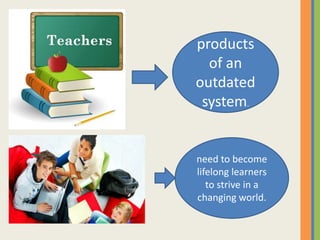
products
of an
outdated
system.
need to become
lifelong learners
to strive in a
changing world.
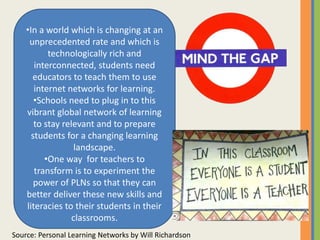
•In a world which is changing at an
unprecedented rate and which is
technologically rich and
interconnected, students need
educators to teach them to use
internet networks for learning.
•Schools need to plug in to this
vibrant global network of learning
to stay relevant and to prepare
students for a changing learning
landscape.
•One way for teachers to
transform is to experiment the
power of PLNs so that they can
better deliver these new skills and
literacies to their students in their
classrooms.
Source: Personal Learning Networks by Will Richardson
Literacy has always been a collection of cultural and communicative
practices shared among members of particular groups.
As society and technology change, so does literacy.. Twenty-first century readers and writers need to:
Develop proficiency with the tools of technology
Build relationships with others to pose and solve problems collaboratively and cross-
culturally
Design and share information for global communities to meet a variety of purposes
Manage, analyze and synthesize multiple streams of simultaneous information
Create, critique, analyze, and evaluate multi-media texts
Attend to the ethical responsibilities required by these complex environments
Source: http://www.ncte.org/positions/statements/21stcentdefinition
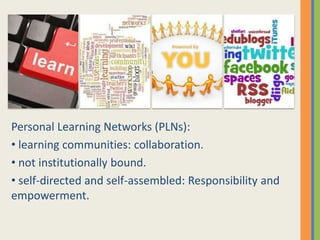
Personal Learning Networks (PLNs):
• learning communities: collaboration.
• not institutionally bound.
• self-directed and self-assembled: Responsibility and
empowerment.
Ingredients
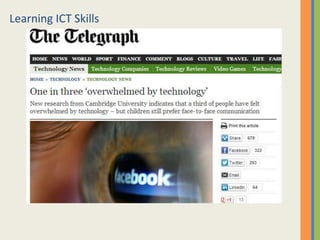
Learning ICT Skills
Learning ICT Skills
Source: Marian Atta’s webinar for IATEFL on Learning ICT Skills.
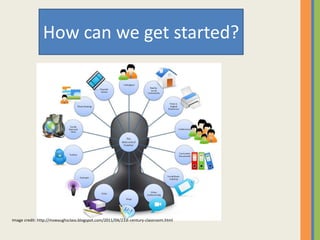
Image credit: http://mswaughsclass.blogspot.com/2011/04/21st-century-classroom.html
How can we get started?
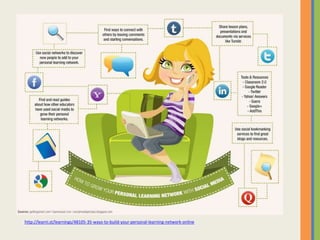
http://learni.st/learnings/48105-35-ways-to-build-your-personal-learning-network-online
A huge virtual staffroom.
Source: http://vimeo.com/20008272
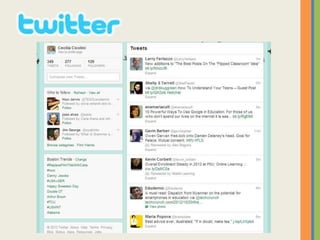
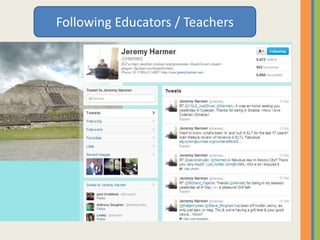
Following Educators / Teachers
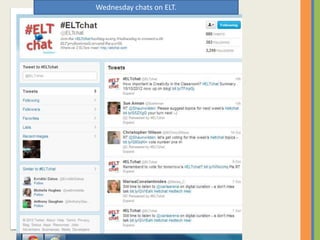
Wednesday chats on ELT.
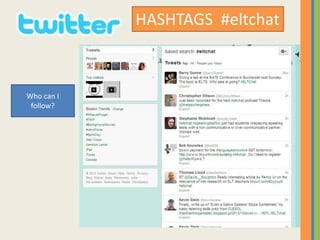
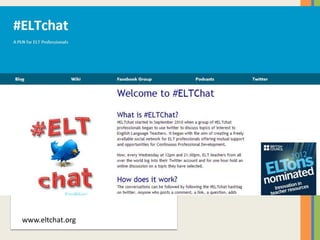
HASHTAGS #eltchat
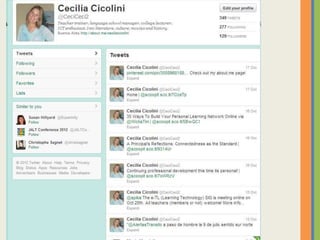
Who can I
follow?
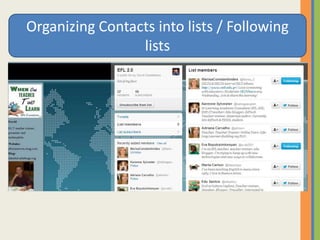
Organizing Contacts into lists / Following
lists
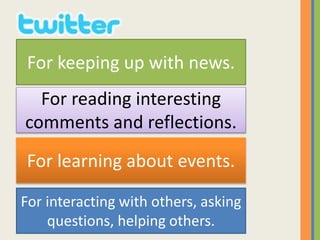
For keeping up with news.
For reading interesting
comments and reflections.
For learning about events.
For interacting with others, asking
questions, helping others.
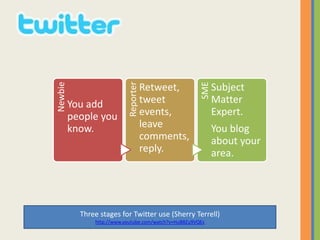
Newbie
You add
people you
know. Reporter
Retweet,
tweet
events,
leave
comments,
reply.
SME
Subject
Matter
Expert.
You blog
about your
area.
Three stages for Twitter use (Sherry Terrell)
http://www.youtube.com/watch?v=HuB8Zu9VQEs
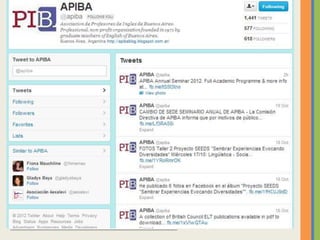
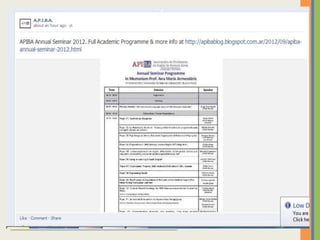
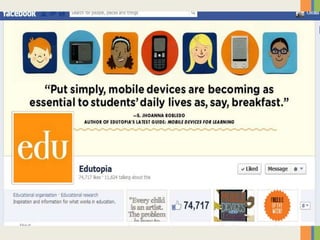
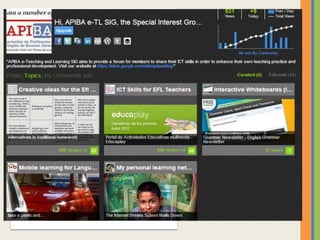
APIBA’s PAGE
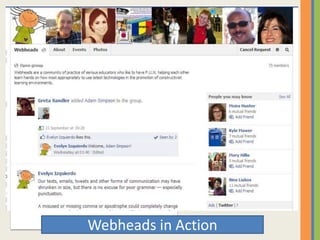
Webheads in Action
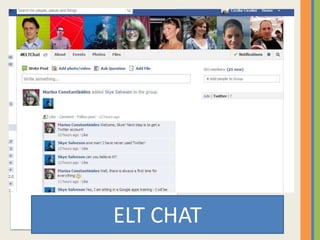
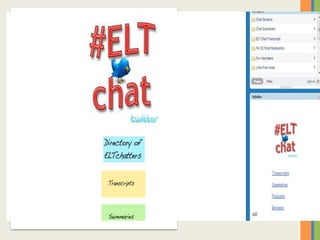
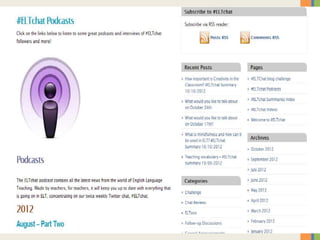
ELT CHAT
Grazing on the web
for more…
www.eltchat.org
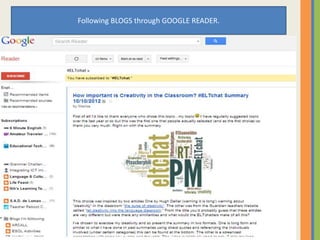
Following BLOGS through GOOGLE READER.
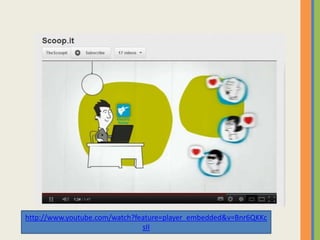
http://www.youtube.com/watch?feature=player_embedded&v=Bnr6QKKc
sII
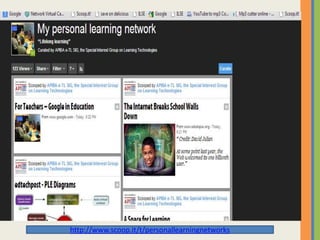
http://www.scoop.it/t/personallearningnetworks
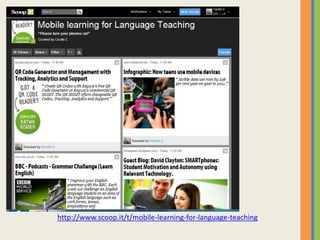
http://www.scoop.it/t/mobile-learning-for-language-teaching
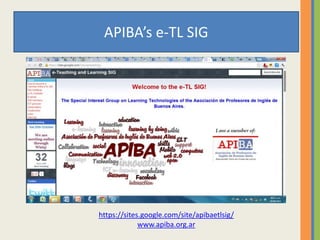
APIBA’s e-TL SIG
https://sites.google.com/site/apibaetlsig/
www.apiba.org.ar
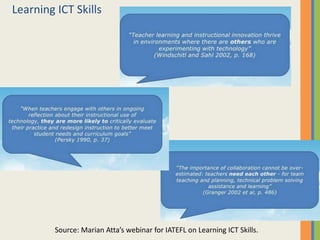
Teacher learning and instructional
innovation thrive in environments where
there are others who are experimenting
with technology (Windschitl and Sahl 2002,
p. 168)
The importance of collaboration cannot be
overestimated: teachers need each other -
for team teaching and planning, technical
problem solving, assistance and learning
(Granger 2002)
What would you like to learn?
What are your current goals
for professional
development?
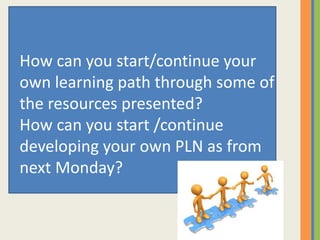
How can you start/continue your
own learning path through some of
the resources presented?
How can you start /continue
developing your own PLN as from
next Monday?
"Isolation is what has stopped us
growing. Isolation can limit our
potential to an individual
subjective experience, one we
share with no one...
Paradoxically, self-development is dependent on
our interaction with colleagues and students. Our
unique perception of reality can be enriched
through the experience of others. Through
cooperation we have a chance to escape from
simple egocentric subjectivity, without chasing a
non-existent objectivity.“
Ana Maria Armendariz, published in the ELT News
& Views Magazine, June 1997.
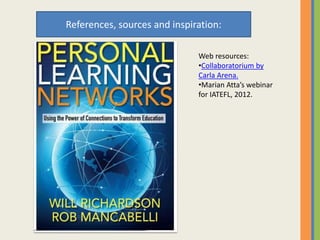
References, sources and inspiration:
Web resources:
•Collaboratorium by
Carla Arena.
•Marian Atta’s webinar
for IATEFL, 2012.
cecilia.cicolini@gmail.com
www.learningpaths.com.ar

Personal learning networks

  • 1.
    Cecilia Cicolini Becoming lifelonglearners through Personal Learning Networks. PLNs for Professional Development
  • 2.
    To the memoryof Ana Armendariz, whose passionate teaching and love for our profession shaped and inspired a whole generation of teachers, including myself. Those we love don't go away, They walk beside us every day, Unseen, unheard, but always near, Still loved, still missed and very dear. Anonymous
  • 3.
    How do youdevelop as a teacher?
  • 4.
  • 5.
  • 6.
    21st Century Learning:Inspiring Stories MARK KLASSEN A cinematographer with a growing reputation for creating beautiful videos. His work shows a great sense of framing, movement and perspective – all the qualities on which compelling filmmaking is built. He has won competitions, received awards and has a growing list of clients who seek out his skills. Source: Will Richardson’s Personal Learning Networks.
  • 7.
    Prediction: How oldis Mark? How did he train as film maker? Awarded third place (tie) in the city of Kitchener's 2011 Youth Video competition. 'Hommage' is a visual expression of the peace Mark Klassen finds while enjoying nature and canoeing with his brother. Source: http://www.youtube.com/watch?v=DTDmqF7Y1g4
  • 8.
    •Mark is seventeenand he lives in Toronto. • He has never had a minute of traditional classroom instruction in his chosen craft. • His education has been built on a healthy mix of apprenticeship, experimentation and self-direction. •He has learnt much working with other artists in the Toronto area through volunteering and internships.
  • 9.
    •He has alsoupgraded his skills with people far away from Canada, people he has never met face to face, never spoken to and probably never will -people who share his love of video and want to help him become even better. •Since 2009, he has become part of an expanding global network of cinematographers online with whom he interacts in a regular basis.
  • 10.
    MARK IS CONNECTEDTHROUGH HIS PERSONAL LEARNING NETWORK.
  • 15.
    Source: Carla Arena’sOnline Circles of Learning Learning in the past
  • 16.
    Learning now andin the future
  • 17.
    Adapted from WillRichardson’s PLNs. A PLN is the rich set of connections each of us can make to people in both our online and offline world who can help us with our learning pursuits. While we have always had this type of people in our day-to-day lives, the internet pushes the potential scope and scales of those networks to unprecedented heights. Learning networks are very different in form and purpose to social networks. In a PLN, we connect to people we don’t always know, helpful strangers who share our passion for a particular topic. We do not make these connections just to keep in touch – we make them to learn.
  • 19.
    In this newinteractive Web world, I have become a nomadic learner; I graze on knowledge. I find what I need when I need it. There is no linear curriculum to my learning, no formal structure other than the tools I use to connect to the people and sources that point me to what I need to know and learn, the same tools I use to then give back what I have discovered. I have become, at long last, that lifelong learner my teachers always hoped I would become. Unfortunately, it's about thirty years too late for them to see it. The good news for all of us is that today, anyone can become a lifelong learner. (Yes, even you.) These technologies are user friendly in a way that technologies have not been in the past. Will Richardson http://www.edutopia.org/new-face-learning
  • 20.
  • 21.
    products of an outdated system. need tobecome lifelong learners to strive in a changing world.
  • 22.
    •In a worldwhich is changing at an unprecedented rate and which is technologically rich and interconnected, students need educators to teach them to use internet networks for learning. •Schools need to plug in to this vibrant global network of learning to stay relevant and to prepare students for a changing learning landscape. •One way for teachers to transform is to experiment the power of PLNs so that they can better deliver these new skills and literacies to their students in their classrooms. Source: Personal Learning Networks by Will Richardson
  • 23.
    Literacy has alwaysbeen a collection of cultural and communicative practices shared among members of particular groups. As society and technology change, so does literacy.. Twenty-first century readers and writers need to: Develop proficiency with the tools of technology Build relationships with others to pose and solve problems collaboratively and cross- culturally Design and share information for global communities to meet a variety of purposes Manage, analyze and synthesize multiple streams of simultaneous information Create, critique, analyze, and evaluate multi-media texts Attend to the ethical responsibilities required by these complex environments Source: http://www.ncte.org/positions/statements/21stcentdefinition
  • 24.
    Personal Learning Networks(PLNs): • learning communities: collaboration. • not institutionally bound. • self-directed and self-assembled: Responsibility and empowerment.
  • 25.
  • 26.
  • 27.
    Learning ICT Skills Source:Marian Atta’s webinar for IATEFL on Learning ICT Skills.
  • 29.
  • 30.
  • 31.
    A huge virtualstaffroom.
  • 32.
  • 35.
  • 37.
  • 38.
  • 39.
    Organizing Contacts intolists / Following lists
  • 40.
    For keeping upwith news. For reading interesting comments and reflections. For learning about events. For interacting with others, asking questions, helping others.
  • 41.
    Newbie You add people you know.Reporter Retweet, tweet events, leave comments, reply. SME Subject Matter Expert. You blog about your area. Three stages for Twitter use (Sherry Terrell) http://www.youtube.com/watch?v=HuB8Zu9VQEs
  • 43.
  • 45.
  • 47.
  • 48.
    Grazing on theweb for more…
  • 49.
  • 54.
  • 59.
  • 61.
  • 62.
  • 63.
  • 66.
    Teacher learning andinstructional innovation thrive in environments where there are others who are experimenting with technology (Windschitl and Sahl 2002, p. 168) The importance of collaboration cannot be overestimated: teachers need each other - for team teaching and planning, technical problem solving, assistance and learning (Granger 2002)
  • 67.
    What would youlike to learn? What are your current goals for professional development?
  • 68.
    How can youstart/continue your own learning path through some of the resources presented? How can you start /continue developing your own PLN as from next Monday?
  • 69.
    "Isolation is whathas stopped us growing. Isolation can limit our potential to an individual subjective experience, one we share with no one...
  • 70.
    Paradoxically, self-development isdependent on our interaction with colleagues and students. Our unique perception of reality can be enriched through the experience of others. Through cooperation we have a chance to escape from simple egocentric subjectivity, without chasing a non-existent objectivity.“ Ana Maria Armendariz, published in the ELT News & Views Magazine, June 1997.
  • 71.
    References, sources andinspiration: Web resources: •Collaboratorium by Carla Arena. •Marian Atta’s webinar for IATEFL, 2012.
  • 72.