Geotextile fo soil
stabilization
Geotextiles for soil stabilization 1
PRESENTED BY
AGLAIA
Introduction
• Geotextiles have been utilized in the construction of
reinforced soil walls since the early 1970’s.
• They are used to wrap compacted soil in layers producing a
stable composite structure.
• Geotextile-reinforced soil walls somewhat resemble the
popular sandbag walls which have been used for some
decades.
Geotextiles for soil stabilization 2
Geotextiles
• They are permeable fabrics which, when used in association
with soil, have the ability to separate, filter, reinforce, protect,
or drain.
• They are made from polypropylene or polyester
• geotextile fabrics come in three basic forms:
1. woven (resembling mail bag sacking)
2. needle punched (resembling felt),
3. heat bonded (resembling ironed felt).
Geotextiles for soil stabilization 3
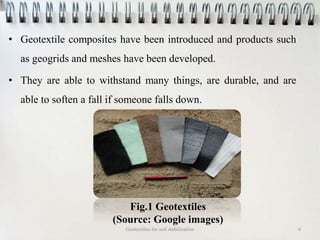
• Geotextile composites have been introduced and products such
as geogrids and meshes have been developed.
• They are able to withstand many things, are durable, and are
able to soften a fall if someone falls down.
Geotextiles for soil stabilization 4
Fig.1 Geotextiles
(Source: Google images)
Types Of Geotextiles
Geotextiles for soil stabilization 5
Geotextiles are made up of polymers such as polyester or
polypropylene.
They are divided into 3 categories on the basis of the way they are
prepared;
Woven fabrics
Non-woven fabrics
Knitted fabrics
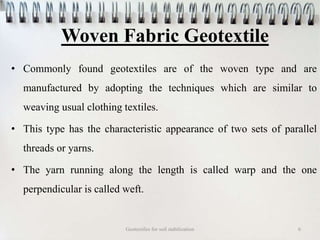
Woven Fabric Geotextile
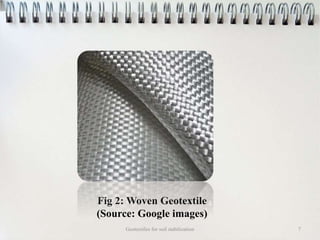
• Commonly found geotextiles are of the woven type and are
manufactured by adopting the techniques which are similar to
weaving usual clothing textiles.
• This type has the characteristic appearance of two sets of parallel
threads or yarns.
• The yarn running along the length is called warp and the one
perpendicular is called weft.
Geotextiles for soil stabilization 6
Fig 2: Woven Geotextile
(Source: Google images)
Geotextiles for soil stabilization 7
Non-Woven Geotextile
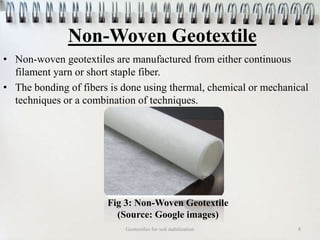
• Non-woven geotextiles are manufactured from either continuous
filament yarn or short staple fiber.
• The bonding of fibers is done using thermal, chemical or mechanical
techniques or a combination of techniques.
Geotextiles for soil stabilization 8
Fig 3: Non-Woven Geotextile
(Source: Google images)
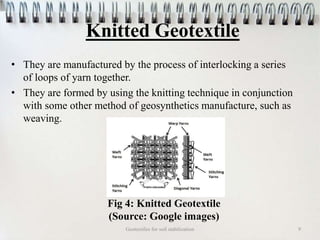
Knitted Geotextile
• They are manufactured by the process of interlocking a series
of loops of yarn together.
• They are formed by using the knitting technique in conjunction
with some other method of geosynthetics manufacture, such as
weaving.
Geotextiles for soil stabilization 9
Fig 4: Knitted Geotextile
(Source: Google images)
Functions Of Geotextiles
Geotextiles for soil stabilization 10
1. Filtration
2. Drainage
3. Séparation
4. Renforcement
5. Sealing
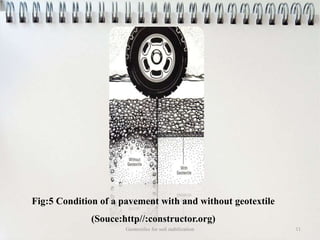
Fig:5 Condition of a pavement with and without geotextile
(Souce:http//:constructor.org)
Geotextiles for soil stabilization 11
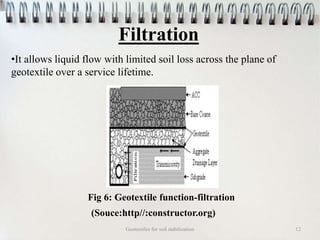
Filtration
Geotextiles for soil stabilization 12
•It allows liquid flow with limited soil loss across the plane of
geotextile over a service lifetime.
Fig 6: Geotextile function-filtration
(Souce:http//:constructor.org)
Drainage/Transmissivity
Geotextiles for soil stabilization 13
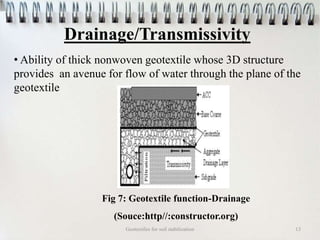
• Ability of thick nonwoven geotextile whose 3D structure
provides an avenue for flow of water through the plane of the
geotextile
Fig 7: Geotextile function-Drainage
(Souce:http//:constructor.org)
Separation
Geotextiles for soil stabilization 14
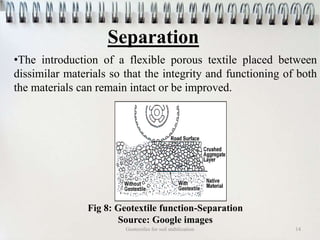
•The introduction of a flexible porous textile placed between
dissimilar materials so that the integrity and functioning of both
the materials can remain intact or be improved.
Fig 8: Geotextile function-Separation
Source: Google images
Reinforcement
Geotextiles for soil stabilization 15
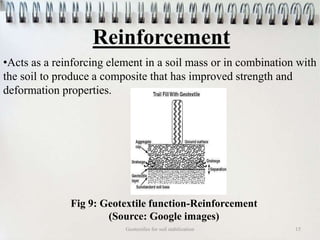
•Acts as a reinforcing element in a soil mass or in combination with
the soil to produce a composite that has improved strength and
deformation properties.
Fig 9: Geotextile function-Reinforcement
(Source: Google images)
Sealing
Geotextiles for soil stabilization 16
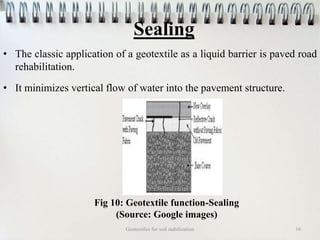
• The classic application of a geotextile as a liquid barrier is paved road
rehabilitation.
• It minimizes vertical flow of water into the pavement structure.
Fig 10: Geotextile function-Sealing
(Source: Google images)
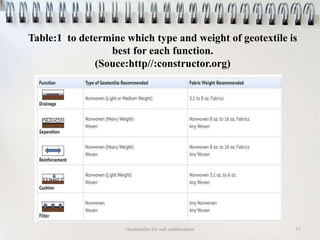
Table:1 to determine which type and weight of geotextile is
best for each function.
(Souce:http//:constructor.org)
Geotextiles for soil stabilization 17
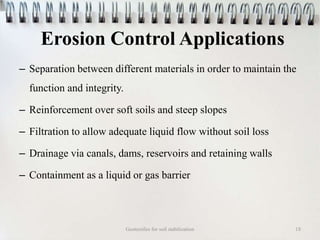
Erosion Control Applications
– Separation between different materials in order to maintain the
function and integrity.
– Reinforcement over soft soils and steep slopes
– Filtration to allow adequate liquid flow without soil loss
– Drainage via canals, dams, reservoirs and retaining walls
– Containment as a liquid or gas barrier
Geotextiles for soil stabilization 18
California Bearing Ratio Test
• The CBR is a semi empirical test that is often employed
in the estimation of the bearing capacity of sub grade
soils for design of pavement.
• It measures the resistance a soil mass offers to the
penetration of a plunger under specified density and
moisture conditions.
• The more difficult it is to penetrate the soil, the higher
the CBR rating.
• It can be clearly seen that due to the placement of non-
woven geotextile, the CBR values increases irrespective
of the placement depth.
Geotextiles for soil stabilization 19
Table 2: Summary of the CBR values (Unsoaked condition)
Source:[1]
Geotextiles for soil stabilization 20
Fig 11: CBR values for reinforced and unreinforced soil sample
Source:[1]
Geotextiles for soil stabilization 21
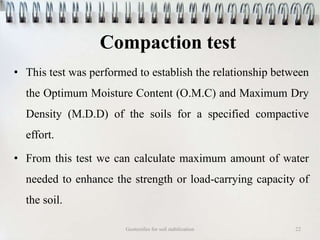
Compaction test
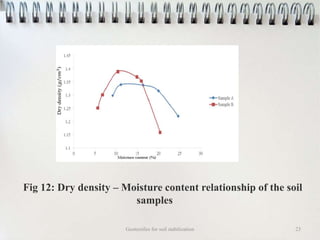
• This test was performed to establish the relationship between
the Optimum Moisture Content (O.M.C) and Maximum Dry
Density (M.D.D) of the soils for a specified compactive
effort.
• From this test we can calculate maximum amount of water
needed to enhance the strength or load-carrying capacity of
the soil.
Geotextiles for soil stabilization 22
Fig 12: Dry density – Moisture content relationship of the soil
samples
Geotextiles for soil stabilization 23
References
• D.A. Ogundare , A.O. Familusi , A.B. Osunkunle And J.O.
Olusami (2018), “Utilization Of Geotextile For Soil Stabilization
”, American Journal of Engineering Research Department of Civil
Engineering, Federal Polytechnic Ede. Volume-7, Issue-8, pp-224-
231.
• S.K. Ghosh, R. Bhattacharyya, M.M. Mondal (2014) “A
Review On Jute Geotextile – Part 1” International Journal of
Research in Engineering and Technology.Department of Jute and
Fiber Technology, University of Calcutta, West Bengal, India
Geotextiles for soil stabilization 24
• Morgan, Roy P.C.; Rickson, R.J. (2011). “Slope Stabilization
and Erosion Control: A Bioengineering Approach”. London.
• WGBH Boston (December 1996). "Interview with Stacey
Loizeaux". NOVA Online. Public Broadcasting Service.
Retrieved 2009-04-29.
• Richards, Davi (2006). "Coir is sustainable alternative to peat
moss in the garden". Garden Hints. Corvallis, OR: Oregon State
University Extension Service. Retrieved 2013-03-06.
Geotextiles for soil stabilization 25
Thank you
For more…. Mail to aglaiaconnect2018@gmail.com

Geotextile fo soil stabilization

  • 1.
    Geotextile fo soil stabilization Geotextilesfor soil stabilization 1 PRESENTED BY AGLAIA
  • 2.
    Introduction • Geotextiles havebeen utilized in the construction of reinforced soil walls since the early 1970’s. • They are used to wrap compacted soil in layers producing a stable composite structure. • Geotextile-reinforced soil walls somewhat resemble the popular sandbag walls which have been used for some decades. Geotextiles for soil stabilization 2
  • 3.
    Geotextiles • They arepermeable fabrics which, when used in association with soil, have the ability to separate, filter, reinforce, protect, or drain. • They are made from polypropylene or polyester • geotextile fabrics come in three basic forms: 1. woven (resembling mail bag sacking) 2. needle punched (resembling felt), 3. heat bonded (resembling ironed felt). Geotextiles for soil stabilization 3
  • 4.
    • Geotextile compositeshave been introduced and products such as geogrids and meshes have been developed. • They are able to withstand many things, are durable, and are able to soften a fall if someone falls down. Geotextiles for soil stabilization 4 Fig.1 Geotextiles (Source: Google images)
  • 5.
    Types Of Geotextiles Geotextilesfor soil stabilization 5 Geotextiles are made up of polymers such as polyester or polypropylene. They are divided into 3 categories on the basis of the way they are prepared; Woven fabrics Non-woven fabrics Knitted fabrics
  • 6.
    Woven Fabric Geotextile •Commonly found geotextiles are of the woven type and are manufactured by adopting the techniques which are similar to weaving usual clothing textiles. • This type has the characteristic appearance of two sets of parallel threads or yarns. • The yarn running along the length is called warp and the one perpendicular is called weft. Geotextiles for soil stabilization 6
  • 7.
    Fig 2: WovenGeotextile (Source: Google images) Geotextiles for soil stabilization 7
  • 8.
    Non-Woven Geotextile • Non-wovengeotextiles are manufactured from either continuous filament yarn or short staple fiber. • The bonding of fibers is done using thermal, chemical or mechanical techniques or a combination of techniques. Geotextiles for soil stabilization 8 Fig 3: Non-Woven Geotextile (Source: Google images)
  • 9.
    Knitted Geotextile • Theyare manufactured by the process of interlocking a series of loops of yarn together. • They are formed by using the knitting technique in conjunction with some other method of geosynthetics manufacture, such as weaving. Geotextiles for soil stabilization 9 Fig 4: Knitted Geotextile (Source: Google images)
  • 10.
    Functions Of Geotextiles Geotextilesfor soil stabilization 10 1. Filtration 2. Drainage 3. Séparation 4. Renforcement 5. Sealing
  • 11.
    Fig:5 Condition ofa pavement with and without geotextile (Souce:http//:constructor.org) Geotextiles for soil stabilization 11
  • 12.
    Filtration Geotextiles for soilstabilization 12 •It allows liquid flow with limited soil loss across the plane of geotextile over a service lifetime. Fig 6: Geotextile function-filtration (Souce:http//:constructor.org)
  • 13.
    Drainage/Transmissivity Geotextiles for soilstabilization 13 • Ability of thick nonwoven geotextile whose 3D structure provides an avenue for flow of water through the plane of the geotextile Fig 7: Geotextile function-Drainage (Souce:http//:constructor.org)
  • 14.
    Separation Geotextiles for soilstabilization 14 •The introduction of a flexible porous textile placed between dissimilar materials so that the integrity and functioning of both the materials can remain intact or be improved. Fig 8: Geotextile function-Separation Source: Google images
  • 15.
    Reinforcement Geotextiles for soilstabilization 15 •Acts as a reinforcing element in a soil mass or in combination with the soil to produce a composite that has improved strength and deformation properties. Fig 9: Geotextile function-Reinforcement (Source: Google images)
  • 16.
    Sealing Geotextiles for soilstabilization 16 • The classic application of a geotextile as a liquid barrier is paved road rehabilitation. • It minimizes vertical flow of water into the pavement structure. Fig 10: Geotextile function-Sealing (Source: Google images)
  • 17.
    Table:1 to determinewhich type and weight of geotextile is best for each function. (Souce:http//:constructor.org) Geotextiles for soil stabilization 17
  • 18.
    Erosion Control Applications –Separation between different materials in order to maintain the function and integrity. – Reinforcement over soft soils and steep slopes – Filtration to allow adequate liquid flow without soil loss – Drainage via canals, dams, reservoirs and retaining walls – Containment as a liquid or gas barrier Geotextiles for soil stabilization 18
  • 19.
    California Bearing RatioTest • The CBR is a semi empirical test that is often employed in the estimation of the bearing capacity of sub grade soils for design of pavement. • It measures the resistance a soil mass offers to the penetration of a plunger under specified density and moisture conditions. • The more difficult it is to penetrate the soil, the higher the CBR rating. • It can be clearly seen that due to the placement of non- woven geotextile, the CBR values increases irrespective of the placement depth. Geotextiles for soil stabilization 19
  • 20.
    Table 2: Summaryof the CBR values (Unsoaked condition) Source:[1] Geotextiles for soil stabilization 20
  • 21.
    Fig 11: CBRvalues for reinforced and unreinforced soil sample Source:[1] Geotextiles for soil stabilization 21
  • 22.
    Compaction test • Thistest was performed to establish the relationship between the Optimum Moisture Content (O.M.C) and Maximum Dry Density (M.D.D) of the soils for a specified compactive effort. • From this test we can calculate maximum amount of water needed to enhance the strength or load-carrying capacity of the soil. Geotextiles for soil stabilization 22
  • 23.
    Fig 12: Drydensity – Moisture content relationship of the soil samples Geotextiles for soil stabilization 23
  • 24.
    References • D.A. Ogundare, A.O. Familusi , A.B. Osunkunle And J.O. Olusami (2018), “Utilization Of Geotextile For Soil Stabilization ”, American Journal of Engineering Research Department of Civil Engineering, Federal Polytechnic Ede. Volume-7, Issue-8, pp-224- 231. • S.K. Ghosh, R. Bhattacharyya, M.M. Mondal (2014) “A Review On Jute Geotextile – Part 1” International Journal of Research in Engineering and Technology.Department of Jute and Fiber Technology, University of Calcutta, West Bengal, India Geotextiles for soil stabilization 24
  • 25.
    • Morgan, RoyP.C.; Rickson, R.J. (2011). “Slope Stabilization and Erosion Control: A Bioengineering Approach”. London. • WGBH Boston (December 1996). "Interview with Stacey Loizeaux". NOVA Online. Public Broadcasting Service. Retrieved 2009-04-29. • Richards, Davi (2006). "Coir is sustainable alternative to peat moss in the garden". Garden Hints. Corvallis, OR: Oregon State University Extension Service. Retrieved 2013-03-06. Geotextiles for soil stabilization 25
  • 26.
    Thank you For more….Mail to aglaiaconnect2018@gmail.com