

®
OGC
Open Standards:
A Success Factor for Smart Cities
Dr. Ingo Simonis
Director, Interoperability Programs & Science, OGC
July 2015
© 2015 Open Geospatial Consortium
OGC
®
© 2015 Open Geospatial Consortium 2
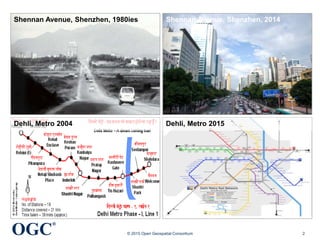
Shennan Avenue, Shenzhen, 1980ies Shennan Avenue, Shenzhen, 2014
Dehli, Metro 2004 Dehli, Metro 2015
OGC
®
© 2015 Open Geospatial Consortium 3
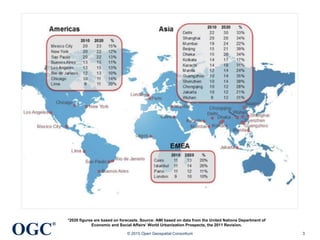
*2020 figures are based on forecasts. Source: AMI based on data from the United Nations Department of
Economic and Social Affairs’ World Urbanization Prospects, the 2011 Revision.
OGC
®
4
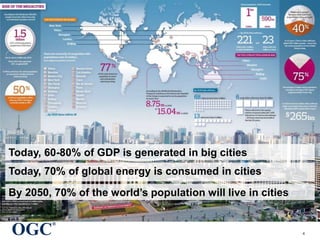
Today, 70% of global energy is consumed in cities
Today, 60-80% of GDP is generated in big cities
By 2050, 70% of the world’s population will live in cities
OGC
®
© 2015 Open Geospatial Consortium 5
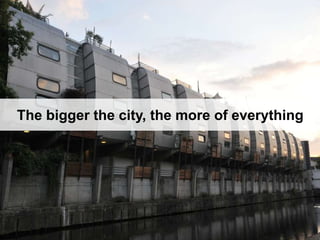
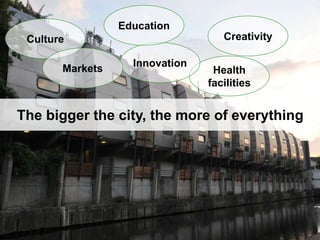
The bigger the city, the more of everything
OGC
®
© 2015 Open Geospatial Consortium 6
The bigger the city, the more of everything
Creativity
Health
facilities
Innovation
Culture
Education
Markets
OGC
®
© 2015 Open Geospatial Consortium 7
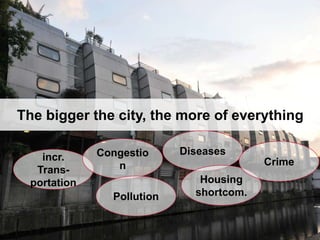
The bigger the city, the more of everything
incr.
Trans-
portation
Congestio
n
Pollution
Diseases
Housing
shortcom.
Crime
OGC
®
© 2015 Open Geospatial Consortium 8
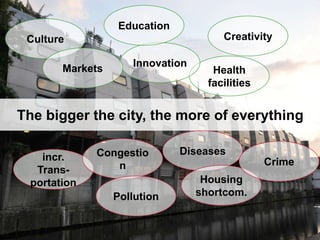
The bigger the city, the more of everything
Creativity
Health
facilities
Innovation
Culture
Education
Markets
incr.
Trans-
portation
Congestio
n
Pollution
Diseases
Housing
shortcom.
Crime
OGC
®
© 2015 Open Geospatial Consortium 9
Science of Cities
OGC
®
© 2015 Open Geospatial Consortium 10
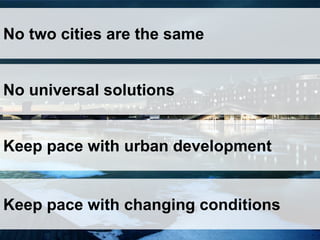
No two cities are the same
No universal solutions
Keep pace with urban development
Keep pace with changing conditions
OGC
®
© 2015 Open Geospatial Consortium 11
OGC
®
© 2015 Open Geospatial Consortium 12
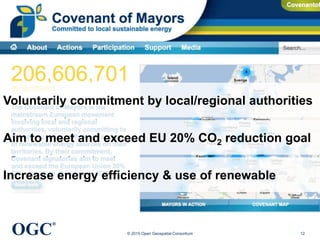
Aim to meet and exceed EU 20% CO2 reduction goal
Increase energy efficiency & use of renewable
Voluntarily commitment by local/regional authorities
OGC
®
© 2015 Open Geospatial Consortium 13
OGC
®
© 2015 Open Geospatial Consortium 14
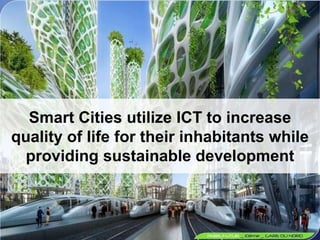
Smart Cities utilize ICT to increase
quality of life for their inhabitants while
providing sustainable development
OGC
®
© 2015 Open Geospatial Consortium 15
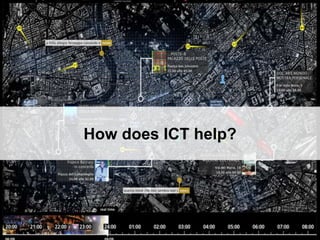
How does ICT help?
OGC
®
© 2015 Open Geospatial Consortium 16
Data is the oil of the 21st century
Neelie Kroes, EU commissioner for digital agenda
OGC
®
© 2015 Open Geospatial Consortium 17
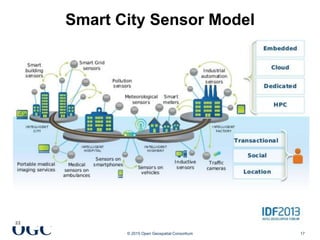
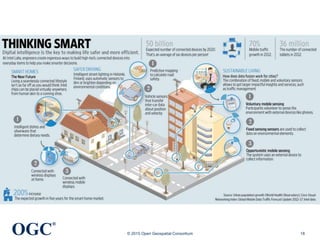
Smart City Sensor Model
OGC
®
© 2015 Open Geospatial Consortium 18
OGC
®
© 2015 Open Geospatial Consortium 19
Consumers & Producers
OGC
®
© 2015 Open Geospatial Consortium
20
OGC
®
© 2015 Open Geospatial Consortium 21
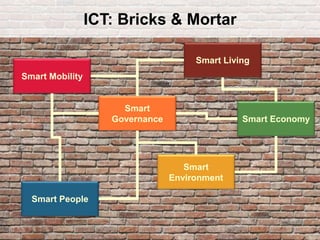
Smart Mobility
Smart
Governance
Smart Living
Smart People
Smart
Environment
Smart Economy
ICT: Bricks & Mortar
OGC
®
© 2015 Open Geospatial Consortium 22
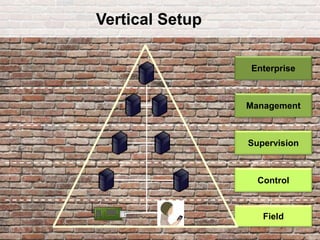
Enterprise
Management
Supervision
Field
Control
Vertical Setup
OGC
®
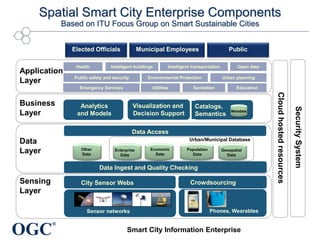
Spatial Smart City Enterprise Components
Based on ITU Focus Group on Smart Sustainable Cities
City Sensor Webs
Sensor networks
Crowdsourcing
Phones, Wearables
Sensing
Layer
Analytics
and Models Metadata
Catalogs,
Semantics
Business
Layer
Visualization and
Decision Support
Population
Data
Data Access
Geospatial
Data
Data
Layer
Data Ingest and Quality Checking
Other
Data
Enterprise
Data
Urban/Municipal Database
Economic
Data
Health
Application
Layer
Intelligent buildings Intelligent transportation Open data
Environmental ProtectionPublic safety and security Urban planning
UtilitiesEmergency Services EducationSanitation
Elected Officials PublicMunicipal Employees
Cloudhostedresources
SecuritySystem
Smart City Information Enterprise
OGC
®
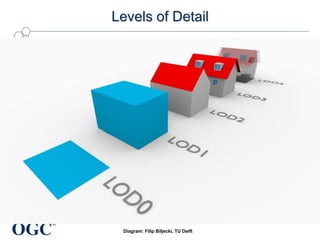
Levels of Detail
Diagram: Filip Biljecki, TU Delft
OGC
®
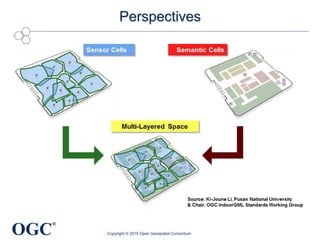
Perspectives
Copyright © 2015 Open Geospatial Consortium
OGC
®
© 2015 Open Geospatial Consortium 26
Science of Cities
OGC
®
© 2015 Open Geospatial Consortium 27
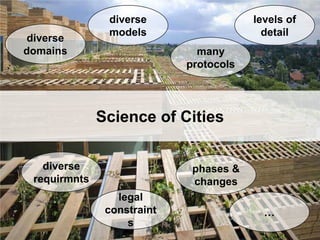
Science of Cities
diverse
domains
levels of
detail
many
protocols
diverse
requirmnts
diverse
models
legal
constraint
s
phases &
changes
…
OGC
®
© 2015 Open Geospatial Consortium 28
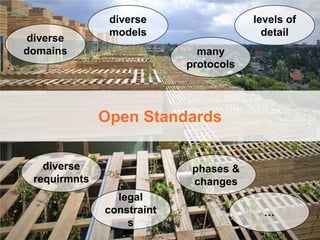
Open Standards
diverse
domains
levels of
detail
many
protocols
diverse
requirmnts
diverse
models
legal
constraint
s
phases &
changes
…
OGC
®
© 2015 Open Geospatial Consortium 29
http://mwpdigitalmedia.com/blog/wp-content/uploads/2015/04/1
Boring…
OGC
®
Benefits: German DIN Study
• Standards promote worldwide trade,
encouraging rationalization, quality assurance
and environmental protection, as well as
improving security and communication.
• Standards have a greater effect on economic
growth than patents or licenses.
• Standards facilitate procurement
• Standards create “Markets”
• "Economic Benefits of Standardization"
• Benefits to German economy of 17 billion Euros in
2010!
(c) 2015 Open Geospatial Consortium
OGC
®
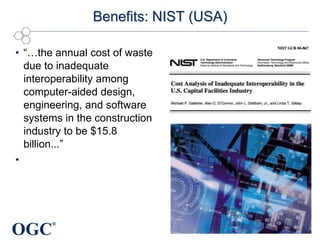
Benefits: NIST (USA)
• “…the annual cost of waste
due to inadequate
interoperability among
computer-aided design,
engineering, and software
systems in the construction
industry to be $15.8
billion...”
•
OGC
®
What is a Standard?
• “An agreed way of doing something”
© 2015 Open Geospatial Consortium
EC: Practical standards guide for researchers - en
OGC
®
What is a Standard?
• “An agreed way of doing something”
• Standards are the distilled wisdom of people with expertise
in their subject matter and who know the needs of the
organizations they represent – people such as
manufacturers, sellers, buyers, customers, trade
associations, users or regulators.
• Standards are knowledge. They are powerful tools that can
help drive innovation and increase productivity. They can
make organizations more successful and people’s
everyday lives easier, safer and healthier.
© 2015 Open Geospatial Consortium
EC: Practical standards guide for researchers - en
OGC
®
Types of standards?
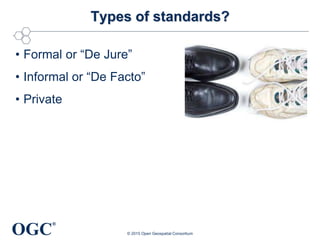
• Formal or “De Jure”
• Informal or “De Facto”
• Private
© 2015 Open Geospatial Consortium
OGC
®
Types of standards?
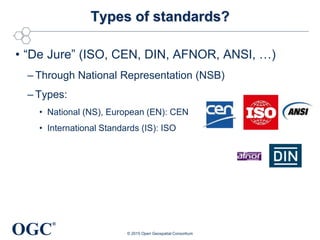
• “De Jure” (ISO, CEN, DIN, AFNOR, ANSI, …)
– Through National Representation (NSB)
– Types:
• National (NS), European (EN): CEN
• International Standards (IS): ISO
© 2015 Open Geospatial Consortium
OGC
®
Types of standards?
• “De Facto” (IEEE, SAE, OGC, OASIS, W3C, …)
– Organisation or individual representation
– Consensus process
– In Technical Committees
© 2015 Open Geospatial Consortium
OGC
®
Types of standards?
• Private
– E.g. ESRI Shape file
• Not based on consensus
© 2015 Open Geospatial Consortium
OGC
®
Types of standards?
• “De Facto ”and “De Jure” work together
– In the Technical Committees
– For OGC, that is ISO/TC211
– (Fast Track Procedure)
© 2015 Open Geospatial Consortium
OGC
®
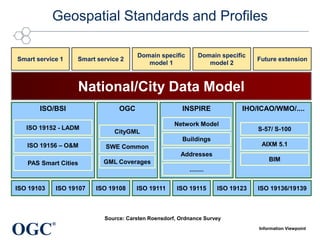
Geospatial Standards and Profiles
ISO/BSI
ISO 19103 ISO 19107 ISO 19108 ISO 19111 ISO 19115 ISO 19123 ISO 19136/19139
ISO 19152 - LADM
ISO 19156 – O&M
PAS Smart Cities
OGC IHO/ICAO/WMO/....INSPIRE
National/City Data Model
Smart service 1 Smart service 2
Domain specific
model 1
Domain specific
model 2
S-57/ S-100
AIXM 5.1
Network Model
Buildings
Addresses
........
CityGML
SWE Common
BIM
Future extension
GML Coverages
Information Viewpoint
Source: Carsten Roensdorf, Ordnance Survey
OGC
®
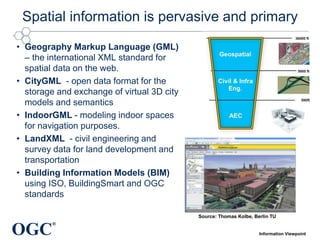
Spatial information is pervasive and primary
• Geography Markup Language (GML)
– the international XML standard for
spatial data on the web.
• CityGML - open data format for the
storage and exchange of virtual 3D city
models and semantics
• IndoorGML - modeling indoor spaces
for navigation purposes.
• LandXML - civil engineering and
survey data for land development and
transportation
• Building Information Models (BIM)
using ISO, BuildingSmart and OGC
standards
Source: Thomas Kolbe, Berlin TU
Information Viewpoint
OGC
®
CityGML Standards Family
• CityGML Standard
– Version 2.0 – current adopted version
– Version 3.0 Standards Working Group underway
• INSPIRE Data Specification on Buildings
– Buildings Theme as in Annex III of the EU INSPIRE Directive
– 3D representations of buildings using CityGML
– Basis of visualization of noise mapping
• National 3D standard in The Netherlands
– OGC Best Practice: CityGML ADE - Dutch 3D Standard
• Additional profiles are underway
– 3D National Data Model for Kingdom of Bahrain
Copyright © 2014 Open Geospatial Consortium
OGC
®
© 2015 Open Geospatial Consortium 42
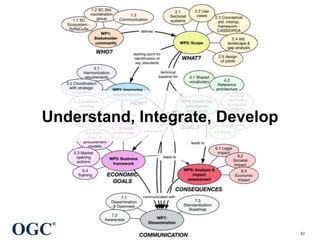
Understand, Integrate, Develop
OGC
®
© 2015 Open Geospatial Consortium 43
OGC
®
© 2015 Open Geospatial Consortium 44
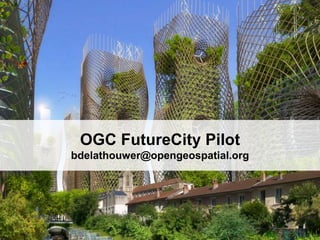
OGC FutureCity Pilot
bdelathouwer@opengeospatial.org
OGC
®
© 2015 Open Geospatial Consortium 45
Ingo Simonis
isimonis @ opengeospatial.org

Open standards: A success factor for smart cities

  • 1.
    ® OGC Open Standards: A SuccessFactor for Smart Cities Dr. Ingo Simonis Director, Interoperability Programs & Science, OGC July 2015 © 2015 Open Geospatial Consortium
  • 2.
    OGC ® © 2015 OpenGeospatial Consortium 2 Shennan Avenue, Shenzhen, 1980ies Shennan Avenue, Shenzhen, 2014 Dehli, Metro 2004 Dehli, Metro 2015
  • 3.
    OGC ® © 2015 OpenGeospatial Consortium 3 *2020 figures are based on forecasts. Source: AMI based on data from the United Nations Department of Economic and Social Affairs’ World Urbanization Prospects, the 2011 Revision.
  • 4.
    OGC ® 4 Today, 70% ofglobal energy is consumed in cities Today, 60-80% of GDP is generated in big cities By 2050, 70% of the world’s population will live in cities
  • 5.
    OGC ® © 2015 OpenGeospatial Consortium 5 The bigger the city, the more of everything
  • 6.
    OGC ® © 2015 OpenGeospatial Consortium 6 The bigger the city, the more of everything Creativity Health facilities Innovation Culture Education Markets
  • 7.
    OGC ® © 2015 OpenGeospatial Consortium 7 The bigger the city, the more of everything incr. Trans- portation Congestio n Pollution Diseases Housing shortcom. Crime
  • 8.
    OGC ® © 2015 OpenGeospatial Consortium 8 The bigger the city, the more of everything Creativity Health facilities Innovation Culture Education Markets incr. Trans- portation Congestio n Pollution Diseases Housing shortcom. Crime
  • 9.
    OGC ® © 2015 OpenGeospatial Consortium 9 Science of Cities
  • 10.
    OGC ® © 2015 OpenGeospatial Consortium 10 No two cities are the same No universal solutions Keep pace with urban development Keep pace with changing conditions
  • 11.
    OGC ® © 2015 OpenGeospatial Consortium 11
  • 12.
    OGC ® © 2015 OpenGeospatial Consortium 12 Aim to meet and exceed EU 20% CO2 reduction goal Increase energy efficiency & use of renewable Voluntarily commitment by local/regional authorities
  • 13.
    OGC ® © 2015 OpenGeospatial Consortium 13
  • 14.
    OGC ® © 2015 OpenGeospatial Consortium 14 Smart Cities utilize ICT to increase quality of life for their inhabitants while providing sustainable development
  • 15.
    OGC ® © 2015 OpenGeospatial Consortium 15 How does ICT help?
  • 16.
    OGC ® © 2015 OpenGeospatial Consortium 16 Data is the oil of the 21st century Neelie Kroes, EU commissioner for digital agenda
  • 17.
    OGC ® © 2015 OpenGeospatial Consortium 17 Smart City Sensor Model
  • 18.
    OGC ® © 2015 OpenGeospatial Consortium 18
  • 19.
    OGC ® © 2015 OpenGeospatial Consortium 19 Consumers & Producers
  • 20.
    OGC ® © 2015 OpenGeospatial Consortium 20
  • 21.
    OGC ® © 2015 OpenGeospatial Consortium 21 Smart Mobility Smart Governance Smart Living Smart People Smart Environment Smart Economy ICT: Bricks & Mortar
  • 22.
    OGC ® © 2015 OpenGeospatial Consortium 22 Enterprise Management Supervision Field Control Vertical Setup
  • 23.
    OGC ® Spatial Smart CityEnterprise Components Based on ITU Focus Group on Smart Sustainable Cities City Sensor Webs Sensor networks Crowdsourcing Phones, Wearables Sensing Layer Analytics and Models Metadata Catalogs, Semantics Business Layer Visualization and Decision Support Population Data Data Access Geospatial Data Data Layer Data Ingest and Quality Checking Other Data Enterprise Data Urban/Municipal Database Economic Data Health Application Layer Intelligent buildings Intelligent transportation Open data Environmental ProtectionPublic safety and security Urban planning UtilitiesEmergency Services EducationSanitation Elected Officials PublicMunicipal Employees Cloudhostedresources SecuritySystem Smart City Information Enterprise
  • 24.
    OGC ® Levels of Detail Diagram:Filip Biljecki, TU Delft
  • 25.
    OGC ® Perspectives Copyright © 2015Open Geospatial Consortium
  • 26.
    OGC ® © 2015 OpenGeospatial Consortium 26 Science of Cities
  • 27.
    OGC ® © 2015 OpenGeospatial Consortium 27 Science of Cities diverse domains levels of detail many protocols diverse requirmnts diverse models legal constraint s phases & changes …
  • 28.
    OGC ® © 2015 OpenGeospatial Consortium 28 Open Standards diverse domains levels of detail many protocols diverse requirmnts diverse models legal constraint s phases & changes …
  • 29.
    OGC ® © 2015 OpenGeospatial Consortium 29 http://mwpdigitalmedia.com/blog/wp-content/uploads/2015/04/1 Boring…
  • 30.
    OGC ® Benefits: German DINStudy • Standards promote worldwide trade, encouraging rationalization, quality assurance and environmental protection, as well as improving security and communication. • Standards have a greater effect on economic growth than patents or licenses. • Standards facilitate procurement • Standards create “Markets” • "Economic Benefits of Standardization" • Benefits to German economy of 17 billion Euros in 2010! (c) 2015 Open Geospatial Consortium
  • 31.
    OGC ® Benefits: NIST (USA) •“…the annual cost of waste due to inadequate interoperability among computer-aided design, engineering, and software systems in the construction industry to be $15.8 billion...” •
  • 32.
    OGC ® What is aStandard? • “An agreed way of doing something” © 2015 Open Geospatial Consortium EC: Practical standards guide for researchers - en
  • 33.
    OGC ® What is aStandard? • “An agreed way of doing something” • Standards are the distilled wisdom of people with expertise in their subject matter and who know the needs of the organizations they represent – people such as manufacturers, sellers, buyers, customers, trade associations, users or regulators. • Standards are knowledge. They are powerful tools that can help drive innovation and increase productivity. They can make organizations more successful and people’s everyday lives easier, safer and healthier. © 2015 Open Geospatial Consortium EC: Practical standards guide for researchers - en
  • 34.
    OGC ® Types of standards? •Formal or “De Jure” • Informal or “De Facto” • Private © 2015 Open Geospatial Consortium
  • 35.
    OGC ® Types of standards? •“De Jure” (ISO, CEN, DIN, AFNOR, ANSI, …) – Through National Representation (NSB) – Types: • National (NS), European (EN): CEN • International Standards (IS): ISO © 2015 Open Geospatial Consortium
  • 36.
    OGC ® Types of standards? •“De Facto” (IEEE, SAE, OGC, OASIS, W3C, …) – Organisation or individual representation – Consensus process – In Technical Committees © 2015 Open Geospatial Consortium
  • 37.
    OGC ® Types of standards? •Private – E.g. ESRI Shape file • Not based on consensus © 2015 Open Geospatial Consortium
  • 38.
    OGC ® Types of standards? •“De Facto ”and “De Jure” work together – In the Technical Committees – For OGC, that is ISO/TC211 – (Fast Track Procedure) © 2015 Open Geospatial Consortium
  • 39.
    OGC ® Geospatial Standards andProfiles ISO/BSI ISO 19103 ISO 19107 ISO 19108 ISO 19111 ISO 19115 ISO 19123 ISO 19136/19139 ISO 19152 - LADM ISO 19156 – O&M PAS Smart Cities OGC IHO/ICAO/WMO/....INSPIRE National/City Data Model Smart service 1 Smart service 2 Domain specific model 1 Domain specific model 2 S-57/ S-100 AIXM 5.1 Network Model Buildings Addresses ........ CityGML SWE Common BIM Future extension GML Coverages Information Viewpoint Source: Carsten Roensdorf, Ordnance Survey
  • 40.
    OGC ® Spatial information ispervasive and primary • Geography Markup Language (GML) – the international XML standard for spatial data on the web. • CityGML - open data format for the storage and exchange of virtual 3D city models and semantics • IndoorGML - modeling indoor spaces for navigation purposes. • LandXML - civil engineering and survey data for land development and transportation • Building Information Models (BIM) using ISO, BuildingSmart and OGC standards Source: Thomas Kolbe, Berlin TU Information Viewpoint
  • 41.
    OGC ® CityGML Standards Family •CityGML Standard – Version 2.0 – current adopted version – Version 3.0 Standards Working Group underway • INSPIRE Data Specification on Buildings – Buildings Theme as in Annex III of the EU INSPIRE Directive – 3D representations of buildings using CityGML – Basis of visualization of noise mapping • National 3D standard in The Netherlands – OGC Best Practice: CityGML ADE - Dutch 3D Standard • Additional profiles are underway – 3D National Data Model for Kingdom of Bahrain Copyright © 2014 Open Geospatial Consortium
  • 42.
    OGC ® © 2015 OpenGeospatial Consortium 42 Understand, Integrate, Develop
  • 43.
    OGC ® © 2015 OpenGeospatial Consortium 43
  • 44.
    OGC ® © 2015 OpenGeospatial Consortium 44 OGC FutureCity Pilot bdelathouwer@opengeospatial.org
  • 45.
    OGC ® © 2015 OpenGeospatial Consortium 45 Ingo Simonis isimonis @ opengeospatial.org