1
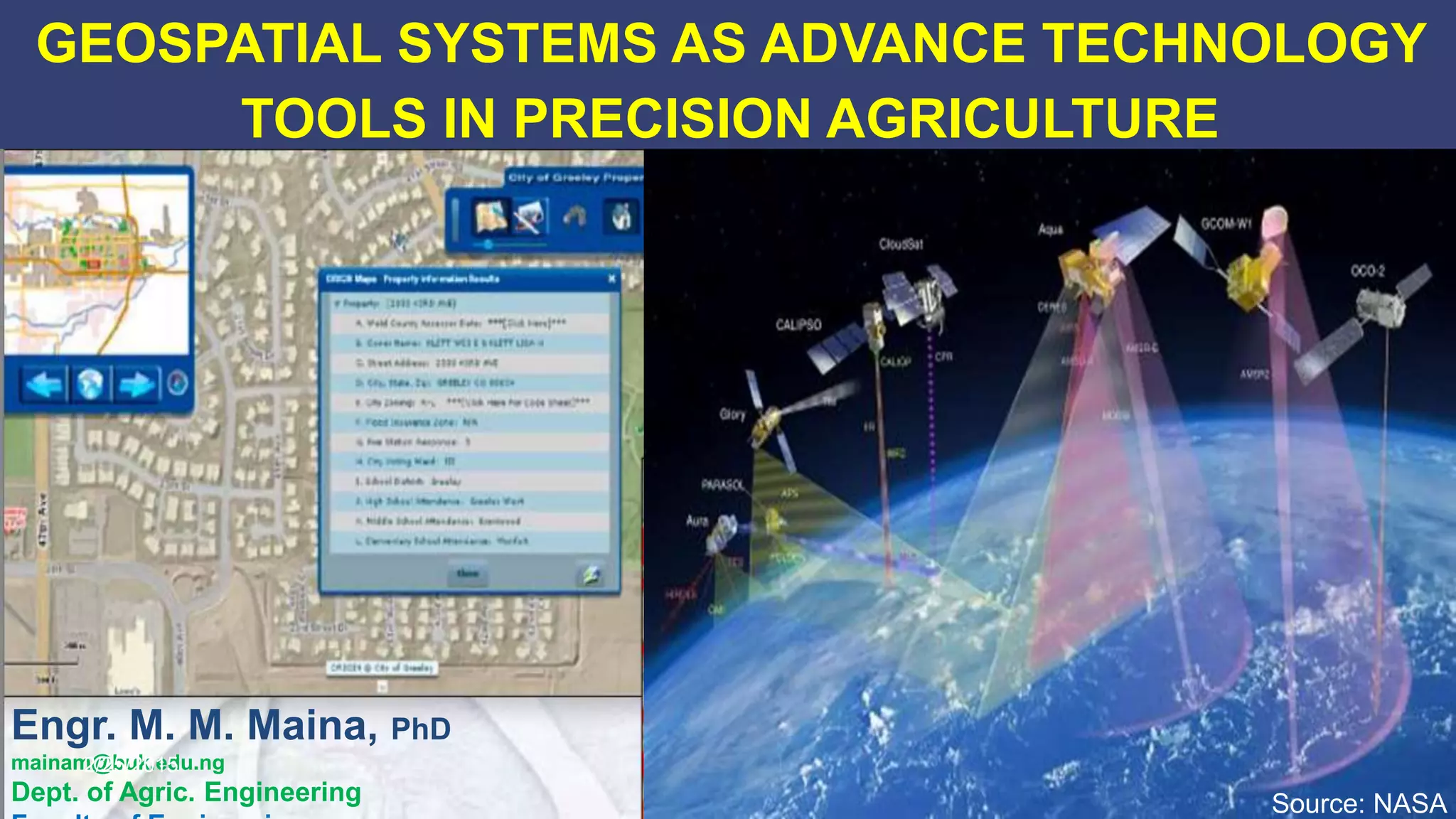
GEOSPATIAL SYSTEMS AS ADVANCE TECHNOLOGY
TOOLS IN PRECISION AGRICULTURE
Engr. M. M. Maina, PhD
mainam@buk.edu.ng
Dept. of Agric. Engineering Source: NASA
2/25/2015
Presentation outlines
 Precision Agriculture
 Global Positioning System (GPS).
 Geographical Information Systems (GIS)
 Basic Concepts of Remote Sensing (RS)
 Software
 Conclusion
2/25/2015 2
3
Precision
Agriculture
2/25/2015
4
PRECISION AGRICULTURE
 Precision farming is an integrated agricultural management system incorporating
several technologies. Precision farming is defined as information and technology
based farming management system to identify, analyze, and manage variability
within fields for optimum profitability, sustainability and protection of land resources.
 Precision farming is geared toward increased productivity in the face of variability
found within the fields. It is not aimed at obtaining same yield everywhere rather
same input on site specific that can guarantee long term benefit/cost ratio..
 The concept of “doing the right thing in the right place at the right time” has a strong
intuitive appeal which gives farmers the ability to use all operations and crop inputs
more effectively.
2/25/2015
PRECISION AGRICULTURE
5
 Precision Agriculture (PA), precision farming (PF), or site
specific management (SSM) as a management technique for
sustainability in production agriculture.
 The aim of PF is to apply the right input in the right place at
the right time and in the right amount.
2/25/2015
6
The technological tools often include:
 Global positioning system, Remote Sensing
 Geographic information system,
 Yield monitor,
 Variable rate technology.
The variable rate applicator has; a. Control computer, b. Locator and
c. Actuator
The application map is loaded into a computer mounted on a variable-rate
applicator. The computer uses the application map and a GPS receiver to direct a
product-delivery controller that changes the amount and/or kind of product
according to the application map.
PRECISION AGRICULTURE CONTD.
2/25/2015
7
 Precision agriculture can address both economic and environmental
issues that surround production agriculture today.
 Future satellites will have better spatial and spectral resolutions.
Launching more satellites will also improve temporal resolution;
hence the delivery time of remote sensing data to the customer will
improve.
 Even third world will begin to fully practice precision agriculture
Future of precision Agriculture
2/25/2015
82/25/2015
What is GPS?
GPS, which stands for Global Positioning System, is the
only system today able to show exact position on the Earth
surface anytime, under any weather, anywhere.
The three parts of GPS are:
•Satellites
•Receivers
•Software
2/25/2015 9
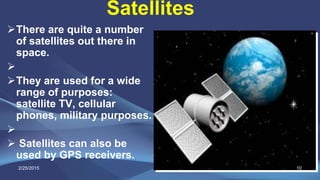
Satellites
There are quite a number
of satellites out there in
space.

They are used for a wide
range of purposes:
satellite TV, cellular
phones, military purposes.

 Satellites can also be
used by GPS receivers.
2/25/2015 10
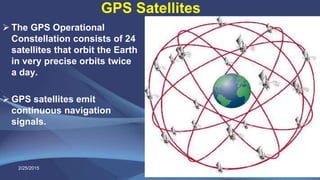
GPS Satellites
 The GPS Operational
Constellation consists of 24
satellites that orbit the Earth
in very precise orbits twice
a day.
 GPS satellites emit
continuous navigation
signals.
2/25/2015 11
Characteristics of GPS
• Free
• Precise
• Reliable
• Anytime & anywhere
• All weather
• Unlimited user capacity
2/25/2015 12
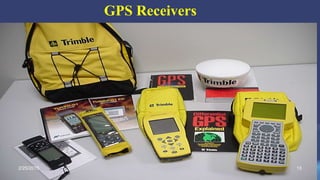
GPS Receivers
2/25/2015 13
142/25/2015
GPS Data Format
The most current geodetic datum used for GPS is the World
Geodetic System of 1984 (WGS84).

All GPS receivers export data in decimal degrees, WGS84
2/25/2015 15
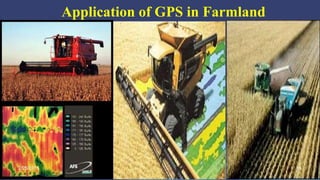
Application of GPS in Farmland
2/25/2015 16
172/25/2015
18
GIS
 Geographic Information System (GIS) is a computer
system for capturing, storing, querying, analyzing, and
displaying geospatial data.
 Geospatial technology is listed by the U.S. Department of
Labor (2012) as one of the three emerging industries,
along with nanotechnology and biotechnology.
2/25/2015
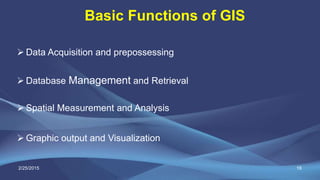
Basic Functions of GIS
19
 Data Acquisition and prepossessing
 Database Management and Retrieval
 Spatial Measurement and Analysis
 Graphic output and Visualization
2/25/2015
20
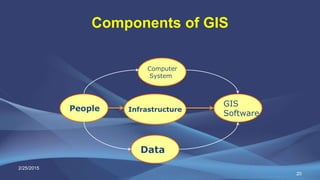
Components of GIS
People
GIS
Software
Infrastructure
Data
Computer
System
2/25/2015
21
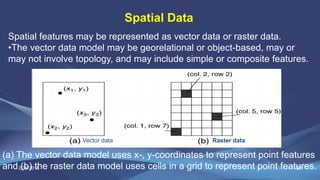
Spatial features may be represented as vector data or raster data.
•The vector data model may be georelational or object-based, may or
may not involve topology, and may include simple or composite features.
Spatial Data
Vector data Raster data
(a) The vector data model uses x-, y-coordinates to represent point features
and (b) the raster data model uses cells in a grid to represent point features.2/25/2015
22
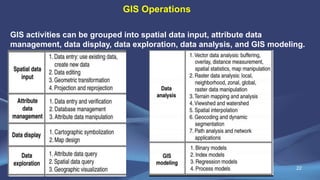
GIS activities can be grouped into spatial data input, attribute data
management, data display, data exploration, data analysis, and GIS modeling.
GIS Operations
2/25/2015
23
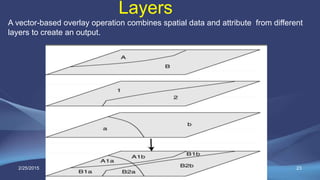
A vector-based overlay operation combines spatial data and attribute from different
layers to create an output.
Layers
2/25/2015
24
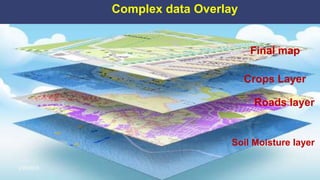
Complex data Overlay
Soil Moisture layer
Crops Layer
Roads layer
Final map
2/25/2015
25
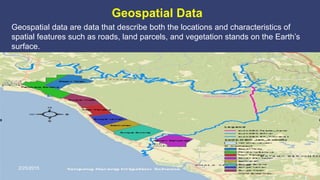
Geospatial data are data that describe both the locations and characteristics of
spatial features such as roads, land parcels, and vegetation stands on the Earth’s
surface.
Geospatial Data
2/25/2015
26
• Geospatial data are better maintained in a standard format.
• Revision and updating are easier.
• Geospatial data and information are easier to search,
analysis and represent.
• More value added product.
• Geospatial data can be shared and exchanged freely.
• Productivity of the staff improved and more efficient.
• Time and money are saved.
• Better decision can be made.
Benefits of GIS
2/25/2015
27
REMOTE
SENSING
2/25/2015
28
 It is the collection of data from a distance without necessary coming in
contact with the surface.
 Data sensors can simply be hand held devices, airborne or spaceborne.
 Plant stress related to moisture, nutrients, compaction, crop diseases and
other plant health concerns are often easily detected in overhead images.

 Remote sensing can reveal in-season variability that affects crop yield,
and can be timely enough to make management decisions that improve
profitability for such crop.
Remote Sensing (RS)
2/25/2015
29
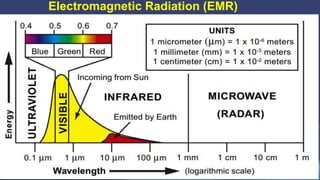
Electromagnetic Radiation (EMR)
2/25/2015
Elements of Remote Sensing
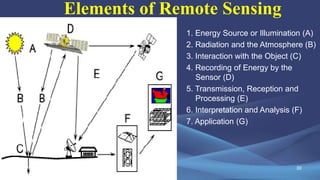
1. Energy Source or Illumination (A)
2. Radiation and the Atmosphere (B)
3. Interaction with the Object (C)
4. Recording of Energy by the
Sensor (D)
5. Transmission, Reception and
Processing (E)
6. Interpretation and Analysis (F)
7. Application (G)
2/25/2015 30
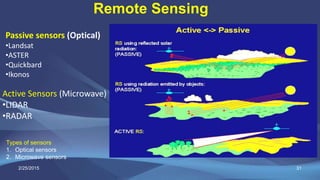
31
Remote Sensing
Types of sensors
1. Optical sensors
2. Microwave sensors
Passive sensors (Optical)
•Landsat
•ASTER
•Quickbard
•Ikonos
Active Sensors (Microwave)
•LIDAR
•RADAR
2/25/2015
322/25/2015
33
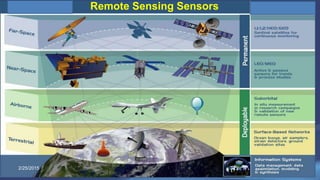
Remote Sensing Sensors
2/25/2015
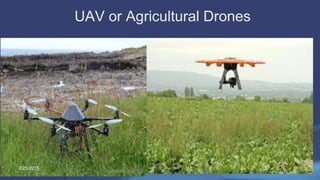
UAV or Agricultural Drones
342/25/2015
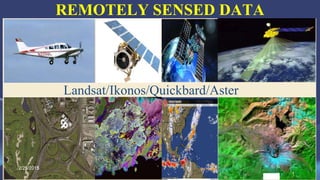
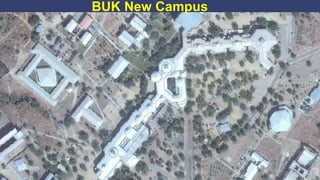
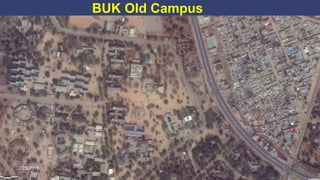
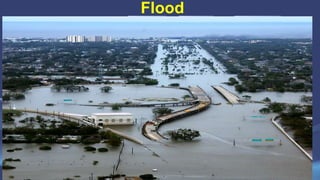
REMOTELY SENSED DATA
Landsat/Ikonos/Quickbard/Aster
352/25/2015
36
BUK New Campus
2/25/2015
37
BUK Old Campus
2/25/2015
2/25/2015 38
Flood
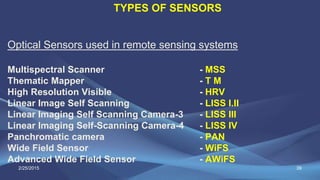
Optical Sensors used in remote sensing systems
Multispectral Scanner - MSS
Thematic Mapper - T M
High Resolution Visible - HRV
Linear Image Self Scanning - LISS I.II
Linear Imaging Self Scanning Camera-3 - LISS III
Linear Imaging Self-Scanning Camera-4 - LISS IV
Panchromatic camera - PAN
Wide Field Sensor - WiFS
Advanced Wide Field Sensor - AWiFS
TYPES OF SENSORS
2/25/2015 39
1 LANDSAT Series
2. MODIS ,ASTER
3 SPOT Series
4. IRS Series
5. IKONOS
6. LIDAR
7. RADAR
8. SRTM
SATELLITE TYPES
2/25/2015 40
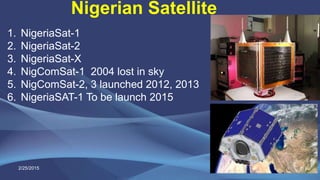
Nigerian Satellite
41
1. NigeriaSat-1
2. NigeriaSat-2
3. NigeriaSat-X
4. NigComSat-1 2004 lost in sky
5. NigComSat-2, 3 launched 2012, 2013
6. NigeriaSAT-1 To be launch 2015
2/25/2015
Software
422/25/2015
GIS and Image Processing Software
43
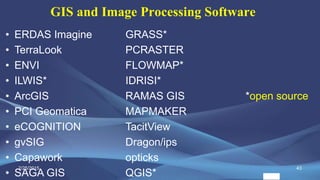
• ERDAS Imagine GRASS*
• TerraLook PCRASTER
• ENVI FLOWMAP*
• ILWIS* IDRISI*
• ArcGIS RAMAS GIS *open source
• PCI Geomatica MAPMAKER
• eCOGNITION TacitView
• gvSIG Dragon/ips
• Capawork opticks
• SAGA GIS QGIS*
2/25/2015
442/25/2015
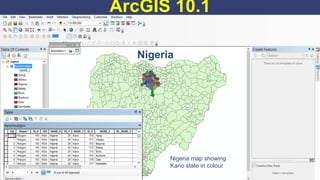
ArcGIS 10.1
45
Nigeria
Nigeria map showing
Kano state in colour2/25/2015
Roles Geospatial Technology in Agriculture
The significance of geospatial technology in agriculture lies to
the fact that agriculture is spatial in nature.
GIS can store information in the form of layers such as soil
nutrient level, yield map, soil moisture content,
Evapotranspiration etc.
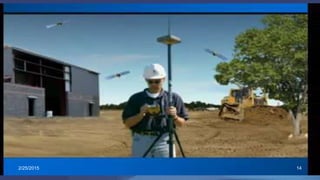
GPS can be used in farm machinery automation and
unmanned farm vehicles.
462/25/2015
Remote sensing keep tract of mapping and monitoring large
farms These include; current extent of crops, disease
infestation, crop stage of growth, soil degradation, irrigated
area, yield prediction etc.
Retrieval of information through spectral emittance.
Decision Support; using the information retrieved critical
decision can be taken to solve immediate problems.
472/25/2015
Challenges
How skilled are the farmers to take advantage of gamut of
technologies that comes their way?
At the fore front of these challenges are the reputation of
farmers that geospatial systems are difficult to learn.
That is hard to process data to make meaning out of it.
Academicians in third world countries on geospatial systems
are adamant to address their immediate problem of
environment.
482/25/2015
49
 There is phobia of using anything to do with computer,
satellite etc., this is not only to farmers but even
among academics.
 Therefore there is need to train and retrain all
stakeholders in geospatial systems to be able to make
use of the abundant and free satellite data online for
sustainable agricultural development and other
environmental issues.
2/25/2015
502/25/2015

Geospatial systems for advance tools in precision agriculture

  • 1.
    1 GEOSPATIAL SYSTEMS ASADVANCE TECHNOLOGY TOOLS IN PRECISION AGRICULTURE Engr. M. M. Maina, PhD mainam@buk.edu.ng Dept. of Agric. Engineering Source: NASA 2/25/2015
  • 2.
    Presentation outlines  PrecisionAgriculture  Global Positioning System (GPS).  Geographical Information Systems (GIS)  Basic Concepts of Remote Sensing (RS)  Software  Conclusion 2/25/2015 2
  • 3.
  • 4.
    4 PRECISION AGRICULTURE  Precisionfarming is an integrated agricultural management system incorporating several technologies. Precision farming is defined as information and technology based farming management system to identify, analyze, and manage variability within fields for optimum profitability, sustainability and protection of land resources.  Precision farming is geared toward increased productivity in the face of variability found within the fields. It is not aimed at obtaining same yield everywhere rather same input on site specific that can guarantee long term benefit/cost ratio..  The concept of “doing the right thing in the right place at the right time” has a strong intuitive appeal which gives farmers the ability to use all operations and crop inputs more effectively. 2/25/2015
  • 5.
    PRECISION AGRICULTURE 5  PrecisionAgriculture (PA), precision farming (PF), or site specific management (SSM) as a management technique for sustainability in production agriculture.  The aim of PF is to apply the right input in the right place at the right time and in the right amount. 2/25/2015
  • 6.
    6 The technological toolsoften include:  Global positioning system, Remote Sensing  Geographic information system,  Yield monitor,  Variable rate technology. The variable rate applicator has; a. Control computer, b. Locator and c. Actuator The application map is loaded into a computer mounted on a variable-rate applicator. The computer uses the application map and a GPS receiver to direct a product-delivery controller that changes the amount and/or kind of product according to the application map. PRECISION AGRICULTURE CONTD. 2/25/2015
  • 7.
    7  Precision agriculturecan address both economic and environmental issues that surround production agriculture today.  Future satellites will have better spatial and spectral resolutions. Launching more satellites will also improve temporal resolution; hence the delivery time of remote sensing data to the customer will improve.  Even third world will begin to fully practice precision agriculture Future of precision Agriculture 2/25/2015
  • 8.
  • 9.
    What is GPS? GPS,which stands for Global Positioning System, is the only system today able to show exact position on the Earth surface anytime, under any weather, anywhere. The three parts of GPS are: •Satellites •Receivers •Software 2/25/2015 9
  • 10.
    Satellites There are quitea number of satellites out there in space.  They are used for a wide range of purposes: satellite TV, cellular phones, military purposes.   Satellites can also be used by GPS receivers. 2/25/2015 10
  • 11.
    GPS Satellites  TheGPS Operational Constellation consists of 24 satellites that orbit the Earth in very precise orbits twice a day.  GPS satellites emit continuous navigation signals. 2/25/2015 11
  • 12.
    Characteristics of GPS •Free • Precise • Reliable • Anytime & anywhere • All weather • Unlimited user capacity 2/25/2015 12
  • 13.
  • 14.
  • 15.
    GPS Data Format Themost current geodetic datum used for GPS is the World Geodetic System of 1984 (WGS84).  All GPS receivers export data in decimal degrees, WGS84 2/25/2015 15
  • 16.
    Application of GPSin Farmland 2/25/2015 16
  • 17.
  • 18.
    18 GIS  Geographic InformationSystem (GIS) is a computer system for capturing, storing, querying, analyzing, and displaying geospatial data.  Geospatial technology is listed by the U.S. Department of Labor (2012) as one of the three emerging industries, along with nanotechnology and biotechnology. 2/25/2015
  • 19.
    Basic Functions ofGIS 19  Data Acquisition and prepossessing  Database Management and Retrieval  Spatial Measurement and Analysis  Graphic output and Visualization 2/25/2015
  • 20.
  • 21.
    21 Spatial features maybe represented as vector data or raster data. •The vector data model may be georelational or object-based, may or may not involve topology, and may include simple or composite features. Spatial Data Vector data Raster data (a) The vector data model uses x-, y-coordinates to represent point features and (b) the raster data model uses cells in a grid to represent point features.2/25/2015
  • 22.
    22 GIS activities canbe grouped into spatial data input, attribute data management, data display, data exploration, data analysis, and GIS modeling. GIS Operations 2/25/2015
  • 23.
    23 A vector-based overlayoperation combines spatial data and attribute from different layers to create an output. Layers 2/25/2015
  • 24.
    24 Complex data Overlay SoilMoisture layer Crops Layer Roads layer Final map 2/25/2015
  • 25.
    25 Geospatial data aredata that describe both the locations and characteristics of spatial features such as roads, land parcels, and vegetation stands on the Earth’s surface. Geospatial Data 2/25/2015
  • 26.
    26 • Geospatial dataare better maintained in a standard format. • Revision and updating are easier. • Geospatial data and information are easier to search, analysis and represent. • More value added product. • Geospatial data can be shared and exchanged freely. • Productivity of the staff improved and more efficient. • Time and money are saved. • Better decision can be made. Benefits of GIS 2/25/2015
  • 27.
  • 28.
    28  It isthe collection of data from a distance without necessary coming in contact with the surface.  Data sensors can simply be hand held devices, airborne or spaceborne.  Plant stress related to moisture, nutrients, compaction, crop diseases and other plant health concerns are often easily detected in overhead images.   Remote sensing can reveal in-season variability that affects crop yield, and can be timely enough to make management decisions that improve profitability for such crop. Remote Sensing (RS) 2/25/2015
  • 29.
  • 30.
    Elements of RemoteSensing 1. Energy Source or Illumination (A) 2. Radiation and the Atmosphere (B) 3. Interaction with the Object (C) 4. Recording of Energy by the Sensor (D) 5. Transmission, Reception and Processing (E) 6. Interpretation and Analysis (F) 7. Application (G) 2/25/2015 30
  • 31.
    31 Remote Sensing Types ofsensors 1. Optical sensors 2. Microwave sensors Passive sensors (Optical) •Landsat •ASTER •Quickbard •Ikonos Active Sensors (Microwave) •LIDAR •RADAR 2/25/2015
  • 32.
  • 33.
  • 34.
    UAV or AgriculturalDrones 342/25/2015
  • 35.
  • 36.
  • 37.
  • 38.
  • 39.
    Optical Sensors usedin remote sensing systems Multispectral Scanner - MSS Thematic Mapper - T M High Resolution Visible - HRV Linear Image Self Scanning - LISS I.II Linear Imaging Self Scanning Camera-3 - LISS III Linear Imaging Self-Scanning Camera-4 - LISS IV Panchromatic camera - PAN Wide Field Sensor - WiFS Advanced Wide Field Sensor - AWiFS TYPES OF SENSORS 2/25/2015 39
  • 40.
    1 LANDSAT Series 2.MODIS ,ASTER 3 SPOT Series 4. IRS Series 5. IKONOS 6. LIDAR 7. RADAR 8. SRTM SATELLITE TYPES 2/25/2015 40
  • 41.
    Nigerian Satellite 41 1. NigeriaSat-1 2.NigeriaSat-2 3. NigeriaSat-X 4. NigComSat-1 2004 lost in sky 5. NigComSat-2, 3 launched 2012, 2013 6. NigeriaSAT-1 To be launch 2015 2/25/2015
  • 42.
  • 43.
    GIS and ImageProcessing Software 43 • ERDAS Imagine GRASS* • TerraLook PCRASTER • ENVI FLOWMAP* • ILWIS* IDRISI* • ArcGIS RAMAS GIS *open source • PCI Geomatica MAPMAKER • eCOGNITION TacitView • gvSIG Dragon/ips • Capawork opticks • SAGA GIS QGIS* 2/25/2015
  • 44.
  • 45.
    ArcGIS 10.1 45 Nigeria Nigeria mapshowing Kano state in colour2/25/2015
  • 46.
    Roles Geospatial Technologyin Agriculture The significance of geospatial technology in agriculture lies to the fact that agriculture is spatial in nature. GIS can store information in the form of layers such as soil nutrient level, yield map, soil moisture content, Evapotranspiration etc. GPS can be used in farm machinery automation and unmanned farm vehicles. 462/25/2015
  • 47.
    Remote sensing keeptract of mapping and monitoring large farms These include; current extent of crops, disease infestation, crop stage of growth, soil degradation, irrigated area, yield prediction etc. Retrieval of information through spectral emittance. Decision Support; using the information retrieved critical decision can be taken to solve immediate problems. 472/25/2015
  • 48.
    Challenges How skilled arethe farmers to take advantage of gamut of technologies that comes their way? At the fore front of these challenges are the reputation of farmers that geospatial systems are difficult to learn. That is hard to process data to make meaning out of it. Academicians in third world countries on geospatial systems are adamant to address their immediate problem of environment. 482/25/2015
  • 49.
    49  There isphobia of using anything to do with computer, satellite etc., this is not only to farmers but even among academics.  Therefore there is need to train and retrain all stakeholders in geospatial systems to be able to make use of the abundant and free satellite data online for sustainable agricultural development and other environmental issues. 2/25/2015
  • 50.