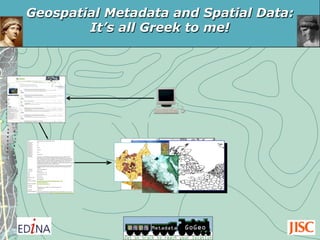
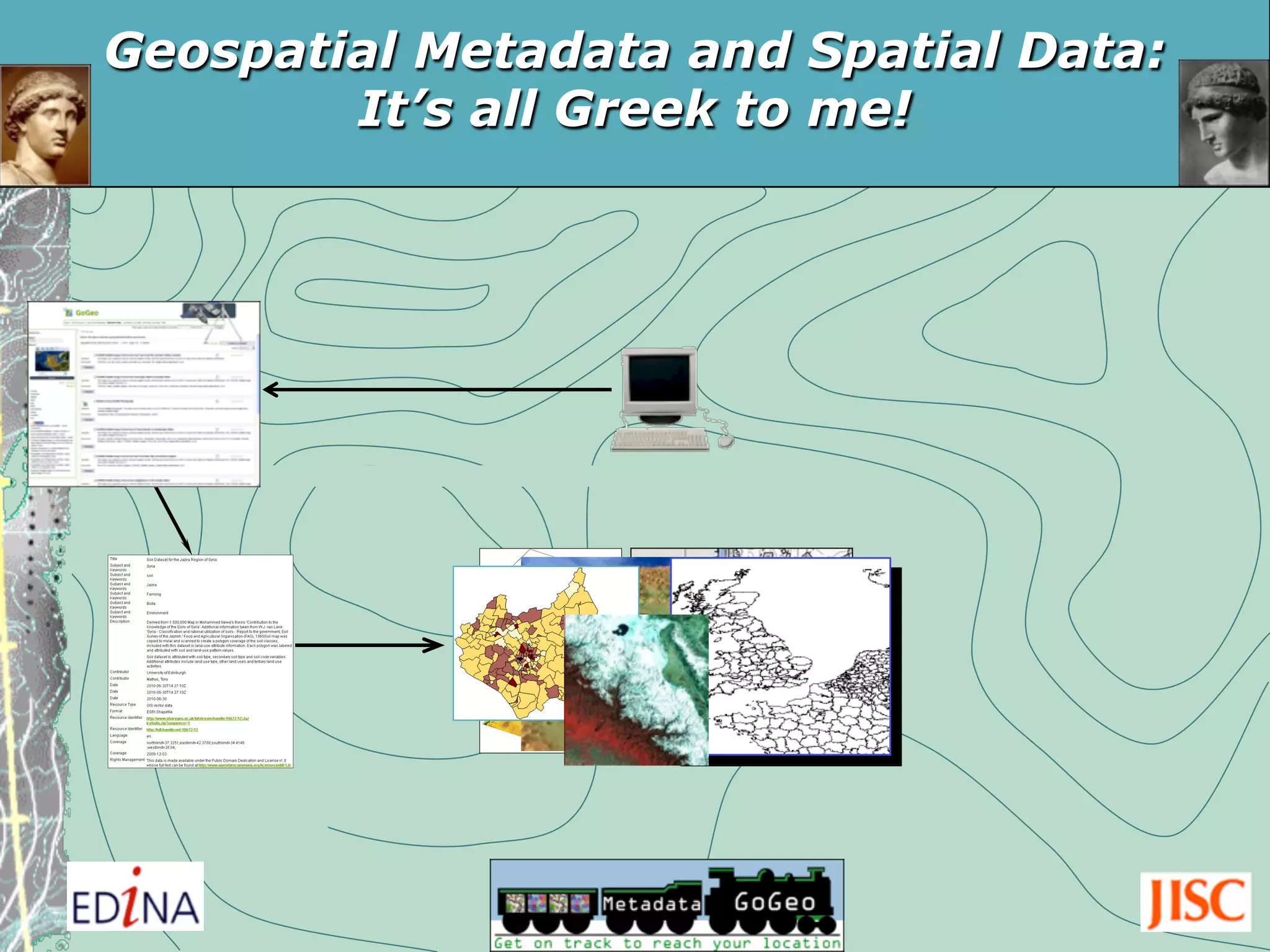

Geospatial Metadata and Spatial Data:
It’s all Greek to me!
Programme
PRESENTATION SESSION:
Ø  Background information
Ø  Metadata, standards and application profiles (ISO 19115,
INSPIRE, UK GEMINI 2.1)
Ø  UK Academic Geospatial Metadata Application Profile, Version 2.1
(UK AGMAP 2.1) and guidelines
Ø  GoGeo portal and Geodoc Metadata Editor tool
Ø  ShareGeo spatial data repositories
REFRESHMENTS (15 minute break)
HANDS-ON SESSION:
Ø  Geodoc Metadata Editor tool, GoGeo portal and ShareGeo Open
spatial data repository
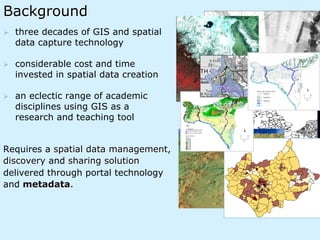
Background
Ø  three decades of GIS and spatial
data capture technology
Ø  considerable cost and time
invested in spatial data creation
Ø  an eclectic range of academic
disciplines using GIS as a
research and teaching tool
Requires a spatial data management,
discovery and sharing solution
delivered through portal technology
and metadata.
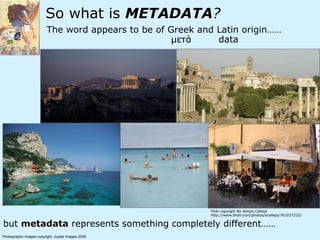
So what is METADATA?
The word appears to be of Greek and Latin origin……
but metadata represents something completely different……
Photographic Images copyright: Jupiter Images 2006
µετά data
Flickr copyright: By Sergio Calleja
http://www.flickr.com/photos/scalleja/761037232/
Photographic Images copyright: Jupiter Images 2006 and it’s not sun and holiday
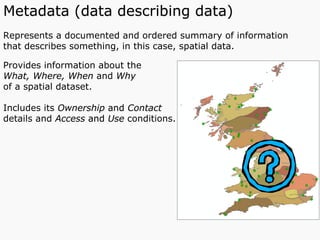
Represents a documented and ordered summary of information
that describes something, in this case, spatial data.
Provides information about the
What, Where, When and Why
of a spatial dataset.
Includes its Ownership and Contact
details and Access and Use conditions.
Metadata (data describing data)
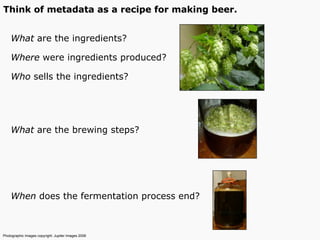
What are the ingredients?
Where were ingredients produced?
Who sells the ingredients?
What are the brewing steps?
When does the fermentation process end?
Photographic Images copyright: Jupiter Images 2006
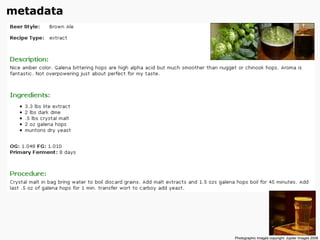
Think of metadata as a recipe for making beer.
metadata
Photographic Images copyright: Jupiter Images 2006
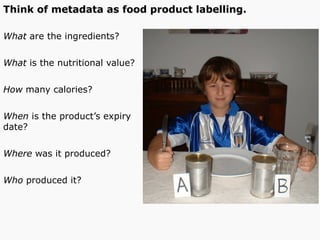
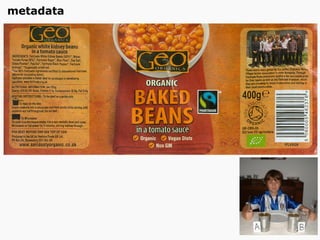
Think of metadata as food product labelling.
What are the ingredients?
What is the nutritional value?
How many calories?
When is the product’s expiry
date?
Where was it produced?
Who produced it?
metadata
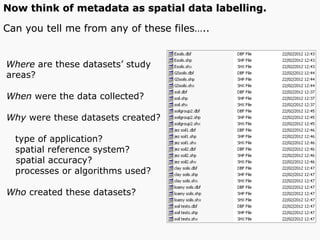
Where are these datasets’ study
areas?
When were the data collected?
Why were these datasets created?
type of application?
spatial reference system?
spatial accuracy?
processes or algorithms used?
Who created these datasets?
Can you tell me from any of these files…..
Now think of metadata as spatial data labelling.
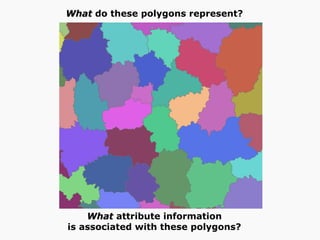
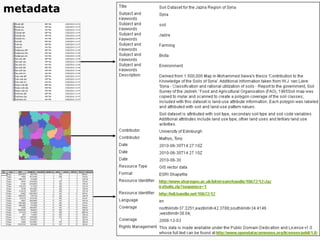
What do these polygons represent?
What attribute information
is associated with these polygons?
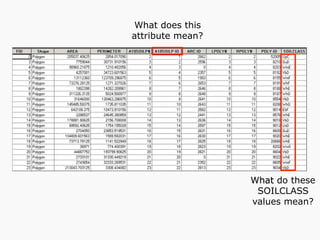
What do these
SOILCLASS
values mean?
What does this
attribute mean?
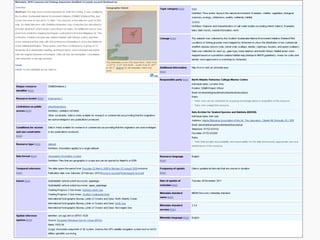
metadata
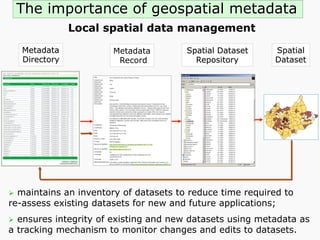
The importance of geospatial metadata
Local spatial data management
Metadata
Record
Spatial Dataset
Repository
Spatial
Dataset
Metadata
Directory
Ø  maintains an inventory of datasets to reduce time required to
re-assess existing datasets for new and future applications;
Ø  ensures integrity of existing and new datasets using metadata as
a tracking mechanism to monitor changes and edits to datasets.
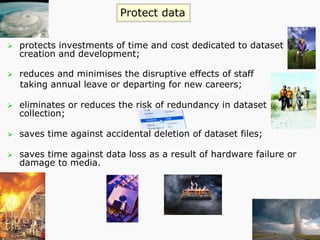
Ø  protects investments of time and cost dedicated to dataset
creation and development;
Ø  reduces and minimises the disruptive effects of staff
taking annual leave or departing for new careers;
Ø  eliminates or reduces the risk of redundancy in dataset
collection;
Ø  saves time against accidental deletion of dataset files;
Ø  saves time against data loss as a result of hardware failure or
damage to media.
Protect data
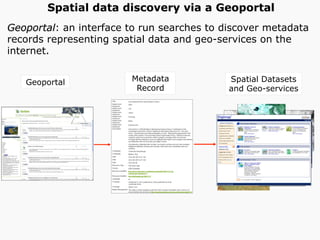
Geoportal: an interface to run searches to discover metadata
records representing spatial data and geo-services on the
internet.
Geoportal Metadata
Record
Spatial Datasets
and Geo-services
Spatial data discovery via a Geoportal
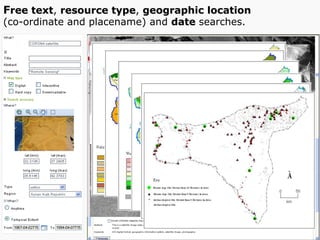
Free text, resource type, geographic location
(co-ordinate and placename) and date searches.
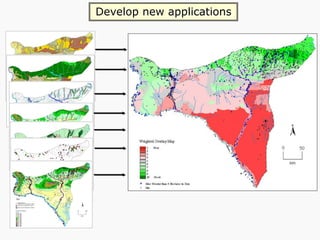
Develop new applications
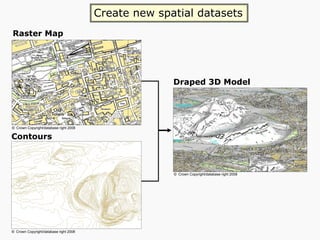
Contours
Raster Map
Draped 3D Model
Create new spatial datasets
© Crown Copyright/database right 2008
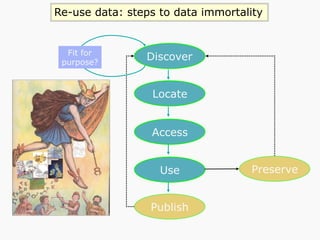
Discover
Locate
Access
Use
Publish
Fit for
purpose?
Preserve
Re-use data: steps to data immortality
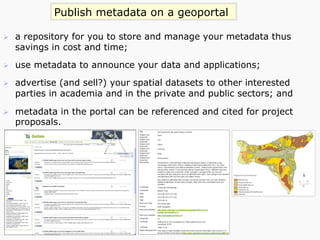
Publish metadata on a geoportal
Ø  a repository for you to store and manage your metadata thus
savings in cost and time;
Ø  use metadata to announce your data and applications;
Ø  advertise (and sell?) your spatial datasets to other interested
parties in academia and in the private and public sectors; and
Ø  metadata in the portal can be referenced and cited for project
proposals.
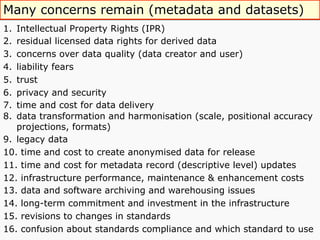
1.  Intellectual Property Rights (IPR)
2.  residual licensed data rights for derived data
3.  concerns over data quality (data creator and user)
4.  liability fears
5.  trust
6.  privacy and security
7.  time and cost for data delivery
8.  data transformation and harmonisation (scale, positional accuracy
projections, formats)
9.  legacy data
10.  time and cost to create anonymised data for release
11.  time and cost for metadata record (descriptive level) updates
12.  infrastructure performance, maintenance & enhancement costs
13.  data and software archiving and warehousing issues
14.  long-term commitment and investment in the infrastructure
15.  revisions to changes in standards
16.  confusion about standards compliance and which standard to use
Many concerns remain (metadata and datasets)
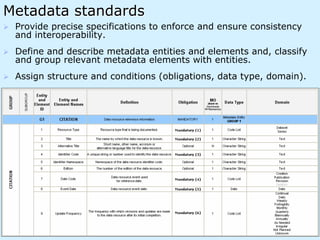
Metadata standards
Ø  Provide precise specifications to enforce and ensure consistency
and interoperability.
Ø  Define and describe metadata entities and elements and, classify
and group relevant metadata elements with entities.
Ø  Assign structure and conditions (obligations, data type, domain).
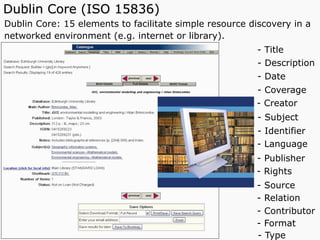
Dublin Core (ISO 15836)
Dublin Core: 15 elements to facilitate simple resource discovery in a
networked environment (e.g. internet or library).
T
Photographic Images copyright: Jupiter Images 2006
- Contributor
- Title
- Date
- Description
- Format
- Identifier
- Language
- Publisher
- Rights
- Source
- Subject
- Relation
- Coverage
- Creator
- Type
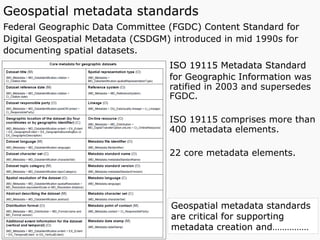
Geospatial metadata standards
Federal Geographic Data Committee (FGDC) Content Standard for
Digital Geospatial Metadata (CSDGM) introduced in mid 1990s for
documenting spatial datasets.
Geospatial metadata standards
are critical for supporting
metadata creation and……………
ISO 19115 Metadata Standard
for Geographic Information was
ratified in 2003 and supersedes
FGDC.
ISO 19115 comprises more than
400 metadata elements.
22 core metadata elements.
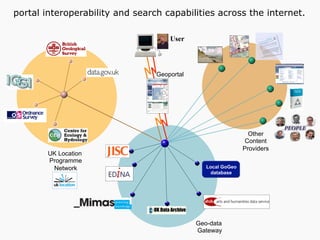
Other
Content
Providers
UK Location
Programme
Network
Geo-data
Gateway
Local GoGeo
database
Geoportal
portal interoperability and search capabilities across the internet.
User
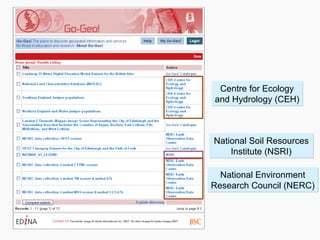
Centre for Ecology
and Hydrology (CEH)
National Environment
Research Council (NERC)
National Soil Resources
Institute (NSRI)
Derived from a geospatial standard and represents a reduction of the
number of entities and elements.
* It should include the core (mandatory) element set of a standard to
support interoperability across the wider geospatial community
(Discoverable level metadata).
* Include additional elements for Descriptive level metadata?
* A profile can be extended to include elements which are best suited
for a working group’s specific applications.
Example: The Biological Data Profile (BDP)
An approved profile with additional elements to document biological
information such as taxonomy, methodology and analytical tools.
http://www.flickr.com/photos/f10n4/186861991/
Geospatial Metadata Application Profiles
Creating application profiles from ISO 19115
ISO 19115
Metadata
Standard
ISO 19115
Core Element Set
Application
Profiles
Academia
(22 + 69= 91)
Public Sector
(22 + 43= 65)
Private Sector
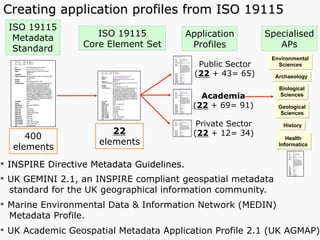
(22 + 12= 34)400
elements
22
elements
Environmental
Sciences
Specialised
APs
* INSPIRE Directive Metadata Guidelines.
* UK GEMINI 2.1, an INSPIRE compliant geospatial metadata
standard for the UK geographical information community.
* Marine Environmental Data & Information Network (MEDIN)
Metadata Profile.
* UK Academic Geospatial Metadata Application Profile 2.1 (UK AGMAP)
Archaeology
Biological
Sciences
Geological
Sciences
History
Health
Informatics
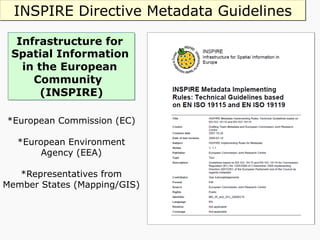
Infrastructure for
Spatial Information
in the European
Community
(INSPIRE)
*European Commission (EC)
*European Environment
Agency (EEA)
*Representatives from
Member States (Mapping/GIS)
INSPIRE Directive Metadata Guidelines
INSPIRE Directive [2007 /2/ EC]
Ø  Targets electronic spatial data and services for environmental
information.
Ø  Aims to create a European Spatial Data Infrastructure (SDI) based
on Member States’ infrastructures, to improve interoperability of
spatial information.
Ø  Data and services to be delivered through European initiatives.
Ø  INSPIRE Regulations came into force on 31 December 2009 and
applies to England, Northern Ireland and Wales.
Ø  Scotland’s Parliament enacted a complementary regulation on the
same date.
Ø  Public authorities obliged to produce and keep ‘metadata’ current
for describing datasets, dataset series and geo-services.
Ø  Includes UK academia (Freedom of Information Act, 2000).
Ø  Provide metadata catalogues to reveal what information is available.
Ø  Provide online data discovery, view, download and transformation
(interoperability) services.
Ø  Licensing arrangements to allow for information sharing, access and
use in accordance with each State’s regulations.
Ø  Set up e-commerce arrangements where charging is applicable.
Ø  Introduce monitoring mechanisms to show that information is being
made available.
Ø  Introduce co-ordination mechanisms to ensure effective operation
of the infrastructure.
Ø  Comply with the 34 spatial data specifications in three annexes
(reference geographies, environmental datasets).
INSPIRE Regulations for member states
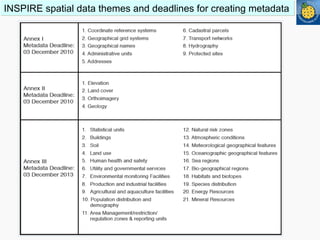
INSPIRE spatial data themes and deadlines for creating metadata
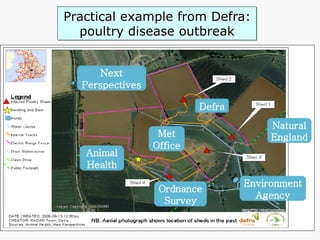
Practical example from Defra:
poultry disease outbreak
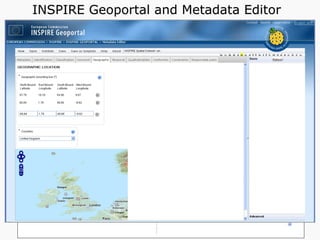
INSPIRE Geoportal and Metadata Editor
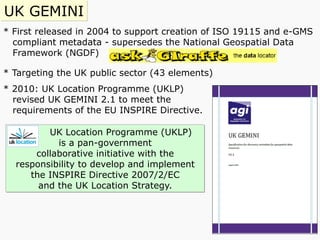
* First released in 2004 to support creation of ISO 19115 and e-GMS
compliant metadata - supersedes the National Geospatial Data
Framework (NGDF)
* Targeting the UK public sector (43 elements)
* 2010: UK Location Programme (UKLP)
revised UK GEMINI 2.1 to meet the
requirements of the EU INSPIRE Directive.
UK GEMINI
UK Location Programme (UKLP)
is a pan-government
collaborative initiative with the
responsibility to develop and implement
the INSPIRE Directive 2007/2/EC
and the UK Location Strategy.
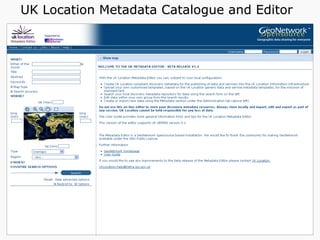
UK Location Metadata Catalogue and Editor
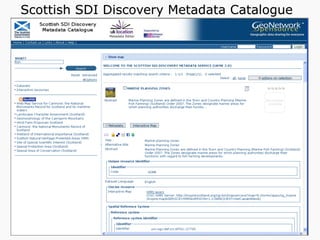
Scottish SDI Discovery Metadata Catalogue
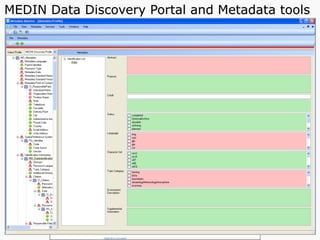
MEDIN Data Discovery Portal and Metadata tools
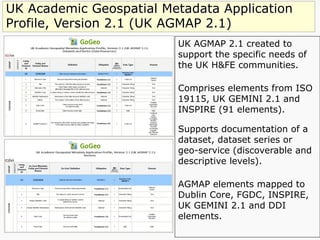
UK Academic Geospatial Metadata Application
Profile, Version 2.1 (UK AGMAP 2.1)
UK AGMAP 2.1 created to
support the specific needs of
the UK H&FE communities.
Comprises elements from ISO
19115, UK GEMINI 2.1 and
INSPIRE (91 elements).
Supports documentation of a
dataset, dataset series or
geo-service (discoverable and
descriptive levels).
AGMAP elements mapped to
Dublin Core, FGDC, INSPIRE,
UK GEMINI 2.1 and DDI
elements.
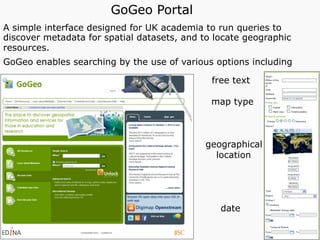
A simple interface designed for UK academia to run queries to
discover metadata for spatial datasets, and to locate geographic
resources.
GoGeo enables searching by the use of various options including
GoGeo Portal
free text
map type
geographical
location
date
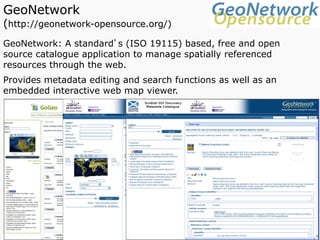
GeoNetwork
(http://geonetwork-opensource.org/)
GeoNetwork: A standard’s (ISO 19115) based, free and open
source catalogue application to manage spatially referenced
resources through the web.
Provides metadata editing and search functions as well as an
embedded interactive web map viewer.
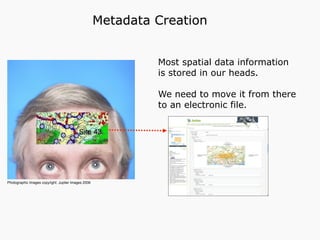
Most spatial data information
is stored in our heads.
We need to move it from there
to an electronic file.
Metadata Creation
Photographic Images copyright: Jupiter Images 2006
mind reading aliens?
Solutions?
Photographic Images copyright: Planet Vulcan Images, 2606
metadata extraction devices?
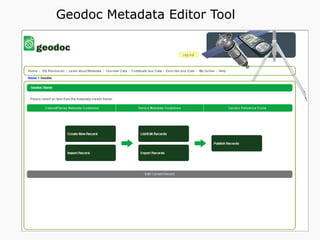
Geodoc Metadata Editor Tool
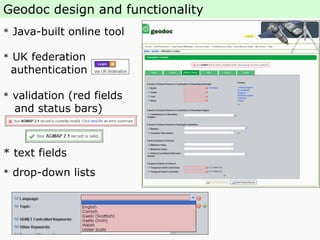
Geodoc design and functionality
* Java-built online tool
* UK federation
authentication access
* validation (red fields
and status bars)
* text fields
* drop-down lists
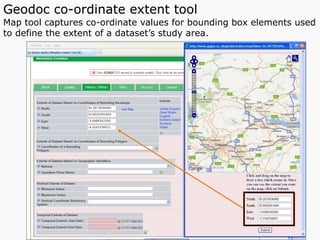
Geodoc co-ordinate extent tool
Map tool captures co-ordinate values for bounding box elements used
to define the extent of a dataset’s study area.
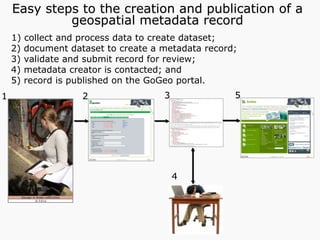
1) collect and process data to create dataset;
2) document dataset to create a metadata record;
3) validate and submit record for review;
4) metadata creator is contacted; and
5) record is published on the GoGeo portal.
1 2 3
Easy steps to the creation and publication of a
geospatial metadata record
Photographic Images copyright: Jupiter Images 2006
4
5
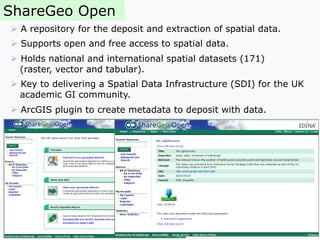
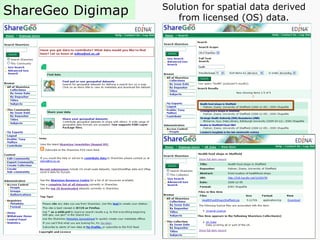
ShareGeo Open
Ø  A repository for the deposit and extraction of spatial data.
Ø  Supports open and free access to spatial data.
Ø  Holds national and international spatial datasets (171)
(raster, vector and tabular).
Ø  Key to delivering a Spatial Data Infrastructure (SDI) for the UK
academic GI community.
Ø  ArcGIS plugin to create metadata to deposit with data.
ShareGeo Digimap Solution for spatial data derived
from licensed (OS) data.
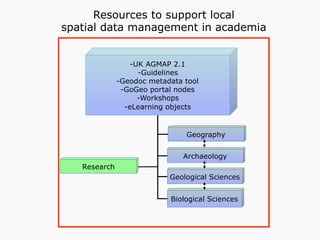
-UK AGMAP 2.1
-Guidelines
-Geodoc metadata tool
-GoGeo portal nodes
-Workshops
-eLearning objects
Geography
Archaeology
Geological Sciences
Biological Sciences
Research
Resources to support local
spatial data management in academia
UK AGMAP 2
Guidelines
Geodoc tadata tool
Customised GoGeo Portal
Nodes
Training
Geography
Archaeology
Geological Sciences
Biological Sciences
University A
UK AGMAP 2
Guidelines
Geodoc metadata tool
Customised GoGeo Portal
Nodes
Training
Geography
Archaeology
Geological Sciences
Biological Sciences
University B
UK AGMAP 2
Guidelines
Geodoc metadata tool
Customised GoGeo Portal
Nodes
Training
Geography
Archaeology
Geological Sciences
Biological Sciences
University C
UK AGMAP 2
Guidelines
Geodoc metadata tool
Customised GoGeo Portal
Nodes
Training
Geography
Archaeology
Geological Sciences
Biological Sciences
University D
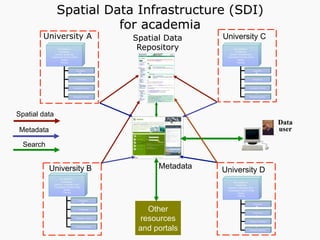
Spatial Data Infrastructure (SDI)
for academia
Other
resources
and portals
Spatial Data
Repository
Spatial data
Metadata
Search
Data
user
Metadata

Geospatial Metadata and Spatial Data: It's all Greek to me!

  • 1.
    Geospatial Metadata andSpatial Data: It’s all Greek to me!
  • 2.
    Programme PRESENTATION SESSION: Ø  Backgroundinformation Ø  Metadata, standards and application profiles (ISO 19115, INSPIRE, UK GEMINI 2.1) Ø  UK Academic Geospatial Metadata Application Profile, Version 2.1 (UK AGMAP 2.1) and guidelines Ø  GoGeo portal and Geodoc Metadata Editor tool Ø  ShareGeo spatial data repositories REFRESHMENTS (15 minute break) HANDS-ON SESSION: Ø  Geodoc Metadata Editor tool, GoGeo portal and ShareGeo Open spatial data repository
  • 3.
    Background Ø  three decadesof GIS and spatial data capture technology Ø  considerable cost and time invested in spatial data creation Ø  an eclectic range of academic disciplines using GIS as a research and teaching tool Requires a spatial data management, discovery and sharing solution delivered through portal technology and metadata.
  • 4.
    So what isMETADATA? The word appears to be of Greek and Latin origin…… but metadata represents something completely different…… Photographic Images copyright: Jupiter Images 2006 µετά data Flickr copyright: By Sergio Calleja http://www.flickr.com/photos/scalleja/761037232/
  • 5.
    Photographic Images copyright:Jupiter Images 2006 and it’s not sun and holiday
  • 6.
    Represents a documentedand ordered summary of information that describes something, in this case, spatial data. Provides information about the What, Where, When and Why of a spatial dataset. Includes its Ownership and Contact details and Access and Use conditions. Metadata (data describing data)
  • 7.
    What are theingredients? Where were ingredients produced? Who sells the ingredients? What are the brewing steps? When does the fermentation process end? Photographic Images copyright: Jupiter Images 2006 Think of metadata as a recipe for making beer.
  • 8.
  • 9.
    Think of metadataas food product labelling. What are the ingredients? What is the nutritional value? How many calories? When is the product’s expiry date? Where was it produced? Who produced it?
  • 10.
  • 11.
    Where are thesedatasets’ study areas? When were the data collected? Why were these datasets created? type of application? spatial reference system? spatial accuracy? processes or algorithms used? Who created these datasets? Can you tell me from any of these files….. Now think of metadata as spatial data labelling.
  • 12.
    What do thesepolygons represent? What attribute information is associated with these polygons?
  • 13.
    What do these SOILCLASS valuesmean? What does this attribute mean?
  • 14.
  • 16.
    The importance ofgeospatial metadata Local spatial data management Metadata Record Spatial Dataset Repository Spatial Dataset Metadata Directory Ø  maintains an inventory of datasets to reduce time required to re-assess existing datasets for new and future applications; Ø  ensures integrity of existing and new datasets using metadata as a tracking mechanism to monitor changes and edits to datasets.
  • 17.
    Ø  protects investmentsof time and cost dedicated to dataset creation and development; Ø  reduces and minimises the disruptive effects of staff taking annual leave or departing for new careers; Ø  eliminates or reduces the risk of redundancy in dataset collection; Ø  saves time against accidental deletion of dataset files; Ø  saves time against data loss as a result of hardware failure or damage to media. Protect data
  • 18.
    Geoportal: an interfaceto run searches to discover metadata records representing spatial data and geo-services on the internet. Geoportal Metadata Record Spatial Datasets and Geo-services Spatial data discovery via a Geoportal
  • 19.
    Free text, resourcetype, geographic location (co-ordinate and placename) and date searches.
  • 20.
  • 21.
    Contours Raster Map Draped 3DModel Create new spatial datasets © Crown Copyright/database right 2008 © Crown Copyright/database right 2008 © Crown Copyright/database right 2008
  • 22.
  • 23.
    Publish metadata ona geoportal Ø  a repository for you to store and manage your metadata thus savings in cost and time; Ø  use metadata to announce your data and applications; Ø  advertise (and sell?) your spatial datasets to other interested parties in academia and in the private and public sectors; and Ø  metadata in the portal can be referenced and cited for project proposals.
  • 24.
    1.  Intellectual PropertyRights (IPR) 2.  residual licensed data rights for derived data 3.  concerns over data quality (data creator and user) 4.  liability fears 5.  trust 6.  privacy and security 7.  time and cost for data delivery 8.  data transformation and harmonisation (scale, positional accuracy projections, formats) 9.  legacy data 10.  time and cost to create anonymised data for release 11.  time and cost for metadata record (descriptive level) updates 12.  infrastructure performance, maintenance & enhancement costs 13.  data and software archiving and warehousing issues 14.  long-term commitment and investment in the infrastructure 15.  revisions to changes in standards 16.  confusion about standards compliance and which standard to use Many concerns remain (metadata and datasets)
  • 25.
    Metadata standards Ø  Provideprecise specifications to enforce and ensure consistency and interoperability. Ø  Define and describe metadata entities and elements and, classify and group relevant metadata elements with entities. Ø  Assign structure and conditions (obligations, data type, domain).
  • 26.
    Dublin Core (ISO15836) Dublin Core: 15 elements to facilitate simple resource discovery in a networked environment (e.g. internet or library). T Photographic Images copyright: Jupiter Images 2006 - Contributor - Title - Date - Description - Format - Identifier - Language - Publisher - Rights - Source - Subject - Relation - Coverage - Creator - Type
  • 27.
    Geospatial metadata standards FederalGeographic Data Committee (FGDC) Content Standard for Digital Geospatial Metadata (CSDGM) introduced in mid 1990s for documenting spatial datasets. Geospatial metadata standards are critical for supporting metadata creation and…………… ISO 19115 Metadata Standard for Geographic Information was ratified in 2003 and supersedes FGDC. ISO 19115 comprises more than 400 metadata elements. 22 core metadata elements.
  • 28.
  • 29.
    Centre for Ecology andHydrology (CEH) National Environment Research Council (NERC) National Soil Resources Institute (NSRI)
  • 30.
    Derived from ageospatial standard and represents a reduction of the number of entities and elements. * It should include the core (mandatory) element set of a standard to support interoperability across the wider geospatial community (Discoverable level metadata). * Include additional elements for Descriptive level metadata? * A profile can be extended to include elements which are best suited for a working group’s specific applications. Example: The Biological Data Profile (BDP) An approved profile with additional elements to document biological information such as taxonomy, methodology and analytical tools. http://www.flickr.com/photos/f10n4/186861991/ Geospatial Metadata Application Profiles
  • 31.
    Creating application profilesfrom ISO 19115 ISO 19115 Metadata Standard ISO 19115 Core Element Set Application Profiles Academia (22 + 69= 91) Public Sector (22 + 43= 65) Private Sector (22 + 12= 34)400 elements 22 elements Environmental Sciences Specialised APs * INSPIRE Directive Metadata Guidelines. * UK GEMINI 2.1, an INSPIRE compliant geospatial metadata standard for the UK geographical information community. * Marine Environmental Data & Information Network (MEDIN) Metadata Profile. * UK Academic Geospatial Metadata Application Profile 2.1 (UK AGMAP) Archaeology Biological Sciences Geological Sciences History Health Informatics
  • 32.
    Infrastructure for Spatial Information inthe European Community (INSPIRE) *European Commission (EC) *European Environment Agency (EEA) *Representatives from Member States (Mapping/GIS) INSPIRE Directive Metadata Guidelines
  • 33.
    INSPIRE Directive [2007/2/ EC] Ø  Targets electronic spatial data and services for environmental information. Ø  Aims to create a European Spatial Data Infrastructure (SDI) based on Member States’ infrastructures, to improve interoperability of spatial information. Ø  Data and services to be delivered through European initiatives. Ø  INSPIRE Regulations came into force on 31 December 2009 and applies to England, Northern Ireland and Wales. Ø  Scotland’s Parliament enacted a complementary regulation on the same date. Ø  Public authorities obliged to produce and keep ‘metadata’ current for describing datasets, dataset series and geo-services. Ø  Includes UK academia (Freedom of Information Act, 2000).
  • 34.
    Ø  Provide metadatacatalogues to reveal what information is available. Ø  Provide online data discovery, view, download and transformation (interoperability) services. Ø  Licensing arrangements to allow for information sharing, access and use in accordance with each State’s regulations. Ø  Set up e-commerce arrangements where charging is applicable. Ø  Introduce monitoring mechanisms to show that information is being made available. Ø  Introduce co-ordination mechanisms to ensure effective operation of the infrastructure. Ø  Comply with the 34 spatial data specifications in three annexes (reference geographies, environmental datasets). INSPIRE Regulations for member states
  • 35.
    INSPIRE spatial datathemes and deadlines for creating metadata
  • 36.
    Practical example fromDefra: poultry disease outbreak
  • 38.
    INSPIRE Geoportal andMetadata Editor
  • 39.
    * First releasedin 2004 to support creation of ISO 19115 and e-GMS compliant metadata - supersedes the National Geospatial Data Framework (NGDF) * Targeting the UK public sector (43 elements) * 2010: UK Location Programme (UKLP) revised UK GEMINI 2.1 to meet the requirements of the EU INSPIRE Directive. UK GEMINI UK Location Programme (UKLP) is a pan-government collaborative initiative with the responsibility to develop and implement the INSPIRE Directive 2007/2/EC and the UK Location Strategy.
  • 40.
    UK Location MetadataCatalogue and Editor
  • 41.
    Scottish SDI DiscoveryMetadata Catalogue
  • 42.
    MEDIN Data DiscoveryPortal and Metadata tools
  • 44.
    UK Academic GeospatialMetadata Application Profile, Version 2.1 (UK AGMAP 2.1) UK AGMAP 2.1 created to support the specific needs of the UK H&FE communities. Comprises elements from ISO 19115, UK GEMINI 2.1 and INSPIRE (91 elements). Supports documentation of a dataset, dataset series or geo-service (discoverable and descriptive levels). AGMAP elements mapped to Dublin Core, FGDC, INSPIRE, UK GEMINI 2.1 and DDI elements.
  • 45.
    A simple interfacedesigned for UK academia to run queries to discover metadata for spatial datasets, and to locate geographic resources. GoGeo enables searching by the use of various options including GoGeo Portal free text map type geographical location date
  • 46.
    GeoNetwork (http://geonetwork-opensource.org/) GeoNetwork: A standard’s(ISO 19115) based, free and open source catalogue application to manage spatially referenced resources through the web. Provides metadata editing and search functions as well as an embedded interactive web map viewer.
  • 47.
    Most spatial datainformation is stored in our heads. We need to move it from there to an electronic file. Metadata Creation Photographic Images copyright: Jupiter Images 2006
  • 48.
    mind reading aliens? Solutions? PhotographicImages copyright: Planet Vulcan Images, 2606
  • 49.
  • 50.
  • 51.
    Geodoc design andfunctionality * Java-built online tool * UK federation authentication access * validation (red fields and status bars) * text fields * drop-down lists
  • 52.
    Geodoc co-ordinate extenttool Map tool captures co-ordinate values for bounding box elements used to define the extent of a dataset’s study area.
  • 53.
    1) collect andprocess data to create dataset; 2) document dataset to create a metadata record; 3) validate and submit record for review; 4) metadata creator is contacted; and 5) record is published on the GoGeo portal. 1 2 3 Easy steps to the creation and publication of a geospatial metadata record Photographic Images copyright: Jupiter Images 2006 4 5
  • 54.
    ShareGeo Open Ø  Arepository for the deposit and extraction of spatial data. Ø  Supports open and free access to spatial data. Ø  Holds national and international spatial datasets (171) (raster, vector and tabular). Ø  Key to delivering a Spatial Data Infrastructure (SDI) for the UK academic GI community. Ø  ArcGIS plugin to create metadata to deposit with data.
  • 55.
    ShareGeo Digimap Solutionfor spatial data derived from licensed (OS) data.
  • 56.
    -UK AGMAP 2.1 -Guidelines -Geodocmetadata tool -GoGeo portal nodes -Workshops -eLearning objects Geography Archaeology Geological Sciences Biological Sciences Research Resources to support local spatial data management in academia
  • 57.
    UK AGMAP 2 Guidelines Geodoctadata tool Customised GoGeo Portal Nodes Training Geography Archaeology Geological Sciences Biological Sciences University A UK AGMAP 2 Guidelines Geodoc metadata tool Customised GoGeo Portal Nodes Training Geography Archaeology Geological Sciences Biological Sciences University B UK AGMAP 2 Guidelines Geodoc metadata tool Customised GoGeo Portal Nodes Training Geography Archaeology Geological Sciences Biological Sciences University C UK AGMAP 2 Guidelines Geodoc metadata tool Customised GoGeo Portal Nodes Training Geography Archaeology Geological Sciences Biological Sciences University D Spatial Data Infrastructure (SDI) for academia Other resources and portals Spatial Data Repository Spatial data Metadata Search Data user Metadata