Spatial Data Infrastructure
Data modelling and web services for data access
Jean-Christophe Desconnets
desconne@mpl.ird.fr
Outline
• Introduction
• Data Modelling
– Methodology
• Conceptualization
• Data Modelling
• Data Encoding
• Data Publication
• Metadata
– Concepts and role
– Metadata profile
• Registry and discovery service
• Web services for data access
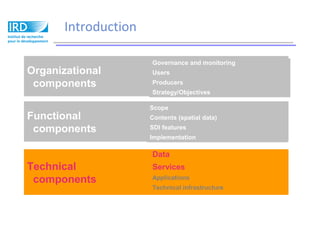
Introduction
Organizational
components
Functional
components
Technical
components
Governance and monitoring
Users
Producers
Strategy/Objectives
Scope
Contents (spatial data)
SDI features
Implementation
Data
Services
Applications
Technical infrastructure
Data Modelling
Issues & purposes of data modelling
Main Issues
• SDI implies data exchanges. These data fulfill a need.
• Crucial to understand the need to define how to model the real world
features of interest
• To build interoperable SDI
– Technical interoperability
– Semantic interoperability (object vocabulary)
Data modelling purposes
To define a consensual data model (feature types & its properties, relations),
extendable based on user-needs and existing data
The differents steps for data modelling
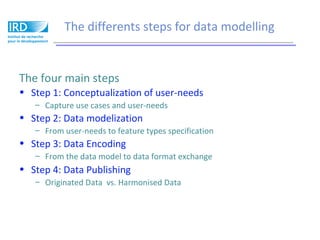
The four main steps
• Step 1: Conceptualization of user-needs
– Capture use cases and user-needs
• Step 2: Data modelization
– From user-needs to feature types specification
• Step 3: Data Encoding
– From the data model to data format exchange
• Step 4: Data Publishing
– Originated Data vs. Harmonised Data
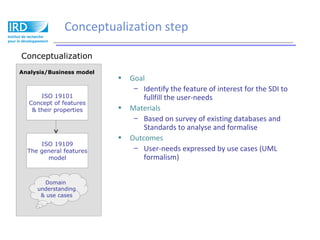
• Goal
– Identify the feature of interest for the SDI to
fullfill the user-needs
• Materials
– Based on survey of existing databases and
Standards to analyse and formalise
• Outcomes
– User-needs expressed by use cases (UML
formalism)
Conceptualization step
ISO 19101
Concept of features
& their properties
ISO 19109
The general features
model
Conceptualization
Analysis/Business model
Domain
understanding
& use cases
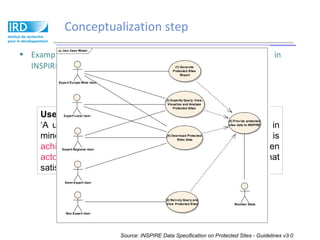
Conceptualization step
• Example with the use cases expressed for Protected Areas dataset in
INSPIRE Framework
Source: INSPIRE Data Specification on Protected Sites - Guidelines v3.0
Use case definition
‘A use case is initiated by a user with a particular goal in
mind, and completes successfully when that goal is
achieved. It describes the sequence of interactions between
actors and the system necessary to deliver the service that
satisfies the goal.’
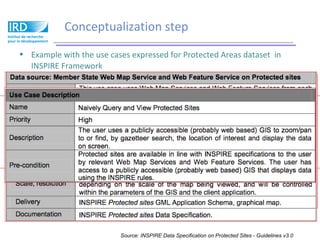
Conceptualization step
• Example with the use cases expressed for Protected Areas dataset in
INSPIRE Framework
Source: INSPIRE Data Specification on Protected Sites - Guidelines v3.0
Narrative description
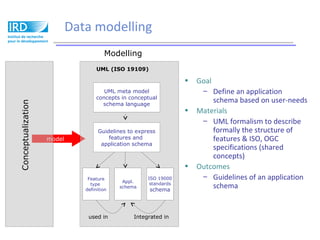
Data modelling
• Goal
– Define an application
schema based on user-needs
• Materials
– UML formalism to describe
formally the structure of
features & ISO, OGC
specifications (shared
concepts)
• Outcomes
– Guidelines of an application
schema
model
Conceptualization
UML meta model
concepts in conceptual
schema language
Guidelines to express
features and
application schema
Modelling
UML (ISO 19109)
Feature
type
definition
Appl.
schema
ISO 19000
standards
schema
Integrated inused in
Data modelling
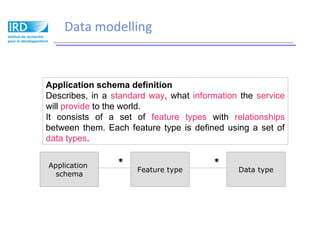
Application schema definition
Describes, in a standard way, what information the service
will provide to the world.
It consists of a set of feature types with relationships
between them. Each feature type is defined using a set of
data types.
Application
schema
Data type
*
Feature type
*
Data modelling
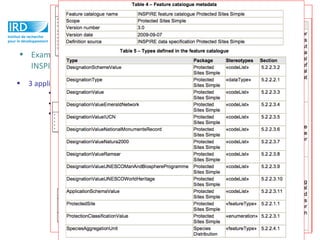
• Example with the use cases expressed for Protected Areas dataset in
INSPIRE Framework:
Source: INSPIRE Data Specification on Protected Sites - Guidelines v3.0
• 3 application schemas proposed:
• Simple
• Full
• Natura2000 (European directive on Nature Conservation)
Data encoding
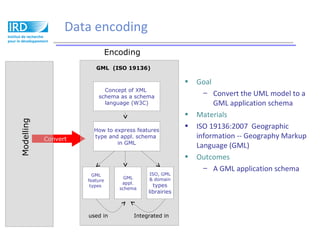
• Goal
– Convert the UML model to a
GML application schema
• Materials
• ISO 19136:2007 Geographic
information -- Geography Markup
Language (GML)
• Outcomes
– A GML application schema
Convert
Modelling
Concept of XML
schema as a schema
language (W3C)
How to express features
type and appl. schema
in GML
Encoding
GML (ISO 19136)
GML
feature
types
GML
appl.
schema
ISO, GML
& domain
types
librairies
Integrated inused in
Data encoding
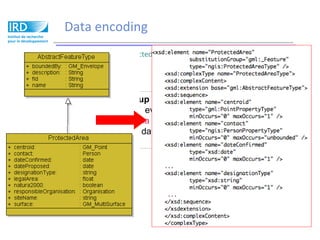
GML: Geographic Markup Language
Defines an encoding of every required ISO standard by
providing an XML schema and defines mapping rules for
each feature types and data types of the general feature
models
• Example of a conversion of ProtectedArea UML Class to GML application
schema (NatureGIS project)
Data Publishing
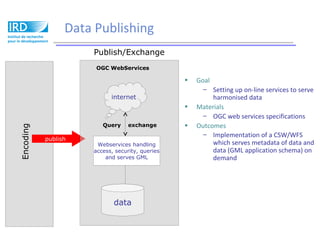
• Goal
– Setting up on-line services to serve
harmonised data
• Materials
– OGC web services specifications
• Outcomes
– Implementation of a CSW/WFS
which serves metadata of data and
data (GML application schema) on
demand
Encoding
publish
Webservices handling
access, security, queries
and serves GML
Publish/Exchange
OGC WebServices
data
internet
Query exchange
Internal data model vs exposed feature types
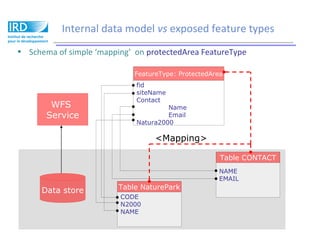
• Exposed data features are the result of a ‘mapping’ of internal
data model to GML application model
– To expose only a subset or a view of internal data
• ‘Mapping’ called ‘data remodelling’ prodiving by ETL tool
• Remodelling data can be stored inside:
– File
– Database
– Or created on the fly
Internal data model vs exposed feature types
• Schema of simple ‘mapping’ on protectedArea FeatureType
Data store
CODE
N2000
NAME
Table NaturePark
NAME
EMAIL
Table CONTACT
WFS
Service
fid
siteName
Contact
Name
Email
Natura2000
FeatureType: ProtectedArea
<Mapping>
Metadata
What is metadata ?
‘Data about data’
Basically, structured information & description which make information
understandable & shareable for users over time
Provide
Description of characteristics of a set of data, such as the content, quality,
currency, access and availability,…
Used
By search engines to improve the matching between user queries and
description resources
For geographical dataset
Provide spatial components such as coordinate reference system, spatial
representation, spatial localisation
Why metadata ?
A key to true usability and interoperability in the GIS environnment
• For data provider
– Reduce the cost of losing information about spatial dataset
– Increase the usability and value of all datasets over time
– Protect GIS data investments in organisations by providing information about their
data holdings
• Arises from the increasing recognition of the benefits it provides as the use and
amounts of data increases
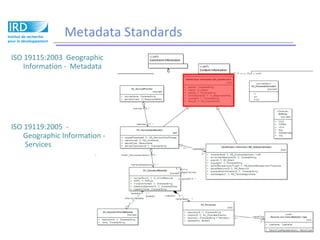
Metadata Standards
ISO 19115:2003 Geographic
Information - Metadata
ISO 19119:2005 -
Geographic Information -
Services
ISO/TS 19139:2007 - Geographic information - Metadata XML Schema Implementation
XML encoding of ISO 19115/119 and comprehensive implementation
specification for digital geographic datasets
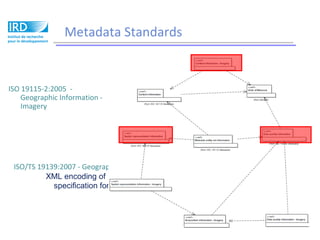
Metadata Standards
ISO 19115-2:2005 -
Geographic Information -
Imagery
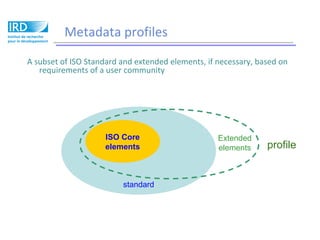
Metadata profiles
A subset of ISO Standard and extended elements, if necessary, based on
requirements of a user community
ISO Core
elements
standard
profile
Extended
elements
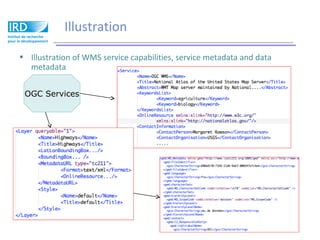
Illustration
• Illustration of WMS service capabilities, service metadata and data
metadata
OGC Services
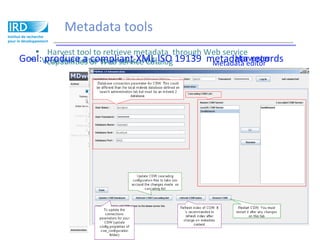
Metadata tools
• Web text Editor to produce XML
• Harvest tool to retrieve metadata through Web service
capabilities or Web service CatalogGoal: produce a compliant XML ISO 19139 metadata recordsMetadata editor
Harvester
Registry and
Discovery service
Concept of Registry
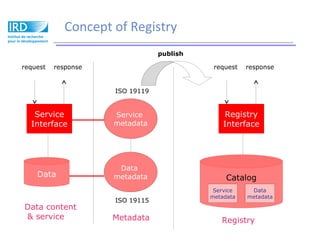
Registry Web Service
– Interfaces for querying & managing a metadata repository
• Registry client
– Application used to query the registry and submit items to be registered
• Catalog
– Based on an information model at a high level of abstraction to
define type of objects stored in the registry and how they are
organised (ebRIM, UDDI)
‘The role of registry is to extract and index a subset of the information held
on metadata in a way that the records can be easily be found again on the
basis of specific criteria’
Concept of Registry
Data
Service
Interface
request response
Data content
& service
Service
metadata
Data
metadata
ISO 19119
ISO 19115
Metadata
Catalog
Registry
Registry
Interface
request response
Service
metadata
Data
metadata
publish
Discovery web service
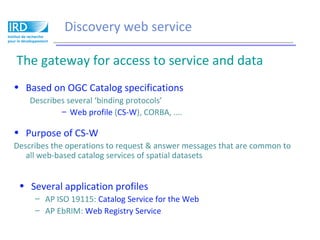
• Based on OGC Catalog specifications
Describes several ‘binding protocols’
– Web profile (CS-W), CORBA, ….
• Purpose of CS-W
Describes the operations to request & answer messages that are common to
all web-based catalog services of spatial datasets
• Several application profiles
– AP ISO 19115: Catalog Service for the Web
– AP EbRIM: Web Registry Service
The gateway for access to service and data
Discovery service capabilities & example
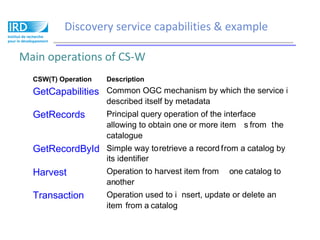
CSW(T) Operation Description
GetCapabilities Common OGC mechanism by which the service is
described itself by metadata
GetRecords Principal query operation of the interface
allowing to obtain one or more item s from the
catalogue
GetRecordById Simple way toretrieve a record from a catalog by
its identifier
Harvest Operation to harvest item from one catalog to
another
Transaction Operation used to i nsert, update or delete an
item from a catalog
Main operations of CS-W
Discovery service capabilities & example
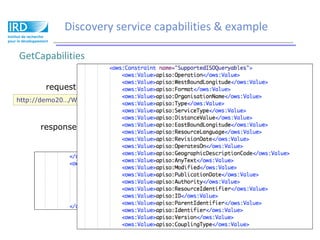
GetCapabilities
http://demo20…/WS/csw?REQUEST=GetCapabilities&SERVICE=CSW&VERSION=2.0.2
request
response
Multi-lingual discovery
Construct queries and retrieve results which may bear on multi-
lingual catalogs (metadata)
– On the catalog contents: internationalisation
• Encoding mechanism XML 19139 (code list, embedded translation,
etc.)
• Use of controlled vocabularies: Thesauri
– On discovery applications: construction and propagation
of multi-lingual requests
– Use of the URI of terminological concepts
– Service to access the vocabulary (Thesaurus web service)
Multi-lingual discovery
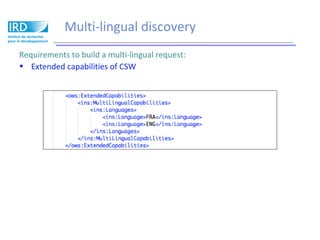
Requirements to build a multi-lingual request:
• Extended capabilities of CSW
Multi-lingual discovery
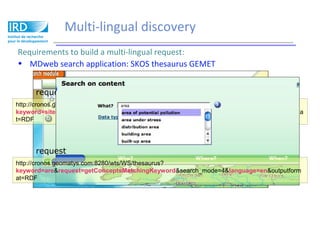
Requirements to build a multi-lingual request:
• MDweb search application: SKOS thesaurus GEMET
http://cronos.geomatys.com:8280/wts/WS/thesaurus?
keyword=site&request=getConceptsMatchingKeyword&search_mode=4&language=fr&outputforma
t=RDF
request
http://cronos.geomatys.com:8280/wts/WS/thesaurus?
keyword=are&request=getConceptsMatchingKeyword&search_mode=4&language=en&outputform
at=RDF
request
Multi-lingual discovery
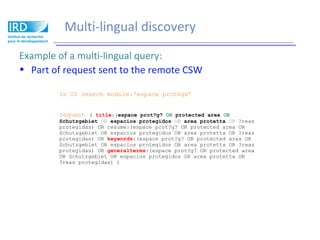
Example of a multi-lingual query:
• Part of request sent to the remote CSW
In UI Search module:‘espace protégé’
request ( title:(espace prot?g? OR protected area OR
Schutzgebiet OR espacios protegidos OR area protetta OR ?reas
protegidas) OR resume:(espace prot?g? OR protected area OR
Schutzgebiet OR espacios protegidos OR area protetta OR ?reas
protegidas) OR keywords:(espace prot?g? OR protected area OR
Schutzgebiet OR espacios protegidos OR area protetta OR ?reas
protegidas) OR generalterms:(espace prot?g? OR protected area
OR Schutzgebiet OR espacios protegidos OR area protetta OR
?reas protegidas) )
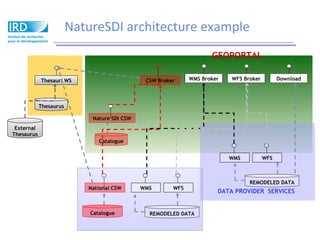
NatureSDI architecture example
Thesaurus
REMODELED DATA
Thesauri WS
Catalogue
Catalogue
Nature SDI CSW
National CSW
CSW Broker WMS Broker WFS Broker Download
WFSWMS
WMS WFS
DATA PROVIDER SERVICES
GEOPORTAL
REMODELED DATA
External
Thesaurus
Thesaurus
REMODELED DATA
Thesauri WS
Catalogue
Catalogue
Nature SDI CSW
National CSW
CSW Broker WMS Broker WFS Broker Download
WFSWMS
WMS WFS
DATA PROVIDER SERVICES
GEOPORTAL
REMODELED DATA
External
Thesaurus
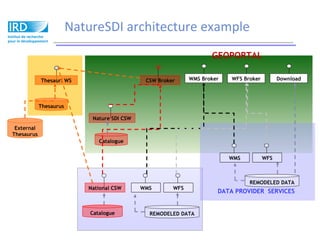
NatureSDI architecture example
Web services for
data access
Data services
• Issue
– Publishing for access to harmonised information for each node
of a SDI
• Purpose
– Implement data publishing solution based on OGC/ISO
standards
• WMS: Web Map Service
• WFS: Web Feature Service
• Associated specifications: Filter encoding, SLD, WMC, …
WMS: Web Map Service
• Is a service interface specification that:
– Enables the dynamic construction of a map as a picture or as a series of
graphics elements, or as a packaged set of geographic features data
– Answers basic queries about the contents of the map
– Can inform others programs about the maps it can produce and provides
metadata about served data
‘A Web Map Service (WMS) is a web interface that allows one to
publish and deploy maps on the Internet’
WMS: Web Map Service
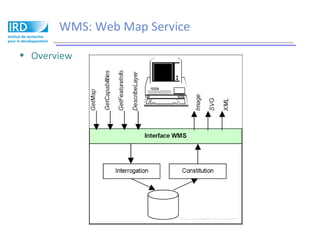
• Main operations
– GetCapabilities: Obtains the capabilities of the server using service-level
metadata. This is a description of the description of WMS information
content, list of layers provided, their extent, CRS, style;
– GetMap: Obtains the map (raster data or image file) whose geographic and
dimensional parameters should be defined by the data service provider’s
WMS;
– GetFeatureInfo: Obtains information about particular features shown on the
image or raster file.
WMS: Web Map Service
• Overview
WMS: Web Map Service
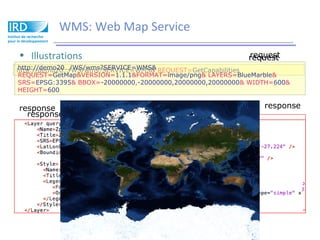
• Illustrations
http://demo20…/WS/wms?SERVICE=WMS& REQUEST=GetCapabilities
request
response
response
http://demo20…/WS/wms?SERVICE=WMS&
REQUEST=GetMap&VERSION=1.1.1&FORMAT=image/png& LAYERS=BlueMarble&
SRS=EPSG:3395& BBOX=-20000000,-20000000,20000000,20000000& WIDTH=600&
HEIGHT=600
request
response
WMS: Web Map Service
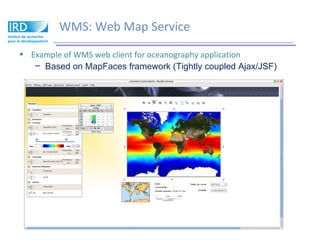
• Example of WMS web client for oceanography application
– Based on MapFaces framework (Tightly coupled Ajax/JSF)
WFS: Web Feature Service
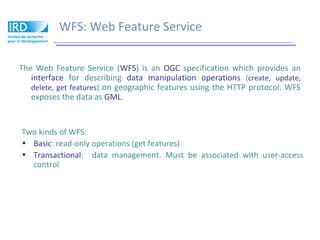
The Web Feature Service (WFS) is an OGC specification which provides an
interface for describing data manipulation operations (create, update,
delete, get features) on geographic features using the HTTP protocol. WFS
exposes the data as GML.
Two kinds of WFS:
• Basic: read-only operations (get features)
• Transactional: data management. Must be associated with user-access
control
WFS: Web Feature Service
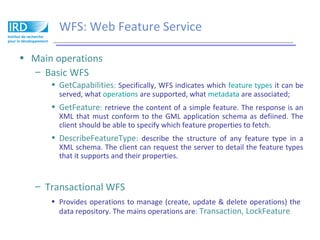
• Main operations
– Transactional WFS
• Provides operations to manage (create, update & delete operations) the
data repository. The mains operations are: Transaction, LockFeature
– Basic WFS
• GetCapabilities: Specifically, WFS indicates which feature types it can be
served, what operations are supported, what metadata are associated;
• GetFeature: retrieve the content of a simple feature. The response is an
XML that must conform to the GML application schema as defiined. The
client should be able to specify which feature properties to fetch.
• DescribeFeatureType: describe the structure of any feature type in a
XML schema. The client can request the server to detail the feature types
that it supports and their properties.
WFS: Web Feature Service
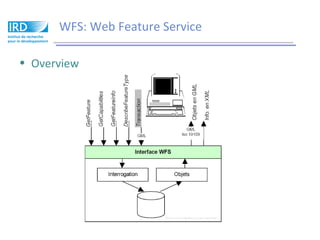
• Overview
WFS: Web Feature Service
• Illustrations
Voir message de mathieu
bossaert
Associated OGC specifications
Many others OGC specifications used to support specific needs, some of
them:
• Data Query specifications
– OGC filter encoding: filter expression in XML encoding used to identify
a subset of features
Example :
Query: « seek the road features with roadtype being equal to 1 »
SQL: « select * from roads where roadtype=1; »
OGC Filter: <Filter>
<PropertyIsEqualTo>
<PropertyName>roadtype</ PropertyName>
<Literal>1<Literal>
</PropertyIsEqualTo>
</Filter>
• Style specification
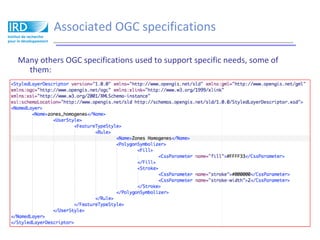
– Style Legend Descriptor (SLD): XM-based styling language to define how to
write a style rule. This rule is send to a WMS in order to draw a map.
Example:
References
‘Nature-GIS Guidelines, Data Infrastructures for protected areas’, Office for
official publications of the European Communities, EUR 21594 EN, ISBN
92-894-9399-2, 2005.

spatial data infrastructure : data modelling and web services for data access

  • 1.
    Spatial Data Infrastructure Datamodelling and web services for data access Jean-Christophe Desconnets desconne@mpl.ird.fr
  • 2.
    Outline • Introduction • DataModelling – Methodology • Conceptualization • Data Modelling • Data Encoding • Data Publication • Metadata – Concepts and role – Metadata profile • Registry and discovery service • Web services for data access
  • 3.
  • 4.
  • 5.
    Issues & purposesof data modelling Main Issues • SDI implies data exchanges. These data fulfill a need. • Crucial to understand the need to define how to model the real world features of interest • To build interoperable SDI – Technical interoperability – Semantic interoperability (object vocabulary) Data modelling purposes To define a consensual data model (feature types & its properties, relations), extendable based on user-needs and existing data
  • 6.
    The differents stepsfor data modelling The four main steps • Step 1: Conceptualization of user-needs – Capture use cases and user-needs • Step 2: Data modelization – From user-needs to feature types specification • Step 3: Data Encoding – From the data model to data format exchange • Step 4: Data Publishing – Originated Data vs. Harmonised Data
  • 7.
    • Goal – Identifythe feature of interest for the SDI to fullfill the user-needs • Materials – Based on survey of existing databases and Standards to analyse and formalise • Outcomes – User-needs expressed by use cases (UML formalism) Conceptualization step ISO 19101 Concept of features & their properties ISO 19109 The general features model Conceptualization Analysis/Business model Domain understanding & use cases
  • 8.
    Conceptualization step • Examplewith the use cases expressed for Protected Areas dataset in INSPIRE Framework Source: INSPIRE Data Specification on Protected Sites - Guidelines v3.0 Use case definition ‘A use case is initiated by a user with a particular goal in mind, and completes successfully when that goal is achieved. It describes the sequence of interactions between actors and the system necessary to deliver the service that satisfies the goal.’
  • 9.
    Conceptualization step • Examplewith the use cases expressed for Protected Areas dataset in INSPIRE Framework Source: INSPIRE Data Specification on Protected Sites - Guidelines v3.0 Narrative description
  • 10.
    Data modelling • Goal –Define an application schema based on user-needs • Materials – UML formalism to describe formally the structure of features & ISO, OGC specifications (shared concepts) • Outcomes – Guidelines of an application schema model Conceptualization UML meta model concepts in conceptual schema language Guidelines to express features and application schema Modelling UML (ISO 19109) Feature type definition Appl. schema ISO 19000 standards schema Integrated inused in
  • 11.
    Data modelling Application schemadefinition Describes, in a standard way, what information the service will provide to the world. It consists of a set of feature types with relationships between them. Each feature type is defined using a set of data types. Application schema Data type * Feature type *
  • 12.
    Data modelling • Examplewith the use cases expressed for Protected Areas dataset in INSPIRE Framework: Source: INSPIRE Data Specification on Protected Sites - Guidelines v3.0 • 3 application schemas proposed: • Simple • Full • Natura2000 (European directive on Nature Conservation)
  • 13.
    Data encoding • Goal –Convert the UML model to a GML application schema • Materials • ISO 19136:2007 Geographic information -- Geography Markup Language (GML) • Outcomes – A GML application schema Convert Modelling Concept of XML schema as a schema language (W3C) How to express features type and appl. schema in GML Encoding GML (ISO 19136) GML feature types GML appl. schema ISO, GML & domain types librairies Integrated inused in
  • 14.
    Data encoding GML: GeographicMarkup Language Defines an encoding of every required ISO standard by providing an XML schema and defines mapping rules for each feature types and data types of the general feature models • Example of a conversion of ProtectedArea UML Class to GML application schema (NatureGIS project)
  • 15.
    Data Publishing • Goal –Setting up on-line services to serve harmonised data • Materials – OGC web services specifications • Outcomes – Implementation of a CSW/WFS which serves metadata of data and data (GML application schema) on demand Encoding publish Webservices handling access, security, queries and serves GML Publish/Exchange OGC WebServices data internet Query exchange
  • 16.
    Internal data modelvs exposed feature types • Exposed data features are the result of a ‘mapping’ of internal data model to GML application model – To expose only a subset or a view of internal data • ‘Mapping’ called ‘data remodelling’ prodiving by ETL tool • Remodelling data can be stored inside: – File – Database – Or created on the fly
  • 17.
    Internal data modelvs exposed feature types • Schema of simple ‘mapping’ on protectedArea FeatureType Data store CODE N2000 NAME Table NaturePark NAME EMAIL Table CONTACT WFS Service fid siteName Contact Name Email Natura2000 FeatureType: ProtectedArea <Mapping>
  • 18.
  • 19.
    What is metadata? ‘Data about data’ Basically, structured information & description which make information understandable & shareable for users over time Provide Description of characteristics of a set of data, such as the content, quality, currency, access and availability,… Used By search engines to improve the matching between user queries and description resources For geographical dataset Provide spatial components such as coordinate reference system, spatial representation, spatial localisation
  • 20.
    Why metadata ? Akey to true usability and interoperability in the GIS environnment • For data provider – Reduce the cost of losing information about spatial dataset – Increase the usability and value of all datasets over time – Protect GIS data investments in organisations by providing information about their data holdings • Arises from the increasing recognition of the benefits it provides as the use and amounts of data increases
  • 21.
    Metadata Standards ISO 19115:2003Geographic Information - Metadata ISO 19119:2005 - Geographic Information - Services
  • 22.
    ISO/TS 19139:2007 -Geographic information - Metadata XML Schema Implementation XML encoding of ISO 19115/119 and comprehensive implementation specification for digital geographic datasets Metadata Standards ISO 19115-2:2005 - Geographic Information - Imagery
  • 23.
    Metadata profiles A subsetof ISO Standard and extended elements, if necessary, based on requirements of a user community ISO Core elements standard profile Extended elements
  • 24.
    Illustration • Illustration ofWMS service capabilities, service metadata and data metadata OGC Services
  • 25.
    Metadata tools • Webtext Editor to produce XML • Harvest tool to retrieve metadata through Web service capabilities or Web service CatalogGoal: produce a compliant XML ISO 19139 metadata recordsMetadata editor Harvester
  • 26.
  • 27.
    Concept of Registry RegistryWeb Service – Interfaces for querying & managing a metadata repository • Registry client – Application used to query the registry and submit items to be registered • Catalog – Based on an information model at a high level of abstraction to define type of objects stored in the registry and how they are organised (ebRIM, UDDI) ‘The role of registry is to extract and index a subset of the information held on metadata in a way that the records can be easily be found again on the basis of specific criteria’
  • 28.
    Concept of Registry Data Service Interface requestresponse Data content & service Service metadata Data metadata ISO 19119 ISO 19115 Metadata Catalog Registry Registry Interface request response Service metadata Data metadata publish
  • 29.
    Discovery web service •Based on OGC Catalog specifications Describes several ‘binding protocols’ – Web profile (CS-W), CORBA, …. • Purpose of CS-W Describes the operations to request & answer messages that are common to all web-based catalog services of spatial datasets • Several application profiles – AP ISO 19115: Catalog Service for the Web – AP EbRIM: Web Registry Service The gateway for access to service and data
  • 30.
    Discovery service capabilities& example CSW(T) Operation Description GetCapabilities Common OGC mechanism by which the service is described itself by metadata GetRecords Principal query operation of the interface allowing to obtain one or more item s from the catalogue GetRecordById Simple way toretrieve a record from a catalog by its identifier Harvest Operation to harvest item from one catalog to another Transaction Operation used to i nsert, update or delete an item from a catalog Main operations of CS-W
  • 31.
    Discovery service capabilities& example GetCapabilities http://demo20…/WS/csw?REQUEST=GetCapabilities&SERVICE=CSW&VERSION=2.0.2 request response
  • 32.
    Multi-lingual discovery Construct queriesand retrieve results which may bear on multi- lingual catalogs (metadata) – On the catalog contents: internationalisation • Encoding mechanism XML 19139 (code list, embedded translation, etc.) • Use of controlled vocabularies: Thesauri – On discovery applications: construction and propagation of multi-lingual requests – Use of the URI of terminological concepts – Service to access the vocabulary (Thesaurus web service)
  • 33.
    Multi-lingual discovery Requirements tobuild a multi-lingual request: • Extended capabilities of CSW
  • 34.
    Multi-lingual discovery Requirements tobuild a multi-lingual request: • MDweb search application: SKOS thesaurus GEMET http://cronos.geomatys.com:8280/wts/WS/thesaurus? keyword=site&request=getConceptsMatchingKeyword&search_mode=4&language=fr&outputforma t=RDF request http://cronos.geomatys.com:8280/wts/WS/thesaurus? keyword=are&request=getConceptsMatchingKeyword&search_mode=4&language=en&outputform at=RDF request
  • 35.
    Multi-lingual discovery Example ofa multi-lingual query: • Part of request sent to the remote CSW In UI Search module:‘espace protégé’ request ( title:(espace prot?g? OR protected area OR Schutzgebiet OR espacios protegidos OR area protetta OR ?reas protegidas) OR resume:(espace prot?g? OR protected area OR Schutzgebiet OR espacios protegidos OR area protetta OR ?reas protegidas) OR keywords:(espace prot?g? OR protected area OR Schutzgebiet OR espacios protegidos OR area protetta OR ?reas protegidas) OR generalterms:(espace prot?g? OR protected area OR Schutzgebiet OR espacios protegidos OR area protetta OR ?reas protegidas) )
  • 36.
    NatureSDI architecture example Thesaurus REMODELEDDATA Thesauri WS Catalogue Catalogue Nature SDI CSW National CSW CSW Broker WMS Broker WFS Broker Download WFSWMS WMS WFS DATA PROVIDER SERVICES GEOPORTAL REMODELED DATA External Thesaurus
  • 37.
    Thesaurus REMODELED DATA Thesauri WS Catalogue Catalogue NatureSDI CSW National CSW CSW Broker WMS Broker WFS Broker Download WFSWMS WMS WFS DATA PROVIDER SERVICES GEOPORTAL REMODELED DATA External Thesaurus NatureSDI architecture example
  • 38.
  • 39.
    Data services • Issue –Publishing for access to harmonised information for each node of a SDI • Purpose – Implement data publishing solution based on OGC/ISO standards • WMS: Web Map Service • WFS: Web Feature Service • Associated specifications: Filter encoding, SLD, WMC, …
  • 40.
    WMS: Web MapService • Is a service interface specification that: – Enables the dynamic construction of a map as a picture or as a series of graphics elements, or as a packaged set of geographic features data – Answers basic queries about the contents of the map – Can inform others programs about the maps it can produce and provides metadata about served data ‘A Web Map Service (WMS) is a web interface that allows one to publish and deploy maps on the Internet’
  • 41.
    WMS: Web MapService • Main operations – GetCapabilities: Obtains the capabilities of the server using service-level metadata. This is a description of the description of WMS information content, list of layers provided, their extent, CRS, style; – GetMap: Obtains the map (raster data or image file) whose geographic and dimensional parameters should be defined by the data service provider’s WMS; – GetFeatureInfo: Obtains information about particular features shown on the image or raster file.
  • 42.
    WMS: Web MapService • Overview
  • 43.
    WMS: Web MapService • Illustrations http://demo20…/WS/wms?SERVICE=WMS& REQUEST=GetCapabilities request response response http://demo20…/WS/wms?SERVICE=WMS& REQUEST=GetMap&VERSION=1.1.1&FORMAT=image/png& LAYERS=BlueMarble& SRS=EPSG:3395& BBOX=-20000000,-20000000,20000000,20000000& WIDTH=600& HEIGHT=600 request response
  • 44.
    WMS: Web MapService • Example of WMS web client for oceanography application – Based on MapFaces framework (Tightly coupled Ajax/JSF)
  • 45.
    WFS: Web FeatureService The Web Feature Service (WFS) is an OGC specification which provides an interface for describing data manipulation operations (create, update, delete, get features) on geographic features using the HTTP protocol. WFS exposes the data as GML. Two kinds of WFS: • Basic: read-only operations (get features) • Transactional: data management. Must be associated with user-access control
  • 46.
    WFS: Web FeatureService • Main operations – Transactional WFS • Provides operations to manage (create, update & delete operations) the data repository. The mains operations are: Transaction, LockFeature – Basic WFS • GetCapabilities: Specifically, WFS indicates which feature types it can be served, what operations are supported, what metadata are associated; • GetFeature: retrieve the content of a simple feature. The response is an XML that must conform to the GML application schema as defiined. The client should be able to specify which feature properties to fetch. • DescribeFeatureType: describe the structure of any feature type in a XML schema. The client can request the server to detail the feature types that it supports and their properties.
  • 47.
    WFS: Web FeatureService • Overview
  • 48.
    WFS: Web FeatureService • Illustrations Voir message de mathieu bossaert
  • 49.
    Associated OGC specifications Manyothers OGC specifications used to support specific needs, some of them: • Data Query specifications – OGC filter encoding: filter expression in XML encoding used to identify a subset of features Example : Query: « seek the road features with roadtype being equal to 1 » SQL: « select * from roads where roadtype=1; » OGC Filter: <Filter> <PropertyIsEqualTo> <PropertyName>roadtype</ PropertyName> <Literal>1<Literal> </PropertyIsEqualTo> </Filter> • Style specification – Style Legend Descriptor (SLD): XM-based styling language to define how to write a style rule. This rule is send to a WMS in order to draw a map. Example:
  • 50.
    References ‘Nature-GIS Guidelines, DataInfrastructures for protected areas’, Office for official publications of the European Communities, EUR 21594 EN, ISBN 92-894-9399-2, 2005.