S t u a r t M a c d o n a l d
A s s o c i a t e D a t a L i b r a r i a n
s t u a r t . m a c d o n a l d @ e d . a c . u k
Research Data Management at
the University of Edinburgh
College of Science and Engineering - "What's new for you in the Library“,
Murray Library, Kings Buildings, University of Edinburgh. 28 May 2014
Overview
 Research Data
 Research Data Management
 Funder Policies and University’s RDM Policy
 RDM Services and Support
 Awareness Raising
 Training
 Progress so far
Defining Research Data
 Research data are collected, observed or created, for the
purposes of analysis to produce and validate original
research results.
 Research data can be generated for different purposes and
through different processes in a multitude of digital
formats
 Both analogue and digital materials are ‘data’.
 Digital data can be:
o created in a digital form ('born digital')
o converted to a digital form (digitised)
Types of Research Data
 Instrument measurements
 Experimental observations
 Still images, video and audio
 Text documents, spreadsheets, databases
 Quantitative data (e.g. household survey data)
 Survey results & interview transcripts
 Simulation data, models & software
 Slides, artefacts, specimens, samples
 Sketches, diaries, lab notebooks …
Research Data Management
 Research data management is caring for,
facilitating access to, preserving and adding value
to research data throughout their lifecycle.
 Data management is one of the essential areas of
responsible conduct of research.
 It provides a framework that supports researchers
and their data throughout the course of their
research and beyond.
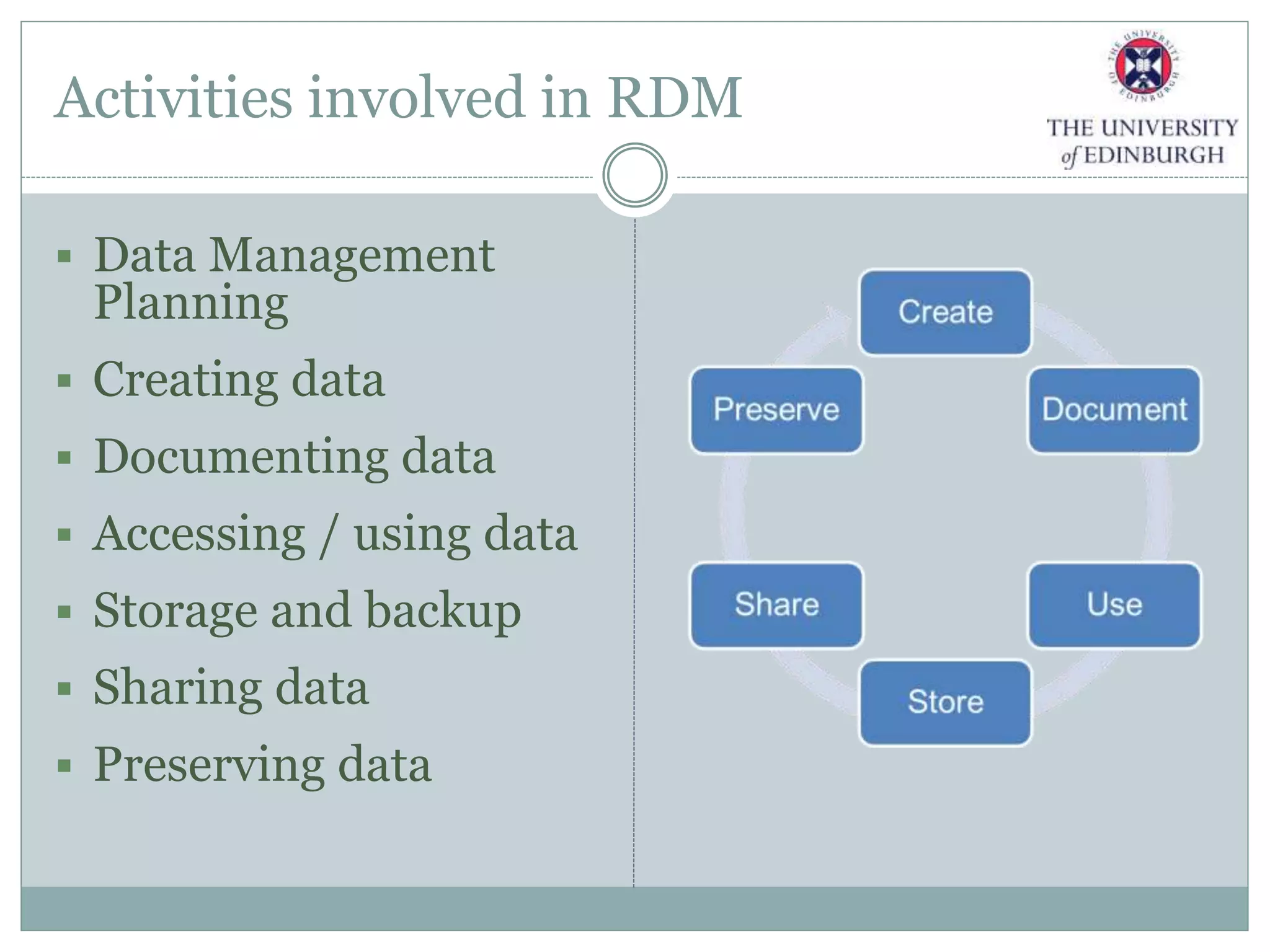
Activities involved in RDM
 Data Management
Planning
 Creating data
 Documenting data
 Accessing / using data
 Storage and backup
 Sharing data
 Preserving data
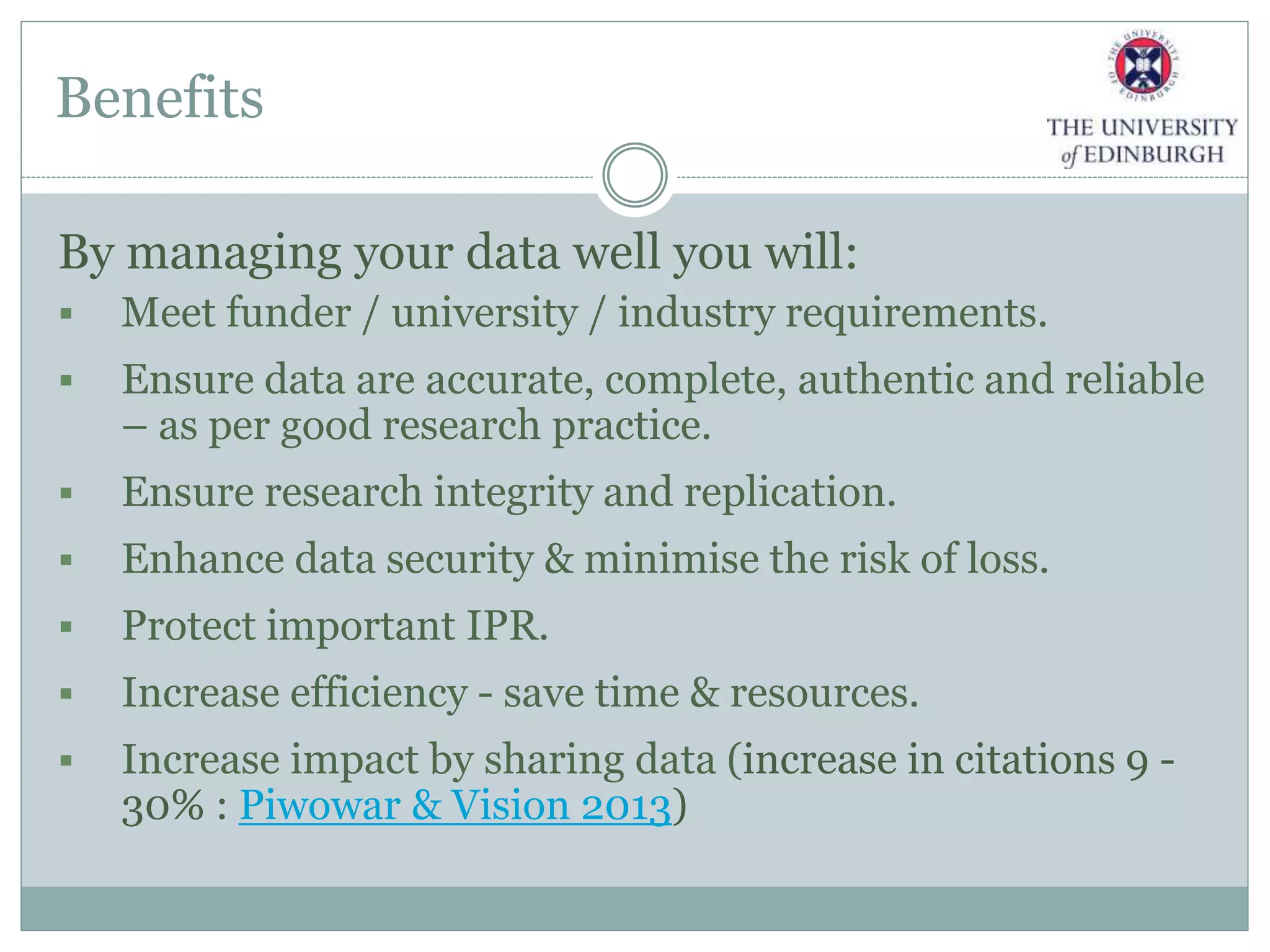
Benefits
By managing your data well you will:
 Meet funder / university / industry requirements.
 Ensure data are accurate, complete, authentic and reliable
– as per good research practice.
 Ensure research integrity and replication.
 Enhance data security & minimise the risk of loss.
 Protect important IPR.
 Increase efficiency - save time & resources.
 Increase impact by sharing data (increase in citations 9 -
30% : Piwowar & Vision 2013)
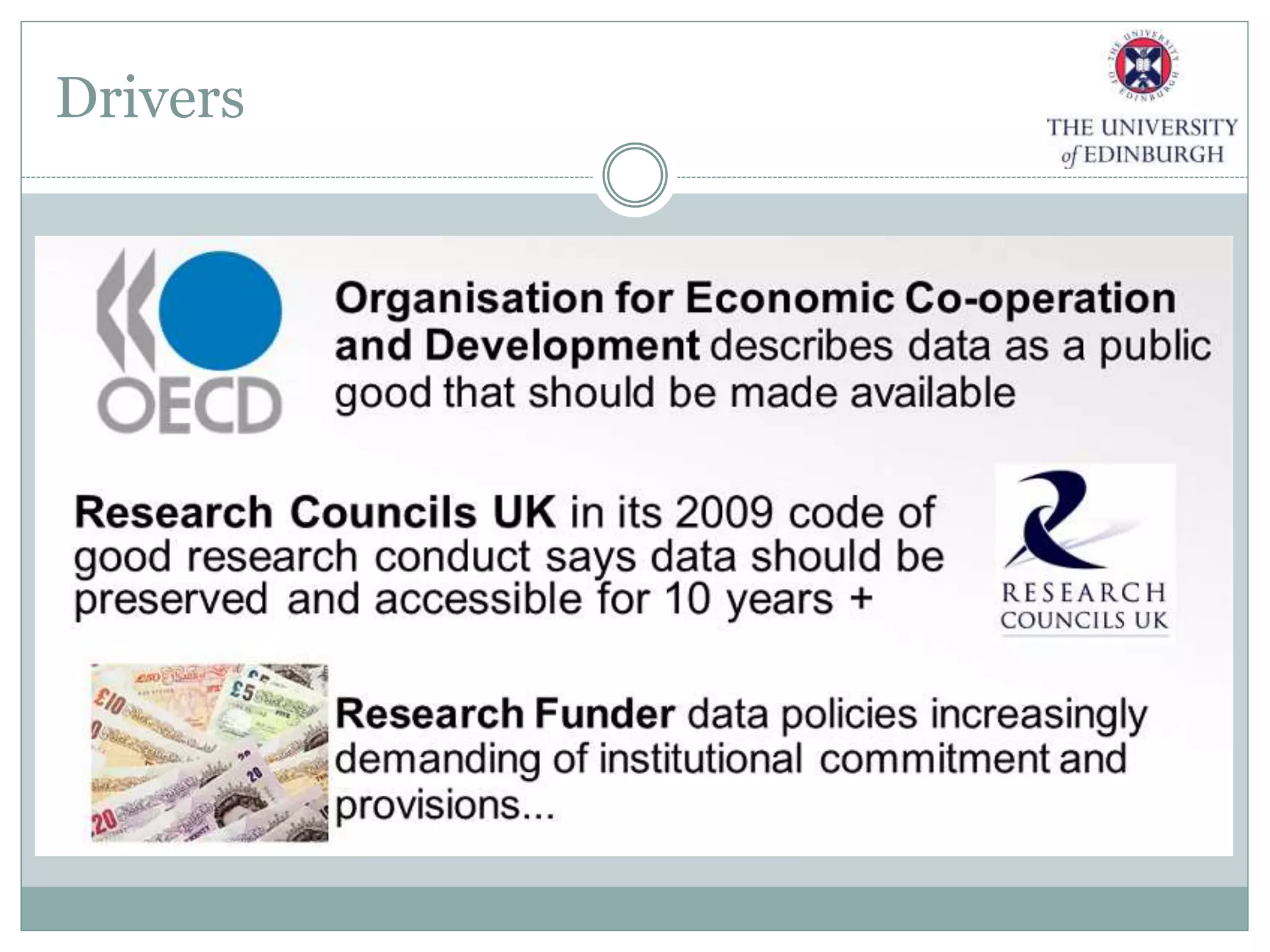
Drivers
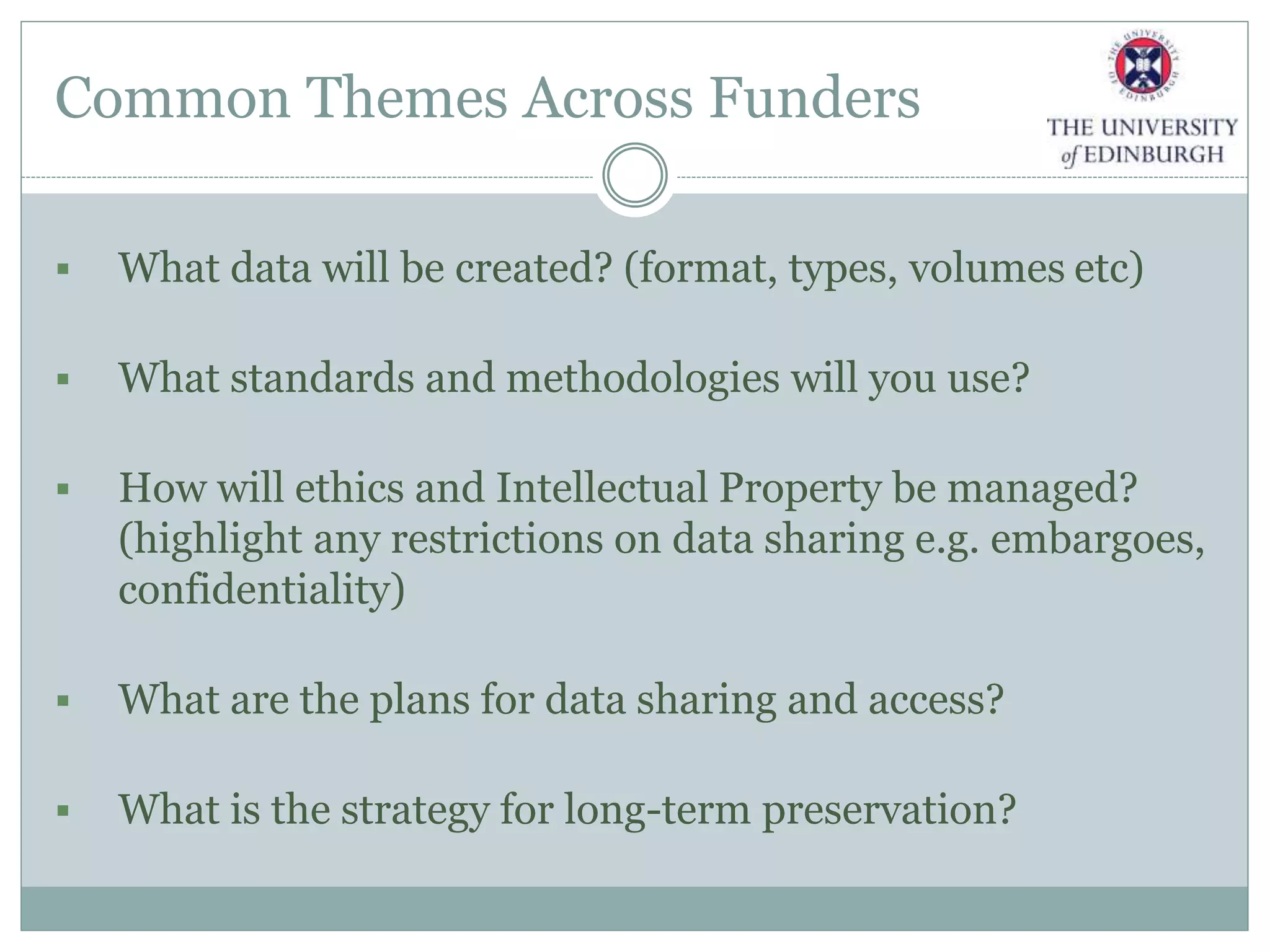
Common Themes Across Funders
 What data will be created? (format, types, volumes etc)
 What standards and methodologies will you use?
 How will ethics and Intellectual Property be managed?
(highlight any restrictions on data sharing e.g. embargoes,
confidentiality)
 What are the plans for data sharing and access?
 What is the strategy for long-term preservation?
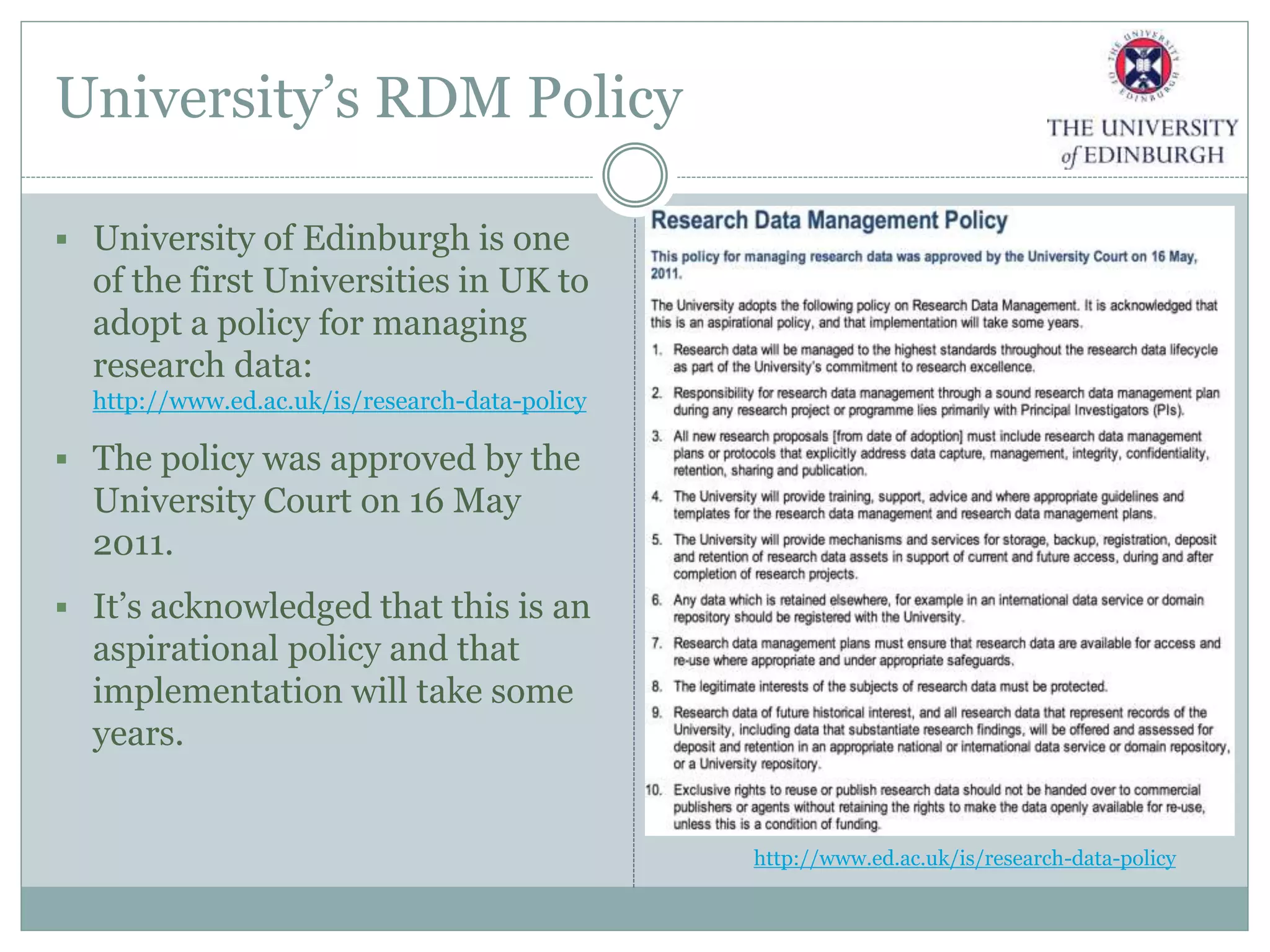
University’s RDM Policy
 University of Edinburgh is one
of the first Universities in UK to
adopt a policy for managing
research data:
http://www.ed.ac.uk/is/research-data-policy
 The policy was approved by the
University Court on 16 May
2011.
 It’s acknowledged that this is an
aspirational policy and that
implementation will take some
years.
http://www.ed.ac.uk/is/research-data-policy
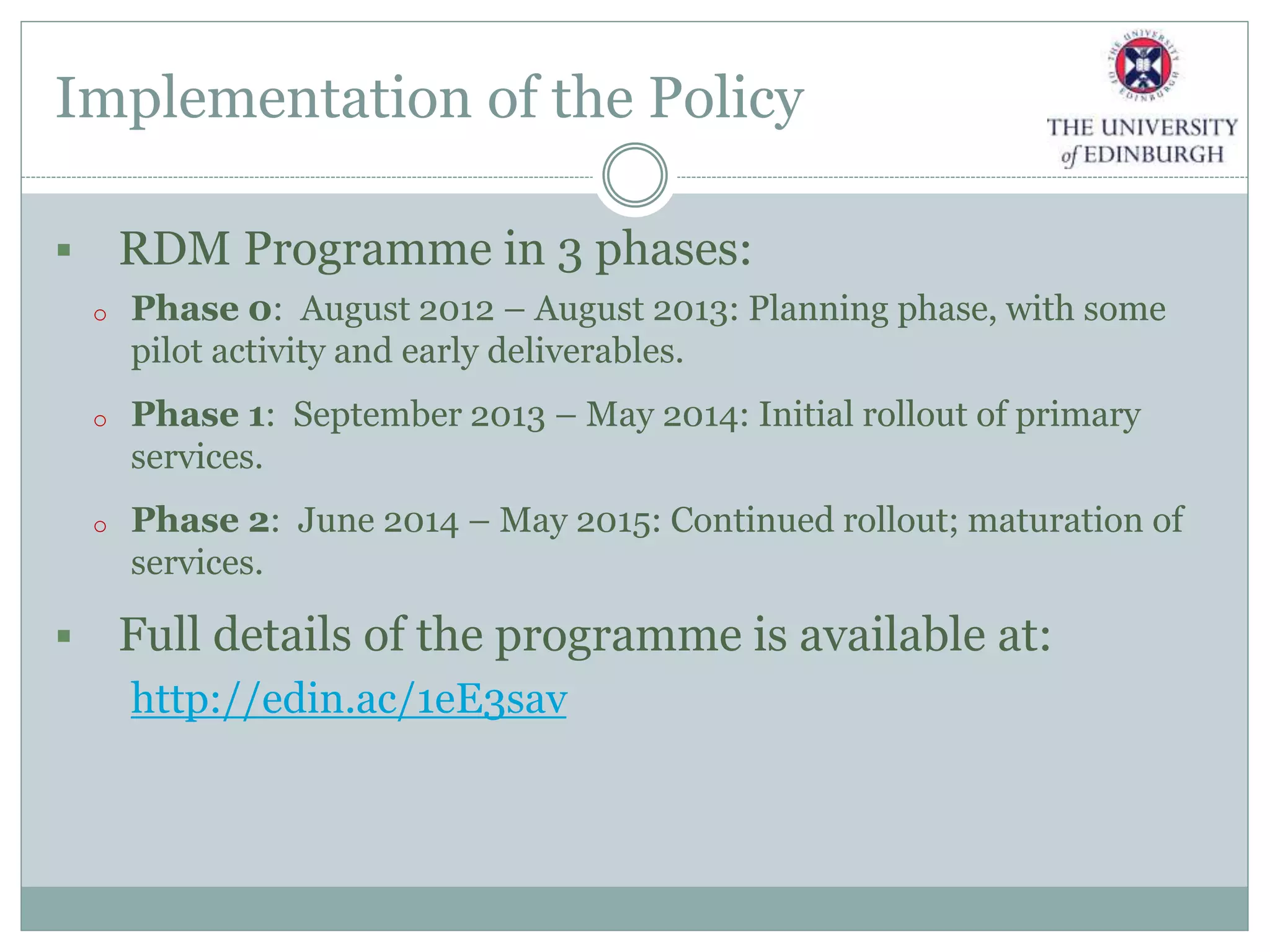
Implementation of the Policy
 RDM Programme in 3 phases:
o Phase 0: August 2012 – August 2013: Planning phase, with some
pilot activity and early deliverables.
o Phase 1: September 2013 – May 2014: Initial rollout of primary
services.
o Phase 2: June 2014 – May 2015: Continued rollout; maturation of
services.
 Full details of the programme is available at:
http://edin.ac/1eE3sav
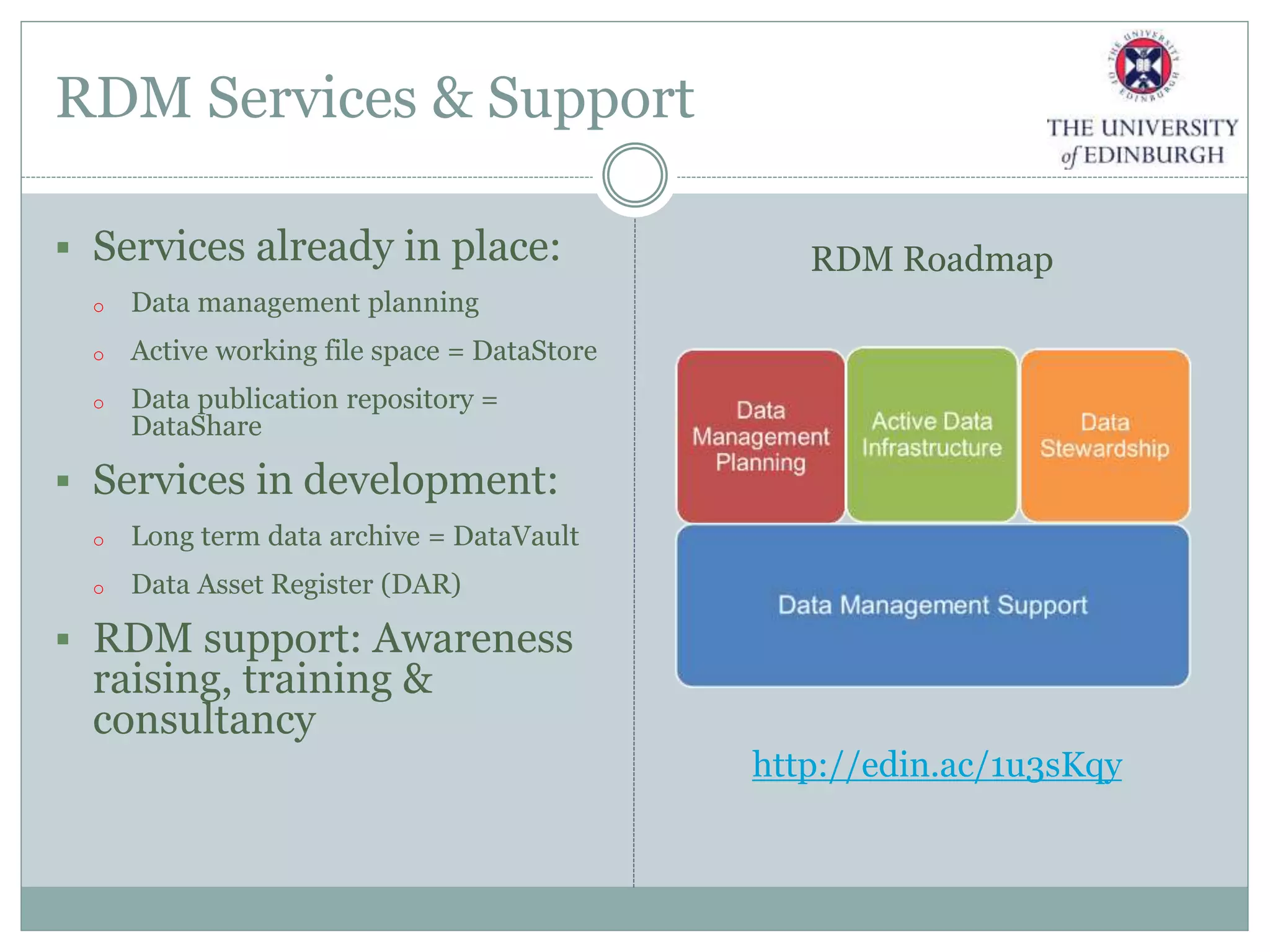
RDM Services & Support
 Services already in place:
o Data management planning
o Active working file space = DataStore
o Data publication repository =
DataShare
 Services in development:
o Long term data archive = DataVault
o Data Asset Register (DAR)
 RDM support: Awareness
raising, training &
consultancy
http://edin.ac/1u3sKqy
RDM Roadmap
Data Management Planning
Support and services for planning activities that are
performed before research data are collected or
created
o Tailored DMP assistance for researchers submitting research
proposals
o Customised DMPonline for University of Edinburgh use
What is a Data Management Plan (DMP)?
DMPs are written at the start of a project to define:
 What data will be collected or created?
 How the data will be documented and described?
 Where the data will be stored?
 Who will be responsible for data security and backup?
 Which data will be shared and/or preserved?
 How the data will be shared and with whom?
Support for DMP
 Academic Support Librarians have received RDM training, including
training on writing Data Management Plans.
 CHSS Research Administrators staff will be receiving training in May
to provide support at the grant application stage. This will be
extended to the Research Administrators in CSE & MVM.
 ERI staff will be receiving RDM training.
 Tailored DMP courses for research staff and PGRs are being
delivered.
 MANTRA also has a module on DMP for self-paced learning.
 General RDM queries can be sent to the Helpline who will direct them
as appropriate.
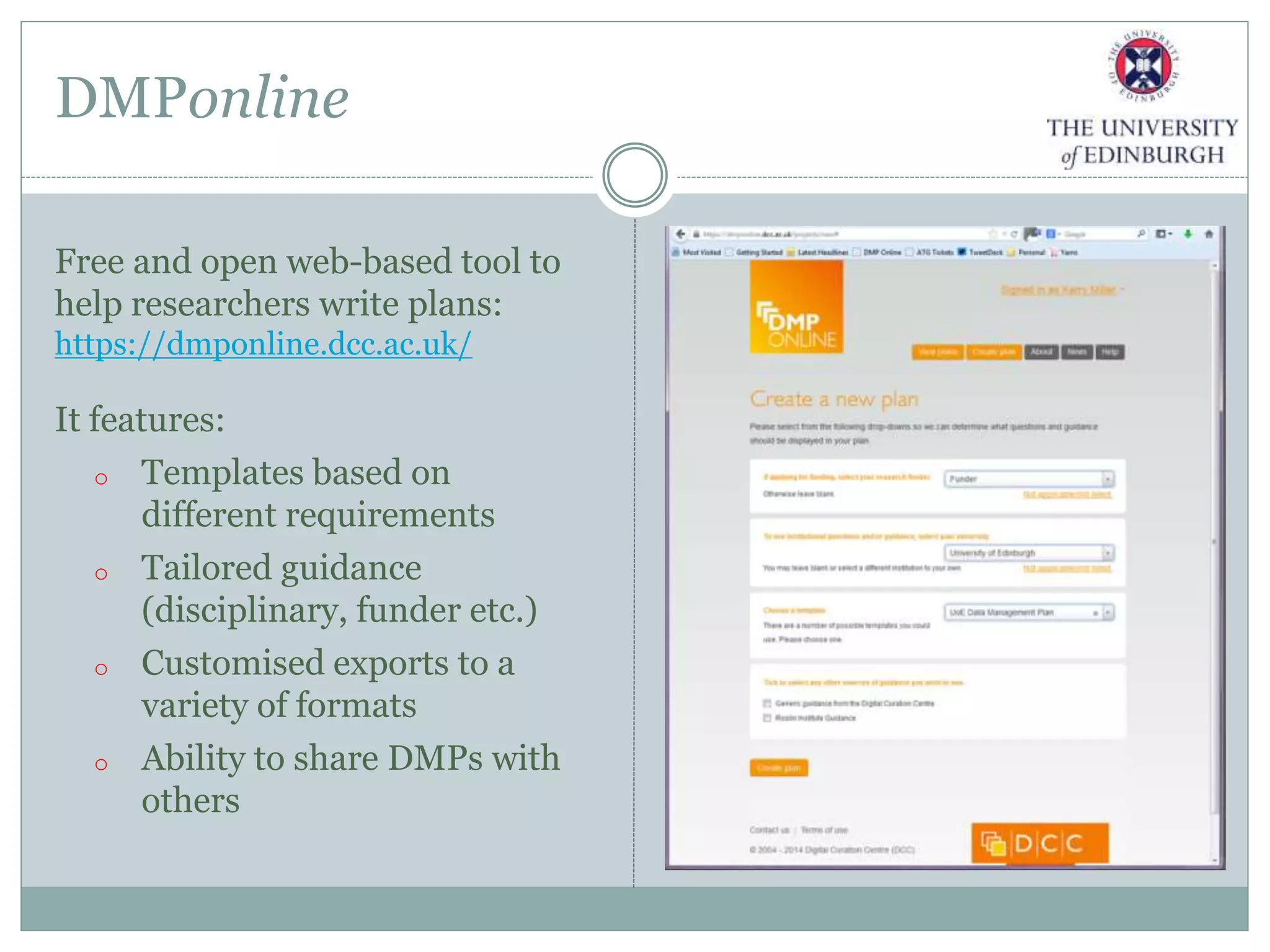
DMPonline
Free and open web-based tool to
help researchers write plans:
https://dmponline.dcc.ac.uk/
It features:
o Templates based on
different requirements
o Tailored guidance
(disciplinary, funder etc.)
o Customised exports to a
variety of formats
o Ability to share DMPs with
others
Templates and Guidance
 Edinburgh University Templates and Guidance are still in
draft.
 Edinburgh University Guidance is provided for those applying
to: AHRC, BBSRC, CRUK, ESRC, MRC, NSF, NERC, STFC, &
Wellcome Trust.
 Edinburgh University Templates are available for Researchers
and PGRs not applying to any of the above.
 Specific Guidance is given for those working at the Roslin
Institute.
DataStore
 The facility to store data that are
actively used in current research
activities
 Provision: 1.6PB storage initially
 0.5 TB (500GB) per researchers,
PGR upwards
 Up to 0.25TB of each allocation can
be used to create “shared” group
storage
 Cost of extra storage: £200 per TB
per year= 1TB primary storage, 10
days online file history, 60 days
backup, DR copy
 Early adopters in three Colleges:
Geosciences; Philosophy, Psychology, &
Language Sciences; Population Health
Sciences; Biological Sciences; Clinical
Neurosciences; and Social & Political
Sciences
 CHSS: all personal spaces rolled out,
waiting for information required for
construction of group spaces. CHSS IT
will roll it out to individual staff and
ensure they have the right information
to use the space.
 All other schools /research centres in
CSE & MVM will follow.
DataShare
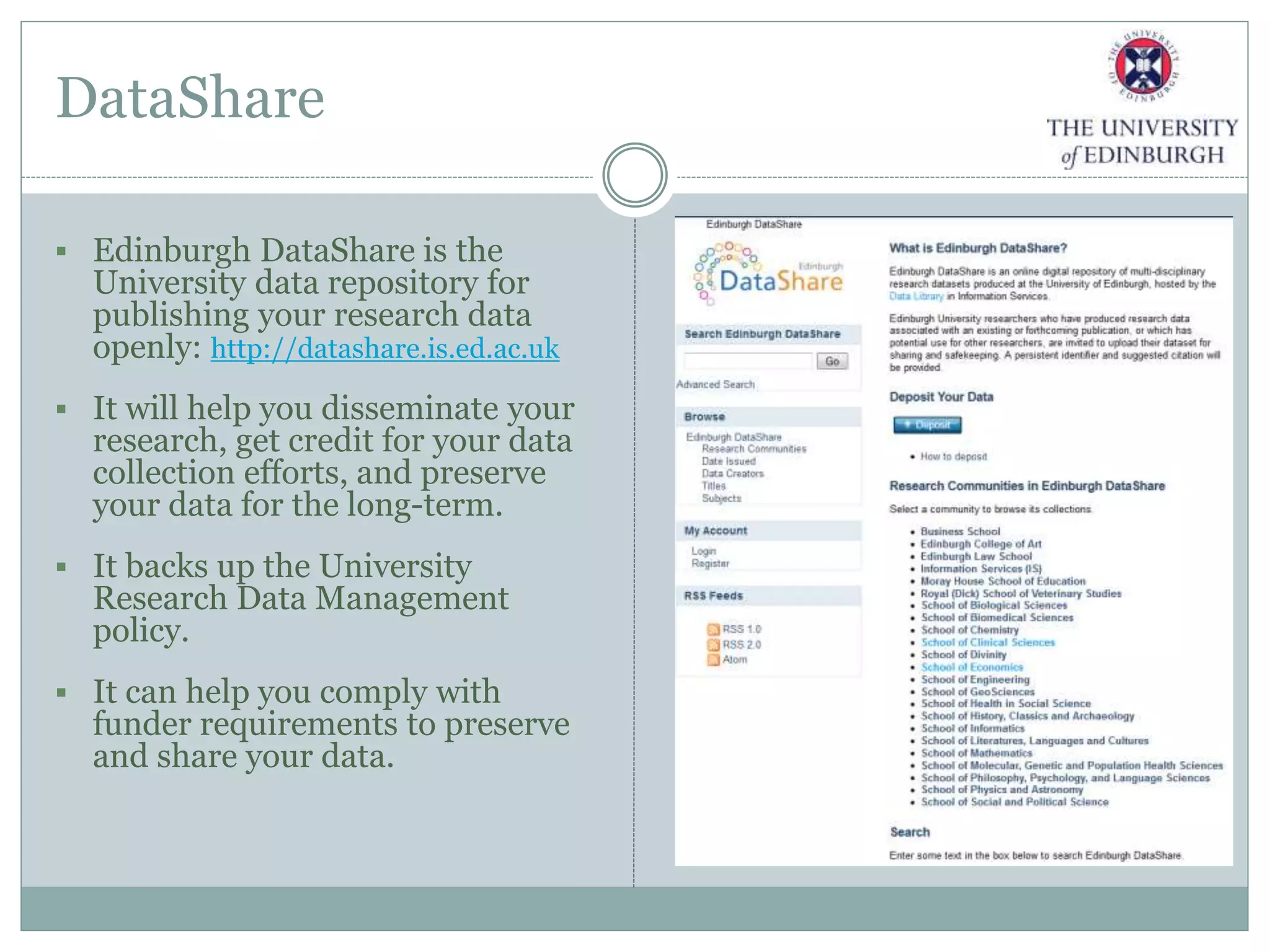
 Edinburgh DataShare is the
University data repository for
publishing your research data
openly: http://datashare.is.ed.ac.uk
 It will help you disseminate your
research, get credit for your data
collection efforts, and preserve
your data for the long-term.
 It backs up the University
Research Data Management
policy.
 It can help you comply with
funder requirements to preserve
and share your data.
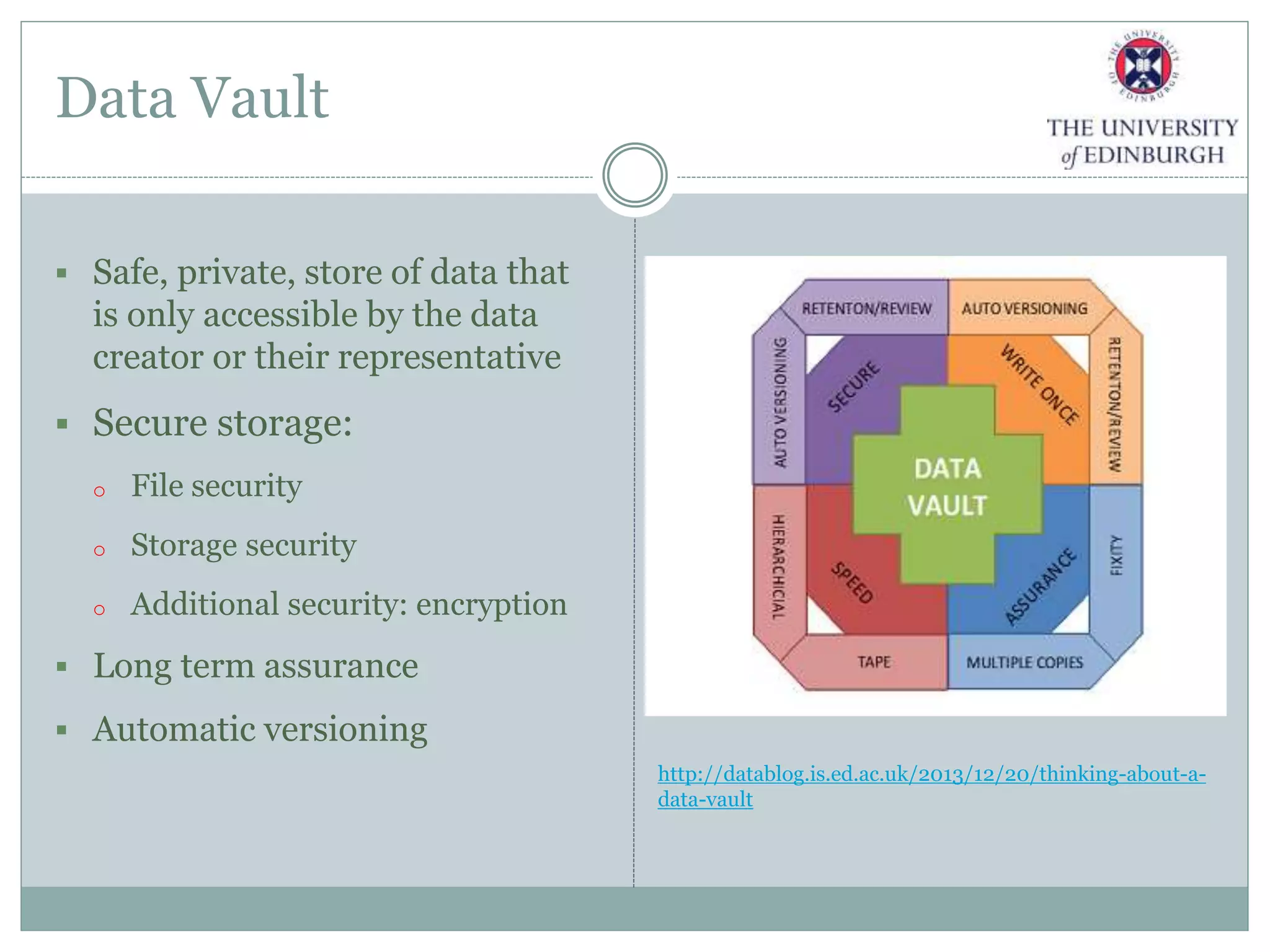
Data Vault
 Safe, private, store of data that
is only accessible by the data
creator or their representative
 Secure storage:
o File security
o Storage security
o Additional security: encryption
 Long term assurance
 Automatic versioning
http://datablog.is.ed.ac.uk/2013/12/20/thinking-about-a-
data-vault
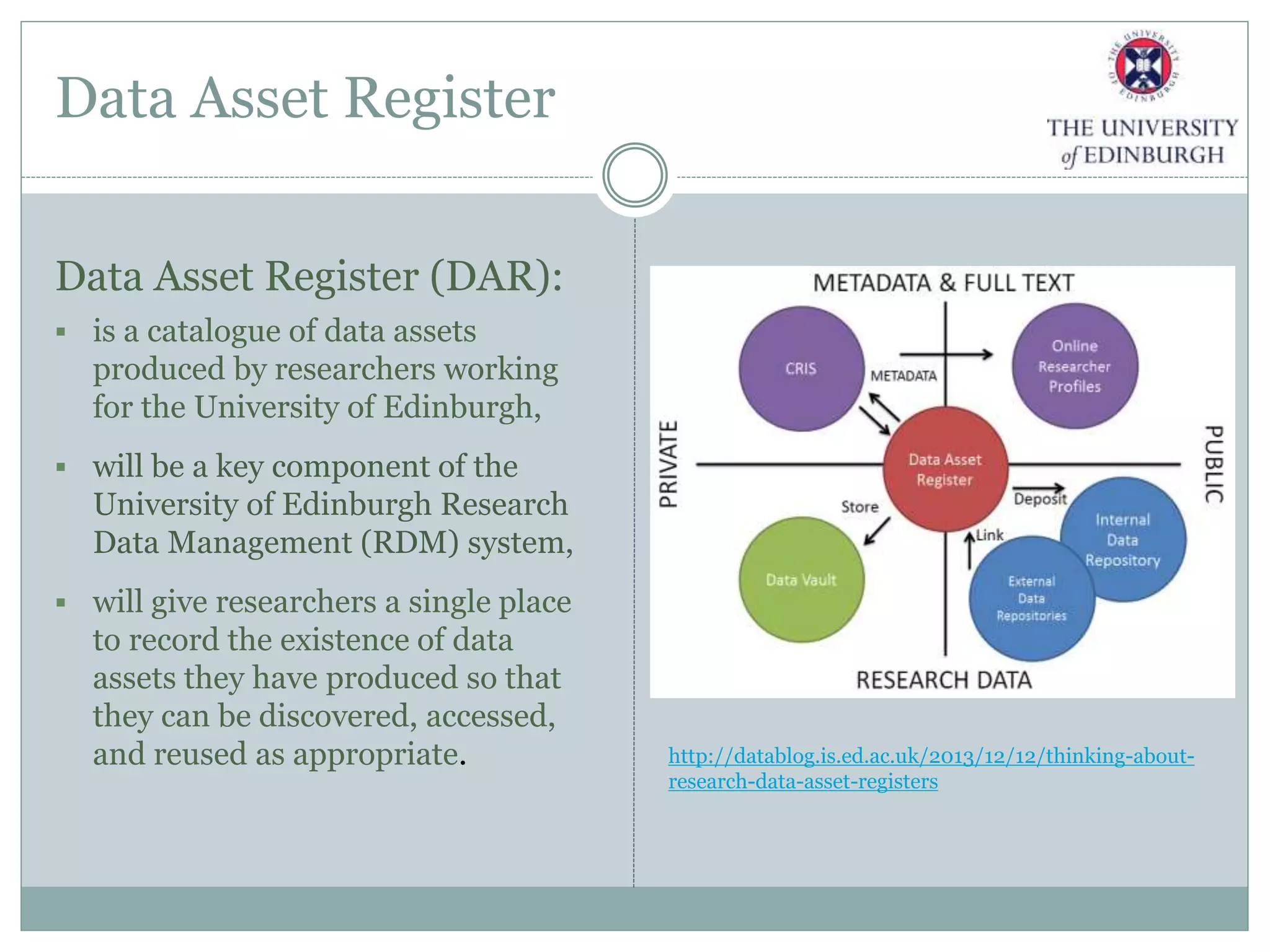
Data Asset Register
Data Asset Register (DAR):
 is a catalogue of data assets
produced by researchers working
for the University of Edinburgh,
 will be a key component of the
University of Edinburgh Research
Data Management (RDM) system,
 will give researchers a single place
to record the existence of data
assets they have produced so that
they can be discovered, accessed,
and reused as appropriate. http://datablog.is.ed.ac.uk/2013/12/12/thinking-about-
research-data-asset-registers
RDM Support
Make the most of local support!
 Research Administrators in your School. We work with
the RAs in each School.
 Your Academic Support Librarian.
 IT staff in your School.
 ERI staff. They will be receiving RDM training.
 Your School’s Ethics Committee
 Bespoke RDM email address or queries can be sent to the
Helpline who will direct them as appropriate.
Communications Activities
There are three key messages which will need to be tailored and made
timely and relevant to our target audiences.
The core of each message however must be maintained to ensure that
everyone gains the same level of understanding.
1. The University is committed to and has invested in RDM
o services, training, support
2. What is meant by Research Data Management?
o definitions, data lifecycle, responsibilities
3. The University is supporting researchers
o encourage good research practice, effect culture change
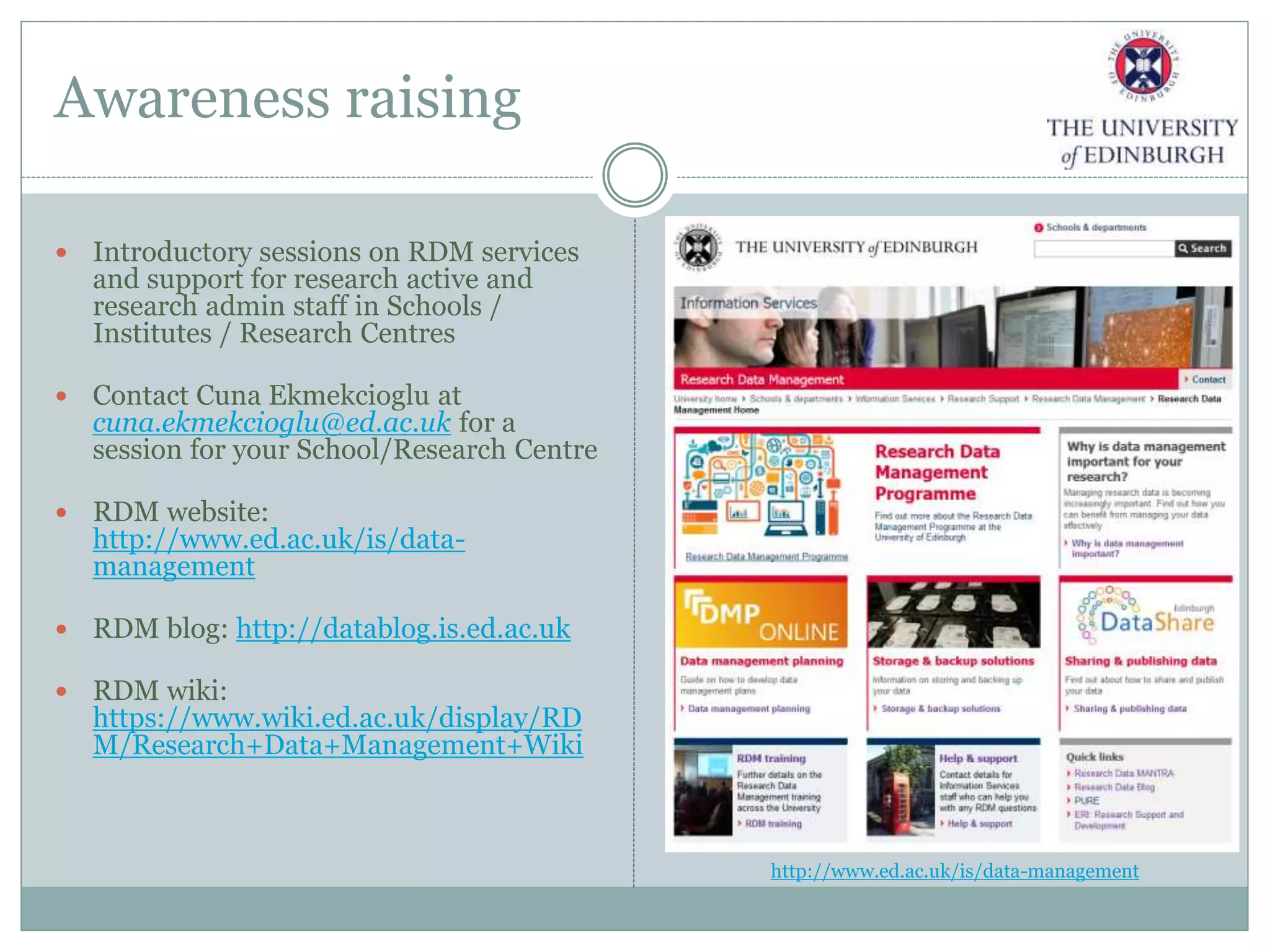
Awareness raising
 Introductory sessions on RDM services
and support for research active and
research admin staff in Schools /
Institutes / Research Centres
 Contact Cuna Ekmekcioglu at
cuna.ekmekcioglu@ed.ac.uk for a
session for your School/Research Centre
 RDM website:
http://www.ed.ac.uk/is/data-
management
 RDM blog: http://datablog.is.ed.ac.uk
 RDM wiki:
https://www.wiki.ed.ac.uk/display/RD
M/Research+Data+Management+Wiki
http://www.ed.ac.uk/is/data-management
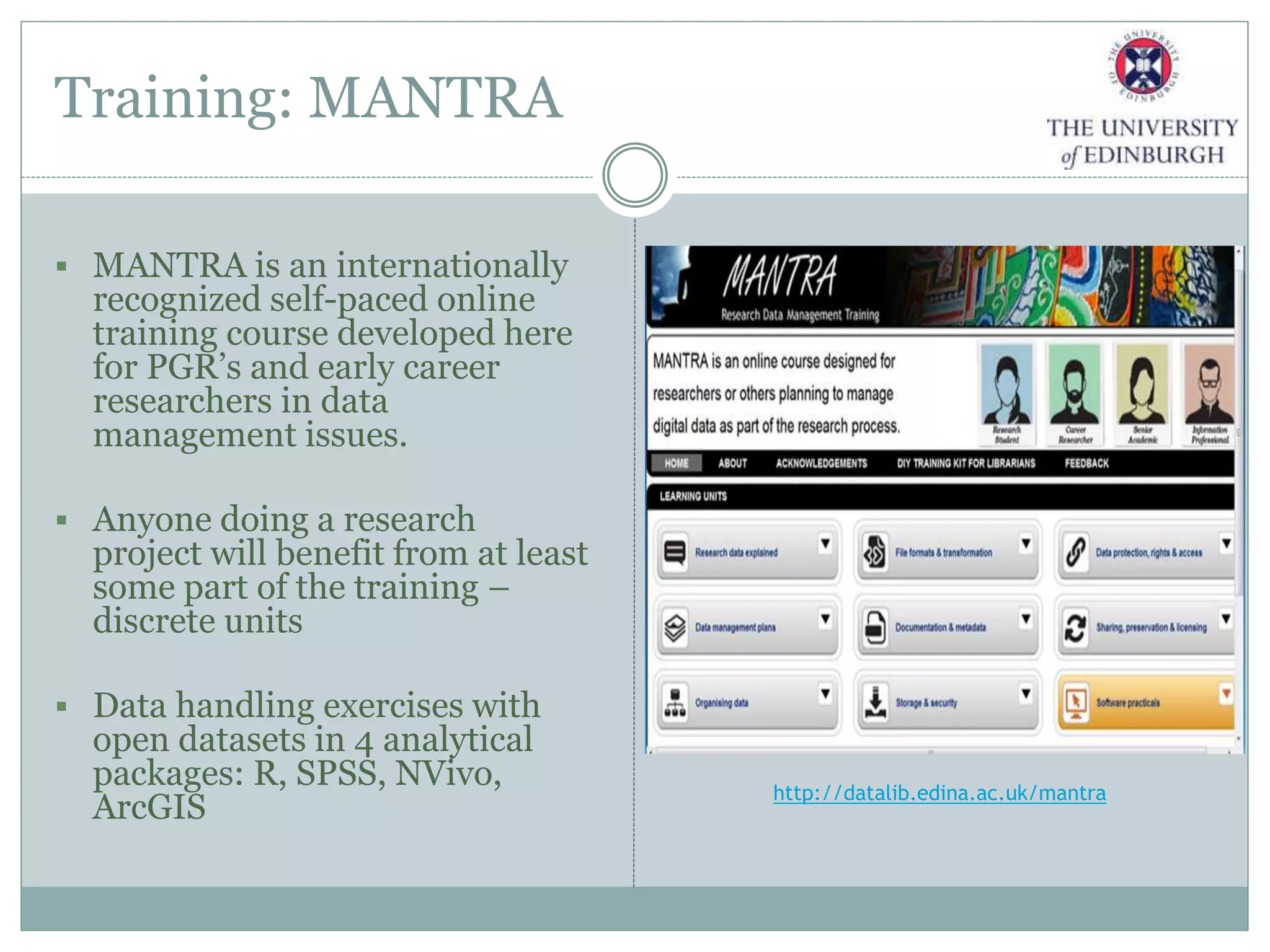
Training: MANTRA
 MANTRA is an internationally
recognized self-paced online
training course developed here
for PGR’s and early career
researchers in data
management issues.
 Anyone doing a research
project will benefit from at least
some part of the training –
discrete units
 Data handling exercises with
open datasets in 4 analytical
packages: R, SPSS, NVivo,
ArcGIS
http://datalib.edina.ac.uk/mantra
Training: Tailored courses
 A range of training programmes
on research data management
(RDM) in the form of
workshops, power sessions,
seminars and drop in sessions to
help researchers with research
data management issues
 http://www.ed.ac.uk/schools-
departments/information-
services/research-support/data-
management/rdm-training
 Creating a data management plan
for your grant application
 Research Data Management
Programme at the University of
Edinburgh
 Good practice in Research Data
Management
 Handling data using SPSS
 Handling data with ArcGIS
 Registration via MyED:
http://edin.ac/1kRMPv3

Progress so far
 Data Share – Live Now
 DMPonline – Live Now
 Website – Live Now
 Data Management Planning Support – Aug 2014
 Data Store – Roll-out completed by Dec 2014
 Training – Ongoing
 Awareness Raising - Ongoing
 Data Asset Register – Dec 2014
 Data Vault – Dec 2014
Any questions?

Research Data Management at the University of Edinburgh

  • 1.
    S t ua r t M a c d o n a l d A s s o c i a t e D a t a L i b r a r i a n s t u a r t . m a c d o n a l d @ e d . a c . u k Research Data Management at the University of Edinburgh College of Science and Engineering - "What's new for you in the Library“, Murray Library, Kings Buildings, University of Edinburgh. 28 May 2014
  • 2.
    Overview  Research Data Research Data Management  Funder Policies and University’s RDM Policy  RDM Services and Support  Awareness Raising  Training  Progress so far
  • 3.
    Defining Research Data Research data are collected, observed or created, for the purposes of analysis to produce and validate original research results.  Research data can be generated for different purposes and through different processes in a multitude of digital formats  Both analogue and digital materials are ‘data’.  Digital data can be: o created in a digital form ('born digital') o converted to a digital form (digitised)
  • 4.
    Types of ResearchData  Instrument measurements  Experimental observations  Still images, video and audio  Text documents, spreadsheets, databases  Quantitative data (e.g. household survey data)  Survey results & interview transcripts  Simulation data, models & software  Slides, artefacts, specimens, samples  Sketches, diaries, lab notebooks …
  • 5.
    Research Data Management Research data management is caring for, facilitating access to, preserving and adding value to research data throughout their lifecycle.  Data management is one of the essential areas of responsible conduct of research.  It provides a framework that supports researchers and their data throughout the course of their research and beyond.
  • 6.
    Activities involved inRDM  Data Management Planning  Creating data  Documenting data  Accessing / using data  Storage and backup  Sharing data  Preserving data
  • 7.
    Benefits By managing yourdata well you will:  Meet funder / university / industry requirements.  Ensure data are accurate, complete, authentic and reliable – as per good research practice.  Ensure research integrity and replication.  Enhance data security & minimise the risk of loss.  Protect important IPR.  Increase efficiency - save time & resources.  Increase impact by sharing data (increase in citations 9 - 30% : Piwowar & Vision 2013)
  • 8.
  • 9.
    Common Themes AcrossFunders  What data will be created? (format, types, volumes etc)  What standards and methodologies will you use?  How will ethics and Intellectual Property be managed? (highlight any restrictions on data sharing e.g. embargoes, confidentiality)  What are the plans for data sharing and access?  What is the strategy for long-term preservation?
  • 10.
    University’s RDM Policy University of Edinburgh is one of the first Universities in UK to adopt a policy for managing research data: http://www.ed.ac.uk/is/research-data-policy  The policy was approved by the University Court on 16 May 2011.  It’s acknowledged that this is an aspirational policy and that implementation will take some years. http://www.ed.ac.uk/is/research-data-policy
  • 11.
    Implementation of thePolicy  RDM Programme in 3 phases: o Phase 0: August 2012 – August 2013: Planning phase, with some pilot activity and early deliverables. o Phase 1: September 2013 – May 2014: Initial rollout of primary services. o Phase 2: June 2014 – May 2015: Continued rollout; maturation of services.  Full details of the programme is available at: http://edin.ac/1eE3sav
  • 12.
    RDM Services &Support  Services already in place: o Data management planning o Active working file space = DataStore o Data publication repository = DataShare  Services in development: o Long term data archive = DataVault o Data Asset Register (DAR)  RDM support: Awareness raising, training & consultancy http://edin.ac/1u3sKqy RDM Roadmap
  • 13.
    Data Management Planning Supportand services for planning activities that are performed before research data are collected or created o Tailored DMP assistance for researchers submitting research proposals o Customised DMPonline for University of Edinburgh use
  • 14.
    What is aData Management Plan (DMP)? DMPs are written at the start of a project to define:  What data will be collected or created?  How the data will be documented and described?  Where the data will be stored?  Who will be responsible for data security and backup?  Which data will be shared and/or preserved?  How the data will be shared and with whom?
  • 15.
    Support for DMP Academic Support Librarians have received RDM training, including training on writing Data Management Plans.  CHSS Research Administrators staff will be receiving training in May to provide support at the grant application stage. This will be extended to the Research Administrators in CSE & MVM.  ERI staff will be receiving RDM training.  Tailored DMP courses for research staff and PGRs are being delivered.  MANTRA also has a module on DMP for self-paced learning.  General RDM queries can be sent to the Helpline who will direct them as appropriate.
  • 16.
    DMPonline Free and openweb-based tool to help researchers write plans: https://dmponline.dcc.ac.uk/ It features: o Templates based on different requirements o Tailored guidance (disciplinary, funder etc.) o Customised exports to a variety of formats o Ability to share DMPs with others
  • 17.
    Templates and Guidance Edinburgh University Templates and Guidance are still in draft.  Edinburgh University Guidance is provided for those applying to: AHRC, BBSRC, CRUK, ESRC, MRC, NSF, NERC, STFC, & Wellcome Trust.  Edinburgh University Templates are available for Researchers and PGRs not applying to any of the above.  Specific Guidance is given for those working at the Roslin Institute.
  • 18.
    DataStore  The facilityto store data that are actively used in current research activities  Provision: 1.6PB storage initially  0.5 TB (500GB) per researchers, PGR upwards  Up to 0.25TB of each allocation can be used to create “shared” group storage  Cost of extra storage: £200 per TB per year= 1TB primary storage, 10 days online file history, 60 days backup, DR copy  Early adopters in three Colleges: Geosciences; Philosophy, Psychology, & Language Sciences; Population Health Sciences; Biological Sciences; Clinical Neurosciences; and Social & Political Sciences  CHSS: all personal spaces rolled out, waiting for information required for construction of group spaces. CHSS IT will roll it out to individual staff and ensure they have the right information to use the space.  All other schools /research centres in CSE & MVM will follow.
  • 19.
    DataShare  Edinburgh DataShareis the University data repository for publishing your research data openly: http://datashare.is.ed.ac.uk  It will help you disseminate your research, get credit for your data collection efforts, and preserve your data for the long-term.  It backs up the University Research Data Management policy.  It can help you comply with funder requirements to preserve and share your data.
  • 20.
    Data Vault  Safe,private, store of data that is only accessible by the data creator or their representative  Secure storage: o File security o Storage security o Additional security: encryption  Long term assurance  Automatic versioning http://datablog.is.ed.ac.uk/2013/12/20/thinking-about-a- data-vault
  • 21.
    Data Asset Register DataAsset Register (DAR):  is a catalogue of data assets produced by researchers working for the University of Edinburgh,  will be a key component of the University of Edinburgh Research Data Management (RDM) system,  will give researchers a single place to record the existence of data assets they have produced so that they can be discovered, accessed, and reused as appropriate. http://datablog.is.ed.ac.uk/2013/12/12/thinking-about- research-data-asset-registers
  • 22.
    RDM Support Make themost of local support!  Research Administrators in your School. We work with the RAs in each School.  Your Academic Support Librarian.  IT staff in your School.  ERI staff. They will be receiving RDM training.  Your School’s Ethics Committee  Bespoke RDM email address or queries can be sent to the Helpline who will direct them as appropriate.
  • 23.
    Communications Activities There arethree key messages which will need to be tailored and made timely and relevant to our target audiences. The core of each message however must be maintained to ensure that everyone gains the same level of understanding. 1. The University is committed to and has invested in RDM o services, training, support 2. What is meant by Research Data Management? o definitions, data lifecycle, responsibilities 3. The University is supporting researchers o encourage good research practice, effect culture change
  • 24.
    Awareness raising  Introductorysessions on RDM services and support for research active and research admin staff in Schools / Institutes / Research Centres  Contact Cuna Ekmekcioglu at cuna.ekmekcioglu@ed.ac.uk for a session for your School/Research Centre  RDM website: http://www.ed.ac.uk/is/data- management  RDM blog: http://datablog.is.ed.ac.uk  RDM wiki: https://www.wiki.ed.ac.uk/display/RD M/Research+Data+Management+Wiki http://www.ed.ac.uk/is/data-management
  • 25.
    Training: MANTRA  MANTRAis an internationally recognized self-paced online training course developed here for PGR’s and early career researchers in data management issues.  Anyone doing a research project will benefit from at least some part of the training – discrete units  Data handling exercises with open datasets in 4 analytical packages: R, SPSS, NVivo, ArcGIS http://datalib.edina.ac.uk/mantra
  • 26.
    Training: Tailored courses A range of training programmes on research data management (RDM) in the form of workshops, power sessions, seminars and drop in sessions to help researchers with research data management issues  http://www.ed.ac.uk/schools- departments/information- services/research-support/data- management/rdm-training  Creating a data management plan for your grant application  Research Data Management Programme at the University of Edinburgh  Good practice in Research Data Management  Handling data using SPSS  Handling data with ArcGIS  Registration via MyED: http://edin.ac/1kRMPv3 
  • 27.
    Progress so far Data Share – Live Now  DMPonline – Live Now  Website – Live Now  Data Management Planning Support – Aug 2014  Data Store – Roll-out completed by Dec 2014  Training – Ongoing  Awareness Raising - Ongoing  Data Asset Register – Dec 2014  Data Vault – Dec 2014
  • 28.