Geography
STUDY GUIDE
GRADE
12
Geography
STUDY GUIDE
GRADE
12
© Department of Basic Education 2014
This content may not be sold or used for commercial purposes.
Curriculum and Assessment Policy Statement (CAPS) Mind the Gap Grade 12
Study Guide Geography
ISBN 978-1-4315-1948-4
This publication has a Creative Commons Attribution NonCommercial Sharealike
license. You can use, modify, upload, download, and share content, but you
must acknowledge the Department of Basic Education, the authors and
contributors. If you make any changes to the content you must send the changes
to the Department of Basic Education. This content may not be sold or used for
commercial purposes. For more information about the terms of the license please
see:
http://creativecommons.org/licenses/by-nc-sa/3.0/.
Copyright © Department of Basic Education 2014
222 Struben Street, Pretoria, South Africa
Contact person: Dr Patricia Watson
Email: watson.p@dbe.gov.za
Tel: (012) 357 4502
http://www.education.gov.za
Call Centre: 0800202933
The first edition published in 2012 Revised National Curriculum Statement (RNCS)
Mind the Gap Grade 12 Study Guide Geography: ISBN 978-0-621-4090
Second edition published in 2014 Curriculum and Assessment Policy Statement
(CAPS) Mind the Gap Grade 12 Study Guide Geography: ISBN 978-1-4315-1948-
4
Mind the Gap team
Series managing editor: Dr Patricia Watson
Production co-ordinators for CAPS edition: Lisa Treffry-Goatley and Radha Pillay
Authors: Julian, Alkasater Richard Brown, Gail Davidson, Mpho Chuene, Gail
Davidson, Ivy Hughes, Portia January, Cedric Kruger, Xolisa Luthi, Johannes
Matlaupe Mashitoa, Mosebestsi Mofokeng, Selvia Singh, Ireen Turpin
Expert readers: Anthony Blignaut, Allison Lamb, Steven Marokane, Tsakane
Mongwe, Vincent Pillay, Pule Rakgoathe, Muofhe Thenga
Editors: Renee Ferreira, Julia Grey
Proofreader: Jenny de Wet
Designers: Alicia Arntzen, Philisiwe Nkosi, Michele Dean, Nomalizo Ngwenya
Study skills: Margarita Karnasopoulos
Illustrators: Michele Dean, Kenneth Kunene, Vusi Malindi, Bié Venter
Cover illustration: Alastair Findlay
Onsite writers’workshop support: Wayne Cussons
© Department of Basic Education 2014
Ministerial foreword
The Department of Basic Education has pleasure in releasing the second
edition of Mind the Gap study guides for Grade 12 learners. These study
guides continue the innovative and committed attempt by the Department
of Basic Education to improve the academic performance of Grade 12
candidates in the National Senior Certificate (NSC) examination.
The study guides have been written by subject expert teams comprised
of teachers, examiners, moderators, subject advisors and subject co-
ordinators. Research started in 2012 shows that the Mind the Gap series
has, without doubt, had a positive impact in improving grades. It is my
fervent wish that the Mind the Gap study guides take us all closer towards
ensuring that no learner is left behind, especially as we move forward in
our celebration of 20 years of democracy.
The second edition of Mind the Gap is aligned to the 2014 Curriculum and
Assessment Policy Statement (CAPS). This means that the writers have
considered the National Policy pertaining to the programme, promotion
requirements and protocol for assessment of the National Curriculum
Statement for Grade 12 in 2014.
The Mind the Gap CAPS study guides take their brief in part from the 2013
National Diagnostic report on learner performance and draws on the
2014 Grade 12 Examination Guidelines. Each of the Mind the Gap study
guides provides explanations of key terminology, simple explanations and
examples of the types of questions that learners can expect to be asked in
an exam. Marking memoranda are included to assist learners in building
their understanding. Learners are also referred to specific questions in
past national exam papers and examination memos that are available on
the Department’s website – www.education.gov.za.
The CAPS edition include Accounting, Economics, Geography, Life
Sciences, Mathematics, Mathematical Literacy and Physical Sciences.
The series is produced in both English and Afrikaans. There are also
nine English First Additional Language study guides. They include EFAL
Paper 1 (Language); EFAL Paper 3 (Writing); and a study guide for each of
the Grade 12 prescribed literature set works.
The study guides have been designed to assist those learners who
have been underperforming due to a lack of exposure to the content
requirements of the curriculum and aims to mind-the-gap between failing
and passing, by bridging the gap in learners’ understanding of commonly
tested concepts so candidates can pass.
All that is now required is for our Grade 12 learners to put in the hours
preparing for the examinations. Learners make us proud – study hard. We
wish each and every one of you good luck for your Grade 12 examinations.
_________________________________
Matsie Angelina Motshekga, MP
Minister of Basic Education
May 2014
© Department of Basic Education 2014
Matsie Angelina Motshekga, MP
Minister of Basic Education
© Department of Basic Education 2014
Mind the Gap CAPS Grade 12 Geography CONTENTS v
Table of Contents
Dear Grade 12 learner.........................................................................................................vii
How to use this study guide...............................................................................................viii
Top 10 study tips...................................................................................................................ix
Question words to help you answer questions................................................................xiv
Study skills to boost your learning.......................................................................................x
On the day of the exam … .................................................................................................xiii
Learner’s checklist...............................................................................................................xv
Chapter 1: Climate and weather....................................................................... 1
KEY CONCEPTS......................................................................................................................2
1.1.Introduction.................................................................................................................3
1.1.1 Synoptic weather map interpretation...........................................................3
1.1.2 Global winds/planetary winds......................................................................6
1.2.Cyclones......................................................................................................................6
1.2.1 Mid-latitude cyclones ....................................................................................6
1.2.2 Tropical cyclones............................................................................................8
1.2.3 Characteristics of mid-latitude cyclones and tropical cyclones..................9
1.3 Factors affecting the South African climate........................................................... 11
1.3.1 The impact of the ocean and the ocean currents on South Africa’s
climate......................................................................................................... 11
1.3.2 The impact of the plateau on South Africa’s climate............................... 13
1.3.3 The impact of the subtropical high pressure belt on South Africa’s
climate......................................................................................................... 13
1.4 Local Climate (valley and city climate)................................................................... 16
1.4.1 Anabatic and katabatic winds.................................................................... 16
1.4.2 Aspect.......................................................................................................... 17
1.4.3 City climates................................................................................................ 19
Chapter 2: Geomorphology............................................................................. 21
KEY CONCEPTS....................................................................................................................21
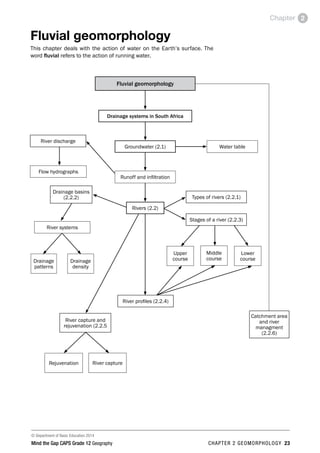
Fluvial geomorphology...................................................................................................... 23
2.1 Groundwater............................................................................................................. 24
2.2 Rivers........................................................................................................................ 26
2.2.1 Types of rivers............................................................................................. 26
2.2.2 Drainage basins.......................................................................................... 29
2.2.3 Stages of a river.......................................................................................... 32
2.2.4 River profiles............................................................................................... 33
2.2.5 River capture and rejuvenation................................................................. 35
2.2.6 Catchment and river management............................................................ 38
Chapter 3: Rural settlement and urban settlement....................................... 40
KEY CONCEPTS....................................................................................................................41
3.1 Study of settlements................................................................................................ 42
3.1.1 Function....................................................................................................... 42
3.1.2 Size and complexity.................................................................................... 43
3.2 Rural settlements....................................................................................................44
3.2.1 Reasons for the location of rural settlements......................................... 46
3.2.2 Rural-urban migration............................................................................... 48
3.3 Urban settlements................................................................................................... 51
3.3.1 Reasons for the location of urban settlements........................................ 51
3.3.2 Types of urban settlements........................................................................ 52
3.3.3 Structure of an urban area........................................................................ 55
3.3.4 Urban settlement problems....................................................................... 66
3.3.5 Economic, social and environmental injustice......................................... 67
© Department of Basic Education 2014
vi CONTENTS Mind the Gap CAPS Grade 12 Geography
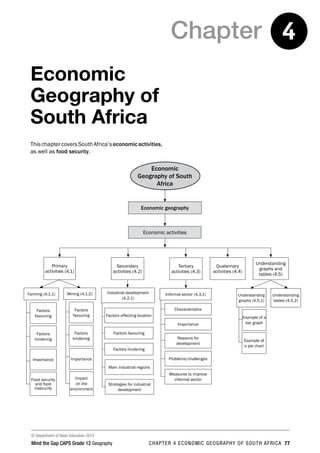
Chapter 4: Economic Geography of South Africa......................................... 77
KEY CONCEPTS................................................................................................................... 78
4.1 Primary economic activities.................................................................................... 80
4.1.1 Farming in South Africa.............................................................................. 81
4.1.2 Mining in South Africa................................................................................84
4.2 Secondary economic activities............................................................................... 85
4.2.1 Industrial development in South Africa..................................................... 86
4.3 Tertiary economic activities..................................................................................... 90
4.3.1 The informal sector in South Africa........................................................... 91
4.4 Quaternary economic activities.............................................................................. 92
4.5 Understanding graphs and tables.......................................................................... 93
4.5.1 Understanding graphs................................................................................ 93
4.5.2 Understanding tables................................................................................. 97
Chapter 5: Mapwork....................................................................................... 100
5.1 Introduction............................................................................................................100
5.2 Some basic mapwork concepts............................................................................101
5.3 Mapwork calculations............................................................................................103
5.3.1 Introduction to mapwork calculations.....................................................103
5.3.2 Mapwork calculations: distance, area and gradient..............................104
5.3.3 Mapwork calculations: true bearing, magnetic declination, magnetic
bearing, position, map sheet reference, vertical exaggeration.............111
5.4 Application of theory to a topographic map and an orthophoto.........................133
5.4.1 Climatology................................................................................................133
5.4.2 Geomorphology.........................................................................................135
5.5 Geographical information systems – GIS.............................................................136
Appendix: Exemplar paper............................................................................ 139
© Department of Basic Education 2014
Mind the Gap CAPS Grade 12 Geography INTRODUCTION vii
Dear Grade 12 learner
This Mind the Gap study guide helps you to prepare for the end-of-year
CAPS Geography Grade 12 exam.
The study guide does NOT cover the entire CAPS curriculum, but it does
focus on core content of each knowledge area and points out where you
can earn easy marks.
You must work your way through this study guide to improve your
understanding, identify your areas of weakness and correct your own
mistakes. To ensure a high-quality pass, you should also cover the
remaining parts of the curriculum using other textbooks and your class
notes.
We are confident that this Mind the Gap study guide can help you to
prepare well so that you pass the end-of-year exams.
Overview of the exam for CAPS
Geography Grade 12
Paper 1 (Theory exam)
225 Marks
Paper 2 (Mapwork exam)
75 Marks
• You are given four questions of
75 marks each in Paper 1. You
are expected to answer only three
questions. Make sure you don’t
repeat a question.
• Carefully read through all the
questions on a topic, including
referring to the diagrams in the
addendum, before you start to
answer the sub-questions. Look out
for clues (hints) that could help you
to answer the questions.
• Use a blue pen to write your
answers. Diagrams should be done
in pencil only.
• Always use point form when
answering questions, except if you
are asked to write a paragraph,
e.g. if a question says: ‘Write a
paragraph of no more than 12
lines...’
• Question 1 – Multiple-choice
(mapwork calculations and some
interpretation): Read each option
carefully to avoid careless mistakes
(15 marks).
• Question 2 – Mapwork skills and
calculations: Write the formula
down for each calculation and show
all workings for all calculations, as
marks are awarded for these steps
(20 marks).
• Question 3 – Interpretation of the
map using your theory knowledge:
Study the map carefully, especially
the blocks mentioned in the
question (e.g. D3), for clues that
could help you answer the question
(25 marks).
• Question 4 – GIS knowledge:
Carefully study your map, including
the reference key, to answer the
questions in this section
(15 marks).
With
Geography,
you always know
where you
are!
© Department of Basic Education 2014
viii INTRODUCTION Mind the Gap CAPS Grade 12 Geography
How to use this study guide
This study guide covers selected aspects of the different topics of the
Grade 12 Geography curriculum in the order that it is usually taught
during the year. The selected aspects of each topic are presented in the
following way:
• An explanation of terms and concepts
• Worked examples to explain and demonstrate
• Activities with questions for you to answer
• Answers for you to use to check your own work
PAY SPECIAL ATTENTION
ACTIVITIES boy
and girl-left and
right of page
Step by step comment
EG - worked examples
HINT!
e.g.
NB NB
hint
activity
activity
comment
exams
Pay special attention
PAY SPECIAL ATTENTION
ACTIVITIES boy
and girl-left and
right of page
Step by step comment
EG - worked examples
HINT!
e.g.
NB NB
hint
activity
activity
comment
exams
Hints to help you
remember a concept
or guide you in
solving problems
PAY SPECIAL ATTENTION
ACTIVITIES boy
and girl-left and
right of page
Step by step comment
EG - worked examples
HINT!
e.g.
NB NB
hint
activity
activity
comment
exams
Worked examples
Step-by-step
instructions
PAY SPECIAL ATTENTION
ACTIVITIES boy
and girl-left and
right of page
Step by step comment
EG - worked examples
HINT!
e.g.
NB NB
hint
activity
activity
comment
exams Refers you to exam
questions
Activities with
questions for you
to answer
• We have provided you with a chapter organogram at the beginning of
each section to focus your thinking and give you an overview of each
section.
• The study guide includes a table of key concepts with definitions
which need to be learnt off by heart. You can gain easy marks for the
recall of definitions in the single mark questions.
• A checklist from the exam guidelines for Geography has been
provided on pages xv to xviii for you to keep track of your progress.
Once you have mastered the core concepts and have confidence in
your answers to the questions provided, tick the last column of the
checklist.
• The activities are based on exam-type questions. Cover the answers
and do the activity on your own. Then check your answers. Reward
yourself for the things you get right. If you get any incorrect answers,
make sure you understand where you went wrong before moving on
to the next section.
• Exemplar Exam paper is included in the study guide for you to do.
Check your answers by looking back at your notes and the exam
memoranda.
Look out for
these icons in the
study guide.
Use this
study guide as a workbook.
Make notes, draw pictures
and highlight important
concepts.
© Department of Basic Education 2014
Mind the Gap CAPS Grade 12 Geography INTRODUCTION ix
Top 10 study tips
1. Have all your materials ready before you begin studying – pencils,
pens, highlighters, paper, etc.
2. Be positive. Make sure your brain holds on to the information
you are learning by reminding yourself how important it is to
remember the work and get the marks.
3. Take a walk outside. A change of scenery will stimulate your
learning. You’ll be surprised at how much more you take in after
being outside in the fresh air.
4. Break up your learning sections into manageable parts. Trying to
learn too much at one time will only result in a tired, unfocused
and anxious brain.
5. Keep your study sessions short but effective and reward yourself
with short, constructive breaks.
6. Teach your concepts to anyone who will listen. It might feel
strange at first, but it is definitely worth reading your revision
notes aloud.
7. Your brain learns well with colours and pictures. Try to use them
whenever you can.
8. Be confident with the learning areas you know well and focus your
brain energy on the sections that you find more difficult to take in.
9. Repetition is the key to retaining information you have to learn.
Keep going, don’t give up.
10. Sleeping at least 8 hours every night, eating properly and drinking
plenty of water are all important things you need to do for your
brain. Studying for exams is like strenuous exercise, so you must
be prepared physically.
Try these
study tips to
make learning
easier.
© Department of Basic Education 2014
x INTRODUCTION Mind the Gap CAPS Grade 12 Geography
Study skills to boost your
learning
This guide makes use of three study techniques you can use to help you
learn the material:
• Mobile notes
• Mnemonics
• Mind maps
Mobile notes
Mobile notes are excellent
tools for learning all the key
concepts in the study guide.
Mobile notes are easy to
make and you can take with
them with you wherever
you go:
1. Fold a blank piece of
paper in half. Fold it in
half again. Fold it again.
2. Open the paper. It will
now be divided into
8 parts.
3. Cut or tear neatly
along the folded lines.
4. On one side, write
the basic concept.
5. On the other side,
write the meaning
or the explanation
of the basic concept.
6. Use different colours
and add pictures to
help you remember.
7. Take these mobile
notes with you
wherever you go and
look at them whenever
you can.
8. As you learn, place
the cards in three
different piles:
• I know well
• Getting there
• I need more
practice
9. The more you learn
them, the better you
will remember them.
These
mobile notes will
help you study
smarter…
1. 
Fold an A4 paper into
8 squares. Cut or tear
neatly along the folded
lines.
2. 
Write the basic concept
on one side of a bit of
paper.
ASPECT
The direction
in which a
slope faces
3. 
Write the definition of
the basic concept on
the back of the piece of
paper.
© Department of Basic Education 2014
Mind the Gap CAPS Grade 12 Geography INTRODUCTION xi
Mnemonics
A mnemonic code is a useful technique for learning information that is
difficult to remember. This is an example of a word mnemonic using the
word MAPPING where each letter of the word stands for something else:
M – Make an effort
A –	
Apply yourself to your studies
P –	
Practise, practise, practise your
mapwork
P – Prepare well for the exams
I –	
Ignite your passion for Geography
N –	
Notice your subject around you
G – Go for it – the stars are the limit!
Mnemonics code information and make it easier to remember.
The more creative you are and the more you link your ‘codes’ to familiar
things, the more helpful your mnemonics will be.
This guide provides several ideas for using mnemonics. Be sure to make
up your own.
Geography brings us all down to Earth!
Success in
Geography
needs mapping
skills.
© Department of Basic Education 2014
xii INTRODUCTION Mind the Gap CAPS Grade 12 Geography
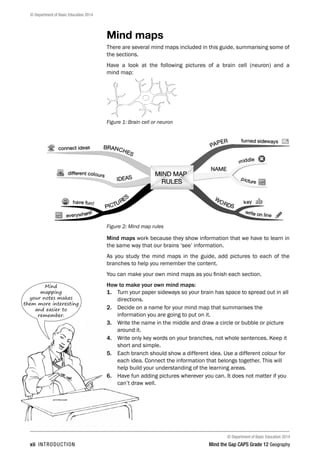
Mind maps
There are several mind maps included in this guide, summarising some of
the sections.
Have a look at the following pictures of a brain cell (neuron) and a
mind map:
Figure 1: Brain cell or neuron
Figure 2: Mind map rules
Mind maps work because they show information that we have to learn in
the same way that our brains ‘see’ information.
As you study the mind maps in the guide, add pictures to each of the
branches to help you remember the content.
You can make your own mind maps as you finish each section.
How to make your own mind maps:
1. Turn your paper sideways so your brain has space to spread out in all
directions.
2. Decide on a name for your mind map that summarises the
information you are going to put on it.
3. 
Write the name in the middle and draw a circle or bubble or picture
around it.
4. Write only key words on your branches, not whole sentences. Keep it
short and simple.
5. Each branch should show a different idea. Use a different colour for
each idea. Connect the information that belongs together. This will
help build your understanding of the learning areas.
6. Have fun adding pictures wherever you can. It does not matter if you
can’t draw well.
Mind
mapping
your notes makes
them more interesting
and easier to
remember.
© Department of Basic Education 2014
Mind the Gap CAPS Grade 12 Geography INTRODUCTION xiii
GOOD
LUCK!
On the day of the exam …
1. Make sure you have all the necessary stationery for your exam, i.e.
pens, pencils, eraser, protractor, compass, calculator (with new
batteries), 30 cm ruler as well as your ID document and exam
admission letter.
2. Arrive on time, at least one hour before the start of the exam.
3. Go to the toilet before entering the exam room. You don’t
want to waste valuable time going to the toilet during the exam.
4. Use the 10 minutes reading time to read the instructions
carefully. This helps to ‘open’ the information in your brain.
Start with the question you think is the easiest to get the flow
going. In the mapwork exam, use this time to look carefully at the
whole map.
5. Break the questions down to make sure you understand what is
being asked. If you don’t answer the question properly you won’t
get any marks for it. Look for the key words in the question to
know how to answer it. A list of these words is on page ix of this
study guide.
6. Try all questions. Each question has some easy marks in it so
make sure that you do all the questions in the exam.
7. Never panic, even if the question seems difficult at first. It will be
linked with something you have covered. Find the connection.
8. Manage your time properly. Don’t waste time on questions you
are unsure of. Move on and come back if time allows.
9. Check weighting – how many marks have been allocated for your
answer? Take note of how marks are allocated to the questions
in this study guide. Do not give more or less information than is
required.
10. Write big and bold and clearly. You will get more marks if the
marker can read your answer clearly.
If you can dream it, you can do it.
Walt Disney
Remember to
take your calculator
to your mapwork
exam!
© Department of Basic Education 2014
xiv INTRODUCTION Mind the Gap CAPS Grade 12 Geography
Question words to help you
answer questions
It is important to look for the question words (the words that tell you what
to do) to correctly understand what the examiner is asking. Use the words
in the following table as a guide when answering questions.
Question word What is required of you
Account for Explain the cause of; explain why; give reasons for
Analyse Separate; examine and interpret critically; positives and negatives; pros and cons
Annotate To add explanatory notes to a sketch, map or drawing
Argue Put forward reasons in support of or against a statement
Classify Place things with similar characteristics in the same group; to arrange according to type or sort
Comment Give your opinion, based on facts
Compare To list both similarities and differences
Contrast Stress the differences between things, events or problems
Define Give a concise and clear meaning
Demonstrate Show or make clear; illustrate or explain; prove by reasoning and evidence (note that you can
give examples)
Describe List the main characteristics of something; give an account of (note that a diagram or map
may be part of a description)
Discuss Give the reasons for your statement; present both sides and reach a conclusion
Evaluate Express an opinion, using evidence, of how good/bad, negative/positive, successful/
unsuccessful something is
Explain Make clear, interpret, and spell out the material you present. Give reasons for differences of
opinion or of results
Give To state facts without discussions or explanations (note that you may be asked to ‘Give a
reason’)
Identify Name a feature from the source material
Interpret To give an explanation of; to give the meaning of
In every exam
question, put a CIRCLE
around the question word and
underline any other important
key words. These words tell
you exactly what is
being asked.
PAY SPECIAL ATTENTION
ACTIVITIES boy
and girl-left and
right of page
EG - worked examples
HINT!
e.g.
NB NB
hint
activity
activity
exams
Examples of question words
1. Draw a longitudinal profile of a river (from source to mouth)
and show the upper, middle and lower course. (4 × 1 = 4)
2. List two features of the upper course of a river. (2 × 2 = 4)
3. Describe a river in its lower course. (2 × 2 = 4)
4. Describe one difference between the river channel in the
upper course and the lower course. (2 × 2 = 4)
[16]
© Department of Basic Education 2014
Mind the Gap CAPS Grade 12 Geography INTRODUCTION xv
Learner’s checklist
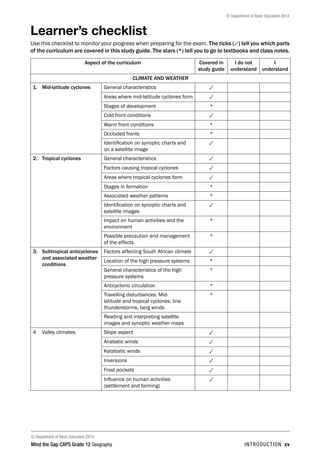
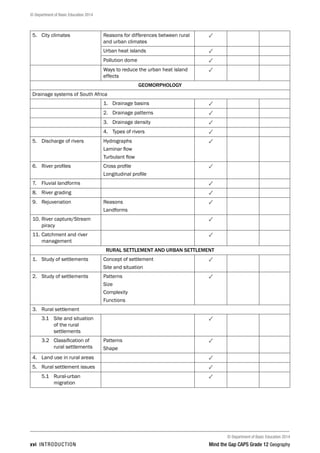
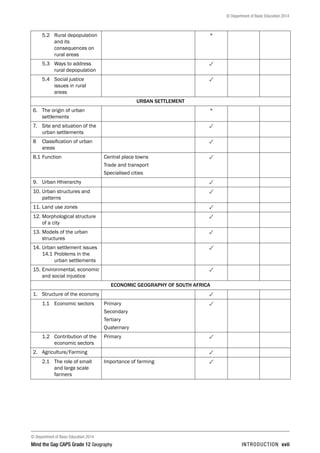
Use this checklist to monitor your progress when preparing for the exam. The ticks (3) tell you which parts
of the curriculum are covered in this study guide. The stars (*) tell you to go to textbooks and class notes.
Aspect of the curriculum Covered in
study guide
I do not
understand
I
understand
CLIMATE AND WEATHER
1. Mid-latitude cyclones General characteristics 3
Areas where mid-latitude cyclones form 3
Stages of development *
Cold front conditions 3
Warm front conditions *
Occluded fronts *
Identification on synoptic charts and
on a satellite image
3
2. Tropical cyclones General characteristics 3
Factors causing tropical cyclones 3
Areas where tropical cyclones form 3
Stages in formation *
Associated weather patterns *
Identification on synoptic charts and
satellite images
3
Impact on human activities and the
environment
*
Possible precaution and management
of the effects
*
3. Subtropical anticyclones
and associated weather
conditions
Factors affecting South African climate 3
Location of the high pressure systems *
General characteristics of the high
pressure systems
*
Anticyclonic circulation *
Travelling disturbances: Mid-
latitude and tropical cyclones, line
thunderstorms, berg winds
*
Reading and interpreting satellite
images and synoptic weather maps
4 Valley climates Slope aspect 3
Anabatic winds 3
Katabatic winds 3
Inversions 3
Frost pockets 3
Influence on human activities
(settlement and farming)
3
© Department of Basic Education 2014
xvi INTRODUCTION Mind the Gap CAPS Grade 12 Geography
5. City climates Reasons for differences between rural
and urban climates
3
Urban heat islands 3
Pollution dome 3
Ways to reduce the urban heat island
effects
3
GEOMORPHOLOGY
Drainage systems of South Africa
1. Drainage basins 3
2. Drainage patterns 3
3. Drainage density 3
4. Types of rivers 3
5. Discharge of rivers Hydrographs
Laminar flow
Turbulant flow
3
6. River profiles Cross profile
Longitudinal profile
3
7. Fluvial landforms 3
8. River grading 3
9. Rejuvenation Reasons
Landforms
3
10. River capture/Stream
piracy
3
11. Catchment and river
management
3
RURAL SETTLEMENT AND URBAN SETTLEMENT
1. Study of settlements Concept of settlement
Site and situation
3
2. Study of settlements Patterns
Size
Complexity
Functions
3
3. Rural settlement
3.1 Site and situation
of the rural
settlements
3
3.2 Classification of
rural settlements
Patterns
Shape
3
4. Land use in rural areas 3
5. Rural settlement issues 3
5.1 Rural-urban
migration
3
© Department of Basic Education 2014
Mind the Gap CAPS Grade 12 Geography INTRODUCTION xvii
5.2 Rural depopulation
and its
consequences on
rural areas
*
5.3 Ways to address
rural depopulation
3
5.4 Social justice
issues in rural
areas
3
URBAN SETTLEMENT
6. The origin of urban
settlements
*
7. Site and situation of the
urban settlements
3
8 Classification of urban
areas
3
8.1 Function Central place towns
Trade and transport
Specialised cities
3
9. Urban Hhierarchy 3
10. Urban structures and
patterns
3
11. Land use zones 3
12. Morphological structure
of a city
3
13. Models of the urban
structures
3
14. Urban settlement issues
14.1 Problems in the
urban settlements
3
15. Environmental, economic
and social injustice
3
ECONOMIC GEOGRAPHY OF SOUTH AFRICA
1. Structure of the economy 3
1.1 Economic sectors Primary
Secondary
Tertiary
Quaternary
3
1.2 Contribution of the
economic sectors
Primary 3
2. Agriculture/Farming 3
2.1 The role of small
and large scale
farmers
Importance of farming 3
© Department of Basic Education 2014
xviii INTRODUCTION Mind the Gap CAPS Grade 12 Geography
2.2 Main products *
2.3 Factors influencing
farming in South
Africa
Promote/Favour
Hinder/Restrict/Limit
3
2.4 Food security and
insecurity
3
3. Mining 3
3.1 Contribution of
mining/Role of
mining
3
3.2 Factors influencing
mining in South
Africa
Promote/Favour
Hinder/Restrict/Limit
3
4. Secondary and tertiary
sectors
3
4.1 Contribution of
secondary and tertiary
sector
Secondary sector 3
Types of Industries *
Factors influencing
industrial development
and their location
Promote/Favour
Hinder/Restrict/Limit
3
South Africa’s industrial
regions
Gauteng (PWV)
Ethekwini (Durban-Pinetown)
Nelson Mandela Metro (Port Elizabeth-
Uitenhage
South Western Cape
3
Strategies for industrial
development
Post-apartheid industrial development
Spatial development initiatives
Industrial development zones
3
Informal sector Characteristics 3
Reasons for development 3
Challenges facing Informal Sector 3
5. Quartenary economic
activiites
3
GEOGRAPHICAL SKILLS AND TECHNIQUES
1. Mapwork techniques 3
2. Application 3
Photographs
3. Photographs used in
mapwork
*
4. Application 3
5. GIS 3
© Department of Basic Education 2014
Mind the Gap CAPS Grade 12 Geography CHAPTER 1 CLIMATE AND WEATHER 1
Chapter 1
Climate and
weather
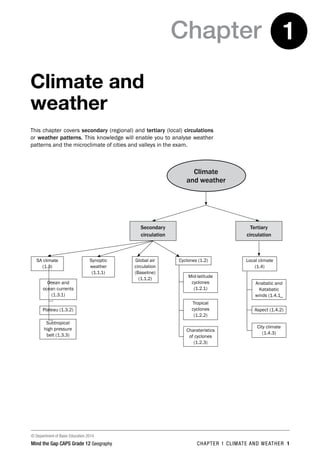
This chapter covers secondary (regional) and tertiary (local) circulations
or weather patterns. This knowledge will enable you to analyse weather
patterns and the microclimate of cities and valleys in the exam.
Secondary
circulation
Tertiary
circulation
Synoptic
weather
(1.1.1)
Global air
circulation
(Baseline)
(1.1.2)
Cyclones (1.2)
Anabatic and
Katabatic
winds (1.4.1_
Aspect (1.4.2)
City climate
(1.4.3)
Ocean and
ocean currents
(1.3.1)
Plateau (1.3.2)
Subtropical
high pressure
belt (1.3.3)
Climate
and weather
Local climate
(1.4)
SA climate
(1.3)
Mid-latitude
cyclones
(1.2.1)
Tropical
cyclones
(1.2.2)
Charateristics
of cyclones
(1.2.3)
© Department of Basic Education 2014
2 CHAPTER 1 CLIMATE AND WEATHER Mind the Gap CAPS Grade 12 Geography
Chapter
1
Key concepts
CONCEPT DEFINITION
Anabatic winds Warm winds that blow up a valley slope during the day.
Anticyclone
(high pressure)
Forms as a result of sinking air. Air movement is anticlockwise, divergent
(outwards), subsiding (sinking) in the southern hemisphere, e.g. South Atlantic
High, South Indian High and Kalahari High.
Aspect The direction in which a slope faces.
Berg winds Hot, dry winds that blow from the interior of South Africa to coastal areas.
Climate change Long-term changes to the global climate, resulting in unusual and extreme
(stronger) weather conditions.
Cyclone
(low pressure)
Forms as a result of rising air. Air movement is clockwise, convergent (inwards),
rising (convection) in the southern hemisphere, e.g. coastal low, tropical
cyclone, mid-latitude cyclone.
Heat island Higher temperatures in urban areas than the surrounding rural area. There are
many causes of heat island including pollution.
Inversion layer Zone where sinking cold air meets with the rising warm air. A layer of the
atmosphere in which temperature increases with height.
Inter-tropical convergence
zone (ITCZ)
An area along the equator where the tropical easterlies from both hemispheres
meet.
Katabatic winds Cold winds that blow down a valley slope at night.
Polar Easterlies Winds that blow from the pole towards subpolar low pressure belts (90° to
60°).
Temperature inversion Temperature increasing with height.
Thermal belt Zone of warmer temperature above the valley floor.
Tropical easterlies/trade
winds
Winds that blow from the subtropical high belts towards the equatorial low
pressure belt (0° to 30°).
Westerlies Winds that blow from the subtropical high pressure belts to the subpolar low
pressure belts (30° to 60°).
If you know and understand the definitions in this chapter, you will
be able to answer most of the questions in the climate and weather
(climatology) section of the final exam. Use your mobile notes to learn these concepts
well (see page x for instructions on how to make them). Adding pictures to your mobile
notes will help you remember the concepts.
PAY SPECIAL ATTENTION
ACTIVITIES boy
and girl-left and
right of page
Step by step comment
EG - worked examples
HINT!
e.g.
NB NB
hint
activity
activity
comment
exams
© Department of Basic Education 2014
Mind the Gap CAPS Grade 12 Geography CHAPTER 1 CLIMATE AND WEATHER 3
Chapter 1
1.1 Introduction
Our focus will be on the South African climate, mid-latitude cyclones,
tropical cyclones, sub-tropical anticyclones and local climate (valley and
city climate). But first we need to understand synoptic weather charts
(maps), and satellite images.
1.1.1 Synoptic weather map
interpretation
To better understand weather patterns and weather phenomena you need
to be able to interpret the synoptic weather map. A synoptic weather map
shows weather conditions and phenomena (temperature, precipitation,
wind speed and direction, atmospheric pressure and cloud coverage) over
a wide area at a given time based on worldwide observations recorded at
the same time (from weather stations, airplanes, weather balloons and
satellites).
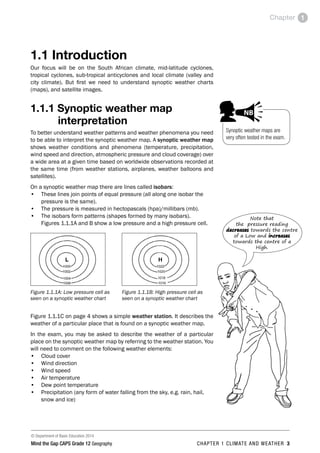
On a synoptic weather map there are lines called isobars:
• These lines join points of equal pressure (all along one isobar the
pressure is the same).
• The pressure is measured in hectopascals (hpa)/millibars (mb).
• The isobars form patterns (shapes formed by many isobars).
Figures 1.1.1A and B show a low pressure and a high pressure cell.
Figure 1.1.1A: Low pressure cell as
seen on a synoptic weather chart
Figure 1.1.1B: High pressure cell as
seen on a synoptic weather chart
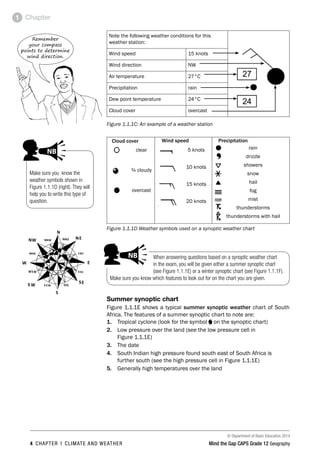
Figure 1.1.1C on page 4 shows a simple weather station. It describes the
weather of a particular place that is found on a synoptic weather map.
In the exam, you may be asked to describe the weather of a particular
place on the synoptic weather map by referring to the weather station. You
will need to comment on the following weather elements:
• Cloud cover
• Wind direction
• Wind speed
• Air temperature
• Dew point temperature
• Precipitation (any form of water falling from the sky, e.g. rain, hail,
snow and ice)
Note that
the pressure reading
decreases towards the centre
of a Low and increases
towards the centre of a
High.
Synoptic weather maps are
very often tested in the exam.
PAY SPECIAL ATTENTION
ACTIVITIES boy
and girl-left and
right of page
Step by step comment
EG - worked examples
HINT!
e.g.
NB NB
hint
activity
activity
comment
exams
© Department of Basic Education 2014
4 CHAPTER 1 CLIMATE AND WEATHER Mind the Gap CAPS Grade 12 Geography
Chapter
1
Note the following weather conditions for this
weather station:
Wind speed 15 knots
Wind direction NW
Air temperature 27°C
Precipitation rain
Dew point temperature 24°C
Cloud cover overcast
Figure 1.1.1C: An example of a weather station
Cloud cover
clear
¾ cloudy
overcast
5 knots
10 knots
15 knots
20 knots
Wind speed Precipitation
rain
drizzle
showers
snow
hail
fog
mist
thunderstorms
thunderstorms with hail
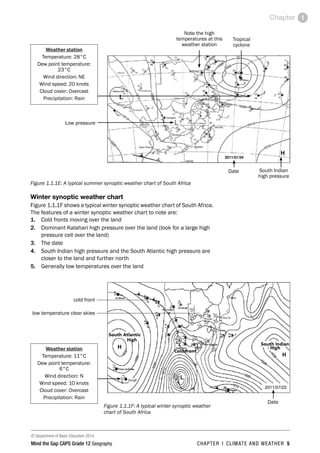
Figure 1.1.1D Weather symbols used on a synoptic weather chart
Summer synoptic chart
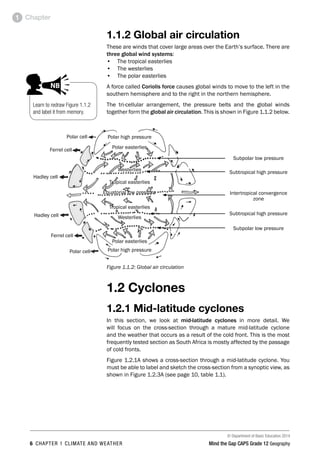
Figure 1.1.1E shows a typical summer synoptic weather chart of South
Africa. The features of a summer synoptic chart to note are:
1. Tropical cyclone (look for the symbol on the synoptic chart)
2. Low pressure over the land (see the low pressure cell in
Figure 1.1.1E)
3. The date
4. South Indian high pressure found south east of South Africa is
further south (see the high pressure cell in Figure 1.1.1E)
5. Generally high temperatures over the land
Remember
your compass
points to determine
wind direction.
Make sure you know the
weather symbols shown in
Figure 1.1.1D (right). They will
help you to write this type of
question.
PAY SPECIAL ATTENTION
ACTIVITIES boy
and girl-left and
right of page
Step by step comment
EG - worked examples
HINT!
e.g.
NB NB
hint
activity
activity
comment
exams
When answering questions based on a synoptic weather chart
in the exam, you will be given either a summer synoptic chart
(see Figure 1.1.1E) or a winter synoptic chart (see Figure 1.1.1F).
Make sure you know which features to look out for on the chart you are given.
PAY SPECIAL ATTENTION
ACTIVITIES boy
and girl-left and
right of page
EG - worked examples
HINT!
e.g.
NB NB
hint
activity
activity
exams
© Department of Basic Education 2014
Mind the Gap CAPS Grade 12 Geography CHAPTER 1 CLIMATE AND WEATHER 5
Chapter 1
Weather station
Temperature: 28°C
Dew point temperature:
23°C
Wind direction: NE
Wind speed: 20 knots
Cloud cover: Overcast
Precipitation: Rain
Note the high
temperatures at this
weather station
Tropical
cyclone
Low pressure
Date South Indian
high pressure
Figure 1.1.1E: A typical summer synoptic weather chart of South Africa
Winter synoptic weather chart
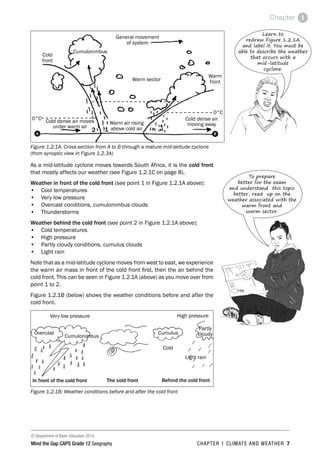
Figure 1.1.1F shows a typical winter synoptic weather chart of South Africa.
The features of a winter synoptic weather chart to note are:
1. Cold fronts moving over the land
2. Dominant Kalahari high pressure over the land (look for a large high
pressure cell over the land)
3. The date
4. South Indian high pressure and the South Atlantic high pressure are
closer to the land and further north
5. Generally low temperatures over the land
Weather station
Temperature: 11°C
Dew point temperature:
6°C
Wind direction: N
Wind speed: 10 knots
Cloud cover: Overcast
Precipitation: Rain
Date

Figure 1.1.1F: A typical winter synoptic weather
chart of South Africa
11
•
6
Gough
cold front
low temperature clear skies
© Department of Basic Education 2014
6 CHAPTER 1 CLIMATE AND WEATHER Mind the Gap CAPS Grade 12 Geography
Chapter
1
1.1.2 Global air circulation
These are winds that cover large areas over the Earth’s surface. There are
three global wind systems:
• The tropical easterlies
• The westerlies
• The polar easterlies
A force called Coriolis force causes global winds to move to the left in the
southern hemisphere and to the right in the northern hemisphere.
The tri-cellular arrangement, the pressure belts and the global winds
together form the global air circulation. This is shown in Figure 1.1.2 below.
Polar cell Polar high pressure
Polar easterlies
Westerlies
Tropical easterlies
Equatorial low pressure
Tropical easterlies
Westerlies
Polar easterlies
Polar high pressure
Ferrel cell
Hadley cell
Hadley cell
Ferrel cell
Polar cell
Subpolar low pressure
Subtropical high pressure
Intertropical convergence
zone
Subtropical high pressure
Subpolar low pressure
Figure 1.1.2: Global air circulation
1.2 Cyclones
1.2.1 Mid-latitude cyclones
In this section, we look at mid-latitude cyclones in more detail. We
will focus on the cross-section through a mature mid-latitude cyclone
and the weather that occurs as a result of the cold front. This is the most
frequently tested section as South Africa is mostly affected by the passage
of cold fronts.
Figure 1.2.1A shows a cross-section through a mid-latitude cyclone. You
must be able to label and sketch the cross-section from a synoptic view, as
shown in Figure 1.2.3A (see page 10, table 1.1).
Learn to redraw Figure 1.1.2
and label it from memory.
PAY SPECIAL ATTENTION
ACTIVITIES boy
and girl-left and
right of page
Step by step comment
EG - worked examples
HINT!
e.g.
NB NB
hint
activity
activity
comment
exams
© Department of Basic Education 2014
Mind the Gap CAPS Grade 12 Geography CHAPTER 1 CLIMATE AND WEATHER 7
Chapter 1
General movement
of system
Cold
front
Warm sector
Warm
front
Warm air rising
above cold air
Cold dense air
moving away
Cold dense air moves
under warm air
Cumulonimbus
0°C
0°C
2 1
A B
Figure 1.2.1A: Cross-section from A to B through a mature mid-latitude cyclone
(from synoptic view in Figure 1.2.3A)
As a mid-latitude cyclone moves towards South Africa, it is the cold front
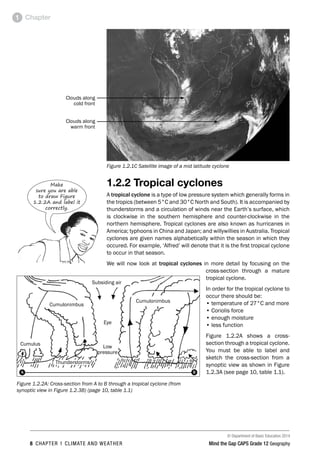
that mostly affects our weather (see Figure 1.2.1C on page 8).
Weather in front of the cold front (see point 1 in Figure 1.2.1A above):
• Cool temperatures
• Very low pressure
• Overcast conditions, cumulonimbus clouds
• Thunderstorms
Weather behind the cold front (see point 2 in Figure 1.2.1A above):
• Cold temperatures
• High pressure
• Partly cloudy conditions, cumulus clouds
• Light rain
Note that as a mid-latitude cyclone moves from west to east, we experience
the warm air mass in front of the cold front first, then the air behind the
cold front. This can be seen in Figure 1.2.1A (above) as you move over from
point 1 to 2.
Figure 1.2.1B (below) shows the weather conditions before and after the
cold front.
In front of the cold front The cold front Behind the cold front
Cumulus
Overcast
Cumulonimbus
Partly
cloudy
High pressure
Cold
Light rain
Figure 1.2.1B: Weather conditions before and after the cold front
Very low pressure
To prepare
better for the exam
and understand this topic
better, read up on the
weather associated with the
warm front and
warm sector.
Learn to
redraw Figure 1.2.1A
and label it. You must be
able to describe the weather
that occurs with a
mid-latitude
cyclone.
© Department of Basic Education 2014
8 CHAPTER 1 CLIMATE AND WEATHER Mind the Gap CAPS Grade 12 Geography
Chapter
1
Clouds along
cold front
Clouds along
warm front
Figure 1.2.1C Satellite image of a mid latitude cyclone
1.2.2 Tropical cyclones
A tropical cyclone is a type of low pressure system which generally forms in
the tropics (between 5°C and 30°C North and South). It is accompanied by
thunderstorms and a circulation of winds near the Earth’s surface, which
is clockwise in the southern hemisphere and counter-clockwise in the
northern hemisphere. Tropical cyclones are also known as hurricanes in
America; typhoons in China and Japan; and willywillies in Australia. Tropical
cyclones are given names alphabetically within the season in which they
occured. For example, ‘Alfred’ will denote that it is the first tropical cyclone
to occur in that season.
We will now look at tropical cyclones in more detail by focusing on the
cross-section through a mature
tropical cyclone.
In order for the tropical cyclone to
occur there should be:
• 
temperature of 27°C and more
• Coriolis force
• enough moisture
• less function

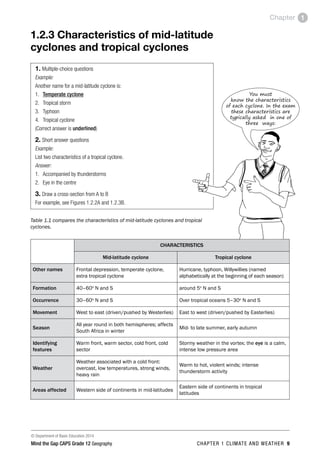
Figure 1.2.2A shows a cross-
section through a tropical cyclone.
You must be able to label and
sketch the cross-section from a
synoptic view as shown in Figure
1.2.3A (see page 10, table 1.1).
Subsiding air
Cumulus
Cumulonimbus
Cumulonimbus
Eye
Low
pressure
Thunderstorms
A B
Figure 1.2.2A: Cross-section from A to B through a tropical cyclone (from
synoptic view in Figure 1.2.3B) (page 10, table 1.1)
Make
sure you are able
to draw Figure
1.2.2A and label it
correctly.
© Department of Basic Education 2014
Mind the Gap CAPS Grade 12 Geography CHAPTER 1 CLIMATE AND WEATHER 9
Chapter 1
1.2.3 Characteristics of mid-latitude
cyclones and tropical cyclones
1. Multiple-choice questions
Example:
Another name for a mid-latitude cyclone is:
1. Temperate cyclone
2. Tropical storm
3. Typhoon
4. Tropical cyclone
(Correct answer is underlined)
2. Short answer questions
Example:
List two characteristics of a tropical cyclone.
Answer:
1. Accompanied by thunderstorms
2. Eye in the centre
3. Draw a cross-section from A to B
For example, see Figures 1.2.2A and 1.2.3B.
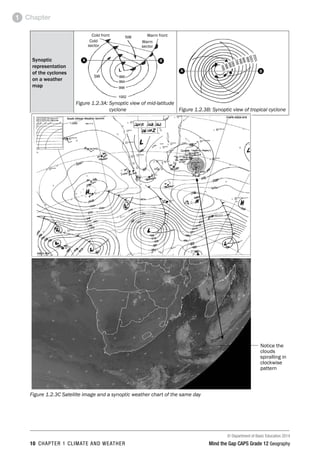
Table 1.1 compares the characteristics of mid-latitude cyclones and tropical
cyclones.
CHARACTERISTICS
Mid-latitude cyclone Tropical cyclone
Other names Frontal depression, temperate cyclone,
extra tropical cyclone
Hurricane, typhoon, Willywillies (named
alphabetically at the beginning of each season)
Formation 40–60o
N and S around 5o
N and S
Occurrence 30–60o
N and S Over tropical oceans 5–30o
N and S
Movement West to east (driven/pushed by Westerlies) East to west (driven/pushed by Easterlies)
Season
All year round in both hemispheres; affects
South Africa in winter
Mid- to late summer, early autumn
Identifying
features
Warm front, warm sector, cold front, cold
sector
Stormy weather in the vortex; the eye is a calm,
intense low pressure area
Weather
Weather associated with a cold front:
overcast, low temperatures, strong winds,
heavy rain
Warm to hot, violent winds; intense
thunderstorm activity
Areas affected Western side of continents in mid-latitudes
Eastern side of continents in tropical
latitudes
You must
know the characteristics
of each cyclone. In the exam
these characteristics are
typically asked in one of
three ways:
© Department of Basic Education 2014
10 CHAPTER 1 CLIMATE AND WEATHER Mind the Gap CAPS Grade 12 Geography
Chapter
1
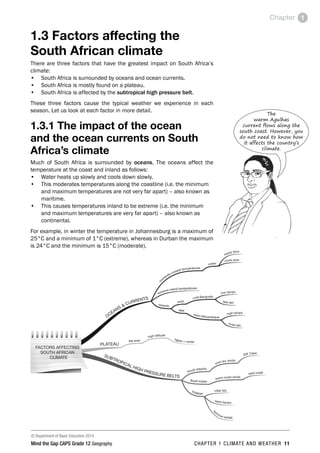
Synoptic
representation
of the cyclones
on a weather
map
A B
Cold
sector
Cold front NW Warm front
Warm
sector
SW
Figure 1.2.3A: 
Synoptic view of mid-latitude
cyclone
A B
Figure 1.2.3B: Synoptic view of tropical cyclone
Table 1.1: Characteristics of mid-latitude and tropical cyclones
Figure 1.2.3C Satellite image and a synoptic weather chart of the same day
Notice the
clouds
spiralling in
clockwise
pattern
© Department of Basic Education 2014
Mind the Gap CAPS Grade 12 Geography CHAPTER 1 CLIMATE AND WEATHER 11
Chapter 1
1.3 Factors affecting the
South African climate
There are three factors that have the greatest impact on South Africa’s
climate:
• South Africa is surrounded by oceans and ocean currents.
• South Africa is mostly found on a plateau.
• South Africa is affected by the subtropical high pressure belt.
These three factors cause the typical weather we experience in each
season. Let us look at each factor in more detail.
1.3.1 The impact of the ocean
and the ocean currents on South
Africa’s climate
Much of South Africa is surrounded by oceans. The oceans affect the
temperature at the coast and inland as follows:
• Water heats up slowly and cools down slowly.
• This moderates temperatures along the coastline (i.e. the minimum
and maximum temperatures are not very far apart) – also known as
maritime.
• This causes temperatures inland to be extreme (i.e. the minimum
and maximum temperatures are very far apart) – also known as
continental.
For example, in winter the temperature in Johannesburg is a maximum of
25°C and a minimum of 1°C (extreme), whereas in Durban the maximum
is 24°C and the minimum is 15°C (moderate).
The
warm Agulhas
current flows along the
south coast. However, you
do not need to know how
it affects the country’s
climate.
© Department of Basic Education 2014
12 CHAPTER 1 CLIMATE AND WEATHER Mind the Gap CAPS Grade 12 Geography
Chapter
1
The ocean currents also affect the temperatures and rainfall:
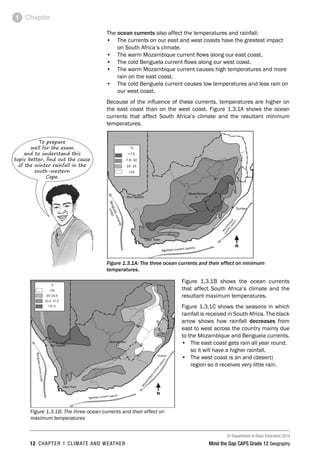
• The currents on our east and west coasts have the greatest impact
on South Africa’s climate.
• The warm Mozambique current flows along our east coast.
• The cold Benguela current flows along our west coast.
• The warm Mozambique current causes high temperatures and more
rain on the east coast.
• The cold Benguela current causes low temperatures and less rain on
our west coast.
Because of the influence of these currents, temperatures are higher on
the east coast than on the west coast. Figure 1.3.1A shows the ocean
currents that affect South Africa’s climate and the resultant minimum
temperatures.
°C
7,5
7,5–10
10–15
15
Bloemfontein
Agulhas current (warm)
Durban
Port Nolloth
Cape Town
M
o
z
a
m
b
i
q
u
e
c
u
r
r
e
n
t
(
w
a
r
m
)
Figure 1.3.1A: The three ocean currents and their effect on minimum
temperatures.
Figure 1.3.1B shows the ocean currents
that affect South Africa’s climate and the
resultant maximum temperatures.
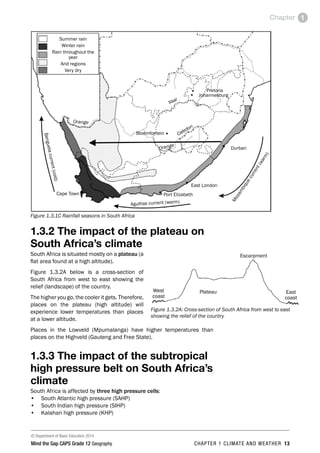
Figure 1.3.1C shows the seasons in which
rainfall is received in South Africa. The black
arrow shows how rainfall decreases from
east to west across the country mainly due
to the Mozambique and Benguela currents.
• The east coast gets rain all year round,
so it will have a higher rainfall.
• The west coast is an arid (desert)
region so it receives very little rain.
°C
20
20–22,5
22,5–27,5
27,5
Bloemfontein
M
o
z
a
m
b
i
q
u
e
c
u
r
r
e
n
t
(
w
a
r
m
)
Agulhas current (warm)
Be
ng
ue
la
cu
rr
en
t
(c
ol
d)
Durban
Port Nolloth
Cape Town
Figure 1.3.1B: The three ocean currents and their effect on
maximum temperatures
B
e
n
g
u
e
l
a
c
u
r
r
e
n
t
s
(
c
o
l
d
)
To prepare
well for the exam
and to understand this
topic better, find out the cause
of the winter rainfall in the
south-western
Cape.
© Department of Basic Education 2014
Mind the Gap CAPS Grade 12 Geography CHAPTER 1 CLIMATE AND WEATHER 13
Chapter 1
Summer rain
Winter rain
Rain throughout the
year
Arid regions
Very dry
Pretoria
M
o
z
a
m
b
i
q
u
e
c
u
r
r
e
n
t
(
w
a
r
m
)
Agulhas current (warm)
B
e
n
g
u
e
la
c
u
r
r
e
n
t
(
c
o
ld
)
Durban
Orange
Cape Town
East London
Port Elizabeth
Bloemfontein
Johannesburg
Orange
Vaal
Caledon
Figure 1.3.1C Rainfall seasons in South Africa
1.3.2 The impact of the plateau on
South Africa’s climate
South Africa is situated mostly on a plateau (a
flat area found at a high altitude).
Figure 1.3.2A below is a cross-section of
South Africa from west to east showing the
relief (landscape) of the country.
The higher you go, the cooler it gets. Therefore,
places on the plateau (high altitude) will
experience lower temperatures than places
at a lower altitude.
Places in the Lowveld (Mpumalanga) have higher temperatures than
places on the Highveld (Gauteng and Free State).
1.3.3 The impact of the subtropical
high pressure belt on South Africa’s
climate
South Africa is affected by three high pressure cells:
• South Atlantic high pressure (SAHP)
• South Indian high pressure (SIHP)
• Kalahari high pressure (KHP)
West
coast
East
coast
Escarpment
Plateau
Figure 1.3.2A: Cross-section of South Africa from west to east
showing the relief of the country
© Department of Basic Education 2014
14 CHAPTER 1 CLIMATE AND WEATHER Mind the Gap CAPS Grade 12 Geography
Chapter
1
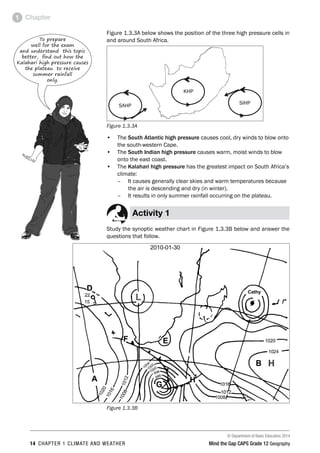
Figure 1.3.3A below shows the position of the three high pressure cells in
and around South Africa.
SAHP
KHP
SIHP
Figure 1.3.3A
• The South Atlantic high pressure causes cool, dry winds to blow onto
the south-western Cape.
• The South Indian high pressure causes warm, moist winds to blow
onto the east coast.
• The Kalahari high pressure has the greatest impact on South Africa’s
climate:
–
– It causes generally clear skies and warm temperatures because
the air is descending and dry (in winter).
–
– It results in only summer rainfall occurring on the plateau.
Activity 1
Study the synoptic weather chart in Figure 1.3.3B below and answer the
questions that follow.
Figure 1.3.3B
To prepare
well for the exam
and understand this topic
better, find out how the
Kalahari high pressure causes
the plateau to receive
summer rainfall
only.
© Department of Basic Education 2014
Mind the Gap CAPS Grade 12 Geography CHAPTER 1 CLIMATE AND WEATHER 15
Chapter 1
1. Name the high pressure cells labelled A and B. (2 × 2 = 4)
2. Give TWO pieces of evidence from the map that this is
a summer map. (2 × 2 = 4)
3. Identify the low pressure cell labelled E. (1 × 2 = 2)
4. The letter G indicates a mid-latitude cyclone.
a) Name the fronts labelled F and H. (2 × 2 = 4)
b) In which direction does this cyclone generally move? (1 × 2 = 2)
c) Describe how front F will affect the weather of
Cape Town. (3 × 2 = 6)
5. Refer to the cyclone named Cathy.
a) What type of cyclone is Cathy? (1 × 2 = 2)
b) State how many cyclones have occurred for this
season, including Cathy. (1 × 2 = 2)
c) In which direction does this cyclone move? (1 × 2 = 2)
d) List TWO conditions necessary for this cyclone to form. (2 × 2 = 4)
6. Refer to the weather station labelled D and describe the
weather in terms of: cloud cover, wind speed, wind
direction, air temperature, dewpoint temperature. (4 × 2 = 8)
[40]
Answers to activity 1
1. A – South Atlantic high pressure33
B – South Indian high pressure33(4)
2. A tropical cyclone can be seen on the map.33
Mid-latitude cyclones are seen south of South Africa.33
The South Indian and South Atlantic high pressures are
south of South Africa.33
A low pressure cell can be seen over the centre of
South Africa.33
The date: 30/01/201033 (any 2) (4)
3. Coastal low pressure33(2)
4. a) F – Cold front33; H – Warm front33(4)
b) In an easterly direction/from west to east33(2)
c) Temperatures will decrease33; pressure will increase33;
Cumulonimbus clouds and thunderstorms will occur33(6)
5. a) Tropical cyclone33(2)
b) Three33(2)
c) Westerly/from east to west33(2)
d) Temperature must be above 27°C33; Humidity must be
high33; There must only be light and variable wind33;
The atmosphere must be unstable33; There must be a
wide area of low pressure with closed isobars33; It must
be between 5°S and 25°S (needs Coriolis force)33;
Little surface friction33 (any 2) (4)
6. Cloud cover: Clear skies33; Wind speed: 10 knots33;
Wind direction: SSE33; Air temperature: 22°C33;
Dewpoint temperature: 15 °C33(8)
[40]
© Department of Basic Education 2014
16 CHAPTER 1 CLIMATE AND WEATHER Mind the Gap CAPS Grade 12 Geography
Chapter
1
1.4 Local climate (valley and
city climate)
Valley climate occurs on a local scale and lasts for a few hours. In this
section we will focus on:
• Anabatic and katabatic winds
• Aspect
1.4.1 Anabatic and katabatic winds
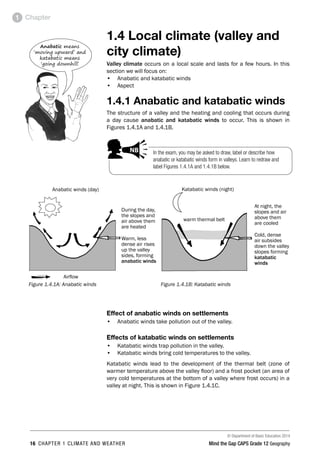
The structure of a valley and the heating and cooling that occurs during
a day cause anabatic and katabatic winds to occur. This is shown in
Figures 1.4.1A and 1.4.1B.
Figure 1.4.1A: Anabatic winds Figure 1.4.1B: Katabatic winds
Airflow
During the day,
the slopes and
air above them
are heated
Warm, less
dense air rises
up the valley
sides, forming
anabatic winds
Anabatic winds (day) Katabatic winds (night)
Effect of anabatic winds on settlements
• Anabatic winds take pollution out of the valley.
Effects of katabatic winds on settlements
• Katabatic winds trap pollution in the valley.
• Katabatic winds bring cold temperatures to the valley.
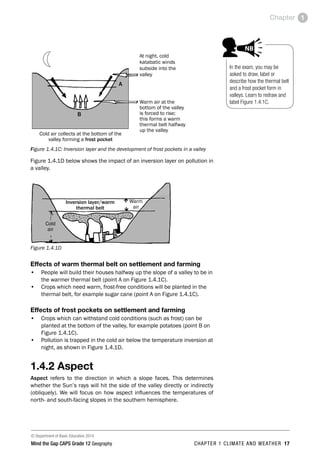
Katabatic winds lead to the development of the thermal belt (zone of
warmer temperature above the valley floor) and a frost pocket (an area of
very cold temperatures at the bottom of a valley where frost occurs) in a
valley at night. This is shown in Figure 1.4.1C.
At night, the
slopes and air
above them
are cooled
Cold, dense
air subsides
down the valley
slopes forming
katabatic
winds
warm thermal belt
Anabatic means
‘moving upward’ and
katabatic means
‘going downhill’
.

In the exam, you may be asked to draw, label or describe how
anabatic or katabatic winds form in valleys. Learn to redraw and
label Figures 1.4.1A and 1.4.1B below.
PAY SPECIAL ATTENTION
ACTIVITIES boy
and girl-left and
right of page
Step by step comment
EG - worked examples
HINT!
e.g.
NB NB
hint
activity
activity
comment
exams
© Department of Basic Education 2014
Mind the Gap CAPS Grade 12 Geography CHAPTER 1 CLIMATE AND WEATHER 17
Chapter 1
At night, cold
katabatic winds
subside into the
valley
Warm air at the
bottom of the valley
is forced to rise;
this forms a warm
thermal belt halfway
up the valley
Cold air collects at the bottom of the
valley forming a frost pocket
B
A
Figure 1.4.1C: Inversion layer and the development of frost pockets in a valley
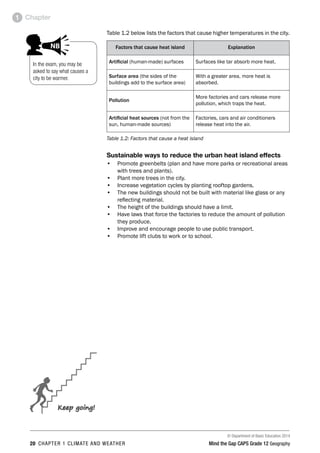
Figure 1.4.1D below shows the impact of an inversion layer on pollution in
a valley.
Inversion layer/warm
thermal belt
Warm
air
Cold
air
Figure 1.4.1D
Effects of warm thermal belt on settlement and farming
• People will build their houses halfway up the slope of a valley to be in
the warmer thermal belt (point A on Figure 1.4.1C).
• Crops which need warm, frost-free conditions will be planted in the
thermal belt, for example sugar cane (point A on Figure 1.4.1C).
Effects of frost pockets on settlement and farming
• Crops which can withstand cold conditions (such as frost) can be
planted at the bottom of the valley, for example potatoes (point B on
Figure 1.4.1C).
• Pollution is trapped in the cold air below the temperature inversion at
night, as shown in Figure 1.4.1D.
1.4.2 Aspect
Aspect refers to the direction in which a slope faces. This determines
whether the Sun’s rays will hit the side of the valley directly or indirectly
(obliquely). We will focus on how aspect influences the temperatures of
north- and south-facing slopes in the southern hemisphere.
In the exam, you may be
asked to draw, label or
describe how the thermal belt
and a frost pocket form in
valleys. Learn to redraw and
label Figure 1.4.1C.
PAY SPECIAL ATTENTION
ACTIVITIES
and girl-left
right of pag
Step by step comm
EG - worked examples
HINT!
e.g.
NB
hint
activity
activity
exams
© Department of Basic Education 2014
18 CHAPTER 1 CLIMATE AND WEATHER Mind the Gap CAPS Grade 12 Geography
Chapter
1
Let us look at how the Sun’s rays affect slope temperatures in the southern
hemisphere:
• North-facing slopes receive the direct rays of the Sun, making them
warmer.
• South-facing slopes receive the indirect rays of the Sun, making
them cooler.
Figure 1.4.2A shows how aspect influences the temperatures of north- and
south-facing slopes in the southern hemisphere.
Figure 1.4.2A: The impact of aspect on the temperatures of north- and south-facing slopes in the southern
hemisphere
North-
facing slope
South-
facing slope
• Direct Sun’s rays
• Heat a smaller surface
• Therefore slope is
warmer
• Indirect (oblique) Sun’s
rays
• Heat a larger surface area
• Therefore slope is cooler
Activity 2
Figure 1.4.2B (left) illustrates valley climates. Study the diagram and
answer the questions that follow.
1. Name the valley winds depicted in A and B. (2 × 2 = 4)
2. State ONE advantage of the wind labelled A. (1 × 2 = 2)
3. Name the layer labelled C. (1 × 2 = 2)
4. Explain how the wind labelled B influences:
a) Farming in the valley (2 × 2 = 4)
b) Industry in the valley (2 × 2 = 4)
[16]
Answers to activity 2
1. A – Anabatic wind/upslope wind33
B – Katabatic wind/downslope wind/gravity wind33(4)
2. It can carry pollution out of the valley.33(2)
3. Inversion layer/thermal belt33(2)
Warm air
rising
Cold air
sinking
A
B
C
Figure 1.4.2B: Valley climates
S N
In the exam, you may be asked to draw, label or describe how
aspect affects the temperature on a north- or south-facing slope in
the southern hemisphere. Learn to redraw and label Figure 1.4.2A.
PAY SPECIAL ATTENTION
ACTIVITIES boy
and girl-left and
right of page
Step by step comment
EG - worked examples
HINT!
e.g.
NB NB
hint
activity
activity
comment
exams
© Department of Basic Education 2014
Mind the Gap CAPS Grade 12 Geography CHAPTER 1 CLIMATE AND WEATHER 19
Chapter 1
Answers to activity 2 continued
4. a) Winds bring cold air into the valley.33
These winds cause a frost pocket to form.33
The frost can kill the crops.33(4)
b) Cold conditions make working conditions in the industry
difficult.33
Pollution produced by the industry will be trapped in the
valley.33(4)
[16]
1.4.3 City climates
Urbanareas(cities)experienceadifferentclimatecomparedtothesurrounding
rural areas. This results in the formation of a heat island over the city. In this
section, we will focus on the causes of a heat island. An urban heat island
is when the city has warmer temperatures than the surrounding rural areas.
In the exam, you may be asked how the temperatures change as you move
towards the centre of the city. Figure 1.4.3A shows how the temperatures
increase the closer you get to the city centre (also called the Central
Business District, or CBD). Note also the lower temperatures over the park.
Temperature
(°C)
Rural Suburban
residential
Commercial CBD Urban
residential
Park Suburban
residential
28
27
26
25
24
23
Figure 1.4.3A: An urban heat island profile
temperature
Figure 1.4.3B: Pollution dome: Pollution dome is a layer of pollution trapped over the city.
Pollution dome
Temperature profile
Urban Suburban Rural
Air
temperature
Air flow
Pollution
Pollution dome is closer to the
surface during the night.
Pollution domes have a vertical dimension
during the day.
© Department of Basic Education 2014
20 CHAPTER 1 CLIMATE AND WEATHER Mind the Gap CAPS Grade 12 Geography
Chapter
1
Table 1.2 below lists the factors that cause higher temperatures in the city.
Factors that cause heat island Explanation
Artificial (human-made) surfaces Surfaces like tar absorb more heat.
Surface area (the sides of the
buildings add to the surface area)
With a greater area, more heat is
absorbed.
Pollution
More factories and cars release more
pollution, which traps the heat.
Artificial heat sources (not from the
sun, human-made sources)
Factories, cars and air conditioners
release heat into the air.
Table 1.2: Factors that cause a heat island
Sustainable ways to reduce the urban heat island effects
• Promote greenbelts (plan and have more parks or recreational areas
with trees and plants).
• Plant more trees in the city.
• Increase vegetation cycles by planting rooftop gardens.
• The new buildings should not be built with material like glass or any
reflecting material.
• The height of the buildings should have a limit.
• Have laws that force the factories to reduce the amount of pollution
they produce.
• Improve and encourage people to use public transport.
• Promote lift clubs to work or to school.
Keep going!
In the exam, you may be
asked to say what causes a
city to be warmer.
PAY SPECIAL ATTENTION
ACTIVITIES boy
and girl-left and
right of page
Step by step comment
EG - worked examples
HINT!
e.g.
NB NB
hint
activity
activity
comment
exams
© Department of Basic Education 2014
Mind the Gap CAPS Grade 12 Geography CHAPTER 2 GEOMORPHOLOGY 21
Chapter 2
Geomorphology
Geomorphology is the study of the
landforms found on the Earth’s
surface and the processes that
create them. In this chapter, fluvial
geomorphology is covered.
The following table of key concepts
covers fluvial geomorphology.
Key concepts
Concept Definition
Base flow The flow of groundwater in the same direction as the river.
Base level The lowest level to which a river can erode.
Condensation When water vapour reaches dew point temperature and changes into
water droplets.
Deposition When a river deposits (lays down) the sediment it is carrying on the river
bed.
Drainage basin An area drained by a river system.
Erosion The removal of soil and wearing away of rocks by wind, water or ice.
Evaporation When water in the liquid form is converted (changed) into water vapour
(gas).
Fluvial hydrographs Show runoff of a river at particular time at a point on a river.
Groundwater Water stored below the ground in soil and rock.
Headward erosion When a river cuts back towards its source.
Infiltration/percolation A process whereby water seeps into the soil or rock.
Interception The process by which raindrops are prevented from falling to the ground
by plant leaves, stems and branches.
If you know and
understand these definitions
of fluvial geomorphology, then you
will be able to answer most of the
questions in the Geomorphology
section of the final exam.
Use mobile notes to learn these
key concepts. They are
easy marks!
© Department of Basic Education 2014
22 CHAPTER 2 GEOMORPHOLOGY Mind the Gap CAPS Grade 12 Geography
Chapter
2
Concept Definition
Perennial river/permanent river River that flows throughout the year.
Precipitation Any form of water falling from the sky (e.g. rain, hail, snow).
Rejuvenation The renewal of erosion activity in a river.
River/channel flow Water that flows within a river channel.
River discharge The volume of water that flows past a point in a river in a given time.
River meander A series of bends in a river as it moves along the floodplain.
River source This is where a river starts; normally high up in mountainous areas.
River mouth This is where a river ends; normally when it reaches the sea or ocean.
Runoff/overland flow Rainwater which runs overland towards a river, lake or the sea.
Seasonal/periodic/non-perennial
river
River that only flows during the rainfall season.
Stream capture/piracy When one river ‘robs’ another of its water.
Stream channel Where the water flows in a river (river bed).
Throughflow The movement of groundwater through the soil due to gravity.
Transpiration Water vapour is released from leaves in trees and plants.
Tributary A smaller river which flows into (joins) a larger river.
Watershed/Drainage divide High-lying land separating drainage basins.
Water table The level below which the ground is saturated (it can hold no more
water).
© Department of Basic Education 2014
Mind the Gap CAPS Grade 12 Geography CHAPTER 2 GEOMORPHOLOGY 23
Chapter 2
Fluvial geomorphology
This chapter deals with the action of water on the Earth’s surface. The
word fluvial refers to the action of running water.
River discharge
Flow hydrographs
Types of rivers (2.2.1)
Rivers (2.2)
Drainage basins
(2.2.2)
Stages of a river (2.2.3)
Upper
course
Lower
course
Middle
course
River systems
Drainage
density
Drainage
patterns
River profiles (2.2.4)
Fluvial geomorphology
Water table
Groundwater (2.1)
Drainage systems in South Africa
River capture and
rejuvenation (2.2.5
River capture
Rejuvenation
Catchment area
and river
managment
(2.2.6)
Runoff and infiltration
© Department of Basic Education 2014
24 CHAPTER 2 GEOMORPHOLOGY Mind the Gap CAPS Grade 12 Geography
Chapter
2
2.1 Groundwater
Groundwater is water stored beneath the Earth’s surface. When
precipitation (rain) falls to the surface of the Earth, it either flows over the
surface (runoff) or it is absorbed (infiltrates) into the groundwater supply.
This section studies how the infiltration, runoff and groundwater systems
work and lead to the formation of rivers. Refer to Figure 2.1A below of the
water cycle (this was studied in Grade 10).
Evaporation
Condensation
Transport
Precipitation
Infiltration
Surface
runoff
Ocean
River discharge
Water table
Groundwater
Bedrock
Stream
flow
Figure 2.1A: The water cycle
Groundwater supplies are replenished (filled up) when water infiltrates
into the ground. For water to infiltrate into the soil, three important aspects
should be present:
1. Enough porous soil or rock to allow the water to infiltrate through it.
2. Time for the surface water to be absorbed into the ground. This is
affected by the steepness of the slope and the nature of the rain.
3. Vegetation (plants) to slow down the speed of runoff, making it
easier for infiltration to happen.
© Department of Basic Education 2014
Mind the Gap CAPS Grade 12 Geography CHAPTER 2 GEOMORPHOLOGY 25
Chapter 2
To see how these three aspects affect runoff and infiltration
study Table 2.1 below.
Factor Impact on groundwater
Porous rock More infiltration, less runoff and more groundwater
Rock is not porous Less infiltration, more runoff and less groundwater
More time (gentle
slope)
More infiltration, less runoff and more groundwater
Less time (steep
slope)
Less infiltration, more runoff and less groundwater
More vegetation More infiltration, less runoff and more groundwater
Less vegetation Less infiltration, more runoff and less groundwater
Table 2.1: Factors affecting runoff and infiltration
Figure 2.1B below shows the impact of rock type, time and vegetation on
groundwater. From the diagram we can see how the amount of groundwater
affects the height of the water table. This is the level below which the
ground is saturated (when it can hold no more water).
Precipitation
Infiltration
Runoff loss
by overland
flow
Soil layer
Water table
Groundwater
Base flow
Stream
runoff
Moisture loss
by transpiration
and
evaporation
Figure 2.1B: Factors that affect groundwater and movement of water on the
surface
Activity 2.1
1. List three important things that should be present for
water to infiltrate into the soil. (3 × 2 = 6)
2. Describe how groundwater supplies are replenished
(filled up). (1 × 2 = 2)
3. Why is it important to manage (look after) groundwater? (1 × 2 = 2)
[10]
Run-off and infiltration factors
are the same as drainage
density factors.
PAY SPECIAL ATTENTION
ACTIVITIES boy
and girl-left and
right of page
Step by step comment
EG - worked examples
HINT!
e.g.
NB NB
hint
activity
activity
comment
exams
In the exam, you may be
given a diagram and asked to
identify which aspect or factor
has affected the runoff or
infiltration.
PAY SPECIAL ATTENTION
ACTIVITIE
and girl-l
right of p
Step by step com
EG - worked examples
HINT!
e.g.
NB
hint
activity
activity
exams
© Department of Basic Education 2014
26 CHAPTER 2 GEOMORPHOLOGY Mind the Gap CAPS Grade 12 Geography
Chapter
2
Answers to activity 2.1
1. Porous rock33, time for water to infiltrate (steepness of the
slope) 33, more vegetation33(6)
2. Groundwater supplies are replenished by precipitation33.(2)
3. South Africa has a shortage of water33.
To ensure we have a sustainable supply of water33.(2)
[10]
2.2 Rivers
When there is less infiltration, more runoff takes place. This starts as sheet
flow but very soon the water flows in a path called channel flow.
When we study rivers we look at them in different ways:
• Types of rivers
• River discharge
• Drainage basins
• Stages and profiles of rivers
2.2.1 Types of rivers
The water table refers to the surface of the water-saturated part of the
ground. The height of the water table changes each season. This gives rise
to different types of rivers. Rivers are classified depending on when (or if)
the river valley cuts into the water table.
There are three types of rivers:
• Permanent rivers flow all year round and are always in contact with
the water table.
• Periodic rivers only flow during the rainy season. They are in contact
with the water table only in the rainy season.
• Episodic rivers only flow after heavy rainfall when runoff flows into
the river. They do not come into contact with the water table.
Permanent river Periodic river Episodic river
KEY:
Water table (rainy season)
Water table (dry season)
Figure 2.2.1A: Cross section of the three different types of rivers
In paper 2 you may be asked
to identify the types of rivers.
AL ATTENTION
ACTIVITIES boy
and girl-left and
right of page
p comment
ed examples
NB
comment
In the exam, you may be
given a diagram of a cross
section of a river and asked
to identify the type of river.
Learn to identify the different
river types by redrawing and
labelling Figure 2.2.1A.
PAY SPECIAL ATTENTION
EG - worked examples
HINT!
e.g.
NB NB
hint
activity
exams
© Department of Basic Education 2014
Mind the Gap CAPS Grade 12 Geography CHAPTER 2 GEOMORPHOLOGY 27
Chapter 2
River discharge
The amount of water flowing out of a river shows many aspects of a river.
One way to study this discharge or runoff is by looking at a flow hydrograph.
When runoff enters a river, the amount of water flowing in the river
increases. A hydrograph records how quickly the water level increases
(time) and how high the water level reaches (peak flow discharge).
A flow hydrograph combines two graphs:
• A bar graph showing the amount of precipitation
• A line graph showing how the water level increases and decreases
over time
Figure 2.2.1B below shows an example of a flow hydrograph. Study the
graph and then read the explanation alongside.
Explanation of the elements in Figure 2.2.2B(left):
1. The line graph shows the volume of the river over
time. The horizontal axis shows time in hours and
the vertical axis shows runoff in cubic metres per
second (m3
/sec).
2. The rising segment shows the rate at which
the water in the river is increasing. It is steep if
infiltration is rapid. It is gentle if infiltration is slow
as water takes longer to reach the river.
• Urban areas have a rapid rising segment as
the water reaches the river quickly.
• Naturally vegetated areas allow for
infiltration and the rising segment is less
steep.
3. The falling segment shows the rate at which the
water in the river is decreasing. It may be less
steep than the rising segment.
• In urban areas the segment falls rapidly as
less water has been added as base flow due
to lower infiltration.
• Natural areas show a slower decrease due to
added base flow from infiltrated water.
4. The bar graph shows the amount of rainfall
(precipitation) that occurs in the drainage basin
over time. This is shown on the vertical axis in
millimetres (mm).
5. Time lag (also called lag time) is the time that
it takes from the heaviest rainfall to the fullest
amount of water in the river (peak flow). It is
calculated by establishing the time difference
between the heaviest rainfall and the peak flow of
the river.
6. Base flow is the groundwater contribution to the
discharge of a river.
7. The highest point on the line graph is the peak
flow discharge. This is when the river reaches its
highest volume.
Runoff
(cubic
metres
per
second)
→
7
Time (hours/days) →
Figure 2.2.1B: The different parts of a flow hydrograph
5
2
3
4
1
6
50 mm
40 mm
30 mm
20 mm
10 mm
Rainfall
(in
millimetres)
This section
- River discharge, is from
Grade 10. However it
may be examinable in
Grade 12.
© Department of Basic Education 2014
28 CHAPTER 2 GEOMORPHOLOGY Mind the Gap CAPS Grade 12 Geography
Chapter
2
The flow hydrograph in Figure 2.2.1B can be interpreted as follows:
The slope of the line graph indicates the increase in the river’s volume
(discharge). If the slope of the line graph is steep, there is more runoff
than infiltration. If the slope is gentle, there is more infiltration than runoff.
The graph in Figure 2.2.1B has a steep slope, so there is more runoff than
infiltration.
The highest point on the line graph is the peak flow discharge. This is when
the river reaches its highest volume. The difference in time between when it
rains and when the peak flow discharge occurs is called the time lag. The time
lag is affected by the amount of runoff and infiltration that occurs. More runoff
causes a shorter time lag and more infiltration causes a longer time lag.
The following factors influence the time lag:
• Amount of vegetation (increased vegetation reduces runoff and
causes a longer time lag)
• Steepness of slope (a steeper slope increases runoff and causes a
shorter time lag)
• Amount of rainfall (lots of rainfall increases runoff and causes a
shorter time lag)
• Nature of rainfall (heavy rainfall increases runoff and causes a
shorter time lag)
Figure 2.2.1C below shows the difference in the time lag between a natural
catchment and an urbanised catchment.
River
discharge
Time
Natural catchment
Urbanised catchment
Figure 2.2.1C: Flow hydrographs and the impact of the type of surface of the
area surrounding the river
We can interpret the flow hydrograph in Figure 2.2.1C as follows:
• The line graph for the urbanised catchment area is much steeper
than the line graph for the natural catchment as there is more runoff
and less infiltration in the urbanised catchment.
• This is because the urbanised catchment has less vegetation which
results in more runoff.
Natural catchment
(more vegetation)
Urbanised catchment
(less vegetation)
More infiltration Less infiltration
Less runoff More runoff
Longer time lag Shorter time lag
Lower peak discharge Higher peak discharge
Table 2.2: 
The difference between natural catchment and urbanised catchment
The amount of runoff on the surface leads to the development of rivers,
which together form a river system within a drainage basin.
In the exam, you may be
asked to determine the
impact on time lag if an area
that has a lot of vegetation
(natural catchment) becomes
urbanised (is covered by a
city).
AL ATTENTION
ACTIVITIES boy
and girl-left and
right of page
p comment
ed examples
NB
comment
Study Table 2.2
(right) and make sure you
know the difference between
a natural catchment and
an urbanised catchment so
that you can interpret flow
hydrographs in the exam.
Remember, the catchment
area refers to the area from
which rainfall flows into a
river, lake or reservoir.
PAY SPECIAL ATTENTION
ACTIVITIES boy
EG - worked examples
HINT!
e.g.
NB NB
hint
activity
exams
© Department of Basic Education 2014
Mind the Gap CAPS Grade 12 Geography CHAPTER 2 GEOMORPHOLOGY 29
Chapter 2
Flow characteristics
The nature of the landscape over which the rivers flow will determine how
the water moves in the river systems. Figure 2.2.1D (right) shows the two
types of flow, namely laminar and turbulent flow.
A smooth channel causes a laminar flow of water and is more efficient.
Less of the available energy is used to overcome friction (found on the lower
course of a river).
A rough channel causes a turbulent flow of water. An uneven rocky bed
causes an uneven flow of water. This increases the surface area for friction.
This type of flow is very inefficient (found on the upper course of a river).
2.2.2 Drainage basins
A drainage basin is an area
drained by a river system.
You need to know the
different parts of a drainage
basin to understand the
other aspects of rivers,
such as a river’s source,
river mouth, watershed and
tributaries. Figure 2.2.2A
(right) shows the different
parts of a drainage basin.
A river does not flow by
itself but is part of a river
system (a main river and all
its tributaries).
We will now look at two
aspects of river systems: drainage density and drainage patterns.
Drainage density
Drainage density describes how many streams there are in a drainage
basin. Drainage density is affected by the same factors that affect runoff
and infiltration:
• More infiltration will cause fewer rivers to occur, causing a low
drainage density.
• More runoff will cause more rivers to occur, causing a high drainage
density.
Figure 2.2.2B (i) (right) shows a low drainage density and Figure 2.2.2B (ii)
(right) shows a high drainage density.
Interpretation of Figure 2.2.2B (i):
Drainage basin (i) has fewer tributaries so it has a low drainage density.
Some reasons for low drainage density are:
• Soft rainfall causing more infiltration
• Gentle slopes causing more infiltration
• Lots of vegetation causing more infiltration
• Very little rain so the ground can still hold more water causing more
infiltration
Figure 2.2.2A:
The different parts of a drainage basin
Watershed
Source
Tributaries
River mouth
Figure 2.2.2B: Low drainage
density (i) and high drainage
density (ii)
(i) (ii)
Figure 2.2.1D Turbulent and
Laminar flow
Learn Figure 2.2.2A in order
to label a similar diagram in
an exam question.
PAY SPECIAL ATTENTION
ACTIVITIES boy
and girl-left and
right of page
Step by step comment
EG - worked examples
HINT!
e.g.
NB NB
hint
activity
activity
comment
exams
You may be asked in an exam
to give reasons for an area
having a high or low drainage
density.
PAY SPECIAL ATTENTION
ACTIVITIE
and girl-l
right of p
EG - worked examples
HINT!
e.g.
NB
hint
activity
activity
exams
Laminar
Turbulant
© Department of Basic Education 2014
30 CHAPTER 2 GEOMORPHOLOGY Mind the Gap CAPS Grade 12 Geography
Chapter
2
Interpretation of Figure 2.2.2B (ii):
Drainage basin (ii) has more tributaries so it has a high drainage density.
Some reasons for high drainage density are:
• Heavy rainfall causing more runoff
• Steep slopes causing more runoff
• Very little vegetation causing more runoff
• Lots of rain so the ground cannot hold any more water causing more
runoff
Activity 2.2
Refer to drainage basins A and B in Figure 2.2.2C and the flow hydrograph
showing line graphs D and E after a period of rainfall, to answer the
following questions.
1. The rivers in drainage basin A flow all year
round. What type of river would this be
classified as? (1 × 2 = 2)
2. Graph D in the flow hydrograph shows the
runoff of drainage basin A after a period of rain.
a) Define the term ‘lag time’. (1 × 2 = 2)
b) How would the lag time change if massive
deforestation were to occur in drainage
basin A where D was recorded? (1 × 2 = 2)
c) Justify your answer in question b). (2 × 2 = 4)
d) Name another factor which could occur
and have the same impact on the lag
time as mentioned in question b). (1 × 2 = 2)
3. a) State the drainage density of drainage
basin B. (1 × 2 = 2)
b) Describe THREE possible causes for the drainage density
found in drainage basin B. (3 × 2 = 6)
[20]
Answers to activity 2.2
1. Permanent river33(2)
2. a) 
The difference in time between when it rains and when the
peak flow discharge occurs.33(2)
b) Lag time will be shorter33(2)
c) There is less vegetation33, so there is more runoff33.(4)
d) Steep slope33/Heavy rainfall33/Lots of rain33 (any 1)(2)
3. a) High drainage density33(2)
b) Heavy rainfall causing more runoff33
Steep slopes causing more runoff33
Very little vegetation causing more runoff33
Lots of rain so the ground cannot hold any more water
causing more runoff33 (any 3)(6)
[20]
Complete
activity 2.2 to
practise the concepts
you have learnt so far
in this chapter.
A B
Q
D
E
Figure 2.2.2C: Drainage basins and flow
hydrograph
© Department of Basic Education 2014
Mind the Gap CAPS Grade 12 Geography CHAPTER 2 GEOMORPHOLOGY 31
Chapter 2
Drainage patterns
In a river system, individual streams flow over the surface in stream
channels. These channels will cut into the rock surface where it is easiest
to erode the rock. These channels form patterns known as drainage
patterns. Figure 2.2.2D, E, F below show three types of drainage patterns.
Figure 2.2.2D: Dendritic pattern
Name: Dendritic
Description: Looks like the branches of a tree with tributaries joining the
main river at acute angles
Explanation: Occurs where the underlying rock is of homogenous (equal)
resistance, namely either horizontal (flat) sedimentary rock, massive
igneous or metamorphic rock
Figure 2.2.2E: Trellis pattern
Name: Trellis
Description: Parallel streams with short tributaries joining at right angles
(90°)
Explanation: Occurs where the surface rock is of alternate resistance
(strong and weak rock), or where sedimentary rock is folded
Figure 2.2.2F: Radial pattern
Name: Radial
Description: Streams flow outwards from one raised central point (dome or
volcano)
Explanation: Rivers flow downhill and away from the highest central point.
Activity 2.3
Identify and briefly describe the drainage patterns in Figure 2.2.3G below.
 (3 × 4 = 12)
[12]
A B C
Figure 2.2.3G: Drainage patterns
You may be asked in an exam to identify the drainage pattern,
describe the pattern (what it looks like) or explain what caused the
pattern to occur. When you are asked to explain the cause of the drainage pattern, you
may be required to name the underlying rock structure in the area.
ECIAL ATTENTION
ACTIVITIES boy
and girl-left and
right of page
step comment
orked examples
NB
comment
Figures
2.2.2 D, E and F
summarise the main
things you need to
learn about drainage
patterns.
© Department of Basic Education 2014
32 CHAPTER 2 GEOMORPHOLOGY Mind the Gap CAPS Grade 12 Geography
Chapter
2
Answers to activity 2.3
A Dendritic: Looks like the branches of a tree with tributaries
joining the main river at acute angles. 3333(4)
B Trellis: Parallel streams with short tributaries joining at right
angles (90°). 3333(4)
C Radial: Streams flow outwards from one raised central point
(dome or volcano). 3333(4)
[12]
2.2.3 Stages of a river
As a river flows from the mountains (source) to the sea (mouth), the amount
of erosion and deposition changes. This changes what the river looks like
from its source to its mouth:
• In its upper course, a river erodes vertically (downwards) creating
steep valleys.
• In the middle course, lateral erosion and a little bit of deposition
occur. The lateral erosion occurs unequally (unevenly) on the sides
of the river. This causes the river to start meandering (flowing or
bending from side to side).
• By the time the river reaches its lower course, the eroded material
(sediment) carried by the river begins to be deposited onto the
floodplains. A floodplain is a wide, flat area alongside a river.
• Floodplains are formed by the river eroding laterally (sideways). In
the lower course the meanders may be cut off when the river flows
straight, forming an ox-bow (U-shaped) lake.
Figure 2.2.3A (see page 33) shows the stages of a river in plan
view.
Figure 2.2.3B (see page 33) shows the stages of a river in oblique
view.
Table 2.3 (see page 33) summarises the features of a river at
each stage.
You may be asked in an exam to identify the stage of a river
from a plan view, an oblique view or a cross section diagram. You
may also be asked to draw a river in a plan view or a cross section diagram of a river
at a particular stage. To do this, learn the characteristic features of each stage. This is
also useful for identifying the stage of a river on a topographic map.
EXAM
TIP
PAY SPECIAL ATTENTION
ACTIVITIES boy
and girl-left and
right of page
EG - worked examples
HINT!
e.g.
NB
hint
tip
activity
exam
activity
© Department of Basic Education 2014
Mind the Gap CAPS Grade 12 Geography CHAPTER 2 GEOMORPHOLOGY 33
Chapter 2
Upper course Middle course Lower course
Meander
Ox-bow lake
Floodplain
Figure 2.2.3A: 
Plan view of upper course, middle course and lower course
Figure 2.2.3B: 
Oblique view of upper course, middle course and lower course
Typical features at each stage
• Steep, V-shaped valley
• Narrow channel
• Waterfalls
• Gorges (steep, narrow valley)
• Open, gentle sloping valley with
floodplain
• Wider channel
• Meanders (slip-off and undercut
slopes)
• Wide, flat floodplain
• Wide valley
• Very wide channel
• Oxbow lakes
Table 2.3: Typical features of a river at each stage
2.2.4 River profiles
When we look at a river from the side (profile view) we can study it from
two sides:
• Longitudinal profile: The profile from the river’s source to its mouth.
• Cross profile: The profile from one side of the river valley to the other
side, through the river channel (depth and width).
Figures 2.2.4A and 2.2.4B (i) to (iii) on the next page show the profiles of
a river. These figures are drawn as cross–sectional views. A cross section
can be drawn as a longitudinal profile and as a cross profile.
See the next
section on river
profiles for a cross
section of each
stage.
© Department of Basic Education 2014
34 CHAPTER 2 GEOMORPHOLOGY Mind the Gap CAPS Grade 12 Geography
Chapter
2
Source
Mouth
Figure 2.2.4A: Cross sectional view of a longitudinal profile
(i) Cross profile of (ii) Cross profile of (iii) Cross profile of
upper course middle course lower course
Figure 2.2.4B: Cross-sectional views of a cross profile at different stages in a
river
Activity 2.4
1. Draw a longitudinal profile of a river (from source to mouth)
and show the upper, middle and lower courses. (1 × 4 = 4)
2. List two features of the upper course of a river. (2 × 2 = 4)
3. Describe a river in its lower course. (2 × 2 = 4)
4. Describe one difference between the river channel in the
upper course and the lower course. (2 × 2 = 4)
[16]
Answers to activity 2.4
1.
Source
Mouth
Upper
course
Middle
course
Lower
course
(4)
2. Steep V-shaped valley 33
Narrow channel 33
Interlocking spurs 33
Waterfalls 33
Gorges 33 (any 2) (4)
3. Wide flat floodplain 33
Wide valley 33
Very wide channel 33
Ox-bow lakes 33 (any 2) (4)
4. Narrow channel in the upper course 33
Wide channel in the lower course 33(4)
[16]
© Department of Basic Education 2014
Mind the Gap CAPS Grade 12 Geography CHAPTER 2 GEOMORPHOLOGY 35
Chapter 2
Figure 2.2.5A: An oblique view of a Figure 2.2.5B: An oblique view of a
river valley in the upper course before river valley in the upper course after
river rejuvenation has occurred		 river rejuvenation has occurred
2.2.5 River capture and rejuvenation
The longitudinal profile of a river has a concave shape. Changes can occur
to a river’s longitudinal profile because of two processes:
• Rejuvenation: We will focus on the causes of rejuvenation and the
changes to the cross profiles of each stage in a river.
• River capture: We will focus on the features that occur as a result of
river capture.
Rejuvenation
When a river gets more energy it is said to be rejuvenated. It has more
energy to erode downwards and laterally (sideways).
The causes of river rejuvenation are:
• An increase in the volume of the river, giving the river more energy.
• A drop in sea level due to uplift of land makes the longitudinal profile
steeper, giving the river more energy.
Let us now look at the changes in the cross profiles of a river due to
rejuvenation:
• Upper course: The valley becomes steeper and more V-shaped. This
is shown in Figure 2.2.5B (below right).
Figure 2.2.5C: A cross profile of a
river valley in the middle course after
rejuvenation has occurred
Figure 2.2.5D: A cross profile of a river valley in the lower course after
rejuvenation has occurred
Oldest floodplain
Second oldest floodplain
River
Floodplain terrace
covered with silt
Terrace
North South
Middle course: Downward erosion
results in a second U-shaped valley
forming. This results in a valley
within a valley. This is shown in
Figure 2.2.5C (above).

Lower course: Downward and lateral (sideways) erosion cause a
second valley to form. Because floodplains occur in this stage of
a river, the valleys have a step-like (terraced) appearance. This is
shown in Figure 2.2.5D (above). If meanders occur, they will be
eroded downwards (incised) forming steep-sided meanders.
© Department of Basic Education 2014
36 CHAPTER 2 GEOMORPHOLOGY Mind the Gap CAPS Grade 12 Geography
Chapter
2
Let us now look at the changes in the
longitudinal profile of a river due to
rejuvenation:
The concave shape of a longitudinal
profile is called a graded profile. When
rejuvenation occurs, there is a sudden drop
in the profile, causing the profile to no longer
be concave. The profile is now an ungraded
profile. The sudden drop in the profile is
called a knickpoint. Rejuvenation can occur
more than once along a river’s profile forming
knickpoints along the way. Figure 2.2.5E
(left) shows a graded (concave) longitudinal
profile of a river before rejuvenation. Figure
2.2.5F (left) shows an ungraded (not
concave) longitudinal profile of a river after
rejuvenation.
The river wants to regain its concave profile
so it will erode the knickpoints, making them
less visible over time.
River capture
A river is rejuvenated when it gets more energy. A river which has more
energy can lead to more erosion, especially headward erosion. Headward
erosion is when the source of a river erodes backwards towards the
watershed. The headward erosion eventually leads to the river capturing
the water of another river. River capture is sometimes called river piracy.
This is because one river ‘robs’ another river of its water.
Headward erosion occurs because a river has more energy. Reasons for
the increased energy are:
• A river flowing over a steeper gradient will flow faster
• A river with a larger volume will flow faster
• A river flowing over less resistant rock will flow faster
In Figures 2.2.5G and H (see page 37) you can see how river A erodes back
(headward erosion) towards river B. River A ‘captures’ extra water from
river B. River A is rejuvenated.
Study Figures 2.2.5I and J (see page 37) of stream capture and note the
different features formed as a result of river capture.
Figure 2.2.6E: Graded longitudinal profile of a river before
rejuvenation
Figure 2.2.5F: Ungraded longitudinal profile of a river after
rejuvenation
Source
Mouth
Source
Knickpoint
Knickpoint
Knickpoints and incised valley
sections retreat upstream
A graded
profile has no
kickpoint, it is a
smooth concave slope.
An ungraded profile
has one or more
kickpoints
You may be asked in an exam to identify if rejuvenation has
occurred. Knickpoints occur during rejuvenation. After rejuvenation,
knickpoints wear away, making the profile smooth once again (graded).
PAY SPECIAL ATTENTION
ACTIVITIES boy
and girl-left and
right of page
Step by step comment
EG - worked examples
HINT!
e.g.
NB NB
hint
activity
activity
comment
exams
© Department of Basic Education 2014
Mind the Gap CAPS Grade 12 Geography CHAPTER 2 GEOMORPHOLOGY 37
Chapter 2
Once river capture has occurred, various features are visible in the
drainage basin.
River B
River A
River B
River A
Figure 2.2.5G: Oblique view of the Figure 2.2.5H: Oblique of the area
area before river capture			 after river capture
River B
River A
River B
River A
Headward
erosion
Captured river
Captured river
Captor
river
Captor
river
Wind gap
Misfit
stream
Elbow of
capture
Figure 2.2.5I: Plan view of the area Figure 2.2.5J: Plan view of the area
before river capture			 after river capture
Study Figures 2.2.5 I and J (above) and take note of the different features
formed as a result of river capture.
Feature Explanation
Captor river The energetic stream that cuts back and intercepts (takes) the water of the other river.
Captured river The river which has its water intercepted (taken) by the captor river.
Misfit stream The river that has lost its source water as a result of capture. It is also called the beheaded
stream.
Elbow of capture The point of capture where a change of flow direction occurs.
Wind gap The area between the elbow of capture and the misfit stream where water stops flowing
and dry deposited gravels are exposed.
Waterfall This may form at the point where the captured river flows into the captor river.
Table 2.4: Features of river capture
PAY SPECIAL ATTENTION
ACTIVITIES boy
and girl-left and
right of page
EG - worked examples
HINT!
e.g.
NB NB
hint
activity
activity
exams
Example of a description of river
capture
River capture takes place when the energetic stream (captor stream) cuts back and
intercepts (takes) the water from the other river (captured/beheaded river). The captured
river turns into a misfit stream and a wind gap forms (where water stops flowing
altogether). An elbow of capture is formed at the point of capture. Sometimes a waterfall
may be formed at the elbow of capture. The captor stream is rejuvenated.
You may be asked in an exam
to identify the features of river
capture on a diagram or you
may be asked to describe
the features in detail. Use
mobile notes to help you learn
the features of river capture
provided in Table 2.4.
PAY SPECIAL ATTENTION
AC
an
rig
Step by step
EG - worked examples
HINT!
e.g.
NB
hint
activity
activity
exams
You may be asked in an exam
to describe how river capture
occurs. Learn the description
given in the box (left).
PAY SPECIAL ATTENTION
EG - worked examples
HINT!
e.g.
NB NB
hint
exams
© Department of Basic Education 2014
38 CHAPTER 2 GEOMORPHOLOGY Mind the Gap CAPS Grade 12 Geography
Chapter
2
Activity 2.5
Figure 2.2.5K (right) shows
a plan view of an area before
river capture has occurred.
Redraw the rivers after river
capture has occurred.
On the diagram you have
drawn, label the resultant
features of river capture.
[6]
Answer to activity 2.5
Captured river3
Elbow of capture3
Misfit stream3
Captor river3
Waterfall3
Wind gap3
Figure 2.2.5L [6]
2.2.6 Catchment area and river
management
Importance of managing drainage basins
and catchment areas
• South Africa is not a water rich country.
• Our river systems are a resource.
• Like all other natural resources, rivers are shared.
• Water is essential for our survival and well-being, as well as for social
and economic development.
• Water resources are used for agriculture, industry, domestic use,
hydro electric power and recreation.
• River systems are part of the water cycle.
• All water bodies are linked.
• The way we use the land has a dramatic impact on the water cycle.
• Our river systems are a habitat and function as ecosystems.
• A river links together many ecosystems in a catchment.
River B
Watershed
Headward
erosion
River A
Figure 2.2.5K
This may be
examined as a
case study.
© Department of Basic Education 2014
Mind the Gap CAPS Grade 12 Geography CHAPTER 2 GEOMORPHOLOGY 39
Chapter 2
Impact of people on drainage basins and
catchment areas
• Landfills, mining and agriculture pollute groundwater.
• Industries and sewage works discharge water waste into rivers.
• Agricultural run-off contains fertilizers and pesticides, which pollute
rivers.
• Domestic use of rivers in informal settlements pollutes and litters
rivers.
• Boreholes reduce the amount of groundwater that feeds rivers.
• Alien vegetation consumes large quantities of water very quickly in
the river zone.
• Overgrazing and removal of vegetation reduce groundwater and
increase run-off.
• Dams change the flow of a river.
• Draining of wetlands causes increased flooding.
• Flood control methods restrict the path of a river.
Activity 2.6
Use the topographical map of Nelspruit 2530BD at the back of this study
guide to answer the following questions.
1. The contour interval of this topographical map is...
A. 1000 metres B. 50 000 metres
C. 25 metres D. 20 metres
2. The Crocodile River is a/an...
A. Periodic river B. Exotic river
C. Permanent river D. Seasonal river
(2 × 2 = 4)
[4]
Answers to activity 2.6
1. D 33
2. C 33 [4]
Keep going!
© Department of Basic Education 2014
40 CHAPTER 3 RURAL SETTLEMENT AND URBAN SETTLEMENT Mind the Gap CAPS Grade 12 Geography
Chapter
3
Rural
settlement and urban
settlement
Settlement geography is the study of where people live and the reasons why they
live where they do.
If you
know and understand
the key concepts on the next
page, you will be able to answer
most of the questions in the
Settlement section of the
final exam. Make mobile notes
(instructions are on page x in the
introduction) and use them to
learn these key
concepts.
Economic
social and
environmental
injustice
(3.3.5)
Study of settlements
Study of settlements (3.1)
Size and complexity (3.1.2)
Farmstead, hamlet, village,
town, city, metropolis,
conurbation, megalopolis
Function (3.1.1)
Rural – unifunctional (3.2) Urban – multifunctional (3.3)
Patterns
(3.2.1B)
Dispersed
Reasons for
location
(3.2.2)
Nucleated
Site (3.2.2A)
Situation
(3.2.2B)
Reasons
for location
(3.3.1)
Rural–urban
migration
(3.2.3)
Push and
pull factors
(3.2.3A)
Site
(3.3.1A)
Types of
urban
settlements
(3.3.2)
Central places
(3.3.2A)
Strategies for
rural areas
(3.2.3B)
Trade and
transport
(3.3.2B)
Urban
settlement
problems
(3.3.4)
Urban profile
(3.3.3A)
Specialised
(3.3.2C)
Urban street
patterns
(3.3.3B)
Urban land
use zones
(3.3.3C)
Land use
(3.2.1A)
Land use
models
(3.3.3D)
Structure of
urban area
(3.3.3)
© Department of Basic Education 2014
Mind the Gap CAPS Grade 12 Geography CHAPTER 3 RURAL SETTLEMENT AND URBAN SETTLEMENT 41
Chapter 3
Key concepts
Concept Definition
Agenda 21 (local) A plan of action or process to ensure sustainable development by:
• Including local communities in all decisions made.
• Using local resources wisely.
• Including indigenous knowledge.
• Developing the local community and improving the quality of life of people
alongside conservation strategies.
Break-of-bulk town/city Where one type of transport is replaced by another type, e.g. a harbour or port.
Central place town/city Provides urban services to surrounding rural area.
Dispersed pattern/
isolated pattern
Buildings are arranged far apart from one another.
Dormitory town/city A settlement which is mostly residential, as people work in a nearby city.
Dry-point settlement A settlement in a wet area which could be flooded and so is situated away from the
water source.
Function Refers to the activities (primary, secondary or tertiary) that take place in settlements.
Gap town/city A town or city situated at a point of access over or through a physical barrier, e.g. at a
mountain pass.
Hierarchy Ranking of places from villages to megalopolis OR ranking of functions or orders
within an urban centre.
Informal settlement An informal or unplanned area that is occupied by people who do not have access
to formal housing and who erect dwellings on open land, usually on the outskirts
of a town. Buildings are made of cardboard, zinc, plastic or wood, or any available
materials. It is also sometimes called a squatter camp or shanty town.
Junction town/city Where two major transport routes meet. This can be roads or railway lines.
Land use zones Areas in an urban area that have a specific purpose or function.
Minimum service area The minimum area needed to maintain a settlement, service or function.
Multifunctional This is classified as urban because it has both secondary and tertiary activities.
Nucleated pattern/
clustered pattern
Buildings are arranged close to one another.
Pull factors (positive
factors)
The qualities of an area that make people want to move there.
Push factors
(negative factors)
Problems experienced in an area that make people move away.
Range The maximum distance people are prepared to travel to a settlement or a function.
Rate of urbanisation The speed at which urbanisation is taking place.
Rural depopulation A decrease in the number of people living in rural areas as the population ages
because young people are leaving.
Rural–urban migration People move from the rural areas in search of better opportunities in cities.
© Department of Basic Education 2014
42 CHAPTER 3 RURAL SETTLEMENT AND URBAN SETTLEMENT Mind the Gap CAPS Grade 12 Geography
Chapter
3
Concept Definition
Settlement A group of people living on a day-to-day basis in an area that has buildings,
communication networks and functions.
Settlement pattern This refers to a settlement being arranged either in a nucleated or dispersed manner.
Site The actual piece of land that a settlement is found on.
Situation The settlement in relation to its surrounding environment.
Specialised town/city A town or city with one main dominant function.
Sphere of influence The maximum area served by a settlement or function.
Threshold population The minimum number of people needed to maintain a settlement or function or to
keep it profitable.
Trade and transport
town/city
Town or city found near to or on transport routes.
Types of towns/cities There are three main types of towns/cities:
• Central place towns/cities.
• Trade and transport towns/cities.
–
– Break-of-bulk towns/cities.
–
– Junction towns/cities.
–
– Gap towns/cities.
• Specialised towns/cities.
Types of settlements These are classified as either rural or urban according to function.
Unifunctional This is classified as rural because it has mainly primary activities.
Urban expansion The area that an urban area uses (physical area) increases over time, e.g. new
buildings and infrastructure.
Urban growth The number of people living in an urban area increases by natural increase (births
minus deaths) as well as rural–urban migration.
Urban profile The view of an urban area from the side to indicate the different land use zones.
Urbanisation An ever increasing percentage of the total population living in urban areas.
Village shapes Rural villages are classified as linear, round/square or crossroads.
Wet-point settlement A settlement in a dry area situated near to a water source.
3.1 Study of settlements
In this chapter we learn that settlements are classified according to function, or
size and complexity.
3.1.1 Function
• Rural settlements are mainly unifunctional (they have one main function)
with only primary economic activities occurring, e.g. farming or forestry.
• Urban settlements are multifunctional (they have many functions), i.e.
they have both secondary activities (factories/manufacturing) and tertiary
activities (services).
© Department of Basic Education 2014
Mind the Gap CAPS Grade 12 Geography CHAPTER 3 RURAL SETTLEMENT AND URBAN SETTLEMENT 43
Chapter 3
3.1.2 Size and complexity
• Settlements are classified from the smallest to the largest.
• A farmstead, hamlet and village are rural settlements.
• A town, city, metropolis, conurbation and megalopolis are urban
settlements.
Study Figure 3.1.2 below to understand the differences in size and
complexity of rural and urban settlements.
Rural
Farmstead
A single farm and outbuildings
ò
Hamlet
A loose grouping of a few farmsteads
ò
Village
A denser grouping of many farmsteads
Urban
ò
Town
A densely populated urban area, e.g. Harrismith or Beaufort West
ò
City
A large town where many people live and work, e.g. East London,
Bloemfontein
ò
Metropolis
A main city in a region which is surrounded by dependent towns, e.g.
Cape Town, Durban, Port Elizabeth
ò
Conurbation
A large urban area formed by the growth and coalescence of a number of
cities and towns, e.g. Witwatersrand
ò
Megalopolis
A gigantic urban complex formed when a number of conurbations join,
e.g. Boston, New York and Washington (Bonywash)
Figure 3.1.2: Size and complexity of settlements
It is important to be able to
classify settlements according
to their function, size and
complexity, and pattern.
PAY SPECIAL ATTENTION
EG - worked examples
HINT!
e.g.
NB
hint
exams
© Department of Basic Education 2014
44 CHAPTER 3 RURAL SETTLEMENT AND URBAN SETTLEMENT Mind the Gap CAPS Grade 12 Geography
Chapter
3
Activity 3.1
Complete the table to illustrate your understanding of the classification of
settlements as either rural or urban.
Rural Urban
Function (activity) (1 × 2 = 2) (1 × 2 = 2)
Size and complexity
(smallest to largest
settlements) (3) (5)
[12]
Answers to activity 3.1
Rural Urban
Function (activity) Unifunctional (primary
activities)33(2)
Multifunctional (secondary
and tertiary activities)33
(2)
Size and complexity
(smallest to largest
settlements)
Farmstead, hamlet
and village333
(3)
Town3
, city3, metropolis3,
conurbation3,
megalopolis3(5)
[12]
3.2 Rural settlements
Rural settlements are the smallest settlements which are unifunctional.
They are farmsteads, hamlets or villages, where primary activities
(farming, fishing, forestry or mining) take place. Figure 3.2.A illustrates a
rural settlement.
Land use in rural settlements
The largest land use in South Africa is agriculture. Approximately 12, 1% of
the land is used for both commercial and subsistence cultivation of crops.
Although rural communities focus on primary economic activities (farming
and forestry), there are a number of different ways in which the land in
these settlements can be used.
Subsistence farming involves using the land to grow crops and breed
animals that are a source of food for the family living on the farm. The aim
is not to sell the goods, but to consume them.
Commercial farming is practised where the land is used to grow crops or
breed animals that are then sold as food sources to other markets. The
main aim of this rural land use is to generate income for the farmers.
Commercial farming can be either intensive or extensive.
Commercial farming can be divided into:
• Stock farming: Animals, for example, cows, chicken, sheep, pigs.
• Crop farming: Cultivation of land, for example, maize, wheat, fruit,
vegetables.
• Mixed farming: A combination of stock and crop farming.
You need to
know how to
identify stock and
crop farming on
a map.
© Department of Basic Education 2014
Mind the Gap CAPS Grade 12 Geography CHAPTER 3 RURAL SETTLEMENT AND URBAN SETTLEMENT 45
Chapter 3
Figure 3.2A: Rural settlement
Rural settlement patterns
A rural settlement pattern refers to whether the farmsteads are grouped
together or not. There are two rural settlement patterns:
• Nucleated pattern: Farmsteads are arranged close to one another.
Figure 3.2.B (below left) shows a nucleated pattern. These buildings
are rural, so they cannot be classified as being larger than a hamlet
or village.
• Dispersed pattern: Farmsteads are arranged far apart from one
another. Figure 3.2.C (below right) shows a dispersed pattern.
This can only be an isolated farmstead – this is one farm house,
stables or sheds or kraals, and surrounding fields.
Key:■ = buildings Key:■ = buildings
Figure 3.2B: Nucleated rural pattern Figure 3.2C: Dispersed rural
					pattern
Try to
imagine yourself living in
these different settlement
patterns to help you
remember the advantages
and disadvantages.
In an exam you may be asked to identify the pattern of settlement

(nucleated or dispersed). Learn Figures 3.2B and 3.2C below to
enable you to answer this question.
PAY SPECIAL ATTENTION
ACTIVITIES boy
and girl-left and
right of page
EG - worked examples
HINT!
e.g.
NB NB
hint
activity
activity
exams
© Department of Basic Education 2014
46 CHAPTER 3 RURAL SETTLEMENT AND URBAN SETTLEMENT Mind the Gap CAPS Grade 12 Geography
Chapter
3
In the exam,
you may be asked
what the advantages or
disadvantages are of living
in a nucleated or dispersed
settlement. Study table 3.1
(right) to help you answer
this question.
Nucleated rural settlement
Advantages Disadvantages
• More interaction with people
• Safer as there are more people
• Can share ideas on how to
solve a problem
• Can share the cost of tools and
machinery
• Not enough privacy
• There may be arguments as you have to
agree on how to solve a problem
• Have to share the profits
• Cannot use tools or machinery when
you want to
Dispersed rural settlement
Advantages Disadvantages
• More privacy
• Can make your own decisions
• All the profit is your own
• Better use of machinery and
tools
• Not enough interaction with people
• Not as safe as it is far from other people
• Have to pay for all costs by yourself
• Difficult to share ideas when you have a
problem
Table 3.1: Advantages and disadvantages of living in a dispersed or nucleated
rural settlement
When you learn these advantages and disadvantages remember that:
• If it is an advantage for nucleated it will be a disadvantage for dispersed.
• If it is a disadvantage for dispersed it will be an advantage for nucleated.
PAY SPECIAL ATTENTION
ACTIVITIES boy
and girl-left and
right of page
Step by step comment
EG - worked examples
HINT!
e.g.
NB NB
hint
activity
activity
comment
exams
3.2.1 Reasons for the location
of rural settlements
Where a settlement occurs is referred to as its location. We will discuss the
location of settlements under the headings site and situation.
• The site of a rural settlement refers to the exact piece of ground the
settlement is found on.
• The situation of a settlement refers to the settlement in relation to its
surrounding environment.
Figure 3.2.1A below illustrates the relationship between the site and the
situation of a settlement.
situation
situation
situation
situation
site
x
Figure 3.2.1A: Site and situation of a settlement
© Department of Basic Education 2014
Mind the Gap CAPS Grade 12 Geography CHAPTER 3 RURAL SETTLEMENT AND URBAN SETTLEMENT 47
Chapter 3
Site of a rural settlement
When choosing a site for rural settlements, the following factors are
considered:
• Availability of water
• Arable (fertile) land
• Pastoral (grazing) land
• Building materials
• Fuel such as wood from a forest
Situation of a settlement
When choosing a situation for rural settlements the following factors are
considered:
• Above the flood line away from a river
• On the north-facing slope for warmer temperatures
• In the thermal belt for warmer night time temperatures
• Next to a road for accessibility
In an exam you may be asked to identify factors that affected
the choice of the site of a particular settlement in a diagram. In
this type of question if a key is given, study it carefully to help you answer the question.
Learn the information above to help you answer this question.
PECIAL ATTENTION
ACTIVITIES boy
and girl-left and
right of page
y step comment
worked examples
NB
y
y
comment
Activity 3.2
Study the two rural settlement diagrams in Figures 3.2.1B and 3.2.1C and
complete the table.
Figure 3.2.1B		 Figure 3.2.1C
Figure 3.2.2B Figure 3.2.2C
Function (1 × 2 = 2) (1 × 2 = 2)
Settlement pattern (1 × 2 = 2) (1 × 2 = 2)
Factors affecting the site (1 × 2 = 2) (1 × 2 = 2)
Factors affecting the situation (1 × 2 = 2) (1 × 2 = 2)
[16]
These last two
factors are not as
relevant today as they
were in the past.
Practise
applying what you have
learnt about the site
and situation of rural
settlements by
completing Activity
3.2.
© Department of Basic Education 2014
48 CHAPTER 3 RURAL SETTLEMENT AND URBAN SETTLEMENT Mind the Gap CAPS Grade 12 Geography
Chapter
3
Answers to activity 3.2
Figure 3.2.2B Figure 3.2.2C
Function Rural/unifunctional33
(2)
Rural/unifunctional 33
(2)
Settlement
pattern
Nucleated33
(2)
Dispersed/isolated33
(2)
Factors affecting
the site
Arable land33
Drinking water33
(any 1) (2)
Arable land33
Drinking water33
Grazing land 33
(any 1) (2)
Factors affecting
the situation
Away from water33
Dry point settlement33
(any 1) (2)
Away from water33
Dry point settlement33
Near a road for
transport33
(any 1) (2)
[16]
3.2.2 Rural-urban migration
As countries develop and urban areas expand, more and more people
move from the rural areas to cities and towns. This movement of people
from a rural area to an urban area is called rural-urban migration.
In this section we look at the factors that cause people to leave the rural
areas (push factors) and move to the urban areas (pull factors). We will
also look at what governments do to keep people in the rural areas.
Push and pull factors causing people
to leave the rural areas
Table 3.2 below summarises the factors that make people want to leave
the rural areas and move to cities.
Make sure
you understand the
difference between
push and pull
factors.
Push factors
Remember, these make you
want to leave rural areas.
They push you away.
Pull factors
Remember, these make you
want to move to urban areas.
They pull you in.
Natural disasters, such as drought or floods, have a
greater impact in rural areas.
Natural disasters have a smaller impact; government
provides more help to urban areas during droughts
and floods.
Lack of facilities in rural areas, e.g. fewer schools,
colleges or universities, and fewer hospitals or clinics in
rural areas
Better and more access to education and medical
facilities in urban areas
© Department of Basic Education 2014
Mind the Gap CAPS Grade 12 Geography CHAPTER 3 RURAL SETTLEMENT AND URBAN SETTLEMENT 49
Chapter 3
Lack of services in rural areas, e.g. water, electricity,
transport
Better access to services in urban areas, e.g. water,
electricity, transport
Lack of employment in rural areas – few jobs are
available and there is little variety in the types of jobs
available
More jobs and more types of jobs available in urban
areas
Lack of housing in rural areas More housing and better housing available in urban
areas
Lack of recreational facilities, entertainment and social
interaction in rural areas
More recreational facilities, entertainment and social
interaction in urban areas
Poverty in rural areas, which limits people's chances of
improving their standard of living.
Better standard of living possible in urban areas
Table 3.2: Push and pull factors
Strategies for getting people to stay in rural
areas
Rural to urban migration causes many problems in rural and urban areas.
Because of this, the government has various solutions or strategies (plans)
to keep people in rural areas and to attract people back to rural areas.
Agenda 21 is a broad strategy to develop rural areas. Some of the basic
ideas are included in the list below:
• Before you can implement a solution, it is important to speak to the
local people and get their ideas on how to improve the area.
• Solutions should look to use the skills and talents of the local
people.
• Basic needs (food, shelter, clothing and clean running water)
must be satisfied before other development can happen.
• Improve services (like electricity and roads) and facilities (like
hospitals and schools) to encourage people to stay in the area.
• When providing for these basic needs, such as building roads or
clinics, use local labour and train people so they can use their
new skill or trade to earn a living in the area.
• Improve food security by educating farmers in the use of better
farming methods, tools and seeds.
• Attract secondary activities, like factories, to rural areas. Encourage
these industries to use local raw materials and skills to ensure
rural people are employed.
Rural depopulation does not only affect rural areas but also small
towns. Many people are leaving small towns to move to the big cities. Below
are some basic ideas to consider when improving small towns:
• Improve roads to and from the small town.
• Upgrade facilities in the small town.
• Town councils must find ways to advertise their town to attract
tourists or people to come and live there, for example:
–
– Build old age homes and offer services specifically for older
people. This would attract older people to retire to the
small town.
–
– Develop a holiday resort, or attract people for weekend
getaways to the small town.
© Department of Basic Education 2014
50 CHAPTER 3 RURAL SETTLEMENT AND URBAN SETTLEMENT Mind the Gap CAPS Grade 12 Geography
Chapter
3
Summary
of
rural
settlements
© Department of Basic Education 2014
Mind the Gap CAPS Grade 12 Geography CHAPTER 3 RURAL SETTLEMENT AND URBAN SETTLEMENT 51
Chapter 3
3.3 Urban settlements
Urban settlements are towns or cities where secondary and tertiary
activities take place. More and more people are living in urban areas so
towns are growing larger and more complex all the time. Figure 3.3A below
shows an urban settlement.
Figure 3.3A: An urban settlement
3.3.1 Reasons for the location
of urban settlements
Where a settlement is found or occurs is referred to as its location.
Site of an urban settlement
When choosing a site for urban settlements, the following factors are
considered:
• Availability of water: This is no longer as relevant, since water can be
piped over long distances.
• Soil: People prefer to build on soil which allows water to drain
through it. It is difficult to build on clay because water collects on top
of this type of soil.
• Rock structure: Sites which are far from sinkholes, fault lines and
volcanoes are better to build on.
• Relief: Sites with gentle gradients are preferred, as building costs
are cheaper.
• Transport and trade: Development often occurs at a river crossing.
• Human factors: Sites with historical, cultural or social value attract
people to live in the area.
In an exam you may be
asked to identify factors
that affected the choice of
a particular settlement in
a diagram. In this type of
question, if a key is given
look at it carefully to help you
answer the question. Learn
the information (left) to help
you answer this question.
PAY SPECIAL ATTENTION
EG - worked examples
HINT!
e.g.
NB NB
hint
exams
© Department of Basic Education 2014
52 CHAPTER 3 RURAL SETTLEMENT AND URBAN SETTLEMENT Mind the Gap CAPS Grade 12 Geography
Chapter
3
Use the word CRIME to help
you remember the different
types of specialised towns:
C Commuter
R Resort
I Industrial
M Mining
E Education
3.3.2 Types of urban settlements
Urban areas are classified according to their function (the main reason
why they are there). There are three main types of urban areas:
• Central places
• Trade and transport towns or cities
• Specialised town or cities
Table 3.3 summarises the three types of urban areas.
1. Central places
Small towns supplying urban goods and services to surrounding rural areas
Low order good/service
• Need often (bread, milk, doctor)
• Smaller threshold population
• Several shops/services
High order good/service
• Don't need or need less often (e.g. TV, health spa)
• Larger threshold population
• Few shops/services
2. Trade/transport towns or cities
Develop where transport routes meet
Break of bulk
Transport changes, e.g. from sea to
land
Example: Durban
Junction
Intersection of two main transport
routes
Example: De Aar (Touws River)
Gap
Point of access at physical barrier
(e.g. mountain pass)
Example: De Doorns (Hex River Pass)
3. Specialised towns or cities
Develop because of one main function in the area
Mining
Example:
Welkom
Education
Example:
Grahamstown
Industrial
Example:
Secunda
Resort
Example:
Margate
Commuter/dormitory
Example:
Soweto
Table 3.3: The three types of urban areas
Make up your own
mnemonics to remember
the facts about these
three types of urban areas
(see page xi in the introduction
to learn more about
mnemonics).
© Department of Basic Education 2014
Mind the Gap CAPS Grade 12 Geography CHAPTER 3 RURAL SETTLEMENT AND URBAN SETTLEMENT 53
Chapter 3
Central places
Centralplacesaresmalltownsthatsupplyurbanservicestothesurrounding
rural area. They have shops that sell basic goods or provide basic services
to people who live and work on the farms in the area. Goods or services
may be classified as low or high order. Study Table 3.4 below to learn the
differences between low and high order goods or services.
Low order goods/services High order goods/services
Definition A function or good you need or buy
often
A function or good you buy less often or
do not need on a regular basis
Examples Low order goods: bread, milk, petrol
Low order services: doctors,
mechanics
High order goods: television, designer
shoes
High order services: specialist doctors,
health spas
Threshold population Smaller number of people Larger number of people
Number of these shops or
services
Many – people want to buy low order
goods and services on a regular basis
Few – people do not need high order
goods and services very often
Table 3.4: Low and high order goods or services
• Threshold population: The number of people a function must
serve in order to be profitable, or the number of people needed
to support a function or town. Threshold population refers to
how many customers a shop or service must have in order to be
profitable.
• Range: The distance a person will travel to obtain a particular good
or service. Range refers to how far someone will travel to buy a
particular product or access a particular service.
• Sphere of influence or service area: The area served by a business
selling a particular good or service. This is the area where people
live who buy goods from a particular shop or use a particular
service.
Activity 3.3
1. Expand the blank diagram in Figure 3.3.2A below and use the
following terms to add a key to the diagram:
a) Threshold population (1 × 2 = 2)
b) Range (1 × 2 = 2)
c) Sphere of influence  (1 × 2 = 2)
Figure 3.3.2A
2. Write definitions to show your understanding of the terms in
a), b) and c). (3 × 2 = 6)
[12]
Make sure you
know these three
definitions which relate
to central places. They
are easy marks!
Apply what
you have learnt
about central places
by completing
activity 3.3.
© Department of Basic Education 2014
54 CHAPTER 3 RURAL SETTLEMENT AND URBAN SETTLEMENT Mind the Gap CAPS Grade 12 Geography
Chapter
3
Answers to activity 3.3
1.
KEY:
Settlement or function33
Sphere of influence33
Range33
Threshold population33
Figure 3.3.2B
2. a) 
The minimum number of people needed to maintain a
settlement or function33(2)
b) The maximum distance people are prepared to travel to a
settlement or a function33(2)
c) The maximum area served by a settlement or function33(2)
[12]
Trade and transport towns or cities
These are towns or cities which develop at a point where transport routes
meet. Easy access to trade and transport in the area is the reason why
people settle there.
There are three types of trade and transport cities:
• Break-of-bulk towns or cities: They develop at a point where the
type of transport changes. This is most often at a harbour where the
transport changes from sea to land.
• Junction towns or cities: They develop at an intersection of two major
transport routes, for example a railway junction.
• Gap towns or cities: They develop at a point of access through or
over a physical barrier, for example at a mountain pass.
Specialised towns or cities
These are towns or cities which have developed because of one main
or dominant function occurring in the area. If the function were to stop
then the city would be at risk of becoming a ghost town (a deserted town).
Examples of specialised towns or cities are:
• Mining towns or cities, e.g. Welkom
• Education towns or cities, e.g. Grahamstown
• Industrial towns or cities, e.g. Secunda, Sasolburg
• Resort towns or cities, e.g. Margate
• Dormitory or commuter towns or cities, e.g. Soweto
In an exam, you may be asked to identify the type of trade and transport city in a
diagram. If a key is given, look at it carefully to help you answer the question. Learn the
information above to help you answer this question.
PAY SPECIAL ATTENTION
ACTIVITIES boy
and girl-left and
EG - worked examples
HINT!
e.g.
NB NB
hint
activity
exams
© Department of Basic Education 2014
Mind the Gap CAPS Grade 12 Geography CHAPTER 3 RURAL SETTLEMENT AND URBAN SETTLEMENT 55
Chapter 3
3.3.3 Structure of an urban area
The study of an urban area involves focusing on the following three aspects:
• Urban profile
• Urban street patterns
• Urban land use zones
Urban profile
An urban profile is a view of the urban area from the side, like looking at
the side view of a person’s face. We call the side view a profile. A profile is
seen in cross section drawings.
Figure 3.3.3A below shows a cross section of an urban profile.
High income
residential
Suburban
office park
Low income
housing/informal
settlement
Transition zone
Suburban
shopping centre
Industrial
zone
Rural urban
fringe
CBD
Figure 3.3.3A: An urban profile
When we study an urban profile we take note of the height, the density of
the buildings, and land value.
• Looking at the city from the centre towards the outskirts
The height of the buildings decreases the further away you go from
the centre of the city. The density (how many buildings there are in
an area) also decreases the further you go from the city centre. The
reason for the decrease in density and height is because land value
decreases as you move away from the centre of the city.
• Looking at a city from the outskirts towards the centre
The height of the buildings increases the closer you get to the city
centre. The density of the buildings also increases the closer you get
to the city centre.
• Thinking about land value
Land value in the centre of the city is very high because it is in high
demand (lots of people value it and want to live or work there). The
land value decreases the further you go from the city centre.
The density and height in the centre of the city is highest because
of the high land value. People must make maximum use of the land.
This is why there are many high-rise buildings in the city centre.
Due to the high land value in the city centre, certain functions will
move to the outskirts of the city, such as factories, businesses and
residential (houses). Factories and business are often located in
specific areas known as industrial or office parks. Houses are located
in residential suburbs.
© Department of Basic Education 2014
56 CHAPTER 3 RURAL SETTLEMENT AND URBAN SETTLEMENT Mind the Gap CAPS Grade 12 Geography
Chapter
3
Figure 3.3.3B below shows the urban profile and how the land value
decreases from the central business district (CBD) towards the outskirts
of the urban area.
High-income
residential: Large;
expensive homes;
swimming pools; tennis
courts; big grounds
Suburban office park
(also called outlying
business district):
Landscaped offices
in suburbs; parking
available; peaceful
surroundings
Low-cost housing/
informal settlement:
Residential; high
density; basic services
not always available
Transitional zone: Around
CBD; old buildings,
usually run-down; mixed
land use e.g. warehouses
and industry; some
redevelopment
Suburban shopping
centre: Large shopping
centres in residential
suburbs; lots of parking
available; entertainment
and retail (shops)
Industrial zone:
Factories (heavy and
light industry); out of
town; noisy and dirty;
needs to be close to
transport routes
Urban–rural fringe:
On outskirts of
built-up area;
smallholdings, golf
courses; horse-
riding stables; plant
nurseries; cemeteries;
land not so expensive
CBD (Central Business
District): Tallest
buildings; most
expensive land; centre
of business activity;
accessible to all
Figure 3.3.3B: Urban profile showing decrease in land value from the CBD towards the outskirts of the urban area
In an exam you may be asked to describe how the building density
or buildings might change as you move away from the CBD. You
may also be asked to explain why the height or density of buildings changes. Learn the
information above to help you answer this question.
PAY SPECIAL ATTENTION
ACTIVITIES boy
and girl-left and
right of page
Step by step comment
EG - worked examples
HINT!
e.g.
NB NB
hint
activity
activity
comment
exams
Activity 3.4
1. On the urban profile shown in Figure 3.3.3B on page 56 draw
a line graph to show how land value changes as you move
towards the CBD. (1 × 2 = 2)
2. How does building density change as you move towards the
centre of the city? (1 × 2 = 2)
3. Explain your answer in question 2. (2 × 2 = 4)
4. Why would an office park move away from the Central
Business District? (2 × 2 = 4)
[12]
Apply your
understanding of urban
profiles by completing
Activity 3.4.
© Department of Basic Education 2014
Mind the Gap CAPS Grade 12 Geography CHAPTER 3 RURAL SETTLEMENT AND URBAN SETTLEMENT 57
Chapter 3
Answers to activity 3.4
1.
Land
value
City profile
Figure 3.3.3C
2. The density of the buildings increases. 33(2)
3. The land is very expensive in the CBD so many buildings are built
closer together and on smaller pieces of land. 33  (4)
4. Land value is cheaper 33/There is less traffic congestion 33/
It is closer to clients 33/There is less noise 33/There is more
parking33 (any 2) (4)
[12]
Urban street patterns
The structure of an urban area can be studied from above by looking at the
patterns formed by the streets of the urban area. The layout or arrangement
of the roads is called the street pattern. In this section we focus on four
street patterns:
• Gridiron
• Radial
• Planned irregular
• Unplanned irregular
Study Figures 3.3.3A to D to G (below and on page 58) to understand the
four street patterns.
Gridiron street pattern
• The roads intersect at right angles, forming rectangular blocks.
• Found in the CBD and older cities
Advantages of the gridiron street pattern
• Easy to find way around (cannot get lost)
• Land can be divided up easily
• Can be converted into one-way streets to ease traffic congestion
• Shorter distance to travel
• Little wastage of land
Disadvantages of the gridiron street pattern
• Traffic congestion as traffic stops at every intersection
• More accidents because of intersections
• Monotonous (boring) suburb layout
Figure 3.3.3D: Gridiron street pattern
land value
© Department of Basic Education 2014
58 CHAPTER 3 RURAL SETTLEMENT AND URBAN SETTLEMENT Mind the Gap CAPS Grade 12 Geography
Chapter
3
In Paper 1 or Paper 2 you may be asked to identify the street
pattern and state the advantages and disadvantages of the street
pattern. You may also be asked to give the age of a settlement based on the street
pattern in the settlement.
PAY SPECIAL ATTENTION
ACTIVITIES boy
and girl-left and
right of page
Step by step comment
EG - worked examples
HINT!
e.g.
NB NB
hint
activity
activity
comment
exams
Radial street pattern
• The roads spread out from a central point, similar to a spider’s web.
• Found in very old cities like Paris in Europe or Kimberley in South
Africa. It is also found in more recently planned cities like Sasolburg
in South Africa.
Advantages of the radial street pattern
• Easier flow of traffic
• All roads lead to central point in town, for example a place of
worship, monument, town square, etc.
Disadvantages of the radial street pattern
• Traffic jams are common as all roads lead to the centre
• Traffic is slow as there are no shortcuts
• Space is wasted Figure 3.3.3E: Radial street pattern
Planned irregular street pattern
• The roads have few intersections and curve a lot.
• Found in modern cities and newer suburbs
Advantages of the planned irregular street pattern
• Improves the flow of traffic
• Roads are quieter because there are fewer intersections and less
through-traffic
• Interesting suburb layout because of unexpected turns in the road
• Accommodates the nature of the topography
Disadvantages of the planned irregular street pattern
• It is easy to get lost.
• It is not easy to subdivide or expand.
Figure 3.3.3F: 
Planned irregular
street pattern
Unplanned irregular street pattern
• There is no clear design or plan to these roads.
• Typical of informal settlements
Advantages of the unplanned street pattern
• One of a kind (unique) pattern
Disadvantages of the unplanned street pattern
• Traffic congestion
• Unplanned/no order
• Get lost easily
Figure 3.3.3G: 
Unplanned irregular
street pattern
Urban land use zones
The structure of an urban area can be studied by looking
at the different land use zones in a city. A land use zone
is an area which has features that define its function. For
example, a residential area is made up of houses or flats,
recreational areas, schools and shops. These features tell us
that people live in the area. Another example is an industrial
area, which is made up of many large buildings (factories),
major transport routes and few open or green areas.
Urban street
patterns will be tested
in activity 3.5 in the
mapwork interpretation of
settlement based on
the Nelspruit map.
© Department of Basic Education 2014
Mind the Gap CAPS Grade 12 Geography CHAPTER 3 RURAL SETTLEMENT AND URBAN SETTLEMENT 59
Chapter 3
The photographs and some orthophotos in Figures
3.3.3H (i)–(xiv) below show different land use
zones and their features. An orthophoto is an aerial
photograph that has been geometrically corrected
so that the scale is uniform and there is no visual
distortion. Remember, aerial means ‘seen from above’.
Description Photograph Orthophoto
Central Business
District (CBD)
• In the city centre
• Highest land values
• Most accessible
• Highest building density
• Tallest buildings
(i) (ii)
Transition zone
• Zone of mixed and changing
land use, e.g. residential
becoming commercial
• Often a zone of decay
• Landlords are not
maintaining the area or
buildings.
• Working class residents live
here, in high-density flats or
small houses.
(iii)
Light industry
• Often near the CBD or in
planned industrial estates
(areas where government
plans to provide needed
power and transport for
factories)
• Found near road transport
as raw materials are often
transported more easily in
this way
• Little noise and air pollution
created by these industries (iv) (v)
See if you
can find examples
of these land use
zones in the area
where you live.
© Department of Basic Education 2014
60 CHAPTER 3 RURAL SETTLEMENT AND URBAN SETTLEMENT Mind the Gap CAPS Grade 12 Geography
Chapter
3
Description Photograph Orthophoto
Heavy industry
• Found on the outskirts of the
city where land is cheapest
• Found near major road and
rail networks for transport of
raw materials and finished
products
• Often low-income housing is
found nearby
• Heavy air and noise pollution
• Needs to be on flat land,
near a water source
(vi)
Middle- to high-income
residential/upper class
residential
• Found away from the CBD
• Often has a good view
• Townhouses and big houses
• Larger properties as more
space is available
• Good services and facilities,
including recreation areas
(vii) (viii)
Low-income
residential/working
class residential
• Buildings very close together
• Close to business area
• Fewer facilities and poor
services
• Small blocks
• Buildings look the same
(ix)
Informal settlement
• Found on the city outskirts
• No service delivery (no
roads, sanitation, water,
electricity or schools)
• High poverty levels
• High crime rates
• Houses are built out of
plastic, wood, zinc, etc
• Unhealthy conditions
• Very dense housing with
unplanned street patterns (x)
© Department of Basic Education 2014
Mind the Gap CAPS Grade 12 Geography CHAPTER 3 RURAL SETTLEMENT AND URBAN SETTLEMENT 61
Chapter 3
Description Photograph Orthophoto
Green belt/recreation
• No buildings in this area
• Used for public gardens,
parks and sports fields. Area
has many trees and lawns.
• Helps to clean the air in
urban areas
• Calms traffic and reduces
noise levels
(xi) (xii)
Rural urban fringe
• Mixed land use with both
urban and rural functions
• Urban functions like rubbish
dumps, airports, cemeteries
and golf courses
• Land use starting to change
from rural to urban as city
expands
• Large properties because
land here is often cheaper
• Less developed areas
• Plots and smallholdings (xiii) (xiv)
Figure 3.3.3H: Land use zones
Land use models
Land use models are simplified diagrams which are used to represent
the pattern of land use functions within a city or a town. It should be
remembered that these are a simplification of reality and it is unlikely that
any model will fit every town or a city well.
The urban models listed below are a few examples of the currently used
urban models in the world.
They are:
• Multiple nuclei model
• The modern American-Western city model
• Third world city model
• South African city model.
As cities developed and changed over time, people designed land use
models to represent the patterns of land use at that time. Today most
cities fit the multiple nuclei model.
In developing countries cities have a different pattern, with sections that
are well developed and defined (for example, areas where the colonial
© Department of Basic Education 2014
62 CHAPTER 3 RURAL SETTLEMENT AND URBAN SETTLEMENT Mind the Gap CAPS Grade 12 Geography
Chapter
3
powers lived), and sections that are unplanned and irregular (for example,
areas where the indigenous people lived). The irregular sections have
grown due to rural-urban migration.
South African cities have a completely different pattern due to apartheid
laws like the Group Areas Act. Our cities have a multiple nuclei pattern with
some additions – see Figure 3.3.3K.
Centre Industrial
Industrial/Manufacturing — Transport axis
Commercial
Figure 3.3.3I : 
An example of the Figure 3.3.3J: Multiple nuclei city model
American-Western city model
Figure 3.3.3K: 
An example of a third world city model Figure 3.3.3L: An example of an apartheid city model
(Latin American city)
1. Commercial 2. Elite residential sector
3. Middle-class residential 4. Zone of in situ accretion
5. Zone of maturity 6. Gentrification
7. Zone of peripheral squatter settlements
freestanding informal
settlement
African
township
low
white
low
white
CBD
buffer strip
‘coloured’ or
Indian private
high income
white area
middle income
white group area
middle
income
white
group
area
major
roads
‘coloured’ or
Indian private
middle
white
i
n
d
u
s
t
r
i
a
l
b
u
f
f
e
r
1
2
2 2
3
4
6
5
5
5
4
5
4
4
7 7
D
i
s
a
m
e
n
i
t
y
Disam
enity
Mall
Market
CBD
3
2
P
e
r
i
f
e
r
i
c
o
P
e
r
i
f
e
r
i
c
o
Industrial
Park
Residential
surburb
Industrial
surburb
Heavy industry
Light
industry
CBD
Low class
residential
Outlying
business
district
Medium class
residential
High class
residential
© Department of Basic Education 2014
Mind the Gap CAPS Grade 12 Geography CHAPTER 3 RURAL SETTLEMENT AND URBAN SETTLEMENT 63
Chapter 3
Land use zones and mapwork interpretation
It is important that you understand how to identify land use zones on a topographic map
or orthophoto, as this is a frequently asked question in the Mapwork section of the exam
(Paper 2).
Central Business District
• In the centre of the town
• Has a gridiron pattern
• Transport routes meet here
Working class residential zone
• Near CBD or industrial area or sewage disposal works or railway line
• Very small blocks (grey blocks on a map show built-up areas)
Upper class residential areas
• On outskirts of town (but not near factories or sewage works)
• Near to golf courses or the sea
• Large grey blocks
Heavy industry
• On outskirts of town
• Next to main transport routes (highway or railroad)
• Near a river
• Indicated by large black blocks on the map
In Paper 1 and Paper 2 you may be asked to identify the
land use zones seen in diagrams, cartoons, photographs and
on a topographic map or on an orthophoto. You may also be asked to describe the
characteristics of the land use zone. Learn the above information to help you answer
the question.
ECIAL ATTENTION
ACTIVITIES boy
and girl-left and
right of page
step comment
rked examples
NB
comment
Activity 3.5
This activity is a mapwork interpretation of a settlement. Refer to the
topographic map 2530BD Nelspruit and the orthophoto map extract at
the back of this study guide and answer the following questions.
1. Nelspruit/Mbombela is the capital of which South African
province? (1 × 2 = 2)
2. a) 
What factors influenced the site of Nelspruit/
Mbombela? (4 × 2 = 8)
b) Discuss the situation of Nelspruit/Mbombela. (3 × 2 = 6)
3. a) 
Identify the settlement pattern in block C2. Give a
reason to support your answer. (2 × 2 = 4)
b) What is the shape of the settlement in block B3?
Why do you think it has taken this shape? (2 × 2 = 4)
4. Classify the type of farming in block C3 as fully as possible,
explaining your answer. (3 × 2 = 6)
5. a) 
What is different about the farm Friedenheim in block
C5? (1 × 2 = 2)
© Department of Basic Education 2014
64 CHAPTER 3 RURAL SETTLEMENT AND URBAN SETTLEMENT Mind the Gap CAPS Grade 12 Geography
Chapter
3
b) How could this farm help to prevent rural–urban
migration? (1 × 2 = 2)
6. What type of city would Nelspruit/Mbombela be classified
as? Explain your answer. (2 × 2 = 4)
7. a) 
Give the block reference of the land use zone known
as the CBD. (1 × 2 = 2)
b) Draw a simple cross section sketch to illustrate the
urban profile of the land use zone in question a). (2 × 2 = 4)
c) What type of street pattern is found in this zone?
Give two advantages and two disadvantages for this
street pattern. (5 × 2 = 10)
8. West Acres is an example of an upper income residential
area. Give two reasons from the map to support this
statement.  (2 × 2 = 4)
Study the orthophoto at the back of the study guide.
9. What land use is found at A, B, C and D? (4 × 2 = 8)
10. The residents of West Acres do not like travelling to the
centre of Nelspruit/Mbombela to do their shopping as it
has become so congested. Where would you suggest that
they build a new shopping mall? Explain why you have
chosen this site to build on. (3 × 2 = 6)
[70]
Answers to activity 3.5
1. Nelspruit/Mbombela is the capital of Mpumalanga province.33(2)
2. a) Analysis of the site of Nelspruit/Mbombela:
• Near water from the river33
• Arable land from the river valley33
• Possible building material from the surrounding hills33
• Possible fuel from the vegetation on the slopes33(8)
b) Discussion of the situation of Nelspruit/Mbombela:
i) Topography: It is on the valley floor so easy to establish3/
Gap city between the mountains3
ii) Gradient: The city is built on flat land for the large
buildings3/Residential areas are more on the slopes3
iii) River: Buildings on the inner bank away from possible
flooding3
iv) Transport: On the main road to Mozambique on N43/
Links to the west–east and north–south3/Part of
Maputo Corridor3 (any 3 facts) (6)
3. a) 
Block C2 is a nucleated settlement pattern.33
The buildings are close to one another.33(4)
b) The settlement in block B3 has a linear shape.33 It lies along
the road/along a contour so that it is easy to build on the
same height above sea level/altitude.33(4)
© Department of Basic Education 2014
Mind the Gap CAPS Grade 12 Geography CHAPTER 3 RURAL SETTLEMENT AND URBAN SETTLEMENT 65
Chapter 3
Answers to activity 3.5 (continued)
4. The type of farming in block C3 is commercial farming.33
The farm is large33/The farmer lives on his farm and has
maximum control33/The farm is near to the road for easy
transport.33 (any 3 facts) (6)
5. a) 
The farm Friedenheim in block C5 is an experimental farm.
It has a research/education function.33(2)
b) This farm can help to prevent rural–urban migration because:
It creates work for the people living in the area and people
can migrate back to the area33/It supports Agenda 21,
enabling people to become more independent or able to
make a living.33  (any 1 fact) (2)
6. Nelspruit (Mbombela) can be classified as any one of the
following:
Central place – there is a lot of farming in the area so Nelspruit
offers urban services to the surrounding rural area, e.g. market
for farm produce, schools for rural children to attend.3333
Trade and transport city – it is built where two major roads
meet3333.
Gap city – it is built in the valley between mountains.3333
 (any 1) (4)
7. a) 
The land use zone known as the CBD is in block E4 on
the map.33  (2)
b) Simple cross section sketch to illustrate the urban profile
of this land use zone:
N4 highway
SE
NW
Figure 3.3.3M(4)
c) This zone has a gridiron street pattern.33
Advantages (any 2) Disadvantages (any 2)
• Easy to find your way around
(cannot get lost)33
• Land can be divided up
easily33
• Can be converted into one-
way streets to ease traffic
congestion33
• Shorter distance to travel33
• Little wastage of land33
• Traffic congestion as
traffic stops at every
intersection33
• More accidents because of
intersections33
• Heavy traffic causes road
rage 33
• More pollution from cars33
• Monotonous (boring) town
layout33
(10)
© Department of Basic Education 2014
66 CHAPTER 3 RURAL SETTLEMENT AND URBAN SETTLEMENT Mind the Gap CAPS Grade 12 Geography
Chapter
3
Study Tables 3.5
to 3.7 to learn about
the causes, effects and
solutions to these three
urban problems.
Answers to activity 3.5 (continued)
8. West Acres is an example of an upper income residential area.
Two reasons are evident on the map to support this statement:
• Away from the CBD33
• It has large blocks of land between the roads.33
• Street pattern plan is irregular33
• It is on the warmer, north-facing slope so land will be more
expensive.33
• Away from pollution and noise33 (any 2) (4)
Questions based on the orthophoto:
9. Land use found at A, B, C and D:
A = Transport (railway station)/Industrial33
B = Commercial/Business – CBD33
C = Residential33
D = Recreation/Showground33(8)
10. The best place for a shopping mall for the residents of West Acres
would be near E on the orthophoto. The reasons are as follows:
• The land is not being used for other purposes.33
• It is near a road so people living nearby can get there easily.33
• It is close to the suburb West Acres.33
• The land here is quite flat (as indicated by the contours that
are far apart).33 (any 3 reasons) (6)
[70]
3.3.4 Urban settlement problems
As an urban area grows and more people move into the area, certain
problems are created and get worse as the city gets bigger. These problems
are often worse in the CBD.
In this section we focus on the following three urban problems:
• Congestion
• Urban decay
• Centralisation
Problem: Congestion (too many cars on the roads)
Causes Effect Solution
• Too many people
using own cars
• Not enough public
transport
• Old street planning
• Increased air
pollution
• More accidents
• More stress and
health problems; road
rage
• Improve public
transport
• Have lift schemes
• Encourage some
businesses to move
out of the CBD
• Synchronize traffic
lights
Table 3.5: Causes, effects and solutions to the urban problem of congestion
© Department of Basic Education 2014
Mind the Gap CAPS Grade 12 Geography CHAPTER 3 RURAL SETTLEMENT AND URBAN SETTLEMENT 67
Chapter 3
Problem: 
Urban decay (where parts of the city are not looked after or are
over-used)
Causes Effect Solution
• CBD moving into
residential areas
• Too many people
living in the city
• Unoccupied/empty
buildings
• Slums develop
• Services and facilities
decline
• Increased pollution
• Area becomes dirty
and neglected (not
looked after)
• Get people in slums
to help fix up their
area, increase
their ownership of
buildings
• Improve and upgrade
services and facilities
Table 3.6: Causes, effects and solutions to the urban problem of urban decay
Problem: 
Centralisation (too many people and activities moving into the city,
close to centre)
Causes Effect Solution
• High demand for land
in the city
• Too many people
living in the city
• Increased pollution
• Increase in health
problems
• Increased destruction
of the environment
• Overuse of resources
• Production of too
much waste
• Move certain
functions out of the
city
• Stricter controls on all
types of pollution
• Develop more green
belts
Table 3.7: Causes, effects and solutions to the urban problem of centralisation
In an exam you may be asked to state the causes or effect or
solution to an urban problem. You may also be asked to describe
the causes or effect or solution to an urban problem in a paragraph.
PAY SPECIAL ATTENTION
ACTIVITIES boy
and girl-left and
right of page
Step by step comment
EG - worked examples
HINT!
e.g.
NB NB
hint
activity
activity
comment
exams
3.3.5 Economic, social and
environmental injustice
In geography you are often asked to describe, explain, or discuss the effect,
impact, or injustice of particular phenomena. To do this, we first need to
understand the meanings of these words.
• Injustice: inequity, unfairness, unjustness, wrong, grievance; means
an act that inflicts undeserved hurt. Injustice applies to any act that
involves unfairness to another or violation of one’s rights
• Opposite of injustice: equity, fairness, justice.
• Economic injustice: when different people have different levels of
income in a society.
• Social Injustice: the distribution of advantages and disadvantages
within a society.
• Environmental injustice: the unfair distribution of environmental
benefits and burdens. Environmental justice is the fair treatment
and meaningful involvement of all people regardless of race,
© Department of Basic Education 2014
68 CHAPTER 3 RURAL SETTLEMENT AND URBAN SETTLEMENT Mind the Gap CAPS Grade 12 Geography
Chapter
3
colour, national origin, or income with respect to the development,
implementation, and enforcement of environmental laws,
regulations, and policies.
• Impact: the effect or impression of one thing on another.
• Effect: something brought about by a cause or agent; a result or
outcome.
In Geography when a questionrefers to economic,social and environmental
factors, impacts or injustices the term relates to the following:
• Economic: this term deals with the making of or losing money by
business, countries, and individuals. It includes economic activities
(primary, secondary, and tertiary activities). It is concerned with the
human-made environment; the infrastructure and buildings.
• Social: this term relates or deals with people, demographic factors
(birth rates, death rates, income, literacy levels and employment),
and basic needs.
• Environmental: of, relating to, or associated with the environment.
In a test or exam the question would be as shown below. Possible answers
are given.
Discusstheeconomic,social,andenvironmentalinjusticesofthefollowing:
Or
Discuss the economic, social, and environmental impacts or effects of
the following:
1. Flooding (Mid-latitude cyclones, tropical cyclones)
2. Drought (HP cells)
3. Global warming
4. Mining
5. Zone of decay/Overpopulation or overcrowding
6. Rural depopulation
7. Globalisation/Increased trade
© Department of Basic Education 2014
Mind the Gap CAPS Grade 12 Geography CHAPTER 3 RURAL SETTLEMENT AND URBAN SETTLEMENT 69
Chapter 3
Summary
of
urban
settlements
Mind map to be corrected
© Department of Basic Education 2014
70 CHAPTER 3 RURAL SETTLEMENT AND URBAN SETTLEMENT Mind the Gap CAPS Grade 12 Geography
Chapter
3
Activity 3.6
Refer to Figure 3.3.5A below, which shows a settlement typical of the
South African urban landscape. It shows urban functions or services of a
low and a high order.
Figure 3.3.5A
1. a) What is a settlement? (1 × 2 = 2)
b) Is the settlement shown in Figure 3.3.5A a rural or an
urban settlement? (1 × 2 = 2)
c) Give one reason for your answer to question b) above.(1 × 2 = 2)
2. a) 
Distinguish between a low-order function and a high-
order function. (2 × 2 = 4)
b) From Figure 3.3.5A, identify one low-order function and
one high-order function. (1 × 2 = 2)
c) Explain the meaning of the term sphere of influence
of a function or service. (1 × 2 = 2)
d) Will the hospital or the café have a larger sphere of
influence? (1 × 2 = 2)
e) Explain your answer to question d) above. (2 × 2 = 4)
3. a) 
The bakery is an example of a light industry. What is
a light industry? (1 × 2 = 2)
b) Unlike a heavy industry, the bakery can be located
close to the hospital. Explain why this bakery does
not have to be located outside the city. (2 × 2 = 4)
c) Why is it important for the bakery to have a central
location? (2 × 2 = 4)
4. a) 
With reference to Figure 3.3.5A, explain why many
people from the surrounding rural areas are attracted
to this settlement. (2 × 2 = 4)
b) Explain why it is important for the illustrated
settlement to slow down the movement of people
from rural areas to this settlement. (2 × 2 = 4)
[38]
Apply your
knowledge from the
whole settlement section to
complete activities
3.6 and 3.7.
© Department of Basic Education 2014
Mind the Gap CAPS Grade 12 Geography CHAPTER 3 RURAL SETTLEMENT AND URBAN SETTLEMENT 71
Chapter 3
Answers to activity 3.6
1. a) 
A settlement is a grouping of people, buildings, communication
networks and activities that function as a single, integrated
system on a regular, daily basis. 33  (2)
b) It is an urban settlement. 33(2)
c) It is multifunctional33/Secondary and tertiary functions
are shown.33 (any 1) (2)
2. a) 
Low-order function: Needed on a daily basis; has a small
sphere of influence, small range and small threshold
population33(2)
High-order function: Needed less often; has a large sphere
of influence, large range and large threshold population.33(2)
b) Low-order: Bakery/Café/Flour mill33
High order: SABC/Hospital/Bank/Chem-Lab Research 33
 (any 1) (2)
c) Sphere of influence is the area served by a function or
service 33(2)
d) Hospital 33(2)
e) A hospital has a high-order function and people are
prepared to travel great distances to use this service.33  (2)
A hospital needs a large threshold population and therefore
a large sphere of influence is needed.33(2)
3. a) 
A light industry is an industry that uses small quantities of
raw materials and causes little pollution.33  (2)
b) Reasons why the bakery does not have to be located outside
the city:
• Little air pollution 33
• Little noise pollution 33
• No bad odours (bad smells) 33
• No dangerous activities 33
• Only needs a small piece of land 33 (any 2) (4)
c) Reasons why it is important for the bakery to have a central
location:
• Products are perishable (can go bad) 33
• Must be close to the consumers 33
• More accessible 33 (any 2) (4)
4. a) 
Reasons why people are attracted to the settlement:
• Variety of services (e.g hospital, bank, transport) 33
• Job opportunities in many different economic activities33
• Higher paid jobs in secondary and tertiary sectors 33
• Good infrastructure 33
• Entertainment33 (any 2) (4)
© Department of Basic Education 2014
72 CHAPTER 3 RURAL SETTLEMENT AND URBAN SETTLEMENT Mind the Gap CAPS Grade 12 Geography
Chapter
3
Answers to activity 3.6 (continued)
b) Slowing down the rural-urban migration must happen so
that it can:
–
– Avoid overcrowding 33
–
– Reduce traffic congestion 33
–
– Reduce pressure on resources 33
–
– Reduce the unemployment caused by too many people
coming to the city 33
–
– Reduce the problem of lower standards of living 33
–
– Reduce the problem of informal settlements being built 33
–
– Prevent a possible increase in crime 33
–
– Prevent urban decay 33
–
– Prevent the development of social problems 33 (any 2) (4)
[38]
Activity 3.7
Refer to Figure 3.7 and read the following extract (Cape Peninsula) before
you answer the questions that follow.
The Cape Peninsula stretches from the Cape of Good Hope and Cape Point northwards
to Table Mountain and the city of Cape Town. It comprises, for the most part, strikingly
beautiful mountains, including the well-known Table Mountain which overlooks the bay
and city. Its western and eastern shorelines are graced by attractive residential and
resort centres that are a magnet for holiday-makers.
(Adapted from Traveller’s Guide to South Africa)
Question 1
Refer to the wine farms located in the area of Constantia. Wine
farm estates are examples of isolated farmsteads.
1.1 Define the term isolated farmstead. (1 × 2 = 2)
1.2 State two economic advantages of this settlement pattern.
 (2 × 2 = 4)
1.3 Describe two social disadvantages of this settlement
pattern. (2 × 2 = 4)
1.4 Wine farms in South Africa form part of all three economic activities:
primary, secondary and tertiary activities. Explain this statement in a
short a paragraph (no more than 12 lines).  (6 × 2 = 12)
[22]
Question 2
Study the city of Cape Town in the centre of Figure 3.7 to answer the
following questions.
2.1 Define the term site. (1 × 2 = 2)
2.2 What two factors were responsible for the site chosen for
the development of Cape Town? (2 × 2 = 4)
2.3 Why is Cape Town classified as a break-of-bulk point? (1 × 2 = 2)
© Department of Basic Education 2014
Mind the Gap CAPS Grade 12 Geography CHAPTER 3 RURAL SETTLEMENT AND URBAN SETTLEMENT 73
Chapter 3
Figure 3.3.5B: Cape Peninsula
© Department of Basic Education 2014
74 CHAPTER 3 RURAL SETTLEMENT AND URBAN SETTLEMENT Mind the Gap CAPS Grade 12 Geography
Chapter
3
2.4 a) What do the letters CBD stand for? (1 × 2 = 2)
b) Identify the street pattern of the CBD of Cape Town. (1 × 2 = 2)
c) Provide one advantage and one disadvantage of this
street pattern. (2 × 2 = 4)
d) With reference to Figure 3.7, identify one characteristic
of the CBD’s profile. (1 × 2 = 2)
e) Explain why the CBD has the characteristic you
identified in question d). (2 × 2 = 4)
2.5 What evidence is there that the CBD of Cape Town is the
most accessible land use zone? (1 × 2 = 2)
[24]
Question 3
Refer to the residential areas of Sea Point and the Malay Quarters.
3.1 a) Classify the two areas as low- or high-income areas
respectively. (2 × 2 = 4)
b) Explain your classification of Sea Point in question a)
by referring to evidence from Figure 3.7. (2 × 2 = 4)
3.2 The open space around the Malay Quarter may attract
migrants from the rural areas.
a) What is likely to develop here as a result of this
migration? (1 × 2 = 2)
b) Explain the occurrence of this development. (2 × 2 = 4)
c) State two reasons for these migrants leaving the
rural areas. (2 × 2 = 4)
d) What problems are associated with this development?
 (2 × 2 = 4)
e) You are part of a task team set up by the government to
provide suggestions on how to slow the movement of
people from the rural areas, as well as attract people
back to small towns. In a short paragraph (no more than
12 lines), discuss some of your suggestions. (6 × 2 = 12)
[34]
Question 4
4.1 Provide the correct term for the following phrases:
a) A settlement where only primary activities occur (1 × 2 = 2)
b) An urban settlement which consists of a main city
with surrounding dependent towns (1 × 2 = 2)
c) The increase in the number of people living in an urban
area (1 × 2 = 2)
d) A resource from the earth which cannot be
replenished. (1 × 2 = 2)
e) The economic sector which involves the accessing
and distribution of information. (1 × 2 = 2)
© Department of Basic Education 2014
Mind the Gap CAPS Grade 12 Geography CHAPTER 3 RURAL SETTLEMENT AND URBAN SETTLEMENT 75
Chapter 3
4.2 Match the columns. Simply write the number of the term
in Column A next to the letter of the correct phrase from
Column B.
Column A Column B
a) Junction town
b) Zone of decay
c) Centrifugal forces
d) Intensive farming
e) Spatial development
initiatives
i) Plans to provide basic needs to all areas
ii) Farmland with a high carrying capacity
iii) Reasons why people leave a CBD or city
iv) Plans to improve the peripheral areas
v) An old area in the CBD
vi) A town formed where two rivers meet
vii) 
An area around the CBD with mixed
functions
viii) 
A town formed at a point where two major
transport routes meet
 (5 × 2 = 10)
[20]
Answers to activity 3.7
Question 1
1.1 An individual farmstead on its own piece of land. 33(2)
1.2 All profit is your own 33/Make own decisions 33/
Make effective use of machinery 33/Less time wasted
travelling to work. 33 (any 2) (4)
1.3 Little social interaction 33/Less help in times of trouble 33/
No sharing of ideas. 33  (any 2) (4)
1.4 Primary activities refer to the extraction of raw material from
the Earth. The growing of grapes is a primary activity. 3333
Secondary activities refer to the manufacturing of raw material
into processed goods. Making wine from grapes is a secondary
activity. 3333
Tertiary activities refer to the provision of services and selling
of goods. Wine farms sell wine/have restaurants and wine
tasting which attracts tourists. 3333(12)
[22]
Question 2
2.1 A site is the exact piece of land a settlement is found on.33(2)
2.2 Available flat land 33/Natural harbour providing access to the
ocean33(4)
2.3 It has a harbour where the mode of transport changes, e.g from
land to sea. 33(2)
2.4 a) Central Business District33(2)
b) Gridiron street pattern33(2)
c) Advantage: Easy to find your way 33/Easy to extend 33/
Easy to subdivide33 (any 1)
Disadvantage: Causes traffic congestion 33/Monotonous
(boring) layout 33 (any 1) (4)
© Department of Basic Education 2014
76 CHAPTER 3 RURAL SETTLEMENT AND URBAN SETTLEMENT Mind the Gap CAPS Grade 12 Geography
Chapter
3
Answers to activity 3.7 (continued)
d) Tall buildings/Skyscrapers33(2)
e) Land is in demand so price increases 33/Cheaper to
build upwards33 (any 1) (4)
2.5 All transport routes converge in the CBD. 33(2)
[24]
Question 3
3.1 a) Sea Point – high income 33; Malay Quarter – low income 33
(4)
b) Has sea view, which increases land value 33/On outskirts
city; residents can afford transport costs33  (any 1) (4)
3.2 a) Informal settlement (squatter settlement)33(2)
b) Migrants are uneducated so they cannot find a job33
They cannot afford rent or to buy a house33(4)
c) Family land not big enough to divide among children 33/
Traditional farming methods so low food output 33/
Inadequate services and facilities 33/Droughts and
floods have greater impact 33/Farm workers evicted 33/
Job losses due to increased mechanisation33 (any 2) (4)
d) High degree of unemployment 33/Social problems,
such as violence and crime, more common 33/
Increase in litter and pollution 33/Waterborne diseases
common 33/Increased spread of diseases33 (any 2) (4)
e) Need to speak to community and find out their needs 33/
Find out skills and talents in area 33/Need to set up industry
in area based on local skills or raw materials or products 33/
Improve farming methods of subsistence farmers 33/Possibly
change to commercial cash crops33/Small towns advertise
attractions in their town33/Find ways to attract tourists, for
example lodges, casinos, holiday resorts, etc. 33/ Develop
or market the town as a commuter or retirement town 33/
Petition government to maintain services and facilities 33
(any 6 facts; include points for both rural areas and towns) (12)
[34]
Question 4
4.1 a) Rural
b) Metropolis
c) Urban growth
d) Natural, non-renewable resource
e) Quaternary(10)
4.2 a) – viii)
b) – vii)
c) – iii)
d) – ii)
e) – iv) (10)
[20]
Keep going!
© Department of Basic Education 2014
Mind the Gap CAPS Grade 12 Geography CHAPTER 4 ECONOMIC GEOGRAPHY OF SOUTH AFRICA 77
Chapter 4
Economic
Geography of
South Africa
ThischaptercoversSouthAfrica’seconomicactivities,
as well as food security.
Economic
Geography of South
Africa
Economic geography
Economic activities
Primary
activities (4.1)
Secondary
activities (4.2)
Industrial development
(4.2.1)
Tertiary
activities (4.3)
Informal sector (4.3.1)
Characteristics
Importance
Reasons for
development
Problems/challenges
Measures to improve
informal sector
Quaternary
activities (4.4)
Farming (4.1.1)
Factors
favouring
Factors
hindering
Importance
Food security
and food
insecurity
Mining (4.1.2)
Factors
favouring
Factors
hindering
Importance
Impact
on the
environment
Factors affecting location
Factors favouring
Factors hindering
Main industrial regions
Strategies for industrial
development
Understanding
graphs and
tables (4.5)
Understanding
graphs (4.5.1)
Understanding
tables (4.5.2)
Example of a
bar graph
Example of
a pie chart
© Department of Basic Education 2014
78 CHAPTER 4 ECONOMIC GEOGRAPHY OF SOUTH AFRICA Mind the Gap CAPS Grade 12 Geography
Chapter
4
Key concepts
Concept Definition
Balance of payment A country’s financial statement showing its transactions with the rest of the
world
Balance of trade The value of exports minus the value of imports
Bridge industries Industries that are located between the source of raw materials and the
customer, e.g. oil refineries
Centralisation Movement of industries into core areas
Decentralisation Movement of activities away from over-centralised areas
Economic activities Activities that people practise to meet their needs or earn a living
Exports Goods and services that are sold to foreign countries
Favourable trade balance Occurs when the value of exports is greater than the value of imports
Food insecurity When not all the people have enough food to meet their needs for a healthy
and productive life
Food security When all the people have enough food to meet their needs for a healthy and
productive life
Footloose industries Industries that can be located in any place without being affected by factors
such as resources or transport, e.g. diamond processing and computer chip
manufacturing
Foreign exchange The money paid to South Africa by other countries, e.g. dollars and pounds, in
exchange for goods and services
Formal sector Registered businesses that are licensed to sell goods or provide services
Globalisation The way in which the economic, social, political and cultural activities of
countries across the world are interconnected (working together)
Gross Domestic Product (GDP) The total value of goods and services produced within the borders of the
country in a year
Gross National Product (GNP) The total value of goods and services produced by the permanent citizens of a
country in one year (note that permanent citizens may work out of the country)
Hawker An informal street trader
Imports Goods and services that are bought from foreign countries
Industrial Development Zone
(IDZ)
Industrial estates or areas aimed at economic growth and new investment;
used by developing countries to attract investment, create jobs and boost
exports
Informal sector Activities by small, unregistered businesses that sell goods or provide services
without being licensed, e.g. petty trade, casual employment, spaza shops and
street hawkers or traders
Infrastructure Transport network (roads, railways) and services (electricity,
telecommunication, water and sewerage) that are in place
If you know
and understand all
the definitions of economic
geography, you will be able to
answer most of the questions in the
economic geography section of the
final exam. Use mobile notes to help
you memorise these key concepts.
Instructions for making them
are on page x in
this guide.
© Department of Basic Education 2014
Mind the Gap CAPS Grade 12 Geography CHAPTER 4 ECONOMIC GEOGRAPHY OF SOUTH AFRICA 79
Chapter 4
Concept Definition
Primary activities Activities that involve taking natural resources from the earth, e.g. farming
(livestock, crops), forestry, mining, fishing
Quaternary activities Activities that deal with information and research
Secondary activities Activities that involve the processing of raw materials and manufacturing of
goods, e.g. factories and industries
Semi-skilled worker A worker who does routine tasks (simple tasks that are done on a regular
basis); someone who is not skilled or trained to do specialised work (difficult
tasks that need special training)
Skilled worker A worker who has a specific set of skills or specialised knowledge that has
usually been obtained through some kind of formal training
Spatial Development
Initiatives (SDI)
Programme aimed at improving infrastructure and attracting business
investments in rural areas that were neglected and underdeveloped
Tertiary activities Activities that deal with the supply of services, e.g. banking, trade and transport
Trade The flow of goods and services from producers to consumers across the world
Trading bloc A group of countries that have common markets or trade agreements
Unskilled worker A worker who performs simple duties that do not require any specific skills,
training or previous experience; usually involves hard physical labour
In an exam you may be asked to test your understanding of terms
by matching the key concept with the definitions provided. An
example of this kind of question is provided in activity 4.1 on page 80. Practise this by
completing the activity.
CIAL ATTENTION
ACTIVITIES boy
and girl-left and
right of page
tep comment
ked examples
NB
comment
Take care not to confuse the terms gross domestic product (GDP) and
gross national product (GNP) with one another.
GDP refers to the total
value of goods and
services produced in one
year within the borders of
South Africa.
GNP refers to the total
value of goods and
services produced in one
year by the permanent
citizens of a country (even
if they live and work in
another country).
CTIVITIES boy
nd girl-left and
ght of page
comment
NB
comment
© Department of Basic Education 2014
80 CHAPTER 4 ECONOMIC GEOGRAPHY OF SOUTH AFRICA Mind the Gap CAPS Grade 12 Geography
Chapter
4
Activity 4.1
Choose a term from Column B that matches a statement in Column A. Write
only the letter (A to F) next to the question number (1 to 5), for example
6 – G.
Column A Column B
1. Obtaining raw materials from the
earth
2. Total value of goods and services
produced by the permanent
citizens of a country in one year
3. Provision of services
4. Processing of raw materials
5. Value of all goods and services
produced in a country in one year
A. Gross domestic product
B. Tertiary activity
C. Gross national product
D. Primary activities
E. Economic activities
F. Secondary activities
[10]
Answers to activity 4.1
1 D (Primary activities) 33(2)
2 C (Gross National Product) 33(2)
3 B (Tertiary activities) 33(2)
4 F (Secondary activities) 33(2)
5 A (Gross Domestic Product) 33(2)
[10]
In the next section we focus on primary, secondary and tertiary economic
activities. These economic activities are important to the economy and
the country’s development, and are interdependent. Primary activities
stimulate secondary activities which, in turn, stimulate job creation in the
tertiary sector.
4.1 Primary economic
activities
Primary activities involve extracting (removing) raw materials from the
earth, for example farming, fishing, forestry and mining. We focus on
farming and mining as they are the two primary activities that contribute
the most to South Africa’s economy.
© Department of Basic Education 2014
Mind the Gap CAPS Grade 12 Geography CHAPTER 4 ECONOMIC GEOGRAPHY OF SOUTH AFRICA 81
Chapter 4
4.1.1 Farming in South Africa
In this section we focus on factors that favour and hinder farming. There
are different types of farming: crop farming, stock farming and mixed
farming (both crop and stock). The word ‘agriculture’ is used to refer to all
types of farming. Firstly, pay attention to Table 4.1, where the differences
between a large scale farmer and small scale farmer are explained.
Table 4.1 The differences between a large scale farmer and a small scale farmer
Small scale farmer Large scale farmer
• Farmers with limited resources
• Hobby farmers, retirement farmers, lifestyle farmers
• Those who sell directly to consumers — through farmers markets, CSAs
and other marketing channels which are not part of the traditional,
wholesale distribution chain
• Those who grow vegetables or fruits while also raising livestock
The modern trend to enlarge
farms to reach optimal size as a
business enterprise rather than as
a unit size suited to single family
management.
Factors favouring (promoting) farming
These factors make farming more productive and profitable:
• There is a high demand (market) for farming products so farmers
sell their crops more easily. Farmers’ profits rise when they can sell
for a higher price to overseas markets with a demand for their crops
or stock.
• The fertile floodplains of rivers allow farmers to produce more crops
or grazing land (pastures) in these areas. This supports farming and
increases profits.
• The eastern half of the country gets more than 500 mm of rain a
year. This makes it possible to produce more crops and ensures
greener pastures for stock farming, therefore increasing profits.
• The relatively high summer temperatures help crops to grow and
increase crop production. It also ensures greener pastures for
stock farming.
• Availability of labour (workers)
Factors hindering (restrict/limit) farming
These factors make farming difficult and therefore less productive and
less profitable:
• Rainfall is low and unreliable on the plateau, which limits crop
production and decreases available pastures for stock farming.
• Soil erosion due to incorrect farming methods increases farming
costs and decreases profits.
• Natural hazards such as droughts, floods and hail storms damage
crops and stock and decrease production and profits.
• HIV and AIDS have a negative impact on the health and productivity
of farm workers.
• Price fluctuations (when prices go up and down) make it difficult for
farmers to stay in business and make a profit.
• Pests which affect crops and stock are costly to control and cause a
decrease in production and profits.
Use the following word
mnemonic to help you
remember the factors that
favour farming in South Africa:
F = Fertility Ò Farmer
D = Demand Ò Daniel
R = Rain Ò Reaps
T = Temperatures Ò Tomatoes
Use the following word
mnemonic to help you remember
the factors that hinder farming in
South Africa:
H = Hazards Ò Hungry
P = Price Ò People
S = Soil Ò Seek
H = Health Ò Healthy
R = Rainfall Ò Round
P = Pests Ò Potatoes
© Department of Basic Education 2014
82 CHAPTER 4 ECONOMIC GEOGRAPHY OF SOUTH AFRICA Mind the Gap CAPS Grade 12 Geography
Chapter
4
Importance of farming in South Africa
(role of farming in SA)
Farming benefits the economy and people in these ways:
• Farming provides jobs to people and so decreases unemployment.
• Farming provides food to the country so less food needs to be
imported. Food that is supplied locally is less expensive than
imported food.
• Farming equipment is expensive because much of it is imported,
but South Africa has reduced these costs by manufacturing some
equipment locally, for example irrigation systems.
• Farming involves moving crops to the markets, which in turn leads
to improving the country’s infrastructure (roads, railways and
communication systems).
• South African farming products are exported to other countries
earning us foreign exchange. This improves the country’s economy.
Food security and insecurity
Food security is when all the people have enough food to meet their needs
for a healthy and productive life. Some of the factors (reasons) why people
have enough food (food security) are:
• Commercial farms are able to produce enough food due to
favourable climatic factors.
• People can afford to buy the food. In other words, farmers have a
market.
• The need to import food from other countries at high costs is
reduced because food is grown locally.
• Genetically modified crops are more resistant to diseases, pests and
viruses so more crops can be produced.
Food insecurity is when not all the people have enough food to meet their
needs for a healthy and productive life. Food insecurity affects poor people,
many of whom live in rural areas. These people try to survive by growing
their own food. This is called subsistence farming. This type of farming
provides only enough food for the farmer’s own family.
Some of the factors (reasons) why people do not have enough food (food
insecurity) are:
• There is a lack of fertile (arable) land on which to grow food.
• Climate change increases natural disasters (droughts and floods)
that damage crops.
• When you are poor it is more difficult to buy the things you need to
farm, such as enough land, equipment, seeds and irrigation systems.
• Subsistence farmers are often uneducated about ways to improve crop
production so land is often overused for crops or overgrazed by cattle.
Some of the measures (ways) to prevent food insecurity are:
• Prevent soil erosion by practising better farming methods, for
example crop rotation or rotational grazing (putting cattle in different
fields or camps).
• Use efficient ways of storing food, especially when more crops are
produced in high-rainfall seasons.
• Improve ways of storing and using water supplies to reduce water
wastage.
In an exam you may be asked
to define the terms food
security and food insecurity
and state the factors that
lead to food security and
food insecurity. Learn this
information to answer this
question.
AL ATTENTION
ACTIVITIES boy
and girl-left and
right of page
p comment
ed examples
NB
comment
In an exam you may be asked
to state the factors that favour
or hinder farming. You may
also be asked to explain the
importance of farming to
South Africa.
PAY SPECIAL ATTENTION
ACTIVITIES boy
and girl-left and
right of page
Step by step comment
EG - worked examples
HINT!
e.g.
NB NB
hint
activity
activity
comment
exams
Apply what
you have learnt
about food security by
completing activity
4.2 on page 83.
© Department of Basic Education 2014
Mind the Gap CAPS Grade 12 Geography CHAPTER 4 ECONOMIC GEOGRAPHY OF SOUTH AFRICA 83
Chapter 4
Activity 4.2
The cartoon in Figure 4.1.1 below shows how environmental problems can
affect food security.
Wake up, people! Many environmental problems threaten our food security...
Like overfishing...
And climate change...
We’ll all be
better off if we
limit our fishing
so that there will
be enough fish
for next year.
Unfortunately, they are not
going to like rising sea levels.
Each individual fisherman wants to
maximise his profit, but too much fishing
can destroy the fishery for everyone.
Out of the way, there’s
profit to be made!
I like cheap electricity! I like cheap fertilisers!
I like
cheap
petrol!
Figure 4.1.1: Factors contributing to food insecurity
1. How has the use of fossil fuels and fertilisers caused
climate change? (3 × 2 = 6)
2. How does climate change link to rising sea levels? (2 × 2 = 4)
3. How would rising sea levels affect food security? (1 × 2 = 2)
4. Explain your answer in question 3.  (1 × 2 = 2)
5. Name another factor in the cartoon that would affect
food security. (1 × 2 = 2)
[16]
Answers to activity 4.2
1. Fossil fuels and fertilisers release greenhouse gases like
carbon dioxide and methane into the air. 33 These gases
trap heat in the atmosphere. 33 This increases the Earth’s
temperature, which leads to changes in Earth’s climate and
weather. 33(6)
2. The increase in the Earth’s temperature causes the polar
icecaps to melt. 33 This leads to increasing sea levels. 33(4)
3. It would decrease food security/cause food insecurity. 33(2)
4. Land would be flooded, so there is less land to use for
agriculture or food production. 33(2)
5. Overfishing33(2)
[16]
© Department of Basic Education 2014
84 CHAPTER 4 ECONOMIC GEOGRAPHY OF SOUTH AFRICA Mind the Gap CAPS Grade 12 Geography
Chapter
4
4.1.2 Mining in South Africa
In this section we focus on factors favouring and hindering mining. There
are different types of mining: open cast and shaft mining.
Factors favouring (promoting) mining
These factors make mining more productive and profitable:
• South Africa has many different minerals which can be mined and
used in factories or exported so the country earns foreign exchange.
• South African mines benefit from having lots of local unskilled
labour. This results in lower labour costs and therefore higher profits.
• Foreign skilled miners come to work in South African mines and the
mines benefit from their knowledge and skills.
• Many countries invested money in our mines, which assisted with
further development of the mines and a lowering of costs.
• A well-developed infrastructure (roads and railway lines, water and
electricity) assists mines to do business.
Factors hindering (restrict/limit) mining
These factors make mining less productive and less profitable:
• The high temperatures in some underground mines create difficult
working conditions and this decreases productivity.
• Large distances between the mines and the harbours or towns
increase the cost of transporting the minerals to the markets.
• There are high costs involved in training and housing mine workers.
• Mine worker strikes decrease productivity and profits.
• Water shortages and underground flooding of mines are a serious
problem. It is expensive to fix the problem and this decreases profits.
• Ensuring safety on the mines is costly, especially when tunnel roofs
collapse.
The importance of mining to
the South African economy
(role of mining in SA)
Mining benefits the economy and people in these ways:
• The mining sector provides many jobs, which decreases
unemployment.
• Mines supply raw materials to secondary activities such as factories
and industries. This in turn stimulates industrial development.
• When mines start up, new towns and transport networks develop
around the mines.
• Mining stimulates other sectors of the economy, such as farming,
building and trade, to meet the needs of the growing number of
people who live and work in mining towns.
• Harbours, like those at Saldanha Bay (Western Cape) and Richards
Bay (KwaZulu-Natal), expand (grow bigger) to cope with increased
mineral exports to other countries. This creates more jobs and also
helps other sectors of the economy to grow.
• The export of mining products increases the profits of the mines
because they earn foreign exchange.
Use the following word mnemonic to
help you remember the factors that
favour mining in South Africa:
M = Minerals Ò Miners
L = Labour Ò Love
F = Foreign Ò Finding
I = Investment Ò Important
I = Infrastructure Ò Irons
Use the following word mnemonic to
help you remember the factors that
hinder mining in South Africa:
S = Safety Ò Sometimes
W = Water Ò Workers
C = Costs Ò Can
D = Distances Ò Dig
T = Temperatures Ò Too
S = Strikes Ò Slowly
© Department of Basic Education 2014
Mind the Gap CAPS Grade 12 Geography CHAPTER 4 ECONOMIC GEOGRAPHY OF SOUTH AFRICA 85
Chapter 4
Impact of mining on the environment
The processes involved in removing minerals from the earth create waste
products and have a negative effect on the environment. Some of the
negative effects of mining are:
• The natural vegetation is removed to clear the ground for mining
activities. This leads to an increase in soil erosion in these areas.
• When vegetation is removed it destroys natural habitats and
damages ecosystems, which can lead to the extinction of plants and
animals in the area.
• The land is destroyed when mine dumps and slimes dams are built
to store waste.
• Chemicals that leach (wash off) from the mine dumps when it rains
cause water and land pollution.
• Sinkholes are a danger in areas where mining takes place.
• Coal is a major mining product in South Africa. Power stations burn
coal to make electricity. The carbon dioxide that is released during
this process contributes to global warming and climate change.
4.2 Secondary economic
activities
Secondary activities involve the processing of raw materials and
manufacturing of goods. We use the word ‘industries’ for secondary
activities. For example, sugar cane is turned into sugar at an industry
called a sugar refinery; trees are turned into wood shavings and then
paper at an industry called a sawmill; cowhides are turned into leather to
make handbags and shoes at an industry called a tannery.
Secondary activities can be divided into heavy and light industries. Learn
the information in Table 4.2 below to understand the differences between
these two types of industries.
Light industry Heavy industry
Example Jewellery making, clothes factory,
computer manufacturer, food and
beverages
Power stations, iron and steel factory,
motor vehicle factory, paper mill
Location In a city in the CBD; in the zone of decay;
in an industrial estate
On the outskirts of a city; in rural areas
near the raw material source
Raw material Small, may be partially processed Large, bulk, not processed
Land requirements No specific needs, may be in a multi-
storey building
Needs a large area of flat land, single-
storey buildings
Infrastructure Uses existing road network and local
power supply
Needs access to major roads or railways,
water supply and power supply
Environmental impact Has little to no impact on the surrounding
area
Utilises a large amount of water and
causes air and noise pollution
Table 4.2: The differences between heavy and light industries
In an exam you may be asked
to identify a heavy or light
industry from a picture or
on a topographic map. You
may also be asked to state
the characteristics of heavy
or light industries. Learn
the information in Table 4.2
to help you answer these
questions.
PAY SPECIAL ATTENTION
ACTIVITIES boy
and girl-left and
right of page
Step by step comment
EG - worked examples
HINT!
e.g.
NB NB
hint
activity
activity
comment
exams
In an exam you may be asked
to state the factors that favour
or hinder mining. You may
also be asked to explain the
importance of mining to South
Africa and the impact of
mining on the environment.
PAY SPECIAL ATTENTION
ACTIVITI
and girl-
right of p
Step by step com
EG - worked examples
HINT!
e.g.
NB
hint
activity
activity
exams
© Department of Basic Education 2014
86 CHAPTER 4 ECONOMIC GEOGRAPHY OF SOUTH AFRICA Mind the Gap CAPS Grade 12 Geography
Chapter
4
In the next sections we focus on factors that affect the location of industries
and the factors that favour or hinder the development of secondary
economic activity. We look at the development of the four main industrial
regions in South Africa:
• Pretoria–Witwatersrand–Vereeniging complex (PWV) (Gauteng)
• Durban–Pinetown (Ethekwini)
• Port Elizabeth–Uitenhage (Nelson Mandela Bay)
• Southwestern Cape
4.2.1 Industrial development in
South Africa
The availability of raw materials in South Africa has led to the development
of large industries (factories) that process the raw materials or use semi-
finished products to manufacture final products.
Factors affecting the location of an industry
When deciding where to site an industry, the following two factors are the
most important:
• Raw materials: How close are the natural resources or raw materials
the industry needs to make its product?
• Markets: How close is the industry to the market where it sells its
product? In other words, how close are the consumers (the people
that buy the product)?
An industry will locate itself close to either the raw materials or the market.
If the raw material is large and difficult to transport, the industry will locate
close to the raw material. This industry would be called raw-material
orientated.
If the raw material is smaller and easier to transport, the industry will locate
close to the market. The industry would be called market orientated.
The following factors can also affect the location of an industry:
• Transport: Access to major transport routes between the industry,
the raw material source and the market.
• Energy: A reliable supply of electricity is needed to be able to process
raw materials or manufacture goods.
• Labour: A skilled and unskilled work force must live in the area where
the industry is located.
• Link industries: These are industries that you sell your product to.
How close the industry is to its link industries will affect its transport
costs.
• Government policies: Government may offer subsidies or tax
incentives to industries that locate in certain areas, which may help
to decrease costs.
© Department of Basic Education 2014
Mind the Gap CAPS Grade 12 Geography CHAPTER 4 ECONOMIC GEOGRAPHY OF SOUTH AFRICA 87
Chapter 4
Factors favouring (promoting) industrial
development in South Africa
These factors make industries more productive and more profitable:
• South Africa has a wide range of industries because there is a wide
range of raw materials to support production.
• A well-developed infrastructure (roads and railway lines, water and
electricity) assists industries to do business.
• The availability of cheap, level (flat) land makes it cheaper to develop
industries in South Africa.
• The availability of a large skilled and unskilled labour force in the
areas where industries are located decreases the costs of training
and worker accommodation and transport.
Factors hindering (restricting/limiting)
industrial development in South Africa
These factors make industries less productive and less profitable:
• The large distances between South Africa and its foreign markets
increase transport costs and make it more difficult to compete with
industries in those countries.
• There is a shortage of skilled labour in South Africa. This increases
labour costs because industries have to attract foreign skilled labour
and pay high salaries to retain skilled workers.
• Labour strikes decrease the productivity of industries in South
Africa and this increases costs and limits further industrial
development.
• Water and electricity shortages and price increases limit further
industrial development.
Importance of industrial development in
South Africa
• When we export processed goods we earn more foreign exchange
than if we exported the raw material.
• Industries provide more and higher paid employment to the
population, this in turn leads to an increase in the standard of living
of the population. This increases their buying power which further
stimulates industrial development. It also increases the money made
from rates and taxes, so the government has more money to spend
on improving infrastructure and other facilities.
• The employment of people in industries leads to the development of
more skills and experience; this in turn leads to the development of
new technology.
• Industrial growth stimulates the development of all other services
and facilities.
Main industrial regions in South Africa
Figure 4.2.1A on page 88 shows the four main industrial regions in South
Africa.
© Department of Basic Education 2014
88 CHAPTER 4 ECONOMIC GEOGRAPHY OF SOUTH AFRICA Mind the Gap CAPS Grade 12 Geography
Chapter
4
PWV
(Gauteng)
This
is
the
largest
industrial
region
in
South
Africa.
Factors
favouring
industries
•
Large
markets
•
Plenty
of
skilled
and
unskilled
labour
•
Many
different
kinds
of
raw
materials
•
Well-developed
transport
routes
•
Access
to
money
(capital
from
banks
and
investors)
Kinds
of
industries:
•
Chemical
factories
•
Iron
and
steel
factories
•
Food
and
drink
(beverages)
factories
•
Motor
vehicles
Southwestern
Cape
This
is
the
third
largest
industrial
region
in
South
Africa.
Factors
favouring
industries:
•
Access
to
a
shipping
port
•
Factories
have
been
here
for
a
long
time
due
to
historical
reasons,
such
as
the
arrival
of
the
early
settlers
•
Plenty
of
skilled
and
unskilled
labour
•
Availability
of
farming
products
Kinds
of
industries:
•
Clothing
and
footwear
factories
•
Food
processing
factories
•
Fish
canning
and
packing
factories
•
Wine
making
1
2
4
3
Port
Elizabeth–Uitenhage
(Nelson
Mandela
Bay)
Southwestern
Cape
Durban–
Pinetown
(Ethekwini)
PWV
(Gauteng)
Durban–Pinetown
(Ethekwini)
This
is
the
second
largest
industrial
region
in
South
Africa.
Factors
favouring
industries:
•
Access
to
a
shipping
port
•
Large
markets
•
Plenty
of
skilled
and
unskilled
labour
•
Many
different
kinds
of
raw
materials
•
Well-developed
transport
routes
•
Access
to
money
(capital
from
banks
and
investors)
•
Good
water
supply
Kinds
of
industries:
•
Food
processing
factories
•
Sugar
refining
(making
sugar
from
sugar
cane)
•
Motor
manufacturing
•
Oil
refining
(making
petrol
from
crude
oil)
•
Chemicals
factories
Port
Elizabeth–Uitenhage
(Nelson
Mandela
Bay)
This
is
the
fourth
largest
industrial
region
in
South
Africa.
Factors
favouring
industries:
•
Access
to
a
shipping
port
•
Factories
have
been
here
for
a
long
time
due
to
historical
reasons
such
as
the
arrival
of
the
early
settlers
•
Plenty
of
skilled
and
unskilled
labour
•
Availability
of
farming
products
Kinds
of
industries:
•
Motor
vehicle
factories
•
Leather
goods
factories
•
Textiles
factories
Figure
4.2.1A: South Africa’s four industrial regions
© Department of Basic Education 2014
Mind the Gap CAPS Grade 12 Geography CHAPTER 4 ECONOMIC GEOGRAPHY OF SOUTH AFRICA 89
Chapter 4
Activity 4.3
Choose a term from the box that matches the descriptions that follow.
heavy industries; footloose industries; market-orientated industries; centralisation;
decentralisation; Durban–Pinetown; Gauteng/Pretoria–Witwatersrand–Vereeniging
1. Over-concentration of industries in a few core areas
2. The largest industrial core area in South Africa
3. Industries that can locate anywhere due to improved technology
4. Industries that must be close to the consumers
5. These industries are associated with high noise and air pollution
(5 × 2 = 10)
Answers to activity 4.3
1. Centralisation 33(2)
2. Gauteng/Pretoria–Witwatersrand–Vereeniging 33(2)
3. Footloose industries 33(2)
4. Market-orientated industries 33(2)
5. Heavy industries 33(2)
[10]
Strategies for industrial development
As part of the development plan for underdeveloped regions, the South
African Government (Department of Trade and industry in partnership with the
Department of Transport) introduced TWO development plans:
• Spatial Development Initiative (SDI)
• Industrial Development Zones (IDZ)
Spatial Development Initiative Industrial Development Zones
• Is a development corridor, that is,
development along a major transport
route, for example, a major highway.
• Connects major industrial or mining
areas.
• Government improves infrastructure
all along the development corridor to
stimulate development and access to
areas along the route.
• Small towns and activities such as
farming and tourism are developed
along the route.
• Usually close to harbours or airports
• Include already existing factories in
a town
• Government plans upgrade of
infrastructure and services to attract
further development
• IDZs are linked to each other or
other major cities by SDIs
Table 4.3
Apply what you
have learnt about
secondary industries
by completing
activity 4.3.
© Department of Basic Education 2014
90 CHAPTER 4 ECONOMIC GEOGRAPHY OF SOUTH AFRICA Mind the Gap CAPS Grade 12 Geography
Chapter
4
Platinum SDI Industrial
– Agri-tourism
Gauteng SDI
Phalaborwa SDI
Maputo
Development
Corridor
Lubombo SDI
Agri-tourism
Richard’s Bay SDI
KwaZulu-Natal
SDI Industrial
Wild Coast SDI
Agr-tourism
Fish River SDI
Industrial
West Coast
Investment initiative
Coast-to-coast SDI
to Walvis Bay
Figure 4.2.1B: Spacial Development Initiatives
4.3 Tertiary economic
activities
Tertiary economic activities involve the selling of goods and provision of
services. For example, the selling of goods would include any supermarket,
car dealer or clothes shop. Examples of services are hairdressers, doctors,
internet cafes, and repair and maintenance companies.
Tertiary economic activities are divided into the formal sector and informal
sector. In this section we will focus on the informal sector in South Africa, its
characteristics and the reasons for its development. We will also look at the
challenges facing this sector and how the informal sector can be improved.
Figure 4.2.1C: Industrial Development Zones
CREATING JOBS – INDUSTRIAL DEVELOPMENT ZONES
Coega IDZ
• Motor industry
• Jobs created:
7 147
• Value of investment
to date: R2,1 billion
East London IDZ
• Jobs created
to date: 930
manufacturing and
related jobs
• Value of investment
to date: R1,3 billion
Johannesburg IDZ
Still to be developed
Richards Bay IDZ
The R670 million
Tata ferrochrome
plant employs 300
people. Possible future
investment of
R400 million could
create another 400 jobs
© Department of Basic Education 2014
Mind the Gap CAPS Grade 12 Geography CHAPTER 4 ECONOMIC GEOGRAPHY OF SOUTH AFRICA 91
Chapter 4
4.3.1 The informal sector in
South Africa
Examples of people who work in the informal sector are hawkers, parking
guards and casual labourers (painters, tilers, gardeners, cleaning staff).
• If not registered, then they don’t pay income tax.
Characteristics of the informal sector
The informal sector has the following characteristics:
• Workers are self-employed.
• Women and children are mainly involved in this sector.
• It is associated with casual labour.
• It employs unskilled or semi-skilled workers.
Importance of the informal sector
The informal sector benefits the economy and people in the following ways:
• It provides an income to many people and decreases unemployment.
• Informal traders are more accessible to working class consumers.
• Consumers can buy goods in smaller quantities and at a lower price.
• It provides opportunities for people to grow and apply their
entrepreneurial skills.
Reasons for the development of
the informal sector
• Large scale job losses in the formal sector increase the number of
people who make work for themselves in the informal sector.
• Greater mechanisation (use of machinery) on farms and in industry
results in more workers being unemployed and needing to make
work for themselves in the informal sector.
• People who lack formal qualifications are less likely to be employed
in the formal sector, causing them to make work for themselves in
the informal sector.
• Immigrants who are not able to find legal employment in the formal
sector turn to the informal sector to make an income.
Problems or challenges facing
the informal sector
These factors make informal trading less productive and less profitable:
• Traders are frequently harassed by local authorities.
• Traders do not have access to proper trading facilities.
• Traders and their goods are exposed to the weather.
• Banks do not like to give loans to informal traders.
• The sector is unpredictable and the income unreliable.
Measures to improve the informal sector
These are some of the things that can be done to help informal traders:
• Local authorities can provide specific areas for informal trading.
• Local authorities can provide infrastructure, such as hawker stalls.
• Banks can make access to bank loans easier.
Do not confuse the terms
informal sector and informal
settlement with one another:
• 
Informal sector is the
economic term for people
not employed in the formal
sector.
• 
Informal settlement
refers to ‘squatter’ areas,
where people live.
PAY SPECIAL ATTENTION
Step by step
EG - worked examples
HINT!
e.g.
NB
hint
activity
activity
exams
Characteristics
are the things that
members of a group
have in common.
© Department of Basic Education 2014
92 CHAPTER 4 ECONOMIC GEOGRAPHY OF SOUTH AFRICA Mind the Gap CAPS Grade 12 Geography
Chapter
4
• Local authorities can provide training to teach people the necessary
skills to develop their businesses.
4.4 Quaternary economic
activities
Quaternary economic activities deal with communication, technology and
research. Examples of quaternary activities are new product development,
medical research, customer surveys and market research, call centres,
facebook, Google and other information age businesses.
Activity 4.4
Choose a description from Column B that matches a term in Column A.
Write only the letter (A-L) next to the question number (1-10), e.g. 11.L
Column A Column B
1. Trade
2. Import
3. Decentralisation
4. Trading blocs
5. Industrial
Development
Zones
6. Informal sector
7. MEDCs
8. Multinational
corporation
9. LEDCs
10. Globalisation
A. Groups of countries that have common markets or
trade agreements
B. Industrial estates aimed at economic growth and
new investment
C. Buying and selling of goods and services
D. Movement of activities away from over- centralised
areas
E. Commodity brought into a country
F. Movement of industries into core areas
G. The way in which activities of countries across the
world are interconnected
H. Countries that are less developed in the world
I. The trade involving businesses not registered with
the government and occupying premises illegally
J. Company that has factories, offices or shops in
different countries
K. Countries that are more developed than others
L. Value added to raw materials
(10 × 2 = 20)
Answers to activity 4.4
1. C 33
2. E 33
3. D 33
4. A 33
5. B 33
6. I 33
7. K 33
8. J 33
9. H 33
10. G 33 (10 × 2 = 20)
[20]
© Department of Basic Education 2014
Mind the Gap CAPS Grade 12 Geography CHAPTER 4 ECONOMIC GEOGRAPHY OF SOUTH AFRICA 93
Chapter 4
The economic geography section will appear in Section B of the
theory paper in Questions 3 and 4. Note that you will be asked
to answer questions based on information contained in texts, graphs and tables. The
answers can be found in the information given, so read the information carefully to find
the answer.
PAY SPECIAL ATTENTION
ACTIVITIES boy
and girl-left and
right of page
Step by step comment
EG - worked examples
HINT!
e.g.
NB NB
hint
activity
activity
comment
exams
4.5 Understanding graphs
and tables
In the exam, economic concepts are often tested using tables or graphs.
It is important that you understand how to get information from a graph or
table to answer such questions.
When a question in the exam refers to a table or graph, it is
important that you study the table or graph before you read
the questions. This is similar to reading a comprehension text before answering the
questions. You will need to UNDERSTAND the table or graph in order to answer the
questions.
ECIAL ATTENTION
ACTIVITIES boy
and girl-left and
right of page
step comment
orked examples
NB
y
comment
4.5.1 Understanding graphs
In this section we look at two types of graphs: bar graphs and pie charts.
Follow these steps when you read a graph:
Steps to reading a bar graph
Step 1: The heading of a graph will tell you what the graph shows and
what is being compared. It will tell you how the two or more factors
shown on the graph are connected. In other words, it will tell you what
the relationship is between the factors shown.
Step 2: Look at the labels on the different axes to see what factors
are being compared on the graph. These should be the same factors
mentioned in the heading.
Step 3: Look at the units of measurement on the different axes, for
example percentage and time, or amount of money compared across
economic sectors.
Step 4: Look at what is being compared and how the factors affect one
another. In other words, try and understand the relationship between the
different factors. For example, as the one factor increases so the other
factor may decrease, or as one factor increases so the other factor may
stay the same.
The next section
will help you to understand
graphs and tables in
economic geography. Learn
this information to prepare
for this section of
the exam.

Here are some
helpful guidelines
that show you to
how to read and
understand graphs.
PAY SPECIAL ATTENTION
ACTIVITIES boy
and girl-left and
right of page
Step by step comment
EG - worked examples
HINT!
e.g.
NB
hint
activity
activity
exams
© Department of Basic Education 2014
94 CHAPTER 4 ECONOMIC GEOGRAPHY OF SOUTH AFRICA Mind the Gap CAPS Grade 12 Geography
Chapter
4
Step 5: Look for anything that is unusual on the graph. See if there is
anything that does not fit the relationship between the factors. In other
words, if the relationship shown is that one factor increases and all the
other factors except for one factor decrease, we will have something to
say about the exception. For example, on a graph it could be shown that
the contribution of primary economic activities increased production
over time, except for mining whose production decreased.
Step 6: Now read the questions set. Circle the question word to
understand what is asked. Set about answering the questions. You will
find the answers by reading the information in the graph.
Example of a bar graph
Carefully study the bar graph in Figure 4.5.1A below which shows the
contribution of different economic sectors to South Africa’s GDP (Gross
Domestic Product).
Figure 4.5.1A: Example of a bar graph
Follow these steps to read the
graph
1. The heading – the graph shows GDP (factor 1) in relation to
different industries (factor 2), and time (factor 3).
2. The axes – the vertical axis shows factor 1 (the GDP). The horizontal
axis shows factor 2 (different industries) and factor 3 (time).
3. Units of measurement – on the vertical axis factor 1 (GDP) is
shown as a percentage of total GDP. The horizontal axis lists factor
2 (industries) by name and factor 3 (time) in years.
4. Look at whether the GDP trend goes up or down from 1995 to
2002 in each industry. For example, manufacturing goes down
from 1995 to 2002. The amount it decreases is calculated by
subtracting the lower amount from the higher amount: 21,2% –
20,2% = 1%.
5. Look at what is unusual – the contribution of finance and transport
is much higher in 2002.
6. Now read the questions in activity 4.5 on page 95.
Let us apply
these steps by looking
at specific examples
in Figure 4.5.1A
(right) and 4.5.1.B
on page 95.
© Department of Basic Education 2014
Mind the Gap CAPS Grade 12 Geography CHAPTER 4 ECONOMIC GEOGRAPHY OF SOUTH AFRICA 95
Chapter 4
Activity 4.5
The following questions refer to the graph in Figure 4.5.1A on page 94.
1. What do the letters GDP stand for? (1 × 2 = 2)
2. Which industry contributes the most to the GDP? (1 × 2 = 2)
3. To what economic activity does mining and agriculture
belong to? (1 × 2 = 2)
4. Mining and agriculture contribute less to the GDP than
manufacturing, which is a secondary activity. Explain the
reason for this observation. (2 × 2 = 4)
5. The contribution of transport to the GDP increased
from 1995 to 2002. Give a possible reason for this. (1 × 2 = 2)
[12]
Answers to activity 4.5
1. Gross domestic product. 33(2)
2. Manufacturing 33(2)
3. Primary 33(2)
4. Mining and agriculture produce raw materials which are sold for
less money than processed goods sold by manufacturing
industries. 33(2)
5. Increased government spending on infrastructure
development 33/ Increased use of public transport generating
more revenue for the state. More purchases and use of private
vehicles. 33(2)
[12]
Example of a pie chart
Carefully study the pie chart or pie graph below (Figure 4.5.1B) illustrating
the contribution of different provinces to the national GDP.
Western Cape 14.4%
North West 6.3%
Northern Cape 2.2%
Mpumalanga 6.8%
Limpopo 6.7%
Eastern Cape 8.1%
Free State 5.5%
Gauteng 33.3%
KwaZulu-Natal 16.7%
Figure 4.5.1: Contribution of different provinces to the national GDP
© Department of Basic Education 2014
96 CHAPTER 4 ECONOMIC GEOGRAPHY OF SOUTH AFRICA Mind the Gap CAPS Grade 12 Geography
Chapter
4
Follow the steps to read
the graph
1. The heading – the graph shows GDP (factor 1) in relation to
different provinces (factor 2).
2. The sectors (pieces or slices) of the pie graph show factor 1 – the
contribution of each province to the GDP.
3. Units of measurement – the sectors of the pie graph show factor 1
(GDP) in percentage.
4. The relationship between the different factors – because a pie
chart compares parts of a whole, you need to note the different
sizes of the sectors. This tells you how much each province
contributes to the total GDP.
5. Look for anything that is unusual – for example, which is the
largest piece of the pie (Gauteng) and which is the smallest piece
of the pie (Northern Cape).
6. Now read the questions in activity 4.6.
Activity 4.6
The following questions refer to Figure 4.5.1B on page 95.
1. Rank the top three provinces in terms of their contribution
to the GDP from largest to smallest contribution. (1 × 2 = 2)
2. Give two reasons why the province ranked first in your
answer in question 1 holds that position. (2 × 2 = 4)
3. The following questions refer to the province which
contributes the least to the national GDP.
a) Name the province which contributes the least to the
national GDP. (1 × 2 = 2)
b) Name the ocean current that flows alongside this
province. (1 × 2 = 2)
c) What impact does this ocean current have on the
rainfall in this province? (1 × 2 = 2)
d) Explain how your answer in question c) affects the
province’s contribution to the GDP. (2 × 2 = 4)
[16]
© Department of Basic Education 2014
Mind the Gap CAPS Grade 12 Geography CHAPTER 4 ECONOMIC GEOGRAPHY OF SOUTH AFRICA 97
Chapter 4
Answers to activity 4.6
1. Gauteng, KwaZulu-Natal, Western Cape 33(2)
2. Gauteng has the most industries 33/many tertiary activities 33/
a large population which creates large market 33/many
companies have main branches or headquarters there 33.
 (any 2) (4)
3. a) Northern Cape 33(2)
b) Benguela 33(2)
c) Decreases rainfall 33(2)
d) Less rainfall lowers productivity on farms so less produce to
sell 33/Less rainfall causes poor water supply which limits
industrial development. 33(4)
[16]
4.5.2 Understanding tables
In this section we look at how to read and understand the information in a
table. Follow these steps when you read a table:
Steps to read a table
Step 1: Look at the heading for the table to see what is shown
Step 2: Look at the labels in the different columns
Step 3: Look at the relationship between what is compared
Step 4: Now read the questions
Carefully study Table 4.4 below and then follow the steps to read the table.
South Africa's mineral production and relative ranking in the world
Mineral
SA’s percentage of
world production
World position
Asbestos 6 4
Chromium 76 1
Coal 11 4
Diamonds 24 2
Iron 7 5
Manganese 78 1
Platinum group 79 1
Table 4.4
© Department of Basic Education 2014
98 CHAPTER 4 ECONOMIC GEOGRAPHY OF SOUTH AFRICA Mind the Gap CAPS Grade 12 Geography
Chapter
4
Steps
1. The heading – the table shows which minerals (factor 1)
South Africa produces, how much we produce (factor 2), and
where we are ranked in the world of production (factor 3).
2. The first column lists factor 1 (minerals), the second column
shows factor 2 (percentage of world production), and the
third column shows factor 3 (the country’s ranking in world
production).
3. What mineral do we produce most of (Platinum) and where are
we ranked in the world for manganese (first)? For how many
minerals do we rank in first or second place? (three – chromium,
manganese and platinum group)
4. Now read the questions in activity 4.7.
Activity 4.7
The following questions refer to Table 4.4 on page 97.
1. What economic activity does the extraction of minerals
fall into? (1 × 2 = 2)
2. a) 
South Africa is a major mineral producer in the world.
State three factors that favour mining in South Africa. (3 × 2 = 6)
b) State the two reasons why mining is important to
South Africa. (2 × 2 = 4)
3. What major mineral mined in South Africa is not listed in
table 4.4? (1 × 2 = 2)
4. The price for platinum increased dramatically, but has now
decreased again. What problem does this price fluctuation
cause for the platinum mines? (2 × 2 = 4)
[18]
© Department of Basic Education 2014
Mind the Gap CAPS Grade 12 Geography CHAPTER 4 ECONOMIC GEOGRAPHY OF SOUTH AFRICA 99
Chapter 4
Answers to activity 4.7
1. Primary33(2)
2. a) 
The country has many different minerals 33/It has lots of
local unskilled labour 33/It has access to many foreign
skilled miners 33/Many countries invested money in our
mines 33/The country has a well-developed infrastructure
(roads and railway lines, water and electricity). 33 (any 3) (6)
b) Mines provide employment to many South Africans 33/
Mines supply raw materials to factories 33/When mines
start up, new towns and transport networks develop 33/
Other economic activities, such as farming and trade,
increase to meet the needs of the new mining towns 33/
Harbours grow bigger 33/Export of mining products
increases the profits of the mines.  (any 2) (4)
3. Gold33(2)
4. It will cause productivity to increase and decrease. 33
As productivity decreases, costs increase and profits fall. 33
It will cause the mine’s profits to increase and decrease. 33
As profits decrease, mine workers may lose their jobs. 33
(any 2 facts; or any other logical answer) (4)
[18]
Keep going!
© Department of Basic Education 2014
100 CHAPTER 5 MAPWORK Mind the Gap CAPS Grade 12 Geography
Chapter
5
Mapwork
5.1 Introduction
Mapwork is a practical section of Geography where you are required to
apply all the different skills, techniques and the theory that you have
learnt. It consists of the following sections:
• Mapwork calculations
• Reading, interpretation and analysis of theory
• Geographical Information Systems (GIS)
Maps tell you a story about a place. Look at all the information given on
the map to interpret it:
• What is the name on the top of the map?
• Look at the latitude and longitude. Get an idea where the map is. For
example, 20°S would indicate it is in Limpopo.
• Look at all the information provided (magnetic declination
information, scale of the map, contour interval, map projection used)
in the ‘margins’ of the map.
• Look at the bottom of the map, for the diagram showing the map
sheet reference. It may show additional information such as oceans
or borders.
• Notice where roads or railways go off the map. The town they lead to
may give you clues.
• Make use of the key/reference list to identify features. Remember,
the first word in the reference list refers to the first picture and not
both pictures.
Look for the following aspects on the map:
• Is this a high or low rainfall area? Is the rainfall seasonal?
• What kinds of rivers are visible and how many are there?
• Identify the urban and rural areas.
• Identify the different land uses in the mapped area, for example,
agricultural/industrial/built-up areas.
• What factors may have affected the location of various land uses?
For example, industry alongside a perennial river.
• Identify the type of farming – is it commercial or subsistence?
• Look at the relief – is it flat or hilly, are the slopes steep or gentle?
Look at the contour lines to determine this.
Look at the information given in the orthophoto:
• Is the orthophoto labelled? If not, check the numbers or letters in the
question, for example: ‘Identify land use labelled G on orthophoto’ –
G will only be on one of the photos.
• Is a rectangle drawn around the area covered by the orthophoto? If
not, orientate the photo to the map.
• Read the instructions carefully as you may need to use both the map
and the photograph to answer a question.
• Make use of all the information on the orthophoto, for example, road
names, heights, etc.
Remember your
calculator, protractor,
30 cm ruler and
a pencil.
A topographic
map is a way to
show mountains,
valleys and aspects of a
landscape by means of
contour lines and intervals.
An orthophoto map is a
corrected aerial photograph.
Human-made and other
features that are not clear are
labelled on the orthophoto.
PAY SPECIAL ATTENTION
ACTIVITIES boy
and girl-left and
right of page
EG - worked examples
HINT!
e.g.
NB NB
hint
activity
activity
exams
© Department of Basic Education 2014
Mind the Gap CAPS Grade 12 Geography CHAPTER 5 MAPWORK 101
Chapter 5
5.2 Some basic mapwork
concepts
1. Direction is expressed using the points on a compass – North, South,
East and West, and the points between them. These are known as
the 16 cardinal points.
Figure 5.2.1: The 16 cardinal points of a compass
2. The three main lines of latitude that run across the surface of
the Earth are the equator, the Tropic of Cancer and the Tropic of
Capricorn. The equator is the longest line of latitude (where the
Earth is widest in an East–West direction). It is located at 0 degrees
latitude. The equator divides the planet into the northern and
southern hemispheres. The Tropic of Cancer is located at 231
3° north
of the equator. The Tropic of Capricorn lies at 231
3° south of the
equator. The Tropic of Capricorn runs through northern South Africa.
Figure 5.2.2: The three main lines of latitude
3. Reading a map is as easy as reading a book but, instead of using the
alphabet, you have to know the conventional signs used in maps.
These help you to see the landscape (relief, drainage, vegetation
and huhuman-made features). Conventional signs are used to show
particular features. They may be letters of the alphabet or symbols.
Many symbols look like the features they represent.
Use the following mnemonic
to remember the order of the
compass points:
N – Never North
E – Eat East
S – Silk South
W – Worms West
TROPIC OF CANCER
EQUATOR
TROPIC OF CAPRICORN
© Department of Basic Education 2014
102 CHAPTER 5 MAPWORK Mind the Gap CAPS Grade 12 Geography
Chapter
5
The following table lists some of the symbols you may find on a map:
Symbol What it looks like
Weir Represented as a black line across a river, like a dam wall. It is a barrier or mini dam wall
which slows down the flow of water.
Furrow and canal Represented as a solid blue line and labelled as furrow or canal. It is used to transport
water from source (dam/river) to where it is needed.
Aerodrome A small airport
Slimes dam Represented as a solid black line forming a geometric shape, often rectangular. It stores
liquid waste from the mining process.
Mine dump Represented as solid lines radiating out from a central point. It is a small mountain-like
feature, often yellowish in colour. It consists of solid waste from the mining process.
Rifle range/
shooting range
These are enclosed by a solid black line. This is a place where people practise shooting.
Table 5.1: Symbols found on maps
Colours are often used to make symbols clearer. There are six colour groups:
Colour What it is used for
Brown Land or earth features: Contours, eroded areas, prominent rocky outcrops, sandy areas
and dunes, secondary roads
Blue Water features: Aqueducts, canals, furrows, coastlines, dams, lakes, marshes, swamps
and vleis, pans, rivers, water-towers. National freeways are also shown in dark blue
Green Vegetation features: Cultivated fields, golf courses, nature and game reserve boundaries,
state forest boundaries, orchards and vineyards, recreation grounds, woodland/plantations
Black Construction features: Roads, tracks, railways, buildings, bridges, cemeteries,
communication towers, dam walls, excavations and mine dumps, telephone lines, power
lines, wind pumps, wrecks, ruins, trigonometrical station, boundaries
Grey Construction features: Built-up areas
Red Construction features: National, arterial and main roads, lighthouses and marine lights.
Pink also shows international boundaries
Table 5.2: Colours used on maps
4. Contour lines on a map show the area’s relief (the difference in
elevation) or altitude (height in metres of the land above sea level).
The closer together the contour lines are, the steeper the slope is.
The lines are labelled so that you read up the slope.
780
740
700
680
640
700
6
6
0
Figure 5.2.3: Countour lines of a steep slope Figure 5.2.4: Contour lines of gentle slope
© Department of Basic Education 2014
Mind the Gap CAPS Grade 12 Geography CHAPTER 5 MAPWORK 103
Chapter 5
5.3 Mapwork calculations
5.3.1 Introduction to mapwork
calculations
In this section you will learn how to do various mapwork calculations on a
topographic map and an orthophoto. These calculations will be explained
by means of examples.
When doing calculations, you will be required to give an answer in
kilometres or metres. Always take note of whether the calculation is to be
done from a topographic map or an orthophoto, as this will change your
scale. The orthophoto scale is larger and provides more detail. Use the
conversion table below (Table 5.3).
TOPOGRAPHIC MAP
1 cm : 50 000 cm
1 cm = 500 m
1 cm = 0,5 km
ORTHOPHOTO MAP
1 cm: 10 000 cm
1 cm: 100 m
1 cm: 0,1 km
Scale
If the answer must be in kilometres
(km)
If the answer must be in metres
(m)
Topographic map
1:50 000
Multiply by 0,5 on a topographic map Multiply by 500 on a topographic map
Orthophoto map
1:10 000
Multiply by 0,1 on an orthophoto Multiply by 100 on an orthophoto
Table 5.3: Converting a given scale to kilometres or metres
Topographic map extract
Orthophoto map extract
Calculations in mapwork need a good understanding of difference in
height and straight line distance to calculate distance, gradient and area.
Look at the example and revise these calculations.
Learn the
conversions given in
Table 5.3 below.
A 1 : 10 000
scale is 5 times
larger than a
1 : 50 000 scale.
PAY SPECIAL ATTENTION
ACTIVITIES boy
and girl-left and
right of page
Step by step comment
EG - worked examples
HINT!
e.g.
NB NB
hint
activity
activity
comment
exams
© Department of Basic Education 2014
104 CHAPTER 5 MAPWORK Mind the Gap CAPS Grade 12 Geography
Chapter
5
Example
On a 1:50 000 map
•1 200
•
1 260
Difference in height (vertical)
Simply subtract the smaller height from the greater height.
For example, to calculate the difference in height between spot height
1 260 and spot height 1 200:
1 260 − 1 200 = 60 m
Straight line distance (horizontal)
Measure the distance on the map in centimetres and multiply by the scale.
For example, to calculate the distance between spot height 1 200 and
spot height 1 260 in kilometres:
Map distance = 2,4 cm
Scale: 1 cm represents 0,5 km
2,4 × 0,5 = 1,2 km
5.3.2 Mapwork calculations:
distance, area and gradient
Intheexamyoumaybeaskedtododistance,areaandgradientcalculations
on a topographic map or an orthophoto. The following are examples of
these calculations for both topographic maps and orthophotos. The
method and formulae are the same for both kinds of maps, but remember
to use the correct conversion calculation on page 103.
Distance
This is the straight line distance from one point to another or the actual
distance, e.g distance along a road, railway, hiking trail, etc.
We calculate distance to find out how far one place is from another.
Formula
Actual distance = map distance × scale
AD = MD × S
Method for calculating distance
Follow these steps:
Step 1: Measure the map distance in centimetres.
Step 2: To convert to kilometres, multiply the map distance by 0,5 if
on a topographic map, or by 0,1 if on an orthophoto to get km.
To convert to metres, multiply the map distance by 500 if on a
topographic map or by 100 if on an orthophoto.
Always take note
of the unit in which the
answer must be given,
for example km
or m.
© Department of Basic Education 2014
Mind the Gap CAPS Grade 12 Geography CHAPTER 5 MAPWORK 105
Chapter 5
If the exam
question asks for “the
distance along a road”
then you would measure
the line as if you were
walking on it.
ACTIVITIES boy
and girl-left and
right of page
Step by step comment
EG - worked examples
HINT!
e.g.
hint
activity
activity
comment
exams

Worked example 1 – straight line
distance
Calculate the distance from point A to point B.
Topographic map calculation:
A
1: 50 000
B
Map distance: 4,6 cm
Scale: 1 cm represents 0,5 km
Distance: 4,6 cm × 0,5 = 2,3 km
Orthophoto calculation:
A
1: 10 000
B
Map distance: 4,6 cm
Scale: 1 cm represents 0,1 km
Distance: 4,6 cm × 0,1 = 0,46 km
PAY SPECIAL ATTENTION
ACTIVITIES boy
and girl-left and
right of page
Step by step comment
EG - worked examples
HINT!
e.g.
NB NB
hint
activity
activity
comment
exams

Worked example 2 – actual distance
Calculate the distance along the road from point A to point B.
Topographic map calculation:
A
1: 50 000
B
Map distance: 3 cm
Scale: 1 cm represents 0,5 km
Distance: 3 cm × 0,5 = 1,5 km
Orthophoto calculation:
A
1: 10 000
B
Map distance: 3 cm
Scale: 1 cm represents 0,1 km
Distance: 3 cm × 0,1 = 0,3 km
Activity 5.1
Calculate the following distances which are shown on a topographic map.
•120
r 5
1. Calculate the distance from trig. station 5 to spot height 120
in metres. (3)
2. Calculate the distance along the powerline in kilometres. (3)
[6]
© Department of Basic Education 2014
106 CHAPTER 5 MAPWORK Mind the Gap CAPS Grade 12 Geography
Chapter
5
Answers to activity 5.1
1. Distance = 4,4 cm3 × 5003 = 2 200 m3(3)
2. Distance = 6,8 cm 3× 0,53 = 3,4 km3  (3)
[6]
Activity 5.2
Calculate the following distances which are shown on an orthophoto.
■
P
1. Calculate the distance from the post office to the dipping tank in
metres.(3)
2. Calculate the distance along the track in kilometres. (3)
[6]
Answers to activity 5.2
1. Distance = 6,6 cm3 × 1003 = 660 m3(3)
2. Distance = 5,4 cm3 × 0,13 =0,54 km3(3)
[6]
Area
Area is the amount of surface a two-dimensional shape covers. (A two-
dimensional shape has length and breadth.)
We calculate area to find out how much land is covered (e.g. by a maize
field) or how much space we have to build on.
Formula for area
Area = Length × Breadth
A = L × B
Method for calculating area
Follow these steps:
Step 1: Measure the length in cm and convert to km or m.
Step 2: Measure the breadth in cm and convert to km or m.
Step 3: Apply the formula A = L × B.
Step 4: 
Write the answer in kilometres squared (km²) or metres
squared (m²).
© Department of Basic Education 2014
Mind the Gap CAPS Grade 12 Geography CHAPTER 5 MAPWORK 107
Chapter 5
ACTIVITIES boy
and girl-left and
right of page
Step by step comment
EG - worked examples
HINT!
e.g.
hint
activity
activity
comment
exams

Worked example
Topographic map calculation: Orthophoto calculation:
Length
4,4 cm
3,6 cm Breadth
1: 50 000
Answer in km²
A = L × B
L: 4,4 cm × 0,5 = 2,2 km
B: 3,6 cm × 0,5 = 1,8 km
A: 2,2 × 1,8 = 3,96 km²
Answer in m²
A = L × B
L: 4,4 cm × 500 = 2 200 m
B: 3,6 cm × 500 = 1 800 m
A: 2 200 × 1 800 = 39 600 m²
Length
4,4 cm
3,6 cm
Breadth
1: 10 000
Answer in km2
A = L × B
L: 4,4 cm × 0,1 = 0,44 km
B: 3,6 cm × 0,1 = 0,36 km
A: 0,44 × 0,36 = 0,1584 km²
Answer in m2
A = L × B
L: 4,4 cm × 100 = 440 m
B: 3,6 cm × 100 = 360 m
A: 440 × 360 = 158 400 m²
Activity 5.3
1. The block below is shown on a topographic map. Calculate the area
of the block in metres squared. (5)
2. The block below is shown on a topographic map. Calculate the area
of the block in kilometres squared. (5)
[10]
Always write
the formula A = L × B.
It’s an easy mark.
© Department of Basic Education 2014
108 CHAPTER 5 MAPWORK Mind the Gap CAPS Grade 12 Geography
Chapter
5
Answers to activity 5.3
1. A = L × B3
L: 3,7 cm × 500 = 1 850 m3
B: 1,1 cm × 500 = 550 m3
A: 1 850 × 550 = 1 017 500 m²33(5)
2. A = L × B3
L: 4,4 cm × 0,5 = 2,2 km3
B: 2,3 cm × 0,5 = 1,15 km3
A: 2,2 × 1,15 = 2,53 km²33(5)
[10]
Activity 5.4
1. The block below is shown on an orthophoto. Calculate the area of the
block in metres squared. (5)
2. The block below is shown on an orthophoto. Calculate the area of the
block in kilometres squared. (5)
[10]
Answers to activity 5.4
1. A = L × B3
L: 4,4 cm × 100 = 440 m3
B: 1,1 cm × 100 = 110 m3
A: 440 × 110 = 48 400 m²33(5)
2. A = L × B3
L: 1,1 cm × 0,1 = 0,11 km3
B: 1,1 cm × 0,1 = 0,11 km3
A: 0,11 × 0,11 = 0,0121 km²33(5)
[10]
© Department of Basic Education 2014
Mind the Gap CAPS Grade 12 Geography CHAPTER 5 MAPWORK 109
Chapter 5
Gradient
Gradient is the relationship between height and distance. The gradient
tells us how steep a straight line is.
We calculate gradient to find out how steep or gentle a slope is.
Formula for gradient
Gradient =
Height (vertical)
Distance (horizontal)
OR
G =
H
D
Method for calculating gradient
Follow these steps:
Step 1: Calculate the difference in height by subtracting the lowest
height from the highest height. The answer must be in metres.
Step 2: Measure the distance in cm.
Step 3: 
Convert to metres by multiplying by 500 (if you are working
with a topographic map) or by 100 (if you are working with an
orthophoto).
Step 4: Write the two answers as a ratio.
Step 5: 
Divide both sides of the ratio by the height. This is so we can get
a ratio of 1 to a relative number, in other words, distance.
Step 6: Your answer is the gradient written as a ratio.
PAY SPECIAL ATTENTION
ACTIVITIES boy
and girl-left and
right of page
Step by step comment
EG - worked examples
HINT!
e.g.
NB NB
hint
activity
activity
comment
exams

Worked example
Topographic map calculation: Orthophoto calculation:
Calculate the gradient between
·5400 and ·5000
G =
H
D
H: 5 400 – 5000 = 400 m
D: 2,2 cm × 500 = 1 100 m
G:
400:1 100
400:400
= 1:2,75
Calculate the gradient between
·5400 and ·5000
G =
H
D
5 400 – 5 000 = 400
11 cm × 100 1 100
400: 1 100
400
= 1:2,75
Always write
the formula G =
H
D
in
your answer.
This will give you
a mark.
.5000
.5400
© Department of Basic Education 2014
110 CHAPTER 5 MAPWORK Mind the Gap CAPS Grade 12 Geography
Chapter
5
Activity 5.5
Calculate the gradient from trig. station 8 to spot height 1120, which are
shown on a topographic map.
• 1120
r
8
980
[5]
Answer to activity 5.5
G =
H 3
D
H: 1 120 − 980 = 140 m3
D: 4,4 cm × 500 = 2 200 m3
G:
140 : 2 200 3
140 140
= 1:15,713
[5]
Activity 5.6
Calculate the gradient from trig. station 8 to spot height 213, which are
shown on an orthophoto. [5]
• 213
r
8
121
Note that 8 is
the number of the
trig. station. The
height is written below
the triangle, i.e. it
is 980.
© Department of Basic Education 2014
Mind the Gap CAPS Grade 12 Geography CHAPTER 5 MAPWORK 111
Chapter 5
Answer to activity 5.6
G =
H 3
D
H: 213 − 121 = 92 m 3
D: 4,4 cm × 100 = 440 m3
G:
92 : 440 3
92 92
= 1:4,783
[5]
5.3.3 Mapwork calculations: True
bearing, magnetic declination,
magnetic bearing, position,
map sheet reference, vertical
exaggeration
Note that true bearing, magnetic declination, magnetic bearing and
position, and map sheet reference calculations can only be done on a
topographic map. Vertical exaggeration calculations can be done on both
a topographic map and an orthophoto.
True bearing
True bearing is the angle measured clockwise from true north (0°).
We calculate true bearing, magnetic declination and magnetic bearing
to help us determine in which direction we are going or to help us find
our way.
Method for measuring the true
bearing from A to B
Follow these steps:
Step 1: Draw a straight line joining A and B.
Step 2: Draw a north line through A (the point of measurement).
Step 3: Place the 0 of your protractor at the top of the north line.
Step 4: 
Moving in a clockwise direction from 0, read off where the line
joining A and B touches the protractor.
The true bearing from A to
B is 138°. (In the exam, a
degree either way will be
accepted, i.e. the answer can
be 137° to 139°.)
PAY SPECIAL ATTENTION
EG - worked examples
HINT!
e.g.
NB
hint
activity
exams
© Department of Basic Education 2014
112 CHAPTER 5 MAPWORK Mind the Gap CAPS Grade 12 Geography
Chapter
5
A
B
TN
Activity 5.7
•110
r
8
1. Calculate the true bearing from trig. station 8 to spot
height 110. (2)
2. Calculate the true bearing of trig. station 8 from spot
height 110. (2)
[4]
Answers to activity 5.7
1. 58° (57°– 59°)33(2)
2. 238° (237°– 239°) 33(2)
[4]
Magnetic declination
Magnetic declination is the angle between true north and magnetic north.
This angle is calculated when the map is drawn, but the position of magnetic
north changes, so the angle between true north and magnetic north (the
magnetic declination) will also change. You will need to calculate what the
magnetic declination is for the current year.
You will find the magnetic declination for the year the map was drawn
on the map. This information appears on a map on the left-hand side or
at the bottom of the map. You need this information to do the magnetic
declination calculation. Look at the following example:
Always remember
to move to the right
(clockwise).
© Department of Basic Education 2014
Mind the Gap CAPS Grade 12 Geography CHAPTER 5 MAPWORK 113
Chapter 5
Example
Mean magnetic declination (MD) 20º 10’ west of true north (1990.01)
Mean annual change (AC) 2’ westwards (1985–1995)
MD
TN
MN
Note the following:
• TN is true north. This is found at the North Pole.
• MN is magnetic north. This is the direction in which a compass would
point.
• MD is the magnetic declination. It is the angle you are calculating.
• 1990.01 refers to the year and the month that the declination was
recorded.
• 1985–1995 refers to the years the mapmaker used to get the mean
(average) magnetic declination. You will not need these years.
• Mean annual change refers to how much the magnetic declination
changes by each year. The change is in minutes (this is shown by the
symbol ‘).
• The declination can change in a westerly (angle increases) or
easterly (angle decreases) direction.
Method for calculating magnetic
declination
Follow these steps:
Step 1: 
Work out the difference in years between the current year and
year given on the map. Your answer must be in years. (Use the
year that is printed straight after the words ‘true north’. You can
ignore the month that is shown.)
Step 2: 
Multiply the number of years with the mean annual change (this
is given on the map) to get the change since the declination was
recorded.
Step 3: 
If the mean annual change is eastwards, then you have to
subtract the change from the magnetic declination given. If the
mean annual change is westwards, then you must add it to the
given magnetic declination.
Step 4: 
Your answer is the magnetic declination for the current year.
Magnetic declination is always west of true north.
PAY SPECIAL ATTENTION
EG - worked examples
HINT!
e.g.
NB
hint
exams
East means (–)
minus from left to right.
(–)
(–)
© Department of Basic Education 2014
114 CHAPTER 5 MAPWORK Mind the Gap CAPS Grade 12 Geography
Chapter
5
ACTIVITIES boy
and girl-left and
right of page
Step by step comment
EG - worked examples
HINT!
e.g.
hint
activity
activity
comment
exams

Worked example 1: If the annual
change is westwards
Mean magnetic declination (MD) 20º 10’ west of true north (1990.01)
Mean annual change (AC) 2’ westwards (1985–1995)
MD
TN
MN
Calculating magnetic declination for 2012
MD = 20° 10’ W of TN
AC = 2’ W
2012 – 1990 = 22 years
22 × 2’ W = 44’ W
MD = 20° 10’ W + 44’ W = 20° 54’ W of TN
PAY SPECIAL ATTENTION
ACTIVITIES boy
and girl-left and
right of page
Step by step comment
EG - worked examples
HINT!
e.g.
NB NB
hint
activity
activity
comment
exams

Worked example 1: If the annual
change is eastwards
Mean magnetic declination (MD) 18º 50’ west of true north (1985.01)
Mean annual change (AC) 1’ eastwards (1980–1990)
MD
TN
MN
Calculating magnetic declination for 2012
MD = 18° 50’ W of TN
AC = 1’ E
2012 − 1985 = 27 years
27 × 1’ E = 27’ E
MD = 18° 50’ W – 27’ E = 18° 23’ W of TN
© Department of Basic Education 2014
Mind the Gap CAPS Grade 12 Geography CHAPTER 5 MAPWORK 115
Chapter 5
ACTIVITIES boy
and girl-left and
right of page
Step by step comment
EG - worked examples
HINT!
e.g.
hint
activity
activity
comment
exams

Worked example 3: If the magnetic
declination is given with a decimal
place instead of minutes
If the MD given on the map is recorded as a decimal, for example 23°,5 W, you must
multiply the number after the comma by 6 to convert it to minutes. For example:
5 × 6 = 30’. So, the MD is now 23°30’ W.The decimal comma has been removed and
you have a MD in degrees and minutes.
Now look at the following worked example:
Mean magnetic declination (MD) 18º,3 west of true north (1985.01)
Mean annual change (AC) 1’ westwards (1980–1990)
MD
TN
MN
Calculating magnetic declination for 2012
MD = 18°,3 W of TN = 18° 18’ W of TN
AC = 1’ W
2012 – 1985 = 27 years
27 × 1’ W = 27’ W
MD = 18° 18’ W + 27’ W = 18° 45’ W of TN
PAY SPECIAL ATTENTION
ACTIVITIES boy
and girl-left and
right of page
Step by step comment
EG - worked examples
HINT!
e.g.
NB NB
hint
activity
activity
comment
exams

Worked example 4: If the magnetic
declination answer has the minutes
greater than 59’
Once you have done your calculation, if the magnetic declination for the current year has
minutes greater than 59’ you need to convert the minutes to degrees.
For example: MD = 23° 76’
76’ – 60’ leaves 16’. The 60 minutes you subtracted equal 1 degree, which you add to
the 23° to get 24° 16’.
Now look at the following worked example:
Mean magnetic declination (MD) 31º 33’ west of true north (1990.08)
Mean annual change (AC) 2’ westwards (1987–1993)
Remember that
1° = 60’ (1 degree =
60 minutes)
© Department of Basic Education 2014
116 CHAPTER 5 MAPWORK Mind the Gap CAPS Grade 12 Geography
Chapter
5
MD
TN
MN
Calculating magnetic declination for the current year
MD = 31° 33’ W of TN
AC = 2’ W
2012 – 1990 = 22 years
22 × 2’ W = 44’ W
MD = 31° 33’ W + 44’ W
= 31° 77’ W of TN
= 32° 17’ W of TN
• Always add
degrees to
degrees and
minutes to minutes.
Never add degrees to
minutes.
• Always subtract degrees
from degrees and minutes
from minutes. Never
subtract minutes from
degrees!
PAY SPECIAL ATTENTION
ACTIVITIES boy
and girl-left and
right of page
Step by step comment
EG - worked examples
HINT!
e.g.
NB NB
hint
activity
activity
comment
exams
PAY SPECIAL ATTENTION
ACTIVITIES boy
and girl-left and
right of page
Step by step comment
EG - worked examples
HINT!
e.g.
NB NB
hint
activity
activity
comment
exams

Worked example 5: When the
change is eastwards and the
change is greater than the minutes
in the MD
If the mean annual change has minutes greater than the minutes in the magnetic
declination, you need to borrow a degree in the magnetic declination and convert it into
minutes. Look at the following example:
MD = 20° 10’ W – 44’ E
Before you can subtract the mean annual change of 44’ E from the given magnetic
declination, you need to borrow 1° from 20° and convert it to minutes. This leaves you
with 19°. Now take the 1° and convert it to 60’ (remember that 1° = 60’). Now add the
60’ to the 10’. This gives you 70’. Now you can continue with the calculation:
19° 70’ – 44’ E = 19° 26’ W
Now look at the following worked example:
Mean magnetic declination (MD) 25º 32’ west of true north (1986.04)
Mean annual change (AC) 2’ eastwards (1983–1992)
MD
TN
MN
© Department of Basic Education 2014
Mind the Gap CAPS Grade 12 Geography CHAPTER 5 MAPWORK 117
Chapter 5
Calculating magnetic declination for 2012
MD = 25° 32’ W of TN
AC = 2’ E
2012 – 1986 = 26 years
26 × 2’ E = 52’ E
MD = 25° 32’ W – 52’ E
= 24° 92’ – 52’
= 24° 40’ W of TN
Magnetic bearing
Magnetic bearing is the angle measured clockwise from magnetic north.
Here the magnetic north line is taken as 0º whereas in true bearing, true
north is taken as 0°.
MN
TN True bearing
Magnetic bearing
A
B
Formula for magnetic bearing
Magnetic bearing = true bearing + magnetic declination
MB = TB + MD
© Department of Basic Education 2014
118 CHAPTER 5 MAPWORK Mind the Gap CAPS Grade 12 Geography
Chapter
5
Method for calculating magnetic
bearing
To get the true bearing and the magnetic declination we use the same
methods applied in 5.3.3A (on page 111) and 5.3.3B (on page 112).
These methods are provided again below. Follow these steps:
Step 1: Measure the true bearing from A to B (as described in 5.1.3A)
Step 1a: Draw a straight line joining A and B.
Step 1b: Draw a north line through A (the point of measurement).
Step 1c: Place the 0 of your protractor at the top of the north line.
Step 1d: Moving in a clockwise direction from 0, read off where the line
joining A and B touches the protractor.
Step 2: Calculate the magnetic declination (as described in 5.1.3B)
Step 2a: Work out the difference in years between the current year and
year given on the map. Your answer must be in years. (Use the
year that is printed straight after the words ‘true north’. You can
ignore the month that is shown.)
Step 2b: Multiply the number of years with the mean annual change (this
is given on the map) to get the change since the declination
was recorded.
Step 2c: If the mean annual change is eastwards, then you have to
subtract the change from the magnetic declination given. If the
mean annual change is westwards, then you must add it to the
given magnetic declination.
Step 2d: Your answer is the magnetic declination for the current year.
Magnetic declination is always west of true north.
Step 3: Now add the true bearing to the magnetic declination. Your
answer must not have a direction (north, south, east or west)
because it is an angle measured only in degrees and minutes.
Example
MD = 18°,8 W = 17° 48’ W
Change in years = 2012 – 1988 = 24 years
Change since 1989 = 24 × 4’ = 96’ W = 1° 36’ W
MD = 17° 48’ + 1° 36’
= 18° 84’ W = 19° 24’ W
TB = between 299° and 303°
MB = TB + MD
= 301° + 19° 24’
MB = 320° 24’
Always write
the formula
MB = TB + MD
in your calculations
as this will earn you a
mark.
© Department of Basic Education 2014
Mind the Gap CAPS Grade 12 Geography CHAPTER 5 MAPWORK 119
Chapter 5
ACTIVITIES boy
and girl-left and
right of page
Step by step comment
EG - worked examples
HINT!
e.g.
hint
activity
activity
comment
exams
Worked example 1
Mean magnetic declination (MD) 20º, 2’ west of true north (2001.09)
Mean annual change (AC) 1’ westwards (1998–2004)
MD
TN
MN
Calculate the magnetic bearing of the post office from the dipping tank for 2012.
MB = TB + MD
TB = 272° (271°– 273°)
MD = 20°, 2 W of TN = 20°12’ W of TN
AC = 1’ W
2012 – 2001 = 11 years
11 × 1’ W = 11’ W
MD = 20° 12’ W + 11’ W = 20° 23’ W of TN
MB = 20° 23’ + 272°
= 291° 23’– 293° 23’
© Department of Basic Education 2014
120 CHAPTER 5 MAPWORK Mind the Gap CAPS Grade 12 Geography
Chapter
5
ACTIVITIES boy
and girl-left and
right of page
Step by step comment
EG - worked examples
HINT!
e.g.
hint
activity
activity
comment
exams
Worked example 2
8
9800
120
•
r
Mean magnetic declination (MD) 20º 31’ west of true north (1998.10)
Mean annual change (AC) 4’ westwards (1995–2001)
MD
TN
MN
Calculate the magnetic bearing from trig. beacon 8 to spot height 120 for 2012.
MB = TB + MD
TB = 57° (56°– 58°)
MD = 20°31’ W of TN
AC = 4’ W
2012 – 1998 = 14 years
14 × 4’ W = 56’ W
MD = 20° 31’ W + 56’ W
= 20° 87’ W of TN
= 21° 27’ W of TN
MB = 21° 27’ + 57°
= 77° 27’ – 79° 27’
Position/co-ordinates
Co-ordinates are a set of two numbers that indicate the exact position
of any point on Earth. Latitude is the co-ordinate that specifies the north–
south position of a point on the Earth’s surface. Longitude is the co-
ordinate that specifies the east–west position of a point on the Earth’s
surface.
Co-ordinates are useful as they tell us exactly where a place or landform is.
© Department of Basic Education 2014
Mind the Gap CAPS Grade 12 Geography CHAPTER 5 MAPWORK 121
Chapter 5
Example of position/co-ordinates
If you wanted to locate a house and only had the co-ordinates 35°S 29°E,
you would have to search an area of 6 084 km2
. You would need to be
more specific when giving the location of a place.
Note the following about position/co-ordinates:
• On a 1:50 000 map the numbers in the top left corner indicate
latitude and longitude. Latitude and longitude are measured in
degrees and minutes.
350
12'
(latitude)
290
31'
(longitude)
• Each line drawn on a map is 1’ of latitude or longitude (‘ is the sign
for a minute).
• Each fifth minute on a map is labelled. This helps you to count
accurately.
• Latitude minutes increase as you move south (down the map).
• Longitude minutes increase as you move east (to your right along
the map).
• The correct format for writing position is as follows:
_____° ____,___’ S
_____° ____,___’ E

Method for finding the position of an
object
You can calculate the position of spot height 501 using the diagram in
Figure 5.3.1.
•
Figure 5.3.1
Think of latitude and longitude
in the following way:
L A T I T U D E
O
N
G
I
T
U
D
E
501
Learn
the format
for writing position.
Note that you always
write latitude N or
S first.
© Department of Basic Education 2014
122 CHAPTER 5 MAPWORK Mind the Gap CAPS Grade 12 Geography
Chapter
5
Use the following steps
Step 1: 
Write the format for position like this (leaving the blanks for you
to fill your answer in later).
_____° ____,___' S
_____° ____,___' E
Step 2: 
Work out the degrees for latitude and longitude for the map.
They are written in the top left-hand corner of the map. Write
the degrees down on your format.
24° ____,___' S
31° ____,___' E
Step 3: 
Work out the minutes for latitude and longitude. The spot
height is in the 10' block for latitude (not the 11' block for
latitude) and the 28' block for longitude (not the 29' block for
longitude). Write the minutes down in the blank spaces of your
position format.
24° 10',___' S
31° 28',___' E
Step 4: 
Measure the distance between 10' and 11' and divide it by
2. Then make a mark on the line between 10' and 11' where
3 cm is.
240
11'
310
28' 310
29'
240
10'
501
Step 5: 
Measure the distance between 28' and 29' and divide it by 2.
Make a mark on the line between 28' and 29' where 4,7 cm is.
Step 6: 
The space between 10' and 11' is divided into 10 decimal
places, in other words, 10,1'; 10,2'; 10,3'; 10,4'; 10,5'; 10,6';
10,7'; 10,8' and 10,9'.
As the spot height is in the bottom half of the block, we are only
concerned with the 10,5’ to 10,9’ part of the block.
Once you have divided the block in half, divide the half you are
interested in equally with 4 lines. This can be done freehand (without
a ruler), but judge carefully so that the spaces are equal.
After 10,9’ it becomes 11’, so
you can never have 10,10’.
After 28,9’ it becomes 29’, so
you can never have 28,10’
AL ATTENTION
d examples
NB
© Department of Basic Education 2014
Mind the Gap CAPS Grade 12 Geography CHAPTER 5 MAPWORK 123
Chapter 5
Step 7: 
The space between 28' and 29' is divided into 10 decimal
places, in other words, 28,1'; 28,2'; 28,3'; 28,4'; 28,5'; 28,6';
28,7'; 28,8' and 28,9'.
As the spot height is in the right-hand half of the block, we are only
concerned with the 28,5' to 28,9' part of the block.
Once you have divided the block in half, divide the half you are
interested in equally with 4 lines. This can be done freehand (without
a ruler), but judge carefully so that the spaces are equal.
Steps 6 and 7 are shown below:
240
11'
310
28' 310
29'
240
10'
501
10,5'
28,5'
Step 8: 
Line up your ruler with the spot height and the line for latitude
(on the left of the map). Make a mark. Read off the decimal
place for latitude and write it down on your position format.
24° 10,8' S or 24° 10,9' S (both answers are acceptable)
Step 9:Line up your ruler with the spot height and the line for longitude
(at the top of the map). Make a mark. Read off the decimal
place for longitude and write it down on your format.
31° 28,8' E
240
11'
310
28' 310
29'
240
10'
501
10,5'
28,5'
In the exam, position is often
asked in the multiple-choice
section of the paper. Be
careful, as an answer may
look correct – but longitude
is written first! You should
know this is wrong because
latitude is always written
first!
Example
The position of spot height
501 in Figure 5.1 is…
A. 31° 28,8’ S; 24°10,8’ E
B. 31° 28,8’ E; 24° 10,8’ S
C. 24° 10,8’ S; 31° 28,8’ E
D. 24°11,8’ S ; 31° 29,8’ E
(The correct answer is C.)
PAY SPECIAL ATTENTION
ACTIVITI
and girl-
right of p
EG - worked examples
HINT!
e.g.
NB
hint
activity
activity
exams
Make sure your
ruler is straight
by lining up the
markings on the ruler with
any of the lines on the map.
PAY SPECIAL ATTENTION
ACTIVITIES boy
and girl-left and
right of page
Step by step comment
EG - worked examples
HINT!
e.g.
NB
hint
activity
activity
exams
© Department of Basic Education 2014
124 CHAPTER 5 MAPWORK Mind the Gap CAPS Grade 12 Geography
Chapter
5
Your answer is now complete:
24° 10,8' S or 24° 10,9' S (both answers would be accepted)
31° 28,8' E
Map sheet references/map code
The map sheet reference is the title of the map and refers to the area that
the map covers. The sheet reference links one South African map to all the
maps of South Africa.
An example of a map sheet reference is 3318CD. The digits (numbers) and
letters have specific meaning:
The numbers in the map sheet reference refer to the intersection of the
lines of latitude and longitude (3318CD). The first two numbers refer to
latitude (33) and the last two numbers refer to longitude (18). The letters
CD refer to the blocks.
The area within these lines of latitude and longitude is divided into four
squares, labelled A, B, C and D (big blocks).
Each of the big blocks is then subdivided into four smaller squares, also
labelled A, B, C and D (small blocks).
Example 1
For the map title 3318CD Cape Town:
Give the map sheet reference to the east of 3318CD.
• The block to the east of 3318CD (light shading) is block C (darker
shading).
Remember,
latitude (N or S)
is always written
first.
In the exam, you may be asked two types of questions based on
the map sheet reference:
• Typical question 1: What is the map sheet reference of the map? (You will find the
answer at the top of the map in front of the name of the place shown on the map.)
• Typical question 2: Name the map sheet reference in any direction from the given
map sheet reference. (This is explained in Examples 1 and 2 below.)
PAY SPECIAL ATTENTION
ACTIVITIES boy
and girl-left and
right of page
Step by step comment
EG - worked examples
HINT!
e.g.
NB NB
hint
activity
activity
comment
exams
Remember,
you will always be given
a South African topographical
map, so your latitude will
always be South and your
longitude will always
be East.
© Department of Basic Education 2014
Mind the Gap CAPS Grade 12 Geography CHAPTER 5 MAPWORK 125
Chapter 5
• This block is still within the 33° latitude and 18° longitude area, so
the numbers (3318) stay the same.
• But it is now in big block D, so the letters change to DC.
• The map sheet to the east of 3318CD is 3318DC.
Practise this type of question by trying the following:
1. Give the map sheet reference for the map to the north of 3318CD.
2. Give the map sheet reference for the map to the north-east of
3318CD.
3. Give the map sheet reference for the map to the north-west of
3318CD.
Answers:
1. 3318CB
2. 3318DA
3. 3318CA
Example 2
For the map title 3318CD Cape Town.
Give the map sheet reference to the south of 3318CD.
• The block to the south of 3318CD (light shading) is the block B
(darker shading).
• This block is out of the 33° latitude area and in the 34° latitude
area. However, the block is still within the 18° longitude area. The
latitude changes but the longitude stays the same (3418).
• It is now in big block A, so the letters change to AB.
• The map sheet to the south of 3318CD is 3418AB.
Always look for
a grid showing
the map sheet
reference at the bottom of
a map sheet. It may also
provide you with information
to help you answer other
questions.
PAY SPECIAL ATTENTION
ACTIVITIES boy
and girl-left and
right of page
Step by step comment
EG - worked examples
HINT!
e.g.
NB
hint
activity
activity
exams
© Department of Basic Education 2014
126 CHAPTER 5 MAPWORK Mind the Gap CAPS Grade 12 Geography
Chapter
5
Practise this type of question by trying the following:
1. Give the map sheet reference for the map to the south-east of
3318CD.
2. Give the map sheet reference for the map to the south-west of
3318CD.
Answers:
1. 3418BA
2. 3418AA
Vertical exaggeration
In mapwork, we draw a cross section (view from the side) of an area or
landform to better understand what the area or landform looks like.
A cross section is when we ‘cut’ through a landform, to see what it looks
like from the side. Figure 5.3.2 below shows a cross section through a tap.
Figure 5.3.2: A cross section through a tap
To draw a cross section of a landform, we need to look at the contour lines.
These are the brown lines we see all over a topographic map. Contour lines
show the height of the area. Along one contour line, the height is the same.
Study
Figure 5.3.2
to understand what
is meant by the term
cross section.
When answering this type of question, take note of the following:
• If you are asked for the grid reference north and you go north (up) out of the big
block, the latitude must decrease by 1°.
• If you are asked for the grid reference south and you go south (down) out of the big
block, the latitude must increase by 1°.
• If you are asked for the grid reference east and you go east (right) out of the big
block, the longitude must increase by 1°.
• If you are asked for the grid reference west and you go west (left) out of the big
block, the longitude must decrease by 1°.
PAY SPECIAL ATTENTION
ACTIVITIES boy
and girl-left and
right of page
Step by step comment
EG - worked examples
HINT!
e.g.
NB NB
hint
activity
activity
comment
exams
© Department of Basic Education 2014
Mind the Gap CAPS Grade 12 Geography CHAPTER 5 MAPWORK 127
Chapter 5
Figure 5.3.3 below is a contour map of a landform. If we had to draw a
cross section from A to B on Figure 5.3.3 we would first imagine we were
walking from A to B:
• Looking at the heights on the contours we see we are walking uphill;
• Then we go downhill a little bit;
• Then uphill again; and
• Then downhill to B.
Figure 5.3.3: A contour map of a landform
A cross section is drawn on a graph. We use the vertical axis to show the
height and horizontal axis to show the distance.
If the vertical and horizontal scales are the same, it is not easy to see the
differences in slope.
Figure 5.3.4 below shows the cross section from A to B (in Figure 5.3.3).
Because the vertical and horizontal scales are the same (1:10 000), we do
not really get a good idea of the differences in slope.
Figure 5.3.4: Cross section from A to B (vertical and horizontal scales the same)
© Department of Basic Education 2014
128 CHAPTER 5 MAPWORK Mind the Gap CAPS Grade 12 Geography
Chapter
5
To overcome this problem, we exaggerate (make it more obvious or clear)
the profile vertically by using a different vertical scale from the horizontal
scale. This is shown in Figure 5.3.5.
Figure 5.3.5 uses a vertical scale where 1 cm represents 20 m for the
same map. It is much easier to see the changes in slope along the profile.
Figure 5.3.5: Cross-section from A to B (vertical and horizontal scales differ)
We therefore say the cross-section has been exaggerated, and we need to
calculate how many times it has been made steeper or exaggerated. This
is called the vertical exaggeration.
Formula to calculate vertical exaggeration
Vertical exaggeration = Vertical scale divided by Horizontal scale
VE = VS ÷ HS
or
VE =
VS
HS
Remember the
horizontal scale lies
the same way as
the horizon.
© Department of Basic Education 2014
Mind the Gap CAPS Grade 12 Geography CHAPTER 5 MAPWORK 129
Chapter 5
Method for calculating vertical
exaggeration
Follow these steps:
Step 1: Change the vertical scale from a word scale to a number
scale. The vertical scale will be given to you in the question,
e.g. 1 cm = 40 m.
You must have the same units on both sides of the vertical scale
in order to write it as a number scale. We need to convert 40 m
into cm. To do this you multiply the 40 m by 100 (1 m = 100 cm).
Our scale becomes 1 cm = 4 000 cm or 1
4 000
.
Step 2: The horizontal scale is already written as a number scale. On a
topographic map the scale is 1:50 000 and on an orthophoto
the scale is 1:10 000.
Step 3: Write both scales as fractions and divide the vertical scale by the
horizontal scale:
VE = 1 ÷ 1
		 4000		 50 000
Step 4: Now ‘tip and times’ the two fractions. You do this by swopping
the top and bottom numbers of the horizontal scale fraction and
then multiplying the top of each fraction together and the bottom
of each fraction together.
VE = 1 × 50 000
		 4000		 1
Step 5: You are now left with one fraction. Divide the top by the bottom.
(Use your calculator to divide 50 000 by 4 000.)
VE = 50 000
		 4 000
An easy way to remember that the horizontal scale goes on top is that
‘H’ comes before ‘V’ in the alphabet.
PAY SPECIAL ATTENTION
ACTIVITIES boy
and girl-left and
right of page
EG - worked examples
HINT!
e.g.
NB NB
hint
activity
activity
exams
Step 6: Write the answer as follows:
VE = 12,5 times
This means the cross section has been exaggerated 12,5 times
in order to see the changes in the landscape more easily.
© Department of Basic Education 2014
130 CHAPTER 5 MAPWORK Mind the Gap CAPS Grade 12 Geography
Chapter
5
Example of a topographic map calculation:
Calculate the vertical exaggeration for a cross
section drawn on a topographical map with a
vertical scale of 1 cm = 20 m.
VE = VS ÷ HS
Step 1:
VS: 1 cm = 20 m
1 cm = 20 × 100 cm = 2000 cm
VS 1:2000
VS 1
2 000
Step 2:
HS 1:50 000
HS 1
50 000
Step 3:
VE = 1 ÷ 1
2 000		 50 000
Step 4:
VE = 1 × 50 000
2 000		 1
Step 5:
VE = 50 000
2 000
Step 6:
Answer:
VE = 25 times
Example of an orthophoto calculation:
Calculate the vertical exaggeration for a cross
section drawn on an orthophoto with a vertical
scale of 1 cm = 20 m.
VE = VS ÷ HS
Step 1 :
VS: 1 cm = 20 m
1 cm = 20 × 100 cm = 2000 cm
VS 1:2000
VS 1
2 000
Step 2:
HS 1:10 000
HS 1
10 000
Step 3:
VE = 1 ÷ 1
2 000		 10 000
Step 4:
VE = 1 × 10 000
2 000		 1
Step 5:
VE = 10 000
2 000
Step 6:
Answer:
VE = 5 times
PAY SPECIAL ATTENTION
ACTIVITIES boy
and girl-left and
right of page
Step by step comment
EG - worked examples
HINT!
e.g.
NB NB
hint
activity
activity
comment
exams
Worked example 1
Calculate the vertical exaggeration for a cross section drawn on a topographical map
with a vertical scale of 1 cm = 50 m.
Answer
VE = VS ÷ HS
VS: 1 cm = 50 m
1 cm = 50 × 100 cm = 5000 cm
VS 1:5 000
VS
1
5 000
HS 1:50 000
HS
1
50 000
VE = 1 ÷ 1
5 000		 50 000
VE = 1 × 50 000
5 000		 1
VE =
50 000
5 000
VE = 10 times
Always write the
formula VE = VS ÷ HS
as this will earn you
a mark.
© Department of Basic Education 2014
Mind the Gap CAPS Grade 12 Geography CHAPTER 5 MAPWORK 131
Chapter 5
ACTIVITIES boy
and girl-left and
right of page
Step by step comment
EG - worked examples
HINT!
e.g.
hint
activity
activity
comment
exams
Worked example 2
Calculate the vertical exaggeration for a cross section drawn on an orthophoto map with
a vertical scale of 1 cm = 25 m.
Answer
VE = VS ÷ HS
VS: 1 cm = 25 m
1 cm = 25 × 100 cm = 2 500 cm
VS 1:2 500
VS
1
2 500
HS 1:10 000
HS
1
10 000
VE = 1 ÷ 1
2 500		 10 000
VE = 1 × 10 000
2 500		 1
VE =
10 000
2 500
VE = 4 times
Intervisibility
Intervisibility is used to determine whether one place is visible from another
place, in other words, whether you can see one place from another place.
Imagine a person at each of the points. Can they see each other? If they can, we say that there is intervisibility between the
two points. If they cannot see each other, we say that there is no intervisibility between the two points.
Method to determine intervisibility
To work out whether two places are intervisible, follow
these steps:
Step 1: Draw a line joining the points between the two places.
Step 2: Look to see if the line you have drawn cuts through any part of the
cross section. If it does cut through, then there is no intervisibility
between the two points. If it does not cut through, then there is
intervisibility between the two points.
In the exam, you may be
given a cross section and
asked to determine if two
places are intervisible.
PAY SPECIAL ATTENTION
EG - worked examples
HINT!
e.g.
NB
hint
© Department of Basic Education 2014
132 CHAPTER 5 MAPWORK Mind the Gap CAPS Grade 12 Geography
Chapter
5
Example 1
In Figure 5.3.6 below, is point Q intervisible from point P?
Vertical scale
1 cm = 20 m
Horizontal scale 1:10 000
Figure 5.3.6: Determining intervisibility between points P and Q
The answer is that there is no intervisibility between P and Q, as the
line cuts through the cross-section (goes through the mountain). This
means you cannot see point Q from point P, and you cannot see point P
from point Q.
Example 2
In Figure 5.3.7 below, is point X intervisible from point Q?
Vertical scale
1 cm = 20 m
Horizontal scale 1:10 000
Figure 5.3.7: Determining intervisibility between points X and Q
The answer is there is intervisibility between X and Q, as the line does not
cut through the cross-section. This means you can see point X from point
Q, and you can see point Q from point X.
Activity 5.8
Refer to the topographical map and orthophoto of Nelspruit at the back of
this study guide to answer the following questions:
1. Calculate the area covered by block B3 on the Nelspruit
topographical map in kilometres squared. (5)
2. Calculate the magnetic bearing for 2012 from trig. beacon
101 (C3) to spot height 676 (C4) on the topographical map.
Show all steps followed (calculations). Marks will be allocated
for calculations. (10)
3. Calculate the gradient between trig. beacon 101 in block C3
and spot height 676 in block C4. (5)
[20]
Check how
well you can do
mapwork calculations
by completing
activity 5.8.
© Department of Basic Education 2014
Mind the Gap CAPS Grade 12 Geography CHAPTER 5 MAPWORK 133
Chapter 5
Answers to activity 5.8
1. Area = length × breadth3
= (3,7 cm × 0,5) km3 × (3,3 cm × 0,5) km3
= 1,85 km × 1,65 km3
= 3,05 km2
3(5)
2. Magnetic declination: 15°02' west of true north
Annual change: 03' E3
Number of years: 2012 – 1986 = 26 years3
26 × 3' = 78' E3 = 1° 18' E3
Magnetic declination: =15°02' W – 1°18' E3
= 14° 62' W – 1° 18' E3
= 13°44' W3
Magnetic bearing = True bearing + Magnetic declination3
= 102° + 13° 44' W3
= 115° 44'3(10)
3. Gradient = Height = H 3
Distance		D
H = 754,4 – 676 = 78,4 m3
D = 5,6 cm × 500 = 2 800 m3
G = 78,4 : 2 800 3
78,4 78,4
G = 1:35,73(5)
[20]
5.4 Application of theory to
a topographic map and an
orthophoto
In this section we look at how the theory that you have learnt in previous
chapters can be applied to a topographic map or an orthophoto.
5.4.1 Climatology
In the exam, you may be asked questions such as:
1. Which slopes are the warmest?
Determine which slope faces north. North-facing slopes are the warmest.
PAY SPECIAL ATTENTION
EG - worked examples
HINT!
e.g.
NB NB
hint
exams
2. Which slopes are the coldest?

Determine which slope faces south. South-facing slopes are the coldest.
PAY SPECIAL ATTENTION
EG - worked examples
HINT!
e.g.
NB NB
hint
© Department of Basic Education 2014
134 CHAPTER 5 MAPWORK Mind the Gap CAPS Grade 12 Geography
Chapter
5
3. Why are there more houses and plantations on a slope in a valley?
Determine which slope faces north. North-facing slopes are the warmest
and people choose to live there. Plants also grow better there.
PAY SPECIAL ATTENTION
ACTIVITIES boy
and girl-left and
right of page
Step by step comment
EG - worked examples
HINT!
e.g.
NB NB
hint
activity
activity
comment
exams
4. Where will the thermal belt occur?
Determine where the valley is and where halfway up the valley would be.
This is where you will find the thermal belt (temperature inversion).
PAY SPECIAL ATTENTION
ACTIVITIES boy
and girl-left and
right of page
Step by step comment
EG - worked examples
HINT!
e.g.
NB NB
hint
activity
activity
comment
exams
5. Where will frost occur?
Determine where the bottom of the valley is. Frost pockets occur at the
bottom of a valley.
PAY SPECIAL ATTENTION
ACTIVITIES boy
and girl-left and
right of page
Step by step comment
EG - worked examples
HINT!
e.g.
NB NB
hint
activity
activity
comment
exams
6. Does the area experience high rainfall?
Determine the amount of cultivated land, the number of perennial rivers
(flow all year round) and the total number of rivers in an area (drainage
density). High-rainfall areas have lots of cultivated land, many perennial
rivers indicate high drainage density.
PAY SPECIAL ATTENTION
ACTIVITIES boy
and girl-left and
right of page
Step by step comment
EG - worked examples
HINT!
e.g.
NB NB
hint
activity
activity
comment
exams
7. Does the area experience low rainfall?
Determine the amount of cultivated land, the number of perennial rivers
(flow all year round) and non-perennial rivers (only flow in the rainy season),
and the total number of rivers in an area (drainage density). Low-rainfall
areas have very little cultivated land; few, if any, perennial rivers and many non-
perennial rivers; and few rivers, indicating low drainage density.
PAY SPECIAL ATTENTION
ACTIVITIES boy
and girl-left and
right of page
Step by step comment
EG - worked examples
HINT!
e.g.
NB NB
hint
activity
activity
comment
exams
8. Does the area experience seasonal rainfall?
Determine the number of non-perennial streams, dams, furrows and
whether the cultivated land is next to a river. Seasonal rainfall areas have
mostly non-perennial rivers, many dams, furrows and the cultivated land is
next to the perennial rivers.
PAY SPECIAL ATTENTION
ACTIVITIES boy
and girl-left and
right of page
EG - worked examples
HINT!
e.g.
NB NB
hint
activity
exams
Questions 6, 7
and 8 also test some
geomorphology
knowledge.
© Department of Basic Education 2014
Mind the Gap CAPS Grade 12 Geography CHAPTER 5 MAPWORK 135
Chapter 5
5.4.2 Geomorphology
In the exam, you may be asked questions such as:
1. In which direction does the river flow?
Determine the height of the river at each point where it starts and ends
on the map. A river flows downhill, so it flows from the highest point to the
lowest point.
Look at the tributaries that join the main river. The direction in which tributaries join
the main river follows the same direction in which the river is flowing.
PAY SPECIAL ATTENTION
ACTIVITIES boy
and girl-left and
right of page
Step by step comment
EG - worked examples
HINT!
e.g.
NB NB
hint
activity
activity
comment
exams
2. Identify the drainage pattern of the river.
Determine the pattern of the river system. Is it a dendritic, radial or trellis
pattern? Refer to Figure 2.2.3 C to E on page 31 showing drainage patterns
in Chapter 2: Geomorphology.
PAY SPECIAL ATTENTION
ACTIVITIES boy
and girl-left and
right of page
Step by step comment
EG - worked examples
HINT!
e.g.
NB NB
hint
activity
activity
comment
exams
3. Determine the underlying rock structure of an area.
Determine the drainage pattern in the area. The causes of a drainage
pattern tell you the kind of rock in the area. For example, if there is
a dendritic drainage then the underlying rocks are either horizontal
sedimentary rock, igneous or metamorphic rock. Refer to Figure 2.2.3 C to E showing
drainage patterns in Chapter 2: Geomorphology.
PAY SPECIAL ATTENTION
ACTIVITIES boy
and girl-left and
right of page
Step by step comment
EG - worked examples
HINT!
e.g.
NB NB
hint
activity
activity
comment
exams
4. In which stage (course) is the river?
Determine the steepness of the sides of the valley and the steepness of
the river course. A very steep valley is V-shaped and has a steep gradient.
This is where the upper course of a river is found. In contrast, if you find a
wide floodplain (flat area alongside a river), meanders, marshes or vleis, and oxbow
lakes, this is where the lower course of a river is found.
PAY SPECIAL ATTENTION
ACTIVITIES boy
and girl-left and
right of page
Step by step comment
EG - worked examples
HINT!
e.g.
NB NB
hint
activity
activity
comment
exams
© Department of Basic Education 2014
136 CHAPTER 5 MAPWORK Mind the Gap CAPS Grade 12 Geography
Chapter
5
5.5 Geographical information
systems – GIS
GIS is an organised collection of computers, computer programmes,
geographic data and people. This definition gives you the components that
make up GIS: People who know how to use computers (hardware) and
programmes (software) to provide information (from geographic data) are
able to solve a problem or answer a specific question.
Key concepts
Concept Definition
Components
of GIS
Hardware (computers), software (computer programmes), data
(information), people, procedures (how to solve a problem or
answer a question), network (where to get the information from).
Spatial data Spatial data refers to the position of an object, in other words,
its co-ordinates.
For example, the spatial data for a tree could be: 29°30,3' S;
19°10,8' E
Attribute
data
Attribute data is information that describes or gives the
characteristics of an object.
For example, the attribute data for a tree could be: It is an
acacia tree, which is 5 m tall.
Vector data Spatial data stored in the form of co-ordinates, shown as point,
line or polygon features.
a) Point
features
Point features on a map include spot height, buildings and trig.
stations.
b) Line
features
Line features on a map include rivers, roads and walls.
c) Polygon
features
Polygon features on a map include cultivated land, built-up
areas and dams.
In a mapwork exam, you may be asked to identify a point, line or
polygon feature on a map. Look at the conventional signs shown in
the block (referred to in the question).
• Point features are indicated by a circle (e.g. spot height), triangle (e.g. trig. station),
square (e.g. building, post office), rectangle (e.g. factory) or a single object (wind
pump, dipping tank).
• Line features are indicated by a straight line (e.g. farm boundary, wall) or a curved
line (e.g. rivers, roads and railways).
• A polygon feature is any sign that takes up more space than a single feature, for
example, a dam, cultivated land, built-up area or golf course.
PAY SPECIAL ATTENTION
EG - worked examples
HINT!
e.g.
NB NB
hint
exams
If you know
and understand this
definition of geographic
information systems (GIS), then
you will be able to answer the
relevant questions in the mapwork
section of the final exam.
Use mobile notes to
help you learn these
key concepts.
© Department of Basic Education 2014
Mind the Gap CAPS Grade 12 Geography CHAPTER 5 MAPWORK 137
Chapter 5
Buffering To demarcate (mark off) an area around an object. The marked-off area is the buffer zone.
Buffer zones often protect people from living in a dangerous area.
For example, along a river people should live above the 50-year flood line. The 50-year flood
line is the height below which the river floods. The area below the 50-year flood line is the
buffer zone for this area. If you live in the buffer zone your home is likely to be affected when
the river floods. If you take notice of the buffer zone and live above the 50-year flood line,
your home is likely to be safe when the river floods.
Figure 5.5.1 below shows how point, line and polygon features have buffer zones placed
around them.
Buffering a
multipoint
Buffering a
point
Buffering a polygon
with one interior ring
Buffering a
linestring
Figure 5.5.1: Buffer zones
Raster data Spatial data stored in the form of pixels. Pixels are similar to the blocks found on a
topographic map (e.g. block A3). The size of the pixel (block) will determine in how much
detail an area will be shown. Smaller pixels show more detail. Larger pixels show less detail.
Remote sensing Taking a picture of something from far away, for example from a satellite.
Spatial resolution How clear and easy the detail is to see.
Data or thematic
layering
When different kinds of information are placed
one on top of the other to see the overall picture.
For example, on the Nelspruit map, the layers of
data needed to draw block D1 are:
• Vegetation
• Contour lines
• Roads
• Power lines
• Built-up areas
• Water
Figure 5.5.2 illustrates the idea of data layering.
Data sharing Data sharing is the practice of making data used for scholarly research available to other
investigators.
Data
standardisation
It is the process of achieving agreement on common data definitions, representation and
structures to which all data layers must conform.
Data security This means protecting a database from destructive forces and the unwanted actions of
unauthorised users. This may be done by encryption, firewall or password.
Data querying This is a process used to retrieve or get data from the data base.
Statistical
analysis
The collection of methods used to process large amounts of data and report overall trends.
Customers
Buildings
Streets
Reality
Figure 5.5.2: Data layering
© Department of Basic Education 2014
138 CHAPTER 5 MAPWORK Mind the Gap CAPS Grade 12 Geography
Chapter
5
Activity 5.9
Refer to the topographic map 2530BD Nelspruit and the orthophoto map
extract at the back of this study guide to answer the following questions.
1. Underline the correct term that matches the description below:
a) Data that refers to the actual position of an object is
vector/raster data. (1 × 2 = 2)
b) Data that is stored in pixels is vector/raster data. (1 × 2 = 2)
2. Refer to block B1 on the 2530BD Nelspruit topographic
map. Give an example from this block of the following:
a) Point feature (1 × 2 = 2)
b) Line feature (1 × 2 = 2)
c) Polygon feature (1 × 2 = 2)
3. List any four layers that were used to draw this
topographic map. (4 × 2 = 8)
[18]
Answers to activity 5.9
1. a) Data that refers to the actual position of an object is vector3/
raster data. (2)
b) Data that is stored in pixels is vector/raster3 data. (2)
2. a) Point feature: spot height3/farmstead3/tree3 (any 1) (2)
b) Line feature: contour3/power line3/track or hiking trail3/
road3/dam wall3/river (perennial or non- perennial)3/
furrow3 (any 1) (2)
c) Polygon feature: woodland3/cultivated land3/orchards3/
excavations3 (any 1) (2)
3. The following layers were used to draw the topographic map:
• Woodland – all the farming land and woodland areas33
• Height – the brown contour lines33
• Water – all the rivers and the perennial water and furrows33
• Transport – roads and track/hiking trail33(8)
[18]
Now that
you have studied the
concepts that relate
to GIS, you can do the
following activity.
You are
there, well
done!
© Department of Basic Education 2014
Mind the Gap CAPS Grade 12 Geography APPENDIX 1 139
Appendix
Appendix:
Exemplar exam
paper
The 2014 Geography exams have a new format in line with CAPS. The
Department of Basic Education has offered an example of Geography
Paper 1 and Paper 2 with marking memoranda.
Use these exam papers, marking memoranda and maps to help you
prepare for your exams:
1. Answer the questions in each of the four exams (one Geography
Theory and three Geography Mapwork exams). Make sure you have
enough of a break between each one so that you are not too tired to
think properly.
2. Treat each one as a ‘real’ exam by making sure you have all the
materials you need (pens, pencils, eraser, protractor, compass and
calculator). Time yourself so you complete Geography Paper 1 within
3 hours; and each of the Geography Paper 2 exams within 1 ½ hours.
3. This exercise is meant to test your knowledge – so don’t cheat
yourself by looking up the answers provided in the marking
memoranda before you’ve finished each exam.
4. Use the memoranda to check whether or not your answers are
correct. Note where you have got answers wrong – these are the
sections of the curriculum that you need to do more work on. Go
back to your textbooks and to the relevant sections of this study
guide. Spend time learning the sections for which you got the lowest
marks.
5. Remember: success at Mapwork depends on practise, practise,
practise, and then more practise! That is why you have been provided
with three Mapwork exams (Paper 2). Complete each one of them over
and over again, until you get most of the questions rights. That way you
will fly in your year-end exams!
Appendix
© Department of Basic Education 2014
140 APPENDIX 1 Mind the Gap CAPS Grade 12 Geography
Geography/P1
2
DBE/2014
NSC
–
Grade
12
Exemplar
Copyright
reserved
Please
turn
over
INSTRUCTIONS
AND
INFORMATION
1.
2.
3.
4.
5.
6.
7.
8.
9.
This
question
paper
consists
of
four
questions.
Answer
ANY
THREE
questions
of
75
marks
each.
All
diagrams
are
included
in
the
ANNEXURE.
Number
the
answers
correctly
according
to
the
numbering
system
used
in
this
question
paper.
Number
all
your
answers
in
the
CENTRE
of
the
line.
Leave
a
line
between
subsections
of
questions
answered.
Start
EACH
question
on
a
NEW
page.
Do
NOT
write
in
the
margins
of
the
ANSWER
BOOK.
Illustrate
your
answers
with
labelled
diagrams,
where
possible.
Write
neatly
and
legibly.
Appendix
© Department of Basic Education 2014
Mind the Gap CAPS Grade 12 Geography APPENDIX 1 141
Geography/P1
3
DBE/2014
NSC
–
Grade
12
Exemplar
Copyright
reserved
Please
turn
over
SECTION
A:
CLIMATE,
WEATHER
AND
GEOMORPHOLOGY
Answer
at
least
ONE
question
from
this
section.
If
you
answer
ONE
question
from
SECTION
A,
you
MUST
answer
TWO
questions
from
SECTION
B.
QUESTION
1
1.1
Answer
the
following
questions
based
on
the
weather
station
model
below:
1.1.1
1.1.2
1.1.3
1.1.4
1.1.5
1.1.6
1.1.7
Write
down
the
air
temperature
at
the
weather
station.
From
which
direction
is
the
wind
blowing?
What
is
the
wind
speed
in
knots?
Does
the
cloud
cover
indicate
OVERCAST
or
CLEAR
skies?
Name
the
precipitation
shown
on
the
weather
station
model.
Write
down
the
dew
point
temperature
at
the
weather
station.
Is
the
probability
of
rain
HIGH
or
LOW
at
this
weather
station?
(7
x
1)
(7)
1.2
Study
the
drainage
patterns
in
FIGURE
1.2.
Indicate
to
which
drainage
pattern
each
of
the
following
descriptions
refers.
Write
only
the
answer
next
to
the
question
number
(1.2.1–1.2.8)
in
the
ANSWER
BOOK.
You
may
use
the
same
answer
more
than
once.
1.2.1
1.2.2
1.2.3
1.2.4
1.2.5
1.2.6
1.2.7
1.2.8
Resembles
the
branches
of
a
tree
Forms
on
rocks
that
have
many
joints
and
faults
The
main
stream
has
many
90º
angles
along
its
course
This
pattern
forms
on
rocks
that
have
a
uniform
resistance
to
erosion
Streams
flow
away
from
a
central
point
The
tributaries
join
the
main
stream
at
acute
(small)
angles
Only
forms
on
massive
igneous
rocks
The
tributaries
join
the
main
stream
at
a
90º
angle
(8
x
1)
(8)
24
•
21
Geography/P1
4
DBE/2014
NSC
–
Grade
12
Exemplar
Copyright
reserved
Please
turn
over
1.3
Study
the
information
and
satellite
image
on
tropical
cyclone
Haruna
in
FIGURE
1.3
and
answer
the
questions
that
follow.
1.3.1
Name
the
centre
of
the
tropical
cyclone
labelled
A
on
the
satellite
image.
(1
x
1)
(1)
1.3.2
State
the
direction
in
which
the
clouds
are
turning/rotating
around
the
centre
of
the
tropical
cyclone.
(1
x
1)
(1)
1.3.3
What
was
the
lifespan
(time
of
existence)
of
tropical
cyclone
Haruna?
(1
x
1)
(1)
1.3.4
How
many
tropical
cyclones,
including
Haruna,
have
Mozambique
already
experienced
for
the
season?
(1
x
2)
(2)
1.3.5
Give
ONE
reason
why
tropical
cyclone
Haruna
weakened
when
it
moved
over
Madagascar.
(1
x
2)
(2)
1.3.6
Evaluate
why
the
impact
of
a
tropical
cyclone
is
more
severe
in
a
country
like
Mozambique
than
in
developed
countries.
(4
x
2)
(8)
1.4
Study
FIGURE
1.4
which
shows
the
microclimate
of
a
city.
1.4.1
Which
areas
in
the
city
experience
the
highest
and
lowest
temperatures
respectively?
(2
x
1)
(2)
1.4.2
Define
the
term
urban
heat
island.
(1
x
1)
(1)
1.4.3
State
ONE
difference
between
an
urban
heat
island
and
a
pollution
dome.
(1
x
2)
(2)
1.4.4
Give
ONE
reason
why
a
pollution
dome
forms.
(1
x
2)
(2)
1.4.5
Discuss
TWO
factors,
evident
in
FIGURE
1.4,
that
cause
cities
to
record
higher
temperatures
than
the
surrounding
rural
area.
(2
x
2)
(4)
1.4.6
If
you
were
an
urban
planner,
describe
how
you
would
sustainably
decrease
the
impact
of
urban
heat
islands.
(2
x
2)
(4)
1.5
FIGURE
1.5
is
a
sketch
of
a
river
system.
1.5.1
Name
the
high
ridge
labelled
A.
(1
x
1)
(1)
1.5.2
What
purpose
does
the
high
ridge
(A)
serve?
(1
x
2)
(2)
1.5.3
Explain
TWO
natural
factors
that
could
influence
the
stream
flow
of
the
river
system.
(2
x
2)
(4)
1.5.4
Explain
the
formation
of
the
delta
at
B
in
FIGURE
1.5.
(2
x
2)
(4)
1.5.5
State
TWO
advantages
of
farming
in
area
C.
(2
x
2)
(4)
Appendix
© Department of Basic Education 2014
142 APPENDIX 1 Mind the Gap CAPS Grade 12 Geography
Geography/P1
5
DBE/2014
NSC
–
Grade
12
Exemplar
Copyright
reserved
Please
turn
over
1.6
Read
the
case
study
on
the
Umgeni
River
in
FIGURE
1.6.
1.6.1
Name
the
human
activity
that
is
polluting
the
Umgeni
River.
(1
x
1)
(1)
1.6.2
What
evidence
suggests
that
the
Umgeni
River
is
dirty?
(1
x
2)
(2)
1.6.3
State
the
negative
impact
of
the
dirty
water
on
the
quality
of
life
of
people
living
in
the
area.
(2
x
2)
(4)
1.6.4
Suggest
strategies
that
could
be
put
in
place
to
reduce
the
negative
impact
of
humans
on
the
Umgeni
River.
(4
x
2)
(8)
[75]
QUESTION
2
2.1
Refer
to
FIGURE
2.1
showing
two
pressure
cells
in
the
Southern
Hemisphere.
Indicate
whether
the
descriptions
below
refer
to
pressure
cell
A
or
B.
Write
only
the
answer
next
to
the
question
number
(2.1.1–2.1.8)
in
the
ANSWER
BOOK.
You
may
use
the
same
answer
more
than
once.
2.1.1
2.1.2
2.1.3
2.1.4
2.1.5
2.1.6
2.1.7
2.1.8
An
example
of
a
high-pressure
cell
Air
converges
into
the
pressure
cell
This
pressure
cell
dominates
the
land
in
winter
over
South
Africa
Air
diverges
from
this
cell
Associated
with
clear
skies
and
stable
weather
Also
known
as
a
cyclone
Associated
with
warm,
rising
air
Associated
with
the
Tropical
Pressure
Belt
(8
x
1)
(8)
2.2
Refer
to
FIGURE
2.2
showing
fluvial
landforms
and
answer
the
questions
that
follow.
2.2.1
Name
the
outer
bank
of
the
river
labelled
A.
(1
x
1)
(1)
2.2.2
Does
the
inner
bank
(B)
of
a
river
experience
more
EROSION
or
more
DEPOSITION?
(1
x
1)
(1)
2.2.3
Name
the
fluvial
feature
labelled
C.
(1
x
1)
(1)
2.2.4
What
is
feature
D
called
after
it
dries
up?
(1
x
1)
(1)
2.2.5
Name
the
stream
channel
pattern
labelled
E.
(1
x
1)
(1)
2.2.6
Is
feature
E
formed
by
EROSION
or
DEPOSITION?
(1
x
1)
(1)
2.2.7
Is
feature
C
generally
found
in
the
UPPER
or
LOWER
course
of
a
river?
(1
x
1)
(1)
Geography/P1
6
DBE/2014
NSC
–
Grade
12
Exemplar
Copyright
reserved
Please
turn
over
2.3
Study
the
synoptic
weather
map
in
FIGURE
2.3
and
answer
the
questions
that
follow.
2.3.1
Identify
the
THREE
pressure
systems
labelled
A,
B
and
C
respectively.
(3
x
1)
(3)
2.3.2
Explain
why
high-pressure
cell
A
limits
rainfall
over
the
interior
of
the
country
during
winter
months.
(2
x
2)
(4)
2.3.3
What
evidence
on
the
synoptic
weather
map
suggests
that
high-
pressure
cell
B
is
ridging?
(1
x
2)
(2)
2.3.4
Evaluate
the
negative
impact
of
the
cyclone
labelled
C
on
the
economy
of
South
Africa.
(4
x
2)
(8)
2.4
FIGURE
2.4
is
based
on
valley
climates.
2.4.1
Name
the
wind
labelled
A.
(1
x
1)
(1)
2.4.2
Explain
why
wind
A
occurs
at
night.
(2
x
2)
(4)
2.4.3
A
temperature
inversion
has
formed
at
B.
With
reference
to
FIGURE
2.4,
assess
the
impact
that
this
is
likely
to
have
on
the
health
of
people
living
in
the
valley.
(2
x
2)
(4)
2.4.4
Give
TWO
reasons
why
area
C
is
not
suitable
for
the
planting
of
all
types
of
crops.
(2
x
2)
(4)
2.5
FIGURE
2.5
illustrates
two
drainage
basins.
2.5.1
Define
the
term
drainage
basin.
(1
x
1)
(1)
2.5.2
Define
the
term
drainage
density.
(1
x
1)
(1)
2.5.3
Which
drainage
basin,
X
or
Y,
has
a
greater
drainage
density?
(1
x
2)
(2)
2.5.4
Give
ONE
reason
for
your
answer
to
QUESTION
2.5.3.
(1
x
2)
(2)
2.5.5
Discuss
TWO
factors
that
could
result
in
a
drainage
basin
having
a
high
drainage
density.
(2
x
2)
(4)
2.5.6
Explain
the
impact
of
urban
development
at
points
A,
B
and
C
on
the
drainage
density
of
drainage
basin
X.
(2
x
2)
(4)
Appendix
© Department of Basic Education 2014
Mind the Gap CAPS Grade 12 Geography APPENDIX 1 143
Geography/P1
7
DBE/2014
NSC
–
Grade
12
Exemplar
Copyright
reserved
Please
turn
over
2.6
FIGURE
2.6
illustrates
river
capture.
2.6.1
Is
river
S
or
river
T
the
captor
stream?
(1
x
1)
(1)
2.6.2
Name
the
features
of
river
capture
that
developed
at
points
A,
B
and
C.
(3
x
1)
(3)
2.6.3
Give
TWO
possible
reasons
why
the
tributary
of
river
T
eroded
through
the
watershed.
(2
x
2)
(4)
2.6.4
Write
a
short
paragraph
in
which
you
explain
the
impact
of
river
capture
on
the
sustainability
of
the
river
as
an
ecosystem.
(4
x
2)
(8)
[75]
Geography/P1
8
DBE/2014
NSC
–
Grade
12
Exemplar
Copyright
reserved
Please
turn
over
SECTION
B:
RURAL
AND
URBAN
SETTLEMENTS
AND
ECONOMIC
GEOGRAPHY
OF
SOUTH
AFRICA
Answer
at
least
ONE
question
from
this
section.
If
you
answer
ONE
question
from
SECTION
B,
you
MUST
answer
TWO
questions
from
SECTION
A.
QUESTION
3
3.1
Refer
to
settlements
A
to
E
in
FIGURE
3.1.
Indicate
to
which
settlement
each
of
the
following
descriptions
refers.
Write
only
the
letter
(A–E)
next
to
the
question
number
(3.1.1–3.1.7)
in
the
ANSWER
BOOK.
You
may
use
the
same
answer
more
than
once.
3.1.1
3.1.2
3.1.3
3.1.4
3.1.5
3.1.6
3.1.7
Settlements
located
close
to
a
source
of
water
because
water
is
scarce
Farmsteads
that
are
dispersed/isolated
Farmsteads
that
follow
a
linear
shape
Farmsteads
that
have
a
roughly
circular
shape
An
isolated
settlement
most
likely
associated
with
subsistence
farming
Associated
with
large
commercial
farms
that
are
profit
driven
Farmsteads
associated
with
intensive
commercial
farming
(7
x
1)
(7)
3.2
Choose
a
term
from
COLUMN
B
that
matches
the
description
in
COLUMN
A.
Write
only
the
letter
(A–I)
next
to
the
question
number
(3.2.1–3.2.8)
in
the
ANSWER
BOOK.
You
may
use
each
answer
only
ONCE.
COLUMN
A
COLUMN
B
3.2.1
3.2.2
3.2.3
3.2.4
3.2.5
3.2.6
3.2.7
3.2.8
Goods
sold
within
South
Africa's
borders
The
extraction
of
raw
materials
from
nature
Linked
to
innovation,
research
and
development
Exchange
of
goods
and
services
Goods
sold
outside
South
Africa's
borders
Value
of
goods
and
services
produced
locally
Refers
to
services
such
as
roads
and
communication
networks
Provision
of
services
A
B
C
D
E
F
G
H
I
trade
secondary
sector
gross
domestic
product
infrastructure
primary
sector
export
market
tertiary
activities
home
market
quaternary
sector
(8
x
1)
(8)
Appendix
© Department of Basic Education 2014
144 APPENDIX 1 Mind the Gap CAPS Grade 12 Geography
Geography/P1
9
DBE/2014
NSC
–
Grade
12
Exemplar
Copyright
reserved
Please
turn
over
3.3
FIGURE
3.3
shows
a
simple
urban
land-use
model.
3.3.1
Which
urban
land-use
model
does
FIGURE
3.3
show?
(1
x
1)
(1)
3.3.2
Identify
the
land-use
zone
at
A.
(1
x
1)
(1)
3.3.3
Discuss
TWO
factors
that
would
have
influenced
the
location
of
land-use
zone
A.
(2
x
2)
(4)
3.3.4
Describe
the
location
of
the
rural-urban
fringe.
(1
x
2)
(2)
3.3.5
Although
the
inner
city
area
is
dilapidated
(buildings
are
in
a
poor
state),
it
still
has
very
high
property
values.
Explain
why
the
dilapidation
does
not
impact
on
property
values.
(4
x
2)
(8)
3.4
Refer
to
the
case
study
in
FIGURE
3.4,
based
on
urbanisation
in
South
Africa.
3.4.1
Define
the
term
urbanisation.
(1
x
1)
(1)
3.4.2
What
proportion
of
South
Africans
lived
in
urban
areas
in
2011?
(1
x
1)
(1)
3.4.3
Give
TWO
possible
reasons
for
the
high
growth
rate
in
urbanisation
in
South
Africa
as
mentioned
in
the
case
study.
(2
x
2)
(4)
3.4.4
What
is
the
term
used
to
describe
the
decreasing
number
of
people
left
in
rural
areas?
(1
x
2)
(2)
3.4.5
Briefly
discuss
the
negative
aspects
of
urbanisation
for
cities
in
South
Africa.
(3
x
2)
(6)
3.5
Refer
to
FIGURE
3.5
showing
the
contribution
of
economic
activities
to
the
GDP.
3.5.1
Which
economic
activity
contributed
the
highest
percentage
to
the
GDP?
(1
x
1)
(1)
3.5.2
What
was
the
percentage
contribution
of
the
activity
mentioned
in
QUESTION
3.5.1
to
the
GDP?
(1
x
1)
(1)
3.5.3
Discuss
any
TWO
natural
factors
that
limit
agricultural
development
in
South
Africa.
(2
x
2)
(4)
3.5.4
Discuss
the
importance
of
agriculture
for
economic
development
in
South
Africa.
(2
x
2)
(4)
3.5.5
Incorrect
farming
methods
have
a
negative
impact
on
food
security
in
South
Africa.
Explain
this
statement.
(2
x
2)
(4)
Geography/P1
10
DBE/2014
NSC
–
Grade
12
Exemplar
Copyright
reserved
Please
turn
over
3.6
Read
the
extract
on
the
Maputo
Development
Corridor
in
FIGURE
3.6
and
answer
the
questions
that
follow.
3.6.1
What
does
the
abbreviation
SDI
stand
for?
(1
x
1)
(1)
3.6.2
Name
ONE
development
project
associated
with
the
Maputo
Development
Corridor.
(1
x
1)
(1)
3.6.3
How
does
the
Maputo
Development
Corridor
contribute
to
the
economy
of
South
Africa?
(1
x
2)
(2)
3.6.4
The
establishment
of
the
Maputo
Development
Corridor
will
address
the
problem
of
industrial
centralisation
in
Gauteng.
Explain
this
statement.
(2
x
2)
(4)
3.6.5
Outline
the
economic
advantages
for
communities
living
along
the
Maputo
Development
Corridor.
(4
x
2)
(8)
[75]
QUESTION
4
4.1
Refer
to
the
settlement
hierarchy
in
FIGURE
4.1
that
shows
the
classification
of
different
types
of
settlements.
Choose
the
correct
answer
from
those
given
in
brackets
in
the
statements
below.
Write
only
the
answer
next
to
the
question
number
(4.1.1–4.1.8)
in
the
ANSWER
BOOK.
4.1.1
4.1.2
4.1.3
4.1.4
4.1.5
4.1.6
4.1.7
4.1.8
The
isolated
farmhouse
is
(a
single/multiple)
building(s).
The
number
of
settlements
(increases/decreases)
as
you
move
up
the
settlement
hierarchy
from
the
isolated
farmstead
to
the
conurbation.
The
size
of
the
population
(increases/decreases)
as
you
move
down
the
settlement
hierarchy
from
a
conurbation
to
an
isolated
farmstead.
A
large
city
can
also
be
called
a
(megalopolis/metropolis).
The
settlement
hierarchy
in
FIGURE
4.1
is
a
South
African
example
of
a
settlement
hierarchy
as
the
(largest/smallest)
of
all
settlements
is
not
included.
The
only
example
of
a
conurbation
in
South
Africa
is
found
in
the
(PWV/Durban-Pinetown)
Industrial
Region.
The
relationship
between
the
size
of
the
population
and
the
number
of
settlements
is
(directly/indirectly)
proportional.
The
(hamlet/small
town)
is
an
example
of
a
rural
settlement.
(8
x
1)
(8)
Appendix
© Department of Basic Education 2014
Mind the Gap CAPS Grade 12 Geography APPENDIX 1 145
Geography/P1
11
DBE/2014
NSC
–
Grade
12
Exemplar
Copyright
reserved
Please
turn
over
4.2
Various
options
are
given
as
possible
answers
to
the
following
questions.
Choose
the
answer
and
write
only
the
letter
(A–D)
next
to
the
question
number
(4.2.1–4.2.7)
in
the
ANSWER
BOOK.
4.2.1
Which
ONE
of
the
following
economic
activities
is
associated
with
the
tertiary
sector?
A
B
C
D
Mining
Forestry
Retail
Agriculture
4.2.2
Industries
that
are
service-orientated
are
known
as
…
industries.
A
B
C
D
market-orientated
raw
materials
orientated
footloose
bridge
4.2.3
The
clustering
of
economic
activities
that
are
similar
and
rely
on
each
other
is
referred
to
as
…
A
B
C
D
agglomeration.
centralisation.
decentralisation.
nationalisation.
4.2.4
Designated
areas
that
do
not
have
traditional
trade
barriers
are
called
…
A
B
C
D
industrial
development
zones.
free-trade
zones.
spatial
development
initiatives.
special
economic
zones.
4.2.5
The
sector
of
the
economy
that
is
not
regulated
and
registered
for
taxes
is
the
...
sector.
A
B
C
D
formal
tertiary
informal
primary
4.2.6
Intensive
farming
for
local
and
export
markets
is
called
…
farming.
A
B
C
D
small-scale
commercial
subsistence
livestock
Geography/P1
12
DBE/2014
NSC
–
Grade
12
Exemplar
Copyright
reserved
Please
turn
over
4.2.7
The
provision
of
electricity
is
a
…
activity.
A
B
C
D
primary
secondary
tertiary
quaternary
(7
x
1)
(7)
4.3
Refer
to
FIGURE
4.3
which
shows
an
informal
settlement.
4.3.1
Informal
settlements
are
known
by
different
names
throughout
the
world.
Give
an
example
of
ONE
such
a
name.
(1
x
1)
(1)
4.3.2
State
the
trend
in
the
development
of
informal
settlements.
(1
x
1)
(1)
4.3.3
Give
ONE
reason
for
the
trend
mentioned
in
QUESTION
4.3.2.
(1
x
2)
(2)
4.3.4
Excluding
the
trend
stated
in
QUESTION
4.3.2,
discuss
any
TWO
problems
associated
with
informal
settlements.
(2
x
2)
(4)
4.3.5
Most
of
the
municipalities
in
South
Africa
have
not
had
much
success
in
stopping
the
development
of
informal
settlements.
Advise
the
municipalities
on
how
this
problem
can
be
solved
sustainably.
(4
x
2)
(8)
4.4
Read
the
article
on
a
social
justice
issue
in
FIGURE
4.4.
4.4.1
Explain
what
is
meant
by
the
term
social
justice.
(1
x
1)
(1)
4.4.2
Name
the
social
justice
issue
that
the
story
captures.
(1
x
1)
(1)
4.4.3
Why
is
the
word
'new'
emphasised
in
the
article?
(1
x
2)
(2)
4.4.4
Name
the
law
that
secures
the
rights
of
people
who
live
under
insecure
conditions
on
land
owned
by
others.
(1
x
2)
(2)
4.4.5
Excluding
the
social
justice
issue
mentioned
in
QUESTION
4.4.2,
discuss
TWO
other
social
justice
issues
experienced
in
rural
areas.
(2
x
2)
(4)
4.4.6
Discuss
any
TWO
problems
that
the
government
experiences
with
land
reform.
(2
x
2)
(4)
Appendix
© Department of Basic Education 2014
146 APPENDIX 1 Mind the Gap CAPS Grade 12 Geography
Geography/P1
13
DBE/2014
NSC
–
Grade
12
Exemplar
Copyright
reserved
4.5
Refer
to
FIGURE
4.5
on
informal
trade.
4.5.1
When
is
trade
considered
to
be
informal?
(1
x
1)
(1)
4.5.2
Give
ONE
point
of
evidence
from
FIGURE
4.5
that
it
represents
informal
trade.
(1
x
1)
(1)
4.5.3
State
TWO
negative
conditions
that
informal
traders
have
to
cope
with
on
a
daily
basis.
(2
x
2)
(4)
4.5.4
With
reference
to
FIGURE
4.5,
describe
how
local
authorities
can
improve
the
working
space
of
informal
traders.
(2
x
2)
(4)
4.5.5
Name
ONE
negative
implication
of
the
informal
sector
for
the
South
African
economy.
(1
x
2)
(2)
4.5.6
Despite
the
negative
implication
named
in
QUESTION
4.5.5,
the
South
African
government
and
local
authorities
tolerate
the
presence
of
informal
traders.
Explain
why
this
is
the
case.
(2
x
2)
(4)
4.6
Refer
to
FIGURE
4.6,
a
map
showing
the
Gauteng
(PWV)
Industrial
Region.
4.6.1
Refer
to
insert
A
and
select
the
letter
(B,
C,
D
or
G)
that
represents
the
Gauteng
(PWV)
Industrial
Region.
(1
x
1)
(1)
4.6.2
Name
the
main
primary
activity
that
stimulated
the
growth
of
Gauteng
(PWV)
as
the
major
industrial
region
in
South
Africa.
(1
x
1)
(1)
4.6.3
Discuss
THREE
problems
that
developed
as
a
result
of
an
over-
concentration
of
industries
in
the
Gauteng
(PWV)
Industrial
Region.
(2
x
2)
(4)
4.6.4
Despite
the
problems
associated
with
industrial
development
in
the
Gauteng
(PWV)
Industrial
Region,
industrial
development
in
this
region
is
important
for
economic
development
in
South
Africa
as
a
whole.
Discuss
this
statement.
(4
x
2)
(8)
[75]
TOTAL:
225
Appendix
© Department of Basic Education 2014
Mind the Gap CAPS Grade 12 Geography APPENDIX 1 147
Geography/P1
2
DBE/2014
NSC
–
Grade
12
Exemplar
–
Annexure
Copyright
reserved
Please
turn
over
FIGURE
1.2:
DRAINAGE
PATTERNS
[Source:
www.tulane.edu]
FIGURE
1.3:
TROPICAL
CYCLONE
TROPICAL
CYCLONE
HARUNA
Tropical
cyclone
Haruna
developed
in
the
Mozambique
Channel
on
18
February
2013.
It
reached
a
peak
wind
speed
of
150
km
per
hour.
It
weakened
significantly
when
it
reached
land,
where
a
previous
system
had
already
flooded
the
land.
When
Haruna
arrived,
7
402
houses
were
destroyed,
rice
and
maize
crops
were
damaged,
26
people
were
killed,
127
injured
and
there
was
an
outbreak
of
diseases
after
the
tropical
cyclone
dissipated.
It
dissipated
on
24
February
2013.
[Source:
South
African
Weather
Service]
A
Dendritic
Radial
Rectangular
Appendix
© Department of Basic Education 2014
148 APPENDIX 1 Mind the Gap CAPS Grade 12 Geography
Geography/P1
3
DBE/2014
NSC
–
Grade
12
Exemplar
–
Annexure
Copyright
reserved
Please
turn
over
FIGURE
1.4:
URBAN
MICROCLIMATE
[Source:
www.healthyurbanhabitat.com.au]
FIGURE
1.5:
RIVER
SYSTEM
[Source:
www.stevekluge.com]
source
distributaries
A
high
ridges
streams
B
C
mouth
Rural-urban
fringe
Rural-urban
fringe
Industries
CBD
Geography/P1
4
DBE/2014
NSC
–
Grade
12
Exemplar
–
Annexure
Copyright
reserved
Please
turn
over
FIGURE
1.6:
RIVER
MANAGEMENT
UMGENI
RIVER
'ONE
OF
DIRTIEST'
IN
SA
7
June
2013
By
Tony
Carnie
Durban
–
The
Umgeni
River
is
one
of
the
dirtiest
rivers
in
the
country,
with
recent
studies
showing
proof
of
cholera,
shigella,
salmonella
and
other
harmful
viruses
and
bacteria
at
every
sampling
point
between
the
Inanda
Dam
and
Blue
Lagoon
in
Durban.
The
release
of
the
study
comes
after
the
city's
health
unit
has
raised
the
alarm
over
a
suspected
outbreak
of
diarrhoea
in
Durban
after
two
children
died
and
more
than
150
people
were
hospitalised
in
the
past
three
months.
Though
they
do
not
pinpoint
the
exact
pollution
sources,
the
researchers
suggest
that
the
most
likely
sources
of
the
viruses
and
bacteria
in
the
Umgeni
are
inadequate
municipal
sewage
treatment
and
run-off
from
informal
houses
close
to
the
river.
'No
wastewater
treatment
is
provided
and
raw
sewage
enters
the
rivers
and
streams
directly.
Because
of
a
lack
of
infrastructure
in
some
settlements,
the
residents
are
often
forced
to
inhabit
river
banks
…
People
living
in
these
areas
often
utilise
the
contaminated
surface
water
for
crop
irrigation,
recreation
and
domestic
and
personal
use
such
as
for
washing,
drinking
water
and
cooking
without
prior
treatment.'
The
230
km
Umgeni
River
had
been
chosen
for
the
study
because
it
is
the
primary
source
of
water
for
more
than
3,5
million
people
in
an
area
which
generates
almost
65
per
cent
of
the
provincial
gross
domestic
product.
[Source:
Mercury]
FIGURE
2.1:
PRESSURE
CELLS
[Source:
www.northwestpassage.blogspot.com]
Appendix
© Department of Basic Education 2014
Mind the Gap CAPS Grade 12 Geography APPENDIX 1 149
Geography/P1
5
DBE/2014
NSC
–
Grade
12
Exemplar
–
Annexure
Copyright
reserved
Please
turn
over
FIGURE
2.2:
FLUVIAL
LANDFORMS
[Source:
www.easymapwork.blogspot.com]
FIGURE
2.3:
SYNOPTIC
WEATHER
MAP
[Source:
South
African
Weather
Service]
Appendix
© Department of Basic Education 2014
150 APPENDIX 1 Mind the Gap CAPS Grade 12 Geography
Geography/P1
7
DBE/2014
NSC
–
Grade
12
Exemplar
–
Annexure
Copyright
reserved
Please
turn
over
FIGURE
2.6:
RIVER
CAPTURE
[Source:
www.wikipedia.org]
FIGURE
3.1:
RURAL
SETTLEMENTS
flood
plain
river
City
–
4
km
water
source
road
farmstead
farm
boundary
A
B
C
S
T
Hard
rock
Soft
rock
Geography/P1
8
DBE/2014
NSC
–
Grade
12
Exemplar
–
Annexure
Copyright
reserved
Please
turn
over
FIGURE
3.3:
URBAN
LAND-USE
ZONES
[Source:
GCSE
Geography
Examination]
FIGURE
3.4:
URBANISATION
SOUTH
AFRICA
GOES
WITH
THE
URBANISATION
FLOW
Two-thirds
of
people
in
South
Africa
now
live
in
urban
areas
as
a
result
of
growing
urbanisation
over
the
last
few
decades.
The
proportion
of
people
living
in
urban
areas
increased
from
52%
in
1990
to
62%
in
2011.
The
share
of
those
living
in
rural
areas
dropped
from
48%
to
38%
over
the
same
period.
South
Africa's
long-term
urbanisation
trend
is
partly
the
result
of
freer
movement
of
people
after
apartheid.
Higher
economic
growth
in
urban
areas
has
also
drawn
people
to
cities
in
search
of
employment,
including
immigrants
from
outside
the
country.
[Source:
www.sairr.org.za/media/media-releases/Urbanisation%2520-%252022_Jan_2013.pdf]
rural-urban
fringe
suburbs
inner
city
A
Appendix
© Department of Basic Education 2014
Mind the Gap CAPS Grade 12 Geography APPENDIX 1 151
Geography/P1
9
DBE/2014
NSC
–
Grade
12
Exemplar
–
Annexure
Copyright
reserved
Please
turn
over
FIGURE
3.5:
CONTRIBUTION
OF
ECONOMIC
ACTIVITIES
TO
THE
GDP
[Source:
www.internetmatters.co.za/images/contrib.png]
FIGURE
3.6:
THE
MAPUTO
DEVELOPMENT
CORRIDOR
THE
MAPUTO
DEVELOPMENT
CORRIDOR
SDI
The
Maputo
Development
Corridor
runs
from
Witbank
in
Mpumalanga,
through
Nelspruit,
to
the
capital
of
Mozambique,
Maputo.
The
transport
route
offers
the
shortest
link
from
Gauteng,
the
industrial
heart
of
South
Africa,
to
an
export
harbour.
One
hundred
and
thirty
investment
opportunities
have
been
identified
for
infrastructure
provision
and
for
agriculture,
mining,
energy,
chemicals
and
manufacturing.
The
main
infrastructure
projects
are
the
N4
Maputo
Corridor
toll
road,
costing
R1,5
billion,
the
upgrading
of
the
railway
line
from
Ressano
Garcia
to
Maputo,
the
upgrading
of
the
Maputo
port
(including
the
dredging
of
the
harbour
to
make
it
deeper)
and
the
upgrading
of
telecommunication.
CONTRIBUTION
TO
GDP
59
120
565
357
78
260
63,9
0
100
200
300
400
500
600
7
6
5
4
3
2
1
2,1%
8,7%
2,6%
12%
19%
4%
2%
KEY:
1.
Agriculture
2.
Mining
and
quarrying
3.
Electricity,
gas
and
water
4.
Manufacturing
5.
Finance
6.
Construction
7.
Internet
Geography/P1
10
DBE/2014
NSC
–
Grade
12
Exemplar
–
Annexure
Copyright
reserved
Please
turn
over
FIGURE
4.1:
SETTLEMENT
HIERARCHY
FIGURE
4.3:
INFORMAL
SETTLEMENTS
In
2005,
an
estimated
934
million
people
lived
in
informal
settlements
in
developing
countries.
This
number
is
projected
to
increase
to
1,5
billion
by
2020,
and
to
2
billion
by
2031.
[Source:
Human
settlements
programme:
UN]
Fewest
Number
of
settlements
Most
Conurbation
Large
city
City
Town
Small
town
Village
Hamlet
Isolated
farmstead
Huge
Size
of
population
Tiny
Appendix
© Department of Basic Education 2014
152 APPENDIX 1 Mind the Gap CAPS Grade 12 Geography
Geography/P1
11
DBE/2014
NSC
–
Grade
12
Exemplar
–
Annexure
Copyright
reserved
Please
turn
over
FIGURE
4.4:
SOCIAL
JUSTICE
ISSUES
IN
RURAL
AREAS
TELLING
THE
STORY
ABOUT
SOUTH
AFRICA'S
RURAL
POOR
by
Gara
LaMarche
This
is
a
story
about
the
Skhosanas,
interviewed
by
Social
Surveys
Africa:
Until
2001,
they
survived
relatively
well
on
the
farm.
They
had
a
tap
for
water;
they
had
firewood.
Then
the
farm
was
sold
to
a
new
owner
who
wanted
the
Skhosanas
off
the
land.
For
two
years,
they
fought
eviction.
After
all,
this
was
the
'new'
South
Africa,
and,
for
the
first
time,
they
had
rights.
But
the
farm
owner
shut
down
their
water
tap
and
ordered
them
to
stop
gathering
wood
on
his
land.
Finally,
the
owner
came
early
one
morning
when
the
children
were
still
asleep,
broke
down
the
door,
and
threw
the
family's
furniture
and
belongings
onto
the
road.
The
children
were
afraid
they
would
have
nowhere
to
sleep.
Mr
Skhosana
was
ill
and
could
not
work
anymore.
Mrs
Skhosana
says
she
will
never
forget
the
experience
of
'being
thrown
out
like
rubbish'.
FIGURE
4.5:
INFORMAL
TRADE
Informal
means
something
relaxed,
casual,
flexible
and
without
rules
and
regulations.
If
we
talk
about
an
informal
economy,
then
we
refer
to
an
economy
which
does
not
have
rules
and
regulations.
A
business
in
the
informal
economy,
for
example,
doesn't
pay
tax.
It
does
not
follow
the
laws
which
control
bigger,
formal
businesses.
Ma'Mlambo's
FRESH
fruit
and
vegetables
STORAGE
Geography/P1
12
DBE/2014
NSC
–
Grade
12
Exemplar
–
Annexure
Copyright
reserved
FIGURE
4.6:
THE
GAUTENG
(PWV)
INDUSTRIAL
REGION
Central
business
district
and
industrial
area
Proclaimed
mining
area
Residential
area
Main
road
Railway
Rosslyn
Centurion
Kempton
Park
Randburg
Randfontein
Carletonville
Germiston
Nigel
Heidelberg
Meyerton
Vereeniging
Vanderbijlpark
G
D
B
C
INSERT
A
INSERT
B
Water
Labour
Fuel/Power
Market
0
5
10
15
20
kilometres
Appendix
© Department of Basic Education 2014
Mind the Gap CAPS Grade 12 Geography APPENDIX 1 153
Geography/P1
2
DBE/2014
NSC
–
Grade
12
Exemplar
–
Memorandum
Copyright
reserved
Please
turn
over
SECTION
A
QUESTION
1
1.1
1.1.1
1.1.2
1.1.3
1.1.4
1.1.5
1.1.6
1.1.7
24
°C
(1)
East
North-East
(1)
10
knots
(1)
Overcast
skies
(1)
Rain
(1)
21°
C
(1)
High
(1)
(7
x
1)
(7)
1.2
1.2.1
1.2.2
1.2.3
1.2.4
1.2.5
1.2.6
1.2.7
1.2.8
Dendritic
(1)
Rectangular
(1)
Rectangular
(1)
Dendritic
(1)
Radial
(1)
Dendritic
(1)
Radial
(1)
Rectangular
(1)
(8
x
1)
(8)
1.3
1.3.1
The
eye
(of
the
storm)
(1)
(1
x
1)
(1)
1.3.2
Clockwise
(1)
(1
x
1)
(1)
1.3.3
7
days
(18
to
24
February
2013)
(1)
(1
x
1)
(1)
1.3.4
Eight
(2)
(1
x
2)
(2)
1.3.5
Increased
friction
from
moving
over
land
caused
it
to
lose
momentum
(2)
Cut
off
from
water
which
is
its
source
of
energy
(2)
Condensation
and
the
release
of
latent
heat
is
reduced
(2)
[Any
ONE]
(1
x
2)
(2)
1.3.6
Mozambique
is
a
poorer
(less
developed)
country
and
has
fewer
resources
to
effectively
deal
with
a
tropical
cyclone
(2)
Their
early
warning
systems
are
not
as
effective
as
in
developed
countries
(2)
Lack
of
media
coverage
to
warn
people,
e.g.
TV,
radio
and
the
Internet
(2)
Many
people
are
not
aware
of
dangers
associated
with
a
tropical
cyclone
(2)
Mozambique's
disaster
management
policies
and
techniques
are
not
as
sophisticated
as
those
of
developed
countries
(2)
Mozambicans
often
build
their
houses
from
less
weather
resistant
materials
(2)
Collapsing
of
poorly
built
houses
cause
more
damage
and
loss
of
lives
(2)
Many
people
don't
know
what
to
do
when
a
tropical
cyclone
hits
(2)
Many
do
not
evacuate
or
leave
their
villages
and
homes
in
time
(2)
Appendix
© Department of Basic Education 2014
154 APPENDIX 1 Mind the Gap CAPS Grade 12 Geography
Geography/P1
3
DBE/2014
NSC
–
Grade
12
Exemplar
–
Memorandum
Copyright
reserved
Please
turn
over
People
are
too
poor
to
stock
up
on
necessities
for
an
emergency
(2)
Lack
of
emergency
evacuation
services
(2)
Poorly
developed
infrastructure
makes
it
difficult
for
emergency
services
to
reach
people
(2)
Poorly
equipped
health
services
cannot
provide
medication
to
prevent
outbreak
of
diseases
(2)
[Any
FOUR.
Accept
other
reasonable
answers]
(4
x
2)
(8)
1.4
1.4.1
Highest
–
CBD
(1)
Lowest
–
Rural-urban
fringe
(1)
(2
x
1)
(2)
1.4.2
An
urban
area
with
higher
temperatures
surrounded
by
lower
temperatures
of
the
rural
areas
(1)
[Concept]
(1
x
1)
(1)
1.4.3
As
a
result
of
convection,
the
urban
heat
island
extends
vertically
during
day
time
dispersing
pollution
particles
to
the
upper
troposphere
(2)
At
night
time,
the
cooler
atmosphere
subside
pushing
pollution
particles
downward,
resulting
in
a
concentration
closer
to
the
Earth's
surface
(2)
The
heat
island
during
the
day
has
a
greater
vertical
dimension
while
the
pollution
dome
at
night
is
compressed
over
the
city
(2)
The
heat
island
is
well-developed
during
the
day
and
the
pollution
dome
is
well
developed
at
night
time
(2)
[CONCEPT
–
Any
ONE]
(1
x
2)
(2)
1.4.4
Pollution
domes
are
caused
when
a
temperature
inversion
forms,
which
traps
air
pollutants
(dust
and
soot)
over
the
urban
area
(2)
(1
x
2)
(2)
1.4.5
More
artificial
surfaces
(like
glass
and
dark
paving)
absorb
more
heat
(2)
Buildings
increase
surface
area
which
can
absorb
heat
(2)
High
density
of
buildings
traps
heat
in
city
(2)
Fewer
plants
to
assist
with
cooling
processes
(evapotranspiration)
in
city
(2)
The
presence
of
industries
emitting
greenhouse
gases
will
contribute
to
higher
temperatures
in
the
cities
(2)
[Any
TWO.
Accept
other
reasons
visible
in
diagram]
(2
x
2)
(4)
1.4.6
Plant
more
trees
and
have
more
vegetated
areas/green
belts
(2)
Rooftop
gardens
(2)
Develop
water
bodies
(like
fountains/ponds)
in
urban
areas
to
decrease
the
air
temperatures
through
higher
levels
of
evaporation
and
transpiration
(2)
Use
light
building
material
to
reflect
more
heat
rather
than
absorb
heat
(2)
Control
number
of
vehicles
entering
the
city
(2)
Geography/P1
4
DBE/2014
NSC
–
Grade
12
Exemplar
–
Memorandum
Copyright
reserved
Please
turn
over
Restrict
industrial
activities
to
daytime
when
less
pollutants/heat
will
be
trapped
(2)
Build
chimneys/stacks
that
release
pollutants
above
inversion
layer
(2)
Filters
in
chimneys
to
trap
pollutants
(2)
Decentralisation
of
industries
(2)
[Any
TWO.
Accept
other
sustainable
measures]
(2
x
2)
(4)
1.5
1.5.1
An
interfluve
(1)
(1
x
1)
(1)
1.5.2
Separates
water
between
two
streams
in
the
same
drainage
basin
(2)
(1
x
2)
(2)
1.5.3
High
rainfall
leads
to
a
higher
stream
discharge/Low
rainfall
leads
to
a
lower
stream
discharge
(2)
Saturated
soil
leads
to
a
higher
stream
discharge/Unsaturated
soil
leads
to
a
lower
stream
discharge
(2)
Low
permeability
leads
to
a
higher
stream
discharge/High
permeability
leads
to
a
lower
stream
discharge
(2)
Sparse
vegetation
leads
to
a
higher
stream
discharge/Dense
vegetation
leads
to
a
lower
stream
discharge
(2)
Steep
slope
leads
to
a
higher
stream
discharge/Gradual
slope
leads
to
a
lower
stream
discharge
(2)
[Any
TWO]
(2
x
2)
(4)
1.5.4
River
flows
over
level
ground
close
to
coastline
(2)
River
loses
energy
and
slows
down
(2)
Heavier
material
of
the
bed
load
is
dumped,
causing
sediments
to
build
up
on
the
sea
floor
(2)
Main
stream
splits
into
small
distributaries
as
it
flows
through
deposited
material
(2)
[Any
TWO]
(2
x
2)
(4)
1.5.5
The
soils
are
rich
in
nutrients/fertile
(2)
A
water
source
is
close
by/river
provides
water
(2)
Land
is
flat/gentle
gradient
(2)
[Any
TWO]
(2
x
2)
(4)
1.6
1.6.1
Inadequate
municipal
sewage
treatment
(1)
(1
x
1)
(1)
1.6.2
Studies
show
the
presence
of
harmful
viruses
in
river
(2)
(1
x
2)
(2)
1.6.3
An
outbreak
of
diarrhoea
in
Durban
(2)
Two
children
died
(2)
People
are
hospitalised
(2)
It
could
cause
an
outbreak
in
cholera
(2)
People
cannot
go
to
work
(2)
Loss
of
income
(2)
People
cannot
afford
high
cost
of
health
care
(2)
[Any
TWO]
(2
x
2)
(4)
Appendix
© Department of Basic Education 2014
Mind the Gap CAPS Grade 12 Geography APPENDIX 1 155
Geography/P1
5
DBE/2014
NSC
–
Grade
12
Exemplar
–
Memorandum
Copyright
reserved
Please
turn
over
1.6.4
Stricter
control
and
enforcement
of
legislation
which
monitors
effluents
from
factories
(2)
More
hefty
fines
to
punish
polluters
(2)
Improved
waste
treatment
facilities
(2)
Have
a
buffer
so
that
people
cannot
live
close
to
rivers
(2)
Provide
running
water
in
or
close
to
homes
(2)
Regular
testing
of
water
quality
(2)
Increased
awareness
of
and
education
on
the
problems
which
people
cause
by
living
so
close
to
rivers
(2)
[Any
FOUR.
Accept
other
reasonable
solutions]
(4
x
2)
(8)
[75]
QUESTION
2
2.1
2.1.1
2.1.2
2.1.3
2.1.4
2.1.5
2.1.6
2.1.7
2.1.8
B
(1)
A
(1)
B
(1)
B
(1)
B
(1)
A
(1)
A
(1)
A
(1)
(8
x
1)
(8)
2.2
2.2.1
2.2.2
2.2.3
2.2.4
2.2.5
2.2.6
2.2.7
Cutback/Undercut
bluff
(1)
Deposition
(1)
Meander
(1)
Meander
scar
(1)
Braided
stream
(1)
Deposition
(1)
Lower
course
(1)
(7
x
1)
(7)
2.3
2.3.1
A
Kalahari/Continental
High-pressure
Cell
(1)
B
South
Atlantic/St
Helena
High-pressure
Cell
(1)
C
Mid-latitude
cyclone
(1)
(3
x
1)
(3)
2.3.2
Consists
of
cold
descending
air
that
forms
an
inversion
layer
lower
than
the
Escarpment
(2)
Prevents
moist
air
from
moving
into
the
interior
from
the
ocean
(2)
Stable
weather
conditions,
therefore
no
cloud
formation
(2)
[Any
TWO]
(2
x
2)
(4)
2.3.3
Isobars
elongate
away
from
the
high-pressure
cell
(2)
(1
x
2)
(2)
2.3.4
Damage
to
property
which
has
to
be
repaired
(2)
Higher
food
prices
because
crops
are
damaged/destroyed
(2)
Damage
to
infrastructure
makes
it
difficult
to
transport
farm
produce
(2)
Food
has
to
be
imported
at
a
higher
rate
(2)
Water
pipes
and
electricity
poles
have
to
be
replaced
(2)
(8)
Geography/P1
6
DBE/2014
NSC
–
Grade
12
Exemplar
–
Memorandum
Copyright
reserved
Please
turn
over
Impact
on
subsistence
farmers
is
greater
and
they
may
not
be
able
to
recover
(2)
Snow
associated
with
the
cold
front
causes
the
death
of
livestock
(2)
Poor
weather
conditions
increase
accident
risk
(2)
Costly
to
provide
emergency
food/water/shelter
supplies
(2)
[Any
FOUR.
Accept
any
other
reasonable
answers]
(4
x
2)
2.4
2.4.1
Katabatic/downslope/mountain
wind
(1)
(1
x
1)
(1)
2.4.2
Upper
slopes
cool
down
rapidly
(2)
Air
cools
down
rapidly
and
becomes
heavy
and
dense
(2)
Air
moves
down
the
slope
(2)
[Any
TWO.
Accept
any
other
reasonable
answer]
(2
x
2)
(4)
2.4.3
Polluted
air
trapped
below
the
inversion
(2)
Causes
respiratory
diseases
such
as
asthma
(2)
Poisonous
gases
that
pollute
the
air
cause
skin
irritations
(2)
Eye
irritation
which
affects
the
comfort
of
people
(2)
[Any
TWO.
Accept
any
other
reasonable
answer]
(2
x
2)
(4)
2.4.4
Night
temperatures
are
very
low
and
falls
below
freezing
point
(2)
Frost
develops
(frost
pocket)
and
not
all
crops
are
frost
resistant
(2)
(2
x
2)
(4)
2.5
2.5.1
The
total
area
drained
by
a
river
and
its
tributaries
(1)
[CONCEPT]
(1
x
1)
(1)
2.5.2
Total
length
of
all
the
streams
in
relation
to
the
size
of
the
drainage
basin
it
drains
(1)
[CONCEPT]
(1
x
1)
(1)
2.5.3
X
(2)
(1
x
2)
(2)
2.5.4
Many
streams
to
cover
the
greater
part
of
the
drainage
basin
(2)
[CONCEPT]
(1
x
2)
(2)
2.5.5
An
increase
in
precipitation
will
increase
the
number
of
streams
(2)
Saturated
soil
increases
run-off,
forming
more
streams
(2)
Low
permeability
results
in
run-off
and
the
development
of
streams
(2)
Sparse
vegetation
increases
run-off
and
more
streams
form
(2)
Steep
gradients
increase
run-off
and
more
streams
develop
(2)
[Any
TWO]
(2
x
2)
(4)
2.5.6
Drainage
density
will
increase
(2)
More
artificial
surfaces
and
storm
water
drainage
increase
run-off
outside
urban
developments
(2)
More
small
streams
develop
(2)
[Any
TWO]
(2
x
2)
(4)
Appendix
© Department of Basic Education 2014
156 APPENDIX 1 Mind the Gap CAPS Grade 12 Geography
Geography/P1
7
DBE/2014
NSC
–
Grade
12
Exemplar
–
Memorandum
Copyright
reserved
Please
turn
over
2.6
2.6.1
T
(1)
(1
x
1)
(1)
2.6.2
A
elbow
of
capture
(1)
B
dry
gap/wind
gap/river
gravels
(1)
C
misfit
stream
(1)
(3
x
1)
(3)
2.6.3
Stream
flows
down
steeper
gradient
(2)
Higher
precipitation
promoting
greater
run-off
and
more
erosive
power
(2)
Soft
bedrock
through
which
it
is
flowing
(2)
The
presence
of
faults
and
joints
(2)
[Any
TWO]
(2
x
2)
(4)
2.6.4
Increased
volume
of
water
in
the
captor
stream
(2)
Downward
erosion
increases
(2)
Increase
in
stream
load
changes
ecosystem
of
river
(2)
Volume
of
water
decreases
in
the
misfit
stream
(2)
The
carrying
capacity
of
the
misfit
stream
is
reduced,
affecting
plant
and
animal
life
(2)
Ecosystems
are
disrupted
and
change
(2)
Sustainability
of
captor
stream
is
maintained
(2)
Sustainability
of
misfit
stream
is
reduced
(2)
[Any
FOUR.
Accept
other
reasonable
answers]
(4
x
2)
(8)
[75]
Geography/P1
8
DBE/2014
NSC
–
Grade
12
Exemplar
–
Memorandum
Copyright
reserved
Please
turn
over
SECTION
B
QUESTION
3
3.1
3.1.1
3.1.2
3.1.3
3.1.4
3.1.5
3.1.6
3.1.7
C
(1)
A/E
(1)
B
(1)
C
(1)
E
(1)
A
(1)
B
(1)
(7
x
1)
(7)
3.2
3.2.1
3.2.2
3.2.3
3.2.4
3.2.5
3.2.6
3.2.7
3.2.8
H
(1)
E
(1)
I
(1)
A
(1)
F
(1)
C
(1)
D
(1)
G
(1)
(8
x
1)
(8)
3.1
3.3.1
Burgess/Concentric
Zone
Model
(1)
(1
x
1)
(1)
3.3.2
CBD
(1)
(1
x
1)
(1)
3.3.3
Land-use
zone
A
is
the
most
accessible
part
of
the
city
(2)
Functional
prestige
attracts
services
(2)
Functional
convenience
attracts
services
(2)
Large
sphere
of
influence
of
land-use
zone
A
(2)
[Any
TWO.
Accept
other
reasonable
answers]
(2
x
2)
(4)
3.3.4
Located
on
the
outskirts
of
the
city/urban
area
(2)
(1
x
2)
(2)
3.3.5
This
is
the
zone
into
which
the
CBD
will
expand
(2)
This
land-use
zone
is
therefore
in
demand
(2)
Competition
to
purchase
the
land
is
high
(2)
This
zone
is
where
urban
renewal
projects
will
take
place
(2)
New
owners
will
demolish
the
buildings
(2)
No
need
for
current
owners
to
renovate/fix
buildings
(2)
[Any
FOUR.
Accept
other
reasonable
answers]
(4
x
2)
(8)
3.4
3.4.1
The
process
whereby
the
percentage
of
people
living
in
an
urban
area
increases
(1)
[CONCEPT]
(1
x
1)
(1)
3.4.2
62%
(1)
(1
x
1)
(1)
Appendix
© Department of Basic Education 2014
Mind the Gap CAPS Grade 12 Geography APPENDIX 1 157
Geography/P1
9
DBE/2014
NSC
–
Grade
12
Exemplar
–
Memorandum
Copyright
reserved
Please
turn
over
3.4.3
In
post-apartheid
South
Africa
people
are
allowed
to
move
freely
in
all
urban
areas
(2)
Higher
economic
growth
in
urban
areas
creates
opportunities
for
employment
(2)
Immigrants
from
outside
the
country
(2)
[Any
TWO]
(2
x
2)
(4)
3.4.4
Rural
depopulation
(2)
(1
x
2)
(2)
3.4.5
Higher
rates
of
urban
growth
means
pressure
on
existing
services
(2)
Higher
rates
of
land
pollution
due
to
increase
in
waste
disposal
(2)
Increase
in
the
number
of
informal
settlements
and
population
growth
in
informal
settlements
(2)
More
unemployed
people
are
forced
to
become
economically
active
in
the
informal
economic
sector
(2)
Crime
rates
increase
(2)
Infrastructure
e.g.
roads
can
no
longer
cope
with
demands
(2)
Increasing
pollution
(air,
water,
noise)
Litter
increases
(2)
[Any
THREE.
Accept
other
reasonable
answers]
(3
x
2)
(6)
3.5
3.5.1
Finance
(1)
(1
x
1)
(1)
3.5.2
19%
(1)
(1
x
1)
(1)
3.5.3
Climate:
Most
of
South
Africa
is
drought
prone
and
rainfall
is
unreliable
(2)
Soil:
There
is
limited
arable
land
available
for
agriculture
(2)
Due
to
climatic
conditions
there
is
a
higher
rate
of
soil
erosion
(2)
Climate
change:
As
weather
conditions
become
hotter
and
drier
there
is
a
higher
rate
of
crop
loss
(2)
Climate
hazards:
Hailstorms
can
destroy
crops
(2)
Lightning
sets
crops/grazing
fields
alight
(2)
Floods
cause
destruction
of
plants
and
animals
(2
Diseases:
Foot
and
mouth
disease
causes
the
loss
of
livestock
(2)
Avian
flu
has
impacted
on
the
poultry
industry
(2)
[Any
TWO.
Accept
other
natural/physical
causes]
(2
x
2)
(4)
3.5.4
An
important
source
of
employment
in
the
primary
economic
sector
(2)
Promotes
development
of
secondary
activities
(2)
Food
exports
provide
foreign
capital
(2)
Promotes
development
of
towns/markets
(2)
Promotes
development
of
infrastructure
(2)
[Any
TWO.
Accept
other
reasonable
answers]
(2
x
2)
(4)
Geography/P1
10
DBE/2014
NSC
–
Grade
12
Exemplar
–
Memorandum
Copyright
reserved
Please
turn
over
3.5.5
Incorrect
farming
results
in
soil
erosion
(2)
Soil
becomes
infertile
(2)
Loss
of
water
due
to
incorrect
farming
methods
(2)
Irrigation
decreases
(2)
Yields
decrease
(2)
Not
enough
food
to
feed
growing
population
(2)
[Any
TWO.
Accept
other
reasonable
answers]
(2
x
2)
(4)
3.6
3.6.1
Spatial
Development
Initiative
(1)
(1
x
1)
(1)
3.6.2
N4
toll
road
(1)
Upgrading
of
railway
line
from
Ressano
Garcia
to
Maputo
(1)
Upgrading
of
Maputo
port
(1)
Upgrading
of
telecommunication
(1)
[Any
ONE]
(1
x
1)
(1)
3.6.3
Good
transport
network
to
transport
raw
material
and/or
finished
goods
(1)
Well-developed
harbours
to
export
goods
(1)
Good
transport
network
to
transport
workers
to
their
places
of
work
(2)
Generate
employment
opportunities
(2)
Promotes
international
trade
(2)
Promotes
domestic
trade
(2)
Well-developed
harbours
to
export
and/or
import
goods
(2)
[Any
ONE]
(1
x
2)
(2)
3.6.4
Industrial
development
promoted
along
the
SDI
(2)
Industries
move
out
of
PWV/Gauteng
to
peripheral
areas
along
the
corridor
(2)
Establishment
of
more
industries
in
PWV/Gauteng
slowed
down
(2)
[Any
TWO]
(2
x
2)
(4)
3.6.5
Establishment
of
industrial
growth
nodes
along
the
corridor
(2)
Employment
opportunities
created
(2)
Improved
infrastructure
attracts
tourists
(2)
Income
provided
by
selling
arts
and
crafts
(2)
Improve
standards
of
living
(2)
Improved
accessibility
to
services
(2)
Greater
accessibility
to
employment
opportunities
(2)
[Any
FOUR
points
or
TWO
explained
in
detail.
Accept
any
other
reasonable
answers]
(4
x
2)
(8)
[75]
Appendix
© Department of Basic Education 2014
158 APPENDIX 1 Mind the Gap CAPS Grade 12 Geography
Geography/P1
11
DBE/2014
NSC
–
Grade
12
Exemplar
–
Memorandum
Copyright
reserved
Please
turn
over
QUESTION
4
4.1
4.1.1
4.1.2
4.1.3
4.1.4
4.1.5
4.1.6
4.1.7
4.1.8
single
(1)
decreases
(1)
decreases
(1)
metropolis
(1)
largest
(1)
PWV
(1)
indirectly
(1)
hamlet
(1)
(8
x
1)
(8)
4.2
4.2.1
4.2.2
4.2.3
4.2.4
4.2.5
4.2.6
4.2.7
C
(1)
C
(1)
A
(1)
B
(1)
C
(1)
B
(1)
C
(1)
(7
x
1)
(7)
4.3
4.3.1
Squatter
camps/Bustees/Favelas
(1)
[Any
ONE.
Accept
other
alternate
names]
(1
x
1)
(1)
4.3.2
Increasing
trend
(1)
(1
x
1)
(1)
4.3.3
People
migrate
from
rural
areas
to
urban
areas
in
search
of
employment
(2)
Not
enough
housing
and
people
build
shacks
to
live
in
(2)
[Any
ONE]
(1
x
2)
(2)
4.3.4
Poor
infrastructure/examples
(2)
Poor
service
delivery/examples
(2)
Inadequate
housing
(2)
Lack
of
medical/educational
services
(2)
Overcrowding
(2)
Lack
of
open
spaces
(2)
High
crime
rate
(2)
High
levels
of
pollution
(2)
Social
problems
(2)
[Any
TWO.
Accept
other]
(2
x
2)
(4)
4.3.5
More
low-cost
housing
needs
to
be
built
to
accommodate
people
without
homes
(2)
Improve
facilities
and
services
in
rural
areas
to
stem
the
movement
of
people
to
urban
areas
(2)
To
provide
more
job
opportunities
in
outlying
areas
(2)
To
have
stricter
laws
concerning
the
occupation
of
vacant
land
(2)
To
relocate
existing
people
living
in
informal
settlements
(2)
To
subsidise
people
to
build
proper
homes
(2)
Use
of
the
site
and
service
scheme
where
people
are
given
plots
of
land
and
encouraged
to
use
their
own
skills
to
build
homes
(2)
[Any
FOUR.
Accept
other
reasonable
answers]
(4
x
2)
(8)
Geography/P1
12
DBE/2014
NSC
–
Grade
12
Exemplar
–
Memorandum
Copyright
reserved
Please
turn
over
4.4
4.4.1
Ensuring
that
people
are
treated
fairly
and
that
all
their
socials
needs
are
provided
for
(1)
[CONCEPT]
(1
x
1)
(1)
4.4.2
Being
denied
access
to
a
home
(1)
(1
x
1)
(1)
4.4.3
It
shows
that
although
we
are
living
in
a
democratic
country
some
things
have
not
changed
(2)
(1
x
2)
(2)
4.4.4
Land
tenure
reform
(2)
(1
x
2)
(2)
4.4.5
No
access
to
piped
water
(2)
No
electricity
(2)
No
access
to
basic
services
such
as
clinics,
schools,
proper
infrastructure
(2)
Insufficient
job
opportunities,
underpaid
(2)
[Any
TWO.
Accept
other
reasonable
answers]
(2
x
2)
(4)
4.4.6
The
willing
buyer/seller
principle
takes
time
to
settle
(2)
It
takes
time
to
mediate
disputes
and
resolve
issues
(2)
Huge
costs
are
involved
(2)
Political
interference
(2)
Distrust
in
government's
reasoning
(2)
Eviction
of
farm
workers
despite
the
new
land
tenure
laws
(2)
Lack
of
support
from
government
(2)
Disagreement
between
government
and
traditional
leaders
about
the
extent
of
land
to
be
restored
(2)
People
having
no
interest
in
farming
or
agricultural
knowledge
and
therefore
not
utilising
the
redistributed
land
(2)
[Any
TWO.
Accept
other
reasonable
answers]
(2
x
2)
(4)
4.5
4.5.1
When
there
is
no
formal
structure
governing
the
trade,
e.g.
no
taxes
are
paid,
traders
are
not
registered
etc.
(1)
Trade
that
is
relaxed,
casual,
flexible,
without
rules
or
regulations
(1)
[CONCEPT]
(1
x
1)
(1)
4.5.2
No
formal
structure
from
which
the
business
is
operated/selling
goods
on
the
pavement
(1)
(1
x
1)
(1)
4.5.3
No
shelter
(2)
No
storage
facilities
(2)
No
ablution
facilities/toilets
(2)
Exposed
to
weather
elements
(2)
Unhygienic
working
conditions
(2)
Abuse
by
local
authorities/police
[Any
TWO.
Accept
other
reasonable
answers]
(2
x
2)
(4)
4.5.4
Provide
shelter
(2)
Provide
storage
facilities
(2)
Provide
toilets
(2)
Provide
water
(2)
[Any
TWO.
Must
give
answer
from
sketch]
(2
x
2)
(4)
Appendix
© Department of Basic Education 2014
Mind the Gap CAPS Grade 12 Geography APPENDIX 1 159
Geography/P1
13
DBE/2014
NSC
–
Grade
12
Exemplar
–
Memorandum
Copyright
reserved
4.5.5
No
taxes
paid
(2)
No
income
for
country
(2)
GDP
cannot
be
correctly
determined
(2)
Costly
to
provide
proper
facilities
for
informal
traders
(2)
[Any
ONE.
Accept
other
reasonable
answers]
(1
x
2)
(2)
4.5.6
The
informal
sector
has
absorbed
a
lot
of
unemployed
people
(2)
People
learn
entrepreneurial
skills
that
are
transferable
to
the
formal
business
sector
(2)
The
informal
sector
boosts
the
local
fruit
and
vegetable
markets
as
they
stock
from
these
centres,
e.g.
Johannesburg
and
Tshwane
Fresh
Produce
Markets
(2)
The
poor
people
involved
in
this
sector
use
it
as
a
means
of
survival
rather
than
resorting
to
criminal
activities
(2)
[Any
TWO.
Accept
other
reasonable
answers]
(2
x
2)
(4)
4.6
4.6.1
G
(1)
(1
x
1)
(1)
4.6.2
Mining
(1)
(1
x
1)
(1)
4.6.3
Higher
rate
of
influx
of
population
due
to
employment
opportunities
(2)
Contaminated
ground
water
has
led
to
AMD
(acid
mine
drainage)
(2)
More
air/noise
pollution
(2)
The
limited
provision
of
water
results
in
lower
production
rates
(2)
Pressure
on
resources
such
as
coal
for
energy
(2)
Development
of
informal
settlements
(2)
Increase
in
crime
and
other
social
problems
(2)
Strain
on
ageing
infrastructure
(2)
Gauteng
becomes
strategically
vulnerable
(2)
[Any
TWO.
Accept
other
reasonable
answers]
(2
x
2)
(4)
4.6.4
Provide
employment
(2)
Finished
products
exported
(2)
Provides
government
with
income
(2)
Improves
South
Africa's
balance
of
trade
(2)
Attracts
foreign
investments
(2)
Build
trade
relationships
(2)
Taxes
paid
by
industries
provide
income
to
government
(2)
Development
of
infrastructure
which
improves
export
ability
(2)
Development
of
urban
settlements/markets
(2)
The
upgrading
of
OR
Tambo
International
Airport
in
this
industrial
hub
has
made
the
airport
to
be
a
gateway
to
Africa
and
the
rest
of
the
world,
thereby
facilitating
economic
growth
(2)
[Any
FOUR.
Accept
other
reasonable
answers]
(4
x
2)
(8)
[75]
TOTAL:
225
Appendix
© Department of Basic Education 2014
160 APPENDIX 1 Mind the Gap CAPS Grade 12 Geography
Geography/P2
2
DBE/2014
NSC
–
Grade
12
Exemplar
Copyright
reserved
Please
turn
over
RESOURCE
MATERIAL
1.
2.
3.
An
extract
from
topographical
map
3424BB
HUMANSDORP
Orthophoto
map
3424BB
1
HUMANSDORP
NOTE:
The
resource
material
must
be
collected
by
schools
for
their
own
use.
INSTRUCTIONS
AND
INFORMATION
1.
2.
3.
4.
5.
6.
7.
8.
Write
your
name
and
class/grade
in
the
spaces
on
the
cover
page.
Answer
ALL
the
questions
in
the
spaces
provided
in
this
question
paper.
You
are
supplied
with
a
1
:
50
000
topographical
map
3424BB
of
HUMANSDORP
and
an
orthophoto
map
of
a
part
of
the
mapped
area.
You
must
hand
the
topographical
map
and
the
orthophoto
map
to
the
invigilator
at
the
end
of
this
examination
session.
You
must
use
the
blank
page
at
the
back
of
this
question
paper
for
all
rough
work
and
calculations.
Do
NOT
detach
this
page
from
the
question
paper.
Show
ALL
calculations
and
formulae,
where
applicable.
Marks
will
be
allocated
for
these.
You
may
use
a
non-programmable
calculator.
The
following
English
terms
and
their
Afrikaans
translations
are
shown
on
the
topographical
map:
ENGLISH
AFRIKAANS
Brick
works
Steenmakery
Caravan
park
Karavaanpark
Diggings
Uitgrawings
Golf
course
Gholfbaan
River
Rivier
River
mouth
Riviermond
Sewage
works
Rioolwerke
Wetland
Vlei
Appendix
© Department of Basic Education 2014
Mind the Gap CAPS Grade 12 Geography APPENDIX 1 161
Geography/P2
3
DBE/2014
NSC
–
Grade
12
Exemplar
Copyright
reserved
Please
turn
over
GENERAL
INFORMATION
ON
HUMANSDORP
Humansdorp
is
a
small
town
in
the
Eastern
Cape
with
a
population
of
around
35
000.
This
town
is
the
centre
of
the
Cacadu
municipal
district's
industry
and
farming.
It
is
also
considered
the
gateway
to
the
coastal
town
of
Jeffreys
Bay,
which
is
16
kilometres
away.
Humansdorp
is
a
50-minute
drive
away
from
Port
Elizabeth.
It
is
eco-friendly
and
maintains
its
small-town
charm
with
various
hiking
trails
and
forest
walks.
FIGURE
1
QUESTION
1:
MULTIPLE-CHOICE
QUESTIONS
The
questions
below
are
based
on
the
1
:
50
000
topographical
map
3424BB
HUMANSDORP
as
well
as
the
orthophoto
map
of
a
part
of
the
mapped
area.
Various
options
are
provided
as
possible
answers
to
the
following
questions.
Choose
the
answer
and
write
only
the
letter
(A–D)
in
the
block
next
to
the
question.
1.1
The
scale
of
the
topographical
map
is
…
than
the
scale
of
the
orthophoto
map.
A
B
C
D
10
times
larger
5
times
larger
5
times
smaller
10
times
smaller
1.2
The
town
of
Jeffreys
Bay
is
a/an
…
A
B
C
D
recreational
town.
industrial
town.
educational
town.
gap
town.
1.3
The
shape
of
the
town
of
Humansdorp
is
…
A
B
C
D
circular.
linear.
T-shaped.
Y-shaped.
Humansdorp
Population
density
2
000
0,1–5
5–10
10–25
25–50
50–100
100–250
Geography/P2
4
DBE/2014
NSC
–
Grade
12
Exemplar
Copyright
reserved
Please
turn
over
1.4
Wavecrest
in
block
B11
has
a/an
...
street
pattern.
A
B
C
D
grid
planned
irregular
radial
unplanned
irregular
1.5
The
major
primary
activity
visible
in
the
mapped
area
is
…
A
B
C
D
fishing.
mining.
forestry.
crop
farming.
1.6
The
general
flow
direction
of
the
river
in
block
D8
on
the
topographical
map
is
...
A
B
C
D
southerly.
northerly.
easterly.
north-westerly.
1.7
Primary
activities
are
limited
at
X
owing
to
...
A
B
C
D
a
lack
of
transport.
non-perennial
streams.
marshes.
distance
from
markets.
1.8
The
feature
found
at
P
in
block
B11
is
a
…
A
B
C
D
sand
island.
sandy
beach.
bay.
coastal
rock.
1.9
The
province
that
Humansdorp
is
located
in
is
(the)
…
A
B
C
D
Western
Cape.
Eastern
Cape.
KwaZulu-Natal.
North
West.
1.10
The
feature
labelled
1
on
the
orthophoto
map
is
…
A
B
C
D
diggings.
a
dry
pan.
perennial
water.
sewage
works.
Appendix
© Department of Basic Education 2014
162 APPENDIX 1 Mind the Gap CAPS Grade 12 Geography
Geography/P2
5
DBE/2014
NSC
–
Grade
12
Exemplar
Copyright
reserved
Please
turn
over
1.11
The
slope
formed
between
5
and
6
on
the
orthophoto
map
is
a/an
…
slope.
A
B
C
D
concave
terraced
convex
even
1.12
The
natural
feature
marked
5–6
on
the
orthophoto
map
is
a
…
A
B
C
D
saddle.
hill.
ridge.
valley.
1.13
The
index
number
of
the
map
sheet
northeast
of
Humansdorp
is
…
A
B
C
D
3424BB.
3324DC.
3424DD.
3325CC.
1.14
The
grid
reference/coordinates/position
of
trigonometrical
station
140
in
block
B3
is
…
A
B
C
D
34°01'20''S
24°47'44''E/34°01,3S
24°47,7E.
34°02'40''S
24°48'16''E/34°02,7S
24°48,3E.
34°01'20''E
24°47'44''S/34°01,3E
24°47,7S.
34°02'40''E
24°48'16''S/34°02,7E
24°48,3S.
1.15
The
city/town
located
68
km
from
the
mapped
area
is
…
A
B
C
D
Clarkson.
Port
Elizabeth.
Hankey.
Plettenberg
Bay.
(15
x
1)
[15]
Geography/P2
6
DBE/2014
NSC
–
Grade
12
Exemplar
Copyright
reserved
Please
turn
over
QUESTION
2:
MAP
CALCULATIONS
AND
TECHNIQUES
2.1
Calculate
the
straight-line
distance,
in
kilometres,
between
trigonometrical
station
294
in
block
F1
and
trigonometrical
station
94
in
block
E1.
Show
ALL
calculations.
(3
x
1)
(3)
2.2
Determine
the
present
magnetic
bearing
of
trigonometrical
station
290
in
block
F8
from
trigonometrical
station
292
in
block
D9.
n
declinatio
magnetic
present
bearing
true
bearing
magnetic
Present
:
Formula
+
=
(6
x
1)
(6)
Appendix
© Department of Basic Education 2014
Mind the Gap CAPS Grade 12 Geography APPENDIX 1 163
Geography/P2
7
DBE/2014
NSC
–
Grade
12
Exemplar
Copyright
reserved
Please
turn
over
2.3
Calculate
the
average
gradient
between
trigonometrical
station
290
in
block
F8
and
trigonometrical
station
292
in
block
D9.
Show
ALL
calculations.
equivalent
horisontal
interval
vertical
Gradient
:
Formula
=
(6
x
1)
(6)
2.4
Refer
to
the
cross-section
from
spot
height
24
in
block
F7
to
trigonometrical
station
number
290
in
block
F8
below
and
answer
the
questions
that
follow.
2.4.1
If
you
stand
at
A,
will
you
be
able
to
see
a
person
at
B?
(1
x
1)
(1)
2.4.2
Give
ONE
reason
for
your
answer
to
QUESTION
2.4.1.
(1
x
1)
(1)
∙24
B
A
∆290
Vertical
scale:
1
cm
represents
20
m
Geography/P2
8
DBE/2014
NSC
–
Grade
12
Exemplar
Copyright
reserved
Please
turn
over
2.4.3
Calculate
the
vertical
exaggeration
of
the
cross-section.
Show
ALL
calculations.
scale
horisontal
scale
vertical
on
exaggerati
tical
Ver
:
Formula
=
(3
x
1)
(3)
[20]
Appendix
© Department of Basic Education 2014
164 APPENDIX 1 Mind the Gap CAPS Grade 12 Geography
Geography/P2
9
DBE/2014
NSC
–
Grade
12
Exemplar
Copyright
reserved
Please
turn
over
QUESTION
3:
APPLICATION
AND
INTERPRETATION
3.1
Refer
to
points
3
and
4
on
the
orthophoto
map.
3.1.1
Name
the
landform
that
is
found
between
points
3
and
4
on
the
orthophoto
map.
(1
x
1)
(1)
3.1.2
Name
the
type
of
wind
that
will
occur
at
this
landform
during
the
night.
(1
x
2)
(2)
3.1.3
Draw
a
simple,
labelled
free-hand
cross-section
to
show
the
wind
identified
in
QUESTION
3.1.2.
(1
x
2)
(2)
3.2
In
which
stage
of
development
is
Krom
River
in
block
I5?
Give
a
reason
for
your
answer.
Stage:
Reason:
(1
+
2)
(3)
3.3
Give
a
possible
explanation
why
so
many
marshes
developed
in
the
mapped
area.
(1
x
2)
(2)
Geography/P2
10
DBE/2014
NSC
–
Grade
12
Exemplar
Copyright
reserved
Please
turn
over
3.4
Study
the
table
below
showing
the
average
annual
midday
temperatures
for
areas
5
and
11
on
the
orthophoto
map
and
answer
the
question
that
follows.
Area
11
Area
5
24,5
°C
19
°C
Area
11
has
a
higher
average
temperature
than
area
5.
Give
ONE
possible
reason
for
this
difference
in
temperature.
(1
x
2)
(2)
3.5
Find
residential
area
12
on
the
orthophoto
map.
Also
refer
to
the
topographical
map.
Is
residential
area
12
a
high-
or
low-income
residential
area?
Give
a
reason
for
your
answer.
Income
area:
Reason:
(1
+
2)
(3)
3.6
State
whether
zone
10
on
the
orthophoto
map
is
a
light
or
heavy
industrial
area.
Give
a
reason
for
your
answer.
Type
of
industrial
area:
Reason:
(1
+
2)
(3)
3.7
Jeffreys
Bay
has
a
roughly
linear
shape.
Explain
why
this
is
the
case.
(2
x
2)
(4)
3.8
Refer
to
FIGURE
1
on
page
3.
Is
FIGURE
1
a
political
or
thematic
map?
Give
a
reason
for
your
answer.
Type
of
map:
Reason:
(1
+
2)
(3)
[25]
Appendix
© Department of Basic Education 2014
Mind the Gap CAPS Grade 12 Geography APPENDIX 1 165
Geography/P2
11
DBE/2014
NSC
–
Grade
12
Exemplar
Copyright
reserved
Please
turn
over
QUESTION
4:
GEOGRAPHICAL
INFORMATION
SYSTEMS
(GIS)
4.1
Refer
to
the
images
below
illustrating
spatial
resolution
and
answer
the
questions
that
follow.
4.1.1
Define
the
term
spatial
resolution.
(1
x
1)
(1)
4.1.2
Which
image,
A
or
B,
has
a
better
spatial
resolution?
Give
a
reason
for
your
answer.
Image:
Reason:
(1
+
2)
(3)
4.2
Buffering
plays
an
important
role
in
flood
prevention
at
Kleinriviermond
(Klein
River
mouth)
in
block
I6.
4.2.1
Define
the
term
buffering.
(1
x
1)
(1)
A
B
Geography/P2
12
DBE/2014
NSC
–
Grade
12
Exemplar
Copyright
reserved
4.2.2
You
want
to
build
a
holiday
resort
near
Kromriviermond
(Krom
River
mouth),
but
you
are
concerned
about
the
Krom
River
flooding.
Explain
how
you
could
use
buffering
to
assist
you
with
this
problem.
(1
x
2)
(2)
4.3
Refer
to
block
E7
on
the
topographical
map.
4.3.1
Identify
the
following
in
block
E7:
(a)
A
point
feature:
(1
x
1)
(1)
(b)
A
line
feature:
(1
x
1)
(1)
(c)
An
area/polygon
feature:
(1
x
1)
(1)
4.4
You
are
asked
to
do
a
paper
GIS
to
determine
the
accessibility
of
Humansdorp.
Name
the
main
data
layer
you
would
use
in
your
investigation
and
give
a
reason
for
your
answer.
Main
layer:
Reason:
(1
+
2)
(3)
4.5
Explain
why
data
manipulation
is
important
in
a
GIS.
(1
x
2)
(2)
[15]
TOTAL:
75
Appendix
© Department of Basic Education 2014
166 APPENDIX 1 Mind the Gap CAPS Grade 12 Geography
Geography/P2
DBE/2014
NSC
–
Grade
12
Exemplar
Copyright
reserved
ROUGH
WORK
AND
CALCULATIONS
Appendix
© Department of Basic Education 2014
Mind the Gap CAPS Grade 12 Geography APPENDIX 1 167
Geography/P2
2
DBE/2014
NSC
–
Grade
12
Exemplar
–
Memorandum
Copyright
reserved
Please
turn
over
RESOURCE
MATERIAL
1.
2.
3.
An
extract
from
topographical
map
3424BB
HUMANSDORP
Orthophoto
map
3424BB
1
HUMANSDORP
NOTE:
The
resource
material
must
be
collected
by
schools
for
their
own
use.
INSTRUCTIONS
AND
INFORMATION
1.
2.
3.
4.
5.
6.
7.
8.
Write
your
name
and
class/grade
in
the
spaces
on
the
cover
page.
Answer
ALL
the
questions
in
the
spaces
provided
in
this
question
paper.
You
are
supplied
with
a
1
:
50
000
topographical
map
3424BB
of
HUMANSDORP
and
an
orthophoto
map
of
a
part
of
the
mapped
area.
You
must
hand
the
topographical
map
and
the
orthophoto
map
to
the
invigilator
at
the
end
of
this
examination
session.
You
must
use
the
blank
page
at
the
back
of
this
question
paper
for
all
rough
work
and
calculations.
Do
NOT
detach
this
page
from
the
question
paper.
Show
ALL
calculations
and
formulae,
where
applicable.
Marks
will
be
allocated
for
these.
You
may
use
a
non-programmable
calculator.
The
following
English
terms
and
their
Afrikaans
translations
are
shown
on
the
topographical
map:
ENGLISH
AFRIKAANS
Brick
works
Steenmakery
Caravan
park
Karavaanpark
Diggings
Uitgrawings
Golf
course
Gholfbaan
River
Rivier
River
mouth
Riviermond
Sewage
works
Rioolwerke
Wetland
Vlei
Appendix
© Department of Basic Education 2014
168 APPENDIX 1 Mind the Gap CAPS Grade 12 Geography
Geography/P2
3
DBE/2014
NSC
–
Grade
12
Exemplar
–
Memorandum
Copyright
reserved
Please
turn
over
GENERAL
INFORMATION
ON
HUMANSDORP
Humansdorp
is
a
small
town
in
the
Eastern
Cape
with
a
population
of
around
35
000.
This
town
is
the
centre
of
the
Cacadu
municipal
district's
industry
and
farming.
It
is
also
considered
the
gateway
to
the
coastal
town
of
Jeffreys
Bay,
which
is
16
kilometres
away.
Humansdorp
is
a
50-minute
drive
away
from
Port
Elizabeth.
It
is
eco-friendly
and
maintains
its
small-town
charm
with
various
hiking
trails
and
forest
walks.
FIGURE
1
QUESTION
1:
MULTIPLE-CHOICE
QUESTIONS
The
questions
below
are
based
on
the
1
:
50
000
topographical
map
3424BB
HUMANSDORP,
as
well
as
the
orthophoto
map
of
a
part
of
the
mapped
area.
Various
options
are
provided
as
possible
answers
to
the
following
questions.
Choose
the
answer
and
write
only
the
letter
(A–D)
in
the
block
next
to
the
question.
1.1
The
scale
of
the
topographical
map
is
…
than
the
scale
of
the
orthophoto
map.
A
B
C
D
10
times
larger
5
times
larger
5
times
smaller
10
times
smaller
C
1.2
The
town
of
Jeffreys
Bay
is
a/an
…
A
B
C
D
recreational
town.
industrial
town.
educational
town.
gap
town.
A
1.3
The
shape
of
the
town
of
Humansdorp
is
…
A
B
C
D
circular.
linear.
T-shaped.
Y-shaped.
B
Humansdorp
Population
density
2
000
0,1–5
5–10
10–25
25–50
50–100
100–250
Geography/P2
4
DBE/2014
NSC
–
Grade
12
Exemplar
–
Memorandum
Copyright
reserved
Please
turn
over
1.4
Wavecrest
in
block
B11
has
a/an
...
street
pattern.
A
B
C
D
grid
planned
irregular
radial
unplanned
irregular
B
1.5
The
major
primary
activity
visible
in
the
mapped
area
is
…
A
B
C
D
fishing.
mining.
forestry.
crop
farming.
D
1.6
The
general
flow
direction
of
the
river
in
block
D8
on
the
topographical
map
is
...
A
B
C
D
southerly.
northerly.
easterly.
north-westerly.
A
1.7
Primary
activities
are
limited
at
X
owing
to
...
A
B
C
D
a
lack
of
transport.
non-perennial
streams.
marshes.
distance
from
markets.
C
1.8
The
feature
found
at
P
in
block
B11
is
a
…
A
B
C
D
sand
island.
sandy
beach.
bay.
coastal
rock.
D
1.9
The
province
that
Humansdorp
is
located
in
is
(the)
…
A
B
C
D
Western
Cape.
Eastern
Cape.
KwaZulu-Natal.
North
West.
B
1.10
The
feature
labelled
1
on
the
orthophoto
map
is
…
A
B
C
D
diggings.
a
dry
pan.
perennial
water.
sewage
works.
C
Appendix
© Department of Basic Education 2014
Mind the Gap CAPS Grade 12 Geography APPENDIX 1 169
Geography/P2
5
DBE/2014
NSC
–
Grade
12
Exemplar
–
Memorandum
Copyright
reserved
Please
turn
over
1.11
The
slope
formed
between
5
and
6
on
the
orthophoto
map
is
a/an
…
slope.
A
B
C
D
concave
terraced
convex
even
A
1.12
The
natural
feature
marked
5–6
on
the
orthophoto
map
is
a
…
A
B
C
D
saddle.
hill.
ridge.
valley.
C
1.13
The
index
number
of
the
map
sheet
northeast
of
Humansdorp
is
…
A
B
C
D
3424BB.
3324DC.
3424DD.
3325CC.
D
1.14
The
grid
reference/coordinates/position
of
trigonometrical
station
140
in
block
B3
is
…
A
B
C
D
34°01'20''S
24°47'44''E/34°01,3S
24°47,7E.
34°02'40''S
24°48'16''E/34°02,7S
24°48,3E.
34°01'20''E
24°47'44''S/34°01,3E
24°47,7S.
34°02'40''E
24°48'16''S/34°02,7E
24°48,3S.
A
1.15
The
city/town
located
68
km
from
the
mapped
area
is
…
A
B
C
D
Clarkson.
Port
Elizabeth.
Hankey.
Plettenberg
Bay.
B
(15
x
1)
[15]
Geography/P2
6
DBE/2014
NSC
–
Grade
12
Exemplar
–
Memorandum
Copyright
reserved
Please
turn
over
QUESTION
2:
MAP
CALCULATIONS
AND
TECHNIQUES
2.1
Calculate
the
straight-line
distance,
in
kilometres,
between
trigonometrical
station
294
in
block
F1
and
trigonometrical
station
94
in
block
E1.
Show
ALL
calculations.
Actual
Distance
=
Map
Distance
x
Map
Scale
=
4,8
cm

x
0,5
km

=
2,4
km

Range
[2,3
km
to
2,5
km]
(3
x
1)
(3)
2.2
Determine
the
present
magnetic
bearing
of
trigonometrical
station
290
in
block
F8
from
trigonometrical
station
292
in
block
D9.
n
declinatio
magnetic
present
bearing
true
bearing
magnetic
Present
:
Formula
+
=
True
bearing
=
203
°
(201
o
–
205
°
)

Difference
in
years
=
2014
–
2001
=
13
years

Mean
annual
change
=
9'W
Total
change
=
13
x
9'W
=
117'W
=
1
°
57'W

Magnetic
declination
in
2014
=
25
o
29'W
+1
°
57'W

=
26
o
86'W
=
27
o
26'W

Magnetic
bearing
=
203
°
+
27
o
26'
=
230
o
26'

Range
[228
o
26'
to
232
o
26']
(6
x
1)
(6)
Appendix
© Department of Basic Education 2014
170 APPENDIX 1 Mind the Gap CAPS Grade 12 Geography
Geography/P2
7
DBE/2014
NSC
–
Grade
12
Exemplar
–
Memorandum
Copyright
reserved
Please
turn
over
2.3
Calculate
the
average
gradient
between
trigonometrical
station
290
in
block
F8
and
trigonometrical
station
292
in
block
D9.
Show
ALL
calculations.
equivalent
horisontal
interval
vertical
Gradient
:
Formula
=
VI
=
47,3
m
–
26,5
m

VI
=
47,3
m
–
26,5
m

=
20,8
m

=
20,8
m

HE
=
5,9
cm

x
500
m
OR
HE
=
5,9
cm

x
10
000
cm
100
100
=
2
950
m

=
2
950
m

Gradient
=
20,8_
Gradient
=
20,8
2
950

2
950

=
1
_
=
_
1__
141,8
141,8
=
1:141,8

=
1:141,8

Range
[1:139
to
1:144,2]
(6
x
1)
(6)
2.4
Refer
to
the
cross-section
from
spot
height
24
in
block
F7
to
trigonometrical
station
number
290
in
block
F8
below
and
answer
the
questions
that
follow.
2.4.1
If
you
stand
at
A,
will
you
be
able
to
see
a
person
at
B?
Yes

(1
x
1)
(1)
2.4.2
Give
ONE
reason
for
your
answer
to
QUESTION
2.4.1.
No
obstructions/high
lying
areas
between
the
two
points.

[Concept]
(1
x
1)
(1)
∙24
B
A
∆290
Vertical
scale:
1
cm
represents
20
m
Geography/P2
8
DBE/2014
NSC
–
Grade
12
Exemplar
–
Memorandum
Copyright
reserved
Please
turn
over
2.4.3
Calculate
the
vertical
exaggeration
of
the
cross-section.
Show
ALL
calculations.
scale
horisontal
scale
vertical
on
exaggerati
tical
Ver
:
Formula
=
Vertical
Exaggeration
=
Vertical
Scale
Horizontal
Scale
=
1:2
000
1:50
000

=
1__
x
50
000
2
000
1

=
25
1
=
25
times

(3
x
1)
(3)
[20]
Appendix
© Department of Basic Education 2014
Mind the Gap CAPS Grade 12 Geography APPENDIX 1 171
Geography/P2
9
DBE/2014
NSC
–
Grade
12
Exemplar
–
Memorandum
Copyright
reserved
Please
turn
over
QUESTION
3:
APPLICATION
AND
INTERPRETATION
3.1
Refer
to
points
3
and
4
on
the
orthophoto
map.
3.1.1
Name
the
landform
that
is
found
between
points
3
and
4
on
the
orthophoto
map.
(River)
valley

(1
x
1)
(1)
3.1.2
Name
the
type
of
wind
that
will
occur
at
this
landform
during
the
night.
Katabatic/downslope/mountain
breeze

(1
x
2)
(2)
3.1.3
Draw
a
simple,
labelled
free-hand
cross-section
to
show
the
wind
identified
in
QUESTION
3.1.2.
(1
x
2)
(2)
3.2
In
which
stage
of
development
is
Krom
River
in
block
I5?
Give
a
reason
for
your
answer.
Stage:
Plain
stage/old
age
stage/lower
course

Reason:
There
are
braided
streams

Wide
flood
plain

It
is
next
to
the
ocean

[Any
ONE]
(1
+
2)
(3)
3.3
Give
a
possible
explanation
why
so
many
marshes
developed
in
the
mapped
area.
Area
flat/gentle
slope

Water
does
not
drain
away
easily

Soil
is
saturated/waterlogged

[Any
ONE.
Accept
other
suitable
explanation]
(1
x
2)
(2)
Katabatic
Wind

Geography/P2
10
DBE/2014
NSC
–
Grade
12
Exemplar
–
Memorandum
Copyright
reserved
Please
turn
over
3.4
Study
the
table
below
showing
the
average
annual
midday
temperatures
for
areas
5
and
11
on
the
orthophoto
map
and
answer
the
question
that
follows.
Area
11
Area
5
24,5
°C
19
°C
Area
11
has
a
higher
average
temperature
than
area
5.
Give
ONE
possible
reason
for
this
difference
in
temperature.
Area
11
is
an
urban
area
and
area
5
is
a
rural
area

Area
11
is
made
up
of
artificial
surfaces
(concrete,
steel,
tar)
and
area
5
of
vegetation

Natural
processes
e.g.
evapotranspiration
occurs
at
5,
but
are
limited
at
11

More
pollution
at
11
to
trap
heat
than
at
5

More
artificial
heating
at
11
than
at
5

[Any
ONE-
Accept
other
answers
related
to
urban
heat
islands]
(1
x
2)
(2)
3.5
Find
residential
zone
12
on
the
orthophoto
map.
Also
refer
to
the
topographical
map.
Is
residential
area
12
a
high-
or
low-income
residential
area?
Give
a
reason
for
your
answer.
Income
area:
Low-income
residential
area

Reason:
It
has
small
plots

It
has
high
density
housing

[Any
ONE.
Accept
other
suitable
reasons]
(1
+
2)
(3)
3.6
State
whether
zone
10
on
the
orthophoto
map
is
a
light
or
heavy
industrial
area.
Give
a
reason
for
your
answer.
Type
of
industrial
area:
Heavy
industry

Reason:
It
is
found
on
the
outskirts
of
town

Flat
land

Space
for
expansion

[Any
ONE.
Accept
other
suitable
reasons]
(1
+
2)
(3)
3.7
Jeffreys
Bay
has
a
roughly
linear
shape.
Explain
why
this
is
the
case.
Follows
the
shape
of
the
coastline

Suburbs
develop
as
close
as
possible
to
the
coastline

Residents
prefer
a
sea
view

Settlement
wants
to
take
advantage
of
the
cooling
effect
of
the
sea
breeze

[Any
TWO]
(2
x
2)
(4)
3.8
Refer
to
FIGURE
1
on
page
3.
Is
FIGURE
1
a
political
or
thematic
map?
Give
a
reason
for
your
answer.
Type
of
map:
Thematic
map

Reason:
Focuses
on
a
specific
theme
and
that
is
population
density

[Concept]
(1
+
2)
(3)
[25]
Appendix
© Department of Basic Education 2014
172 APPENDIX 1 Mind the Gap CAPS Grade 12 Geography
Geography/P2
11
DBE/2014
NSC
–
Grade
12
Exemplar
–
Memorandum
Copyright
reserved
Please
turn
over
QUESTION
4:
GEOGRAPHICAL
INFORMATION
SYSTEMS
(GIS)
4.1
Refer
to
the
images
below
illustrating
spatial
resolution
and
answer
the
questions
that
follow.
4.1.1
Define
the
term
spatial
resolution.
It
describes
the
amount
of
detail
shown
by
a
map
or
image

[Concept]
(1
x
1)
(1)
4.1.2
Which
image,
A
or
B,
has
a
better
spatial
resolution?
Give
a
reason
for
your
answer.
Image:
B

Reason:
It
has
smaller
and
more
pixels

It
has
more
detail

[Any
ONE
reason]
(1
+
2)
(3)
4.2
Buffering
plays
an
important
role
in
flood
prevention
at
Kleinriviermond
(Klein
River
mouth)
in
block
I6.
4.2.1
Define
the
term
buffering.
A
line
used
to
demarcate
an
area
around
a
spatial
feature

[Concept]
(1
x
1)
(1)
A
B
Geography/P2
12
DBE/2014
NSC
–
Grade
12
Exemplar
–
Memorandum
Copyright
reserved
4.2.2
You
want
to
build
a
holiday
resort
near
Kromriviermond
(Krom
River
mouth),
but
you
are
concerned
about
the
Krom
River
flooding.
Explain
how
you
could
use
buffering
to
assist
you
with
this
problem.
One
could
use
buffering
to
demarcate
the
area
around
the
river
where
flooding
could
occur
and
build
outside
this
area

(1
x
2)
(2)
4.3
Refer
to
block
E7
on
the
topographical
map.
4.3.1
Identify
the
following
in
block
E7:
(a)
A
point
feature:
Reservoir

Windmill

[Any
ONE]
(1
x
1)
(1)
(b)
A
line
feature:
Secondary
road

Other
road

River/stream

Dam
wall

Contour
line

[Any
ONE]
(1
x
1)
(1)
(c)
An
area/polygon
feature:
Dam

Perennial
water

Non-perennial
water

[Any
ONE]
(1
x
1)
(1)
4.4
You
are
asked
to
do
a
paper
GIS
to
determine
the
accessibility
of
Humansdorp.
Name
the
main
data
layer
you
would
use
in
your
investigation
and
give
a
reason
for
your
answer.
Main
layer:
Transport/roads

Reason:
Accessibility
determined
by
transport
infrastructure
as
transport
networks
are
needed
to
reach
Humansdorp

[Concept]
(1
+
2)
(3)
4.5
Explain
why
data
manipulation
is
important
in
a
GIS.
Data
manipulation
involves
getting
the
different
data
sources
into
a
format
that
can
be
integrated

When
all
the
data
layers
are
in
similar
data
files
the
data
can
be
integrated
(put
together)

Statistical
information
must
be
manipulated
into
such
a
file
format
that
it
can
be
used
in
the
GIS
software
and
linked
to
specific
spatial
features

Errors
in
the
database
can
be
eliminated
during
manipulation

[Any
ONE.
Concept]
(1
x
2)
(2)
TOTAL:
75
Appendix
© Department of Basic Education 2014
Mind the Gap CAPS Grade 12 Geography APPENDIX 1 173
© Department of Basic Education 2014
174 APPENDIX 1 Mind the Gap CAPS Grade 12 Geography
Appendix
The Mind the Gap study guide series assists you to make the leap by studying
hard to achieve success in the Grade 12 exam.
This publication is not for sale.
© Copyright Department of Basic Education www.education.gov.za
Call Centre 0800 202 933

MIND THE SERIES STUDY GUIDE GEOGRAPHY GRADE 12.pdf

  • 1.
  • 3.
  • 4.
    This content maynot be sold or used for commercial purposes. Curriculum and Assessment Policy Statement (CAPS) Mind the Gap Grade 12 Study Guide Geography ISBN 978-1-4315-1948-4 This publication has a Creative Commons Attribution NonCommercial Sharealike license. You can use, modify, upload, download, and share content, but you must acknowledge the Department of Basic Education, the authors and contributors. If you make any changes to the content you must send the changes to the Department of Basic Education. This content may not be sold or used for commercial purposes. For more information about the terms of the license please see: http://creativecommons.org/licenses/by-nc-sa/3.0/. Copyright © Department of Basic Education 2014 222 Struben Street, Pretoria, South Africa Contact person: Dr Patricia Watson Email: watson.p@dbe.gov.za Tel: (012) 357 4502 http://www.education.gov.za Call Centre: 0800202933 The first edition published in 2012 Revised National Curriculum Statement (RNCS) Mind the Gap Grade 12 Study Guide Geography: ISBN 978-0-621-4090 Second edition published in 2014 Curriculum and Assessment Policy Statement (CAPS) Mind the Gap Grade 12 Study Guide Geography: ISBN 978-1-4315-1948- 4 Mind the Gap team Series managing editor: Dr Patricia Watson Production co-ordinators for CAPS edition: Lisa Treffry-Goatley and Radha Pillay Authors: Julian, Alkasater Richard Brown, Gail Davidson, Mpho Chuene, Gail Davidson, Ivy Hughes, Portia January, Cedric Kruger, Xolisa Luthi, Johannes Matlaupe Mashitoa, Mosebestsi Mofokeng, Selvia Singh, Ireen Turpin Expert readers: Anthony Blignaut, Allison Lamb, Steven Marokane, Tsakane Mongwe, Vincent Pillay, Pule Rakgoathe, Muofhe Thenga Editors: Renee Ferreira, Julia Grey Proofreader: Jenny de Wet Designers: Alicia Arntzen, Philisiwe Nkosi, Michele Dean, Nomalizo Ngwenya Study skills: Margarita Karnasopoulos Illustrators: Michele Dean, Kenneth Kunene, Vusi Malindi, Bié Venter Cover illustration: Alastair Findlay Onsite writers’workshop support: Wayne Cussons © Department of Basic Education 2014
  • 5.
    Ministerial foreword The Departmentof Basic Education has pleasure in releasing the second edition of Mind the Gap study guides for Grade 12 learners. These study guides continue the innovative and committed attempt by the Department of Basic Education to improve the academic performance of Grade 12 candidates in the National Senior Certificate (NSC) examination. The study guides have been written by subject expert teams comprised of teachers, examiners, moderators, subject advisors and subject co- ordinators. Research started in 2012 shows that the Mind the Gap series has, without doubt, had a positive impact in improving grades. It is my fervent wish that the Mind the Gap study guides take us all closer towards ensuring that no learner is left behind, especially as we move forward in our celebration of 20 years of democracy. The second edition of Mind the Gap is aligned to the 2014 Curriculum and Assessment Policy Statement (CAPS). This means that the writers have considered the National Policy pertaining to the programme, promotion requirements and protocol for assessment of the National Curriculum Statement for Grade 12 in 2014. The Mind the Gap CAPS study guides take their brief in part from the 2013 National Diagnostic report on learner performance and draws on the 2014 Grade 12 Examination Guidelines. Each of the Mind the Gap study guides provides explanations of key terminology, simple explanations and examples of the types of questions that learners can expect to be asked in an exam. Marking memoranda are included to assist learners in building their understanding. Learners are also referred to specific questions in past national exam papers and examination memos that are available on the Department’s website – www.education.gov.za. The CAPS edition include Accounting, Economics, Geography, Life Sciences, Mathematics, Mathematical Literacy and Physical Sciences. The series is produced in both English and Afrikaans. There are also nine English First Additional Language study guides. They include EFAL Paper 1 (Language); EFAL Paper 3 (Writing); and a study guide for each of the Grade 12 prescribed literature set works. The study guides have been designed to assist those learners who have been underperforming due to a lack of exposure to the content requirements of the curriculum and aims to mind-the-gap between failing and passing, by bridging the gap in learners’ understanding of commonly tested concepts so candidates can pass. All that is now required is for our Grade 12 learners to put in the hours preparing for the examinations. Learners make us proud – study hard. We wish each and every one of you good luck for your Grade 12 examinations. _________________________________ Matsie Angelina Motshekga, MP Minister of Basic Education May 2014 © Department of Basic Education 2014 Matsie Angelina Motshekga, MP Minister of Basic Education
  • 6.
    © Department ofBasic Education 2014
  • 7.
    © Department ofBasic Education 2014 © Department of Basic Education 2014 Mind the Gap CAPS Grade 12 Geography CONTENTS v Table of Contents Dear Grade 12 learner.........................................................................................................vii How to use this study guide...............................................................................................viii Top 10 study tips...................................................................................................................ix Question words to help you answer questions................................................................xiv Study skills to boost your learning.......................................................................................x On the day of the exam … .................................................................................................xiii Learner’s checklist...............................................................................................................xv Chapter 1: Climate and weather....................................................................... 1 KEY CONCEPTS......................................................................................................................2 1.1.Introduction.................................................................................................................3 1.1.1 Synoptic weather map interpretation...........................................................3 1.1.2 Global winds/planetary winds......................................................................6 1.2.Cyclones......................................................................................................................6 1.2.1 Mid-latitude cyclones ....................................................................................6 1.2.2 Tropical cyclones............................................................................................8 1.2.3 Characteristics of mid-latitude cyclones and tropical cyclones..................9 1.3 Factors affecting the South African climate........................................................... 11 1.3.1 The impact of the ocean and the ocean currents on South Africa’s climate......................................................................................................... 11 1.3.2 The impact of the plateau on South Africa’s climate............................... 13 1.3.3 The impact of the subtropical high pressure belt on South Africa’s climate......................................................................................................... 13 1.4 Local Climate (valley and city climate)................................................................... 16 1.4.1 Anabatic and katabatic winds.................................................................... 16 1.4.2 Aspect.......................................................................................................... 17 1.4.3 City climates................................................................................................ 19 Chapter 2: Geomorphology............................................................................. 21 KEY CONCEPTS....................................................................................................................21 Fluvial geomorphology...................................................................................................... 23 2.1 Groundwater............................................................................................................. 24 2.2 Rivers........................................................................................................................ 26 2.2.1 Types of rivers............................................................................................. 26 2.2.2 Drainage basins.......................................................................................... 29 2.2.3 Stages of a river.......................................................................................... 32 2.2.4 River profiles............................................................................................... 33 2.2.5 River capture and rejuvenation................................................................. 35 2.2.6 Catchment and river management............................................................ 38 Chapter 3: Rural settlement and urban settlement....................................... 40 KEY CONCEPTS....................................................................................................................41 3.1 Study of settlements................................................................................................ 42 3.1.1 Function....................................................................................................... 42 3.1.2 Size and complexity.................................................................................... 43 3.2 Rural settlements....................................................................................................44 3.2.1 Reasons for the location of rural settlements......................................... 46 3.2.2 Rural-urban migration............................................................................... 48 3.3 Urban settlements................................................................................................... 51 3.3.1 Reasons for the location of urban settlements........................................ 51 3.3.2 Types of urban settlements........................................................................ 52 3.3.3 Structure of an urban area........................................................................ 55 3.3.4 Urban settlement problems....................................................................... 66 3.3.5 Economic, social and environmental injustice......................................... 67
  • 8.
    © Department ofBasic Education 2014 © Department of Basic Education 2014 vi CONTENTS Mind the Gap CAPS Grade 12 Geography Chapter 4: Economic Geography of South Africa......................................... 77 KEY CONCEPTS................................................................................................................... 78 4.1 Primary economic activities.................................................................................... 80 4.1.1 Farming in South Africa.............................................................................. 81 4.1.2 Mining in South Africa................................................................................84 4.2 Secondary economic activities............................................................................... 85 4.2.1 Industrial development in South Africa..................................................... 86 4.3 Tertiary economic activities..................................................................................... 90 4.3.1 The informal sector in South Africa........................................................... 91 4.4 Quaternary economic activities.............................................................................. 92 4.5 Understanding graphs and tables.......................................................................... 93 4.5.1 Understanding graphs................................................................................ 93 4.5.2 Understanding tables................................................................................. 97 Chapter 5: Mapwork....................................................................................... 100 5.1 Introduction............................................................................................................100 5.2 Some basic mapwork concepts............................................................................101 5.3 Mapwork calculations............................................................................................103 5.3.1 Introduction to mapwork calculations.....................................................103 5.3.2 Mapwork calculations: distance, area and gradient..............................104 5.3.3 Mapwork calculations: true bearing, magnetic declination, magnetic bearing, position, map sheet reference, vertical exaggeration.............111 5.4 Application of theory to a topographic map and an orthophoto.........................133 5.4.1 Climatology................................................................................................133 5.4.2 Geomorphology.........................................................................................135 5.5 Geographical information systems – GIS.............................................................136 Appendix: Exemplar paper............................................................................ 139
  • 9.
    © Department ofBasic Education 2014 © Department of Basic Education 2014 Mind the Gap CAPS Grade 12 Geography INTRODUCTION vii Dear Grade 12 learner This Mind the Gap study guide helps you to prepare for the end-of-year CAPS Geography Grade 12 exam. The study guide does NOT cover the entire CAPS curriculum, but it does focus on core content of each knowledge area and points out where you can earn easy marks. You must work your way through this study guide to improve your understanding, identify your areas of weakness and correct your own mistakes. To ensure a high-quality pass, you should also cover the remaining parts of the curriculum using other textbooks and your class notes. We are confident that this Mind the Gap study guide can help you to prepare well so that you pass the end-of-year exams. Overview of the exam for CAPS Geography Grade 12 Paper 1 (Theory exam) 225 Marks Paper 2 (Mapwork exam) 75 Marks • You are given four questions of 75 marks each in Paper 1. You are expected to answer only three questions. Make sure you don’t repeat a question. • Carefully read through all the questions on a topic, including referring to the diagrams in the addendum, before you start to answer the sub-questions. Look out for clues (hints) that could help you to answer the questions. • Use a blue pen to write your answers. Diagrams should be done in pencil only. • Always use point form when answering questions, except if you are asked to write a paragraph, e.g. if a question says: ‘Write a paragraph of no more than 12 lines...’ • Question 1 – Multiple-choice (mapwork calculations and some interpretation): Read each option carefully to avoid careless mistakes (15 marks). • Question 2 – Mapwork skills and calculations: Write the formula down for each calculation and show all workings for all calculations, as marks are awarded for these steps (20 marks). • Question 3 – Interpretation of the map using your theory knowledge: Study the map carefully, especially the blocks mentioned in the question (e.g. D3), for clues that could help you answer the question (25 marks). • Question 4 – GIS knowledge: Carefully study your map, including the reference key, to answer the questions in this section (15 marks). With Geography, you always know where you are!
  • 10.
    © Department ofBasic Education 2014 © Department of Basic Education 2014 viii INTRODUCTION Mind the Gap CAPS Grade 12 Geography How to use this study guide This study guide covers selected aspects of the different topics of the Grade 12 Geography curriculum in the order that it is usually taught during the year. The selected aspects of each topic are presented in the following way: • An explanation of terms and concepts • Worked examples to explain and demonstrate • Activities with questions for you to answer • Answers for you to use to check your own work PAY SPECIAL ATTENTION ACTIVITIES boy and girl-left and right of page Step by step comment EG - worked examples HINT! e.g. NB NB hint activity activity comment exams Pay special attention PAY SPECIAL ATTENTION ACTIVITIES boy and girl-left and right of page Step by step comment EG - worked examples HINT! e.g. NB NB hint activity activity comment exams Hints to help you remember a concept or guide you in solving problems PAY SPECIAL ATTENTION ACTIVITIES boy and girl-left and right of page Step by step comment EG - worked examples HINT! e.g. NB NB hint activity activity comment exams Worked examples Step-by-step instructions PAY SPECIAL ATTENTION ACTIVITIES boy and girl-left and right of page Step by step comment EG - worked examples HINT! e.g. NB NB hint activity activity comment exams Refers you to exam questions Activities with questions for you to answer • We have provided you with a chapter organogram at the beginning of each section to focus your thinking and give you an overview of each section. • The study guide includes a table of key concepts with definitions which need to be learnt off by heart. You can gain easy marks for the recall of definitions in the single mark questions. • A checklist from the exam guidelines for Geography has been provided on pages xv to xviii for you to keep track of your progress. Once you have mastered the core concepts and have confidence in your answers to the questions provided, tick the last column of the checklist. • The activities are based on exam-type questions. Cover the answers and do the activity on your own. Then check your answers. Reward yourself for the things you get right. If you get any incorrect answers, make sure you understand where you went wrong before moving on to the next section. • Exemplar Exam paper is included in the study guide for you to do. Check your answers by looking back at your notes and the exam memoranda. Look out for these icons in the study guide. Use this study guide as a workbook. Make notes, draw pictures and highlight important concepts.
  • 11.
    © Department ofBasic Education 2014 © Department of Basic Education 2014 Mind the Gap CAPS Grade 12 Geography INTRODUCTION ix Top 10 study tips 1. Have all your materials ready before you begin studying – pencils, pens, highlighters, paper, etc. 2. Be positive. Make sure your brain holds on to the information you are learning by reminding yourself how important it is to remember the work and get the marks. 3. Take a walk outside. A change of scenery will stimulate your learning. You’ll be surprised at how much more you take in after being outside in the fresh air. 4. Break up your learning sections into manageable parts. Trying to learn too much at one time will only result in a tired, unfocused and anxious brain. 5. Keep your study sessions short but effective and reward yourself with short, constructive breaks. 6. Teach your concepts to anyone who will listen. It might feel strange at first, but it is definitely worth reading your revision notes aloud. 7. Your brain learns well with colours and pictures. Try to use them whenever you can. 8. Be confident with the learning areas you know well and focus your brain energy on the sections that you find more difficult to take in. 9. Repetition is the key to retaining information you have to learn. Keep going, don’t give up. 10. Sleeping at least 8 hours every night, eating properly and drinking plenty of water are all important things you need to do for your brain. Studying for exams is like strenuous exercise, so you must be prepared physically. Try these study tips to make learning easier.
  • 12.
    © Department ofBasic Education 2014 © Department of Basic Education 2014 x INTRODUCTION Mind the Gap CAPS Grade 12 Geography Study skills to boost your learning This guide makes use of three study techniques you can use to help you learn the material: • Mobile notes • Mnemonics • Mind maps Mobile notes Mobile notes are excellent tools for learning all the key concepts in the study guide. Mobile notes are easy to make and you can take with them with you wherever you go: 1. Fold a blank piece of paper in half. Fold it in half again. Fold it again. 2. Open the paper. It will now be divided into 8 parts. 3. Cut or tear neatly along the folded lines. 4. On one side, write the basic concept. 5. On the other side, write the meaning or the explanation of the basic concept. 6. Use different colours and add pictures to help you remember. 7. Take these mobile notes with you wherever you go and look at them whenever you can. 8. As you learn, place the cards in three different piles: • I know well • Getting there • I need more practice 9. The more you learn them, the better you will remember them. These mobile notes will help you study smarter… 1. Fold an A4 paper into 8 squares. Cut or tear neatly along the folded lines. 2. Write the basic concept on one side of a bit of paper. ASPECT The direction in which a slope faces 3. Write the definition of the basic concept on the back of the piece of paper.
  • 13.
    © Department ofBasic Education 2014 © Department of Basic Education 2014 Mind the Gap CAPS Grade 12 Geography INTRODUCTION xi Mnemonics A mnemonic code is a useful technique for learning information that is difficult to remember. This is an example of a word mnemonic using the word MAPPING where each letter of the word stands for something else: M – Make an effort A – Apply yourself to your studies P – Practise, practise, practise your mapwork P – Prepare well for the exams I – Ignite your passion for Geography N – Notice your subject around you G – Go for it – the stars are the limit! Mnemonics code information and make it easier to remember. The more creative you are and the more you link your ‘codes’ to familiar things, the more helpful your mnemonics will be. This guide provides several ideas for using mnemonics. Be sure to make up your own. Geography brings us all down to Earth! Success in Geography needs mapping skills.
  • 14.
    © Department ofBasic Education 2014 © Department of Basic Education 2014 xii INTRODUCTION Mind the Gap CAPS Grade 12 Geography Mind maps There are several mind maps included in this guide, summarising some of the sections. Have a look at the following pictures of a brain cell (neuron) and a mind map: Figure 1: Brain cell or neuron Figure 2: Mind map rules Mind maps work because they show information that we have to learn in the same way that our brains ‘see’ information. As you study the mind maps in the guide, add pictures to each of the branches to help you remember the content. You can make your own mind maps as you finish each section. How to make your own mind maps: 1. Turn your paper sideways so your brain has space to spread out in all directions. 2. Decide on a name for your mind map that summarises the information you are going to put on it. 3. Write the name in the middle and draw a circle or bubble or picture around it. 4. Write only key words on your branches, not whole sentences. Keep it short and simple. 5. Each branch should show a different idea. Use a different colour for each idea. Connect the information that belongs together. This will help build your understanding of the learning areas. 6. Have fun adding pictures wherever you can. It does not matter if you can’t draw well. Mind mapping your notes makes them more interesting and easier to remember.
  • 15.
    © Department ofBasic Education 2014 © Department of Basic Education 2014 Mind the Gap CAPS Grade 12 Geography INTRODUCTION xiii GOOD LUCK! On the day of the exam … 1. Make sure you have all the necessary stationery for your exam, i.e. pens, pencils, eraser, protractor, compass, calculator (with new batteries), 30 cm ruler as well as your ID document and exam admission letter. 2. Arrive on time, at least one hour before the start of the exam. 3. Go to the toilet before entering the exam room. You don’t want to waste valuable time going to the toilet during the exam. 4. Use the 10 minutes reading time to read the instructions carefully. This helps to ‘open’ the information in your brain. Start with the question you think is the easiest to get the flow going. In the mapwork exam, use this time to look carefully at the whole map. 5. Break the questions down to make sure you understand what is being asked. If you don’t answer the question properly you won’t get any marks for it. Look for the key words in the question to know how to answer it. A list of these words is on page ix of this study guide. 6. Try all questions. Each question has some easy marks in it so make sure that you do all the questions in the exam. 7. Never panic, even if the question seems difficult at first. It will be linked with something you have covered. Find the connection. 8. Manage your time properly. Don’t waste time on questions you are unsure of. Move on and come back if time allows. 9. Check weighting – how many marks have been allocated for your answer? Take note of how marks are allocated to the questions in this study guide. Do not give more or less information than is required. 10. Write big and bold and clearly. You will get more marks if the marker can read your answer clearly. If you can dream it, you can do it. Walt Disney Remember to take your calculator to your mapwork exam!
  • 16.
    © Department ofBasic Education 2014 © Department of Basic Education 2014 xiv INTRODUCTION Mind the Gap CAPS Grade 12 Geography Question words to help you answer questions It is important to look for the question words (the words that tell you what to do) to correctly understand what the examiner is asking. Use the words in the following table as a guide when answering questions. Question word What is required of you Account for Explain the cause of; explain why; give reasons for Analyse Separate; examine and interpret critically; positives and negatives; pros and cons Annotate To add explanatory notes to a sketch, map or drawing Argue Put forward reasons in support of or against a statement Classify Place things with similar characteristics in the same group; to arrange according to type or sort Comment Give your opinion, based on facts Compare To list both similarities and differences Contrast Stress the differences between things, events or problems Define Give a concise and clear meaning Demonstrate Show or make clear; illustrate or explain; prove by reasoning and evidence (note that you can give examples) Describe List the main characteristics of something; give an account of (note that a diagram or map may be part of a description) Discuss Give the reasons for your statement; present both sides and reach a conclusion Evaluate Express an opinion, using evidence, of how good/bad, negative/positive, successful/ unsuccessful something is Explain Make clear, interpret, and spell out the material you present. Give reasons for differences of opinion or of results Give To state facts without discussions or explanations (note that you may be asked to ‘Give a reason’) Identify Name a feature from the source material Interpret To give an explanation of; to give the meaning of In every exam question, put a CIRCLE around the question word and underline any other important key words. These words tell you exactly what is being asked. PAY SPECIAL ATTENTION ACTIVITIES boy and girl-left and right of page EG - worked examples HINT! e.g. NB NB hint activity activity exams Examples of question words 1. Draw a longitudinal profile of a river (from source to mouth) and show the upper, middle and lower course. (4 × 1 = 4) 2. List two features of the upper course of a river. (2 × 2 = 4) 3. Describe a river in its lower course. (2 × 2 = 4) 4. Describe one difference between the river channel in the upper course and the lower course. (2 × 2 = 4) [16]
  • 17.
    © Department ofBasic Education 2014 © Department of Basic Education 2014 Mind the Gap CAPS Grade 12 Geography INTRODUCTION xv Learner’s checklist Use this checklist to monitor your progress when preparing for the exam. The ticks (3) tell you which parts of the curriculum are covered in this study guide. The stars (*) tell you to go to textbooks and class notes. Aspect of the curriculum Covered in study guide I do not understand I understand CLIMATE AND WEATHER 1. Mid-latitude cyclones General characteristics 3 Areas where mid-latitude cyclones form 3 Stages of development * Cold front conditions 3 Warm front conditions * Occluded fronts * Identification on synoptic charts and on a satellite image 3 2. Tropical cyclones General characteristics 3 Factors causing tropical cyclones 3 Areas where tropical cyclones form 3 Stages in formation * Associated weather patterns * Identification on synoptic charts and satellite images 3 Impact on human activities and the environment * Possible precaution and management of the effects * 3. Subtropical anticyclones and associated weather conditions Factors affecting South African climate 3 Location of the high pressure systems * General characteristics of the high pressure systems * Anticyclonic circulation * Travelling disturbances: Mid- latitude and tropical cyclones, line thunderstorms, berg winds * Reading and interpreting satellite images and synoptic weather maps 4 Valley climates Slope aspect 3 Anabatic winds 3 Katabatic winds 3 Inversions 3 Frost pockets 3 Influence on human activities (settlement and farming) 3
  • 18.
    © Department ofBasic Education 2014 © Department of Basic Education 2014 xvi INTRODUCTION Mind the Gap CAPS Grade 12 Geography 5. City climates Reasons for differences between rural and urban climates 3 Urban heat islands 3 Pollution dome 3 Ways to reduce the urban heat island effects 3 GEOMORPHOLOGY Drainage systems of South Africa 1. Drainage basins 3 2. Drainage patterns 3 3. Drainage density 3 4. Types of rivers 3 5. Discharge of rivers Hydrographs Laminar flow Turbulant flow 3 6. River profiles Cross profile Longitudinal profile 3 7. Fluvial landforms 3 8. River grading 3 9. Rejuvenation Reasons Landforms 3 10. River capture/Stream piracy 3 11. Catchment and river management 3 RURAL SETTLEMENT AND URBAN SETTLEMENT 1. Study of settlements Concept of settlement Site and situation 3 2. Study of settlements Patterns Size Complexity Functions 3 3. Rural settlement 3.1 Site and situation of the rural settlements 3 3.2 Classification of rural settlements Patterns Shape 3 4. Land use in rural areas 3 5. Rural settlement issues 3 5.1 Rural-urban migration 3
  • 19.
    © Department ofBasic Education 2014 © Department of Basic Education 2014 Mind the Gap CAPS Grade 12 Geography INTRODUCTION xvii 5.2 Rural depopulation and its consequences on rural areas * 5.3 Ways to address rural depopulation 3 5.4 Social justice issues in rural areas 3 URBAN SETTLEMENT 6. The origin of urban settlements * 7. Site and situation of the urban settlements 3 8 Classification of urban areas 3 8.1 Function Central place towns Trade and transport Specialised cities 3 9. Urban Hhierarchy 3 10. Urban structures and patterns 3 11. Land use zones 3 12. Morphological structure of a city 3 13. Models of the urban structures 3 14. Urban settlement issues 14.1 Problems in the urban settlements 3 15. Environmental, economic and social injustice 3 ECONOMIC GEOGRAPHY OF SOUTH AFRICA 1. Structure of the economy 3 1.1 Economic sectors Primary Secondary Tertiary Quaternary 3 1.2 Contribution of the economic sectors Primary 3 2. Agriculture/Farming 3 2.1 The role of small and large scale farmers Importance of farming 3
  • 20.
    © Department ofBasic Education 2014 © Department of Basic Education 2014 xviii INTRODUCTION Mind the Gap CAPS Grade 12 Geography 2.2 Main products * 2.3 Factors influencing farming in South Africa Promote/Favour Hinder/Restrict/Limit 3 2.4 Food security and insecurity 3 3. Mining 3 3.1 Contribution of mining/Role of mining 3 3.2 Factors influencing mining in South Africa Promote/Favour Hinder/Restrict/Limit 3 4. Secondary and tertiary sectors 3 4.1 Contribution of secondary and tertiary sector Secondary sector 3 Types of Industries * Factors influencing industrial development and their location Promote/Favour Hinder/Restrict/Limit 3 South Africa’s industrial regions Gauteng (PWV) Ethekwini (Durban-Pinetown) Nelson Mandela Metro (Port Elizabeth- Uitenhage South Western Cape 3 Strategies for industrial development Post-apartheid industrial development Spatial development initiatives Industrial development zones 3 Informal sector Characteristics 3 Reasons for development 3 Challenges facing Informal Sector 3 5. Quartenary economic activiites 3 GEOGRAPHICAL SKILLS AND TECHNIQUES 1. Mapwork techniques 3 2. Application 3 Photographs 3. Photographs used in mapwork * 4. Application 3 5. GIS 3
  • 21.
    © Department ofBasic Education 2014 Mind the Gap CAPS Grade 12 Geography CHAPTER 1 CLIMATE AND WEATHER 1 Chapter 1 Climate and weather This chapter covers secondary (regional) and tertiary (local) circulations or weather patterns. This knowledge will enable you to analyse weather patterns and the microclimate of cities and valleys in the exam. Secondary circulation Tertiary circulation Synoptic weather (1.1.1) Global air circulation (Baseline) (1.1.2) Cyclones (1.2) Anabatic and Katabatic winds (1.4.1_ Aspect (1.4.2) City climate (1.4.3) Ocean and ocean currents (1.3.1) Plateau (1.3.2) Subtropical high pressure belt (1.3.3) Climate and weather Local climate (1.4) SA climate (1.3) Mid-latitude cyclones (1.2.1) Tropical cyclones (1.2.2) Charateristics of cyclones (1.2.3)
  • 22.
    © Department ofBasic Education 2014 2 CHAPTER 1 CLIMATE AND WEATHER Mind the Gap CAPS Grade 12 Geography Chapter 1 Key concepts CONCEPT DEFINITION Anabatic winds Warm winds that blow up a valley slope during the day. Anticyclone (high pressure) Forms as a result of sinking air. Air movement is anticlockwise, divergent (outwards), subsiding (sinking) in the southern hemisphere, e.g. South Atlantic High, South Indian High and Kalahari High. Aspect The direction in which a slope faces. Berg winds Hot, dry winds that blow from the interior of South Africa to coastal areas. Climate change Long-term changes to the global climate, resulting in unusual and extreme (stronger) weather conditions. Cyclone (low pressure) Forms as a result of rising air. Air movement is clockwise, convergent (inwards), rising (convection) in the southern hemisphere, e.g. coastal low, tropical cyclone, mid-latitude cyclone. Heat island Higher temperatures in urban areas than the surrounding rural area. There are many causes of heat island including pollution. Inversion layer Zone where sinking cold air meets with the rising warm air. A layer of the atmosphere in which temperature increases with height. Inter-tropical convergence zone (ITCZ) An area along the equator where the tropical easterlies from both hemispheres meet. Katabatic winds Cold winds that blow down a valley slope at night. Polar Easterlies Winds that blow from the pole towards subpolar low pressure belts (90° to 60°). Temperature inversion Temperature increasing with height. Thermal belt Zone of warmer temperature above the valley floor. Tropical easterlies/trade winds Winds that blow from the subtropical high belts towards the equatorial low pressure belt (0° to 30°). Westerlies Winds that blow from the subtropical high pressure belts to the subpolar low pressure belts (30° to 60°). If you know and understand the definitions in this chapter, you will be able to answer most of the questions in the climate and weather (climatology) section of the final exam. Use your mobile notes to learn these concepts well (see page x for instructions on how to make them). Adding pictures to your mobile notes will help you remember the concepts. PAY SPECIAL ATTENTION ACTIVITIES boy and girl-left and right of page Step by step comment EG - worked examples HINT! e.g. NB NB hint activity activity comment exams
  • 23.
    © Department ofBasic Education 2014 Mind the Gap CAPS Grade 12 Geography CHAPTER 1 CLIMATE AND WEATHER 3 Chapter 1 1.1 Introduction Our focus will be on the South African climate, mid-latitude cyclones, tropical cyclones, sub-tropical anticyclones and local climate (valley and city climate). But first we need to understand synoptic weather charts (maps), and satellite images. 1.1.1 Synoptic weather map interpretation To better understand weather patterns and weather phenomena you need to be able to interpret the synoptic weather map. A synoptic weather map shows weather conditions and phenomena (temperature, precipitation, wind speed and direction, atmospheric pressure and cloud coverage) over a wide area at a given time based on worldwide observations recorded at the same time (from weather stations, airplanes, weather balloons and satellites). On a synoptic weather map there are lines called isobars: • These lines join points of equal pressure (all along one isobar the pressure is the same). • The pressure is measured in hectopascals (hpa)/millibars (mb). • The isobars form patterns (shapes formed by many isobars). Figures 1.1.1A and B show a low pressure and a high pressure cell. Figure 1.1.1A: Low pressure cell as seen on a synoptic weather chart Figure 1.1.1B: High pressure cell as seen on a synoptic weather chart Figure 1.1.1C on page 4 shows a simple weather station. It describes the weather of a particular place that is found on a synoptic weather map. In the exam, you may be asked to describe the weather of a particular place on the synoptic weather map by referring to the weather station. You will need to comment on the following weather elements: • Cloud cover • Wind direction • Wind speed • Air temperature • Dew point temperature • Precipitation (any form of water falling from the sky, e.g. rain, hail, snow and ice) Note that the pressure reading decreases towards the centre of a Low and increases towards the centre of a High. Synoptic weather maps are very often tested in the exam. PAY SPECIAL ATTENTION ACTIVITIES boy and girl-left and right of page Step by step comment EG - worked examples HINT! e.g. NB NB hint activity activity comment exams
  • 24.
    © Department ofBasic Education 2014 4 CHAPTER 1 CLIMATE AND WEATHER Mind the Gap CAPS Grade 12 Geography Chapter 1 Note the following weather conditions for this weather station: Wind speed 15 knots Wind direction NW Air temperature 27°C Precipitation rain Dew point temperature 24°C Cloud cover overcast Figure 1.1.1C: An example of a weather station Cloud cover clear ¾ cloudy overcast 5 knots 10 knots 15 knots 20 knots Wind speed Precipitation rain drizzle showers snow hail fog mist thunderstorms thunderstorms with hail Figure 1.1.1D Weather symbols used on a synoptic weather chart Summer synoptic chart Figure 1.1.1E shows a typical summer synoptic weather chart of South Africa. The features of a summer synoptic chart to note are: 1. Tropical cyclone (look for the symbol on the synoptic chart) 2. Low pressure over the land (see the low pressure cell in Figure 1.1.1E) 3. The date 4. South Indian high pressure found south east of South Africa is further south (see the high pressure cell in Figure 1.1.1E) 5. Generally high temperatures over the land Remember your compass points to determine wind direction. Make sure you know the weather symbols shown in Figure 1.1.1D (right). They will help you to write this type of question. PAY SPECIAL ATTENTION ACTIVITIES boy and girl-left and right of page Step by step comment EG - worked examples HINT! e.g. NB NB hint activity activity comment exams When answering questions based on a synoptic weather chart in the exam, you will be given either a summer synoptic chart (see Figure 1.1.1E) or a winter synoptic chart (see Figure 1.1.1F). Make sure you know which features to look out for on the chart you are given. PAY SPECIAL ATTENTION ACTIVITIES boy and girl-left and right of page EG - worked examples HINT! e.g. NB NB hint activity activity exams
  • 25.
    © Department ofBasic Education 2014 Mind the Gap CAPS Grade 12 Geography CHAPTER 1 CLIMATE AND WEATHER 5 Chapter 1 Weather station Temperature: 28°C Dew point temperature: 23°C Wind direction: NE Wind speed: 20 knots Cloud cover: Overcast Precipitation: Rain Note the high temperatures at this weather station Tropical cyclone Low pressure Date South Indian high pressure Figure 1.1.1E: A typical summer synoptic weather chart of South Africa Winter synoptic weather chart Figure 1.1.1F shows a typical winter synoptic weather chart of South Africa. The features of a winter synoptic weather chart to note are: 1. Cold fronts moving over the land 2. Dominant Kalahari high pressure over the land (look for a large high pressure cell over the land) 3. The date 4. South Indian high pressure and the South Atlantic high pressure are closer to the land and further north 5. Generally low temperatures over the land Weather station Temperature: 11°C Dew point temperature: 6°C Wind direction: N Wind speed: 10 knots Cloud cover: Overcast Precipitation: Rain Date Figure 1.1.1F: A typical winter synoptic weather chart of South Africa 11 • 6 Gough cold front low temperature clear skies
  • 26.
    © Department ofBasic Education 2014 6 CHAPTER 1 CLIMATE AND WEATHER Mind the Gap CAPS Grade 12 Geography Chapter 1 1.1.2 Global air circulation These are winds that cover large areas over the Earth’s surface. There are three global wind systems: • The tropical easterlies • The westerlies • The polar easterlies A force called Coriolis force causes global winds to move to the left in the southern hemisphere and to the right in the northern hemisphere. The tri-cellular arrangement, the pressure belts and the global winds together form the global air circulation. This is shown in Figure 1.1.2 below. Polar cell Polar high pressure Polar easterlies Westerlies Tropical easterlies Equatorial low pressure Tropical easterlies Westerlies Polar easterlies Polar high pressure Ferrel cell Hadley cell Hadley cell Ferrel cell Polar cell Subpolar low pressure Subtropical high pressure Intertropical convergence zone Subtropical high pressure Subpolar low pressure Figure 1.1.2: Global air circulation 1.2 Cyclones 1.2.1 Mid-latitude cyclones In this section, we look at mid-latitude cyclones in more detail. We will focus on the cross-section through a mature mid-latitude cyclone and the weather that occurs as a result of the cold front. This is the most frequently tested section as South Africa is mostly affected by the passage of cold fronts. Figure 1.2.1A shows a cross-section through a mid-latitude cyclone. You must be able to label and sketch the cross-section from a synoptic view, as shown in Figure 1.2.3A (see page 10, table 1.1). Learn to redraw Figure 1.1.2 and label it from memory. PAY SPECIAL ATTENTION ACTIVITIES boy and girl-left and right of page Step by step comment EG - worked examples HINT! e.g. NB NB hint activity activity comment exams
  • 27.
    © Department ofBasic Education 2014 Mind the Gap CAPS Grade 12 Geography CHAPTER 1 CLIMATE AND WEATHER 7 Chapter 1 General movement of system Cold front Warm sector Warm front Warm air rising above cold air Cold dense air moving away Cold dense air moves under warm air Cumulonimbus 0°C 0°C 2 1 A B Figure 1.2.1A: Cross-section from A to B through a mature mid-latitude cyclone (from synoptic view in Figure 1.2.3A) As a mid-latitude cyclone moves towards South Africa, it is the cold front that mostly affects our weather (see Figure 1.2.1C on page 8). Weather in front of the cold front (see point 1 in Figure 1.2.1A above): • Cool temperatures • Very low pressure • Overcast conditions, cumulonimbus clouds • Thunderstorms Weather behind the cold front (see point 2 in Figure 1.2.1A above): • Cold temperatures • High pressure • Partly cloudy conditions, cumulus clouds • Light rain Note that as a mid-latitude cyclone moves from west to east, we experience the warm air mass in front of the cold front first, then the air behind the cold front. This can be seen in Figure 1.2.1A (above) as you move over from point 1 to 2. Figure 1.2.1B (below) shows the weather conditions before and after the cold front. In front of the cold front The cold front Behind the cold front Cumulus Overcast Cumulonimbus Partly cloudy High pressure Cold Light rain Figure 1.2.1B: Weather conditions before and after the cold front Very low pressure To prepare better for the exam and understand this topic better, read up on the weather associated with the warm front and warm sector. Learn to redraw Figure 1.2.1A and label it. You must be able to describe the weather that occurs with a mid-latitude cyclone.
  • 28.
    © Department ofBasic Education 2014 8 CHAPTER 1 CLIMATE AND WEATHER Mind the Gap CAPS Grade 12 Geography Chapter 1 Clouds along cold front Clouds along warm front Figure 1.2.1C Satellite image of a mid latitude cyclone 1.2.2 Tropical cyclones A tropical cyclone is a type of low pressure system which generally forms in the tropics (between 5°C and 30°C North and South). It is accompanied by thunderstorms and a circulation of winds near the Earth’s surface, which is clockwise in the southern hemisphere and counter-clockwise in the northern hemisphere. Tropical cyclones are also known as hurricanes in America; typhoons in China and Japan; and willywillies in Australia. Tropical cyclones are given names alphabetically within the season in which they occured. For example, ‘Alfred’ will denote that it is the first tropical cyclone to occur in that season. We will now look at tropical cyclones in more detail by focusing on the cross-section through a mature tropical cyclone. In order for the tropical cyclone to occur there should be: • temperature of 27°C and more • Coriolis force • enough moisture • less function Figure 1.2.2A shows a cross- section through a tropical cyclone. You must be able to label and sketch the cross-section from a synoptic view as shown in Figure 1.2.3A (see page 10, table 1.1). Subsiding air Cumulus Cumulonimbus Cumulonimbus Eye Low pressure Thunderstorms A B Figure 1.2.2A: Cross-section from A to B through a tropical cyclone (from synoptic view in Figure 1.2.3B) (page 10, table 1.1) Make sure you are able to draw Figure 1.2.2A and label it correctly.
  • 29.
    © Department ofBasic Education 2014 Mind the Gap CAPS Grade 12 Geography CHAPTER 1 CLIMATE AND WEATHER 9 Chapter 1 1.2.3 Characteristics of mid-latitude cyclones and tropical cyclones 1. Multiple-choice questions Example: Another name for a mid-latitude cyclone is: 1. Temperate cyclone 2. Tropical storm 3. Typhoon 4. Tropical cyclone (Correct answer is underlined) 2. Short answer questions Example: List two characteristics of a tropical cyclone. Answer: 1. Accompanied by thunderstorms 2. Eye in the centre 3. Draw a cross-section from A to B For example, see Figures 1.2.2A and 1.2.3B. Table 1.1 compares the characteristics of mid-latitude cyclones and tropical cyclones. CHARACTERISTICS Mid-latitude cyclone Tropical cyclone Other names Frontal depression, temperate cyclone, extra tropical cyclone Hurricane, typhoon, Willywillies (named alphabetically at the beginning of each season) Formation 40–60o N and S around 5o N and S Occurrence 30–60o N and S Over tropical oceans 5–30o N and S Movement West to east (driven/pushed by Westerlies) East to west (driven/pushed by Easterlies) Season All year round in both hemispheres; affects South Africa in winter Mid- to late summer, early autumn Identifying features Warm front, warm sector, cold front, cold sector Stormy weather in the vortex; the eye is a calm, intense low pressure area Weather Weather associated with a cold front: overcast, low temperatures, strong winds, heavy rain Warm to hot, violent winds; intense thunderstorm activity Areas affected Western side of continents in mid-latitudes Eastern side of continents in tropical latitudes You must know the characteristics of each cyclone. In the exam these characteristics are typically asked in one of three ways:
  • 30.
    © Department ofBasic Education 2014 10 CHAPTER 1 CLIMATE AND WEATHER Mind the Gap CAPS Grade 12 Geography Chapter 1 Synoptic representation of the cyclones on a weather map A B Cold sector Cold front NW Warm front Warm sector SW Figure 1.2.3A: Synoptic view of mid-latitude cyclone A B Figure 1.2.3B: Synoptic view of tropical cyclone Table 1.1: Characteristics of mid-latitude and tropical cyclones Figure 1.2.3C Satellite image and a synoptic weather chart of the same day Notice the clouds spiralling in clockwise pattern
  • 31.
    © Department ofBasic Education 2014 Mind the Gap CAPS Grade 12 Geography CHAPTER 1 CLIMATE AND WEATHER 11 Chapter 1 1.3 Factors affecting the South African climate There are three factors that have the greatest impact on South Africa’s climate: • South Africa is surrounded by oceans and ocean currents. • South Africa is mostly found on a plateau. • South Africa is affected by the subtropical high pressure belt. These three factors cause the typical weather we experience in each season. Let us look at each factor in more detail. 1.3.1 The impact of the ocean and the ocean currents on South Africa’s climate Much of South Africa is surrounded by oceans. The oceans affect the temperature at the coast and inland as follows: • Water heats up slowly and cools down slowly. • This moderates temperatures along the coastline (i.e. the minimum and maximum temperatures are not very far apart) – also known as maritime. • This causes temperatures inland to be extreme (i.e. the minimum and maximum temperatures are very far apart) – also known as continental. For example, in winter the temperature in Johannesburg is a maximum of 25°C and a minimum of 1°C (extreme), whereas in Durban the maximum is 24°C and the minimum is 15°C (moderate). The warm Agulhas current flows along the south coast. However, you do not need to know how it affects the country’s climate.
  • 32.
    © Department ofBasic Education 2014 12 CHAPTER 1 CLIMATE AND WEATHER Mind the Gap CAPS Grade 12 Geography Chapter 1 The ocean currents also affect the temperatures and rainfall: • The currents on our east and west coasts have the greatest impact on South Africa’s climate. • The warm Mozambique current flows along our east coast. • The cold Benguela current flows along our west coast. • The warm Mozambique current causes high temperatures and more rain on the east coast. • The cold Benguela current causes low temperatures and less rain on our west coast. Because of the influence of these currents, temperatures are higher on the east coast than on the west coast. Figure 1.3.1A shows the ocean currents that affect South Africa’s climate and the resultant minimum temperatures. °C 7,5 7,5–10 10–15 15 Bloemfontein Agulhas current (warm) Durban Port Nolloth Cape Town M o z a m b i q u e c u r r e n t ( w a r m ) Figure 1.3.1A: The three ocean currents and their effect on minimum temperatures. Figure 1.3.1B shows the ocean currents that affect South Africa’s climate and the resultant maximum temperatures. Figure 1.3.1C shows the seasons in which rainfall is received in South Africa. The black arrow shows how rainfall decreases from east to west across the country mainly due to the Mozambique and Benguela currents. • The east coast gets rain all year round, so it will have a higher rainfall. • The west coast is an arid (desert) region so it receives very little rain. °C 20 20–22,5 22,5–27,5 27,5 Bloemfontein M o z a m b i q u e c u r r e n t ( w a r m ) Agulhas current (warm) Be ng ue la cu rr en t (c ol d) Durban Port Nolloth Cape Town Figure 1.3.1B: The three ocean currents and their effect on maximum temperatures B e n g u e l a c u r r e n t s ( c o l d ) To prepare well for the exam and to understand this topic better, find out the cause of the winter rainfall in the south-western Cape.
  • 33.
    © Department ofBasic Education 2014 Mind the Gap CAPS Grade 12 Geography CHAPTER 1 CLIMATE AND WEATHER 13 Chapter 1 Summer rain Winter rain Rain throughout the year Arid regions Very dry Pretoria M o z a m b i q u e c u r r e n t ( w a r m ) Agulhas current (warm) B e n g u e la c u r r e n t ( c o ld ) Durban Orange Cape Town East London Port Elizabeth Bloemfontein Johannesburg Orange Vaal Caledon Figure 1.3.1C Rainfall seasons in South Africa 1.3.2 The impact of the plateau on South Africa’s climate South Africa is situated mostly on a plateau (a flat area found at a high altitude). Figure 1.3.2A below is a cross-section of South Africa from west to east showing the relief (landscape) of the country. The higher you go, the cooler it gets. Therefore, places on the plateau (high altitude) will experience lower temperatures than places at a lower altitude. Places in the Lowveld (Mpumalanga) have higher temperatures than places on the Highveld (Gauteng and Free State). 1.3.3 The impact of the subtropical high pressure belt on South Africa’s climate South Africa is affected by three high pressure cells: • South Atlantic high pressure (SAHP) • South Indian high pressure (SIHP) • Kalahari high pressure (KHP) West coast East coast Escarpment Plateau Figure 1.3.2A: Cross-section of South Africa from west to east showing the relief of the country
  • 34.
    © Department ofBasic Education 2014 14 CHAPTER 1 CLIMATE AND WEATHER Mind the Gap CAPS Grade 12 Geography Chapter 1 Figure 1.3.3A below shows the position of the three high pressure cells in and around South Africa. SAHP KHP SIHP Figure 1.3.3A • The South Atlantic high pressure causes cool, dry winds to blow onto the south-western Cape. • The South Indian high pressure causes warm, moist winds to blow onto the east coast. • The Kalahari high pressure has the greatest impact on South Africa’s climate: – – It causes generally clear skies and warm temperatures because the air is descending and dry (in winter). – – It results in only summer rainfall occurring on the plateau. Activity 1 Study the synoptic weather chart in Figure 1.3.3B below and answer the questions that follow. Figure 1.3.3B To prepare well for the exam and understand this topic better, find out how the Kalahari high pressure causes the plateau to receive summer rainfall only.
  • 35.
    © Department ofBasic Education 2014 Mind the Gap CAPS Grade 12 Geography CHAPTER 1 CLIMATE AND WEATHER 15 Chapter 1 1. Name the high pressure cells labelled A and B. (2 × 2 = 4) 2. Give TWO pieces of evidence from the map that this is a summer map. (2 × 2 = 4) 3. Identify the low pressure cell labelled E. (1 × 2 = 2) 4. The letter G indicates a mid-latitude cyclone. a) Name the fronts labelled F and H. (2 × 2 = 4) b) In which direction does this cyclone generally move? (1 × 2 = 2) c) Describe how front F will affect the weather of Cape Town. (3 × 2 = 6) 5. Refer to the cyclone named Cathy. a) What type of cyclone is Cathy? (1 × 2 = 2) b) State how many cyclones have occurred for this season, including Cathy. (1 × 2 = 2) c) In which direction does this cyclone move? (1 × 2 = 2) d) List TWO conditions necessary for this cyclone to form. (2 × 2 = 4) 6. Refer to the weather station labelled D and describe the weather in terms of: cloud cover, wind speed, wind direction, air temperature, dewpoint temperature. (4 × 2 = 8) [40] Answers to activity 1 1. A – South Atlantic high pressure33 B – South Indian high pressure33(4) 2. A tropical cyclone can be seen on the map.33 Mid-latitude cyclones are seen south of South Africa.33 The South Indian and South Atlantic high pressures are south of South Africa.33 A low pressure cell can be seen over the centre of South Africa.33 The date: 30/01/201033 (any 2) (4) 3. Coastal low pressure33(2) 4. a) F – Cold front33; H – Warm front33(4) b) In an easterly direction/from west to east33(2) c) Temperatures will decrease33; pressure will increase33; Cumulonimbus clouds and thunderstorms will occur33(6) 5. a) Tropical cyclone33(2) b) Three33(2) c) Westerly/from east to west33(2) d) Temperature must be above 27°C33; Humidity must be high33; There must only be light and variable wind33; The atmosphere must be unstable33; There must be a wide area of low pressure with closed isobars33; It must be between 5°S and 25°S (needs Coriolis force)33; Little surface friction33 (any 2) (4) 6. Cloud cover: Clear skies33; Wind speed: 10 knots33; Wind direction: SSE33; Air temperature: 22°C33; Dewpoint temperature: 15 °C33(8) [40]
  • 36.
    © Department ofBasic Education 2014 16 CHAPTER 1 CLIMATE AND WEATHER Mind the Gap CAPS Grade 12 Geography Chapter 1 1.4 Local climate (valley and city climate) Valley climate occurs on a local scale and lasts for a few hours. In this section we will focus on: • Anabatic and katabatic winds • Aspect 1.4.1 Anabatic and katabatic winds The structure of a valley and the heating and cooling that occurs during a day cause anabatic and katabatic winds to occur. This is shown in Figures 1.4.1A and 1.4.1B. Figure 1.4.1A: Anabatic winds Figure 1.4.1B: Katabatic winds Airflow During the day, the slopes and air above them are heated Warm, less dense air rises up the valley sides, forming anabatic winds Anabatic winds (day) Katabatic winds (night) Effect of anabatic winds on settlements • Anabatic winds take pollution out of the valley. Effects of katabatic winds on settlements • Katabatic winds trap pollution in the valley. • Katabatic winds bring cold temperatures to the valley. Katabatic winds lead to the development of the thermal belt (zone of warmer temperature above the valley floor) and a frost pocket (an area of very cold temperatures at the bottom of a valley where frost occurs) in a valley at night. This is shown in Figure 1.4.1C. At night, the slopes and air above them are cooled Cold, dense air subsides down the valley slopes forming katabatic winds warm thermal belt Anabatic means ‘moving upward’ and katabatic means ‘going downhill’ . In the exam, you may be asked to draw, label or describe how anabatic or katabatic winds form in valleys. Learn to redraw and label Figures 1.4.1A and 1.4.1B below. PAY SPECIAL ATTENTION ACTIVITIES boy and girl-left and right of page Step by step comment EG - worked examples HINT! e.g. NB NB hint activity activity comment exams
  • 37.
    © Department ofBasic Education 2014 Mind the Gap CAPS Grade 12 Geography CHAPTER 1 CLIMATE AND WEATHER 17 Chapter 1 At night, cold katabatic winds subside into the valley Warm air at the bottom of the valley is forced to rise; this forms a warm thermal belt halfway up the valley Cold air collects at the bottom of the valley forming a frost pocket B A Figure 1.4.1C: Inversion layer and the development of frost pockets in a valley Figure 1.4.1D below shows the impact of an inversion layer on pollution in a valley. Inversion layer/warm thermal belt Warm air Cold air Figure 1.4.1D Effects of warm thermal belt on settlement and farming • People will build their houses halfway up the slope of a valley to be in the warmer thermal belt (point A on Figure 1.4.1C). • Crops which need warm, frost-free conditions will be planted in the thermal belt, for example sugar cane (point A on Figure 1.4.1C). Effects of frost pockets on settlement and farming • Crops which can withstand cold conditions (such as frost) can be planted at the bottom of the valley, for example potatoes (point B on Figure 1.4.1C). • Pollution is trapped in the cold air below the temperature inversion at night, as shown in Figure 1.4.1D. 1.4.2 Aspect Aspect refers to the direction in which a slope faces. This determines whether the Sun’s rays will hit the side of the valley directly or indirectly (obliquely). We will focus on how aspect influences the temperatures of north- and south-facing slopes in the southern hemisphere. In the exam, you may be asked to draw, label or describe how the thermal belt and a frost pocket form in valleys. Learn to redraw and label Figure 1.4.1C. PAY SPECIAL ATTENTION ACTIVITIES and girl-left right of pag Step by step comm EG - worked examples HINT! e.g. NB hint activity activity exams
  • 38.
    © Department ofBasic Education 2014 18 CHAPTER 1 CLIMATE AND WEATHER Mind the Gap CAPS Grade 12 Geography Chapter 1 Let us look at how the Sun’s rays affect slope temperatures in the southern hemisphere: • North-facing slopes receive the direct rays of the Sun, making them warmer. • South-facing slopes receive the indirect rays of the Sun, making them cooler. Figure 1.4.2A shows how aspect influences the temperatures of north- and south-facing slopes in the southern hemisphere. Figure 1.4.2A: The impact of aspect on the temperatures of north- and south-facing slopes in the southern hemisphere North- facing slope South- facing slope • Direct Sun’s rays • Heat a smaller surface • Therefore slope is warmer • Indirect (oblique) Sun’s rays • Heat a larger surface area • Therefore slope is cooler Activity 2 Figure 1.4.2B (left) illustrates valley climates. Study the diagram and answer the questions that follow. 1. Name the valley winds depicted in A and B. (2 × 2 = 4) 2. State ONE advantage of the wind labelled A. (1 × 2 = 2) 3. Name the layer labelled C. (1 × 2 = 2) 4. Explain how the wind labelled B influences: a) Farming in the valley (2 × 2 = 4) b) Industry in the valley (2 × 2 = 4) [16] Answers to activity 2 1. A – Anabatic wind/upslope wind33 B – Katabatic wind/downslope wind/gravity wind33(4) 2. It can carry pollution out of the valley.33(2) 3. Inversion layer/thermal belt33(2) Warm air rising Cold air sinking A B C Figure 1.4.2B: Valley climates S N In the exam, you may be asked to draw, label or describe how aspect affects the temperature on a north- or south-facing slope in the southern hemisphere. Learn to redraw and label Figure 1.4.2A. PAY SPECIAL ATTENTION ACTIVITIES boy and girl-left and right of page Step by step comment EG - worked examples HINT! e.g. NB NB hint activity activity comment exams
  • 39.
    © Department ofBasic Education 2014 Mind the Gap CAPS Grade 12 Geography CHAPTER 1 CLIMATE AND WEATHER 19 Chapter 1 Answers to activity 2 continued 4. a) Winds bring cold air into the valley.33 These winds cause a frost pocket to form.33 The frost can kill the crops.33(4) b) Cold conditions make working conditions in the industry difficult.33 Pollution produced by the industry will be trapped in the valley.33(4) [16] 1.4.3 City climates Urbanareas(cities)experienceadifferentclimatecomparedtothesurrounding rural areas. This results in the formation of a heat island over the city. In this section, we will focus on the causes of a heat island. An urban heat island is when the city has warmer temperatures than the surrounding rural areas. In the exam, you may be asked how the temperatures change as you move towards the centre of the city. Figure 1.4.3A shows how the temperatures increase the closer you get to the city centre (also called the Central Business District, or CBD). Note also the lower temperatures over the park. Temperature (°C) Rural Suburban residential Commercial CBD Urban residential Park Suburban residential 28 27 26 25 24 23 Figure 1.4.3A: An urban heat island profile temperature Figure 1.4.3B: Pollution dome: Pollution dome is a layer of pollution trapped over the city. Pollution dome Temperature profile Urban Suburban Rural Air temperature Air flow Pollution Pollution dome is closer to the surface during the night. Pollution domes have a vertical dimension during the day.
  • 40.
    © Department ofBasic Education 2014 20 CHAPTER 1 CLIMATE AND WEATHER Mind the Gap CAPS Grade 12 Geography Chapter 1 Table 1.2 below lists the factors that cause higher temperatures in the city. Factors that cause heat island Explanation Artificial (human-made) surfaces Surfaces like tar absorb more heat. Surface area (the sides of the buildings add to the surface area) With a greater area, more heat is absorbed. Pollution More factories and cars release more pollution, which traps the heat. Artificial heat sources (not from the sun, human-made sources) Factories, cars and air conditioners release heat into the air. Table 1.2: Factors that cause a heat island Sustainable ways to reduce the urban heat island effects • Promote greenbelts (plan and have more parks or recreational areas with trees and plants). • Plant more trees in the city. • Increase vegetation cycles by planting rooftop gardens. • The new buildings should not be built with material like glass or any reflecting material. • The height of the buildings should have a limit. • Have laws that force the factories to reduce the amount of pollution they produce. • Improve and encourage people to use public transport. • Promote lift clubs to work or to school. Keep going! In the exam, you may be asked to say what causes a city to be warmer. PAY SPECIAL ATTENTION ACTIVITIES boy and girl-left and right of page Step by step comment EG - worked examples HINT! e.g. NB NB hint activity activity comment exams
  • 41.
    © Department ofBasic Education 2014 Mind the Gap CAPS Grade 12 Geography CHAPTER 2 GEOMORPHOLOGY 21 Chapter 2 Geomorphology Geomorphology is the study of the landforms found on the Earth’s surface and the processes that create them. In this chapter, fluvial geomorphology is covered. The following table of key concepts covers fluvial geomorphology. Key concepts Concept Definition Base flow The flow of groundwater in the same direction as the river. Base level The lowest level to which a river can erode. Condensation When water vapour reaches dew point temperature and changes into water droplets. Deposition When a river deposits (lays down) the sediment it is carrying on the river bed. Drainage basin An area drained by a river system. Erosion The removal of soil and wearing away of rocks by wind, water or ice. Evaporation When water in the liquid form is converted (changed) into water vapour (gas). Fluvial hydrographs Show runoff of a river at particular time at a point on a river. Groundwater Water stored below the ground in soil and rock. Headward erosion When a river cuts back towards its source. Infiltration/percolation A process whereby water seeps into the soil or rock. Interception The process by which raindrops are prevented from falling to the ground by plant leaves, stems and branches. If you know and understand these definitions of fluvial geomorphology, then you will be able to answer most of the questions in the Geomorphology section of the final exam. Use mobile notes to learn these key concepts. They are easy marks!
  • 42.
    © Department ofBasic Education 2014 22 CHAPTER 2 GEOMORPHOLOGY Mind the Gap CAPS Grade 12 Geography Chapter 2 Concept Definition Perennial river/permanent river River that flows throughout the year. Precipitation Any form of water falling from the sky (e.g. rain, hail, snow). Rejuvenation The renewal of erosion activity in a river. River/channel flow Water that flows within a river channel. River discharge The volume of water that flows past a point in a river in a given time. River meander A series of bends in a river as it moves along the floodplain. River source This is where a river starts; normally high up in mountainous areas. River mouth This is where a river ends; normally when it reaches the sea or ocean. Runoff/overland flow Rainwater which runs overland towards a river, lake or the sea. Seasonal/periodic/non-perennial river River that only flows during the rainfall season. Stream capture/piracy When one river ‘robs’ another of its water. Stream channel Where the water flows in a river (river bed). Throughflow The movement of groundwater through the soil due to gravity. Transpiration Water vapour is released from leaves in trees and plants. Tributary A smaller river which flows into (joins) a larger river. Watershed/Drainage divide High-lying land separating drainage basins. Water table The level below which the ground is saturated (it can hold no more water).
  • 43.
    © Department ofBasic Education 2014 Mind the Gap CAPS Grade 12 Geography CHAPTER 2 GEOMORPHOLOGY 23 Chapter 2 Fluvial geomorphology This chapter deals with the action of water on the Earth’s surface. The word fluvial refers to the action of running water. River discharge Flow hydrographs Types of rivers (2.2.1) Rivers (2.2) Drainage basins (2.2.2) Stages of a river (2.2.3) Upper course Lower course Middle course River systems Drainage density Drainage patterns River profiles (2.2.4) Fluvial geomorphology Water table Groundwater (2.1) Drainage systems in South Africa River capture and rejuvenation (2.2.5 River capture Rejuvenation Catchment area and river managment (2.2.6) Runoff and infiltration
  • 44.
    © Department ofBasic Education 2014 24 CHAPTER 2 GEOMORPHOLOGY Mind the Gap CAPS Grade 12 Geography Chapter 2 2.1 Groundwater Groundwater is water stored beneath the Earth’s surface. When precipitation (rain) falls to the surface of the Earth, it either flows over the surface (runoff) or it is absorbed (infiltrates) into the groundwater supply. This section studies how the infiltration, runoff and groundwater systems work and lead to the formation of rivers. Refer to Figure 2.1A below of the water cycle (this was studied in Grade 10). Evaporation Condensation Transport Precipitation Infiltration Surface runoff Ocean River discharge Water table Groundwater Bedrock Stream flow Figure 2.1A: The water cycle Groundwater supplies are replenished (filled up) when water infiltrates into the ground. For water to infiltrate into the soil, three important aspects should be present: 1. Enough porous soil or rock to allow the water to infiltrate through it. 2. Time for the surface water to be absorbed into the ground. This is affected by the steepness of the slope and the nature of the rain. 3. Vegetation (plants) to slow down the speed of runoff, making it easier for infiltration to happen.
  • 45.
    © Department ofBasic Education 2014 Mind the Gap CAPS Grade 12 Geography CHAPTER 2 GEOMORPHOLOGY 25 Chapter 2 To see how these three aspects affect runoff and infiltration study Table 2.1 below. Factor Impact on groundwater Porous rock More infiltration, less runoff and more groundwater Rock is not porous Less infiltration, more runoff and less groundwater More time (gentle slope) More infiltration, less runoff and more groundwater Less time (steep slope) Less infiltration, more runoff and less groundwater More vegetation More infiltration, less runoff and more groundwater Less vegetation Less infiltration, more runoff and less groundwater Table 2.1: Factors affecting runoff and infiltration Figure 2.1B below shows the impact of rock type, time and vegetation on groundwater. From the diagram we can see how the amount of groundwater affects the height of the water table. This is the level below which the ground is saturated (when it can hold no more water). Precipitation Infiltration Runoff loss by overland flow Soil layer Water table Groundwater Base flow Stream runoff Moisture loss by transpiration and evaporation Figure 2.1B: Factors that affect groundwater and movement of water on the surface Activity 2.1 1. List three important things that should be present for water to infiltrate into the soil. (3 × 2 = 6) 2. Describe how groundwater supplies are replenished (filled up). (1 × 2 = 2) 3. Why is it important to manage (look after) groundwater? (1 × 2 = 2) [10] Run-off and infiltration factors are the same as drainage density factors. PAY SPECIAL ATTENTION ACTIVITIES boy and girl-left and right of page Step by step comment EG - worked examples HINT! e.g. NB NB hint activity activity comment exams In the exam, you may be given a diagram and asked to identify which aspect or factor has affected the runoff or infiltration. PAY SPECIAL ATTENTION ACTIVITIE and girl-l right of p Step by step com EG - worked examples HINT! e.g. NB hint activity activity exams
  • 46.
    © Department ofBasic Education 2014 26 CHAPTER 2 GEOMORPHOLOGY Mind the Gap CAPS Grade 12 Geography Chapter 2 Answers to activity 2.1 1. Porous rock33, time for water to infiltrate (steepness of the slope) 33, more vegetation33(6) 2. Groundwater supplies are replenished by precipitation33.(2) 3. South Africa has a shortage of water33. To ensure we have a sustainable supply of water33.(2) [10] 2.2 Rivers When there is less infiltration, more runoff takes place. This starts as sheet flow but very soon the water flows in a path called channel flow. When we study rivers we look at them in different ways: • Types of rivers • River discharge • Drainage basins • Stages and profiles of rivers 2.2.1 Types of rivers The water table refers to the surface of the water-saturated part of the ground. The height of the water table changes each season. This gives rise to different types of rivers. Rivers are classified depending on when (or if) the river valley cuts into the water table. There are three types of rivers: • Permanent rivers flow all year round and are always in contact with the water table. • Periodic rivers only flow during the rainy season. They are in contact with the water table only in the rainy season. • Episodic rivers only flow after heavy rainfall when runoff flows into the river. They do not come into contact with the water table. Permanent river Periodic river Episodic river KEY: Water table (rainy season) Water table (dry season) Figure 2.2.1A: Cross section of the three different types of rivers In paper 2 you may be asked to identify the types of rivers. AL ATTENTION ACTIVITIES boy and girl-left and right of page p comment ed examples NB comment In the exam, you may be given a diagram of a cross section of a river and asked to identify the type of river. Learn to identify the different river types by redrawing and labelling Figure 2.2.1A. PAY SPECIAL ATTENTION EG - worked examples HINT! e.g. NB NB hint activity exams
  • 47.
    © Department ofBasic Education 2014 Mind the Gap CAPS Grade 12 Geography CHAPTER 2 GEOMORPHOLOGY 27 Chapter 2 River discharge The amount of water flowing out of a river shows many aspects of a river. One way to study this discharge or runoff is by looking at a flow hydrograph. When runoff enters a river, the amount of water flowing in the river increases. A hydrograph records how quickly the water level increases (time) and how high the water level reaches (peak flow discharge). A flow hydrograph combines two graphs: • A bar graph showing the amount of precipitation • A line graph showing how the water level increases and decreases over time Figure 2.2.1B below shows an example of a flow hydrograph. Study the graph and then read the explanation alongside. Explanation of the elements in Figure 2.2.2B(left): 1. The line graph shows the volume of the river over time. The horizontal axis shows time in hours and the vertical axis shows runoff in cubic metres per second (m3 /sec). 2. The rising segment shows the rate at which the water in the river is increasing. It is steep if infiltration is rapid. It is gentle if infiltration is slow as water takes longer to reach the river. • Urban areas have a rapid rising segment as the water reaches the river quickly. • Naturally vegetated areas allow for infiltration and the rising segment is less steep. 3. The falling segment shows the rate at which the water in the river is decreasing. It may be less steep than the rising segment. • In urban areas the segment falls rapidly as less water has been added as base flow due to lower infiltration. • Natural areas show a slower decrease due to added base flow from infiltrated water. 4. The bar graph shows the amount of rainfall (precipitation) that occurs in the drainage basin over time. This is shown on the vertical axis in millimetres (mm). 5. Time lag (also called lag time) is the time that it takes from the heaviest rainfall to the fullest amount of water in the river (peak flow). It is calculated by establishing the time difference between the heaviest rainfall and the peak flow of the river. 6. Base flow is the groundwater contribution to the discharge of a river. 7. The highest point on the line graph is the peak flow discharge. This is when the river reaches its highest volume. Runoff (cubic metres per second) → 7 Time (hours/days) → Figure 2.2.1B: The different parts of a flow hydrograph 5 2 3 4 1 6 50 mm 40 mm 30 mm 20 mm 10 mm Rainfall (in millimetres) This section - River discharge, is from Grade 10. However it may be examinable in Grade 12.
  • 48.
    © Department ofBasic Education 2014 28 CHAPTER 2 GEOMORPHOLOGY Mind the Gap CAPS Grade 12 Geography Chapter 2 The flow hydrograph in Figure 2.2.1B can be interpreted as follows: The slope of the line graph indicates the increase in the river’s volume (discharge). If the slope of the line graph is steep, there is more runoff than infiltration. If the slope is gentle, there is more infiltration than runoff. The graph in Figure 2.2.1B has a steep slope, so there is more runoff than infiltration. The highest point on the line graph is the peak flow discharge. This is when the river reaches its highest volume. The difference in time between when it rains and when the peak flow discharge occurs is called the time lag. The time lag is affected by the amount of runoff and infiltration that occurs. More runoff causes a shorter time lag and more infiltration causes a longer time lag. The following factors influence the time lag: • Amount of vegetation (increased vegetation reduces runoff and causes a longer time lag) • Steepness of slope (a steeper slope increases runoff and causes a shorter time lag) • Amount of rainfall (lots of rainfall increases runoff and causes a shorter time lag) • Nature of rainfall (heavy rainfall increases runoff and causes a shorter time lag) Figure 2.2.1C below shows the difference in the time lag between a natural catchment and an urbanised catchment. River discharge Time Natural catchment Urbanised catchment Figure 2.2.1C: Flow hydrographs and the impact of the type of surface of the area surrounding the river We can interpret the flow hydrograph in Figure 2.2.1C as follows: • The line graph for the urbanised catchment area is much steeper than the line graph for the natural catchment as there is more runoff and less infiltration in the urbanised catchment. • This is because the urbanised catchment has less vegetation which results in more runoff. Natural catchment (more vegetation) Urbanised catchment (less vegetation) More infiltration Less infiltration Less runoff More runoff Longer time lag Shorter time lag Lower peak discharge Higher peak discharge Table 2.2: The difference between natural catchment and urbanised catchment The amount of runoff on the surface leads to the development of rivers, which together form a river system within a drainage basin. In the exam, you may be asked to determine the impact on time lag if an area that has a lot of vegetation (natural catchment) becomes urbanised (is covered by a city). AL ATTENTION ACTIVITIES boy and girl-left and right of page p comment ed examples NB comment Study Table 2.2 (right) and make sure you know the difference between a natural catchment and an urbanised catchment so that you can interpret flow hydrographs in the exam. Remember, the catchment area refers to the area from which rainfall flows into a river, lake or reservoir. PAY SPECIAL ATTENTION ACTIVITIES boy EG - worked examples HINT! e.g. NB NB hint activity exams
  • 49.
    © Department ofBasic Education 2014 Mind the Gap CAPS Grade 12 Geography CHAPTER 2 GEOMORPHOLOGY 29 Chapter 2 Flow characteristics The nature of the landscape over which the rivers flow will determine how the water moves in the river systems. Figure 2.2.1D (right) shows the two types of flow, namely laminar and turbulent flow. A smooth channel causes a laminar flow of water and is more efficient. Less of the available energy is used to overcome friction (found on the lower course of a river). A rough channel causes a turbulent flow of water. An uneven rocky bed causes an uneven flow of water. This increases the surface area for friction. This type of flow is very inefficient (found on the upper course of a river). 2.2.2 Drainage basins A drainage basin is an area drained by a river system. You need to know the different parts of a drainage basin to understand the other aspects of rivers, such as a river’s source, river mouth, watershed and tributaries. Figure 2.2.2A (right) shows the different parts of a drainage basin. A river does not flow by itself but is part of a river system (a main river and all its tributaries). We will now look at two aspects of river systems: drainage density and drainage patterns. Drainage density Drainage density describes how many streams there are in a drainage basin. Drainage density is affected by the same factors that affect runoff and infiltration: • More infiltration will cause fewer rivers to occur, causing a low drainage density. • More runoff will cause more rivers to occur, causing a high drainage density. Figure 2.2.2B (i) (right) shows a low drainage density and Figure 2.2.2B (ii) (right) shows a high drainage density. Interpretation of Figure 2.2.2B (i): Drainage basin (i) has fewer tributaries so it has a low drainage density. Some reasons for low drainage density are: • Soft rainfall causing more infiltration • Gentle slopes causing more infiltration • Lots of vegetation causing more infiltration • Very little rain so the ground can still hold more water causing more infiltration Figure 2.2.2A: The different parts of a drainage basin Watershed Source Tributaries River mouth Figure 2.2.2B: Low drainage density (i) and high drainage density (ii) (i) (ii) Figure 2.2.1D Turbulent and Laminar flow Learn Figure 2.2.2A in order to label a similar diagram in an exam question. PAY SPECIAL ATTENTION ACTIVITIES boy and girl-left and right of page Step by step comment EG - worked examples HINT! e.g. NB NB hint activity activity comment exams You may be asked in an exam to give reasons for an area having a high or low drainage density. PAY SPECIAL ATTENTION ACTIVITIE and girl-l right of p EG - worked examples HINT! e.g. NB hint activity activity exams Laminar Turbulant
  • 50.
    © Department ofBasic Education 2014 30 CHAPTER 2 GEOMORPHOLOGY Mind the Gap CAPS Grade 12 Geography Chapter 2 Interpretation of Figure 2.2.2B (ii): Drainage basin (ii) has more tributaries so it has a high drainage density. Some reasons for high drainage density are: • Heavy rainfall causing more runoff • Steep slopes causing more runoff • Very little vegetation causing more runoff • Lots of rain so the ground cannot hold any more water causing more runoff Activity 2.2 Refer to drainage basins A and B in Figure 2.2.2C and the flow hydrograph showing line graphs D and E after a period of rainfall, to answer the following questions. 1. The rivers in drainage basin A flow all year round. What type of river would this be classified as? (1 × 2 = 2) 2. Graph D in the flow hydrograph shows the runoff of drainage basin A after a period of rain. a) Define the term ‘lag time’. (1 × 2 = 2) b) How would the lag time change if massive deforestation were to occur in drainage basin A where D was recorded? (1 × 2 = 2) c) Justify your answer in question b). (2 × 2 = 4) d) Name another factor which could occur and have the same impact on the lag time as mentioned in question b). (1 × 2 = 2) 3. a) State the drainage density of drainage basin B. (1 × 2 = 2) b) Describe THREE possible causes for the drainage density found in drainage basin B. (3 × 2 = 6) [20] Answers to activity 2.2 1. Permanent river33(2) 2. a) The difference in time between when it rains and when the peak flow discharge occurs.33(2) b) Lag time will be shorter33(2) c) There is less vegetation33, so there is more runoff33.(4) d) Steep slope33/Heavy rainfall33/Lots of rain33 (any 1)(2) 3. a) High drainage density33(2) b) Heavy rainfall causing more runoff33 Steep slopes causing more runoff33 Very little vegetation causing more runoff33 Lots of rain so the ground cannot hold any more water causing more runoff33 (any 3)(6) [20] Complete activity 2.2 to practise the concepts you have learnt so far in this chapter. A B Q D E Figure 2.2.2C: Drainage basins and flow hydrograph
  • 51.
    © Department ofBasic Education 2014 Mind the Gap CAPS Grade 12 Geography CHAPTER 2 GEOMORPHOLOGY 31 Chapter 2 Drainage patterns In a river system, individual streams flow over the surface in stream channels. These channels will cut into the rock surface where it is easiest to erode the rock. These channels form patterns known as drainage patterns. Figure 2.2.2D, E, F below show three types of drainage patterns. Figure 2.2.2D: Dendritic pattern Name: Dendritic Description: Looks like the branches of a tree with tributaries joining the main river at acute angles Explanation: Occurs where the underlying rock is of homogenous (equal) resistance, namely either horizontal (flat) sedimentary rock, massive igneous or metamorphic rock Figure 2.2.2E: Trellis pattern Name: Trellis Description: Parallel streams with short tributaries joining at right angles (90°) Explanation: Occurs where the surface rock is of alternate resistance (strong and weak rock), or where sedimentary rock is folded Figure 2.2.2F: Radial pattern Name: Radial Description: Streams flow outwards from one raised central point (dome or volcano) Explanation: Rivers flow downhill and away from the highest central point. Activity 2.3 Identify and briefly describe the drainage patterns in Figure 2.2.3G below. (3 × 4 = 12) [12] A B C Figure 2.2.3G: Drainage patterns You may be asked in an exam to identify the drainage pattern, describe the pattern (what it looks like) or explain what caused the pattern to occur. When you are asked to explain the cause of the drainage pattern, you may be required to name the underlying rock structure in the area. ECIAL ATTENTION ACTIVITIES boy and girl-left and right of page step comment orked examples NB comment Figures 2.2.2 D, E and F summarise the main things you need to learn about drainage patterns.
  • 52.
    © Department ofBasic Education 2014 32 CHAPTER 2 GEOMORPHOLOGY Mind the Gap CAPS Grade 12 Geography Chapter 2 Answers to activity 2.3 A Dendritic: Looks like the branches of a tree with tributaries joining the main river at acute angles. 3333(4) B Trellis: Parallel streams with short tributaries joining at right angles (90°). 3333(4) C Radial: Streams flow outwards from one raised central point (dome or volcano). 3333(4) [12] 2.2.3 Stages of a river As a river flows from the mountains (source) to the sea (mouth), the amount of erosion and deposition changes. This changes what the river looks like from its source to its mouth: • In its upper course, a river erodes vertically (downwards) creating steep valleys. • In the middle course, lateral erosion and a little bit of deposition occur. The lateral erosion occurs unequally (unevenly) on the sides of the river. This causes the river to start meandering (flowing or bending from side to side). • By the time the river reaches its lower course, the eroded material (sediment) carried by the river begins to be deposited onto the floodplains. A floodplain is a wide, flat area alongside a river. • Floodplains are formed by the river eroding laterally (sideways). In the lower course the meanders may be cut off when the river flows straight, forming an ox-bow (U-shaped) lake. Figure 2.2.3A (see page 33) shows the stages of a river in plan view. Figure 2.2.3B (see page 33) shows the stages of a river in oblique view. Table 2.3 (see page 33) summarises the features of a river at each stage. You may be asked in an exam to identify the stage of a river from a plan view, an oblique view or a cross section diagram. You may also be asked to draw a river in a plan view or a cross section diagram of a river at a particular stage. To do this, learn the characteristic features of each stage. This is also useful for identifying the stage of a river on a topographic map. EXAM TIP PAY SPECIAL ATTENTION ACTIVITIES boy and girl-left and right of page EG - worked examples HINT! e.g. NB hint tip activity exam activity
  • 53.
    © Department ofBasic Education 2014 Mind the Gap CAPS Grade 12 Geography CHAPTER 2 GEOMORPHOLOGY 33 Chapter 2 Upper course Middle course Lower course Meander Ox-bow lake Floodplain Figure 2.2.3A: Plan view of upper course, middle course and lower course Figure 2.2.3B: Oblique view of upper course, middle course and lower course Typical features at each stage • Steep, V-shaped valley • Narrow channel • Waterfalls • Gorges (steep, narrow valley) • Open, gentle sloping valley with floodplain • Wider channel • Meanders (slip-off and undercut slopes) • Wide, flat floodplain • Wide valley • Very wide channel • Oxbow lakes Table 2.3: Typical features of a river at each stage 2.2.4 River profiles When we look at a river from the side (profile view) we can study it from two sides: • Longitudinal profile: The profile from the river’s source to its mouth. • Cross profile: The profile from one side of the river valley to the other side, through the river channel (depth and width). Figures 2.2.4A and 2.2.4B (i) to (iii) on the next page show the profiles of a river. These figures are drawn as cross–sectional views. A cross section can be drawn as a longitudinal profile and as a cross profile. See the next section on river profiles for a cross section of each stage.
  • 54.
    © Department ofBasic Education 2014 34 CHAPTER 2 GEOMORPHOLOGY Mind the Gap CAPS Grade 12 Geography Chapter 2 Source Mouth Figure 2.2.4A: Cross sectional view of a longitudinal profile (i) Cross profile of (ii) Cross profile of (iii) Cross profile of upper course middle course lower course Figure 2.2.4B: Cross-sectional views of a cross profile at different stages in a river Activity 2.4 1. Draw a longitudinal profile of a river (from source to mouth) and show the upper, middle and lower courses. (1 × 4 = 4) 2. List two features of the upper course of a river. (2 × 2 = 4) 3. Describe a river in its lower course. (2 × 2 = 4) 4. Describe one difference between the river channel in the upper course and the lower course. (2 × 2 = 4) [16] Answers to activity 2.4 1. Source Mouth Upper course Middle course Lower course (4) 2. Steep V-shaped valley 33 Narrow channel 33 Interlocking spurs 33 Waterfalls 33 Gorges 33 (any 2) (4) 3. Wide flat floodplain 33 Wide valley 33 Very wide channel 33 Ox-bow lakes 33 (any 2) (4) 4. Narrow channel in the upper course 33 Wide channel in the lower course 33(4) [16]
  • 55.
    © Department ofBasic Education 2014 Mind the Gap CAPS Grade 12 Geography CHAPTER 2 GEOMORPHOLOGY 35 Chapter 2 Figure 2.2.5A: An oblique view of a Figure 2.2.5B: An oblique view of a river valley in the upper course before river valley in the upper course after river rejuvenation has occurred river rejuvenation has occurred 2.2.5 River capture and rejuvenation The longitudinal profile of a river has a concave shape. Changes can occur to a river’s longitudinal profile because of two processes: • Rejuvenation: We will focus on the causes of rejuvenation and the changes to the cross profiles of each stage in a river. • River capture: We will focus on the features that occur as a result of river capture. Rejuvenation When a river gets more energy it is said to be rejuvenated. It has more energy to erode downwards and laterally (sideways). The causes of river rejuvenation are: • An increase in the volume of the river, giving the river more energy. • A drop in sea level due to uplift of land makes the longitudinal profile steeper, giving the river more energy. Let us now look at the changes in the cross profiles of a river due to rejuvenation: • Upper course: The valley becomes steeper and more V-shaped. This is shown in Figure 2.2.5B (below right). Figure 2.2.5C: A cross profile of a river valley in the middle course after rejuvenation has occurred Figure 2.2.5D: A cross profile of a river valley in the lower course after rejuvenation has occurred Oldest floodplain Second oldest floodplain River Floodplain terrace covered with silt Terrace North South Middle course: Downward erosion results in a second U-shaped valley forming. This results in a valley within a valley. This is shown in Figure 2.2.5C (above). Lower course: Downward and lateral (sideways) erosion cause a second valley to form. Because floodplains occur in this stage of a river, the valleys have a step-like (terraced) appearance. This is shown in Figure 2.2.5D (above). If meanders occur, they will be eroded downwards (incised) forming steep-sided meanders.
  • 56.
    © Department ofBasic Education 2014 36 CHAPTER 2 GEOMORPHOLOGY Mind the Gap CAPS Grade 12 Geography Chapter 2 Let us now look at the changes in the longitudinal profile of a river due to rejuvenation: The concave shape of a longitudinal profile is called a graded profile. When rejuvenation occurs, there is a sudden drop in the profile, causing the profile to no longer be concave. The profile is now an ungraded profile. The sudden drop in the profile is called a knickpoint. Rejuvenation can occur more than once along a river’s profile forming knickpoints along the way. Figure 2.2.5E (left) shows a graded (concave) longitudinal profile of a river before rejuvenation. Figure 2.2.5F (left) shows an ungraded (not concave) longitudinal profile of a river after rejuvenation. The river wants to regain its concave profile so it will erode the knickpoints, making them less visible over time. River capture A river is rejuvenated when it gets more energy. A river which has more energy can lead to more erosion, especially headward erosion. Headward erosion is when the source of a river erodes backwards towards the watershed. The headward erosion eventually leads to the river capturing the water of another river. River capture is sometimes called river piracy. This is because one river ‘robs’ another river of its water. Headward erosion occurs because a river has more energy. Reasons for the increased energy are: • A river flowing over a steeper gradient will flow faster • A river with a larger volume will flow faster • A river flowing over less resistant rock will flow faster In Figures 2.2.5G and H (see page 37) you can see how river A erodes back (headward erosion) towards river B. River A ‘captures’ extra water from river B. River A is rejuvenated. Study Figures 2.2.5I and J (see page 37) of stream capture and note the different features formed as a result of river capture. Figure 2.2.6E: Graded longitudinal profile of a river before rejuvenation Figure 2.2.5F: Ungraded longitudinal profile of a river after rejuvenation Source Mouth Source Knickpoint Knickpoint Knickpoints and incised valley sections retreat upstream A graded profile has no kickpoint, it is a smooth concave slope. An ungraded profile has one or more kickpoints You may be asked in an exam to identify if rejuvenation has occurred. Knickpoints occur during rejuvenation. After rejuvenation, knickpoints wear away, making the profile smooth once again (graded). PAY SPECIAL ATTENTION ACTIVITIES boy and girl-left and right of page Step by step comment EG - worked examples HINT! e.g. NB NB hint activity activity comment exams
  • 57.
    © Department ofBasic Education 2014 Mind the Gap CAPS Grade 12 Geography CHAPTER 2 GEOMORPHOLOGY 37 Chapter 2 Once river capture has occurred, various features are visible in the drainage basin. River B River A River B River A Figure 2.2.5G: Oblique view of the Figure 2.2.5H: Oblique of the area area before river capture after river capture River B River A River B River A Headward erosion Captured river Captured river Captor river Captor river Wind gap Misfit stream Elbow of capture Figure 2.2.5I: Plan view of the area Figure 2.2.5J: Plan view of the area before river capture after river capture Study Figures 2.2.5 I and J (above) and take note of the different features formed as a result of river capture. Feature Explanation Captor river The energetic stream that cuts back and intercepts (takes) the water of the other river. Captured river The river which has its water intercepted (taken) by the captor river. Misfit stream The river that has lost its source water as a result of capture. It is also called the beheaded stream. Elbow of capture The point of capture where a change of flow direction occurs. Wind gap The area between the elbow of capture and the misfit stream where water stops flowing and dry deposited gravels are exposed. Waterfall This may form at the point where the captured river flows into the captor river. Table 2.4: Features of river capture PAY SPECIAL ATTENTION ACTIVITIES boy and girl-left and right of page EG - worked examples HINT! e.g. NB NB hint activity activity exams Example of a description of river capture River capture takes place when the energetic stream (captor stream) cuts back and intercepts (takes) the water from the other river (captured/beheaded river). The captured river turns into a misfit stream and a wind gap forms (where water stops flowing altogether). An elbow of capture is formed at the point of capture. Sometimes a waterfall may be formed at the elbow of capture. The captor stream is rejuvenated. You may be asked in an exam to identify the features of river capture on a diagram or you may be asked to describe the features in detail. Use mobile notes to help you learn the features of river capture provided in Table 2.4. PAY SPECIAL ATTENTION AC an rig Step by step EG - worked examples HINT! e.g. NB hint activity activity exams You may be asked in an exam to describe how river capture occurs. Learn the description given in the box (left). PAY SPECIAL ATTENTION EG - worked examples HINT! e.g. NB NB hint exams
  • 58.
    © Department ofBasic Education 2014 38 CHAPTER 2 GEOMORPHOLOGY Mind the Gap CAPS Grade 12 Geography Chapter 2 Activity 2.5 Figure 2.2.5K (right) shows a plan view of an area before river capture has occurred. Redraw the rivers after river capture has occurred. On the diagram you have drawn, label the resultant features of river capture. [6] Answer to activity 2.5 Captured river3 Elbow of capture3 Misfit stream3 Captor river3 Waterfall3 Wind gap3 Figure 2.2.5L [6] 2.2.6 Catchment area and river management Importance of managing drainage basins and catchment areas • South Africa is not a water rich country. • Our river systems are a resource. • Like all other natural resources, rivers are shared. • Water is essential for our survival and well-being, as well as for social and economic development. • Water resources are used for agriculture, industry, domestic use, hydro electric power and recreation. • River systems are part of the water cycle. • All water bodies are linked. • The way we use the land has a dramatic impact on the water cycle. • Our river systems are a habitat and function as ecosystems. • A river links together many ecosystems in a catchment. River B Watershed Headward erosion River A Figure 2.2.5K This may be examined as a case study.
  • 59.
    © Department ofBasic Education 2014 Mind the Gap CAPS Grade 12 Geography CHAPTER 2 GEOMORPHOLOGY 39 Chapter 2 Impact of people on drainage basins and catchment areas • Landfills, mining and agriculture pollute groundwater. • Industries and sewage works discharge water waste into rivers. • Agricultural run-off contains fertilizers and pesticides, which pollute rivers. • Domestic use of rivers in informal settlements pollutes and litters rivers. • Boreholes reduce the amount of groundwater that feeds rivers. • Alien vegetation consumes large quantities of water very quickly in the river zone. • Overgrazing and removal of vegetation reduce groundwater and increase run-off. • Dams change the flow of a river. • Draining of wetlands causes increased flooding. • Flood control methods restrict the path of a river. Activity 2.6 Use the topographical map of Nelspruit 2530BD at the back of this study guide to answer the following questions. 1. The contour interval of this topographical map is... A. 1000 metres B. 50 000 metres C. 25 metres D. 20 metres 2. The Crocodile River is a/an... A. Periodic river B. Exotic river C. Permanent river D. Seasonal river (2 × 2 = 4) [4] Answers to activity 2.6 1. D 33 2. C 33 [4] Keep going!
  • 60.
    © Department ofBasic Education 2014 40 CHAPTER 3 RURAL SETTLEMENT AND URBAN SETTLEMENT Mind the Gap CAPS Grade 12 Geography Chapter 3 Rural settlement and urban settlement Settlement geography is the study of where people live and the reasons why they live where they do. If you know and understand the key concepts on the next page, you will be able to answer most of the questions in the Settlement section of the final exam. Make mobile notes (instructions are on page x in the introduction) and use them to learn these key concepts. Economic social and environmental injustice (3.3.5) Study of settlements Study of settlements (3.1) Size and complexity (3.1.2) Farmstead, hamlet, village, town, city, metropolis, conurbation, megalopolis Function (3.1.1) Rural – unifunctional (3.2) Urban – multifunctional (3.3) Patterns (3.2.1B) Dispersed Reasons for location (3.2.2) Nucleated Site (3.2.2A) Situation (3.2.2B) Reasons for location (3.3.1) Rural–urban migration (3.2.3) Push and pull factors (3.2.3A) Site (3.3.1A) Types of urban settlements (3.3.2) Central places (3.3.2A) Strategies for rural areas (3.2.3B) Trade and transport (3.3.2B) Urban settlement problems (3.3.4) Urban profile (3.3.3A) Specialised (3.3.2C) Urban street patterns (3.3.3B) Urban land use zones (3.3.3C) Land use (3.2.1A) Land use models (3.3.3D) Structure of urban area (3.3.3)
  • 61.
    © Department ofBasic Education 2014 Mind the Gap CAPS Grade 12 Geography CHAPTER 3 RURAL SETTLEMENT AND URBAN SETTLEMENT 41 Chapter 3 Key concepts Concept Definition Agenda 21 (local) A plan of action or process to ensure sustainable development by: • Including local communities in all decisions made. • Using local resources wisely. • Including indigenous knowledge. • Developing the local community and improving the quality of life of people alongside conservation strategies. Break-of-bulk town/city Where one type of transport is replaced by another type, e.g. a harbour or port. Central place town/city Provides urban services to surrounding rural area. Dispersed pattern/ isolated pattern Buildings are arranged far apart from one another. Dormitory town/city A settlement which is mostly residential, as people work in a nearby city. Dry-point settlement A settlement in a wet area which could be flooded and so is situated away from the water source. Function Refers to the activities (primary, secondary or tertiary) that take place in settlements. Gap town/city A town or city situated at a point of access over or through a physical barrier, e.g. at a mountain pass. Hierarchy Ranking of places from villages to megalopolis OR ranking of functions or orders within an urban centre. Informal settlement An informal or unplanned area that is occupied by people who do not have access to formal housing and who erect dwellings on open land, usually on the outskirts of a town. Buildings are made of cardboard, zinc, plastic or wood, or any available materials. It is also sometimes called a squatter camp or shanty town. Junction town/city Where two major transport routes meet. This can be roads or railway lines. Land use zones Areas in an urban area that have a specific purpose or function. Minimum service area The minimum area needed to maintain a settlement, service or function. Multifunctional This is classified as urban because it has both secondary and tertiary activities. Nucleated pattern/ clustered pattern Buildings are arranged close to one another. Pull factors (positive factors) The qualities of an area that make people want to move there. Push factors (negative factors) Problems experienced in an area that make people move away. Range The maximum distance people are prepared to travel to a settlement or a function. Rate of urbanisation The speed at which urbanisation is taking place. Rural depopulation A decrease in the number of people living in rural areas as the population ages because young people are leaving. Rural–urban migration People move from the rural areas in search of better opportunities in cities.
  • 62.
    © Department ofBasic Education 2014 42 CHAPTER 3 RURAL SETTLEMENT AND URBAN SETTLEMENT Mind the Gap CAPS Grade 12 Geography Chapter 3 Concept Definition Settlement A group of people living on a day-to-day basis in an area that has buildings, communication networks and functions. Settlement pattern This refers to a settlement being arranged either in a nucleated or dispersed manner. Site The actual piece of land that a settlement is found on. Situation The settlement in relation to its surrounding environment. Specialised town/city A town or city with one main dominant function. Sphere of influence The maximum area served by a settlement or function. Threshold population The minimum number of people needed to maintain a settlement or function or to keep it profitable. Trade and transport town/city Town or city found near to or on transport routes. Types of towns/cities There are three main types of towns/cities: • Central place towns/cities. • Trade and transport towns/cities. – – Break-of-bulk towns/cities. – – Junction towns/cities. – – Gap towns/cities. • Specialised towns/cities. Types of settlements These are classified as either rural or urban according to function. Unifunctional This is classified as rural because it has mainly primary activities. Urban expansion The area that an urban area uses (physical area) increases over time, e.g. new buildings and infrastructure. Urban growth The number of people living in an urban area increases by natural increase (births minus deaths) as well as rural–urban migration. Urban profile The view of an urban area from the side to indicate the different land use zones. Urbanisation An ever increasing percentage of the total population living in urban areas. Village shapes Rural villages are classified as linear, round/square or crossroads. Wet-point settlement A settlement in a dry area situated near to a water source. 3.1 Study of settlements In this chapter we learn that settlements are classified according to function, or size and complexity. 3.1.1 Function • Rural settlements are mainly unifunctional (they have one main function) with only primary economic activities occurring, e.g. farming or forestry. • Urban settlements are multifunctional (they have many functions), i.e. they have both secondary activities (factories/manufacturing) and tertiary activities (services).
  • 63.
    © Department ofBasic Education 2014 Mind the Gap CAPS Grade 12 Geography CHAPTER 3 RURAL SETTLEMENT AND URBAN SETTLEMENT 43 Chapter 3 3.1.2 Size and complexity • Settlements are classified from the smallest to the largest. • A farmstead, hamlet and village are rural settlements. • A town, city, metropolis, conurbation and megalopolis are urban settlements. Study Figure 3.1.2 below to understand the differences in size and complexity of rural and urban settlements. Rural Farmstead A single farm and outbuildings ò Hamlet A loose grouping of a few farmsteads ò Village A denser grouping of many farmsteads Urban ò Town A densely populated urban area, e.g. Harrismith or Beaufort West ò City A large town where many people live and work, e.g. East London, Bloemfontein ò Metropolis A main city in a region which is surrounded by dependent towns, e.g. Cape Town, Durban, Port Elizabeth ò Conurbation A large urban area formed by the growth and coalescence of a number of cities and towns, e.g. Witwatersrand ò Megalopolis A gigantic urban complex formed when a number of conurbations join, e.g. Boston, New York and Washington (Bonywash) Figure 3.1.2: Size and complexity of settlements It is important to be able to classify settlements according to their function, size and complexity, and pattern. PAY SPECIAL ATTENTION EG - worked examples HINT! e.g. NB hint exams
  • 64.
    © Department ofBasic Education 2014 44 CHAPTER 3 RURAL SETTLEMENT AND URBAN SETTLEMENT Mind the Gap CAPS Grade 12 Geography Chapter 3 Activity 3.1 Complete the table to illustrate your understanding of the classification of settlements as either rural or urban. Rural Urban Function (activity) (1 × 2 = 2) (1 × 2 = 2) Size and complexity (smallest to largest settlements) (3) (5) [12] Answers to activity 3.1 Rural Urban Function (activity) Unifunctional (primary activities)33(2) Multifunctional (secondary and tertiary activities)33 (2) Size and complexity (smallest to largest settlements) Farmstead, hamlet and village333 (3) Town3 , city3, metropolis3, conurbation3, megalopolis3(5) [12] 3.2 Rural settlements Rural settlements are the smallest settlements which are unifunctional. They are farmsteads, hamlets or villages, where primary activities (farming, fishing, forestry or mining) take place. Figure 3.2.A illustrates a rural settlement. Land use in rural settlements The largest land use in South Africa is agriculture. Approximately 12, 1% of the land is used for both commercial and subsistence cultivation of crops. Although rural communities focus on primary economic activities (farming and forestry), there are a number of different ways in which the land in these settlements can be used. Subsistence farming involves using the land to grow crops and breed animals that are a source of food for the family living on the farm. The aim is not to sell the goods, but to consume them. Commercial farming is practised where the land is used to grow crops or breed animals that are then sold as food sources to other markets. The main aim of this rural land use is to generate income for the farmers. Commercial farming can be either intensive or extensive. Commercial farming can be divided into: • Stock farming: Animals, for example, cows, chicken, sheep, pigs. • Crop farming: Cultivation of land, for example, maize, wheat, fruit, vegetables. • Mixed farming: A combination of stock and crop farming. You need to know how to identify stock and crop farming on a map.
  • 65.
    © Department ofBasic Education 2014 Mind the Gap CAPS Grade 12 Geography CHAPTER 3 RURAL SETTLEMENT AND URBAN SETTLEMENT 45 Chapter 3 Figure 3.2A: Rural settlement Rural settlement patterns A rural settlement pattern refers to whether the farmsteads are grouped together or not. There are two rural settlement patterns: • Nucleated pattern: Farmsteads are arranged close to one another. Figure 3.2.B (below left) shows a nucleated pattern. These buildings are rural, so they cannot be classified as being larger than a hamlet or village. • Dispersed pattern: Farmsteads are arranged far apart from one another. Figure 3.2.C (below right) shows a dispersed pattern. This can only be an isolated farmstead – this is one farm house, stables or sheds or kraals, and surrounding fields. Key:■ = buildings Key:■ = buildings Figure 3.2B: Nucleated rural pattern Figure 3.2C: Dispersed rural pattern Try to imagine yourself living in these different settlement patterns to help you remember the advantages and disadvantages. In an exam you may be asked to identify the pattern of settlement (nucleated or dispersed). Learn Figures 3.2B and 3.2C below to enable you to answer this question. PAY SPECIAL ATTENTION ACTIVITIES boy and girl-left and right of page EG - worked examples HINT! e.g. NB NB hint activity activity exams
  • 66.
    © Department ofBasic Education 2014 46 CHAPTER 3 RURAL SETTLEMENT AND URBAN SETTLEMENT Mind the Gap CAPS Grade 12 Geography Chapter 3 In the exam, you may be asked what the advantages or disadvantages are of living in a nucleated or dispersed settlement. Study table 3.1 (right) to help you answer this question. Nucleated rural settlement Advantages Disadvantages • More interaction with people • Safer as there are more people • Can share ideas on how to solve a problem • Can share the cost of tools and machinery • Not enough privacy • There may be arguments as you have to agree on how to solve a problem • Have to share the profits • Cannot use tools or machinery when you want to Dispersed rural settlement Advantages Disadvantages • More privacy • Can make your own decisions • All the profit is your own • Better use of machinery and tools • Not enough interaction with people • Not as safe as it is far from other people • Have to pay for all costs by yourself • Difficult to share ideas when you have a problem Table 3.1: Advantages and disadvantages of living in a dispersed or nucleated rural settlement When you learn these advantages and disadvantages remember that: • If it is an advantage for nucleated it will be a disadvantage for dispersed. • If it is a disadvantage for dispersed it will be an advantage for nucleated. PAY SPECIAL ATTENTION ACTIVITIES boy and girl-left and right of page Step by step comment EG - worked examples HINT! e.g. NB NB hint activity activity comment exams 3.2.1 Reasons for the location of rural settlements Where a settlement occurs is referred to as its location. We will discuss the location of settlements under the headings site and situation. • The site of a rural settlement refers to the exact piece of ground the settlement is found on. • The situation of a settlement refers to the settlement in relation to its surrounding environment. Figure 3.2.1A below illustrates the relationship between the site and the situation of a settlement. situation situation situation situation site x Figure 3.2.1A: Site and situation of a settlement
  • 67.
    © Department ofBasic Education 2014 Mind the Gap CAPS Grade 12 Geography CHAPTER 3 RURAL SETTLEMENT AND URBAN SETTLEMENT 47 Chapter 3 Site of a rural settlement When choosing a site for rural settlements, the following factors are considered: • Availability of water • Arable (fertile) land • Pastoral (grazing) land • Building materials • Fuel such as wood from a forest Situation of a settlement When choosing a situation for rural settlements the following factors are considered: • Above the flood line away from a river • On the north-facing slope for warmer temperatures • In the thermal belt for warmer night time temperatures • Next to a road for accessibility In an exam you may be asked to identify factors that affected the choice of the site of a particular settlement in a diagram. In this type of question if a key is given, study it carefully to help you answer the question. Learn the information above to help you answer this question. PECIAL ATTENTION ACTIVITIES boy and girl-left and right of page y step comment worked examples NB y y comment Activity 3.2 Study the two rural settlement diagrams in Figures 3.2.1B and 3.2.1C and complete the table. Figure 3.2.1B Figure 3.2.1C Figure 3.2.2B Figure 3.2.2C Function (1 × 2 = 2) (1 × 2 = 2) Settlement pattern (1 × 2 = 2) (1 × 2 = 2) Factors affecting the site (1 × 2 = 2) (1 × 2 = 2) Factors affecting the situation (1 × 2 = 2) (1 × 2 = 2) [16] These last two factors are not as relevant today as they were in the past. Practise applying what you have learnt about the site and situation of rural settlements by completing Activity 3.2.
  • 68.
    © Department ofBasic Education 2014 48 CHAPTER 3 RURAL SETTLEMENT AND URBAN SETTLEMENT Mind the Gap CAPS Grade 12 Geography Chapter 3 Answers to activity 3.2 Figure 3.2.2B Figure 3.2.2C Function Rural/unifunctional33 (2) Rural/unifunctional 33 (2) Settlement pattern Nucleated33 (2) Dispersed/isolated33 (2) Factors affecting the site Arable land33 Drinking water33 (any 1) (2) Arable land33 Drinking water33 Grazing land 33 (any 1) (2) Factors affecting the situation Away from water33 Dry point settlement33 (any 1) (2) Away from water33 Dry point settlement33 Near a road for transport33 (any 1) (2) [16] 3.2.2 Rural-urban migration As countries develop and urban areas expand, more and more people move from the rural areas to cities and towns. This movement of people from a rural area to an urban area is called rural-urban migration. In this section we look at the factors that cause people to leave the rural areas (push factors) and move to the urban areas (pull factors). We will also look at what governments do to keep people in the rural areas. Push and pull factors causing people to leave the rural areas Table 3.2 below summarises the factors that make people want to leave the rural areas and move to cities. Make sure you understand the difference between push and pull factors. Push factors Remember, these make you want to leave rural areas. They push you away. Pull factors Remember, these make you want to move to urban areas. They pull you in. Natural disasters, such as drought or floods, have a greater impact in rural areas. Natural disasters have a smaller impact; government provides more help to urban areas during droughts and floods. Lack of facilities in rural areas, e.g. fewer schools, colleges or universities, and fewer hospitals or clinics in rural areas Better and more access to education and medical facilities in urban areas
  • 69.
    © Department ofBasic Education 2014 Mind the Gap CAPS Grade 12 Geography CHAPTER 3 RURAL SETTLEMENT AND URBAN SETTLEMENT 49 Chapter 3 Lack of services in rural areas, e.g. water, electricity, transport Better access to services in urban areas, e.g. water, electricity, transport Lack of employment in rural areas – few jobs are available and there is little variety in the types of jobs available More jobs and more types of jobs available in urban areas Lack of housing in rural areas More housing and better housing available in urban areas Lack of recreational facilities, entertainment and social interaction in rural areas More recreational facilities, entertainment and social interaction in urban areas Poverty in rural areas, which limits people's chances of improving their standard of living. Better standard of living possible in urban areas Table 3.2: Push and pull factors Strategies for getting people to stay in rural areas Rural to urban migration causes many problems in rural and urban areas. Because of this, the government has various solutions or strategies (plans) to keep people in rural areas and to attract people back to rural areas. Agenda 21 is a broad strategy to develop rural areas. Some of the basic ideas are included in the list below: • Before you can implement a solution, it is important to speak to the local people and get their ideas on how to improve the area. • Solutions should look to use the skills and talents of the local people. • Basic needs (food, shelter, clothing and clean running water) must be satisfied before other development can happen. • Improve services (like electricity and roads) and facilities (like hospitals and schools) to encourage people to stay in the area. • When providing for these basic needs, such as building roads or clinics, use local labour and train people so they can use their new skill or trade to earn a living in the area. • Improve food security by educating farmers in the use of better farming methods, tools and seeds. • Attract secondary activities, like factories, to rural areas. Encourage these industries to use local raw materials and skills to ensure rural people are employed. Rural depopulation does not only affect rural areas but also small towns. Many people are leaving small towns to move to the big cities. Below are some basic ideas to consider when improving small towns: • Improve roads to and from the small town. • Upgrade facilities in the small town. • Town councils must find ways to advertise their town to attract tourists or people to come and live there, for example: – – Build old age homes and offer services specifically for older people. This would attract older people to retire to the small town. – – Develop a holiday resort, or attract people for weekend getaways to the small town.
  • 70.
    © Department ofBasic Education 2014 50 CHAPTER 3 RURAL SETTLEMENT AND URBAN SETTLEMENT Mind the Gap CAPS Grade 12 Geography Chapter 3 Summary of rural settlements
  • 71.
    © Department ofBasic Education 2014 Mind the Gap CAPS Grade 12 Geography CHAPTER 3 RURAL SETTLEMENT AND URBAN SETTLEMENT 51 Chapter 3 3.3 Urban settlements Urban settlements are towns or cities where secondary and tertiary activities take place. More and more people are living in urban areas so towns are growing larger and more complex all the time. Figure 3.3A below shows an urban settlement. Figure 3.3A: An urban settlement 3.3.1 Reasons for the location of urban settlements Where a settlement is found or occurs is referred to as its location. Site of an urban settlement When choosing a site for urban settlements, the following factors are considered: • Availability of water: This is no longer as relevant, since water can be piped over long distances. • Soil: People prefer to build on soil which allows water to drain through it. It is difficult to build on clay because water collects on top of this type of soil. • Rock structure: Sites which are far from sinkholes, fault lines and volcanoes are better to build on. • Relief: Sites with gentle gradients are preferred, as building costs are cheaper. • Transport and trade: Development often occurs at a river crossing. • Human factors: Sites with historical, cultural or social value attract people to live in the area. In an exam you may be asked to identify factors that affected the choice of a particular settlement in a diagram. In this type of question, if a key is given look at it carefully to help you answer the question. Learn the information (left) to help you answer this question. PAY SPECIAL ATTENTION EG - worked examples HINT! e.g. NB NB hint exams
  • 72.
    © Department ofBasic Education 2014 52 CHAPTER 3 RURAL SETTLEMENT AND URBAN SETTLEMENT Mind the Gap CAPS Grade 12 Geography Chapter 3 Use the word CRIME to help you remember the different types of specialised towns: C Commuter R Resort I Industrial M Mining E Education 3.3.2 Types of urban settlements Urban areas are classified according to their function (the main reason why they are there). There are three main types of urban areas: • Central places • Trade and transport towns or cities • Specialised town or cities Table 3.3 summarises the three types of urban areas. 1. Central places Small towns supplying urban goods and services to surrounding rural areas Low order good/service • Need often (bread, milk, doctor) • Smaller threshold population • Several shops/services High order good/service • Don't need or need less often (e.g. TV, health spa) • Larger threshold population • Few shops/services 2. Trade/transport towns or cities Develop where transport routes meet Break of bulk Transport changes, e.g. from sea to land Example: Durban Junction Intersection of two main transport routes Example: De Aar (Touws River) Gap Point of access at physical barrier (e.g. mountain pass) Example: De Doorns (Hex River Pass) 3. Specialised towns or cities Develop because of one main function in the area Mining Example: Welkom Education Example: Grahamstown Industrial Example: Secunda Resort Example: Margate Commuter/dormitory Example: Soweto Table 3.3: The three types of urban areas Make up your own mnemonics to remember the facts about these three types of urban areas (see page xi in the introduction to learn more about mnemonics).
  • 73.
    © Department ofBasic Education 2014 Mind the Gap CAPS Grade 12 Geography CHAPTER 3 RURAL SETTLEMENT AND URBAN SETTLEMENT 53 Chapter 3 Central places Centralplacesaresmalltownsthatsupplyurbanservicestothesurrounding rural area. They have shops that sell basic goods or provide basic services to people who live and work on the farms in the area. Goods or services may be classified as low or high order. Study Table 3.4 below to learn the differences between low and high order goods or services. Low order goods/services High order goods/services Definition A function or good you need or buy often A function or good you buy less often or do not need on a regular basis Examples Low order goods: bread, milk, petrol Low order services: doctors, mechanics High order goods: television, designer shoes High order services: specialist doctors, health spas Threshold population Smaller number of people Larger number of people Number of these shops or services Many – people want to buy low order goods and services on a regular basis Few – people do not need high order goods and services very often Table 3.4: Low and high order goods or services • Threshold population: The number of people a function must serve in order to be profitable, or the number of people needed to support a function or town. Threshold population refers to how many customers a shop or service must have in order to be profitable. • Range: The distance a person will travel to obtain a particular good or service. Range refers to how far someone will travel to buy a particular product or access a particular service. • Sphere of influence or service area: The area served by a business selling a particular good or service. This is the area where people live who buy goods from a particular shop or use a particular service. Activity 3.3 1. Expand the blank diagram in Figure 3.3.2A below and use the following terms to add a key to the diagram: a) Threshold population (1 × 2 = 2) b) Range (1 × 2 = 2) c) Sphere of influence (1 × 2 = 2) Figure 3.3.2A 2. Write definitions to show your understanding of the terms in a), b) and c). (3 × 2 = 6) [12] Make sure you know these three definitions which relate to central places. They are easy marks! Apply what you have learnt about central places by completing activity 3.3.
  • 74.
    © Department ofBasic Education 2014 54 CHAPTER 3 RURAL SETTLEMENT AND URBAN SETTLEMENT Mind the Gap CAPS Grade 12 Geography Chapter 3 Answers to activity 3.3 1. KEY: Settlement or function33 Sphere of influence33 Range33 Threshold population33 Figure 3.3.2B 2. a) The minimum number of people needed to maintain a settlement or function33(2) b) The maximum distance people are prepared to travel to a settlement or a function33(2) c) The maximum area served by a settlement or function33(2) [12] Trade and transport towns or cities These are towns or cities which develop at a point where transport routes meet. Easy access to trade and transport in the area is the reason why people settle there. There are three types of trade and transport cities: • Break-of-bulk towns or cities: They develop at a point where the type of transport changes. This is most often at a harbour where the transport changes from sea to land. • Junction towns or cities: They develop at an intersection of two major transport routes, for example a railway junction. • Gap towns or cities: They develop at a point of access through or over a physical barrier, for example at a mountain pass. Specialised towns or cities These are towns or cities which have developed because of one main or dominant function occurring in the area. If the function were to stop then the city would be at risk of becoming a ghost town (a deserted town). Examples of specialised towns or cities are: • Mining towns or cities, e.g. Welkom • Education towns or cities, e.g. Grahamstown • Industrial towns or cities, e.g. Secunda, Sasolburg • Resort towns or cities, e.g. Margate • Dormitory or commuter towns or cities, e.g. Soweto In an exam, you may be asked to identify the type of trade and transport city in a diagram. If a key is given, look at it carefully to help you answer the question. Learn the information above to help you answer this question. PAY SPECIAL ATTENTION ACTIVITIES boy and girl-left and EG - worked examples HINT! e.g. NB NB hint activity exams
  • 75.
    © Department ofBasic Education 2014 Mind the Gap CAPS Grade 12 Geography CHAPTER 3 RURAL SETTLEMENT AND URBAN SETTLEMENT 55 Chapter 3 3.3.3 Structure of an urban area The study of an urban area involves focusing on the following three aspects: • Urban profile • Urban street patterns • Urban land use zones Urban profile An urban profile is a view of the urban area from the side, like looking at the side view of a person’s face. We call the side view a profile. A profile is seen in cross section drawings. Figure 3.3.3A below shows a cross section of an urban profile. High income residential Suburban office park Low income housing/informal settlement Transition zone Suburban shopping centre Industrial zone Rural urban fringe CBD Figure 3.3.3A: An urban profile When we study an urban profile we take note of the height, the density of the buildings, and land value. • Looking at the city from the centre towards the outskirts The height of the buildings decreases the further away you go from the centre of the city. The density (how many buildings there are in an area) also decreases the further you go from the city centre. The reason for the decrease in density and height is because land value decreases as you move away from the centre of the city. • Looking at a city from the outskirts towards the centre The height of the buildings increases the closer you get to the city centre. The density of the buildings also increases the closer you get to the city centre. • Thinking about land value Land value in the centre of the city is very high because it is in high demand (lots of people value it and want to live or work there). The land value decreases the further you go from the city centre. The density and height in the centre of the city is highest because of the high land value. People must make maximum use of the land. This is why there are many high-rise buildings in the city centre. Due to the high land value in the city centre, certain functions will move to the outskirts of the city, such as factories, businesses and residential (houses). Factories and business are often located in specific areas known as industrial or office parks. Houses are located in residential suburbs.
  • 76.
    © Department ofBasic Education 2014 56 CHAPTER 3 RURAL SETTLEMENT AND URBAN SETTLEMENT Mind the Gap CAPS Grade 12 Geography Chapter 3 Figure 3.3.3B below shows the urban profile and how the land value decreases from the central business district (CBD) towards the outskirts of the urban area. High-income residential: Large; expensive homes; swimming pools; tennis courts; big grounds Suburban office park (also called outlying business district): Landscaped offices in suburbs; parking available; peaceful surroundings Low-cost housing/ informal settlement: Residential; high density; basic services not always available Transitional zone: Around CBD; old buildings, usually run-down; mixed land use e.g. warehouses and industry; some redevelopment Suburban shopping centre: Large shopping centres in residential suburbs; lots of parking available; entertainment and retail (shops) Industrial zone: Factories (heavy and light industry); out of town; noisy and dirty; needs to be close to transport routes Urban–rural fringe: On outskirts of built-up area; smallholdings, golf courses; horse- riding stables; plant nurseries; cemeteries; land not so expensive CBD (Central Business District): Tallest buildings; most expensive land; centre of business activity; accessible to all Figure 3.3.3B: Urban profile showing decrease in land value from the CBD towards the outskirts of the urban area In an exam you may be asked to describe how the building density or buildings might change as you move away from the CBD. You may also be asked to explain why the height or density of buildings changes. Learn the information above to help you answer this question. PAY SPECIAL ATTENTION ACTIVITIES boy and girl-left and right of page Step by step comment EG - worked examples HINT! e.g. NB NB hint activity activity comment exams Activity 3.4 1. On the urban profile shown in Figure 3.3.3B on page 56 draw a line graph to show how land value changes as you move towards the CBD. (1 × 2 = 2) 2. How does building density change as you move towards the centre of the city? (1 × 2 = 2) 3. Explain your answer in question 2. (2 × 2 = 4) 4. Why would an office park move away from the Central Business District? (2 × 2 = 4) [12] Apply your understanding of urban profiles by completing Activity 3.4.
  • 77.
    © Department ofBasic Education 2014 Mind the Gap CAPS Grade 12 Geography CHAPTER 3 RURAL SETTLEMENT AND URBAN SETTLEMENT 57 Chapter 3 Answers to activity 3.4 1. Land value City profile Figure 3.3.3C 2. The density of the buildings increases. 33(2) 3. The land is very expensive in the CBD so many buildings are built closer together and on smaller pieces of land. 33 (4) 4. Land value is cheaper 33/There is less traffic congestion 33/ It is closer to clients 33/There is less noise 33/There is more parking33 (any 2) (4) [12] Urban street patterns The structure of an urban area can be studied from above by looking at the patterns formed by the streets of the urban area. The layout or arrangement of the roads is called the street pattern. In this section we focus on four street patterns: • Gridiron • Radial • Planned irregular • Unplanned irregular Study Figures 3.3.3A to D to G (below and on page 58) to understand the four street patterns. Gridiron street pattern • The roads intersect at right angles, forming rectangular blocks. • Found in the CBD and older cities Advantages of the gridiron street pattern • Easy to find way around (cannot get lost) • Land can be divided up easily • Can be converted into one-way streets to ease traffic congestion • Shorter distance to travel • Little wastage of land Disadvantages of the gridiron street pattern • Traffic congestion as traffic stops at every intersection • More accidents because of intersections • Monotonous (boring) suburb layout Figure 3.3.3D: Gridiron street pattern land value
  • 78.
    © Department ofBasic Education 2014 58 CHAPTER 3 RURAL SETTLEMENT AND URBAN SETTLEMENT Mind the Gap CAPS Grade 12 Geography Chapter 3 In Paper 1 or Paper 2 you may be asked to identify the street pattern and state the advantages and disadvantages of the street pattern. You may also be asked to give the age of a settlement based on the street pattern in the settlement. PAY SPECIAL ATTENTION ACTIVITIES boy and girl-left and right of page Step by step comment EG - worked examples HINT! e.g. NB NB hint activity activity comment exams Radial street pattern • The roads spread out from a central point, similar to a spider’s web. • Found in very old cities like Paris in Europe or Kimberley in South Africa. It is also found in more recently planned cities like Sasolburg in South Africa. Advantages of the radial street pattern • Easier flow of traffic • All roads lead to central point in town, for example a place of worship, monument, town square, etc. Disadvantages of the radial street pattern • Traffic jams are common as all roads lead to the centre • Traffic is slow as there are no shortcuts • Space is wasted Figure 3.3.3E: Radial street pattern Planned irregular street pattern • The roads have few intersections and curve a lot. • Found in modern cities and newer suburbs Advantages of the planned irregular street pattern • Improves the flow of traffic • Roads are quieter because there are fewer intersections and less through-traffic • Interesting suburb layout because of unexpected turns in the road • Accommodates the nature of the topography Disadvantages of the planned irregular street pattern • It is easy to get lost. • It is not easy to subdivide or expand. Figure 3.3.3F: Planned irregular street pattern Unplanned irregular street pattern • There is no clear design or plan to these roads. • Typical of informal settlements Advantages of the unplanned street pattern • One of a kind (unique) pattern Disadvantages of the unplanned street pattern • Traffic congestion • Unplanned/no order • Get lost easily Figure 3.3.3G: Unplanned irregular street pattern Urban land use zones The structure of an urban area can be studied by looking at the different land use zones in a city. A land use zone is an area which has features that define its function. For example, a residential area is made up of houses or flats, recreational areas, schools and shops. These features tell us that people live in the area. Another example is an industrial area, which is made up of many large buildings (factories), major transport routes and few open or green areas. Urban street patterns will be tested in activity 3.5 in the mapwork interpretation of settlement based on the Nelspruit map.
  • 79.
    © Department ofBasic Education 2014 Mind the Gap CAPS Grade 12 Geography CHAPTER 3 RURAL SETTLEMENT AND URBAN SETTLEMENT 59 Chapter 3 The photographs and some orthophotos in Figures 3.3.3H (i)–(xiv) below show different land use zones and their features. An orthophoto is an aerial photograph that has been geometrically corrected so that the scale is uniform and there is no visual distortion. Remember, aerial means ‘seen from above’. Description Photograph Orthophoto Central Business District (CBD) • In the city centre • Highest land values • Most accessible • Highest building density • Tallest buildings (i) (ii) Transition zone • Zone of mixed and changing land use, e.g. residential becoming commercial • Often a zone of decay • Landlords are not maintaining the area or buildings. • Working class residents live here, in high-density flats or small houses. (iii) Light industry • Often near the CBD or in planned industrial estates (areas where government plans to provide needed power and transport for factories) • Found near road transport as raw materials are often transported more easily in this way • Little noise and air pollution created by these industries (iv) (v) See if you can find examples of these land use zones in the area where you live.
  • 80.
    © Department ofBasic Education 2014 60 CHAPTER 3 RURAL SETTLEMENT AND URBAN SETTLEMENT Mind the Gap CAPS Grade 12 Geography Chapter 3 Description Photograph Orthophoto Heavy industry • Found on the outskirts of the city where land is cheapest • Found near major road and rail networks for transport of raw materials and finished products • Often low-income housing is found nearby • Heavy air and noise pollution • Needs to be on flat land, near a water source (vi) Middle- to high-income residential/upper class residential • Found away from the CBD • Often has a good view • Townhouses and big houses • Larger properties as more space is available • Good services and facilities, including recreation areas (vii) (viii) Low-income residential/working class residential • Buildings very close together • Close to business area • Fewer facilities and poor services • Small blocks • Buildings look the same (ix) Informal settlement • Found on the city outskirts • No service delivery (no roads, sanitation, water, electricity or schools) • High poverty levels • High crime rates • Houses are built out of plastic, wood, zinc, etc • Unhealthy conditions • Very dense housing with unplanned street patterns (x)
  • 81.
    © Department ofBasic Education 2014 Mind the Gap CAPS Grade 12 Geography CHAPTER 3 RURAL SETTLEMENT AND URBAN SETTLEMENT 61 Chapter 3 Description Photograph Orthophoto Green belt/recreation • No buildings in this area • Used for public gardens, parks and sports fields. Area has many trees and lawns. • Helps to clean the air in urban areas • Calms traffic and reduces noise levels (xi) (xii) Rural urban fringe • Mixed land use with both urban and rural functions • Urban functions like rubbish dumps, airports, cemeteries and golf courses • Land use starting to change from rural to urban as city expands • Large properties because land here is often cheaper • Less developed areas • Plots and smallholdings (xiii) (xiv) Figure 3.3.3H: Land use zones Land use models Land use models are simplified diagrams which are used to represent the pattern of land use functions within a city or a town. It should be remembered that these are a simplification of reality and it is unlikely that any model will fit every town or a city well. The urban models listed below are a few examples of the currently used urban models in the world. They are: • Multiple nuclei model • The modern American-Western city model • Third world city model • South African city model. As cities developed and changed over time, people designed land use models to represent the patterns of land use at that time. Today most cities fit the multiple nuclei model. In developing countries cities have a different pattern, with sections that are well developed and defined (for example, areas where the colonial
  • 82.
    © Department ofBasic Education 2014 62 CHAPTER 3 RURAL SETTLEMENT AND URBAN SETTLEMENT Mind the Gap CAPS Grade 12 Geography Chapter 3 powers lived), and sections that are unplanned and irregular (for example, areas where the indigenous people lived). The irregular sections have grown due to rural-urban migration. South African cities have a completely different pattern due to apartheid laws like the Group Areas Act. Our cities have a multiple nuclei pattern with some additions – see Figure 3.3.3K. Centre Industrial Industrial/Manufacturing — Transport axis Commercial Figure 3.3.3I : An example of the Figure 3.3.3J: Multiple nuclei city model American-Western city model Figure 3.3.3K: An example of a third world city model Figure 3.3.3L: An example of an apartheid city model (Latin American city) 1. Commercial 2. Elite residential sector 3. Middle-class residential 4. Zone of in situ accretion 5. Zone of maturity 6. Gentrification 7. Zone of peripheral squatter settlements freestanding informal settlement African township low white low white CBD buffer strip ‘coloured’ or Indian private high income white area middle income white group area middle income white group area major roads ‘coloured’ or Indian private middle white i n d u s t r i a l b u f f e r 1 2 2 2 3 4 6 5 5 5 4 5 4 4 7 7 D i s a m e n i t y Disam enity Mall Market CBD 3 2 P e r i f e r i c o P e r i f e r i c o Industrial Park Residential surburb Industrial surburb Heavy industry Light industry CBD Low class residential Outlying business district Medium class residential High class residential
  • 83.
    © Department ofBasic Education 2014 Mind the Gap CAPS Grade 12 Geography CHAPTER 3 RURAL SETTLEMENT AND URBAN SETTLEMENT 63 Chapter 3 Land use zones and mapwork interpretation It is important that you understand how to identify land use zones on a topographic map or orthophoto, as this is a frequently asked question in the Mapwork section of the exam (Paper 2). Central Business District • In the centre of the town • Has a gridiron pattern • Transport routes meet here Working class residential zone • Near CBD or industrial area or sewage disposal works or railway line • Very small blocks (grey blocks on a map show built-up areas) Upper class residential areas • On outskirts of town (but not near factories or sewage works) • Near to golf courses or the sea • Large grey blocks Heavy industry • On outskirts of town • Next to main transport routes (highway or railroad) • Near a river • Indicated by large black blocks on the map In Paper 1 and Paper 2 you may be asked to identify the land use zones seen in diagrams, cartoons, photographs and on a topographic map or on an orthophoto. You may also be asked to describe the characteristics of the land use zone. Learn the above information to help you answer the question. ECIAL ATTENTION ACTIVITIES boy and girl-left and right of page step comment rked examples NB comment Activity 3.5 This activity is a mapwork interpretation of a settlement. Refer to the topographic map 2530BD Nelspruit and the orthophoto map extract at the back of this study guide and answer the following questions. 1. Nelspruit/Mbombela is the capital of which South African province? (1 × 2 = 2) 2. a) What factors influenced the site of Nelspruit/ Mbombela? (4 × 2 = 8) b) Discuss the situation of Nelspruit/Mbombela. (3 × 2 = 6) 3. a) Identify the settlement pattern in block C2. Give a reason to support your answer. (2 × 2 = 4) b) What is the shape of the settlement in block B3? Why do you think it has taken this shape? (2 × 2 = 4) 4. Classify the type of farming in block C3 as fully as possible, explaining your answer. (3 × 2 = 6) 5. a) What is different about the farm Friedenheim in block C5? (1 × 2 = 2)
  • 84.
    © Department ofBasic Education 2014 64 CHAPTER 3 RURAL SETTLEMENT AND URBAN SETTLEMENT Mind the Gap CAPS Grade 12 Geography Chapter 3 b) How could this farm help to prevent rural–urban migration? (1 × 2 = 2) 6. What type of city would Nelspruit/Mbombela be classified as? Explain your answer. (2 × 2 = 4) 7. a) Give the block reference of the land use zone known as the CBD. (1 × 2 = 2) b) Draw a simple cross section sketch to illustrate the urban profile of the land use zone in question a). (2 × 2 = 4) c) What type of street pattern is found in this zone? Give two advantages and two disadvantages for this street pattern. (5 × 2 = 10) 8. West Acres is an example of an upper income residential area. Give two reasons from the map to support this statement. (2 × 2 = 4) Study the orthophoto at the back of the study guide. 9. What land use is found at A, B, C and D? (4 × 2 = 8) 10. The residents of West Acres do not like travelling to the centre of Nelspruit/Mbombela to do their shopping as it has become so congested. Where would you suggest that they build a new shopping mall? Explain why you have chosen this site to build on. (3 × 2 = 6) [70] Answers to activity 3.5 1. Nelspruit/Mbombela is the capital of Mpumalanga province.33(2) 2. a) Analysis of the site of Nelspruit/Mbombela: • Near water from the river33 • Arable land from the river valley33 • Possible building material from the surrounding hills33 • Possible fuel from the vegetation on the slopes33(8) b) Discussion of the situation of Nelspruit/Mbombela: i) Topography: It is on the valley floor so easy to establish3/ Gap city between the mountains3 ii) Gradient: The city is built on flat land for the large buildings3/Residential areas are more on the slopes3 iii) River: Buildings on the inner bank away from possible flooding3 iv) Transport: On the main road to Mozambique on N43/ Links to the west–east and north–south3/Part of Maputo Corridor3 (any 3 facts) (6) 3. a) Block C2 is a nucleated settlement pattern.33 The buildings are close to one another.33(4) b) The settlement in block B3 has a linear shape.33 It lies along the road/along a contour so that it is easy to build on the same height above sea level/altitude.33(4)
  • 85.
    © Department ofBasic Education 2014 Mind the Gap CAPS Grade 12 Geography CHAPTER 3 RURAL SETTLEMENT AND URBAN SETTLEMENT 65 Chapter 3 Answers to activity 3.5 (continued) 4. The type of farming in block C3 is commercial farming.33 The farm is large33/The farmer lives on his farm and has maximum control33/The farm is near to the road for easy transport.33 (any 3 facts) (6) 5. a) The farm Friedenheim in block C5 is an experimental farm. It has a research/education function.33(2) b) This farm can help to prevent rural–urban migration because: It creates work for the people living in the area and people can migrate back to the area33/It supports Agenda 21, enabling people to become more independent or able to make a living.33 (any 1 fact) (2) 6. Nelspruit (Mbombela) can be classified as any one of the following: Central place – there is a lot of farming in the area so Nelspruit offers urban services to the surrounding rural area, e.g. market for farm produce, schools for rural children to attend.3333 Trade and transport city – it is built where two major roads meet3333. Gap city – it is built in the valley between mountains.3333 (any 1) (4) 7. a) The land use zone known as the CBD is in block E4 on the map.33 (2) b) Simple cross section sketch to illustrate the urban profile of this land use zone: N4 highway SE NW Figure 3.3.3M(4) c) This zone has a gridiron street pattern.33 Advantages (any 2) Disadvantages (any 2) • Easy to find your way around (cannot get lost)33 • Land can be divided up easily33 • Can be converted into one- way streets to ease traffic congestion33 • Shorter distance to travel33 • Little wastage of land33 • Traffic congestion as traffic stops at every intersection33 • More accidents because of intersections33 • Heavy traffic causes road rage 33 • More pollution from cars33 • Monotonous (boring) town layout33 (10)
  • 86.
    © Department ofBasic Education 2014 66 CHAPTER 3 RURAL SETTLEMENT AND URBAN SETTLEMENT Mind the Gap CAPS Grade 12 Geography Chapter 3 Study Tables 3.5 to 3.7 to learn about the causes, effects and solutions to these three urban problems. Answers to activity 3.5 (continued) 8. West Acres is an example of an upper income residential area. Two reasons are evident on the map to support this statement: • Away from the CBD33 • It has large blocks of land between the roads.33 • Street pattern plan is irregular33 • It is on the warmer, north-facing slope so land will be more expensive.33 • Away from pollution and noise33 (any 2) (4) Questions based on the orthophoto: 9. Land use found at A, B, C and D: A = Transport (railway station)/Industrial33 B = Commercial/Business – CBD33 C = Residential33 D = Recreation/Showground33(8) 10. The best place for a shopping mall for the residents of West Acres would be near E on the orthophoto. The reasons are as follows: • The land is not being used for other purposes.33 • It is near a road so people living nearby can get there easily.33 • It is close to the suburb West Acres.33 • The land here is quite flat (as indicated by the contours that are far apart).33 (any 3 reasons) (6) [70] 3.3.4 Urban settlement problems As an urban area grows and more people move into the area, certain problems are created and get worse as the city gets bigger. These problems are often worse in the CBD. In this section we focus on the following three urban problems: • Congestion • Urban decay • Centralisation Problem: Congestion (too many cars on the roads) Causes Effect Solution • Too many people using own cars • Not enough public transport • Old street planning • Increased air pollution • More accidents • More stress and health problems; road rage • Improve public transport • Have lift schemes • Encourage some businesses to move out of the CBD • Synchronize traffic lights Table 3.5: Causes, effects and solutions to the urban problem of congestion
  • 87.
    © Department ofBasic Education 2014 Mind the Gap CAPS Grade 12 Geography CHAPTER 3 RURAL SETTLEMENT AND URBAN SETTLEMENT 67 Chapter 3 Problem: Urban decay (where parts of the city are not looked after or are over-used) Causes Effect Solution • CBD moving into residential areas • Too many people living in the city • Unoccupied/empty buildings • Slums develop • Services and facilities decline • Increased pollution • Area becomes dirty and neglected (not looked after) • Get people in slums to help fix up their area, increase their ownership of buildings • Improve and upgrade services and facilities Table 3.6: Causes, effects and solutions to the urban problem of urban decay Problem: Centralisation (too many people and activities moving into the city, close to centre) Causes Effect Solution • High demand for land in the city • Too many people living in the city • Increased pollution • Increase in health problems • Increased destruction of the environment • Overuse of resources • Production of too much waste • Move certain functions out of the city • Stricter controls on all types of pollution • Develop more green belts Table 3.7: Causes, effects and solutions to the urban problem of centralisation In an exam you may be asked to state the causes or effect or solution to an urban problem. You may also be asked to describe the causes or effect or solution to an urban problem in a paragraph. PAY SPECIAL ATTENTION ACTIVITIES boy and girl-left and right of page Step by step comment EG - worked examples HINT! e.g. NB NB hint activity activity comment exams 3.3.5 Economic, social and environmental injustice In geography you are often asked to describe, explain, or discuss the effect, impact, or injustice of particular phenomena. To do this, we first need to understand the meanings of these words. • Injustice: inequity, unfairness, unjustness, wrong, grievance; means an act that inflicts undeserved hurt. Injustice applies to any act that involves unfairness to another or violation of one’s rights • Opposite of injustice: equity, fairness, justice. • Economic injustice: when different people have different levels of income in a society. • Social Injustice: the distribution of advantages and disadvantages within a society. • Environmental injustice: the unfair distribution of environmental benefits and burdens. Environmental justice is the fair treatment and meaningful involvement of all people regardless of race,
  • 88.
    © Department ofBasic Education 2014 68 CHAPTER 3 RURAL SETTLEMENT AND URBAN SETTLEMENT Mind the Gap CAPS Grade 12 Geography Chapter 3 colour, national origin, or income with respect to the development, implementation, and enforcement of environmental laws, regulations, and policies. • Impact: the effect or impression of one thing on another. • Effect: something brought about by a cause or agent; a result or outcome. In Geography when a questionrefers to economic,social and environmental factors, impacts or injustices the term relates to the following: • Economic: this term deals with the making of or losing money by business, countries, and individuals. It includes economic activities (primary, secondary, and tertiary activities). It is concerned with the human-made environment; the infrastructure and buildings. • Social: this term relates or deals with people, demographic factors (birth rates, death rates, income, literacy levels and employment), and basic needs. • Environmental: of, relating to, or associated with the environment. In a test or exam the question would be as shown below. Possible answers are given. Discusstheeconomic,social,andenvironmentalinjusticesofthefollowing: Or Discuss the economic, social, and environmental impacts or effects of the following: 1. Flooding (Mid-latitude cyclones, tropical cyclones) 2. Drought (HP cells) 3. Global warming 4. Mining 5. Zone of decay/Overpopulation or overcrowding 6. Rural depopulation 7. Globalisation/Increased trade
  • 89.
    © Department ofBasic Education 2014 Mind the Gap CAPS Grade 12 Geography CHAPTER 3 RURAL SETTLEMENT AND URBAN SETTLEMENT 69 Chapter 3 Summary of urban settlements Mind map to be corrected
  • 90.
    © Department ofBasic Education 2014 70 CHAPTER 3 RURAL SETTLEMENT AND URBAN SETTLEMENT Mind the Gap CAPS Grade 12 Geography Chapter 3 Activity 3.6 Refer to Figure 3.3.5A below, which shows a settlement typical of the South African urban landscape. It shows urban functions or services of a low and a high order. Figure 3.3.5A 1. a) What is a settlement? (1 × 2 = 2) b) Is the settlement shown in Figure 3.3.5A a rural or an urban settlement? (1 × 2 = 2) c) Give one reason for your answer to question b) above.(1 × 2 = 2) 2. a) Distinguish between a low-order function and a high- order function. (2 × 2 = 4) b) From Figure 3.3.5A, identify one low-order function and one high-order function. (1 × 2 = 2) c) Explain the meaning of the term sphere of influence of a function or service. (1 × 2 = 2) d) Will the hospital or the café have a larger sphere of influence? (1 × 2 = 2) e) Explain your answer to question d) above. (2 × 2 = 4) 3. a) The bakery is an example of a light industry. What is a light industry? (1 × 2 = 2) b) Unlike a heavy industry, the bakery can be located close to the hospital. Explain why this bakery does not have to be located outside the city. (2 × 2 = 4) c) Why is it important for the bakery to have a central location? (2 × 2 = 4) 4. a) With reference to Figure 3.3.5A, explain why many people from the surrounding rural areas are attracted to this settlement. (2 × 2 = 4) b) Explain why it is important for the illustrated settlement to slow down the movement of people from rural areas to this settlement. (2 × 2 = 4) [38] Apply your knowledge from the whole settlement section to complete activities 3.6 and 3.7.
  • 91.
    © Department ofBasic Education 2014 Mind the Gap CAPS Grade 12 Geography CHAPTER 3 RURAL SETTLEMENT AND URBAN SETTLEMENT 71 Chapter 3 Answers to activity 3.6 1. a) A settlement is a grouping of people, buildings, communication networks and activities that function as a single, integrated system on a regular, daily basis. 33 (2) b) It is an urban settlement. 33(2) c) It is multifunctional33/Secondary and tertiary functions are shown.33 (any 1) (2) 2. a) Low-order function: Needed on a daily basis; has a small sphere of influence, small range and small threshold population33(2) High-order function: Needed less often; has a large sphere of influence, large range and large threshold population.33(2) b) Low-order: Bakery/Café/Flour mill33 High order: SABC/Hospital/Bank/Chem-Lab Research 33 (any 1) (2) c) Sphere of influence is the area served by a function or service 33(2) d) Hospital 33(2) e) A hospital has a high-order function and people are prepared to travel great distances to use this service.33 (2) A hospital needs a large threshold population and therefore a large sphere of influence is needed.33(2) 3. a) A light industry is an industry that uses small quantities of raw materials and causes little pollution.33 (2) b) Reasons why the bakery does not have to be located outside the city: • Little air pollution 33 • Little noise pollution 33 • No bad odours (bad smells) 33 • No dangerous activities 33 • Only needs a small piece of land 33 (any 2) (4) c) Reasons why it is important for the bakery to have a central location: • Products are perishable (can go bad) 33 • Must be close to the consumers 33 • More accessible 33 (any 2) (4) 4. a) Reasons why people are attracted to the settlement: • Variety of services (e.g hospital, bank, transport) 33 • Job opportunities in many different economic activities33 • Higher paid jobs in secondary and tertiary sectors 33 • Good infrastructure 33 • Entertainment33 (any 2) (4)
  • 92.
    © Department ofBasic Education 2014 72 CHAPTER 3 RURAL SETTLEMENT AND URBAN SETTLEMENT Mind the Gap CAPS Grade 12 Geography Chapter 3 Answers to activity 3.6 (continued) b) Slowing down the rural-urban migration must happen so that it can: – – Avoid overcrowding 33 – – Reduce traffic congestion 33 – – Reduce pressure on resources 33 – – Reduce the unemployment caused by too many people coming to the city 33 – – Reduce the problem of lower standards of living 33 – – Reduce the problem of informal settlements being built 33 – – Prevent a possible increase in crime 33 – – Prevent urban decay 33 – – Prevent the development of social problems 33 (any 2) (4) [38] Activity 3.7 Refer to Figure 3.7 and read the following extract (Cape Peninsula) before you answer the questions that follow. The Cape Peninsula stretches from the Cape of Good Hope and Cape Point northwards to Table Mountain and the city of Cape Town. It comprises, for the most part, strikingly beautiful mountains, including the well-known Table Mountain which overlooks the bay and city. Its western and eastern shorelines are graced by attractive residential and resort centres that are a magnet for holiday-makers. (Adapted from Traveller’s Guide to South Africa) Question 1 Refer to the wine farms located in the area of Constantia. Wine farm estates are examples of isolated farmsteads. 1.1 Define the term isolated farmstead. (1 × 2 = 2) 1.2 State two economic advantages of this settlement pattern. (2 × 2 = 4) 1.3 Describe two social disadvantages of this settlement pattern. (2 × 2 = 4) 1.4 Wine farms in South Africa form part of all three economic activities: primary, secondary and tertiary activities. Explain this statement in a short a paragraph (no more than 12 lines). (6 × 2 = 12) [22] Question 2 Study the city of Cape Town in the centre of Figure 3.7 to answer the following questions. 2.1 Define the term site. (1 × 2 = 2) 2.2 What two factors were responsible for the site chosen for the development of Cape Town? (2 × 2 = 4) 2.3 Why is Cape Town classified as a break-of-bulk point? (1 × 2 = 2)
  • 93.
    © Department ofBasic Education 2014 Mind the Gap CAPS Grade 12 Geography CHAPTER 3 RURAL SETTLEMENT AND URBAN SETTLEMENT 73 Chapter 3 Figure 3.3.5B: Cape Peninsula
  • 94.
    © Department ofBasic Education 2014 74 CHAPTER 3 RURAL SETTLEMENT AND URBAN SETTLEMENT Mind the Gap CAPS Grade 12 Geography Chapter 3 2.4 a) What do the letters CBD stand for? (1 × 2 = 2) b) Identify the street pattern of the CBD of Cape Town. (1 × 2 = 2) c) Provide one advantage and one disadvantage of this street pattern. (2 × 2 = 4) d) With reference to Figure 3.7, identify one characteristic of the CBD’s profile. (1 × 2 = 2) e) Explain why the CBD has the characteristic you identified in question d). (2 × 2 = 4) 2.5 What evidence is there that the CBD of Cape Town is the most accessible land use zone? (1 × 2 = 2) [24] Question 3 Refer to the residential areas of Sea Point and the Malay Quarters. 3.1 a) Classify the two areas as low- or high-income areas respectively. (2 × 2 = 4) b) Explain your classification of Sea Point in question a) by referring to evidence from Figure 3.7. (2 × 2 = 4) 3.2 The open space around the Malay Quarter may attract migrants from the rural areas. a) What is likely to develop here as a result of this migration? (1 × 2 = 2) b) Explain the occurrence of this development. (2 × 2 = 4) c) State two reasons for these migrants leaving the rural areas. (2 × 2 = 4) d) What problems are associated with this development? (2 × 2 = 4) e) You are part of a task team set up by the government to provide suggestions on how to slow the movement of people from the rural areas, as well as attract people back to small towns. In a short paragraph (no more than 12 lines), discuss some of your suggestions. (6 × 2 = 12) [34] Question 4 4.1 Provide the correct term for the following phrases: a) A settlement where only primary activities occur (1 × 2 = 2) b) An urban settlement which consists of a main city with surrounding dependent towns (1 × 2 = 2) c) The increase in the number of people living in an urban area (1 × 2 = 2) d) A resource from the earth which cannot be replenished. (1 × 2 = 2) e) The economic sector which involves the accessing and distribution of information. (1 × 2 = 2)
  • 95.
    © Department ofBasic Education 2014 Mind the Gap CAPS Grade 12 Geography CHAPTER 3 RURAL SETTLEMENT AND URBAN SETTLEMENT 75 Chapter 3 4.2 Match the columns. Simply write the number of the term in Column A next to the letter of the correct phrase from Column B. Column A Column B a) Junction town b) Zone of decay c) Centrifugal forces d) Intensive farming e) Spatial development initiatives i) Plans to provide basic needs to all areas ii) Farmland with a high carrying capacity iii) Reasons why people leave a CBD or city iv) Plans to improve the peripheral areas v) An old area in the CBD vi) A town formed where two rivers meet vii) An area around the CBD with mixed functions viii) A town formed at a point where two major transport routes meet (5 × 2 = 10) [20] Answers to activity 3.7 Question 1 1.1 An individual farmstead on its own piece of land. 33(2) 1.2 All profit is your own 33/Make own decisions 33/ Make effective use of machinery 33/Less time wasted travelling to work. 33 (any 2) (4) 1.3 Little social interaction 33/Less help in times of trouble 33/ No sharing of ideas. 33 (any 2) (4) 1.4 Primary activities refer to the extraction of raw material from the Earth. The growing of grapes is a primary activity. 3333 Secondary activities refer to the manufacturing of raw material into processed goods. Making wine from grapes is a secondary activity. 3333 Tertiary activities refer to the provision of services and selling of goods. Wine farms sell wine/have restaurants and wine tasting which attracts tourists. 3333(12) [22] Question 2 2.1 A site is the exact piece of land a settlement is found on.33(2) 2.2 Available flat land 33/Natural harbour providing access to the ocean33(4) 2.3 It has a harbour where the mode of transport changes, e.g from land to sea. 33(2) 2.4 a) Central Business District33(2) b) Gridiron street pattern33(2) c) Advantage: Easy to find your way 33/Easy to extend 33/ Easy to subdivide33 (any 1) Disadvantage: Causes traffic congestion 33/Monotonous (boring) layout 33 (any 1) (4)
  • 96.
    © Department ofBasic Education 2014 76 CHAPTER 3 RURAL SETTLEMENT AND URBAN SETTLEMENT Mind the Gap CAPS Grade 12 Geography Chapter 3 Answers to activity 3.7 (continued) d) Tall buildings/Skyscrapers33(2) e) Land is in demand so price increases 33/Cheaper to build upwards33 (any 1) (4) 2.5 All transport routes converge in the CBD. 33(2) [24] Question 3 3.1 a) Sea Point – high income 33; Malay Quarter – low income 33 (4) b) Has sea view, which increases land value 33/On outskirts city; residents can afford transport costs33 (any 1) (4) 3.2 a) Informal settlement (squatter settlement)33(2) b) Migrants are uneducated so they cannot find a job33 They cannot afford rent or to buy a house33(4) c) Family land not big enough to divide among children 33/ Traditional farming methods so low food output 33/ Inadequate services and facilities 33/Droughts and floods have greater impact 33/Farm workers evicted 33/ Job losses due to increased mechanisation33 (any 2) (4) d) High degree of unemployment 33/Social problems, such as violence and crime, more common 33/ Increase in litter and pollution 33/Waterborne diseases common 33/Increased spread of diseases33 (any 2) (4) e) Need to speak to community and find out their needs 33/ Find out skills and talents in area 33/Need to set up industry in area based on local skills or raw materials or products 33/ Improve farming methods of subsistence farmers 33/Possibly change to commercial cash crops33/Small towns advertise attractions in their town33/Find ways to attract tourists, for example lodges, casinos, holiday resorts, etc. 33/ Develop or market the town as a commuter or retirement town 33/ Petition government to maintain services and facilities 33 (any 6 facts; include points for both rural areas and towns) (12) [34] Question 4 4.1 a) Rural b) Metropolis c) Urban growth d) Natural, non-renewable resource e) Quaternary(10) 4.2 a) – viii) b) – vii) c) – iii) d) – ii) e) – iv) (10) [20] Keep going!
  • 97.
    © Department ofBasic Education 2014 Mind the Gap CAPS Grade 12 Geography CHAPTER 4 ECONOMIC GEOGRAPHY OF SOUTH AFRICA 77 Chapter 4 Economic Geography of South Africa ThischaptercoversSouthAfrica’seconomicactivities, as well as food security. Economic Geography of South Africa Economic geography Economic activities Primary activities (4.1) Secondary activities (4.2) Industrial development (4.2.1) Tertiary activities (4.3) Informal sector (4.3.1) Characteristics Importance Reasons for development Problems/challenges Measures to improve informal sector Quaternary activities (4.4) Farming (4.1.1) Factors favouring Factors hindering Importance Food security and food insecurity Mining (4.1.2) Factors favouring Factors hindering Importance Impact on the environment Factors affecting location Factors favouring Factors hindering Main industrial regions Strategies for industrial development Understanding graphs and tables (4.5) Understanding graphs (4.5.1) Understanding tables (4.5.2) Example of a bar graph Example of a pie chart
  • 98.
    © Department ofBasic Education 2014 78 CHAPTER 4 ECONOMIC GEOGRAPHY OF SOUTH AFRICA Mind the Gap CAPS Grade 12 Geography Chapter 4 Key concepts Concept Definition Balance of payment A country’s financial statement showing its transactions with the rest of the world Balance of trade The value of exports minus the value of imports Bridge industries Industries that are located between the source of raw materials and the customer, e.g. oil refineries Centralisation Movement of industries into core areas Decentralisation Movement of activities away from over-centralised areas Economic activities Activities that people practise to meet their needs or earn a living Exports Goods and services that are sold to foreign countries Favourable trade balance Occurs when the value of exports is greater than the value of imports Food insecurity When not all the people have enough food to meet their needs for a healthy and productive life Food security When all the people have enough food to meet their needs for a healthy and productive life Footloose industries Industries that can be located in any place without being affected by factors such as resources or transport, e.g. diamond processing and computer chip manufacturing Foreign exchange The money paid to South Africa by other countries, e.g. dollars and pounds, in exchange for goods and services Formal sector Registered businesses that are licensed to sell goods or provide services Globalisation The way in which the economic, social, political and cultural activities of countries across the world are interconnected (working together) Gross Domestic Product (GDP) The total value of goods and services produced within the borders of the country in a year Gross National Product (GNP) The total value of goods and services produced by the permanent citizens of a country in one year (note that permanent citizens may work out of the country) Hawker An informal street trader Imports Goods and services that are bought from foreign countries Industrial Development Zone (IDZ) Industrial estates or areas aimed at economic growth and new investment; used by developing countries to attract investment, create jobs and boost exports Informal sector Activities by small, unregistered businesses that sell goods or provide services without being licensed, e.g. petty trade, casual employment, spaza shops and street hawkers or traders Infrastructure Transport network (roads, railways) and services (electricity, telecommunication, water and sewerage) that are in place If you know and understand all the definitions of economic geography, you will be able to answer most of the questions in the economic geography section of the final exam. Use mobile notes to help you memorise these key concepts. Instructions for making them are on page x in this guide.
  • 99.
    © Department ofBasic Education 2014 Mind the Gap CAPS Grade 12 Geography CHAPTER 4 ECONOMIC GEOGRAPHY OF SOUTH AFRICA 79 Chapter 4 Concept Definition Primary activities Activities that involve taking natural resources from the earth, e.g. farming (livestock, crops), forestry, mining, fishing Quaternary activities Activities that deal with information and research Secondary activities Activities that involve the processing of raw materials and manufacturing of goods, e.g. factories and industries Semi-skilled worker A worker who does routine tasks (simple tasks that are done on a regular basis); someone who is not skilled or trained to do specialised work (difficult tasks that need special training) Skilled worker A worker who has a specific set of skills or specialised knowledge that has usually been obtained through some kind of formal training Spatial Development Initiatives (SDI) Programme aimed at improving infrastructure and attracting business investments in rural areas that were neglected and underdeveloped Tertiary activities Activities that deal with the supply of services, e.g. banking, trade and transport Trade The flow of goods and services from producers to consumers across the world Trading bloc A group of countries that have common markets or trade agreements Unskilled worker A worker who performs simple duties that do not require any specific skills, training or previous experience; usually involves hard physical labour In an exam you may be asked to test your understanding of terms by matching the key concept with the definitions provided. An example of this kind of question is provided in activity 4.1 on page 80. Practise this by completing the activity. CIAL ATTENTION ACTIVITIES boy and girl-left and right of page tep comment ked examples NB comment Take care not to confuse the terms gross domestic product (GDP) and gross national product (GNP) with one another. GDP refers to the total value of goods and services produced in one year within the borders of South Africa. GNP refers to the total value of goods and services produced in one year by the permanent citizens of a country (even if they live and work in another country). CTIVITIES boy nd girl-left and ght of page comment NB comment
  • 100.
    © Department ofBasic Education 2014 80 CHAPTER 4 ECONOMIC GEOGRAPHY OF SOUTH AFRICA Mind the Gap CAPS Grade 12 Geography Chapter 4 Activity 4.1 Choose a term from Column B that matches a statement in Column A. Write only the letter (A to F) next to the question number (1 to 5), for example 6 – G. Column A Column B 1. Obtaining raw materials from the earth 2. Total value of goods and services produced by the permanent citizens of a country in one year 3. Provision of services 4. Processing of raw materials 5. Value of all goods and services produced in a country in one year A. Gross domestic product B. Tertiary activity C. Gross national product D. Primary activities E. Economic activities F. Secondary activities [10] Answers to activity 4.1 1 D (Primary activities) 33(2) 2 C (Gross National Product) 33(2) 3 B (Tertiary activities) 33(2) 4 F (Secondary activities) 33(2) 5 A (Gross Domestic Product) 33(2) [10] In the next section we focus on primary, secondary and tertiary economic activities. These economic activities are important to the economy and the country’s development, and are interdependent. Primary activities stimulate secondary activities which, in turn, stimulate job creation in the tertiary sector. 4.1 Primary economic activities Primary activities involve extracting (removing) raw materials from the earth, for example farming, fishing, forestry and mining. We focus on farming and mining as they are the two primary activities that contribute the most to South Africa’s economy.
  • 101.
    © Department ofBasic Education 2014 Mind the Gap CAPS Grade 12 Geography CHAPTER 4 ECONOMIC GEOGRAPHY OF SOUTH AFRICA 81 Chapter 4 4.1.1 Farming in South Africa In this section we focus on factors that favour and hinder farming. There are different types of farming: crop farming, stock farming and mixed farming (both crop and stock). The word ‘agriculture’ is used to refer to all types of farming. Firstly, pay attention to Table 4.1, where the differences between a large scale farmer and small scale farmer are explained. Table 4.1 The differences between a large scale farmer and a small scale farmer Small scale farmer Large scale farmer • Farmers with limited resources • Hobby farmers, retirement farmers, lifestyle farmers • Those who sell directly to consumers — through farmers markets, CSAs and other marketing channels which are not part of the traditional, wholesale distribution chain • Those who grow vegetables or fruits while also raising livestock The modern trend to enlarge farms to reach optimal size as a business enterprise rather than as a unit size suited to single family management. Factors favouring (promoting) farming These factors make farming more productive and profitable: • There is a high demand (market) for farming products so farmers sell their crops more easily. Farmers’ profits rise when they can sell for a higher price to overseas markets with a demand for their crops or stock. • The fertile floodplains of rivers allow farmers to produce more crops or grazing land (pastures) in these areas. This supports farming and increases profits. • The eastern half of the country gets more than 500 mm of rain a year. This makes it possible to produce more crops and ensures greener pastures for stock farming, therefore increasing profits. • The relatively high summer temperatures help crops to grow and increase crop production. It also ensures greener pastures for stock farming. • Availability of labour (workers) Factors hindering (restrict/limit) farming These factors make farming difficult and therefore less productive and less profitable: • Rainfall is low and unreliable on the plateau, which limits crop production and decreases available pastures for stock farming. • Soil erosion due to incorrect farming methods increases farming costs and decreases profits. • Natural hazards such as droughts, floods and hail storms damage crops and stock and decrease production and profits. • HIV and AIDS have a negative impact on the health and productivity of farm workers. • Price fluctuations (when prices go up and down) make it difficult for farmers to stay in business and make a profit. • Pests which affect crops and stock are costly to control and cause a decrease in production and profits. Use the following word mnemonic to help you remember the factors that favour farming in South Africa: F = Fertility Ò Farmer D = Demand Ò Daniel R = Rain Ò Reaps T = Temperatures Ò Tomatoes Use the following word mnemonic to help you remember the factors that hinder farming in South Africa: H = Hazards Ò Hungry P = Price Ò People S = Soil Ò Seek H = Health Ò Healthy R = Rainfall Ò Round P = Pests Ò Potatoes
  • 102.
    © Department ofBasic Education 2014 82 CHAPTER 4 ECONOMIC GEOGRAPHY OF SOUTH AFRICA Mind the Gap CAPS Grade 12 Geography Chapter 4 Importance of farming in South Africa (role of farming in SA) Farming benefits the economy and people in these ways: • Farming provides jobs to people and so decreases unemployment. • Farming provides food to the country so less food needs to be imported. Food that is supplied locally is less expensive than imported food. • Farming equipment is expensive because much of it is imported, but South Africa has reduced these costs by manufacturing some equipment locally, for example irrigation systems. • Farming involves moving crops to the markets, which in turn leads to improving the country’s infrastructure (roads, railways and communication systems). • South African farming products are exported to other countries earning us foreign exchange. This improves the country’s economy. Food security and insecurity Food security is when all the people have enough food to meet their needs for a healthy and productive life. Some of the factors (reasons) why people have enough food (food security) are: • Commercial farms are able to produce enough food due to favourable climatic factors. • People can afford to buy the food. In other words, farmers have a market. • The need to import food from other countries at high costs is reduced because food is grown locally. • Genetically modified crops are more resistant to diseases, pests and viruses so more crops can be produced. Food insecurity is when not all the people have enough food to meet their needs for a healthy and productive life. Food insecurity affects poor people, many of whom live in rural areas. These people try to survive by growing their own food. This is called subsistence farming. This type of farming provides only enough food for the farmer’s own family. Some of the factors (reasons) why people do not have enough food (food insecurity) are: • There is a lack of fertile (arable) land on which to grow food. • Climate change increases natural disasters (droughts and floods) that damage crops. • When you are poor it is more difficult to buy the things you need to farm, such as enough land, equipment, seeds and irrigation systems. • Subsistence farmers are often uneducated about ways to improve crop production so land is often overused for crops or overgrazed by cattle. Some of the measures (ways) to prevent food insecurity are: • Prevent soil erosion by practising better farming methods, for example crop rotation or rotational grazing (putting cattle in different fields or camps). • Use efficient ways of storing food, especially when more crops are produced in high-rainfall seasons. • Improve ways of storing and using water supplies to reduce water wastage. In an exam you may be asked to define the terms food security and food insecurity and state the factors that lead to food security and food insecurity. Learn this information to answer this question. AL ATTENTION ACTIVITIES boy and girl-left and right of page p comment ed examples NB comment In an exam you may be asked to state the factors that favour or hinder farming. You may also be asked to explain the importance of farming to South Africa. PAY SPECIAL ATTENTION ACTIVITIES boy and girl-left and right of page Step by step comment EG - worked examples HINT! e.g. NB NB hint activity activity comment exams Apply what you have learnt about food security by completing activity 4.2 on page 83.
  • 103.
    © Department ofBasic Education 2014 Mind the Gap CAPS Grade 12 Geography CHAPTER 4 ECONOMIC GEOGRAPHY OF SOUTH AFRICA 83 Chapter 4 Activity 4.2 The cartoon in Figure 4.1.1 below shows how environmental problems can affect food security. Wake up, people! Many environmental problems threaten our food security... Like overfishing... And climate change... We’ll all be better off if we limit our fishing so that there will be enough fish for next year. Unfortunately, they are not going to like rising sea levels. Each individual fisherman wants to maximise his profit, but too much fishing can destroy the fishery for everyone. Out of the way, there’s profit to be made! I like cheap electricity! I like cheap fertilisers! I like cheap petrol! Figure 4.1.1: Factors contributing to food insecurity 1. How has the use of fossil fuels and fertilisers caused climate change? (3 × 2 = 6) 2. How does climate change link to rising sea levels? (2 × 2 = 4) 3. How would rising sea levels affect food security? (1 × 2 = 2) 4. Explain your answer in question 3. (1 × 2 = 2) 5. Name another factor in the cartoon that would affect food security. (1 × 2 = 2) [16] Answers to activity 4.2 1. Fossil fuels and fertilisers release greenhouse gases like carbon dioxide and methane into the air. 33 These gases trap heat in the atmosphere. 33 This increases the Earth’s temperature, which leads to changes in Earth’s climate and weather. 33(6) 2. The increase in the Earth’s temperature causes the polar icecaps to melt. 33 This leads to increasing sea levels. 33(4) 3. It would decrease food security/cause food insecurity. 33(2) 4. Land would be flooded, so there is less land to use for agriculture or food production. 33(2) 5. Overfishing33(2) [16]
  • 104.
    © Department ofBasic Education 2014 84 CHAPTER 4 ECONOMIC GEOGRAPHY OF SOUTH AFRICA Mind the Gap CAPS Grade 12 Geography Chapter 4 4.1.2 Mining in South Africa In this section we focus on factors favouring and hindering mining. There are different types of mining: open cast and shaft mining. Factors favouring (promoting) mining These factors make mining more productive and profitable: • South Africa has many different minerals which can be mined and used in factories or exported so the country earns foreign exchange. • South African mines benefit from having lots of local unskilled labour. This results in lower labour costs and therefore higher profits. • Foreign skilled miners come to work in South African mines and the mines benefit from their knowledge and skills. • Many countries invested money in our mines, which assisted with further development of the mines and a lowering of costs. • A well-developed infrastructure (roads and railway lines, water and electricity) assists mines to do business. Factors hindering (restrict/limit) mining These factors make mining less productive and less profitable: • The high temperatures in some underground mines create difficult working conditions and this decreases productivity. • Large distances between the mines and the harbours or towns increase the cost of transporting the minerals to the markets. • There are high costs involved in training and housing mine workers. • Mine worker strikes decrease productivity and profits. • Water shortages and underground flooding of mines are a serious problem. It is expensive to fix the problem and this decreases profits. • Ensuring safety on the mines is costly, especially when tunnel roofs collapse. The importance of mining to the South African economy (role of mining in SA) Mining benefits the economy and people in these ways: • The mining sector provides many jobs, which decreases unemployment. • Mines supply raw materials to secondary activities such as factories and industries. This in turn stimulates industrial development. • When mines start up, new towns and transport networks develop around the mines. • Mining stimulates other sectors of the economy, such as farming, building and trade, to meet the needs of the growing number of people who live and work in mining towns. • Harbours, like those at Saldanha Bay (Western Cape) and Richards Bay (KwaZulu-Natal), expand (grow bigger) to cope with increased mineral exports to other countries. This creates more jobs and also helps other sectors of the economy to grow. • The export of mining products increases the profits of the mines because they earn foreign exchange. Use the following word mnemonic to help you remember the factors that favour mining in South Africa: M = Minerals Ò Miners L = Labour Ò Love F = Foreign Ò Finding I = Investment Ò Important I = Infrastructure Ò Irons Use the following word mnemonic to help you remember the factors that hinder mining in South Africa: S = Safety Ò Sometimes W = Water Ò Workers C = Costs Ò Can D = Distances Ò Dig T = Temperatures Ò Too S = Strikes Ò Slowly
  • 105.
    © Department ofBasic Education 2014 Mind the Gap CAPS Grade 12 Geography CHAPTER 4 ECONOMIC GEOGRAPHY OF SOUTH AFRICA 85 Chapter 4 Impact of mining on the environment The processes involved in removing minerals from the earth create waste products and have a negative effect on the environment. Some of the negative effects of mining are: • The natural vegetation is removed to clear the ground for mining activities. This leads to an increase in soil erosion in these areas. • When vegetation is removed it destroys natural habitats and damages ecosystems, which can lead to the extinction of plants and animals in the area. • The land is destroyed when mine dumps and slimes dams are built to store waste. • Chemicals that leach (wash off) from the mine dumps when it rains cause water and land pollution. • Sinkholes are a danger in areas where mining takes place. • Coal is a major mining product in South Africa. Power stations burn coal to make electricity. The carbon dioxide that is released during this process contributes to global warming and climate change. 4.2 Secondary economic activities Secondary activities involve the processing of raw materials and manufacturing of goods. We use the word ‘industries’ for secondary activities. For example, sugar cane is turned into sugar at an industry called a sugar refinery; trees are turned into wood shavings and then paper at an industry called a sawmill; cowhides are turned into leather to make handbags and shoes at an industry called a tannery. Secondary activities can be divided into heavy and light industries. Learn the information in Table 4.2 below to understand the differences between these two types of industries. Light industry Heavy industry Example Jewellery making, clothes factory, computer manufacturer, food and beverages Power stations, iron and steel factory, motor vehicle factory, paper mill Location In a city in the CBD; in the zone of decay; in an industrial estate On the outskirts of a city; in rural areas near the raw material source Raw material Small, may be partially processed Large, bulk, not processed Land requirements No specific needs, may be in a multi- storey building Needs a large area of flat land, single- storey buildings Infrastructure Uses existing road network and local power supply Needs access to major roads or railways, water supply and power supply Environmental impact Has little to no impact on the surrounding area Utilises a large amount of water and causes air and noise pollution Table 4.2: The differences between heavy and light industries In an exam you may be asked to identify a heavy or light industry from a picture or on a topographic map. You may also be asked to state the characteristics of heavy or light industries. Learn the information in Table 4.2 to help you answer these questions. PAY SPECIAL ATTENTION ACTIVITIES boy and girl-left and right of page Step by step comment EG - worked examples HINT! e.g. NB NB hint activity activity comment exams In an exam you may be asked to state the factors that favour or hinder mining. You may also be asked to explain the importance of mining to South Africa and the impact of mining on the environment. PAY SPECIAL ATTENTION ACTIVITI and girl- right of p Step by step com EG - worked examples HINT! e.g. NB hint activity activity exams
  • 106.
    © Department ofBasic Education 2014 86 CHAPTER 4 ECONOMIC GEOGRAPHY OF SOUTH AFRICA Mind the Gap CAPS Grade 12 Geography Chapter 4 In the next sections we focus on factors that affect the location of industries and the factors that favour or hinder the development of secondary economic activity. We look at the development of the four main industrial regions in South Africa: • Pretoria–Witwatersrand–Vereeniging complex (PWV) (Gauteng) • Durban–Pinetown (Ethekwini) • Port Elizabeth–Uitenhage (Nelson Mandela Bay) • Southwestern Cape 4.2.1 Industrial development in South Africa The availability of raw materials in South Africa has led to the development of large industries (factories) that process the raw materials or use semi- finished products to manufacture final products. Factors affecting the location of an industry When deciding where to site an industry, the following two factors are the most important: • Raw materials: How close are the natural resources or raw materials the industry needs to make its product? • Markets: How close is the industry to the market where it sells its product? In other words, how close are the consumers (the people that buy the product)? An industry will locate itself close to either the raw materials or the market. If the raw material is large and difficult to transport, the industry will locate close to the raw material. This industry would be called raw-material orientated. If the raw material is smaller and easier to transport, the industry will locate close to the market. The industry would be called market orientated. The following factors can also affect the location of an industry: • Transport: Access to major transport routes between the industry, the raw material source and the market. • Energy: A reliable supply of electricity is needed to be able to process raw materials or manufacture goods. • Labour: A skilled and unskilled work force must live in the area where the industry is located. • Link industries: These are industries that you sell your product to. How close the industry is to its link industries will affect its transport costs. • Government policies: Government may offer subsidies or tax incentives to industries that locate in certain areas, which may help to decrease costs.
  • 107.
    © Department ofBasic Education 2014 Mind the Gap CAPS Grade 12 Geography CHAPTER 4 ECONOMIC GEOGRAPHY OF SOUTH AFRICA 87 Chapter 4 Factors favouring (promoting) industrial development in South Africa These factors make industries more productive and more profitable: • South Africa has a wide range of industries because there is a wide range of raw materials to support production. • A well-developed infrastructure (roads and railway lines, water and electricity) assists industries to do business. • The availability of cheap, level (flat) land makes it cheaper to develop industries in South Africa. • The availability of a large skilled and unskilled labour force in the areas where industries are located decreases the costs of training and worker accommodation and transport. Factors hindering (restricting/limiting) industrial development in South Africa These factors make industries less productive and less profitable: • The large distances between South Africa and its foreign markets increase transport costs and make it more difficult to compete with industries in those countries. • There is a shortage of skilled labour in South Africa. This increases labour costs because industries have to attract foreign skilled labour and pay high salaries to retain skilled workers. • Labour strikes decrease the productivity of industries in South Africa and this increases costs and limits further industrial development. • Water and electricity shortages and price increases limit further industrial development. Importance of industrial development in South Africa • When we export processed goods we earn more foreign exchange than if we exported the raw material. • Industries provide more and higher paid employment to the population, this in turn leads to an increase in the standard of living of the population. This increases their buying power which further stimulates industrial development. It also increases the money made from rates and taxes, so the government has more money to spend on improving infrastructure and other facilities. • The employment of people in industries leads to the development of more skills and experience; this in turn leads to the development of new technology. • Industrial growth stimulates the development of all other services and facilities. Main industrial regions in South Africa Figure 4.2.1A on page 88 shows the four main industrial regions in South Africa.
  • 108.
    © Department ofBasic Education 2014 88 CHAPTER 4 ECONOMIC GEOGRAPHY OF SOUTH AFRICA Mind the Gap CAPS Grade 12 Geography Chapter 4 PWV (Gauteng) This is the largest industrial region in South Africa. Factors favouring industries • Large markets • Plenty of skilled and unskilled labour • Many different kinds of raw materials • Well-developed transport routes • Access to money (capital from banks and investors) Kinds of industries: • Chemical factories • Iron and steel factories • Food and drink (beverages) factories • Motor vehicles Southwestern Cape This is the third largest industrial region in South Africa. Factors favouring industries: • Access to a shipping port • Factories have been here for a long time due to historical reasons, such as the arrival of the early settlers • Plenty of skilled and unskilled labour • Availability of farming products Kinds of industries: • Clothing and footwear factories • Food processing factories • Fish canning and packing factories • Wine making 1 2 4 3 Port Elizabeth–Uitenhage (Nelson Mandela Bay) Southwestern Cape Durban– Pinetown (Ethekwini) PWV (Gauteng) Durban–Pinetown (Ethekwini) This is the second largest industrial region in South Africa. Factors favouring industries: • Access to a shipping port • Large markets • Plenty of skilled and unskilled labour • Many different kinds of raw materials • Well-developed transport routes • Access to money (capital from banks and investors) • Good water supply Kinds of industries: • Food processing factories • Sugar refining (making sugar from sugar cane) • Motor manufacturing • Oil refining (making petrol from crude oil) • Chemicals factories Port Elizabeth–Uitenhage (Nelson Mandela Bay) This is the fourth largest industrial region in South Africa. Factors favouring industries: • Access to a shipping port • Factories have been here for a long time due to historical reasons such as the arrival of the early settlers • Plenty of skilled and unskilled labour • Availability of farming products Kinds of industries: • Motor vehicle factories • Leather goods factories • Textiles factories Figure 4.2.1A: South Africa’s four industrial regions
  • 109.
    © Department ofBasic Education 2014 Mind the Gap CAPS Grade 12 Geography CHAPTER 4 ECONOMIC GEOGRAPHY OF SOUTH AFRICA 89 Chapter 4 Activity 4.3 Choose a term from the box that matches the descriptions that follow. heavy industries; footloose industries; market-orientated industries; centralisation; decentralisation; Durban–Pinetown; Gauteng/Pretoria–Witwatersrand–Vereeniging 1. Over-concentration of industries in a few core areas 2. The largest industrial core area in South Africa 3. Industries that can locate anywhere due to improved technology 4. Industries that must be close to the consumers 5. These industries are associated with high noise and air pollution (5 × 2 = 10) Answers to activity 4.3 1. Centralisation 33(2) 2. Gauteng/Pretoria–Witwatersrand–Vereeniging 33(2) 3. Footloose industries 33(2) 4. Market-orientated industries 33(2) 5. Heavy industries 33(2) [10] Strategies for industrial development As part of the development plan for underdeveloped regions, the South African Government (Department of Trade and industry in partnership with the Department of Transport) introduced TWO development plans: • Spatial Development Initiative (SDI) • Industrial Development Zones (IDZ) Spatial Development Initiative Industrial Development Zones • Is a development corridor, that is, development along a major transport route, for example, a major highway. • Connects major industrial or mining areas. • Government improves infrastructure all along the development corridor to stimulate development and access to areas along the route. • Small towns and activities such as farming and tourism are developed along the route. • Usually close to harbours or airports • Include already existing factories in a town • Government plans upgrade of infrastructure and services to attract further development • IDZs are linked to each other or other major cities by SDIs Table 4.3 Apply what you have learnt about secondary industries by completing activity 4.3.
  • 110.
    © Department ofBasic Education 2014 90 CHAPTER 4 ECONOMIC GEOGRAPHY OF SOUTH AFRICA Mind the Gap CAPS Grade 12 Geography Chapter 4 Platinum SDI Industrial – Agri-tourism Gauteng SDI Phalaborwa SDI Maputo Development Corridor Lubombo SDI Agri-tourism Richard’s Bay SDI KwaZulu-Natal SDI Industrial Wild Coast SDI Agr-tourism Fish River SDI Industrial West Coast Investment initiative Coast-to-coast SDI to Walvis Bay Figure 4.2.1B: Spacial Development Initiatives 4.3 Tertiary economic activities Tertiary economic activities involve the selling of goods and provision of services. For example, the selling of goods would include any supermarket, car dealer or clothes shop. Examples of services are hairdressers, doctors, internet cafes, and repair and maintenance companies. Tertiary economic activities are divided into the formal sector and informal sector. In this section we will focus on the informal sector in South Africa, its characteristics and the reasons for its development. We will also look at the challenges facing this sector and how the informal sector can be improved. Figure 4.2.1C: Industrial Development Zones CREATING JOBS – INDUSTRIAL DEVELOPMENT ZONES Coega IDZ • Motor industry • Jobs created: 7 147 • Value of investment to date: R2,1 billion East London IDZ • Jobs created to date: 930 manufacturing and related jobs • Value of investment to date: R1,3 billion Johannesburg IDZ Still to be developed Richards Bay IDZ The R670 million Tata ferrochrome plant employs 300 people. Possible future investment of R400 million could create another 400 jobs
  • 111.
    © Department ofBasic Education 2014 Mind the Gap CAPS Grade 12 Geography CHAPTER 4 ECONOMIC GEOGRAPHY OF SOUTH AFRICA 91 Chapter 4 4.3.1 The informal sector in South Africa Examples of people who work in the informal sector are hawkers, parking guards and casual labourers (painters, tilers, gardeners, cleaning staff). • If not registered, then they don’t pay income tax. Characteristics of the informal sector The informal sector has the following characteristics: • Workers are self-employed. • Women and children are mainly involved in this sector. • It is associated with casual labour. • It employs unskilled or semi-skilled workers. Importance of the informal sector The informal sector benefits the economy and people in the following ways: • It provides an income to many people and decreases unemployment. • Informal traders are more accessible to working class consumers. • Consumers can buy goods in smaller quantities and at a lower price. • It provides opportunities for people to grow and apply their entrepreneurial skills. Reasons for the development of the informal sector • Large scale job losses in the formal sector increase the number of people who make work for themselves in the informal sector. • Greater mechanisation (use of machinery) on farms and in industry results in more workers being unemployed and needing to make work for themselves in the informal sector. • People who lack formal qualifications are less likely to be employed in the formal sector, causing them to make work for themselves in the informal sector. • Immigrants who are not able to find legal employment in the formal sector turn to the informal sector to make an income. Problems or challenges facing the informal sector These factors make informal trading less productive and less profitable: • Traders are frequently harassed by local authorities. • Traders do not have access to proper trading facilities. • Traders and their goods are exposed to the weather. • Banks do not like to give loans to informal traders. • The sector is unpredictable and the income unreliable. Measures to improve the informal sector These are some of the things that can be done to help informal traders: • Local authorities can provide specific areas for informal trading. • Local authorities can provide infrastructure, such as hawker stalls. • Banks can make access to bank loans easier. Do not confuse the terms informal sector and informal settlement with one another: • Informal sector is the economic term for people not employed in the formal sector. • Informal settlement refers to ‘squatter’ areas, where people live. PAY SPECIAL ATTENTION Step by step EG - worked examples HINT! e.g. NB hint activity activity exams Characteristics are the things that members of a group have in common.
  • 112.
    © Department ofBasic Education 2014 92 CHAPTER 4 ECONOMIC GEOGRAPHY OF SOUTH AFRICA Mind the Gap CAPS Grade 12 Geography Chapter 4 • Local authorities can provide training to teach people the necessary skills to develop their businesses. 4.4 Quaternary economic activities Quaternary economic activities deal with communication, technology and research. Examples of quaternary activities are new product development, medical research, customer surveys and market research, call centres, facebook, Google and other information age businesses. Activity 4.4 Choose a description from Column B that matches a term in Column A. Write only the letter (A-L) next to the question number (1-10), e.g. 11.L Column A Column B 1. Trade 2. Import 3. Decentralisation 4. Trading blocs 5. Industrial Development Zones 6. Informal sector 7. MEDCs 8. Multinational corporation 9. LEDCs 10. Globalisation A. Groups of countries that have common markets or trade agreements B. Industrial estates aimed at economic growth and new investment C. Buying and selling of goods and services D. Movement of activities away from over- centralised areas E. Commodity brought into a country F. Movement of industries into core areas G. The way in which activities of countries across the world are interconnected H. Countries that are less developed in the world I. The trade involving businesses not registered with the government and occupying premises illegally J. Company that has factories, offices or shops in different countries K. Countries that are more developed than others L. Value added to raw materials (10 × 2 = 20) Answers to activity 4.4 1. C 33 2. E 33 3. D 33 4. A 33 5. B 33 6. I 33 7. K 33 8. J 33 9. H 33 10. G 33 (10 × 2 = 20) [20]
  • 113.
    © Department ofBasic Education 2014 Mind the Gap CAPS Grade 12 Geography CHAPTER 4 ECONOMIC GEOGRAPHY OF SOUTH AFRICA 93 Chapter 4 The economic geography section will appear in Section B of the theory paper in Questions 3 and 4. Note that you will be asked to answer questions based on information contained in texts, graphs and tables. The answers can be found in the information given, so read the information carefully to find the answer. PAY SPECIAL ATTENTION ACTIVITIES boy and girl-left and right of page Step by step comment EG - worked examples HINT! e.g. NB NB hint activity activity comment exams 4.5 Understanding graphs and tables In the exam, economic concepts are often tested using tables or graphs. It is important that you understand how to get information from a graph or table to answer such questions. When a question in the exam refers to a table or graph, it is important that you study the table or graph before you read the questions. This is similar to reading a comprehension text before answering the questions. You will need to UNDERSTAND the table or graph in order to answer the questions. ECIAL ATTENTION ACTIVITIES boy and girl-left and right of page step comment orked examples NB y comment 4.5.1 Understanding graphs In this section we look at two types of graphs: bar graphs and pie charts. Follow these steps when you read a graph: Steps to reading a bar graph Step 1: The heading of a graph will tell you what the graph shows and what is being compared. It will tell you how the two or more factors shown on the graph are connected. In other words, it will tell you what the relationship is between the factors shown. Step 2: Look at the labels on the different axes to see what factors are being compared on the graph. These should be the same factors mentioned in the heading. Step 3: Look at the units of measurement on the different axes, for example percentage and time, or amount of money compared across economic sectors. Step 4: Look at what is being compared and how the factors affect one another. In other words, try and understand the relationship between the different factors. For example, as the one factor increases so the other factor may decrease, or as one factor increases so the other factor may stay the same. The next section will help you to understand graphs and tables in economic geography. Learn this information to prepare for this section of the exam. Here are some helpful guidelines that show you to how to read and understand graphs. PAY SPECIAL ATTENTION ACTIVITIES boy and girl-left and right of page Step by step comment EG - worked examples HINT! e.g. NB hint activity activity exams
  • 114.
    © Department ofBasic Education 2014 94 CHAPTER 4 ECONOMIC GEOGRAPHY OF SOUTH AFRICA Mind the Gap CAPS Grade 12 Geography Chapter 4 Step 5: Look for anything that is unusual on the graph. See if there is anything that does not fit the relationship between the factors. In other words, if the relationship shown is that one factor increases and all the other factors except for one factor decrease, we will have something to say about the exception. For example, on a graph it could be shown that the contribution of primary economic activities increased production over time, except for mining whose production decreased. Step 6: Now read the questions set. Circle the question word to understand what is asked. Set about answering the questions. You will find the answers by reading the information in the graph. Example of a bar graph Carefully study the bar graph in Figure 4.5.1A below which shows the contribution of different economic sectors to South Africa’s GDP (Gross Domestic Product). Figure 4.5.1A: Example of a bar graph Follow these steps to read the graph 1. The heading – the graph shows GDP (factor 1) in relation to different industries (factor 2), and time (factor 3). 2. The axes – the vertical axis shows factor 1 (the GDP). The horizontal axis shows factor 2 (different industries) and factor 3 (time). 3. Units of measurement – on the vertical axis factor 1 (GDP) is shown as a percentage of total GDP. The horizontal axis lists factor 2 (industries) by name and factor 3 (time) in years. 4. Look at whether the GDP trend goes up or down from 1995 to 2002 in each industry. For example, manufacturing goes down from 1995 to 2002. The amount it decreases is calculated by subtracting the lower amount from the higher amount: 21,2% – 20,2% = 1%. 5. Look at what is unusual – the contribution of finance and transport is much higher in 2002. 6. Now read the questions in activity 4.5 on page 95. Let us apply these steps by looking at specific examples in Figure 4.5.1A (right) and 4.5.1.B on page 95.
  • 115.
    © Department ofBasic Education 2014 Mind the Gap CAPS Grade 12 Geography CHAPTER 4 ECONOMIC GEOGRAPHY OF SOUTH AFRICA 95 Chapter 4 Activity 4.5 The following questions refer to the graph in Figure 4.5.1A on page 94. 1. What do the letters GDP stand for? (1 × 2 = 2) 2. Which industry contributes the most to the GDP? (1 × 2 = 2) 3. To what economic activity does mining and agriculture belong to? (1 × 2 = 2) 4. Mining and agriculture contribute less to the GDP than manufacturing, which is a secondary activity. Explain the reason for this observation. (2 × 2 = 4) 5. The contribution of transport to the GDP increased from 1995 to 2002. Give a possible reason for this. (1 × 2 = 2) [12] Answers to activity 4.5 1. Gross domestic product. 33(2) 2. Manufacturing 33(2) 3. Primary 33(2) 4. Mining and agriculture produce raw materials which are sold for less money than processed goods sold by manufacturing industries. 33(2) 5. Increased government spending on infrastructure development 33/ Increased use of public transport generating more revenue for the state. More purchases and use of private vehicles. 33(2) [12] Example of a pie chart Carefully study the pie chart or pie graph below (Figure 4.5.1B) illustrating the contribution of different provinces to the national GDP. Western Cape 14.4% North West 6.3% Northern Cape 2.2% Mpumalanga 6.8% Limpopo 6.7% Eastern Cape 8.1% Free State 5.5% Gauteng 33.3% KwaZulu-Natal 16.7% Figure 4.5.1: Contribution of different provinces to the national GDP
  • 116.
    © Department ofBasic Education 2014 96 CHAPTER 4 ECONOMIC GEOGRAPHY OF SOUTH AFRICA Mind the Gap CAPS Grade 12 Geography Chapter 4 Follow the steps to read the graph 1. The heading – the graph shows GDP (factor 1) in relation to different provinces (factor 2). 2. The sectors (pieces or slices) of the pie graph show factor 1 – the contribution of each province to the GDP. 3. Units of measurement – the sectors of the pie graph show factor 1 (GDP) in percentage. 4. The relationship between the different factors – because a pie chart compares parts of a whole, you need to note the different sizes of the sectors. This tells you how much each province contributes to the total GDP. 5. Look for anything that is unusual – for example, which is the largest piece of the pie (Gauteng) and which is the smallest piece of the pie (Northern Cape). 6. Now read the questions in activity 4.6. Activity 4.6 The following questions refer to Figure 4.5.1B on page 95. 1. Rank the top three provinces in terms of their contribution to the GDP from largest to smallest contribution. (1 × 2 = 2) 2. Give two reasons why the province ranked first in your answer in question 1 holds that position. (2 × 2 = 4) 3. The following questions refer to the province which contributes the least to the national GDP. a) Name the province which contributes the least to the national GDP. (1 × 2 = 2) b) Name the ocean current that flows alongside this province. (1 × 2 = 2) c) What impact does this ocean current have on the rainfall in this province? (1 × 2 = 2) d) Explain how your answer in question c) affects the province’s contribution to the GDP. (2 × 2 = 4) [16]
  • 117.
    © Department ofBasic Education 2014 Mind the Gap CAPS Grade 12 Geography CHAPTER 4 ECONOMIC GEOGRAPHY OF SOUTH AFRICA 97 Chapter 4 Answers to activity 4.6 1. Gauteng, KwaZulu-Natal, Western Cape 33(2) 2. Gauteng has the most industries 33/many tertiary activities 33/ a large population which creates large market 33/many companies have main branches or headquarters there 33. (any 2) (4) 3. a) Northern Cape 33(2) b) Benguela 33(2) c) Decreases rainfall 33(2) d) Less rainfall lowers productivity on farms so less produce to sell 33/Less rainfall causes poor water supply which limits industrial development. 33(4) [16] 4.5.2 Understanding tables In this section we look at how to read and understand the information in a table. Follow these steps when you read a table: Steps to read a table Step 1: Look at the heading for the table to see what is shown Step 2: Look at the labels in the different columns Step 3: Look at the relationship between what is compared Step 4: Now read the questions Carefully study Table 4.4 below and then follow the steps to read the table. South Africa's mineral production and relative ranking in the world Mineral SA’s percentage of world production World position Asbestos 6 4 Chromium 76 1 Coal 11 4 Diamonds 24 2 Iron 7 5 Manganese 78 1 Platinum group 79 1 Table 4.4
  • 118.
    © Department ofBasic Education 2014 98 CHAPTER 4 ECONOMIC GEOGRAPHY OF SOUTH AFRICA Mind the Gap CAPS Grade 12 Geography Chapter 4 Steps 1. The heading – the table shows which minerals (factor 1) South Africa produces, how much we produce (factor 2), and where we are ranked in the world of production (factor 3). 2. The first column lists factor 1 (minerals), the second column shows factor 2 (percentage of world production), and the third column shows factor 3 (the country’s ranking in world production). 3. What mineral do we produce most of (Platinum) and where are we ranked in the world for manganese (first)? For how many minerals do we rank in first or second place? (three – chromium, manganese and platinum group) 4. Now read the questions in activity 4.7. Activity 4.7 The following questions refer to Table 4.4 on page 97. 1. What economic activity does the extraction of minerals fall into? (1 × 2 = 2) 2. a) South Africa is a major mineral producer in the world. State three factors that favour mining in South Africa. (3 × 2 = 6) b) State the two reasons why mining is important to South Africa. (2 × 2 = 4) 3. What major mineral mined in South Africa is not listed in table 4.4? (1 × 2 = 2) 4. The price for platinum increased dramatically, but has now decreased again. What problem does this price fluctuation cause for the platinum mines? (2 × 2 = 4) [18]
  • 119.
    © Department ofBasic Education 2014 Mind the Gap CAPS Grade 12 Geography CHAPTER 4 ECONOMIC GEOGRAPHY OF SOUTH AFRICA 99 Chapter 4 Answers to activity 4.7 1. Primary33(2) 2. a) The country has many different minerals 33/It has lots of local unskilled labour 33/It has access to many foreign skilled miners 33/Many countries invested money in our mines 33/The country has a well-developed infrastructure (roads and railway lines, water and electricity). 33 (any 3) (6) b) Mines provide employment to many South Africans 33/ Mines supply raw materials to factories 33/When mines start up, new towns and transport networks develop 33/ Other economic activities, such as farming and trade, increase to meet the needs of the new mining towns 33/ Harbours grow bigger 33/Export of mining products increases the profits of the mines. (any 2) (4) 3. Gold33(2) 4. It will cause productivity to increase and decrease. 33 As productivity decreases, costs increase and profits fall. 33 It will cause the mine’s profits to increase and decrease. 33 As profits decrease, mine workers may lose their jobs. 33 (any 2 facts; or any other logical answer) (4) [18] Keep going!
  • 120.
    © Department ofBasic Education 2014 100 CHAPTER 5 MAPWORK Mind the Gap CAPS Grade 12 Geography Chapter 5 Mapwork 5.1 Introduction Mapwork is a practical section of Geography where you are required to apply all the different skills, techniques and the theory that you have learnt. It consists of the following sections: • Mapwork calculations • Reading, interpretation and analysis of theory • Geographical Information Systems (GIS) Maps tell you a story about a place. Look at all the information given on the map to interpret it: • What is the name on the top of the map? • Look at the latitude and longitude. Get an idea where the map is. For example, 20°S would indicate it is in Limpopo. • Look at all the information provided (magnetic declination information, scale of the map, contour interval, map projection used) in the ‘margins’ of the map. • Look at the bottom of the map, for the diagram showing the map sheet reference. It may show additional information such as oceans or borders. • Notice where roads or railways go off the map. The town they lead to may give you clues. • Make use of the key/reference list to identify features. Remember, the first word in the reference list refers to the first picture and not both pictures. Look for the following aspects on the map: • Is this a high or low rainfall area? Is the rainfall seasonal? • What kinds of rivers are visible and how many are there? • Identify the urban and rural areas. • Identify the different land uses in the mapped area, for example, agricultural/industrial/built-up areas. • What factors may have affected the location of various land uses? For example, industry alongside a perennial river. • Identify the type of farming – is it commercial or subsistence? • Look at the relief – is it flat or hilly, are the slopes steep or gentle? Look at the contour lines to determine this. Look at the information given in the orthophoto: • Is the orthophoto labelled? If not, check the numbers or letters in the question, for example: ‘Identify land use labelled G on orthophoto’ – G will only be on one of the photos. • Is a rectangle drawn around the area covered by the orthophoto? If not, orientate the photo to the map. • Read the instructions carefully as you may need to use both the map and the photograph to answer a question. • Make use of all the information on the orthophoto, for example, road names, heights, etc. Remember your calculator, protractor, 30 cm ruler and a pencil. A topographic map is a way to show mountains, valleys and aspects of a landscape by means of contour lines and intervals. An orthophoto map is a corrected aerial photograph. Human-made and other features that are not clear are labelled on the orthophoto. PAY SPECIAL ATTENTION ACTIVITIES boy and girl-left and right of page EG - worked examples HINT! e.g. NB NB hint activity activity exams
  • 121.
    © Department ofBasic Education 2014 Mind the Gap CAPS Grade 12 Geography CHAPTER 5 MAPWORK 101 Chapter 5 5.2 Some basic mapwork concepts 1. Direction is expressed using the points on a compass – North, South, East and West, and the points between them. These are known as the 16 cardinal points. Figure 5.2.1: The 16 cardinal points of a compass 2. The three main lines of latitude that run across the surface of the Earth are the equator, the Tropic of Cancer and the Tropic of Capricorn. The equator is the longest line of latitude (where the Earth is widest in an East–West direction). It is located at 0 degrees latitude. The equator divides the planet into the northern and southern hemispheres. The Tropic of Cancer is located at 231 3° north of the equator. The Tropic of Capricorn lies at 231 3° south of the equator. The Tropic of Capricorn runs through northern South Africa. Figure 5.2.2: The three main lines of latitude 3. Reading a map is as easy as reading a book but, instead of using the alphabet, you have to know the conventional signs used in maps. These help you to see the landscape (relief, drainage, vegetation and huhuman-made features). Conventional signs are used to show particular features. They may be letters of the alphabet or symbols. Many symbols look like the features they represent. Use the following mnemonic to remember the order of the compass points: N – Never North E – Eat East S – Silk South W – Worms West TROPIC OF CANCER EQUATOR TROPIC OF CAPRICORN
  • 122.
    © Department ofBasic Education 2014 102 CHAPTER 5 MAPWORK Mind the Gap CAPS Grade 12 Geography Chapter 5 The following table lists some of the symbols you may find on a map: Symbol What it looks like Weir Represented as a black line across a river, like a dam wall. It is a barrier or mini dam wall which slows down the flow of water. Furrow and canal Represented as a solid blue line and labelled as furrow or canal. It is used to transport water from source (dam/river) to where it is needed. Aerodrome A small airport Slimes dam Represented as a solid black line forming a geometric shape, often rectangular. It stores liquid waste from the mining process. Mine dump Represented as solid lines radiating out from a central point. It is a small mountain-like feature, often yellowish in colour. It consists of solid waste from the mining process. Rifle range/ shooting range These are enclosed by a solid black line. This is a place where people practise shooting. Table 5.1: Symbols found on maps Colours are often used to make symbols clearer. There are six colour groups: Colour What it is used for Brown Land or earth features: Contours, eroded areas, prominent rocky outcrops, sandy areas and dunes, secondary roads Blue Water features: Aqueducts, canals, furrows, coastlines, dams, lakes, marshes, swamps and vleis, pans, rivers, water-towers. National freeways are also shown in dark blue Green Vegetation features: Cultivated fields, golf courses, nature and game reserve boundaries, state forest boundaries, orchards and vineyards, recreation grounds, woodland/plantations Black Construction features: Roads, tracks, railways, buildings, bridges, cemeteries, communication towers, dam walls, excavations and mine dumps, telephone lines, power lines, wind pumps, wrecks, ruins, trigonometrical station, boundaries Grey Construction features: Built-up areas Red Construction features: National, arterial and main roads, lighthouses and marine lights. Pink also shows international boundaries Table 5.2: Colours used on maps 4. Contour lines on a map show the area’s relief (the difference in elevation) or altitude (height in metres of the land above sea level). The closer together the contour lines are, the steeper the slope is. The lines are labelled so that you read up the slope. 780 740 700 680 640 700 6 6 0 Figure 5.2.3: Countour lines of a steep slope Figure 5.2.4: Contour lines of gentle slope
  • 123.
    © Department ofBasic Education 2014 Mind the Gap CAPS Grade 12 Geography CHAPTER 5 MAPWORK 103 Chapter 5 5.3 Mapwork calculations 5.3.1 Introduction to mapwork calculations In this section you will learn how to do various mapwork calculations on a topographic map and an orthophoto. These calculations will be explained by means of examples. When doing calculations, you will be required to give an answer in kilometres or metres. Always take note of whether the calculation is to be done from a topographic map or an orthophoto, as this will change your scale. The orthophoto scale is larger and provides more detail. Use the conversion table below (Table 5.3). TOPOGRAPHIC MAP 1 cm : 50 000 cm 1 cm = 500 m 1 cm = 0,5 km ORTHOPHOTO MAP 1 cm: 10 000 cm 1 cm: 100 m 1 cm: 0,1 km Scale If the answer must be in kilometres (km) If the answer must be in metres (m) Topographic map 1:50 000 Multiply by 0,5 on a topographic map Multiply by 500 on a topographic map Orthophoto map 1:10 000 Multiply by 0,1 on an orthophoto Multiply by 100 on an orthophoto Table 5.3: Converting a given scale to kilometres or metres Topographic map extract Orthophoto map extract Calculations in mapwork need a good understanding of difference in height and straight line distance to calculate distance, gradient and area. Look at the example and revise these calculations. Learn the conversions given in Table 5.3 below. A 1 : 10 000 scale is 5 times larger than a 1 : 50 000 scale. PAY SPECIAL ATTENTION ACTIVITIES boy and girl-left and right of page Step by step comment EG - worked examples HINT! e.g. NB NB hint activity activity comment exams
  • 124.
    © Department ofBasic Education 2014 104 CHAPTER 5 MAPWORK Mind the Gap CAPS Grade 12 Geography Chapter 5 Example On a 1:50 000 map •1 200 • 1 260 Difference in height (vertical) Simply subtract the smaller height from the greater height. For example, to calculate the difference in height between spot height 1 260 and spot height 1 200: 1 260 − 1 200 = 60 m Straight line distance (horizontal) Measure the distance on the map in centimetres and multiply by the scale. For example, to calculate the distance between spot height 1 200 and spot height 1 260 in kilometres: Map distance = 2,4 cm Scale: 1 cm represents 0,5 km 2,4 × 0,5 = 1,2 km 5.3.2 Mapwork calculations: distance, area and gradient Intheexamyoumaybeaskedtododistance,areaandgradientcalculations on a topographic map or an orthophoto. The following are examples of these calculations for both topographic maps and orthophotos. The method and formulae are the same for both kinds of maps, but remember to use the correct conversion calculation on page 103. Distance This is the straight line distance from one point to another or the actual distance, e.g distance along a road, railway, hiking trail, etc. We calculate distance to find out how far one place is from another. Formula Actual distance = map distance × scale AD = MD × S Method for calculating distance Follow these steps: Step 1: Measure the map distance in centimetres. Step 2: To convert to kilometres, multiply the map distance by 0,5 if on a topographic map, or by 0,1 if on an orthophoto to get km. To convert to metres, multiply the map distance by 500 if on a topographic map or by 100 if on an orthophoto. Always take note of the unit in which the answer must be given, for example km or m.
  • 125.
    © Department ofBasic Education 2014 Mind the Gap CAPS Grade 12 Geography CHAPTER 5 MAPWORK 105 Chapter 5 If the exam question asks for “the distance along a road” then you would measure the line as if you were walking on it. ACTIVITIES boy and girl-left and right of page Step by step comment EG - worked examples HINT! e.g. hint activity activity comment exams Worked example 1 – straight line distance Calculate the distance from point A to point B. Topographic map calculation: A 1: 50 000 B Map distance: 4,6 cm Scale: 1 cm represents 0,5 km Distance: 4,6 cm × 0,5 = 2,3 km Orthophoto calculation: A 1: 10 000 B Map distance: 4,6 cm Scale: 1 cm represents 0,1 km Distance: 4,6 cm × 0,1 = 0,46 km PAY SPECIAL ATTENTION ACTIVITIES boy and girl-left and right of page Step by step comment EG - worked examples HINT! e.g. NB NB hint activity activity comment exams Worked example 2 – actual distance Calculate the distance along the road from point A to point B. Topographic map calculation: A 1: 50 000 B Map distance: 3 cm Scale: 1 cm represents 0,5 km Distance: 3 cm × 0,5 = 1,5 km Orthophoto calculation: A 1: 10 000 B Map distance: 3 cm Scale: 1 cm represents 0,1 km Distance: 3 cm × 0,1 = 0,3 km Activity 5.1 Calculate the following distances which are shown on a topographic map. •120 r 5 1. Calculate the distance from trig. station 5 to spot height 120 in metres. (3) 2. Calculate the distance along the powerline in kilometres. (3) [6]
  • 126.
    © Department ofBasic Education 2014 106 CHAPTER 5 MAPWORK Mind the Gap CAPS Grade 12 Geography Chapter 5 Answers to activity 5.1 1. Distance = 4,4 cm3 × 5003 = 2 200 m3(3) 2. Distance = 6,8 cm 3× 0,53 = 3,4 km3 (3) [6] Activity 5.2 Calculate the following distances which are shown on an orthophoto. ■ P 1. Calculate the distance from the post office to the dipping tank in metres.(3) 2. Calculate the distance along the track in kilometres. (3) [6] Answers to activity 5.2 1. Distance = 6,6 cm3 × 1003 = 660 m3(3) 2. Distance = 5,4 cm3 × 0,13 =0,54 km3(3) [6] Area Area is the amount of surface a two-dimensional shape covers. (A two- dimensional shape has length and breadth.) We calculate area to find out how much land is covered (e.g. by a maize field) or how much space we have to build on. Formula for area Area = Length × Breadth A = L × B Method for calculating area Follow these steps: Step 1: Measure the length in cm and convert to km or m. Step 2: Measure the breadth in cm and convert to km or m. Step 3: Apply the formula A = L × B. Step 4: Write the answer in kilometres squared (km²) or metres squared (m²).
  • 127.
    © Department ofBasic Education 2014 Mind the Gap CAPS Grade 12 Geography CHAPTER 5 MAPWORK 107 Chapter 5 ACTIVITIES boy and girl-left and right of page Step by step comment EG - worked examples HINT! e.g. hint activity activity comment exams Worked example Topographic map calculation: Orthophoto calculation: Length 4,4 cm 3,6 cm Breadth 1: 50 000 Answer in km² A = L × B L: 4,4 cm × 0,5 = 2,2 km B: 3,6 cm × 0,5 = 1,8 km A: 2,2 × 1,8 = 3,96 km² Answer in m² A = L × B L: 4,4 cm × 500 = 2 200 m B: 3,6 cm × 500 = 1 800 m A: 2 200 × 1 800 = 39 600 m² Length 4,4 cm 3,6 cm Breadth 1: 10 000 Answer in km2 A = L × B L: 4,4 cm × 0,1 = 0,44 km B: 3,6 cm × 0,1 = 0,36 km A: 0,44 × 0,36 = 0,1584 km² Answer in m2 A = L × B L: 4,4 cm × 100 = 440 m B: 3,6 cm × 100 = 360 m A: 440 × 360 = 158 400 m² Activity 5.3 1. The block below is shown on a topographic map. Calculate the area of the block in metres squared. (5) 2. The block below is shown on a topographic map. Calculate the area of the block in kilometres squared. (5) [10] Always write the formula A = L × B. It’s an easy mark.
  • 128.
    © Department ofBasic Education 2014 108 CHAPTER 5 MAPWORK Mind the Gap CAPS Grade 12 Geography Chapter 5 Answers to activity 5.3 1. A = L × B3 L: 3,7 cm × 500 = 1 850 m3 B: 1,1 cm × 500 = 550 m3 A: 1 850 × 550 = 1 017 500 m²33(5) 2. A = L × B3 L: 4,4 cm × 0,5 = 2,2 km3 B: 2,3 cm × 0,5 = 1,15 km3 A: 2,2 × 1,15 = 2,53 km²33(5) [10] Activity 5.4 1. The block below is shown on an orthophoto. Calculate the area of the block in metres squared. (5) 2. The block below is shown on an orthophoto. Calculate the area of the block in kilometres squared. (5) [10] Answers to activity 5.4 1. A = L × B3 L: 4,4 cm × 100 = 440 m3 B: 1,1 cm × 100 = 110 m3 A: 440 × 110 = 48 400 m²33(5) 2. A = L × B3 L: 1,1 cm × 0,1 = 0,11 km3 B: 1,1 cm × 0,1 = 0,11 km3 A: 0,11 × 0,11 = 0,0121 km²33(5) [10]
  • 129.
    © Department ofBasic Education 2014 Mind the Gap CAPS Grade 12 Geography CHAPTER 5 MAPWORK 109 Chapter 5 Gradient Gradient is the relationship between height and distance. The gradient tells us how steep a straight line is. We calculate gradient to find out how steep or gentle a slope is. Formula for gradient Gradient = Height (vertical) Distance (horizontal) OR G = H D Method for calculating gradient Follow these steps: Step 1: Calculate the difference in height by subtracting the lowest height from the highest height. The answer must be in metres. Step 2: Measure the distance in cm. Step 3: Convert to metres by multiplying by 500 (if you are working with a topographic map) or by 100 (if you are working with an orthophoto). Step 4: Write the two answers as a ratio. Step 5: Divide both sides of the ratio by the height. This is so we can get a ratio of 1 to a relative number, in other words, distance. Step 6: Your answer is the gradient written as a ratio. PAY SPECIAL ATTENTION ACTIVITIES boy and girl-left and right of page Step by step comment EG - worked examples HINT! e.g. NB NB hint activity activity comment exams Worked example Topographic map calculation: Orthophoto calculation: Calculate the gradient between ·5400 and ·5000 G = H D H: 5 400 – 5000 = 400 m D: 2,2 cm × 500 = 1 100 m G: 400:1 100 400:400 = 1:2,75 Calculate the gradient between ·5400 and ·5000 G = H D 5 400 – 5 000 = 400 11 cm × 100 1 100 400: 1 100 400 = 1:2,75 Always write the formula G = H D in your answer. This will give you a mark. .5000 .5400
  • 130.
    © Department ofBasic Education 2014 110 CHAPTER 5 MAPWORK Mind the Gap CAPS Grade 12 Geography Chapter 5 Activity 5.5 Calculate the gradient from trig. station 8 to spot height 1120, which are shown on a topographic map. • 1120 r 8 980 [5] Answer to activity 5.5 G = H 3 D H: 1 120 − 980 = 140 m3 D: 4,4 cm × 500 = 2 200 m3 G: 140 : 2 200 3 140 140 = 1:15,713 [5] Activity 5.6 Calculate the gradient from trig. station 8 to spot height 213, which are shown on an orthophoto. [5] • 213 r 8 121 Note that 8 is the number of the trig. station. The height is written below the triangle, i.e. it is 980.
  • 131.
    © Department ofBasic Education 2014 Mind the Gap CAPS Grade 12 Geography CHAPTER 5 MAPWORK 111 Chapter 5 Answer to activity 5.6 G = H 3 D H: 213 − 121 = 92 m 3 D: 4,4 cm × 100 = 440 m3 G: 92 : 440 3 92 92 = 1:4,783 [5] 5.3.3 Mapwork calculations: True bearing, magnetic declination, magnetic bearing, position, map sheet reference, vertical exaggeration Note that true bearing, magnetic declination, magnetic bearing and position, and map sheet reference calculations can only be done on a topographic map. Vertical exaggeration calculations can be done on both a topographic map and an orthophoto. True bearing True bearing is the angle measured clockwise from true north (0°). We calculate true bearing, magnetic declination and magnetic bearing to help us determine in which direction we are going or to help us find our way. Method for measuring the true bearing from A to B Follow these steps: Step 1: Draw a straight line joining A and B. Step 2: Draw a north line through A (the point of measurement). Step 3: Place the 0 of your protractor at the top of the north line. Step 4: Moving in a clockwise direction from 0, read off where the line joining A and B touches the protractor. The true bearing from A to B is 138°. (In the exam, a degree either way will be accepted, i.e. the answer can be 137° to 139°.) PAY SPECIAL ATTENTION EG - worked examples HINT! e.g. NB hint activity exams
  • 132.
    © Department ofBasic Education 2014 112 CHAPTER 5 MAPWORK Mind the Gap CAPS Grade 12 Geography Chapter 5 A B TN Activity 5.7 •110 r 8 1. Calculate the true bearing from trig. station 8 to spot height 110. (2) 2. Calculate the true bearing of trig. station 8 from spot height 110. (2) [4] Answers to activity 5.7 1. 58° (57°– 59°)33(2) 2. 238° (237°– 239°) 33(2) [4] Magnetic declination Magnetic declination is the angle between true north and magnetic north. This angle is calculated when the map is drawn, but the position of magnetic north changes, so the angle between true north and magnetic north (the magnetic declination) will also change. You will need to calculate what the magnetic declination is for the current year. You will find the magnetic declination for the year the map was drawn on the map. This information appears on a map on the left-hand side or at the bottom of the map. You need this information to do the magnetic declination calculation. Look at the following example: Always remember to move to the right (clockwise).
  • 133.
    © Department ofBasic Education 2014 Mind the Gap CAPS Grade 12 Geography CHAPTER 5 MAPWORK 113 Chapter 5 Example Mean magnetic declination (MD) 20º 10’ west of true north (1990.01) Mean annual change (AC) 2’ westwards (1985–1995) MD TN MN Note the following: • TN is true north. This is found at the North Pole. • MN is magnetic north. This is the direction in which a compass would point. • MD is the magnetic declination. It is the angle you are calculating. • 1990.01 refers to the year and the month that the declination was recorded. • 1985–1995 refers to the years the mapmaker used to get the mean (average) magnetic declination. You will not need these years. • Mean annual change refers to how much the magnetic declination changes by each year. The change is in minutes (this is shown by the symbol ‘). • The declination can change in a westerly (angle increases) or easterly (angle decreases) direction. Method for calculating magnetic declination Follow these steps: Step 1: Work out the difference in years between the current year and year given on the map. Your answer must be in years. (Use the year that is printed straight after the words ‘true north’. You can ignore the month that is shown.) Step 2: Multiply the number of years with the mean annual change (this is given on the map) to get the change since the declination was recorded. Step 3: If the mean annual change is eastwards, then you have to subtract the change from the magnetic declination given. If the mean annual change is westwards, then you must add it to the given magnetic declination. Step 4: Your answer is the magnetic declination for the current year. Magnetic declination is always west of true north. PAY SPECIAL ATTENTION EG - worked examples HINT! e.g. NB hint exams East means (–) minus from left to right. (–) (–)
  • 134.
    © Department ofBasic Education 2014 114 CHAPTER 5 MAPWORK Mind the Gap CAPS Grade 12 Geography Chapter 5 ACTIVITIES boy and girl-left and right of page Step by step comment EG - worked examples HINT! e.g. hint activity activity comment exams Worked example 1: If the annual change is westwards Mean magnetic declination (MD) 20º 10’ west of true north (1990.01) Mean annual change (AC) 2’ westwards (1985–1995) MD TN MN Calculating magnetic declination for 2012 MD = 20° 10’ W of TN AC = 2’ W 2012 – 1990 = 22 years 22 × 2’ W = 44’ W MD = 20° 10’ W + 44’ W = 20° 54’ W of TN PAY SPECIAL ATTENTION ACTIVITIES boy and girl-left and right of page Step by step comment EG - worked examples HINT! e.g. NB NB hint activity activity comment exams Worked example 1: If the annual change is eastwards Mean magnetic declination (MD) 18º 50’ west of true north (1985.01) Mean annual change (AC) 1’ eastwards (1980–1990) MD TN MN Calculating magnetic declination for 2012 MD = 18° 50’ W of TN AC = 1’ E 2012 − 1985 = 27 years 27 × 1’ E = 27’ E MD = 18° 50’ W – 27’ E = 18° 23’ W of TN
  • 135.
    © Department ofBasic Education 2014 Mind the Gap CAPS Grade 12 Geography CHAPTER 5 MAPWORK 115 Chapter 5 ACTIVITIES boy and girl-left and right of page Step by step comment EG - worked examples HINT! e.g. hint activity activity comment exams Worked example 3: If the magnetic declination is given with a decimal place instead of minutes If the MD given on the map is recorded as a decimal, for example 23°,5 W, you must multiply the number after the comma by 6 to convert it to minutes. For example: 5 × 6 = 30’. So, the MD is now 23°30’ W.The decimal comma has been removed and you have a MD in degrees and minutes. Now look at the following worked example: Mean magnetic declination (MD) 18º,3 west of true north (1985.01) Mean annual change (AC) 1’ westwards (1980–1990) MD TN MN Calculating magnetic declination for 2012 MD = 18°,3 W of TN = 18° 18’ W of TN AC = 1’ W 2012 – 1985 = 27 years 27 × 1’ W = 27’ W MD = 18° 18’ W + 27’ W = 18° 45’ W of TN PAY SPECIAL ATTENTION ACTIVITIES boy and girl-left and right of page Step by step comment EG - worked examples HINT! e.g. NB NB hint activity activity comment exams Worked example 4: If the magnetic declination answer has the minutes greater than 59’ Once you have done your calculation, if the magnetic declination for the current year has minutes greater than 59’ you need to convert the minutes to degrees. For example: MD = 23° 76’ 76’ – 60’ leaves 16’. The 60 minutes you subtracted equal 1 degree, which you add to the 23° to get 24° 16’. Now look at the following worked example: Mean magnetic declination (MD) 31º 33’ west of true north (1990.08) Mean annual change (AC) 2’ westwards (1987–1993) Remember that 1° = 60’ (1 degree = 60 minutes)
  • 136.
    © Department ofBasic Education 2014 116 CHAPTER 5 MAPWORK Mind the Gap CAPS Grade 12 Geography Chapter 5 MD TN MN Calculating magnetic declination for the current year MD = 31° 33’ W of TN AC = 2’ W 2012 – 1990 = 22 years 22 × 2’ W = 44’ W MD = 31° 33’ W + 44’ W = 31° 77’ W of TN = 32° 17’ W of TN • Always add degrees to degrees and minutes to minutes. Never add degrees to minutes. • Always subtract degrees from degrees and minutes from minutes. Never subtract minutes from degrees! PAY SPECIAL ATTENTION ACTIVITIES boy and girl-left and right of page Step by step comment EG - worked examples HINT! e.g. NB NB hint activity activity comment exams PAY SPECIAL ATTENTION ACTIVITIES boy and girl-left and right of page Step by step comment EG - worked examples HINT! e.g. NB NB hint activity activity comment exams Worked example 5: When the change is eastwards and the change is greater than the minutes in the MD If the mean annual change has minutes greater than the minutes in the magnetic declination, you need to borrow a degree in the magnetic declination and convert it into minutes. Look at the following example: MD = 20° 10’ W – 44’ E Before you can subtract the mean annual change of 44’ E from the given magnetic declination, you need to borrow 1° from 20° and convert it to minutes. This leaves you with 19°. Now take the 1° and convert it to 60’ (remember that 1° = 60’). Now add the 60’ to the 10’. This gives you 70’. Now you can continue with the calculation: 19° 70’ – 44’ E = 19° 26’ W Now look at the following worked example: Mean magnetic declination (MD) 25º 32’ west of true north (1986.04) Mean annual change (AC) 2’ eastwards (1983–1992) MD TN MN
  • 137.
    © Department ofBasic Education 2014 Mind the Gap CAPS Grade 12 Geography CHAPTER 5 MAPWORK 117 Chapter 5 Calculating magnetic declination for 2012 MD = 25° 32’ W of TN AC = 2’ E 2012 – 1986 = 26 years 26 × 2’ E = 52’ E MD = 25° 32’ W – 52’ E = 24° 92’ – 52’ = 24° 40’ W of TN Magnetic bearing Magnetic bearing is the angle measured clockwise from magnetic north. Here the magnetic north line is taken as 0º whereas in true bearing, true north is taken as 0°. MN TN True bearing Magnetic bearing A B Formula for magnetic bearing Magnetic bearing = true bearing + magnetic declination MB = TB + MD
  • 138.
    © Department ofBasic Education 2014 118 CHAPTER 5 MAPWORK Mind the Gap CAPS Grade 12 Geography Chapter 5 Method for calculating magnetic bearing To get the true bearing and the magnetic declination we use the same methods applied in 5.3.3A (on page 111) and 5.3.3B (on page 112). These methods are provided again below. Follow these steps: Step 1: Measure the true bearing from A to B (as described in 5.1.3A) Step 1a: Draw a straight line joining A and B. Step 1b: Draw a north line through A (the point of measurement). Step 1c: Place the 0 of your protractor at the top of the north line. Step 1d: Moving in a clockwise direction from 0, read off where the line joining A and B touches the protractor. Step 2: Calculate the magnetic declination (as described in 5.1.3B) Step 2a: Work out the difference in years between the current year and year given on the map. Your answer must be in years. (Use the year that is printed straight after the words ‘true north’. You can ignore the month that is shown.) Step 2b: Multiply the number of years with the mean annual change (this is given on the map) to get the change since the declination was recorded. Step 2c: If the mean annual change is eastwards, then you have to subtract the change from the magnetic declination given. If the mean annual change is westwards, then you must add it to the given magnetic declination. Step 2d: Your answer is the magnetic declination for the current year. Magnetic declination is always west of true north. Step 3: Now add the true bearing to the magnetic declination. Your answer must not have a direction (north, south, east or west) because it is an angle measured only in degrees and minutes. Example MD = 18°,8 W = 17° 48’ W Change in years = 2012 – 1988 = 24 years Change since 1989 = 24 × 4’ = 96’ W = 1° 36’ W MD = 17° 48’ + 1° 36’ = 18° 84’ W = 19° 24’ W TB = between 299° and 303° MB = TB + MD = 301° + 19° 24’ MB = 320° 24’ Always write the formula MB = TB + MD in your calculations as this will earn you a mark.
  • 139.
    © Department ofBasic Education 2014 Mind the Gap CAPS Grade 12 Geography CHAPTER 5 MAPWORK 119 Chapter 5 ACTIVITIES boy and girl-left and right of page Step by step comment EG - worked examples HINT! e.g. hint activity activity comment exams Worked example 1 Mean magnetic declination (MD) 20º, 2’ west of true north (2001.09) Mean annual change (AC) 1’ westwards (1998–2004) MD TN MN Calculate the magnetic bearing of the post office from the dipping tank for 2012. MB = TB + MD TB = 272° (271°– 273°) MD = 20°, 2 W of TN = 20°12’ W of TN AC = 1’ W 2012 – 2001 = 11 years 11 × 1’ W = 11’ W MD = 20° 12’ W + 11’ W = 20° 23’ W of TN MB = 20° 23’ + 272° = 291° 23’– 293° 23’
  • 140.
    © Department ofBasic Education 2014 120 CHAPTER 5 MAPWORK Mind the Gap CAPS Grade 12 Geography Chapter 5 ACTIVITIES boy and girl-left and right of page Step by step comment EG - worked examples HINT! e.g. hint activity activity comment exams Worked example 2 8 9800 120 • r Mean magnetic declination (MD) 20º 31’ west of true north (1998.10) Mean annual change (AC) 4’ westwards (1995–2001) MD TN MN Calculate the magnetic bearing from trig. beacon 8 to spot height 120 for 2012. MB = TB + MD TB = 57° (56°– 58°) MD = 20°31’ W of TN AC = 4’ W 2012 – 1998 = 14 years 14 × 4’ W = 56’ W MD = 20° 31’ W + 56’ W = 20° 87’ W of TN = 21° 27’ W of TN MB = 21° 27’ + 57° = 77° 27’ – 79° 27’ Position/co-ordinates Co-ordinates are a set of two numbers that indicate the exact position of any point on Earth. Latitude is the co-ordinate that specifies the north– south position of a point on the Earth’s surface. Longitude is the co- ordinate that specifies the east–west position of a point on the Earth’s surface. Co-ordinates are useful as they tell us exactly where a place or landform is.
  • 141.
    © Department ofBasic Education 2014 Mind the Gap CAPS Grade 12 Geography CHAPTER 5 MAPWORK 121 Chapter 5 Example of position/co-ordinates If you wanted to locate a house and only had the co-ordinates 35°S 29°E, you would have to search an area of 6 084 km2 . You would need to be more specific when giving the location of a place. Note the following about position/co-ordinates: • On a 1:50 000 map the numbers in the top left corner indicate latitude and longitude. Latitude and longitude are measured in degrees and minutes. 350 12' (latitude) 290 31' (longitude) • Each line drawn on a map is 1’ of latitude or longitude (‘ is the sign for a minute). • Each fifth minute on a map is labelled. This helps you to count accurately. • Latitude minutes increase as you move south (down the map). • Longitude minutes increase as you move east (to your right along the map). • The correct format for writing position is as follows: _____° ____,___’ S _____° ____,___’ E Method for finding the position of an object You can calculate the position of spot height 501 using the diagram in Figure 5.3.1. • Figure 5.3.1 Think of latitude and longitude in the following way: L A T I T U D E O N G I T U D E 501 Learn the format for writing position. Note that you always write latitude N or S first.
  • 142.
    © Department ofBasic Education 2014 122 CHAPTER 5 MAPWORK Mind the Gap CAPS Grade 12 Geography Chapter 5 Use the following steps Step 1: Write the format for position like this (leaving the blanks for you to fill your answer in later). _____° ____,___' S _____° ____,___' E Step 2: Work out the degrees for latitude and longitude for the map. They are written in the top left-hand corner of the map. Write the degrees down on your format. 24° ____,___' S 31° ____,___' E Step 3: Work out the minutes for latitude and longitude. The spot height is in the 10' block for latitude (not the 11' block for latitude) and the 28' block for longitude (not the 29' block for longitude). Write the minutes down in the blank spaces of your position format. 24° 10',___' S 31° 28',___' E Step 4: Measure the distance between 10' and 11' and divide it by 2. Then make a mark on the line between 10' and 11' where 3 cm is. 240 11' 310 28' 310 29' 240 10' 501 Step 5: Measure the distance between 28' and 29' and divide it by 2. Make a mark on the line between 28' and 29' where 4,7 cm is. Step 6: The space between 10' and 11' is divided into 10 decimal places, in other words, 10,1'; 10,2'; 10,3'; 10,4'; 10,5'; 10,6'; 10,7'; 10,8' and 10,9'. As the spot height is in the bottom half of the block, we are only concerned with the 10,5’ to 10,9’ part of the block. Once you have divided the block in half, divide the half you are interested in equally with 4 lines. This can be done freehand (without a ruler), but judge carefully so that the spaces are equal. After 10,9’ it becomes 11’, so you can never have 10,10’. After 28,9’ it becomes 29’, so you can never have 28,10’ AL ATTENTION d examples NB
  • 143.
    © Department ofBasic Education 2014 Mind the Gap CAPS Grade 12 Geography CHAPTER 5 MAPWORK 123 Chapter 5 Step 7: The space between 28' and 29' is divided into 10 decimal places, in other words, 28,1'; 28,2'; 28,3'; 28,4'; 28,5'; 28,6'; 28,7'; 28,8' and 28,9'. As the spot height is in the right-hand half of the block, we are only concerned with the 28,5' to 28,9' part of the block. Once you have divided the block in half, divide the half you are interested in equally with 4 lines. This can be done freehand (without a ruler), but judge carefully so that the spaces are equal. Steps 6 and 7 are shown below: 240 11' 310 28' 310 29' 240 10' 501 10,5' 28,5' Step 8: Line up your ruler with the spot height and the line for latitude (on the left of the map). Make a mark. Read off the decimal place for latitude and write it down on your position format. 24° 10,8' S or 24° 10,9' S (both answers are acceptable) Step 9:Line up your ruler with the spot height and the line for longitude (at the top of the map). Make a mark. Read off the decimal place for longitude and write it down on your format. 31° 28,8' E 240 11' 310 28' 310 29' 240 10' 501 10,5' 28,5' In the exam, position is often asked in the multiple-choice section of the paper. Be careful, as an answer may look correct – but longitude is written first! You should know this is wrong because latitude is always written first! Example The position of spot height 501 in Figure 5.1 is… A. 31° 28,8’ S; 24°10,8’ E B. 31° 28,8’ E; 24° 10,8’ S C. 24° 10,8’ S; 31° 28,8’ E D. 24°11,8’ S ; 31° 29,8’ E (The correct answer is C.) PAY SPECIAL ATTENTION ACTIVITI and girl- right of p EG - worked examples HINT! e.g. NB hint activity activity exams Make sure your ruler is straight by lining up the markings on the ruler with any of the lines on the map. PAY SPECIAL ATTENTION ACTIVITIES boy and girl-left and right of page Step by step comment EG - worked examples HINT! e.g. NB hint activity activity exams
  • 144.
    © Department ofBasic Education 2014 124 CHAPTER 5 MAPWORK Mind the Gap CAPS Grade 12 Geography Chapter 5 Your answer is now complete: 24° 10,8' S or 24° 10,9' S (both answers would be accepted) 31° 28,8' E Map sheet references/map code The map sheet reference is the title of the map and refers to the area that the map covers. The sheet reference links one South African map to all the maps of South Africa. An example of a map sheet reference is 3318CD. The digits (numbers) and letters have specific meaning: The numbers in the map sheet reference refer to the intersection of the lines of latitude and longitude (3318CD). The first two numbers refer to latitude (33) and the last two numbers refer to longitude (18). The letters CD refer to the blocks. The area within these lines of latitude and longitude is divided into four squares, labelled A, B, C and D (big blocks). Each of the big blocks is then subdivided into four smaller squares, also labelled A, B, C and D (small blocks). Example 1 For the map title 3318CD Cape Town: Give the map sheet reference to the east of 3318CD. • The block to the east of 3318CD (light shading) is block C (darker shading). Remember, latitude (N or S) is always written first. In the exam, you may be asked two types of questions based on the map sheet reference: • Typical question 1: What is the map sheet reference of the map? (You will find the answer at the top of the map in front of the name of the place shown on the map.) • Typical question 2: Name the map sheet reference in any direction from the given map sheet reference. (This is explained in Examples 1 and 2 below.) PAY SPECIAL ATTENTION ACTIVITIES boy and girl-left and right of page Step by step comment EG - worked examples HINT! e.g. NB NB hint activity activity comment exams Remember, you will always be given a South African topographical map, so your latitude will always be South and your longitude will always be East.
  • 145.
    © Department ofBasic Education 2014 Mind the Gap CAPS Grade 12 Geography CHAPTER 5 MAPWORK 125 Chapter 5 • This block is still within the 33° latitude and 18° longitude area, so the numbers (3318) stay the same. • But it is now in big block D, so the letters change to DC. • The map sheet to the east of 3318CD is 3318DC. Practise this type of question by trying the following: 1. Give the map sheet reference for the map to the north of 3318CD. 2. Give the map sheet reference for the map to the north-east of 3318CD. 3. Give the map sheet reference for the map to the north-west of 3318CD. Answers: 1. 3318CB 2. 3318DA 3. 3318CA Example 2 For the map title 3318CD Cape Town. Give the map sheet reference to the south of 3318CD. • The block to the south of 3318CD (light shading) is the block B (darker shading). • This block is out of the 33° latitude area and in the 34° latitude area. However, the block is still within the 18° longitude area. The latitude changes but the longitude stays the same (3418). • It is now in big block A, so the letters change to AB. • The map sheet to the south of 3318CD is 3418AB. Always look for a grid showing the map sheet reference at the bottom of a map sheet. It may also provide you with information to help you answer other questions. PAY SPECIAL ATTENTION ACTIVITIES boy and girl-left and right of page Step by step comment EG - worked examples HINT! e.g. NB hint activity activity exams
  • 146.
    © Department ofBasic Education 2014 126 CHAPTER 5 MAPWORK Mind the Gap CAPS Grade 12 Geography Chapter 5 Practise this type of question by trying the following: 1. Give the map sheet reference for the map to the south-east of 3318CD. 2. Give the map sheet reference for the map to the south-west of 3318CD. Answers: 1. 3418BA 2. 3418AA Vertical exaggeration In mapwork, we draw a cross section (view from the side) of an area or landform to better understand what the area or landform looks like. A cross section is when we ‘cut’ through a landform, to see what it looks like from the side. Figure 5.3.2 below shows a cross section through a tap. Figure 5.3.2: A cross section through a tap To draw a cross section of a landform, we need to look at the contour lines. These are the brown lines we see all over a topographic map. Contour lines show the height of the area. Along one contour line, the height is the same. Study Figure 5.3.2 to understand what is meant by the term cross section. When answering this type of question, take note of the following: • If you are asked for the grid reference north and you go north (up) out of the big block, the latitude must decrease by 1°. • If you are asked for the grid reference south and you go south (down) out of the big block, the latitude must increase by 1°. • If you are asked for the grid reference east and you go east (right) out of the big block, the longitude must increase by 1°. • If you are asked for the grid reference west and you go west (left) out of the big block, the longitude must decrease by 1°. PAY SPECIAL ATTENTION ACTIVITIES boy and girl-left and right of page Step by step comment EG - worked examples HINT! e.g. NB NB hint activity activity comment exams
  • 147.
    © Department ofBasic Education 2014 Mind the Gap CAPS Grade 12 Geography CHAPTER 5 MAPWORK 127 Chapter 5 Figure 5.3.3 below is a contour map of a landform. If we had to draw a cross section from A to B on Figure 5.3.3 we would first imagine we were walking from A to B: • Looking at the heights on the contours we see we are walking uphill; • Then we go downhill a little bit; • Then uphill again; and • Then downhill to B. Figure 5.3.3: A contour map of a landform A cross section is drawn on a graph. We use the vertical axis to show the height and horizontal axis to show the distance. If the vertical and horizontal scales are the same, it is not easy to see the differences in slope. Figure 5.3.4 below shows the cross section from A to B (in Figure 5.3.3). Because the vertical and horizontal scales are the same (1:10 000), we do not really get a good idea of the differences in slope. Figure 5.3.4: Cross section from A to B (vertical and horizontal scales the same)
  • 148.
    © Department ofBasic Education 2014 128 CHAPTER 5 MAPWORK Mind the Gap CAPS Grade 12 Geography Chapter 5 To overcome this problem, we exaggerate (make it more obvious or clear) the profile vertically by using a different vertical scale from the horizontal scale. This is shown in Figure 5.3.5. Figure 5.3.5 uses a vertical scale where 1 cm represents 20 m for the same map. It is much easier to see the changes in slope along the profile. Figure 5.3.5: Cross-section from A to B (vertical and horizontal scales differ) We therefore say the cross-section has been exaggerated, and we need to calculate how many times it has been made steeper or exaggerated. This is called the vertical exaggeration. Formula to calculate vertical exaggeration Vertical exaggeration = Vertical scale divided by Horizontal scale VE = VS ÷ HS or VE = VS HS Remember the horizontal scale lies the same way as the horizon.
  • 149.
    © Department ofBasic Education 2014 Mind the Gap CAPS Grade 12 Geography CHAPTER 5 MAPWORK 129 Chapter 5 Method for calculating vertical exaggeration Follow these steps: Step 1: Change the vertical scale from a word scale to a number scale. The vertical scale will be given to you in the question, e.g. 1 cm = 40 m. You must have the same units on both sides of the vertical scale in order to write it as a number scale. We need to convert 40 m into cm. To do this you multiply the 40 m by 100 (1 m = 100 cm). Our scale becomes 1 cm = 4 000 cm or 1 4 000 . Step 2: The horizontal scale is already written as a number scale. On a topographic map the scale is 1:50 000 and on an orthophoto the scale is 1:10 000. Step 3: Write both scales as fractions and divide the vertical scale by the horizontal scale: VE = 1 ÷ 1 4000 50 000 Step 4: Now ‘tip and times’ the two fractions. You do this by swopping the top and bottom numbers of the horizontal scale fraction and then multiplying the top of each fraction together and the bottom of each fraction together. VE = 1 × 50 000 4000 1 Step 5: You are now left with one fraction. Divide the top by the bottom. (Use your calculator to divide 50 000 by 4 000.) VE = 50 000 4 000 An easy way to remember that the horizontal scale goes on top is that ‘H’ comes before ‘V’ in the alphabet. PAY SPECIAL ATTENTION ACTIVITIES boy and girl-left and right of page EG - worked examples HINT! e.g. NB NB hint activity activity exams Step 6: Write the answer as follows: VE = 12,5 times This means the cross section has been exaggerated 12,5 times in order to see the changes in the landscape more easily.
  • 150.
    © Department ofBasic Education 2014 130 CHAPTER 5 MAPWORK Mind the Gap CAPS Grade 12 Geography Chapter 5 Example of a topographic map calculation: Calculate the vertical exaggeration for a cross section drawn on a topographical map with a vertical scale of 1 cm = 20 m. VE = VS ÷ HS Step 1: VS: 1 cm = 20 m 1 cm = 20 × 100 cm = 2000 cm VS 1:2000 VS 1 2 000 Step 2: HS 1:50 000 HS 1 50 000 Step 3: VE = 1 ÷ 1 2 000 50 000 Step 4: VE = 1 × 50 000 2 000 1 Step 5: VE = 50 000 2 000 Step 6: Answer: VE = 25 times Example of an orthophoto calculation: Calculate the vertical exaggeration for a cross section drawn on an orthophoto with a vertical scale of 1 cm = 20 m. VE = VS ÷ HS Step 1 : VS: 1 cm = 20 m 1 cm = 20 × 100 cm = 2000 cm VS 1:2000 VS 1 2 000 Step 2: HS 1:10 000 HS 1 10 000 Step 3: VE = 1 ÷ 1 2 000 10 000 Step 4: VE = 1 × 10 000 2 000 1 Step 5: VE = 10 000 2 000 Step 6: Answer: VE = 5 times PAY SPECIAL ATTENTION ACTIVITIES boy and girl-left and right of page Step by step comment EG - worked examples HINT! e.g. NB NB hint activity activity comment exams Worked example 1 Calculate the vertical exaggeration for a cross section drawn on a topographical map with a vertical scale of 1 cm = 50 m. Answer VE = VS ÷ HS VS: 1 cm = 50 m 1 cm = 50 × 100 cm = 5000 cm VS 1:5 000 VS 1 5 000 HS 1:50 000 HS 1 50 000 VE = 1 ÷ 1 5 000 50 000 VE = 1 × 50 000 5 000 1 VE = 50 000 5 000 VE = 10 times Always write the formula VE = VS ÷ HS as this will earn you a mark.
  • 151.
    © Department ofBasic Education 2014 Mind the Gap CAPS Grade 12 Geography CHAPTER 5 MAPWORK 131 Chapter 5 ACTIVITIES boy and girl-left and right of page Step by step comment EG - worked examples HINT! e.g. hint activity activity comment exams Worked example 2 Calculate the vertical exaggeration for a cross section drawn on an orthophoto map with a vertical scale of 1 cm = 25 m. Answer VE = VS ÷ HS VS: 1 cm = 25 m 1 cm = 25 × 100 cm = 2 500 cm VS 1:2 500 VS 1 2 500 HS 1:10 000 HS 1 10 000 VE = 1 ÷ 1 2 500 10 000 VE = 1 × 10 000 2 500 1 VE = 10 000 2 500 VE = 4 times Intervisibility Intervisibility is used to determine whether one place is visible from another place, in other words, whether you can see one place from another place. Imagine a person at each of the points. Can they see each other? If they can, we say that there is intervisibility between the two points. If they cannot see each other, we say that there is no intervisibility between the two points. Method to determine intervisibility To work out whether two places are intervisible, follow these steps: Step 1: Draw a line joining the points between the two places. Step 2: Look to see if the line you have drawn cuts through any part of the cross section. If it does cut through, then there is no intervisibility between the two points. If it does not cut through, then there is intervisibility between the two points. In the exam, you may be given a cross section and asked to determine if two places are intervisible. PAY SPECIAL ATTENTION EG - worked examples HINT! e.g. NB hint
  • 152.
    © Department ofBasic Education 2014 132 CHAPTER 5 MAPWORK Mind the Gap CAPS Grade 12 Geography Chapter 5 Example 1 In Figure 5.3.6 below, is point Q intervisible from point P? Vertical scale 1 cm = 20 m Horizontal scale 1:10 000 Figure 5.3.6: Determining intervisibility between points P and Q The answer is that there is no intervisibility between P and Q, as the line cuts through the cross-section (goes through the mountain). This means you cannot see point Q from point P, and you cannot see point P from point Q. Example 2 In Figure 5.3.7 below, is point X intervisible from point Q? Vertical scale 1 cm = 20 m Horizontal scale 1:10 000 Figure 5.3.7: Determining intervisibility between points X and Q The answer is there is intervisibility between X and Q, as the line does not cut through the cross-section. This means you can see point X from point Q, and you can see point Q from point X. Activity 5.8 Refer to the topographical map and orthophoto of Nelspruit at the back of this study guide to answer the following questions: 1. Calculate the area covered by block B3 on the Nelspruit topographical map in kilometres squared. (5) 2. Calculate the magnetic bearing for 2012 from trig. beacon 101 (C3) to spot height 676 (C4) on the topographical map. Show all steps followed (calculations). Marks will be allocated for calculations. (10) 3. Calculate the gradient between trig. beacon 101 in block C3 and spot height 676 in block C4. (5) [20] Check how well you can do mapwork calculations by completing activity 5.8.
  • 153.
    © Department ofBasic Education 2014 Mind the Gap CAPS Grade 12 Geography CHAPTER 5 MAPWORK 133 Chapter 5 Answers to activity 5.8 1. Area = length × breadth3 = (3,7 cm × 0,5) km3 × (3,3 cm × 0,5) km3 = 1,85 km × 1,65 km3 = 3,05 km2 3(5) 2. Magnetic declination: 15°02' west of true north Annual change: 03' E3 Number of years: 2012 – 1986 = 26 years3 26 × 3' = 78' E3 = 1° 18' E3 Magnetic declination: =15°02' W – 1°18' E3 = 14° 62' W – 1° 18' E3 = 13°44' W3 Magnetic bearing = True bearing + Magnetic declination3 = 102° + 13° 44' W3 = 115° 44'3(10) 3. Gradient = Height = H 3 Distance D H = 754,4 – 676 = 78,4 m3 D = 5,6 cm × 500 = 2 800 m3 G = 78,4 : 2 800 3 78,4 78,4 G = 1:35,73(5) [20] 5.4 Application of theory to a topographic map and an orthophoto In this section we look at how the theory that you have learnt in previous chapters can be applied to a topographic map or an orthophoto. 5.4.1 Climatology In the exam, you may be asked questions such as: 1. Which slopes are the warmest? Determine which slope faces north. North-facing slopes are the warmest. PAY SPECIAL ATTENTION EG - worked examples HINT! e.g. NB NB hint exams 2. Which slopes are the coldest? Determine which slope faces south. South-facing slopes are the coldest. PAY SPECIAL ATTENTION EG - worked examples HINT! e.g. NB NB hint
  • 154.
    © Department ofBasic Education 2014 134 CHAPTER 5 MAPWORK Mind the Gap CAPS Grade 12 Geography Chapter 5 3. Why are there more houses and plantations on a slope in a valley? Determine which slope faces north. North-facing slopes are the warmest and people choose to live there. Plants also grow better there. PAY SPECIAL ATTENTION ACTIVITIES boy and girl-left and right of page Step by step comment EG - worked examples HINT! e.g. NB NB hint activity activity comment exams 4. Where will the thermal belt occur? Determine where the valley is and where halfway up the valley would be. This is where you will find the thermal belt (temperature inversion). PAY SPECIAL ATTENTION ACTIVITIES boy and girl-left and right of page Step by step comment EG - worked examples HINT! e.g. NB NB hint activity activity comment exams 5. Where will frost occur? Determine where the bottom of the valley is. Frost pockets occur at the bottom of a valley. PAY SPECIAL ATTENTION ACTIVITIES boy and girl-left and right of page Step by step comment EG - worked examples HINT! e.g. NB NB hint activity activity comment exams 6. Does the area experience high rainfall? Determine the amount of cultivated land, the number of perennial rivers (flow all year round) and the total number of rivers in an area (drainage density). High-rainfall areas have lots of cultivated land, many perennial rivers indicate high drainage density. PAY SPECIAL ATTENTION ACTIVITIES boy and girl-left and right of page Step by step comment EG - worked examples HINT! e.g. NB NB hint activity activity comment exams 7. Does the area experience low rainfall? Determine the amount of cultivated land, the number of perennial rivers (flow all year round) and non-perennial rivers (only flow in the rainy season), and the total number of rivers in an area (drainage density). Low-rainfall areas have very little cultivated land; few, if any, perennial rivers and many non- perennial rivers; and few rivers, indicating low drainage density. PAY SPECIAL ATTENTION ACTIVITIES boy and girl-left and right of page Step by step comment EG - worked examples HINT! e.g. NB NB hint activity activity comment exams 8. Does the area experience seasonal rainfall? Determine the number of non-perennial streams, dams, furrows and whether the cultivated land is next to a river. Seasonal rainfall areas have mostly non-perennial rivers, many dams, furrows and the cultivated land is next to the perennial rivers. PAY SPECIAL ATTENTION ACTIVITIES boy and girl-left and right of page EG - worked examples HINT! e.g. NB NB hint activity exams Questions 6, 7 and 8 also test some geomorphology knowledge.
  • 155.
    © Department ofBasic Education 2014 Mind the Gap CAPS Grade 12 Geography CHAPTER 5 MAPWORK 135 Chapter 5 5.4.2 Geomorphology In the exam, you may be asked questions such as: 1. In which direction does the river flow? Determine the height of the river at each point where it starts and ends on the map. A river flows downhill, so it flows from the highest point to the lowest point. Look at the tributaries that join the main river. The direction in which tributaries join the main river follows the same direction in which the river is flowing. PAY SPECIAL ATTENTION ACTIVITIES boy and girl-left and right of page Step by step comment EG - worked examples HINT! e.g. NB NB hint activity activity comment exams 2. Identify the drainage pattern of the river. Determine the pattern of the river system. Is it a dendritic, radial or trellis pattern? Refer to Figure 2.2.3 C to E on page 31 showing drainage patterns in Chapter 2: Geomorphology. PAY SPECIAL ATTENTION ACTIVITIES boy and girl-left and right of page Step by step comment EG - worked examples HINT! e.g. NB NB hint activity activity comment exams 3. Determine the underlying rock structure of an area. Determine the drainage pattern in the area. The causes of a drainage pattern tell you the kind of rock in the area. For example, if there is a dendritic drainage then the underlying rocks are either horizontal sedimentary rock, igneous or metamorphic rock. Refer to Figure 2.2.3 C to E showing drainage patterns in Chapter 2: Geomorphology. PAY SPECIAL ATTENTION ACTIVITIES boy and girl-left and right of page Step by step comment EG - worked examples HINT! e.g. NB NB hint activity activity comment exams 4. In which stage (course) is the river? Determine the steepness of the sides of the valley and the steepness of the river course. A very steep valley is V-shaped and has a steep gradient. This is where the upper course of a river is found. In contrast, if you find a wide floodplain (flat area alongside a river), meanders, marshes or vleis, and oxbow lakes, this is where the lower course of a river is found. PAY SPECIAL ATTENTION ACTIVITIES boy and girl-left and right of page Step by step comment EG - worked examples HINT! e.g. NB NB hint activity activity comment exams
  • 156.
    © Department ofBasic Education 2014 136 CHAPTER 5 MAPWORK Mind the Gap CAPS Grade 12 Geography Chapter 5 5.5 Geographical information systems – GIS GIS is an organised collection of computers, computer programmes, geographic data and people. This definition gives you the components that make up GIS: People who know how to use computers (hardware) and programmes (software) to provide information (from geographic data) are able to solve a problem or answer a specific question. Key concepts Concept Definition Components of GIS Hardware (computers), software (computer programmes), data (information), people, procedures (how to solve a problem or answer a question), network (where to get the information from). Spatial data Spatial data refers to the position of an object, in other words, its co-ordinates. For example, the spatial data for a tree could be: 29°30,3' S; 19°10,8' E Attribute data Attribute data is information that describes or gives the characteristics of an object. For example, the attribute data for a tree could be: It is an acacia tree, which is 5 m tall. Vector data Spatial data stored in the form of co-ordinates, shown as point, line or polygon features. a) Point features Point features on a map include spot height, buildings and trig. stations. b) Line features Line features on a map include rivers, roads and walls. c) Polygon features Polygon features on a map include cultivated land, built-up areas and dams. In a mapwork exam, you may be asked to identify a point, line or polygon feature on a map. Look at the conventional signs shown in the block (referred to in the question). • Point features are indicated by a circle (e.g. spot height), triangle (e.g. trig. station), square (e.g. building, post office), rectangle (e.g. factory) or a single object (wind pump, dipping tank). • Line features are indicated by a straight line (e.g. farm boundary, wall) or a curved line (e.g. rivers, roads and railways). • A polygon feature is any sign that takes up more space than a single feature, for example, a dam, cultivated land, built-up area or golf course. PAY SPECIAL ATTENTION EG - worked examples HINT! e.g. NB NB hint exams If you know and understand this definition of geographic information systems (GIS), then you will be able to answer the relevant questions in the mapwork section of the final exam. Use mobile notes to help you learn these key concepts.
  • 157.
    © Department ofBasic Education 2014 Mind the Gap CAPS Grade 12 Geography CHAPTER 5 MAPWORK 137 Chapter 5 Buffering To demarcate (mark off) an area around an object. The marked-off area is the buffer zone. Buffer zones often protect people from living in a dangerous area. For example, along a river people should live above the 50-year flood line. The 50-year flood line is the height below which the river floods. The area below the 50-year flood line is the buffer zone for this area. If you live in the buffer zone your home is likely to be affected when the river floods. If you take notice of the buffer zone and live above the 50-year flood line, your home is likely to be safe when the river floods. Figure 5.5.1 below shows how point, line and polygon features have buffer zones placed around them. Buffering a multipoint Buffering a point Buffering a polygon with one interior ring Buffering a linestring Figure 5.5.1: Buffer zones Raster data Spatial data stored in the form of pixels. Pixels are similar to the blocks found on a topographic map (e.g. block A3). The size of the pixel (block) will determine in how much detail an area will be shown. Smaller pixels show more detail. Larger pixels show less detail. Remote sensing Taking a picture of something from far away, for example from a satellite. Spatial resolution How clear and easy the detail is to see. Data or thematic layering When different kinds of information are placed one on top of the other to see the overall picture. For example, on the Nelspruit map, the layers of data needed to draw block D1 are: • Vegetation • Contour lines • Roads • Power lines • Built-up areas • Water Figure 5.5.2 illustrates the idea of data layering. Data sharing Data sharing is the practice of making data used for scholarly research available to other investigators. Data standardisation It is the process of achieving agreement on common data definitions, representation and structures to which all data layers must conform. Data security This means protecting a database from destructive forces and the unwanted actions of unauthorised users. This may be done by encryption, firewall or password. Data querying This is a process used to retrieve or get data from the data base. Statistical analysis The collection of methods used to process large amounts of data and report overall trends. Customers Buildings Streets Reality Figure 5.5.2: Data layering
  • 158.
    © Department ofBasic Education 2014 138 CHAPTER 5 MAPWORK Mind the Gap CAPS Grade 12 Geography Chapter 5 Activity 5.9 Refer to the topographic map 2530BD Nelspruit and the orthophoto map extract at the back of this study guide to answer the following questions. 1. Underline the correct term that matches the description below: a) Data that refers to the actual position of an object is vector/raster data. (1 × 2 = 2) b) Data that is stored in pixels is vector/raster data. (1 × 2 = 2) 2. Refer to block B1 on the 2530BD Nelspruit topographic map. Give an example from this block of the following: a) Point feature (1 × 2 = 2) b) Line feature (1 × 2 = 2) c) Polygon feature (1 × 2 = 2) 3. List any four layers that were used to draw this topographic map. (4 × 2 = 8) [18] Answers to activity 5.9 1. a) Data that refers to the actual position of an object is vector3/ raster data. (2) b) Data that is stored in pixels is vector/raster3 data. (2) 2. a) Point feature: spot height3/farmstead3/tree3 (any 1) (2) b) Line feature: contour3/power line3/track or hiking trail3/ road3/dam wall3/river (perennial or non- perennial)3/ furrow3 (any 1) (2) c) Polygon feature: woodland3/cultivated land3/orchards3/ excavations3 (any 1) (2) 3. The following layers were used to draw the topographic map: • Woodland – all the farming land and woodland areas33 • Height – the brown contour lines33 • Water – all the rivers and the perennial water and furrows33 • Transport – roads and track/hiking trail33(8) [18] Now that you have studied the concepts that relate to GIS, you can do the following activity. You are there, well done!
  • 159.
    © Department ofBasic Education 2014 Mind the Gap CAPS Grade 12 Geography APPENDIX 1 139 Appendix Appendix: Exemplar exam paper The 2014 Geography exams have a new format in line with CAPS. The Department of Basic Education has offered an example of Geography Paper 1 and Paper 2 with marking memoranda. Use these exam papers, marking memoranda and maps to help you prepare for your exams: 1. Answer the questions in each of the four exams (one Geography Theory and three Geography Mapwork exams). Make sure you have enough of a break between each one so that you are not too tired to think properly. 2. Treat each one as a ‘real’ exam by making sure you have all the materials you need (pens, pencils, eraser, protractor, compass and calculator). Time yourself so you complete Geography Paper 1 within 3 hours; and each of the Geography Paper 2 exams within 1 ½ hours. 3. This exercise is meant to test your knowledge – so don’t cheat yourself by looking up the answers provided in the marking memoranda before you’ve finished each exam. 4. Use the memoranda to check whether or not your answers are correct. Note where you have got answers wrong – these are the sections of the curriculum that you need to do more work on. Go back to your textbooks and to the relevant sections of this study guide. Spend time learning the sections for which you got the lowest marks. 5. Remember: success at Mapwork depends on practise, practise, practise, and then more practise! That is why you have been provided with three Mapwork exams (Paper 2). Complete each one of them over and over again, until you get most of the questions rights. That way you will fly in your year-end exams!
  • 160.
    Appendix © Department ofBasic Education 2014 140 APPENDIX 1 Mind the Gap CAPS Grade 12 Geography Geography/P1 2 DBE/2014 NSC – Grade 12 Exemplar Copyright reserved Please turn over INSTRUCTIONS AND INFORMATION 1. 2. 3. 4. 5. 6. 7. 8. 9. This question paper consists of four questions. Answer ANY THREE questions of 75 marks each. All diagrams are included in the ANNEXURE. Number the answers correctly according to the numbering system used in this question paper. Number all your answers in the CENTRE of the line. Leave a line between subsections of questions answered. Start EACH question on a NEW page. Do NOT write in the margins of the ANSWER BOOK. Illustrate your answers with labelled diagrams, where possible. Write neatly and legibly.
  • 161.
    Appendix © Department ofBasic Education 2014 Mind the Gap CAPS Grade 12 Geography APPENDIX 1 141 Geography/P1 3 DBE/2014 NSC – Grade 12 Exemplar Copyright reserved Please turn over SECTION A: CLIMATE, WEATHER AND GEOMORPHOLOGY Answer at least ONE question from this section. If you answer ONE question from SECTION A, you MUST answer TWO questions from SECTION B. QUESTION 1 1.1 Answer the following questions based on the weather station model below: 1.1.1 1.1.2 1.1.3 1.1.4 1.1.5 1.1.6 1.1.7 Write down the air temperature at the weather station. From which direction is the wind blowing? What is the wind speed in knots? Does the cloud cover indicate OVERCAST or CLEAR skies? Name the precipitation shown on the weather station model. Write down the dew point temperature at the weather station. Is the probability of rain HIGH or LOW at this weather station? (7 x 1) (7) 1.2 Study the drainage patterns in FIGURE 1.2. Indicate to which drainage pattern each of the following descriptions refers. Write only the answer next to the question number (1.2.1–1.2.8) in the ANSWER BOOK. You may use the same answer more than once. 1.2.1 1.2.2 1.2.3 1.2.4 1.2.5 1.2.6 1.2.7 1.2.8 Resembles the branches of a tree Forms on rocks that have many joints and faults The main stream has many 90º angles along its course This pattern forms on rocks that have a uniform resistance to erosion Streams flow away from a central point The tributaries join the main stream at acute (small) angles Only forms on massive igneous rocks The tributaries join the main stream at a 90º angle (8 x 1) (8) 24 • 21 Geography/P1 4 DBE/2014 NSC – Grade 12 Exemplar Copyright reserved Please turn over 1.3 Study the information and satellite image on tropical cyclone Haruna in FIGURE 1.3 and answer the questions that follow. 1.3.1 Name the centre of the tropical cyclone labelled A on the satellite image. (1 x 1) (1) 1.3.2 State the direction in which the clouds are turning/rotating around the centre of the tropical cyclone. (1 x 1) (1) 1.3.3 What was the lifespan (time of existence) of tropical cyclone Haruna? (1 x 1) (1) 1.3.4 How many tropical cyclones, including Haruna, have Mozambique already experienced for the season? (1 x 2) (2) 1.3.5 Give ONE reason why tropical cyclone Haruna weakened when it moved over Madagascar. (1 x 2) (2) 1.3.6 Evaluate why the impact of a tropical cyclone is more severe in a country like Mozambique than in developed countries. (4 x 2) (8) 1.4 Study FIGURE 1.4 which shows the microclimate of a city. 1.4.1 Which areas in the city experience the highest and lowest temperatures respectively? (2 x 1) (2) 1.4.2 Define the term urban heat island. (1 x 1) (1) 1.4.3 State ONE difference between an urban heat island and a pollution dome. (1 x 2) (2) 1.4.4 Give ONE reason why a pollution dome forms. (1 x 2) (2) 1.4.5 Discuss TWO factors, evident in FIGURE 1.4, that cause cities to record higher temperatures than the surrounding rural area. (2 x 2) (4) 1.4.6 If you were an urban planner, describe how you would sustainably decrease the impact of urban heat islands. (2 x 2) (4) 1.5 FIGURE 1.5 is a sketch of a river system. 1.5.1 Name the high ridge labelled A. (1 x 1) (1) 1.5.2 What purpose does the high ridge (A) serve? (1 x 2) (2) 1.5.3 Explain TWO natural factors that could influence the stream flow of the river system. (2 x 2) (4) 1.5.4 Explain the formation of the delta at B in FIGURE 1.5. (2 x 2) (4) 1.5.5 State TWO advantages of farming in area C. (2 x 2) (4)
  • 162.
    Appendix © Department ofBasic Education 2014 142 APPENDIX 1 Mind the Gap CAPS Grade 12 Geography Geography/P1 5 DBE/2014 NSC – Grade 12 Exemplar Copyright reserved Please turn over 1.6 Read the case study on the Umgeni River in FIGURE 1.6. 1.6.1 Name the human activity that is polluting the Umgeni River. (1 x 1) (1) 1.6.2 What evidence suggests that the Umgeni River is dirty? (1 x 2) (2) 1.6.3 State the negative impact of the dirty water on the quality of life of people living in the area. (2 x 2) (4) 1.6.4 Suggest strategies that could be put in place to reduce the negative impact of humans on the Umgeni River. (4 x 2) (8) [75] QUESTION 2 2.1 Refer to FIGURE 2.1 showing two pressure cells in the Southern Hemisphere. Indicate whether the descriptions below refer to pressure cell A or B. Write only the answer next to the question number (2.1.1–2.1.8) in the ANSWER BOOK. You may use the same answer more than once. 2.1.1 2.1.2 2.1.3 2.1.4 2.1.5 2.1.6 2.1.7 2.1.8 An example of a high-pressure cell Air converges into the pressure cell This pressure cell dominates the land in winter over South Africa Air diverges from this cell Associated with clear skies and stable weather Also known as a cyclone Associated with warm, rising air Associated with the Tropical Pressure Belt (8 x 1) (8) 2.2 Refer to FIGURE 2.2 showing fluvial landforms and answer the questions that follow. 2.2.1 Name the outer bank of the river labelled A. (1 x 1) (1) 2.2.2 Does the inner bank (B) of a river experience more EROSION or more DEPOSITION? (1 x 1) (1) 2.2.3 Name the fluvial feature labelled C. (1 x 1) (1) 2.2.4 What is feature D called after it dries up? (1 x 1) (1) 2.2.5 Name the stream channel pattern labelled E. (1 x 1) (1) 2.2.6 Is feature E formed by EROSION or DEPOSITION? (1 x 1) (1) 2.2.7 Is feature C generally found in the UPPER or LOWER course of a river? (1 x 1) (1) Geography/P1 6 DBE/2014 NSC – Grade 12 Exemplar Copyright reserved Please turn over 2.3 Study the synoptic weather map in FIGURE 2.3 and answer the questions that follow. 2.3.1 Identify the THREE pressure systems labelled A, B and C respectively. (3 x 1) (3) 2.3.2 Explain why high-pressure cell A limits rainfall over the interior of the country during winter months. (2 x 2) (4) 2.3.3 What evidence on the synoptic weather map suggests that high- pressure cell B is ridging? (1 x 2) (2) 2.3.4 Evaluate the negative impact of the cyclone labelled C on the economy of South Africa. (4 x 2) (8) 2.4 FIGURE 2.4 is based on valley climates. 2.4.1 Name the wind labelled A. (1 x 1) (1) 2.4.2 Explain why wind A occurs at night. (2 x 2) (4) 2.4.3 A temperature inversion has formed at B. With reference to FIGURE 2.4, assess the impact that this is likely to have on the health of people living in the valley. (2 x 2) (4) 2.4.4 Give TWO reasons why area C is not suitable for the planting of all types of crops. (2 x 2) (4) 2.5 FIGURE 2.5 illustrates two drainage basins. 2.5.1 Define the term drainage basin. (1 x 1) (1) 2.5.2 Define the term drainage density. (1 x 1) (1) 2.5.3 Which drainage basin, X or Y, has a greater drainage density? (1 x 2) (2) 2.5.4 Give ONE reason for your answer to QUESTION 2.5.3. (1 x 2) (2) 2.5.5 Discuss TWO factors that could result in a drainage basin having a high drainage density. (2 x 2) (4) 2.5.6 Explain the impact of urban development at points A, B and C on the drainage density of drainage basin X. (2 x 2) (4)
  • 163.
    Appendix © Department ofBasic Education 2014 Mind the Gap CAPS Grade 12 Geography APPENDIX 1 143 Geography/P1 7 DBE/2014 NSC – Grade 12 Exemplar Copyright reserved Please turn over 2.6 FIGURE 2.6 illustrates river capture. 2.6.1 Is river S or river T the captor stream? (1 x 1) (1) 2.6.2 Name the features of river capture that developed at points A, B and C. (3 x 1) (3) 2.6.3 Give TWO possible reasons why the tributary of river T eroded through the watershed. (2 x 2) (4) 2.6.4 Write a short paragraph in which you explain the impact of river capture on the sustainability of the river as an ecosystem. (4 x 2) (8) [75] Geography/P1 8 DBE/2014 NSC – Grade 12 Exemplar Copyright reserved Please turn over SECTION B: RURAL AND URBAN SETTLEMENTS AND ECONOMIC GEOGRAPHY OF SOUTH AFRICA Answer at least ONE question from this section. If you answer ONE question from SECTION B, you MUST answer TWO questions from SECTION A. QUESTION 3 3.1 Refer to settlements A to E in FIGURE 3.1. Indicate to which settlement each of the following descriptions refers. Write only the letter (A–E) next to the question number (3.1.1–3.1.7) in the ANSWER BOOK. You may use the same answer more than once. 3.1.1 3.1.2 3.1.3 3.1.4 3.1.5 3.1.6 3.1.7 Settlements located close to a source of water because water is scarce Farmsteads that are dispersed/isolated Farmsteads that follow a linear shape Farmsteads that have a roughly circular shape An isolated settlement most likely associated with subsistence farming Associated with large commercial farms that are profit driven Farmsteads associated with intensive commercial farming (7 x 1) (7) 3.2 Choose a term from COLUMN B that matches the description in COLUMN A. Write only the letter (A–I) next to the question number (3.2.1–3.2.8) in the ANSWER BOOK. You may use each answer only ONCE. COLUMN A COLUMN B 3.2.1 3.2.2 3.2.3 3.2.4 3.2.5 3.2.6 3.2.7 3.2.8 Goods sold within South Africa's borders The extraction of raw materials from nature Linked to innovation, research and development Exchange of goods and services Goods sold outside South Africa's borders Value of goods and services produced locally Refers to services such as roads and communication networks Provision of services A B C D E F G H I trade secondary sector gross domestic product infrastructure primary sector export market tertiary activities home market quaternary sector (8 x 1) (8)
  • 164.
    Appendix © Department ofBasic Education 2014 144 APPENDIX 1 Mind the Gap CAPS Grade 12 Geography Geography/P1 9 DBE/2014 NSC – Grade 12 Exemplar Copyright reserved Please turn over 3.3 FIGURE 3.3 shows a simple urban land-use model. 3.3.1 Which urban land-use model does FIGURE 3.3 show? (1 x 1) (1) 3.3.2 Identify the land-use zone at A. (1 x 1) (1) 3.3.3 Discuss TWO factors that would have influenced the location of land-use zone A. (2 x 2) (4) 3.3.4 Describe the location of the rural-urban fringe. (1 x 2) (2) 3.3.5 Although the inner city area is dilapidated (buildings are in a poor state), it still has very high property values. Explain why the dilapidation does not impact on property values. (4 x 2) (8) 3.4 Refer to the case study in FIGURE 3.4, based on urbanisation in South Africa. 3.4.1 Define the term urbanisation. (1 x 1) (1) 3.4.2 What proportion of South Africans lived in urban areas in 2011? (1 x 1) (1) 3.4.3 Give TWO possible reasons for the high growth rate in urbanisation in South Africa as mentioned in the case study. (2 x 2) (4) 3.4.4 What is the term used to describe the decreasing number of people left in rural areas? (1 x 2) (2) 3.4.5 Briefly discuss the negative aspects of urbanisation for cities in South Africa. (3 x 2) (6) 3.5 Refer to FIGURE 3.5 showing the contribution of economic activities to the GDP. 3.5.1 Which economic activity contributed the highest percentage to the GDP? (1 x 1) (1) 3.5.2 What was the percentage contribution of the activity mentioned in QUESTION 3.5.1 to the GDP? (1 x 1) (1) 3.5.3 Discuss any TWO natural factors that limit agricultural development in South Africa. (2 x 2) (4) 3.5.4 Discuss the importance of agriculture for economic development in South Africa. (2 x 2) (4) 3.5.5 Incorrect farming methods have a negative impact on food security in South Africa. Explain this statement. (2 x 2) (4) Geography/P1 10 DBE/2014 NSC – Grade 12 Exemplar Copyright reserved Please turn over 3.6 Read the extract on the Maputo Development Corridor in FIGURE 3.6 and answer the questions that follow. 3.6.1 What does the abbreviation SDI stand for? (1 x 1) (1) 3.6.2 Name ONE development project associated with the Maputo Development Corridor. (1 x 1) (1) 3.6.3 How does the Maputo Development Corridor contribute to the economy of South Africa? (1 x 2) (2) 3.6.4 The establishment of the Maputo Development Corridor will address the problem of industrial centralisation in Gauteng. Explain this statement. (2 x 2) (4) 3.6.5 Outline the economic advantages for communities living along the Maputo Development Corridor. (4 x 2) (8) [75] QUESTION 4 4.1 Refer to the settlement hierarchy in FIGURE 4.1 that shows the classification of different types of settlements. Choose the correct answer from those given in brackets in the statements below. Write only the answer next to the question number (4.1.1–4.1.8) in the ANSWER BOOK. 4.1.1 4.1.2 4.1.3 4.1.4 4.1.5 4.1.6 4.1.7 4.1.8 The isolated farmhouse is (a single/multiple) building(s). The number of settlements (increases/decreases) as you move up the settlement hierarchy from the isolated farmstead to the conurbation. The size of the population (increases/decreases) as you move down the settlement hierarchy from a conurbation to an isolated farmstead. A large city can also be called a (megalopolis/metropolis). The settlement hierarchy in FIGURE 4.1 is a South African example of a settlement hierarchy as the (largest/smallest) of all settlements is not included. The only example of a conurbation in South Africa is found in the (PWV/Durban-Pinetown) Industrial Region. The relationship between the size of the population and the number of settlements is (directly/indirectly) proportional. The (hamlet/small town) is an example of a rural settlement. (8 x 1) (8)
  • 165.
    Appendix © Department ofBasic Education 2014 Mind the Gap CAPS Grade 12 Geography APPENDIX 1 145 Geography/P1 11 DBE/2014 NSC – Grade 12 Exemplar Copyright reserved Please turn over 4.2 Various options are given as possible answers to the following questions. Choose the answer and write only the letter (A–D) next to the question number (4.2.1–4.2.7) in the ANSWER BOOK. 4.2.1 Which ONE of the following economic activities is associated with the tertiary sector? A B C D Mining Forestry Retail Agriculture 4.2.2 Industries that are service-orientated are known as … industries. A B C D market-orientated raw materials orientated footloose bridge 4.2.3 The clustering of economic activities that are similar and rely on each other is referred to as … A B C D agglomeration. centralisation. decentralisation. nationalisation. 4.2.4 Designated areas that do not have traditional trade barriers are called … A B C D industrial development zones. free-trade zones. spatial development initiatives. special economic zones. 4.2.5 The sector of the economy that is not regulated and registered for taxes is the ... sector. A B C D formal tertiary informal primary 4.2.6 Intensive farming for local and export markets is called … farming. A B C D small-scale commercial subsistence livestock Geography/P1 12 DBE/2014 NSC – Grade 12 Exemplar Copyright reserved Please turn over 4.2.7 The provision of electricity is a … activity. A B C D primary secondary tertiary quaternary (7 x 1) (7) 4.3 Refer to FIGURE 4.3 which shows an informal settlement. 4.3.1 Informal settlements are known by different names throughout the world. Give an example of ONE such a name. (1 x 1) (1) 4.3.2 State the trend in the development of informal settlements. (1 x 1) (1) 4.3.3 Give ONE reason for the trend mentioned in QUESTION 4.3.2. (1 x 2) (2) 4.3.4 Excluding the trend stated in QUESTION 4.3.2, discuss any TWO problems associated with informal settlements. (2 x 2) (4) 4.3.5 Most of the municipalities in South Africa have not had much success in stopping the development of informal settlements. Advise the municipalities on how this problem can be solved sustainably. (4 x 2) (8) 4.4 Read the article on a social justice issue in FIGURE 4.4. 4.4.1 Explain what is meant by the term social justice. (1 x 1) (1) 4.4.2 Name the social justice issue that the story captures. (1 x 1) (1) 4.4.3 Why is the word 'new' emphasised in the article? (1 x 2) (2) 4.4.4 Name the law that secures the rights of people who live under insecure conditions on land owned by others. (1 x 2) (2) 4.4.5 Excluding the social justice issue mentioned in QUESTION 4.4.2, discuss TWO other social justice issues experienced in rural areas. (2 x 2) (4) 4.4.6 Discuss any TWO problems that the government experiences with land reform. (2 x 2) (4)
  • 166.
    Appendix © Department ofBasic Education 2014 146 APPENDIX 1 Mind the Gap CAPS Grade 12 Geography Geography/P1 13 DBE/2014 NSC – Grade 12 Exemplar Copyright reserved 4.5 Refer to FIGURE 4.5 on informal trade. 4.5.1 When is trade considered to be informal? (1 x 1) (1) 4.5.2 Give ONE point of evidence from FIGURE 4.5 that it represents informal trade. (1 x 1) (1) 4.5.3 State TWO negative conditions that informal traders have to cope with on a daily basis. (2 x 2) (4) 4.5.4 With reference to FIGURE 4.5, describe how local authorities can improve the working space of informal traders. (2 x 2) (4) 4.5.5 Name ONE negative implication of the informal sector for the South African economy. (1 x 2) (2) 4.5.6 Despite the negative implication named in QUESTION 4.5.5, the South African government and local authorities tolerate the presence of informal traders. Explain why this is the case. (2 x 2) (4) 4.6 Refer to FIGURE 4.6, a map showing the Gauteng (PWV) Industrial Region. 4.6.1 Refer to insert A and select the letter (B, C, D or G) that represents the Gauteng (PWV) Industrial Region. (1 x 1) (1) 4.6.2 Name the main primary activity that stimulated the growth of Gauteng (PWV) as the major industrial region in South Africa. (1 x 1) (1) 4.6.3 Discuss THREE problems that developed as a result of an over- concentration of industries in the Gauteng (PWV) Industrial Region. (2 x 2) (4) 4.6.4 Despite the problems associated with industrial development in the Gauteng (PWV) Industrial Region, industrial development in this region is important for economic development in South Africa as a whole. Discuss this statement. (4 x 2) (8) [75] TOTAL: 225
  • 167.
    Appendix © Department ofBasic Education 2014 Mind the Gap CAPS Grade 12 Geography APPENDIX 1 147 Geography/P1 2 DBE/2014 NSC – Grade 12 Exemplar – Annexure Copyright reserved Please turn over FIGURE 1.2: DRAINAGE PATTERNS [Source: www.tulane.edu] FIGURE 1.3: TROPICAL CYCLONE TROPICAL CYCLONE HARUNA Tropical cyclone Haruna developed in the Mozambique Channel on 18 February 2013. It reached a peak wind speed of 150 km per hour. It weakened significantly when it reached land, where a previous system had already flooded the land. When Haruna arrived, 7 402 houses were destroyed, rice and maize crops were damaged, 26 people were killed, 127 injured and there was an outbreak of diseases after the tropical cyclone dissipated. It dissipated on 24 February 2013. [Source: South African Weather Service] A Dendritic Radial Rectangular
  • 168.
    Appendix © Department ofBasic Education 2014 148 APPENDIX 1 Mind the Gap CAPS Grade 12 Geography Geography/P1 3 DBE/2014 NSC – Grade 12 Exemplar – Annexure Copyright reserved Please turn over FIGURE 1.4: URBAN MICROCLIMATE [Source: www.healthyurbanhabitat.com.au] FIGURE 1.5: RIVER SYSTEM [Source: www.stevekluge.com] source distributaries A high ridges streams B C mouth Rural-urban fringe Rural-urban fringe Industries CBD Geography/P1 4 DBE/2014 NSC – Grade 12 Exemplar – Annexure Copyright reserved Please turn over FIGURE 1.6: RIVER MANAGEMENT UMGENI RIVER 'ONE OF DIRTIEST' IN SA 7 June 2013 By Tony Carnie Durban – The Umgeni River is one of the dirtiest rivers in the country, with recent studies showing proof of cholera, shigella, salmonella and other harmful viruses and bacteria at every sampling point between the Inanda Dam and Blue Lagoon in Durban. The release of the study comes after the city's health unit has raised the alarm over a suspected outbreak of diarrhoea in Durban after two children died and more than 150 people were hospitalised in the past three months. Though they do not pinpoint the exact pollution sources, the researchers suggest that the most likely sources of the viruses and bacteria in the Umgeni are inadequate municipal sewage treatment and run-off from informal houses close to the river. 'No wastewater treatment is provided and raw sewage enters the rivers and streams directly. Because of a lack of infrastructure in some settlements, the residents are often forced to inhabit river banks … People living in these areas often utilise the contaminated surface water for crop irrigation, recreation and domestic and personal use such as for washing, drinking water and cooking without prior treatment.' The 230 km Umgeni River had been chosen for the study because it is the primary source of water for more than 3,5 million people in an area which generates almost 65 per cent of the provincial gross domestic product. [Source: Mercury] FIGURE 2.1: PRESSURE CELLS [Source: www.northwestpassage.blogspot.com]
  • 169.
    Appendix © Department ofBasic Education 2014 Mind the Gap CAPS Grade 12 Geography APPENDIX 1 149 Geography/P1 5 DBE/2014 NSC – Grade 12 Exemplar – Annexure Copyright reserved Please turn over FIGURE 2.2: FLUVIAL LANDFORMS [Source: www.easymapwork.blogspot.com] FIGURE 2.3: SYNOPTIC WEATHER MAP [Source: South African Weather Service]
  • 170.
    Appendix © Department ofBasic Education 2014 150 APPENDIX 1 Mind the Gap CAPS Grade 12 Geography Geography/P1 7 DBE/2014 NSC – Grade 12 Exemplar – Annexure Copyright reserved Please turn over FIGURE 2.6: RIVER CAPTURE [Source: www.wikipedia.org] FIGURE 3.1: RURAL SETTLEMENTS flood plain river City – 4 km water source road farmstead farm boundary A B C S T Hard rock Soft rock Geography/P1 8 DBE/2014 NSC – Grade 12 Exemplar – Annexure Copyright reserved Please turn over FIGURE 3.3: URBAN LAND-USE ZONES [Source: GCSE Geography Examination] FIGURE 3.4: URBANISATION SOUTH AFRICA GOES WITH THE URBANISATION FLOW Two-thirds of people in South Africa now live in urban areas as a result of growing urbanisation over the last few decades. The proportion of people living in urban areas increased from 52% in 1990 to 62% in 2011. The share of those living in rural areas dropped from 48% to 38% over the same period. South Africa's long-term urbanisation trend is partly the result of freer movement of people after apartheid. Higher economic growth in urban areas has also drawn people to cities in search of employment, including immigrants from outside the country. [Source: www.sairr.org.za/media/media-releases/Urbanisation%2520-%252022_Jan_2013.pdf] rural-urban fringe suburbs inner city A
  • 171.
    Appendix © Department ofBasic Education 2014 Mind the Gap CAPS Grade 12 Geography APPENDIX 1 151 Geography/P1 9 DBE/2014 NSC – Grade 12 Exemplar – Annexure Copyright reserved Please turn over FIGURE 3.5: CONTRIBUTION OF ECONOMIC ACTIVITIES TO THE GDP [Source: www.internetmatters.co.za/images/contrib.png] FIGURE 3.6: THE MAPUTO DEVELOPMENT CORRIDOR THE MAPUTO DEVELOPMENT CORRIDOR SDI The Maputo Development Corridor runs from Witbank in Mpumalanga, through Nelspruit, to the capital of Mozambique, Maputo. The transport route offers the shortest link from Gauteng, the industrial heart of South Africa, to an export harbour. One hundred and thirty investment opportunities have been identified for infrastructure provision and for agriculture, mining, energy, chemicals and manufacturing. The main infrastructure projects are the N4 Maputo Corridor toll road, costing R1,5 billion, the upgrading of the railway line from Ressano Garcia to Maputo, the upgrading of the Maputo port (including the dredging of the harbour to make it deeper) and the upgrading of telecommunication. CONTRIBUTION TO GDP 59 120 565 357 78 260 63,9 0 100 200 300 400 500 600 7 6 5 4 3 2 1 2,1% 8,7% 2,6% 12% 19% 4% 2% KEY: 1. Agriculture 2. Mining and quarrying 3. Electricity, gas and water 4. Manufacturing 5. Finance 6. Construction 7. Internet Geography/P1 10 DBE/2014 NSC – Grade 12 Exemplar – Annexure Copyright reserved Please turn over FIGURE 4.1: SETTLEMENT HIERARCHY FIGURE 4.3: INFORMAL SETTLEMENTS In 2005, an estimated 934 million people lived in informal settlements in developing countries. This number is projected to increase to 1,5 billion by 2020, and to 2 billion by 2031. [Source: Human settlements programme: UN] Fewest Number of settlements Most Conurbation Large city City Town Small town Village Hamlet Isolated farmstead Huge Size of population Tiny
  • 172.
    Appendix © Department ofBasic Education 2014 152 APPENDIX 1 Mind the Gap CAPS Grade 12 Geography Geography/P1 11 DBE/2014 NSC – Grade 12 Exemplar – Annexure Copyright reserved Please turn over FIGURE 4.4: SOCIAL JUSTICE ISSUES IN RURAL AREAS TELLING THE STORY ABOUT SOUTH AFRICA'S RURAL POOR by Gara LaMarche This is a story about the Skhosanas, interviewed by Social Surveys Africa: Until 2001, they survived relatively well on the farm. They had a tap for water; they had firewood. Then the farm was sold to a new owner who wanted the Skhosanas off the land. For two years, they fought eviction. After all, this was the 'new' South Africa, and, for the first time, they had rights. But the farm owner shut down their water tap and ordered them to stop gathering wood on his land. Finally, the owner came early one morning when the children were still asleep, broke down the door, and threw the family's furniture and belongings onto the road. The children were afraid they would have nowhere to sleep. Mr Skhosana was ill and could not work anymore. Mrs Skhosana says she will never forget the experience of 'being thrown out like rubbish'. FIGURE 4.5: INFORMAL TRADE Informal means something relaxed, casual, flexible and without rules and regulations. If we talk about an informal economy, then we refer to an economy which does not have rules and regulations. A business in the informal economy, for example, doesn't pay tax. It does not follow the laws which control bigger, formal businesses. Ma'Mlambo's FRESH fruit and vegetables STORAGE Geography/P1 12 DBE/2014 NSC – Grade 12 Exemplar – Annexure Copyright reserved FIGURE 4.6: THE GAUTENG (PWV) INDUSTRIAL REGION Central business district and industrial area Proclaimed mining area Residential area Main road Railway Rosslyn Centurion Kempton Park Randburg Randfontein Carletonville Germiston Nigel Heidelberg Meyerton Vereeniging Vanderbijlpark G D B C INSERT A INSERT B Water Labour Fuel/Power Market 0 5 10 15 20 kilometres
  • 173.
    Appendix © Department ofBasic Education 2014 Mind the Gap CAPS Grade 12 Geography APPENDIX 1 153 Geography/P1 2 DBE/2014 NSC – Grade 12 Exemplar – Memorandum Copyright reserved Please turn over SECTION A QUESTION 1 1.1 1.1.1 1.1.2 1.1.3 1.1.4 1.1.5 1.1.6 1.1.7 24 °C (1) East North-East (1) 10 knots (1) Overcast skies (1) Rain (1) 21° C (1) High (1) (7 x 1) (7) 1.2 1.2.1 1.2.2 1.2.3 1.2.4 1.2.5 1.2.6 1.2.7 1.2.8 Dendritic (1) Rectangular (1) Rectangular (1) Dendritic (1) Radial (1) Dendritic (1) Radial (1) Rectangular (1) (8 x 1) (8) 1.3 1.3.1 The eye (of the storm) (1) (1 x 1) (1) 1.3.2 Clockwise (1) (1 x 1) (1) 1.3.3 7 days (18 to 24 February 2013) (1) (1 x 1) (1) 1.3.4 Eight (2) (1 x 2) (2) 1.3.5 Increased friction from moving over land caused it to lose momentum (2) Cut off from water which is its source of energy (2) Condensation and the release of latent heat is reduced (2) [Any ONE] (1 x 2) (2) 1.3.6 Mozambique is a poorer (less developed) country and has fewer resources to effectively deal with a tropical cyclone (2) Their early warning systems are not as effective as in developed countries (2) Lack of media coverage to warn people, e.g. TV, radio and the Internet (2) Many people are not aware of dangers associated with a tropical cyclone (2) Mozambique's disaster management policies and techniques are not as sophisticated as those of developed countries (2) Mozambicans often build their houses from less weather resistant materials (2) Collapsing of poorly built houses cause more damage and loss of lives (2) Many people don't know what to do when a tropical cyclone hits (2) Many do not evacuate or leave their villages and homes in time (2)
  • 174.
    Appendix © Department ofBasic Education 2014 154 APPENDIX 1 Mind the Gap CAPS Grade 12 Geography Geography/P1 3 DBE/2014 NSC – Grade 12 Exemplar – Memorandum Copyright reserved Please turn over People are too poor to stock up on necessities for an emergency (2) Lack of emergency evacuation services (2) Poorly developed infrastructure makes it difficult for emergency services to reach people (2) Poorly equipped health services cannot provide medication to prevent outbreak of diseases (2) [Any FOUR. Accept other reasonable answers] (4 x 2) (8) 1.4 1.4.1 Highest – CBD (1) Lowest – Rural-urban fringe (1) (2 x 1) (2) 1.4.2 An urban area with higher temperatures surrounded by lower temperatures of the rural areas (1) [Concept] (1 x 1) (1) 1.4.3 As a result of convection, the urban heat island extends vertically during day time dispersing pollution particles to the upper troposphere (2) At night time, the cooler atmosphere subside pushing pollution particles downward, resulting in a concentration closer to the Earth's surface (2) The heat island during the day has a greater vertical dimension while the pollution dome at night is compressed over the city (2) The heat island is well-developed during the day and the pollution dome is well developed at night time (2) [CONCEPT – Any ONE] (1 x 2) (2) 1.4.4 Pollution domes are caused when a temperature inversion forms, which traps air pollutants (dust and soot) over the urban area (2) (1 x 2) (2) 1.4.5 More artificial surfaces (like glass and dark paving) absorb more heat (2) Buildings increase surface area which can absorb heat (2) High density of buildings traps heat in city (2) Fewer plants to assist with cooling processes (evapotranspiration) in city (2) The presence of industries emitting greenhouse gases will contribute to higher temperatures in the cities (2) [Any TWO. Accept other reasons visible in diagram] (2 x 2) (4) 1.4.6 Plant more trees and have more vegetated areas/green belts (2) Rooftop gardens (2) Develop water bodies (like fountains/ponds) in urban areas to decrease the air temperatures through higher levels of evaporation and transpiration (2) Use light building material to reflect more heat rather than absorb heat (2) Control number of vehicles entering the city (2) Geography/P1 4 DBE/2014 NSC – Grade 12 Exemplar – Memorandum Copyright reserved Please turn over Restrict industrial activities to daytime when less pollutants/heat will be trapped (2) Build chimneys/stacks that release pollutants above inversion layer (2) Filters in chimneys to trap pollutants (2) Decentralisation of industries (2) [Any TWO. Accept other sustainable measures] (2 x 2) (4) 1.5 1.5.1 An interfluve (1) (1 x 1) (1) 1.5.2 Separates water between two streams in the same drainage basin (2) (1 x 2) (2) 1.5.3 High rainfall leads to a higher stream discharge/Low rainfall leads to a lower stream discharge (2) Saturated soil leads to a higher stream discharge/Unsaturated soil leads to a lower stream discharge (2) Low permeability leads to a higher stream discharge/High permeability leads to a lower stream discharge (2) Sparse vegetation leads to a higher stream discharge/Dense vegetation leads to a lower stream discharge (2) Steep slope leads to a higher stream discharge/Gradual slope leads to a lower stream discharge (2) [Any TWO] (2 x 2) (4) 1.5.4 River flows over level ground close to coastline (2) River loses energy and slows down (2) Heavier material of the bed load is dumped, causing sediments to build up on the sea floor (2) Main stream splits into small distributaries as it flows through deposited material (2) [Any TWO] (2 x 2) (4) 1.5.5 The soils are rich in nutrients/fertile (2) A water source is close by/river provides water (2) Land is flat/gentle gradient (2) [Any TWO] (2 x 2) (4) 1.6 1.6.1 Inadequate municipal sewage treatment (1) (1 x 1) (1) 1.6.2 Studies show the presence of harmful viruses in river (2) (1 x 2) (2) 1.6.3 An outbreak of diarrhoea in Durban (2) Two children died (2) People are hospitalised (2) It could cause an outbreak in cholera (2) People cannot go to work (2) Loss of income (2) People cannot afford high cost of health care (2) [Any TWO] (2 x 2) (4)
  • 175.
    Appendix © Department ofBasic Education 2014 Mind the Gap CAPS Grade 12 Geography APPENDIX 1 155 Geography/P1 5 DBE/2014 NSC – Grade 12 Exemplar – Memorandum Copyright reserved Please turn over 1.6.4 Stricter control and enforcement of legislation which monitors effluents from factories (2) More hefty fines to punish polluters (2) Improved waste treatment facilities (2) Have a buffer so that people cannot live close to rivers (2) Provide running water in or close to homes (2) Regular testing of water quality (2) Increased awareness of and education on the problems which people cause by living so close to rivers (2) [Any FOUR. Accept other reasonable solutions] (4 x 2) (8) [75] QUESTION 2 2.1 2.1.1 2.1.2 2.1.3 2.1.4 2.1.5 2.1.6 2.1.7 2.1.8 B (1) A (1) B (1) B (1) B (1) A (1) A (1) A (1) (8 x 1) (8) 2.2 2.2.1 2.2.2 2.2.3 2.2.4 2.2.5 2.2.6 2.2.7 Cutback/Undercut bluff (1) Deposition (1) Meander (1) Meander scar (1) Braided stream (1) Deposition (1) Lower course (1) (7 x 1) (7) 2.3 2.3.1 A Kalahari/Continental High-pressure Cell (1) B South Atlantic/St Helena High-pressure Cell (1) C Mid-latitude cyclone (1) (3 x 1) (3) 2.3.2 Consists of cold descending air that forms an inversion layer lower than the Escarpment (2) Prevents moist air from moving into the interior from the ocean (2) Stable weather conditions, therefore no cloud formation (2) [Any TWO] (2 x 2) (4) 2.3.3 Isobars elongate away from the high-pressure cell (2) (1 x 2) (2) 2.3.4 Damage to property which has to be repaired (2) Higher food prices because crops are damaged/destroyed (2) Damage to infrastructure makes it difficult to transport farm produce (2) Food has to be imported at a higher rate (2) Water pipes and electricity poles have to be replaced (2) (8) Geography/P1 6 DBE/2014 NSC – Grade 12 Exemplar – Memorandum Copyright reserved Please turn over Impact on subsistence farmers is greater and they may not be able to recover (2) Snow associated with the cold front causes the death of livestock (2) Poor weather conditions increase accident risk (2) Costly to provide emergency food/water/shelter supplies (2) [Any FOUR. Accept any other reasonable answers] (4 x 2) 2.4 2.4.1 Katabatic/downslope/mountain wind (1) (1 x 1) (1) 2.4.2 Upper slopes cool down rapidly (2) Air cools down rapidly and becomes heavy and dense (2) Air moves down the slope (2) [Any TWO. Accept any other reasonable answer] (2 x 2) (4) 2.4.3 Polluted air trapped below the inversion (2) Causes respiratory diseases such as asthma (2) Poisonous gases that pollute the air cause skin irritations (2) Eye irritation which affects the comfort of people (2) [Any TWO. Accept any other reasonable answer] (2 x 2) (4) 2.4.4 Night temperatures are very low and falls below freezing point (2) Frost develops (frost pocket) and not all crops are frost resistant (2) (2 x 2) (4) 2.5 2.5.1 The total area drained by a river and its tributaries (1) [CONCEPT] (1 x 1) (1) 2.5.2 Total length of all the streams in relation to the size of the drainage basin it drains (1) [CONCEPT] (1 x 1) (1) 2.5.3 X (2) (1 x 2) (2) 2.5.4 Many streams to cover the greater part of the drainage basin (2) [CONCEPT] (1 x 2) (2) 2.5.5 An increase in precipitation will increase the number of streams (2) Saturated soil increases run-off, forming more streams (2) Low permeability results in run-off and the development of streams (2) Sparse vegetation increases run-off and more streams form (2) Steep gradients increase run-off and more streams develop (2) [Any TWO] (2 x 2) (4) 2.5.6 Drainage density will increase (2) More artificial surfaces and storm water drainage increase run-off outside urban developments (2) More small streams develop (2) [Any TWO] (2 x 2) (4)
  • 176.
    Appendix © Department ofBasic Education 2014 156 APPENDIX 1 Mind the Gap CAPS Grade 12 Geography Geography/P1 7 DBE/2014 NSC – Grade 12 Exemplar – Memorandum Copyright reserved Please turn over 2.6 2.6.1 T (1) (1 x 1) (1) 2.6.2 A elbow of capture (1) B dry gap/wind gap/river gravels (1) C misfit stream (1) (3 x 1) (3) 2.6.3 Stream flows down steeper gradient (2) Higher precipitation promoting greater run-off and more erosive power (2) Soft bedrock through which it is flowing (2) The presence of faults and joints (2) [Any TWO] (2 x 2) (4) 2.6.4 Increased volume of water in the captor stream (2) Downward erosion increases (2) Increase in stream load changes ecosystem of river (2) Volume of water decreases in the misfit stream (2) The carrying capacity of the misfit stream is reduced, affecting plant and animal life (2) Ecosystems are disrupted and change (2) Sustainability of captor stream is maintained (2) Sustainability of misfit stream is reduced (2) [Any FOUR. Accept other reasonable answers] (4 x 2) (8) [75] Geography/P1 8 DBE/2014 NSC – Grade 12 Exemplar – Memorandum Copyright reserved Please turn over SECTION B QUESTION 3 3.1 3.1.1 3.1.2 3.1.3 3.1.4 3.1.5 3.1.6 3.1.7 C (1) A/E (1) B (1) C (1) E (1) A (1) B (1) (7 x 1) (7) 3.2 3.2.1 3.2.2 3.2.3 3.2.4 3.2.5 3.2.6 3.2.7 3.2.8 H (1) E (1) I (1) A (1) F (1) C (1) D (1) G (1) (8 x 1) (8) 3.1 3.3.1 Burgess/Concentric Zone Model (1) (1 x 1) (1) 3.3.2 CBD (1) (1 x 1) (1) 3.3.3 Land-use zone A is the most accessible part of the city (2) Functional prestige attracts services (2) Functional convenience attracts services (2) Large sphere of influence of land-use zone A (2) [Any TWO. Accept other reasonable answers] (2 x 2) (4) 3.3.4 Located on the outskirts of the city/urban area (2) (1 x 2) (2) 3.3.5 This is the zone into which the CBD will expand (2) This land-use zone is therefore in demand (2) Competition to purchase the land is high (2) This zone is where urban renewal projects will take place (2) New owners will demolish the buildings (2) No need for current owners to renovate/fix buildings (2) [Any FOUR. Accept other reasonable answers] (4 x 2) (8) 3.4 3.4.1 The process whereby the percentage of people living in an urban area increases (1) [CONCEPT] (1 x 1) (1) 3.4.2 62% (1) (1 x 1) (1)
  • 177.
    Appendix © Department ofBasic Education 2014 Mind the Gap CAPS Grade 12 Geography APPENDIX 1 157 Geography/P1 9 DBE/2014 NSC – Grade 12 Exemplar – Memorandum Copyright reserved Please turn over 3.4.3 In post-apartheid South Africa people are allowed to move freely in all urban areas (2) Higher economic growth in urban areas creates opportunities for employment (2) Immigrants from outside the country (2) [Any TWO] (2 x 2) (4) 3.4.4 Rural depopulation (2) (1 x 2) (2) 3.4.5 Higher rates of urban growth means pressure on existing services (2) Higher rates of land pollution due to increase in waste disposal (2) Increase in the number of informal settlements and population growth in informal settlements (2) More unemployed people are forced to become economically active in the informal economic sector (2) Crime rates increase (2) Infrastructure e.g. roads can no longer cope with demands (2) Increasing pollution (air, water, noise) Litter increases (2) [Any THREE. Accept other reasonable answers] (3 x 2) (6) 3.5 3.5.1 Finance (1) (1 x 1) (1) 3.5.2 19% (1) (1 x 1) (1) 3.5.3 Climate: Most of South Africa is drought prone and rainfall is unreliable (2) Soil: There is limited arable land available for agriculture (2) Due to climatic conditions there is a higher rate of soil erosion (2) Climate change: As weather conditions become hotter and drier there is a higher rate of crop loss (2) Climate hazards: Hailstorms can destroy crops (2) Lightning sets crops/grazing fields alight (2) Floods cause destruction of plants and animals (2 Diseases: Foot and mouth disease causes the loss of livestock (2) Avian flu has impacted on the poultry industry (2) [Any TWO. Accept other natural/physical causes] (2 x 2) (4) 3.5.4 An important source of employment in the primary economic sector (2) Promotes development of secondary activities (2) Food exports provide foreign capital (2) Promotes development of towns/markets (2) Promotes development of infrastructure (2) [Any TWO. Accept other reasonable answers] (2 x 2) (4) Geography/P1 10 DBE/2014 NSC – Grade 12 Exemplar – Memorandum Copyright reserved Please turn over 3.5.5 Incorrect farming results in soil erosion (2) Soil becomes infertile (2) Loss of water due to incorrect farming methods (2) Irrigation decreases (2) Yields decrease (2) Not enough food to feed growing population (2) [Any TWO. Accept other reasonable answers] (2 x 2) (4) 3.6 3.6.1 Spatial Development Initiative (1) (1 x 1) (1) 3.6.2 N4 toll road (1) Upgrading of railway line from Ressano Garcia to Maputo (1) Upgrading of Maputo port (1) Upgrading of telecommunication (1) [Any ONE] (1 x 1) (1) 3.6.3 Good transport network to transport raw material and/or finished goods (1) Well-developed harbours to export goods (1) Good transport network to transport workers to their places of work (2) Generate employment opportunities (2) Promotes international trade (2) Promotes domestic trade (2) Well-developed harbours to export and/or import goods (2) [Any ONE] (1 x 2) (2) 3.6.4 Industrial development promoted along the SDI (2) Industries move out of PWV/Gauteng to peripheral areas along the corridor (2) Establishment of more industries in PWV/Gauteng slowed down (2) [Any TWO] (2 x 2) (4) 3.6.5 Establishment of industrial growth nodes along the corridor (2) Employment opportunities created (2) Improved infrastructure attracts tourists (2) Income provided by selling arts and crafts (2) Improve standards of living (2) Improved accessibility to services (2) Greater accessibility to employment opportunities (2) [Any FOUR points or TWO explained in detail. Accept any other reasonable answers] (4 x 2) (8) [75]
  • 178.
    Appendix © Department ofBasic Education 2014 158 APPENDIX 1 Mind the Gap CAPS Grade 12 Geography Geography/P1 11 DBE/2014 NSC – Grade 12 Exemplar – Memorandum Copyright reserved Please turn over QUESTION 4 4.1 4.1.1 4.1.2 4.1.3 4.1.4 4.1.5 4.1.6 4.1.7 4.1.8 single (1) decreases (1) decreases (1) metropolis (1) largest (1) PWV (1) indirectly (1) hamlet (1) (8 x 1) (8) 4.2 4.2.1 4.2.2 4.2.3 4.2.4 4.2.5 4.2.6 4.2.7 C (1) C (1) A (1) B (1) C (1) B (1) C (1) (7 x 1) (7) 4.3 4.3.1 Squatter camps/Bustees/Favelas (1) [Any ONE. Accept other alternate names] (1 x 1) (1) 4.3.2 Increasing trend (1) (1 x 1) (1) 4.3.3 People migrate from rural areas to urban areas in search of employment (2) Not enough housing and people build shacks to live in (2) [Any ONE] (1 x 2) (2) 4.3.4 Poor infrastructure/examples (2) Poor service delivery/examples (2) Inadequate housing (2) Lack of medical/educational services (2) Overcrowding (2) Lack of open spaces (2) High crime rate (2) High levels of pollution (2) Social problems (2) [Any TWO. Accept other] (2 x 2) (4) 4.3.5 More low-cost housing needs to be built to accommodate people without homes (2) Improve facilities and services in rural areas to stem the movement of people to urban areas (2) To provide more job opportunities in outlying areas (2) To have stricter laws concerning the occupation of vacant land (2) To relocate existing people living in informal settlements (2) To subsidise people to build proper homes (2) Use of the site and service scheme where people are given plots of land and encouraged to use their own skills to build homes (2) [Any FOUR. Accept other reasonable answers] (4 x 2) (8) Geography/P1 12 DBE/2014 NSC – Grade 12 Exemplar – Memorandum Copyright reserved Please turn over 4.4 4.4.1 Ensuring that people are treated fairly and that all their socials needs are provided for (1) [CONCEPT] (1 x 1) (1) 4.4.2 Being denied access to a home (1) (1 x 1) (1) 4.4.3 It shows that although we are living in a democratic country some things have not changed (2) (1 x 2) (2) 4.4.4 Land tenure reform (2) (1 x 2) (2) 4.4.5 No access to piped water (2) No electricity (2) No access to basic services such as clinics, schools, proper infrastructure (2) Insufficient job opportunities, underpaid (2) [Any TWO. Accept other reasonable answers] (2 x 2) (4) 4.4.6 The willing buyer/seller principle takes time to settle (2) It takes time to mediate disputes and resolve issues (2) Huge costs are involved (2) Political interference (2) Distrust in government's reasoning (2) Eviction of farm workers despite the new land tenure laws (2) Lack of support from government (2) Disagreement between government and traditional leaders about the extent of land to be restored (2) People having no interest in farming or agricultural knowledge and therefore not utilising the redistributed land (2) [Any TWO. Accept other reasonable answers] (2 x 2) (4) 4.5 4.5.1 When there is no formal structure governing the trade, e.g. no taxes are paid, traders are not registered etc. (1) Trade that is relaxed, casual, flexible, without rules or regulations (1) [CONCEPT] (1 x 1) (1) 4.5.2 No formal structure from which the business is operated/selling goods on the pavement (1) (1 x 1) (1) 4.5.3 No shelter (2) No storage facilities (2) No ablution facilities/toilets (2) Exposed to weather elements (2) Unhygienic working conditions (2) Abuse by local authorities/police [Any TWO. Accept other reasonable answers] (2 x 2) (4) 4.5.4 Provide shelter (2) Provide storage facilities (2) Provide toilets (2) Provide water (2) [Any TWO. Must give answer from sketch] (2 x 2) (4)
  • 179.
    Appendix © Department ofBasic Education 2014 Mind the Gap CAPS Grade 12 Geography APPENDIX 1 159 Geography/P1 13 DBE/2014 NSC – Grade 12 Exemplar – Memorandum Copyright reserved 4.5.5 No taxes paid (2) No income for country (2) GDP cannot be correctly determined (2) Costly to provide proper facilities for informal traders (2) [Any ONE. Accept other reasonable answers] (1 x 2) (2) 4.5.6 The informal sector has absorbed a lot of unemployed people (2) People learn entrepreneurial skills that are transferable to the formal business sector (2) The informal sector boosts the local fruit and vegetable markets as they stock from these centres, e.g. Johannesburg and Tshwane Fresh Produce Markets (2) The poor people involved in this sector use it as a means of survival rather than resorting to criminal activities (2) [Any TWO. Accept other reasonable answers] (2 x 2) (4) 4.6 4.6.1 G (1) (1 x 1) (1) 4.6.2 Mining (1) (1 x 1) (1) 4.6.3 Higher rate of influx of population due to employment opportunities (2) Contaminated ground water has led to AMD (acid mine drainage) (2) More air/noise pollution (2) The limited provision of water results in lower production rates (2) Pressure on resources such as coal for energy (2) Development of informal settlements (2) Increase in crime and other social problems (2) Strain on ageing infrastructure (2) Gauteng becomes strategically vulnerable (2) [Any TWO. Accept other reasonable answers] (2 x 2) (4) 4.6.4 Provide employment (2) Finished products exported (2) Provides government with income (2) Improves South Africa's balance of trade (2) Attracts foreign investments (2) Build trade relationships (2) Taxes paid by industries provide income to government (2) Development of infrastructure which improves export ability (2) Development of urban settlements/markets (2) The upgrading of OR Tambo International Airport in this industrial hub has made the airport to be a gateway to Africa and the rest of the world, thereby facilitating economic growth (2) [Any FOUR. Accept other reasonable answers] (4 x 2) (8) [75] TOTAL: 225
  • 180.
    Appendix © Department ofBasic Education 2014 160 APPENDIX 1 Mind the Gap CAPS Grade 12 Geography Geography/P2 2 DBE/2014 NSC – Grade 12 Exemplar Copyright reserved Please turn over RESOURCE MATERIAL 1. 2. 3. An extract from topographical map 3424BB HUMANSDORP Orthophoto map 3424BB 1 HUMANSDORP NOTE: The resource material must be collected by schools for their own use. INSTRUCTIONS AND INFORMATION 1. 2. 3. 4. 5. 6. 7. 8. Write your name and class/grade in the spaces on the cover page. Answer ALL the questions in the spaces provided in this question paper. You are supplied with a 1 : 50 000 topographical map 3424BB of HUMANSDORP and an orthophoto map of a part of the mapped area. You must hand the topographical map and the orthophoto map to the invigilator at the end of this examination session. You must use the blank page at the back of this question paper for all rough work and calculations. Do NOT detach this page from the question paper. Show ALL calculations and formulae, where applicable. Marks will be allocated for these. You may use a non-programmable calculator. The following English terms and their Afrikaans translations are shown on the topographical map: ENGLISH AFRIKAANS Brick works Steenmakery Caravan park Karavaanpark Diggings Uitgrawings Golf course Gholfbaan River Rivier River mouth Riviermond Sewage works Rioolwerke Wetland Vlei
  • 181.
    Appendix © Department ofBasic Education 2014 Mind the Gap CAPS Grade 12 Geography APPENDIX 1 161 Geography/P2 3 DBE/2014 NSC – Grade 12 Exemplar Copyright reserved Please turn over GENERAL INFORMATION ON HUMANSDORP Humansdorp is a small town in the Eastern Cape with a population of around 35 000. This town is the centre of the Cacadu municipal district's industry and farming. It is also considered the gateway to the coastal town of Jeffreys Bay, which is 16 kilometres away. Humansdorp is a 50-minute drive away from Port Elizabeth. It is eco-friendly and maintains its small-town charm with various hiking trails and forest walks. FIGURE 1 QUESTION 1: MULTIPLE-CHOICE QUESTIONS The questions below are based on the 1 : 50 000 topographical map 3424BB HUMANSDORP as well as the orthophoto map of a part of the mapped area. Various options are provided as possible answers to the following questions. Choose the answer and write only the letter (A–D) in the block next to the question. 1.1 The scale of the topographical map is … than the scale of the orthophoto map. A B C D 10 times larger 5 times larger 5 times smaller 10 times smaller 1.2 The town of Jeffreys Bay is a/an … A B C D recreational town. industrial town. educational town. gap town. 1.3 The shape of the town of Humansdorp is … A B C D circular. linear. T-shaped. Y-shaped. Humansdorp Population density 2 000 0,1–5 5–10 10–25 25–50 50–100 100–250 Geography/P2 4 DBE/2014 NSC – Grade 12 Exemplar Copyright reserved Please turn over 1.4 Wavecrest in block B11 has a/an ... street pattern. A B C D grid planned irregular radial unplanned irregular 1.5 The major primary activity visible in the mapped area is … A B C D fishing. mining. forestry. crop farming. 1.6 The general flow direction of the river in block D8 on the topographical map is ... A B C D southerly. northerly. easterly. north-westerly. 1.7 Primary activities are limited at X owing to ... A B C D a lack of transport. non-perennial streams. marshes. distance from markets. 1.8 The feature found at P in block B11 is a … A B C D sand island. sandy beach. bay. coastal rock. 1.9 The province that Humansdorp is located in is (the) … A B C D Western Cape. Eastern Cape. KwaZulu-Natal. North West. 1.10 The feature labelled 1 on the orthophoto map is … A B C D diggings. a dry pan. perennial water. sewage works.
  • 182.
    Appendix © Department ofBasic Education 2014 162 APPENDIX 1 Mind the Gap CAPS Grade 12 Geography Geography/P2 5 DBE/2014 NSC – Grade 12 Exemplar Copyright reserved Please turn over 1.11 The slope formed between 5 and 6 on the orthophoto map is a/an … slope. A B C D concave terraced convex even 1.12 The natural feature marked 5–6 on the orthophoto map is a … A B C D saddle. hill. ridge. valley. 1.13 The index number of the map sheet northeast of Humansdorp is … A B C D 3424BB. 3324DC. 3424DD. 3325CC. 1.14 The grid reference/coordinates/position of trigonometrical station 140 in block B3 is … A B C D 34°01'20''S 24°47'44''E/34°01,3S 24°47,7E. 34°02'40''S 24°48'16''E/34°02,7S 24°48,3E. 34°01'20''E 24°47'44''S/34°01,3E 24°47,7S. 34°02'40''E 24°48'16''S/34°02,7E 24°48,3S. 1.15 The city/town located 68 km from the mapped area is … A B C D Clarkson. Port Elizabeth. Hankey. Plettenberg Bay. (15 x 1) [15] Geography/P2 6 DBE/2014 NSC – Grade 12 Exemplar Copyright reserved Please turn over QUESTION 2: MAP CALCULATIONS AND TECHNIQUES 2.1 Calculate the straight-line distance, in kilometres, between trigonometrical station 294 in block F1 and trigonometrical station 94 in block E1. Show ALL calculations. (3 x 1) (3) 2.2 Determine the present magnetic bearing of trigonometrical station 290 in block F8 from trigonometrical station 292 in block D9. n declinatio magnetic present bearing true bearing magnetic Present : Formula + = (6 x 1) (6)
  • 183.
    Appendix © Department ofBasic Education 2014 Mind the Gap CAPS Grade 12 Geography APPENDIX 1 163 Geography/P2 7 DBE/2014 NSC – Grade 12 Exemplar Copyright reserved Please turn over 2.3 Calculate the average gradient between trigonometrical station 290 in block F8 and trigonometrical station 292 in block D9. Show ALL calculations. equivalent horisontal interval vertical Gradient : Formula = (6 x 1) (6) 2.4 Refer to the cross-section from spot height 24 in block F7 to trigonometrical station number 290 in block F8 below and answer the questions that follow. 2.4.1 If you stand at A, will you be able to see a person at B? (1 x 1) (1) 2.4.2 Give ONE reason for your answer to QUESTION 2.4.1. (1 x 1) (1) ∙24 B A ∆290 Vertical scale: 1 cm represents 20 m Geography/P2 8 DBE/2014 NSC – Grade 12 Exemplar Copyright reserved Please turn over 2.4.3 Calculate the vertical exaggeration of the cross-section. Show ALL calculations. scale horisontal scale vertical on exaggerati tical Ver : Formula = (3 x 1) (3) [20]
  • 184.
    Appendix © Department ofBasic Education 2014 164 APPENDIX 1 Mind the Gap CAPS Grade 12 Geography Geography/P2 9 DBE/2014 NSC – Grade 12 Exemplar Copyright reserved Please turn over QUESTION 3: APPLICATION AND INTERPRETATION 3.1 Refer to points 3 and 4 on the orthophoto map. 3.1.1 Name the landform that is found between points 3 and 4 on the orthophoto map. (1 x 1) (1) 3.1.2 Name the type of wind that will occur at this landform during the night. (1 x 2) (2) 3.1.3 Draw a simple, labelled free-hand cross-section to show the wind identified in QUESTION 3.1.2. (1 x 2) (2) 3.2 In which stage of development is Krom River in block I5? Give a reason for your answer. Stage: Reason: (1 + 2) (3) 3.3 Give a possible explanation why so many marshes developed in the mapped area. (1 x 2) (2) Geography/P2 10 DBE/2014 NSC – Grade 12 Exemplar Copyright reserved Please turn over 3.4 Study the table below showing the average annual midday temperatures for areas 5 and 11 on the orthophoto map and answer the question that follows. Area 11 Area 5 24,5 °C 19 °C Area 11 has a higher average temperature than area 5. Give ONE possible reason for this difference in temperature. (1 x 2) (2) 3.5 Find residential area 12 on the orthophoto map. Also refer to the topographical map. Is residential area 12 a high- or low-income residential area? Give a reason for your answer. Income area: Reason: (1 + 2) (3) 3.6 State whether zone 10 on the orthophoto map is a light or heavy industrial area. Give a reason for your answer. Type of industrial area: Reason: (1 + 2) (3) 3.7 Jeffreys Bay has a roughly linear shape. Explain why this is the case. (2 x 2) (4) 3.8 Refer to FIGURE 1 on page 3. Is FIGURE 1 a political or thematic map? Give a reason for your answer. Type of map: Reason: (1 + 2) (3) [25]
  • 185.
    Appendix © Department ofBasic Education 2014 Mind the Gap CAPS Grade 12 Geography APPENDIX 1 165 Geography/P2 11 DBE/2014 NSC – Grade 12 Exemplar Copyright reserved Please turn over QUESTION 4: GEOGRAPHICAL INFORMATION SYSTEMS (GIS) 4.1 Refer to the images below illustrating spatial resolution and answer the questions that follow. 4.1.1 Define the term spatial resolution. (1 x 1) (1) 4.1.2 Which image, A or B, has a better spatial resolution? Give a reason for your answer. Image: Reason: (1 + 2) (3) 4.2 Buffering plays an important role in flood prevention at Kleinriviermond (Klein River mouth) in block I6. 4.2.1 Define the term buffering. (1 x 1) (1) A B Geography/P2 12 DBE/2014 NSC – Grade 12 Exemplar Copyright reserved 4.2.2 You want to build a holiday resort near Kromriviermond (Krom River mouth), but you are concerned about the Krom River flooding. Explain how you could use buffering to assist you with this problem. (1 x 2) (2) 4.3 Refer to block E7 on the topographical map. 4.3.1 Identify the following in block E7: (a) A point feature: (1 x 1) (1) (b) A line feature: (1 x 1) (1) (c) An area/polygon feature: (1 x 1) (1) 4.4 You are asked to do a paper GIS to determine the accessibility of Humansdorp. Name the main data layer you would use in your investigation and give a reason for your answer. Main layer: Reason: (1 + 2) (3) 4.5 Explain why data manipulation is important in a GIS. (1 x 2) (2) [15] TOTAL: 75
  • 186.
    Appendix © Department ofBasic Education 2014 166 APPENDIX 1 Mind the Gap CAPS Grade 12 Geography Geography/P2 DBE/2014 NSC – Grade 12 Exemplar Copyright reserved ROUGH WORK AND CALCULATIONS
  • 187.
    Appendix © Department ofBasic Education 2014 Mind the Gap CAPS Grade 12 Geography APPENDIX 1 167 Geography/P2 2 DBE/2014 NSC – Grade 12 Exemplar – Memorandum Copyright reserved Please turn over RESOURCE MATERIAL 1. 2. 3. An extract from topographical map 3424BB HUMANSDORP Orthophoto map 3424BB 1 HUMANSDORP NOTE: The resource material must be collected by schools for their own use. INSTRUCTIONS AND INFORMATION 1. 2. 3. 4. 5. 6. 7. 8. Write your name and class/grade in the spaces on the cover page. Answer ALL the questions in the spaces provided in this question paper. You are supplied with a 1 : 50 000 topographical map 3424BB of HUMANSDORP and an orthophoto map of a part of the mapped area. You must hand the topographical map and the orthophoto map to the invigilator at the end of this examination session. You must use the blank page at the back of this question paper for all rough work and calculations. Do NOT detach this page from the question paper. Show ALL calculations and formulae, where applicable. Marks will be allocated for these. You may use a non-programmable calculator. The following English terms and their Afrikaans translations are shown on the topographical map: ENGLISH AFRIKAANS Brick works Steenmakery Caravan park Karavaanpark Diggings Uitgrawings Golf course Gholfbaan River Rivier River mouth Riviermond Sewage works Rioolwerke Wetland Vlei
  • 188.
    Appendix © Department ofBasic Education 2014 168 APPENDIX 1 Mind the Gap CAPS Grade 12 Geography Geography/P2 3 DBE/2014 NSC – Grade 12 Exemplar – Memorandum Copyright reserved Please turn over GENERAL INFORMATION ON HUMANSDORP Humansdorp is a small town in the Eastern Cape with a population of around 35 000. This town is the centre of the Cacadu municipal district's industry and farming. It is also considered the gateway to the coastal town of Jeffreys Bay, which is 16 kilometres away. Humansdorp is a 50-minute drive away from Port Elizabeth. It is eco-friendly and maintains its small-town charm with various hiking trails and forest walks. FIGURE 1 QUESTION 1: MULTIPLE-CHOICE QUESTIONS The questions below are based on the 1 : 50 000 topographical map 3424BB HUMANSDORP, as well as the orthophoto map of a part of the mapped area. Various options are provided as possible answers to the following questions. Choose the answer and write only the letter (A–D) in the block next to the question. 1.1 The scale of the topographical map is … than the scale of the orthophoto map. A B C D 10 times larger 5 times larger 5 times smaller 10 times smaller C 1.2 The town of Jeffreys Bay is a/an … A B C D recreational town. industrial town. educational town. gap town. A 1.3 The shape of the town of Humansdorp is … A B C D circular. linear. T-shaped. Y-shaped. B Humansdorp Population density 2 000 0,1–5 5–10 10–25 25–50 50–100 100–250 Geography/P2 4 DBE/2014 NSC – Grade 12 Exemplar – Memorandum Copyright reserved Please turn over 1.4 Wavecrest in block B11 has a/an ... street pattern. A B C D grid planned irregular radial unplanned irregular B 1.5 The major primary activity visible in the mapped area is … A B C D fishing. mining. forestry. crop farming. D 1.6 The general flow direction of the river in block D8 on the topographical map is ... A B C D southerly. northerly. easterly. north-westerly. A 1.7 Primary activities are limited at X owing to ... A B C D a lack of transport. non-perennial streams. marshes. distance from markets. C 1.8 The feature found at P in block B11 is a … A B C D sand island. sandy beach. bay. coastal rock. D 1.9 The province that Humansdorp is located in is (the) … A B C D Western Cape. Eastern Cape. KwaZulu-Natal. North West. B 1.10 The feature labelled 1 on the orthophoto map is … A B C D diggings. a dry pan. perennial water. sewage works. C
  • 189.
    Appendix © Department ofBasic Education 2014 Mind the Gap CAPS Grade 12 Geography APPENDIX 1 169 Geography/P2 5 DBE/2014 NSC – Grade 12 Exemplar – Memorandum Copyright reserved Please turn over 1.11 The slope formed between 5 and 6 on the orthophoto map is a/an … slope. A B C D concave terraced convex even A 1.12 The natural feature marked 5–6 on the orthophoto map is a … A B C D saddle. hill. ridge. valley. C 1.13 The index number of the map sheet northeast of Humansdorp is … A B C D 3424BB. 3324DC. 3424DD. 3325CC. D 1.14 The grid reference/coordinates/position of trigonometrical station 140 in block B3 is … A B C D 34°01'20''S 24°47'44''E/34°01,3S 24°47,7E. 34°02'40''S 24°48'16''E/34°02,7S 24°48,3E. 34°01'20''E 24°47'44''S/34°01,3E 24°47,7S. 34°02'40''E 24°48'16''S/34°02,7E 24°48,3S. A 1.15 The city/town located 68 km from the mapped area is … A B C D Clarkson. Port Elizabeth. Hankey. Plettenberg Bay. B (15 x 1) [15] Geography/P2 6 DBE/2014 NSC – Grade 12 Exemplar – Memorandum Copyright reserved Please turn over QUESTION 2: MAP CALCULATIONS AND TECHNIQUES 2.1 Calculate the straight-line distance, in kilometres, between trigonometrical station 294 in block F1 and trigonometrical station 94 in block E1. Show ALL calculations. Actual Distance = Map Distance x Map Scale = 4,8 cm  x 0,5 km  = 2,4 km  Range [2,3 km to 2,5 km] (3 x 1) (3) 2.2 Determine the present magnetic bearing of trigonometrical station 290 in block F8 from trigonometrical station 292 in block D9. n declinatio magnetic present bearing true bearing magnetic Present : Formula + = True bearing = 203 ° (201 o – 205 ° )  Difference in years = 2014 – 2001 = 13 years  Mean annual change = 9'W Total change = 13 x 9'W = 117'W = 1 ° 57'W  Magnetic declination in 2014 = 25 o 29'W +1 ° 57'W  = 26 o 86'W = 27 o 26'W  Magnetic bearing = 203 ° + 27 o 26' = 230 o 26'  Range [228 o 26' to 232 o 26'] (6 x 1) (6)
  • 190.
    Appendix © Department ofBasic Education 2014 170 APPENDIX 1 Mind the Gap CAPS Grade 12 Geography Geography/P2 7 DBE/2014 NSC – Grade 12 Exemplar – Memorandum Copyright reserved Please turn over 2.3 Calculate the average gradient between trigonometrical station 290 in block F8 and trigonometrical station 292 in block D9. Show ALL calculations. equivalent horisontal interval vertical Gradient : Formula = VI = 47,3 m – 26,5 m  VI = 47,3 m – 26,5 m  = 20,8 m  = 20,8 m  HE = 5,9 cm  x 500 m OR HE = 5,9 cm  x 10 000 cm 100 100 = 2 950 m  = 2 950 m  Gradient = 20,8_ Gradient = 20,8 2 950  2 950  = 1 _ = _ 1__ 141,8 141,8 = 1:141,8  = 1:141,8  Range [1:139 to 1:144,2] (6 x 1) (6) 2.4 Refer to the cross-section from spot height 24 in block F7 to trigonometrical station number 290 in block F8 below and answer the questions that follow. 2.4.1 If you stand at A, will you be able to see a person at B? Yes  (1 x 1) (1) 2.4.2 Give ONE reason for your answer to QUESTION 2.4.1. No obstructions/high lying areas between the two points.  [Concept] (1 x 1) (1) ∙24 B A ∆290 Vertical scale: 1 cm represents 20 m Geography/P2 8 DBE/2014 NSC – Grade 12 Exemplar – Memorandum Copyright reserved Please turn over 2.4.3 Calculate the vertical exaggeration of the cross-section. Show ALL calculations. scale horisontal scale vertical on exaggerati tical Ver : Formula = Vertical Exaggeration = Vertical Scale Horizontal Scale = 1:2 000 1:50 000  = 1__ x 50 000 2 000 1  = 25 1 = 25 times  (3 x 1) (3) [20]
  • 191.
    Appendix © Department ofBasic Education 2014 Mind the Gap CAPS Grade 12 Geography APPENDIX 1 171 Geography/P2 9 DBE/2014 NSC – Grade 12 Exemplar – Memorandum Copyright reserved Please turn over QUESTION 3: APPLICATION AND INTERPRETATION 3.1 Refer to points 3 and 4 on the orthophoto map. 3.1.1 Name the landform that is found between points 3 and 4 on the orthophoto map. (River) valley  (1 x 1) (1) 3.1.2 Name the type of wind that will occur at this landform during the night. Katabatic/downslope/mountain breeze  (1 x 2) (2) 3.1.3 Draw a simple, labelled free-hand cross-section to show the wind identified in QUESTION 3.1.2. (1 x 2) (2) 3.2 In which stage of development is Krom River in block I5? Give a reason for your answer. Stage: Plain stage/old age stage/lower course  Reason: There are braided streams  Wide flood plain  It is next to the ocean  [Any ONE] (1 + 2) (3) 3.3 Give a possible explanation why so many marshes developed in the mapped area. Area flat/gentle slope  Water does not drain away easily  Soil is saturated/waterlogged  [Any ONE. Accept other suitable explanation] (1 x 2) (2) Katabatic Wind  Geography/P2 10 DBE/2014 NSC – Grade 12 Exemplar – Memorandum Copyright reserved Please turn over 3.4 Study the table below showing the average annual midday temperatures for areas 5 and 11 on the orthophoto map and answer the question that follows. Area 11 Area 5 24,5 °C 19 °C Area 11 has a higher average temperature than area 5. Give ONE possible reason for this difference in temperature. Area 11 is an urban area and area 5 is a rural area  Area 11 is made up of artificial surfaces (concrete, steel, tar) and area 5 of vegetation  Natural processes e.g. evapotranspiration occurs at 5, but are limited at 11  More pollution at 11 to trap heat than at 5  More artificial heating at 11 than at 5  [Any ONE- Accept other answers related to urban heat islands] (1 x 2) (2) 3.5 Find residential zone 12 on the orthophoto map. Also refer to the topographical map. Is residential area 12 a high- or low-income residential area? Give a reason for your answer. Income area: Low-income residential area  Reason: It has small plots  It has high density housing  [Any ONE. Accept other suitable reasons] (1 + 2) (3) 3.6 State whether zone 10 on the orthophoto map is a light or heavy industrial area. Give a reason for your answer. Type of industrial area: Heavy industry  Reason: It is found on the outskirts of town  Flat land  Space for expansion  [Any ONE. Accept other suitable reasons] (1 + 2) (3) 3.7 Jeffreys Bay has a roughly linear shape. Explain why this is the case. Follows the shape of the coastline  Suburbs develop as close as possible to the coastline  Residents prefer a sea view  Settlement wants to take advantage of the cooling effect of the sea breeze  [Any TWO] (2 x 2) (4) 3.8 Refer to FIGURE 1 on page 3. Is FIGURE 1 a political or thematic map? Give a reason for your answer. Type of map: Thematic map  Reason: Focuses on a specific theme and that is population density  [Concept] (1 + 2) (3) [25]
  • 192.
    Appendix © Department ofBasic Education 2014 172 APPENDIX 1 Mind the Gap CAPS Grade 12 Geography Geography/P2 11 DBE/2014 NSC – Grade 12 Exemplar – Memorandum Copyright reserved Please turn over QUESTION 4: GEOGRAPHICAL INFORMATION SYSTEMS (GIS) 4.1 Refer to the images below illustrating spatial resolution and answer the questions that follow. 4.1.1 Define the term spatial resolution. It describes the amount of detail shown by a map or image  [Concept] (1 x 1) (1) 4.1.2 Which image, A or B, has a better spatial resolution? Give a reason for your answer. Image: B  Reason: It has smaller and more pixels  It has more detail  [Any ONE reason] (1 + 2) (3) 4.2 Buffering plays an important role in flood prevention at Kleinriviermond (Klein River mouth) in block I6. 4.2.1 Define the term buffering. A line used to demarcate an area around a spatial feature  [Concept] (1 x 1) (1) A B Geography/P2 12 DBE/2014 NSC – Grade 12 Exemplar – Memorandum Copyright reserved 4.2.2 You want to build a holiday resort near Kromriviermond (Krom River mouth), but you are concerned about the Krom River flooding. Explain how you could use buffering to assist you with this problem. One could use buffering to demarcate the area around the river where flooding could occur and build outside this area  (1 x 2) (2) 4.3 Refer to block E7 on the topographical map. 4.3.1 Identify the following in block E7: (a) A point feature: Reservoir  Windmill  [Any ONE] (1 x 1) (1) (b) A line feature: Secondary road  Other road  River/stream  Dam wall  Contour line  [Any ONE] (1 x 1) (1) (c) An area/polygon feature: Dam  Perennial water  Non-perennial water  [Any ONE] (1 x 1) (1) 4.4 You are asked to do a paper GIS to determine the accessibility of Humansdorp. Name the main data layer you would use in your investigation and give a reason for your answer. Main layer: Transport/roads  Reason: Accessibility determined by transport infrastructure as transport networks are needed to reach Humansdorp  [Concept] (1 + 2) (3) 4.5 Explain why data manipulation is important in a GIS. Data manipulation involves getting the different data sources into a format that can be integrated  When all the data layers are in similar data files the data can be integrated (put together)  Statistical information must be manipulated into such a file format that it can be used in the GIS software and linked to specific spatial features  Errors in the database can be eliminated during manipulation  [Any ONE. Concept] (1 x 2) (2) TOTAL: 75
  • 193.
    Appendix © Department ofBasic Education 2014 Mind the Gap CAPS Grade 12 Geography APPENDIX 1 173
  • 194.
    © Department ofBasic Education 2014 174 APPENDIX 1 Mind the Gap CAPS Grade 12 Geography Appendix
  • 196.
    The Mind theGap study guide series assists you to make the leap by studying hard to achieve success in the Grade 12 exam. This publication is not for sale. © Copyright Department of Basic Education www.education.gov.za Call Centre 0800 202 933