TE(Civil Engineering) (2015 Pattern)
Infrastructure Engineering and Construction
Techniques (301002)
Semester-I
Unit II- Railways
Unit –II Railways
Rail joints, types, evil effects, remedial measures, Welding of
rails, Short and long welded rails, Types of gradients, Curves,
Grade compensation on curves, Alignment, Super elevation,
Equilibrium cant, Equilibrium speed, Maximum permissible
limits for cant, Cant deficiency, Cant excess, Speed on curves,
Safe speed on curves using Indian railways formula only for fully
transition curves, Concept of negative cant, Points, crossings and
turnouts- functions, Components, elements of points, Types of
crossings and turnouts, Track maintenance: Regular and Periodic.
(Site visit is recommended to learn this topic)
 Welding of rails :-
• The number of joints can be reduced by the process of welding of
rails.
• welded joints are considered as the most perfect & strongest type
of joints
• Welding is done by electrode and molten metal is filled between
gap between the two rails.
 Welding of Rails Purpose
• To increase the rail length by welding and reducing the
weakness at the joint.
• To repair the worn out or damaged rails so as to increase the
life of rail.
• To built up worn out points and rails on the sharp curves.
 Advantage of welding of Rail :-
 Increase the life of rails due to decrease in wear at ends
 Decrease in maintenance cost of 25 %
 Smooth functioning of track
 Decrease in creep.
 Less fish plate and fish bolts are required. Hence
construction cost is reduced.
 Welding provides smooth working of track which results in
comfort to the passengers.
 Better for large bridges as rails of length equal to each span
give better performance and reduce the effect of impact.
Short Welded Rails (S.W.R) :- When the rail contracts and
expands throughout its length,then it is called as Short welded Rails.
Long Welded Rails (L.W.R):- A welded rails of which, the
central part does not undergo any longitudinal movement because of
temperature variations is called as Long Welded Rails (L.W.R).
Long welded rails have minimum length of 300 m and maximum
length of 1000 m.
 When a length is more than 250 m on broad gauge (B.G) and 500
m on meter gauge (M.G) then it is normally considered as long
welded rail.
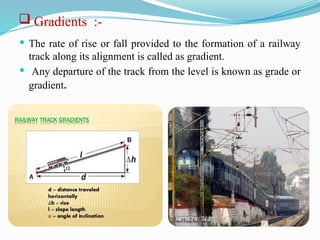
 Gradients :-
 The rate of rise or fall provided to the formation of a railway
track along its alignment is called as gradient.
 Any departure of the track from the level is known as grade or
gradient.
 Why Gradient provided ?
 To provide a uniform rate of rise or fall
 To reach the various station located at different elevation
 To reduce the cost of earth work
 To follow the natural contours of the ground to the extent
possible
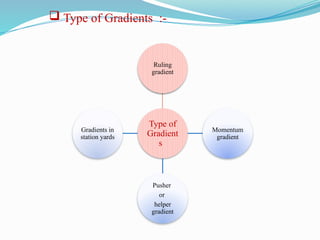
Type of
Gradient
s
Ruling
gradient
Momentum
gradient
Pusher
or
helper
gradient
Gradients in
station yards
 Type of Gradients :-
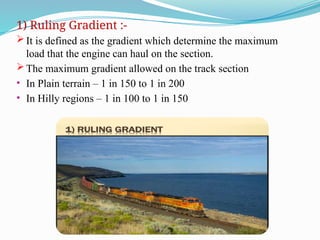
1) Ruling Gradient :-
 It is defined as the gradient which determine the maximum
load that the engine can haul on the section.
 The maximum gradient allowed on the track section
• In Plain terrain – 1 in 150 to 1 in 200
• In Hilly regions – 1 in 100 to 1 in 150
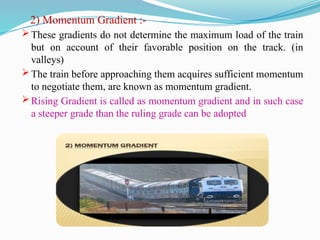
2) Momentum Gradient :-
These gradients do not determine the maximum load of the train
but on account of their favorable position on the track. (in
valleys)
The train before approaching them acquires sufficient momentum
to negotiate them, are known as momentum gradient.
Rising Gradient is called as momentum gradient and in such case
a steeper grade than the ruling grade can be adopted
3) Helping Gradient
 For the portion where the gradient is severe, by arranging a
assisting engine (PUSHER ENGINE OR BANKING ENGINE , it
may be operationally easy or even be economically to run the train
on the basis of load that the engine can carry on the remaining
portion of the track is called “Pusher “ or “Helper” Gradient
 Pusher Gradient are very important in mountains terrain where
steeper gradients are necessary to reduce the length of the track.
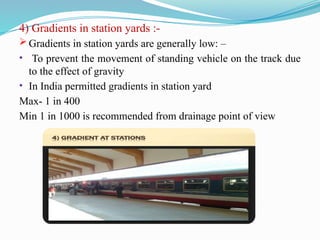
4) Gradients in station yards :-
 Gradients in station yards are generally low: –
• To prevent the movement of standing vehicle on the track due
to the effect of gravity
• In India permitted gradients in station yard
Max- 1 in 400
Min 1 in 1000 is recommended from drainage point of view
Thank you

3.Railways infrastructure engineering.pptx

  • 1.
    TE(Civil Engineering) (2015Pattern) Infrastructure Engineering and Construction Techniques (301002) Semester-I Unit II- Railways
  • 2.
    Unit –II Railways Railjoints, types, evil effects, remedial measures, Welding of rails, Short and long welded rails, Types of gradients, Curves, Grade compensation on curves, Alignment, Super elevation, Equilibrium cant, Equilibrium speed, Maximum permissible limits for cant, Cant deficiency, Cant excess, Speed on curves, Safe speed on curves using Indian railways formula only for fully transition curves, Concept of negative cant, Points, crossings and turnouts- functions, Components, elements of points, Types of crossings and turnouts, Track maintenance: Regular and Periodic. (Site visit is recommended to learn this topic)
  • 3.
     Welding ofrails :- • The number of joints can be reduced by the process of welding of rails. • welded joints are considered as the most perfect & strongest type of joints • Welding is done by electrode and molten metal is filled between gap between the two rails.
  • 4.
     Welding ofRails Purpose • To increase the rail length by welding and reducing the weakness at the joint. • To repair the worn out or damaged rails so as to increase the life of rail. • To built up worn out points and rails on the sharp curves.
  • 5.
     Advantage ofwelding of Rail :-  Increase the life of rails due to decrease in wear at ends  Decrease in maintenance cost of 25 %  Smooth functioning of track  Decrease in creep.  Less fish plate and fish bolts are required. Hence construction cost is reduced.  Welding provides smooth working of track which results in comfort to the passengers.  Better for large bridges as rails of length equal to each span give better performance and reduce the effect of impact.
  • 6.
    Short Welded Rails(S.W.R) :- When the rail contracts and expands throughout its length,then it is called as Short welded Rails. Long Welded Rails (L.W.R):- A welded rails of which, the central part does not undergo any longitudinal movement because of temperature variations is called as Long Welded Rails (L.W.R). Long welded rails have minimum length of 300 m and maximum length of 1000 m.  When a length is more than 250 m on broad gauge (B.G) and 500 m on meter gauge (M.G) then it is normally considered as long welded rail.
  • 7.
     Gradients :- The rate of rise or fall provided to the formation of a railway track along its alignment is called as gradient.  Any departure of the track from the level is known as grade or gradient.
  • 8.
     Why Gradientprovided ?  To provide a uniform rate of rise or fall  To reach the various station located at different elevation  To reduce the cost of earth work  To follow the natural contours of the ground to the extent possible
  • 9.
  • 10.
    1) Ruling Gradient:-  It is defined as the gradient which determine the maximum load that the engine can haul on the section.  The maximum gradient allowed on the track section • In Plain terrain – 1 in 150 to 1 in 200 • In Hilly regions – 1 in 100 to 1 in 150
  • 11.
    2) Momentum Gradient:- These gradients do not determine the maximum load of the train but on account of their favorable position on the track. (in valleys) The train before approaching them acquires sufficient momentum to negotiate them, are known as momentum gradient. Rising Gradient is called as momentum gradient and in such case a steeper grade than the ruling grade can be adopted
  • 13.
    3) Helping Gradient For the portion where the gradient is severe, by arranging a assisting engine (PUSHER ENGINE OR BANKING ENGINE , it may be operationally easy or even be economically to run the train on the basis of load that the engine can carry on the remaining portion of the track is called “Pusher “ or “Helper” Gradient  Pusher Gradient are very important in mountains terrain where steeper gradients are necessary to reduce the length of the track.
  • 14.
    4) Gradients instation yards :-  Gradients in station yards are generally low: – • To prevent the movement of standing vehicle on the track due to the effect of gravity • In India permitted gradients in station yard Max- 1 in 400 Min 1 in 1000 is recommended from drainage point of view
  • 15.