EXERCISE
Arrange the jumbleletters and tell the definition
Atuhakreeq
Clavonci neurotpi
Sdneidalls
Cntotice
Retromr
3.
A geologic hazard,or geohazard, is
a naturally occurring geological
process or phenomenon that has
the potential to cause damage, loss
of life, or other negative impacts on
humans and the environment.
4.
These hazards originatefrom
processes within the Earth and can
manifest as earthquakes, volcanic
eruptions, landslides, and other
related events.
5.
Geologic hazards canlead to loss of life, injuries,
property damage, economic disruption, and
environmental damage.
01
Earthquake
02
Volcanic
Eruption
03
Landslide
6.
Earthquake is ashaking or trembling of
the ground caused by the sudden
movement of rock materials below the
earth's surface.
There are two main types of
earthquakes, the tectonic earthquakes
and volcanic earthquakes.
7.
1.The Tectonic earthquake
•These are the most common type of earthquakes.
• They occur due to the sudden movement of tectonic plates, which
are massive pieces of the Earth's lithosphere that float on the
semi-molten asthenosphere.
• As these plates interact (collide, slide past each other, or move
apart), stress builds up along their boundaries.
• When the stress exceeds the strength of the rocks, they fracture,
releasing energy in the form of seismic waves, causing the ground
to shake.
8.
2. Volcanic earthquake
•These earthquakes are linked to volcanic activity.
• They are triggered by the movement of magma
(molten rock) beneath the Earth's surface.
• As magma moves, it can cause pressure changes
and fractures in the surrounding rock, leading to
tremors and shaking.
9.
An earthquake isa shaking or
trembling of the ground caused by
the sudden movement of rock
materials below the earth's surface.
11.
Most common earthquake
relatedhazard
Ground shaking refers to the vibration of the
Earth's surface, typically caused by seismic waves
generated by earthquakes. strong ground
shaking can cause object to fall
12.
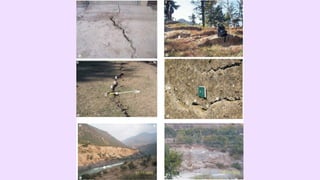
Ground rupture, alsoknown as surface
rupture, is a visible displacement of the
Earth's surface along a fault line during an
earthquake. It occurs when the movement of
a fault during an earthquake is strong
enough to break the surface of the ground.
This can lead to cracks, fissures, and offsets
in the ground
13.
Ground rupture, alsoknown as surface
rupture, is a visible displacement of the
Earth's surface along a fault line during an
earthquake. It occurs when the movement of
a fault during an earthquake is strong
enough to break the surface of the ground.
This can lead to cracks, fissures, and offsets
in the ground
15.
Tsunami a seriesof
powerful ocean waves,
often caused by large
earthquakes, volcanic
eruptions, or underwater
landslides, that can travel
vast distances and cause
significant damage when
they reach coastlines.
16.
Liquefaction is a
processwhere
saturated soil
temporarily loses its
strength and behaves
like a liquid due to
stress like shaking
from an earthquake.
17.
Fire is causeby rupture
of gas lines during
ground shaking, it
poses a threat of
explosion which may
cause to death and
widely destruction.
18.
• A volcaniceruption is the release of
molten rock (magma), ash, and gases
from a volcano onto the Earth's
surface or into the atmosphere.
These eruptions can range from
gentle flows of lava to explosive
events that send ash and debris high
into the air.
20.
Lahar is atype of volcanic
mudflow or debris flow
composed of a mixture of
water, volcanic ash, rocks,
and other debris. It flows
down the slopes of a
volcano, typically along river
valleys, and can be
extremely destructive.
21.
Pyroclastic flow isa fast-moving current
of hot gas and volcanic matter, including
rock fragments, ash, and volcanic gas,
that flows down the slopes of a volcano.
These flows are extremely dangerous due
to their high temperature, high speed,
and destructive power.
23.
Volcanic gases arethe gaseous substances
emitted from volcanoes, both during eruptions
and from vents or fumaroles at other times.
The most abundant gas released is water
vapor, followed by carbon dioxide and sulfur
dioxide. Other gases present in smaller
amounts include hydrogen sulfide, hydrogen
chloride, hydrogen fluoride, and carbon
monoxide.
25.
Tephra falls area
widespread volcanic
hazard consisting of
fragmented volcanic
material (tephra, including
ash) ejected during an
eruption that settles back
to the ground.
26.
Landslide is thedown-slope
movement of a mass of rock, debris, or
earth due to gravity. It's a type of
mass wasting where the force of gravity
overcomes the strength of the slope
material, causing it to slide, fall, or flow
downslope.
28.
Mudflow, also knownas a mudslide, is a
geological phenomenon where a mass of water-
saturated debris, including mud, soil, and rocks,
flows rapidly down a slope. It's essentially a type
of debris flow characterized by a high proportion
of fine-grained material like clay and silt, making
it more fluid and capable of traveling farther and
across lower slopes than other debris flow.
29.
Mudflow, also knownas a mudslide, is a
geological phenomenon where a mass of water-
saturated debris, including mud, soil, and rocks,
flows rapidly down a slope. It's essentially a type
of debris flow characterized by a high proportion
of fine-grained material like clay and silt, making
it more fluid and capable of traveling farther and
across lower slopes than other debris flow.
30.
Earthflow is atype of
mass wasting, where
soil and weathered
rock saturated with
water move
downslope under the
force of gravity.
31.
Rockfall is atype of
landslide, specifically
a rapid downslope
movement of rocks
and boulders
detached from steep
slopes or cliffs.
32.
1. Which ofthe following is a type of earthquake caused by movement along a
fault line?
A. Volcanic earthquake.
B. Tectonic earthquake.
C. Collapse earthquake.
D. Induced earthquake.
2. What causes a volcanic earthquake?
A. Movement of tectonic plates.
B. The collapse of underground caverns.
C. Magma movement beneath a volcano.
D. Human activities like mining.
33.
3. What isa tephra fall?
A. A type of lava flow
B. A mixture of volcanic gases and ash
C. Volcanic material ejected into the air that falls back to the ground
D. A mudflow caused by melted ice
4. What type of natural event is commonly associated with volcanic
earthquakes?
A. Tornadoes
B. Volcanic eruptions
C. Tsunamis
D. Solar flares
34.
5. Which ofthe following is NOT a result of magma movement underground?
A. Ground shaking
B. Fracturing of rock
C. Formation of glaciers
D. Pressure changes
6. Volcanic earthquakes are usually:
A. Caused by oceanic crust collisions
B. Linked to faults in tectonic plates
C. Localized around active volcanoes
D. The strongest type of earthquakes
35.
7. What isliquefaction?
A. Melting of rocks due to heat
B. Cracking of the Earth’s crust
C. Saturated soil losing strength and acting like a liquid
D. Lava turning into soil
8. Which event most commonly triggers liquefaction?
A. Earthquake shaking
B. Volcanic eruption
C. Landslide movement
D. Heavy rainfall
36.
9. What isone of the major consequences of liquefaction during an earthquake?
A. Formation of new volcanoes
B. Increased lightning storms
C. Explosions of groundwater
D. Buildings sinking, tilting, or collapsing
10.Which of the following is an example of a geologic hazard?
A. Tornado
B. Earthquake
C. Drought
D. Wildfire









![GEOLOGICAL HAZARDS [Autosaved].pptx](https://cdn.slidesharecdn.com/ss_thumbnails/geologicalhazardsautosaved-240128120931-9c982cee-thumbnail.jpg?width=640&height=640&fit=bounds)


