World Intellectual Property Organisation-WIPO
VINOTH R
M.Pharm (IP) – 1st Semester
Intellectual Property Rights
CONTENTS
 Introduction
 Quick facts
 Strategic goals
 History
 Member states
 Activities
 Services
 Types of IPR
 Resources
 Classifications
 Training
 Bibliography
 World Intellectual Property Organization (WIPO) is the global forum for
Intellectual property (IP) services, policy, information and cooperation.
 WIPO is one of the specialized agencies of United Nations which was
established in 1967.
Mission
 To promote the protection of IP rights (IPRs) worldwide and extend the
benefits of the international IP system to all member States.
World Intellectual Property Organization (WIPO)
3 / 27
Quick Facts of WIPO
Status: An Intergovernmental organization
Director General: Daren Tang
Member States: 193
Observers: 250 +
Staff: 950 from 101 countries
Treaties Administered: 26
Location: Geneva, Switzerland.
4 / 27
Strategic Goals
Promotion of an IP culture
 To increase understanding of IP
 To encourage use of IP system
 To enhance respect for IP rights
Enhanced access to IP System
 Delivery of practical solutions that empower all stakeholders to
develop, protect, enforce, manage and commercially exploit IPRs for
development
5 / 27
IP: A TOOL FOR DEVELOPMENT
“In the age of the knowledge economy, the efficient and creative use
of knowledge is a key determinant of international competitiveness,
wealth creation and improved social welfare”
“An effective IP system embedded within a national strategy which
anchors IP considerations firmly within the policy-making process
will help a nation to promote and protect its IP assets, thereby
driving economic growth and wealth creation”.
Dr. Kamil Idris
WIPO Ex-Director General (1997-2008)
6 / 27
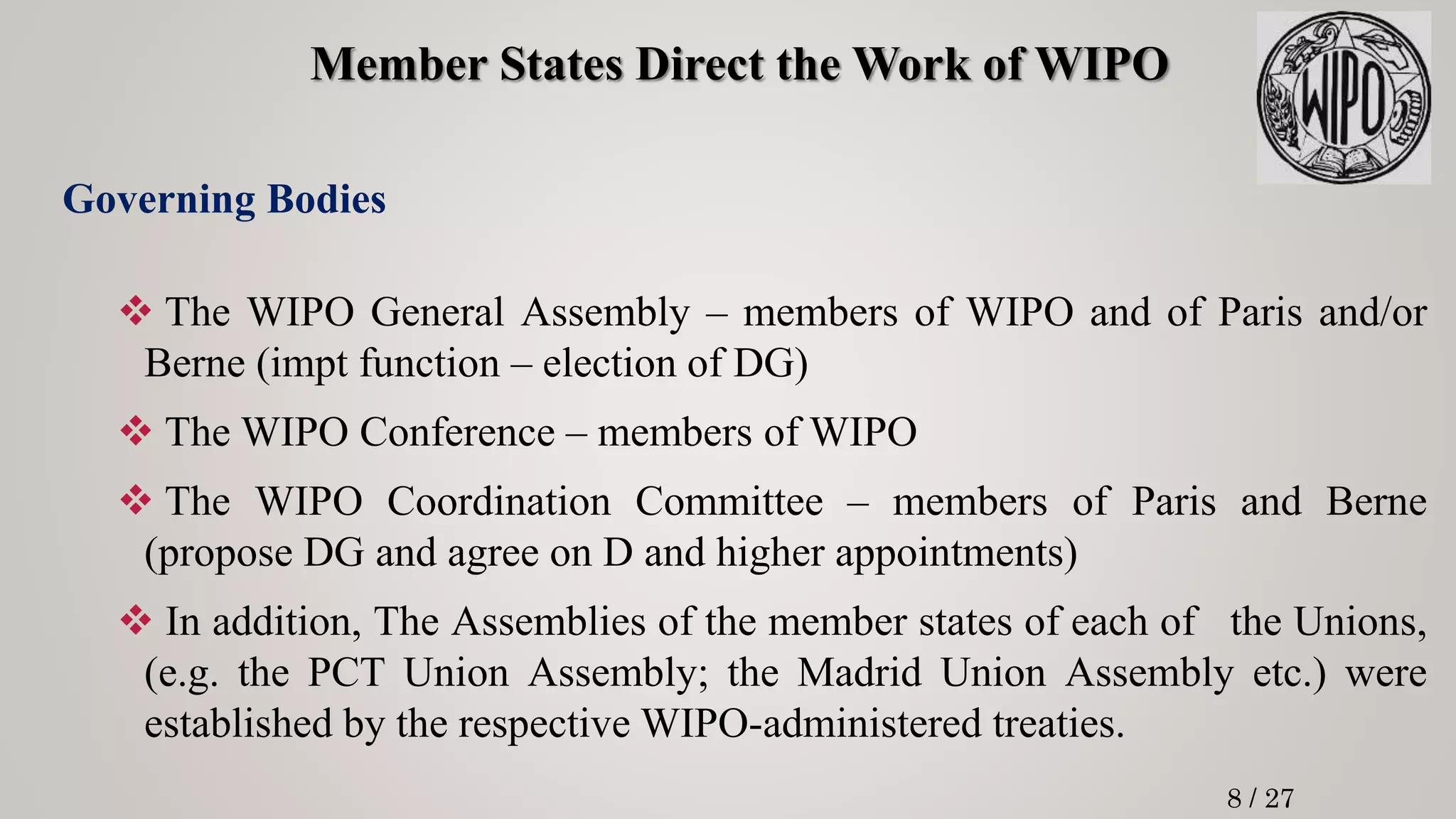
BRIEF HISTORY OF WIPO
 Paris Union 1883
 Berne Union 1886
 International Bureau combined 1893
 WIPO Convention 1967
 UN Specialized Agency 1974
7 / 27
Member States Direct the Work of WIPO
Governing Bodies
 The WIPO General Assembly – members of WIPO and of Paris and/or
Berne (impt function – election of DG)
 The WIPO Conference – members of WIPO
 The WIPO Coordination Committee – members of Paris and Berne
(propose DG and agree on D and higher appointments)
 In addition, The Assemblies of the member states of each of the Unions,
(e.g. the PCT Union Assembly; the Madrid Union Assembly etc.) were
established by the respective WIPO-administered treaties.
8 / 27
Permanent Committees
 Committees of Experts to revise and update the classification systems.
 Program and Budget Committee
 Committee on Development and Intellectual Property (CDIP)
 Intergovernmental Committee on Intellectual Property and Genetic Resources,
Traditional Knowledge and Folklore (IGC).
 Advisory Committee on Enforcement (ACE).
Standing Committees
 Standing Committee on the Law of Patents (SCP).
 Standing Committee on the Law of Trademarks, Industrial Designs and
Geographical Indications (SCT).
 Standing Committee on Copyright and Related Rights (SCCR).
 Standing Committee on Information Technologies (SCIT).
9 / 27
WIPO’S ACTIVITIES
 Norm Setting
 Economic Development
 IP Services
10 / 27
NORM SETTING
 balanced/responsive to emerging needs
 effective in encouraging innovation/creativity
 sufficiently flexible to accommodate national policy objectives
 Blueprint for future development of international patent system to
address.
 logistical problems and policy challenges
 consider implications for developing countries
 Criteria: balanced, reliable, swift, user-friendly, accessible, cost effective
The main objective is the progressive development of International IP
law for an IP system that is
Patents
11 / 27
 Strengthen system
 Ensure it is in line with digital environment
 Build consensus on topical issues
 Facilitate CR-based business & culture development
 Important tool to promote domestic commerce and international trade
 Develop harmonized principles/rules of law
 Promote adequate protection
 Development of international registration & classification systems
NORM SETTING
Copyright and Related Rights
Trademarks, Industrial Design, GI
12 / 27
 Generate practical benefits from using IP system/assets to support socio-
economic development, cultural integrity of communities
 WIPO is concerned by genetic resources & benefit sharing and TK &
Innovation
 Debating broad policy and legal questions
 Sharing practical experience and
 Developing practical tools and mechanisms
NORM SETTING
Traditional Knowledge (TK) & Folklore
13 / 27
ECONOMIC DEVELOPMENT
To maximize strategic use of IP for development by
 Updating IP legislation
 Upgrading IP infrastructure
 Demystifying IP
 Promoting understanding of policy options offered by IP
 Training
14 / 27
SERVICES
Enhancement of global protection systems to further simplify and reduce costs
of obtaining protection in multiple countries for
 Patents (PCT)
 E-filing
 Trademarks (Madrid Agreement)
 Industrial design (Hague Agreement)
 Geographical Indications (Lisbon Agreement)
 Micro-Organisms (Budapest Agreement)
 Alternative dispute resolution (ADR) offered by WIPO Arbitration &
Mediation Center
 WIPO Trademark Database Portal
15 / 27
The Patent Cooperation Treaty (PCT) assists applicants in seeking patent
protection internationally for their inventions, helps patent offices with their
patent granting decisions, and facilitates public access to a wealth of technical
information relating to those inventions.
The Madrid System is a convenient and cost-effective solution for registering
and managing trademarks worldwide. File a single application and pay one set
of fees to apply for protection in up to 123 countries. Modify, renew or expand
your global trademark portfolio through one centralized system.
PCT – The International Patent System
Madrid – The International Trademark System
16 / 27
The Hague System for the International Registration of Industrial Designs
provides a practical business solution for registering up to 100 designs in 74
contracting parties covering 91 countries, through the filing of one single
international application.
Protection for an appellation of origin or a geographical indication in
the contracting parties through a single registration procedure and one set of
fees. (Lisbon Agreement 1958)
Hague – The International Design System
Lisbon – Geographical Indications
17 / 27
 The WIPO Arbitration and Mediation Center offers time- and cost-efficient
alternative dispute resolution (ADR) options, such as mediation, arbitration
expedited arbitration, and expert determination to enable private parties to settle
their domestic or cross-border commercial disputes.
 The WIPO Center is international and specialized in IP and technology disputes.
 The WIPO Center is also the global leader in the provision of domain name
dispute resolution services under the WIPO-designed UDRP.
Alternative Dispute Resolution
18 / 27
 WIPO PROOF is a new digital business service that provides a date- and
time-stamped digital fingerprint of any file, proving its existence at a
specific point in time.
 This new service complements WIPO’s existing intellectual property (IP)
systems.
The WIPO Arbitration and Mediation Center provides time- and cost-
efficient mechanisms to resolve internet domain name disputes, without the
need for court litigation. This service includes the WIPO-initiated Uniform
Domain Name Dispute Resolution Policy (UDRP).
Domain Name Dispute Resolution
WIPO PROOF – Trusted Digital Evidence
19 / 27
20 / 27
RESOURCES
 IP and technology databases
 Patent scope
 Global Brand Database
 Madrid Monitor
 Global Design Database
 Hague Express
 Lisbon Express
 WIPO Pearl
 Artificial intelligence tools
21 / 27
WIPO International Classifications
 International Patent Classification (IPC)
 Nice Classification (for Trademarks)
 Vienna Classification (for figurative elements of marks)
 Locarno Classification (for industrial designs)
22 / 27
PCT: International Applications Received in 2019
(by country of origin)
23 / 27
TRAINING
 WIPO World wide Academy (WWA)
 Distance learning program
 Professional training
 Policy development, teaching and research
 Training trainers
 Partnerships with academic institutions, IGOs, NGOs, joint publications,
materials etc.
24 / 27
25 / 27
Bibliography
 www.wipo.int
26 / 27
Thank You

World Intellectual Property Rights- WIPO

  • 1.
    World Intellectual PropertyOrganisation-WIPO VINOTH R M.Pharm (IP) – 1st Semester Intellectual Property Rights
  • 2.
    CONTENTS  Introduction  Quickfacts  Strategic goals  History  Member states  Activities  Services  Types of IPR  Resources  Classifications  Training  Bibliography
  • 3.
     World IntellectualProperty Organization (WIPO) is the global forum for Intellectual property (IP) services, policy, information and cooperation.  WIPO is one of the specialized agencies of United Nations which was established in 1967. Mission  To promote the protection of IP rights (IPRs) worldwide and extend the benefits of the international IP system to all member States. World Intellectual Property Organization (WIPO) 3 / 27
  • 4.
    Quick Facts ofWIPO Status: An Intergovernmental organization Director General: Daren Tang Member States: 193 Observers: 250 + Staff: 950 from 101 countries Treaties Administered: 26 Location: Geneva, Switzerland. 4 / 27
  • 5.
    Strategic Goals Promotion ofan IP culture  To increase understanding of IP  To encourage use of IP system  To enhance respect for IP rights Enhanced access to IP System  Delivery of practical solutions that empower all stakeholders to develop, protect, enforce, manage and commercially exploit IPRs for development 5 / 27
  • 6.
    IP: A TOOLFOR DEVELOPMENT “In the age of the knowledge economy, the efficient and creative use of knowledge is a key determinant of international competitiveness, wealth creation and improved social welfare” “An effective IP system embedded within a national strategy which anchors IP considerations firmly within the policy-making process will help a nation to promote and protect its IP assets, thereby driving economic growth and wealth creation”. Dr. Kamil Idris WIPO Ex-Director General (1997-2008) 6 / 27
  • 7.
    BRIEF HISTORY OFWIPO  Paris Union 1883  Berne Union 1886  International Bureau combined 1893  WIPO Convention 1967  UN Specialized Agency 1974 7 / 27
  • 8.
    Member States Directthe Work of WIPO Governing Bodies  The WIPO General Assembly – members of WIPO and of Paris and/or Berne (impt function – election of DG)  The WIPO Conference – members of WIPO  The WIPO Coordination Committee – members of Paris and Berne (propose DG and agree on D and higher appointments)  In addition, The Assemblies of the member states of each of the Unions, (e.g. the PCT Union Assembly; the Madrid Union Assembly etc.) were established by the respective WIPO-administered treaties. 8 / 27
  • 9.
    Permanent Committees  Committeesof Experts to revise and update the classification systems.  Program and Budget Committee  Committee on Development and Intellectual Property (CDIP)  Intergovernmental Committee on Intellectual Property and Genetic Resources, Traditional Knowledge and Folklore (IGC).  Advisory Committee on Enforcement (ACE). Standing Committees  Standing Committee on the Law of Patents (SCP).  Standing Committee on the Law of Trademarks, Industrial Designs and Geographical Indications (SCT).  Standing Committee on Copyright and Related Rights (SCCR).  Standing Committee on Information Technologies (SCIT). 9 / 27
  • 10.
    WIPO’S ACTIVITIES  NormSetting  Economic Development  IP Services 10 / 27
  • 11.
    NORM SETTING  balanced/responsiveto emerging needs  effective in encouraging innovation/creativity  sufficiently flexible to accommodate national policy objectives  Blueprint for future development of international patent system to address.  logistical problems and policy challenges  consider implications for developing countries  Criteria: balanced, reliable, swift, user-friendly, accessible, cost effective The main objective is the progressive development of International IP law for an IP system that is Patents 11 / 27
  • 12.
     Strengthen system Ensure it is in line with digital environment  Build consensus on topical issues  Facilitate CR-based business & culture development  Important tool to promote domestic commerce and international trade  Develop harmonized principles/rules of law  Promote adequate protection  Development of international registration & classification systems NORM SETTING Copyright and Related Rights Trademarks, Industrial Design, GI 12 / 27
  • 13.
     Generate practicalbenefits from using IP system/assets to support socio- economic development, cultural integrity of communities  WIPO is concerned by genetic resources & benefit sharing and TK & Innovation  Debating broad policy and legal questions  Sharing practical experience and  Developing practical tools and mechanisms NORM SETTING Traditional Knowledge (TK) & Folklore 13 / 27
  • 14.
    ECONOMIC DEVELOPMENT To maximizestrategic use of IP for development by  Updating IP legislation  Upgrading IP infrastructure  Demystifying IP  Promoting understanding of policy options offered by IP  Training 14 / 27
  • 15.
    SERVICES Enhancement of globalprotection systems to further simplify and reduce costs of obtaining protection in multiple countries for  Patents (PCT)  E-filing  Trademarks (Madrid Agreement)  Industrial design (Hague Agreement)  Geographical Indications (Lisbon Agreement)  Micro-Organisms (Budapest Agreement)  Alternative dispute resolution (ADR) offered by WIPO Arbitration & Mediation Center  WIPO Trademark Database Portal 15 / 27
  • 16.
    The Patent CooperationTreaty (PCT) assists applicants in seeking patent protection internationally for their inventions, helps patent offices with their patent granting decisions, and facilitates public access to a wealth of technical information relating to those inventions. The Madrid System is a convenient and cost-effective solution for registering and managing trademarks worldwide. File a single application and pay one set of fees to apply for protection in up to 123 countries. Modify, renew or expand your global trademark portfolio through one centralized system. PCT – The International Patent System Madrid – The International Trademark System 16 / 27
  • 17.
    The Hague Systemfor the International Registration of Industrial Designs provides a practical business solution for registering up to 100 designs in 74 contracting parties covering 91 countries, through the filing of one single international application. Protection for an appellation of origin or a geographical indication in the contracting parties through a single registration procedure and one set of fees. (Lisbon Agreement 1958) Hague – The International Design System Lisbon – Geographical Indications 17 / 27
  • 18.
     The WIPOArbitration and Mediation Center offers time- and cost-efficient alternative dispute resolution (ADR) options, such as mediation, arbitration expedited arbitration, and expert determination to enable private parties to settle their domestic or cross-border commercial disputes.  The WIPO Center is international and specialized in IP and technology disputes.  The WIPO Center is also the global leader in the provision of domain name dispute resolution services under the WIPO-designed UDRP. Alternative Dispute Resolution 18 / 27
  • 19.
     WIPO PROOFis a new digital business service that provides a date- and time-stamped digital fingerprint of any file, proving its existence at a specific point in time.  This new service complements WIPO’s existing intellectual property (IP) systems. The WIPO Arbitration and Mediation Center provides time- and cost- efficient mechanisms to resolve internet domain name disputes, without the need for court litigation. This service includes the WIPO-initiated Uniform Domain Name Dispute Resolution Policy (UDRP). Domain Name Dispute Resolution WIPO PROOF – Trusted Digital Evidence 19 / 27
  • 20.
  • 21.
    RESOURCES  IP andtechnology databases  Patent scope  Global Brand Database  Madrid Monitor  Global Design Database  Hague Express  Lisbon Express  WIPO Pearl  Artificial intelligence tools 21 / 27
  • 22.
    WIPO International Classifications International Patent Classification (IPC)  Nice Classification (for Trademarks)  Vienna Classification (for figurative elements of marks)  Locarno Classification (for industrial designs) 22 / 27
  • 23.
    PCT: International ApplicationsReceived in 2019 (by country of origin) 23 / 27
  • 24.
    TRAINING  WIPO Worldwide Academy (WWA)  Distance learning program  Professional training  Policy development, teaching and research  Training trainers  Partnerships with academic institutions, IGOs, NGOs, joint publications, materials etc. 24 / 27
  • 25.
  • 26.
  • 27.