TRIPs AGREEMENT
About TRIPs……
• The Agreement on Trade Related Aspects of Intellectual Property
Rights (TRIPS) is an international agreement administered by the
World Trade Organization
• TRIPS is the most important and comprehensive international
agreement on Intellectual Property rights
• It was formed at the end of the Uruguay Round of the General
Agreement on Tariffs and Trade (GATT) in 1994.
• The TRIPS agreement introduced intellectual property law into the
international trading system for the first time
Contd…
• After the Uruguay round, the GATT became the basis for the
establishment of the World Trade Organization (WTO) in 1995
• WTO was established to supervise and liberalize trade
• Adoption of TRIPS is a compulsory requirement of World Trade
Organization membership
• Any country seeking to obtain easy access to the numerous
international markets opened by the World Trade Organization must
enact the strict intellectual property laws mandated by TRIPS
• There are now 153 WTO member nations and 29 observer nations
• When the TRIPs Agreement took effect on January 1, 1995, all
developed countries were given twelve months from the date of
signing the agreement to implement its provisions.
• Developing countries and transition economies (under certain
conditions) were given five years, until 2000.
• Least developed countries (LDCs) were given 11 years, until 2006, to
comply.
• For pharmaceutical patents in these LDCs, the term for compliance
has been extended to 2016.
• There are currently 30 LDCs within the WTO organization bound by
TRIPs and another 10 LDCs are waiting accession.
Intellectual Property Rights ( IPRs )
• IPRs - the rights given to the persons over the creations of their
minds
• They usually give the creator an exclusive right over the use of
his/her creation for a certain period of time
• The TRIPS Agreement sets down minimum standards, which allows
members to provide more extensive protection of intellectual
property if they so wish.
• Members are left free to determine the appropriate method of
implementing the provisions of the Agreement within their own
legal system and practice.
Contd…
• Intellectual Property comprises 2 distinct forms:
– Literary & Artistic Works
– Industrial Property
Literary & Artistic Works :
• They are books, paintings, musical compositions, plays, operas,
movies, radio/ TV programs, performances & other artistic works.
• How are they protected?
– Protected by “Copyright” which provides the individual “author”
or “artist” the exclusive right to do certain things with an
“original work”, including the right to reproduce, publish,
perform the work in public, & to make adaptations of it &
benefit thereby.
Industrial Property :
• Industrial Property describes physical matter that is the product of
an idea or concept or that is developed specifically for commercial
purposes.
• Industrial Property includes :
– Patented objects
– Trademarks
– Industrial Designs
– Trade Secrets
– Layout-designs of Integrated Circuits
– Geographical Indications
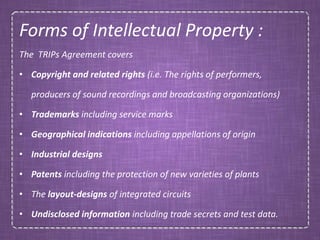
Forms of Intellectual Property :
The TRIPs Agreement covers
• Copyright and related rights (i.e. The rights of performers,
producers of sound recordings and broadcasting organizations)
• Trademarks including service marks
• Geographical indications including appellations of origin
• Industrial designs
• Patents including the protection of new varieties of plants
• The layout-designs of integrated circuits
• Undisclosed information including trade secrets and test data.
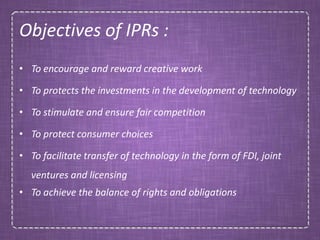
Objectives of IPRs :
• To encourage and reward creative work
• To protects the investments in the development of technology
• To stimulate and ensure fair competition
• To protect consumer choices
• To facilitate transfer of technology in the form of FDI, joint
ventures and licensing
• To achieve the balance of rights and obligations

TRIPs agreement - WTO

  • 1.
  • 2.
    About TRIPs…… • TheAgreement on Trade Related Aspects of Intellectual Property Rights (TRIPS) is an international agreement administered by the World Trade Organization • TRIPS is the most important and comprehensive international agreement on Intellectual Property rights • It was formed at the end of the Uruguay Round of the General Agreement on Tariffs and Trade (GATT) in 1994. • The TRIPS agreement introduced intellectual property law into the international trading system for the first time
  • 3.
    Contd… • After theUruguay round, the GATT became the basis for the establishment of the World Trade Organization (WTO) in 1995 • WTO was established to supervise and liberalize trade • Adoption of TRIPS is a compulsory requirement of World Trade Organization membership • Any country seeking to obtain easy access to the numerous international markets opened by the World Trade Organization must enact the strict intellectual property laws mandated by TRIPS • There are now 153 WTO member nations and 29 observer nations
  • 4.
    • When theTRIPs Agreement took effect on January 1, 1995, all developed countries were given twelve months from the date of signing the agreement to implement its provisions. • Developing countries and transition economies (under certain conditions) were given five years, until 2000. • Least developed countries (LDCs) were given 11 years, until 2006, to comply. • For pharmaceutical patents in these LDCs, the term for compliance has been extended to 2016. • There are currently 30 LDCs within the WTO organization bound by TRIPs and another 10 LDCs are waiting accession.
  • 5.
    Intellectual Property Rights( IPRs ) • IPRs - the rights given to the persons over the creations of their minds • They usually give the creator an exclusive right over the use of his/her creation for a certain period of time • The TRIPS Agreement sets down minimum standards, which allows members to provide more extensive protection of intellectual property if they so wish. • Members are left free to determine the appropriate method of implementing the provisions of the Agreement within their own legal system and practice.
  • 6.
    Contd… • Intellectual Propertycomprises 2 distinct forms: – Literary & Artistic Works – Industrial Property
  • 7.
    Literary & ArtisticWorks : • They are books, paintings, musical compositions, plays, operas, movies, radio/ TV programs, performances & other artistic works. • How are they protected? – Protected by “Copyright” which provides the individual “author” or “artist” the exclusive right to do certain things with an “original work”, including the right to reproduce, publish, perform the work in public, & to make adaptations of it & benefit thereby.
  • 8.
    Industrial Property : •Industrial Property describes physical matter that is the product of an idea or concept or that is developed specifically for commercial purposes. • Industrial Property includes : – Patented objects – Trademarks – Industrial Designs – Trade Secrets – Layout-designs of Integrated Circuits – Geographical Indications
  • 9.
    Forms of IntellectualProperty : The TRIPs Agreement covers • Copyright and related rights (i.e. The rights of performers, producers of sound recordings and broadcasting organizations) • Trademarks including service marks • Geographical indications including appellations of origin • Industrial designs • Patents including the protection of new varieties of plants • The layout-designs of integrated circuits • Undisclosed information including trade secrets and test data.
  • 10.
    Objectives of IPRs: • To encourage and reward creative work • To protects the investments in the development of technology • To stimulate and ensure fair competition • To protect consumer choices • To facilitate transfer of technology in the form of FDI, joint ventures and licensing • To achieve the balance of rights and obligations