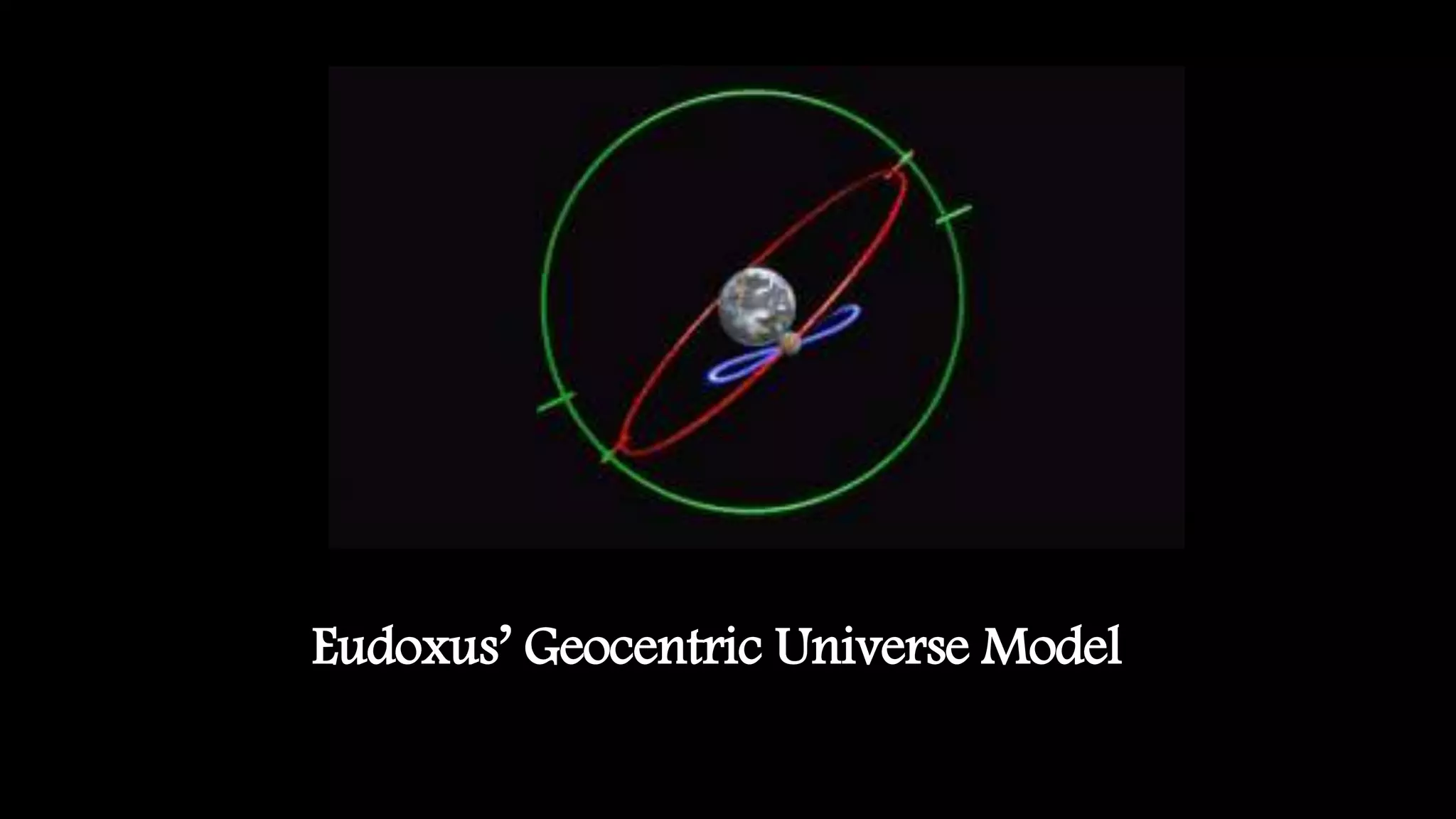
Eudoxus’ Geocentric Universe Model
Eudoxus of Samos
• The universe has 27 concentric spheres with earth as center
• A spherical Earth at the center, while the Sun and the planets were
placed in a giant transparent spheres that orbit the earth.
• The Sun’s spheres orbits the earth every 24 hours.
• Stars are attached to a larger and much farther spheres.
Eudoxus’ Five Basic Principles
1. The Earth is at the center of the universe.
2. All celestial motion is circular. All celestial motion is regular.
3. The center of the path of any celestial motion is the center of the
universe.
4. The center of all celestial motion is the center of the universe.
5. The apparent irregular and non-circular motions of celestial bodies
is a result of the combinations of real, circular motions that satisfy
principles.
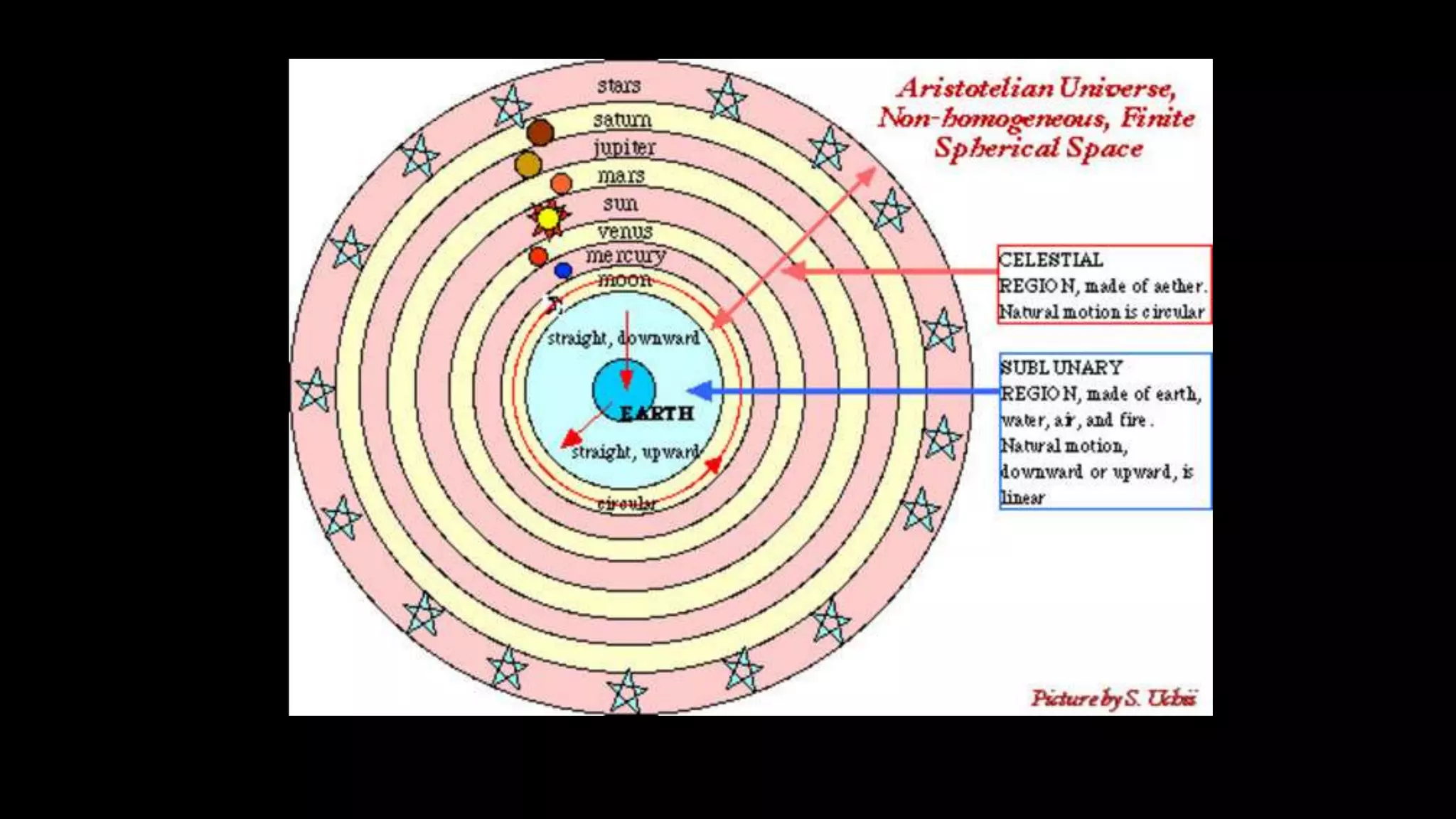
Aristotle and a Finite, Eternal Universe
• He extended Eudoxus’ model.
• The sun, moon, planets and stars are all orbiting the Earth
inside of Eudoxus’ spheres.
• The universe was finite in terms of space but existed
eternally in time.
• Motion of the celestial bodies can be traced to a Prime
Mover that because of its basic movement, all other
crystalline spheres move accordingly.
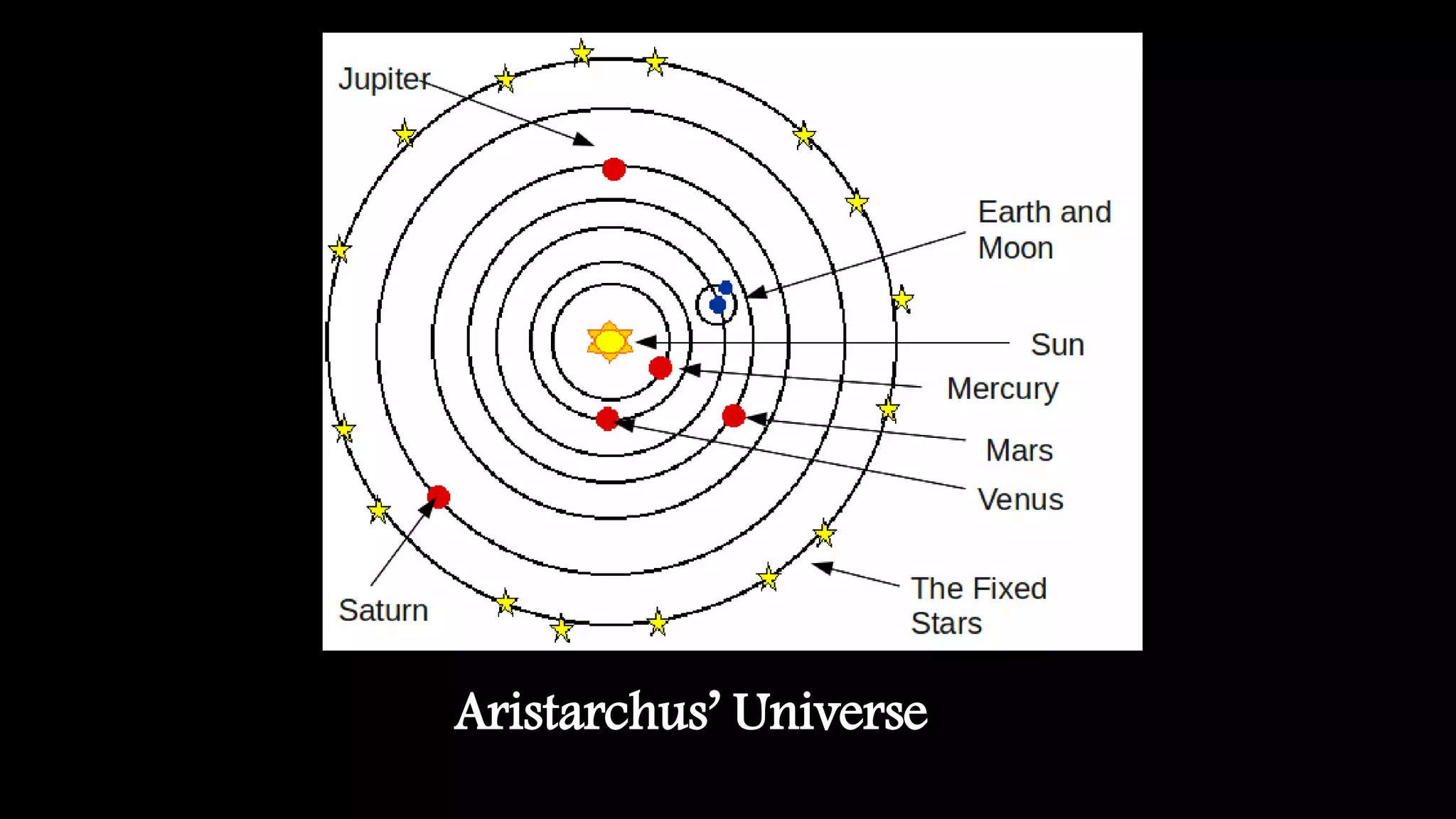
Aristarchus’ Universe
Aristarchus of Samos
• The first person to calculate the relative distance of the Earth and Sun
using trigonometry.
• First hypothesized that the Sun was at the center of the universe.
• Visualized that the Moon orbits around a spherical earth which then
revolves around the sun.
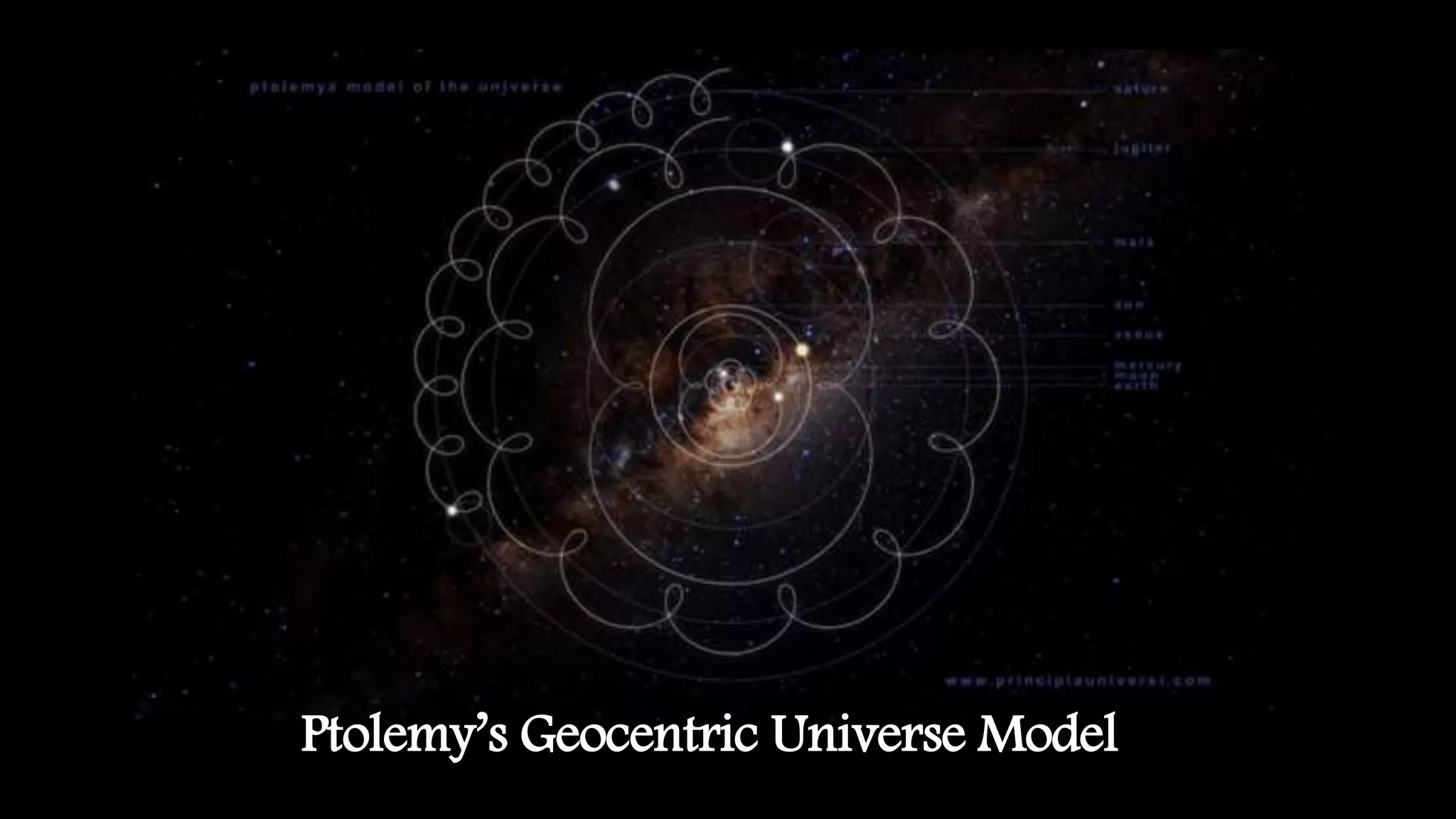
Ptolemy’s Geocentric Universe Model
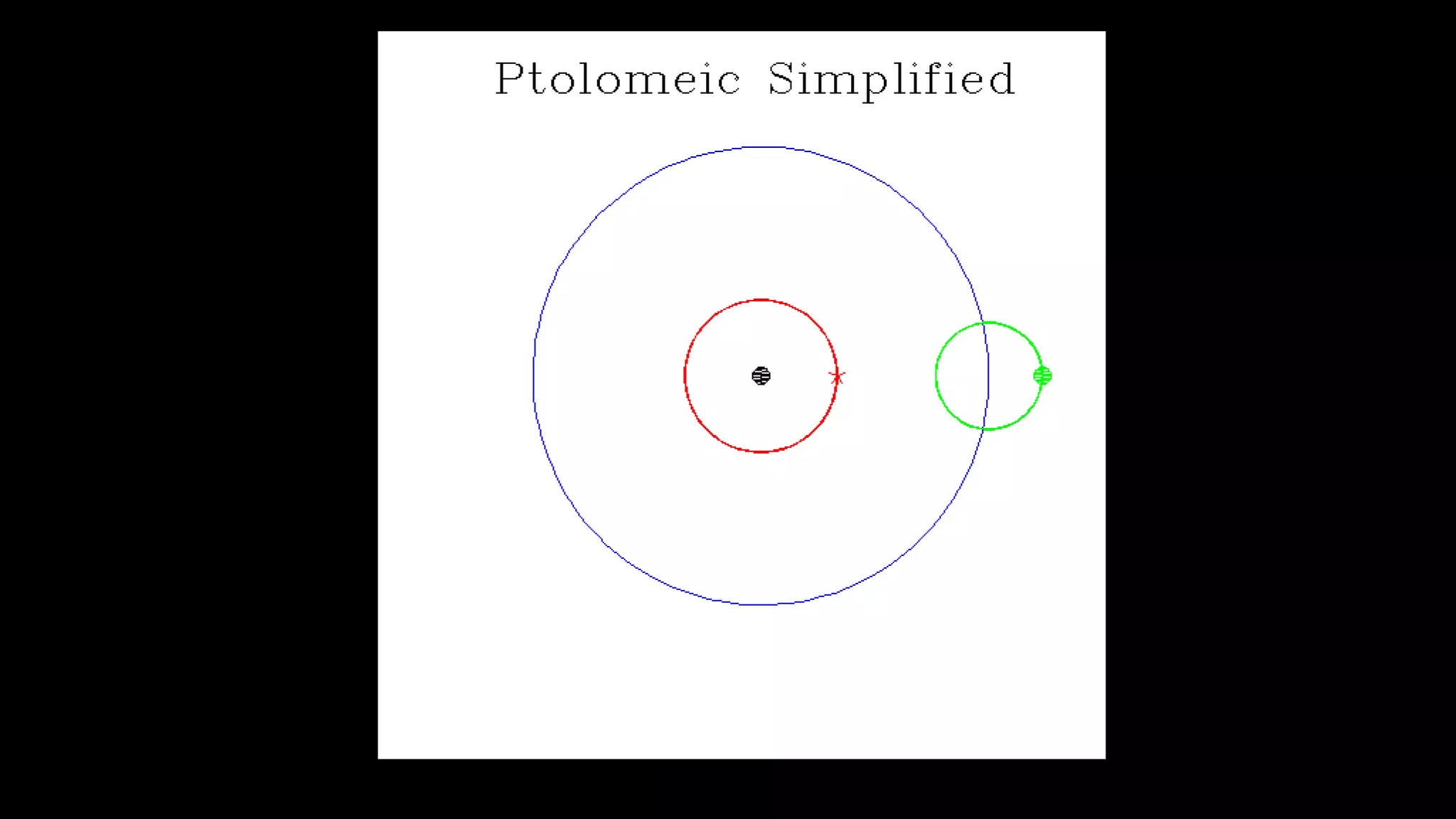
Ptolemy and Epicycles
The Ptolemaic System
• A planet moves counter-clockwise around the center of the deferent.
• The epicycle’s center also moves counter-clockwise around the center
of the deferent.
• The earth is not exactly at the center of the deferent, or it is eccentric
(off the center)
• The planet moves in a retrograde motion. The planet is brightest at
this point because it is closest to the Earth.
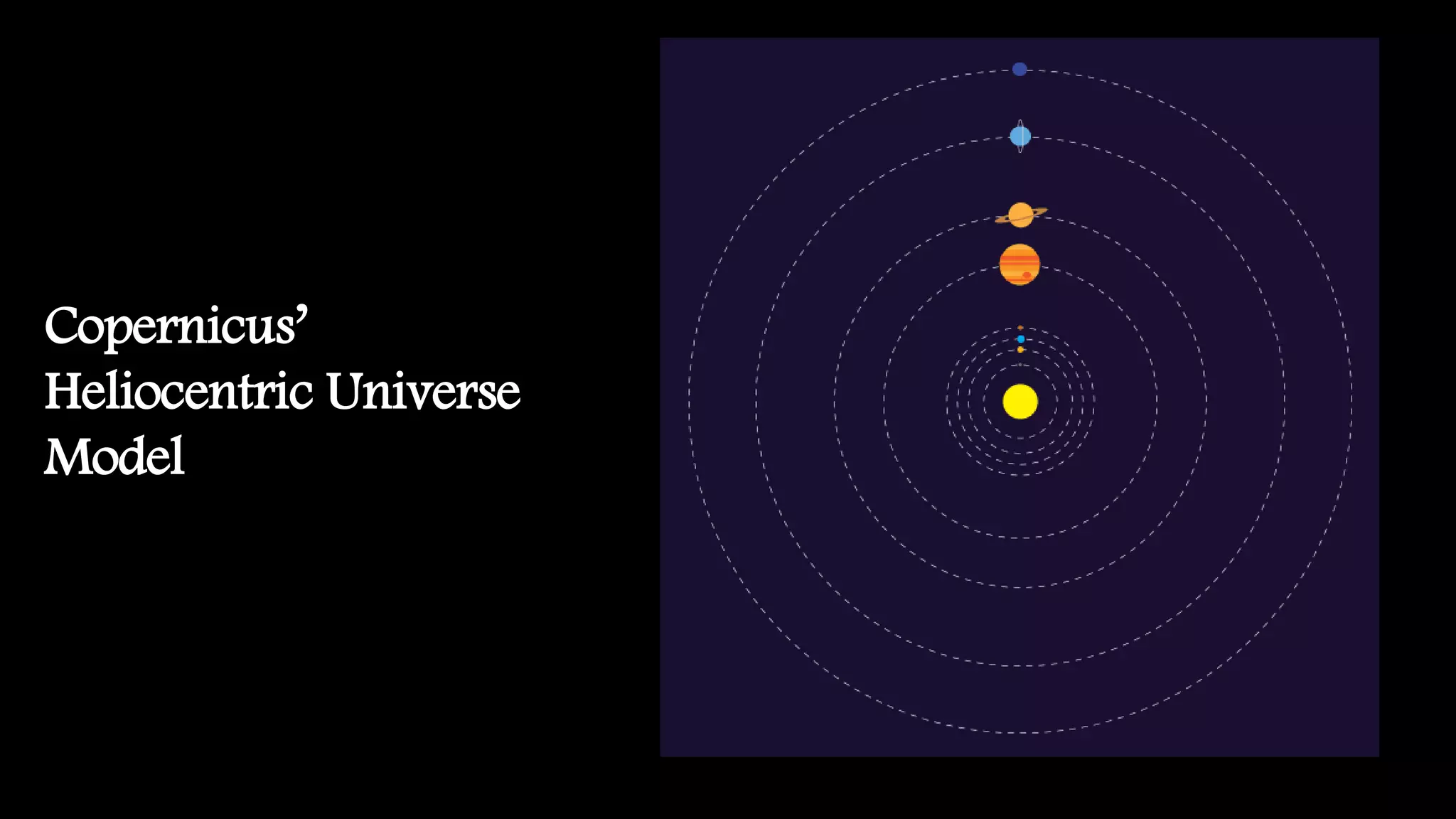
Copernicus’
Heliocentric Universe
Model
Copernicus and a Heliocentric Universe
• Put an end to the geocentric era by publishing his work “On the
Revolutions of the Heavenly Spheres”.
• The motion of spherical heavenly bodies is uniform, eternal and
circular.
• The earth has 3 different motions, daily rotation on its axis, yearly
motion around the sun and the precession, or change in orientation,
of its axis every 26,000 years.

Early models of the Universe

  • 2.
  • 3.
    Eudoxus of Samos •The universe has 27 concentric spheres with earth as center • A spherical Earth at the center, while the Sun and the planets were placed in a giant transparent spheres that orbit the earth. • The Sun’s spheres orbits the earth every 24 hours. • Stars are attached to a larger and much farther spheres.
  • 4.
    Eudoxus’ Five BasicPrinciples 1. The Earth is at the center of the universe. 2. All celestial motion is circular. All celestial motion is regular. 3. The center of the path of any celestial motion is the center of the universe. 4. The center of all celestial motion is the center of the universe. 5. The apparent irregular and non-circular motions of celestial bodies is a result of the combinations of real, circular motions that satisfy principles.
  • 6.
    Aristotle and aFinite, Eternal Universe • He extended Eudoxus’ model. • The sun, moon, planets and stars are all orbiting the Earth inside of Eudoxus’ spheres. • The universe was finite in terms of space but existed eternally in time. • Motion of the celestial bodies can be traced to a Prime Mover that because of its basic movement, all other crystalline spheres move accordingly.
  • 7.
  • 8.
    Aristarchus of Samos •The first person to calculate the relative distance of the Earth and Sun using trigonometry. • First hypothesized that the Sun was at the center of the universe. • Visualized that the Moon orbits around a spherical earth which then revolves around the sun.
  • 9.
  • 11.
    Ptolemy and Epicycles ThePtolemaic System • A planet moves counter-clockwise around the center of the deferent. • The epicycle’s center also moves counter-clockwise around the center of the deferent. • The earth is not exactly at the center of the deferent, or it is eccentric (off the center) • The planet moves in a retrograde motion. The planet is brightest at this point because it is closest to the Earth.
  • 12.
  • 13.
    Copernicus and aHeliocentric Universe • Put an end to the geocentric era by publishing his work “On the Revolutions of the Heavenly Spheres”. • The motion of spherical heavenly bodies is uniform, eternal and circular. • The earth has 3 different motions, daily rotation on its axis, yearly motion around the sun and the precession, or change in orientation, of its axis every 26,000 years.