DAOISM
INTRODUCTION TO WORLD RELIGIONS
EASTERN RELIGIONS
K-W-L
What I Know …..
What I Want to Know ……
What I have Learned ……
GUIDE QUESTIONS
1. What is Daoism? Where did it evolve?
How it is originated?
2. Who is the Founder of Daoism?
3. What is ‘Dao’?
4. What is the ‘Yin’ and ‘Yang’?
5. What are the teachings of Daoism?
PRE-ASSESSMENT
PRE-ASSESSMENT
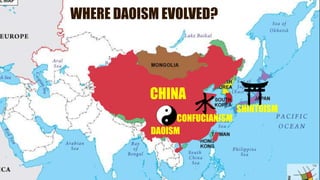
WHERE DAOISM EVOLVED?
CHINA
DAOISM
CONFUCIANISM
SHINTOISM
EAST ASIAN RELIGIONS
All East Asian religions are
concerned with preserving
harmony between every being in
the universe, as there is a
preordained appropriate place
and pattern of behaviour for each
one.
DAOISM
ORIGIN OF CHINESE
PHILOSOPHY-
RELIGION
DAOISM
ORIGIN OF CHINESE
PHILOSOPHY-RELIGION
Between the eight and third
centuries BCE, the feudal system
in China deteriorated, as rulers
failed to protect their vassals
from invaders.As a result,
warlords who could command
respect and provide protection
gained power.DAOISM
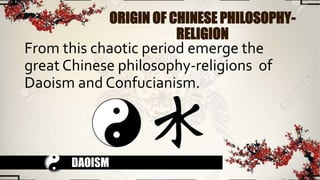
From this chaotic period emerge the
great Chinese philosophy-religions of
Daoism and Confucianism.
DAOISM
ORIGIN OF CHINESE PHILOSOPHY-
RELIGION
ORIGIN OF DAOISM
DAOISM
ORIGIN OF DAOISM
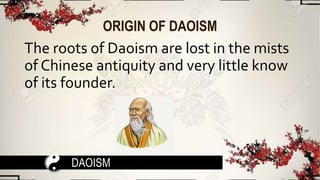
The roots of Daoism are lost in the mists
of Chinese antiquity and very little know
of its founder.
DAOISM
ORIGIN OF DAOISM
It takes its name from the book
Dàodéjĩng orTaoTe Ching
[“Classic of theWay of
Virtue”], a work attributed to
the Chinese philosopher-poet
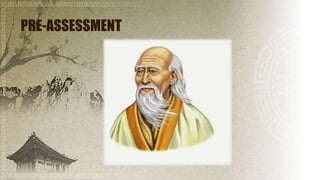
called Lăozĩ [“Old Master”]
DAOISM
ORIGIN OF DAOISM
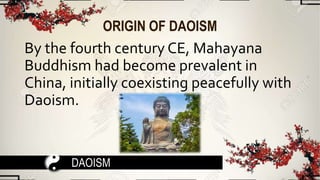
By the fourth century CE, Mahayana
Buddhism had become prevalent in
China, initially coexisting peacefully with
Daoism.
DAOISM
ORIGIN OF DAOISM
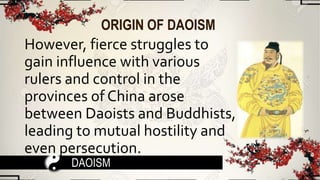
However, fierce struggles to
gain influence with various
rulers and control in the
provinces of China arose
between Daoists and Buddhists,
leading to mutual hostility and
even persecution.
DAOISM
“To attain knowledge,
add things everyday. To
attain Wisdom, remove
things everyday.”
-Dàodéjĩng
DAOISM
The Dàodéjĩng
DAOISM
The Dàodéjĩng
It is the most influential piece of
Chinese literature. Its main declaration
is that all human achievements are
foolishness; it consists of slightly more
than five thousand words contained in
81 chapters and usually translated to
poetic form.
DAOISM
The Dàodéjĩng
The Daodejing focuses on the harmony
of opposites within the peaceful flow of
the Dao. It also adds the concept of the
individual’s relationship to nature and
society, insisting that it is best to let
things take their natural course.
DAOISM
“Dao is the origin of
all beings whose
essence is nothing.”
-Dàodéjĩng
DAOISM
The Dào
DAOISM
The Yin and Yang
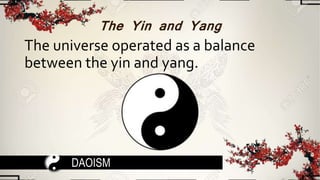
The universe operated as a balance
between the yin and yang.
DAOISM
The Yin and Yang
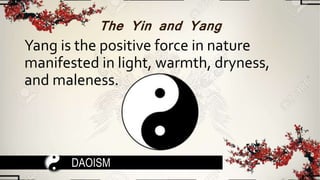
Yang is the positive force in nature
manifested in light, warmth, dryness,
and maleness.
DAOISM
The Yin and Yang
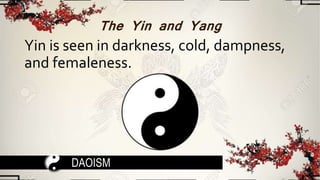
Yin is seen in darkness, cold, dampness,
and femaleness.
DAOISM
The Dào
Intrinsically related to the concepts yan
and ying is a mysterious and indefinable
force called the Dao [path, way, road],
which is a harmonious union of these
opposites.
DAOISM
The Dào
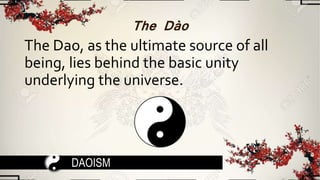
The Dao, as the ultimate source of all
being, lies behind the basic unity
underlying the universe.
DAOISM
THE BASIC
DOCTRINES OF
DAOISM
DAOISM
THE MEANING AND VALUE OF LIFE
Life alone is the greatest of
all possessions and must be
preserved and enjoyed. Life is
to be live simply and as quietly
as possible, the ideal state
characterized by childlike
innocence.
DAOISM
THE WAY TO ACHIEVE
PERSONAL HAPPINNESS AND
FULFILLMENT
The Dao is the one true source of
harmony and peace. Happiness is
attained by discovering the Dao and
living in harmony with it, through
following the ways of nature and simply
letting things be.
DAOISM
4 BASIC PRINCIPLES
OF DAOISM
DAOISM
DAOISM PRINCIPLES
1. Daoism teaches that the best
human being is one who lives in
harmony with nature and with
Dao, by being their natural,
undistorted selves.
DAOISM
DAOISM PRINCIPLES
2.The formula for good life is wuwei or
“nonaction”, which also means to live
and to let live.
DAOISM
DAOISM PRINCIPLES
3.When the mind is clear or empty or has
achieved “nothingness”, one develops
greater sensitivity to what is happening
around him.
DAOISM
DAOISM PRINCIPLES
4.The problem for humans is when they
depart from the simple, natural way of
the universe, which alienates them from
the Dao and from other beings, living
and non-living, human and nonhuman.
DAOISM
THANK YOU!

DAOISM

  • 1.
    DAOISM INTRODUCTION TO WORLDRELIGIONS EASTERN RELIGIONS
  • 2.
    K-W-L What I Know….. What I Want to Know …… What I have Learned ……
  • 3.
    GUIDE QUESTIONS 1. Whatis Daoism? Where did it evolve? How it is originated? 2. Who is the Founder of Daoism? 3. What is ‘Dao’? 4. What is the ‘Yin’ and ‘Yang’? 5. What are the teachings of Daoism?
  • 4.
  • 5.
  • 6.
  • 7.
    EAST ASIAN RELIGIONS AllEast Asian religions are concerned with preserving harmony between every being in the universe, as there is a preordained appropriate place and pattern of behaviour for each one. DAOISM
  • 8.
  • 9.
    ORIGIN OF CHINESE PHILOSOPHY-RELIGION Betweenthe eight and third centuries BCE, the feudal system in China deteriorated, as rulers failed to protect their vassals from invaders.As a result, warlords who could command respect and provide protection gained power.DAOISM
  • 10.
    From this chaoticperiod emerge the great Chinese philosophy-religions of Daoism and Confucianism. DAOISM ORIGIN OF CHINESE PHILOSOPHY- RELIGION
  • 11.
  • 12.
    ORIGIN OF DAOISM Theroots of Daoism are lost in the mists of Chinese antiquity and very little know of its founder. DAOISM
  • 13.
    ORIGIN OF DAOISM Ittakes its name from the book Dàodéjĩng orTaoTe Ching [“Classic of theWay of Virtue”], a work attributed to the Chinese philosopher-poet called Lăozĩ [“Old Master”] DAOISM
  • 14.
    ORIGIN OF DAOISM Bythe fourth century CE, Mahayana Buddhism had become prevalent in China, initially coexisting peacefully with Daoism. DAOISM
  • 15.
    ORIGIN OF DAOISM However,fierce struggles to gain influence with various rulers and control in the provinces of China arose between Daoists and Buddhists, leading to mutual hostility and even persecution. DAOISM
  • 16.
    “To attain knowledge, addthings everyday. To attain Wisdom, remove things everyday.” -Dàodéjĩng DAOISM
  • 17.
  • 18.
    The Dàodéjĩng It isthe most influential piece of Chinese literature. Its main declaration is that all human achievements are foolishness; it consists of slightly more than five thousand words contained in 81 chapters and usually translated to poetic form. DAOISM
  • 19.
    The Dàodéjĩng The Daodejingfocuses on the harmony of opposites within the peaceful flow of the Dao. It also adds the concept of the individual’s relationship to nature and society, insisting that it is best to let things take their natural course. DAOISM
  • 20.
    “Dao is theorigin of all beings whose essence is nothing.” -Dàodéjĩng DAOISM
  • 21.
  • 22.
    The Yin andYang The universe operated as a balance between the yin and yang. DAOISM
  • 23.
    The Yin andYang Yang is the positive force in nature manifested in light, warmth, dryness, and maleness. DAOISM
  • 24.
    The Yin andYang Yin is seen in darkness, cold, dampness, and femaleness. DAOISM
  • 25.
    The Dào Intrinsically relatedto the concepts yan and ying is a mysterious and indefinable force called the Dao [path, way, road], which is a harmonious union of these opposites. DAOISM
  • 26.
    The Dào The Dao,as the ultimate source of all being, lies behind the basic unity underlying the universe. DAOISM
  • 27.
  • 28.
    THE MEANING ANDVALUE OF LIFE Life alone is the greatest of all possessions and must be preserved and enjoyed. Life is to be live simply and as quietly as possible, the ideal state characterized by childlike innocence. DAOISM
  • 29.
    THE WAY TOACHIEVE PERSONAL HAPPINNESS AND FULFILLMENT The Dao is the one true source of harmony and peace. Happiness is attained by discovering the Dao and living in harmony with it, through following the ways of nature and simply letting things be. DAOISM
  • 30.
    4 BASIC PRINCIPLES OFDAOISM DAOISM
  • 31.
    DAOISM PRINCIPLES 1. Daoismteaches that the best human being is one who lives in harmony with nature and with Dao, by being their natural, undistorted selves. DAOISM
  • 32.
    DAOISM PRINCIPLES 2.The formulafor good life is wuwei or “nonaction”, which also means to live and to let live. DAOISM
  • 33.
    DAOISM PRINCIPLES 3.When themind is clear or empty or has achieved “nothingness”, one develops greater sensitivity to what is happening around him. DAOISM
  • 34.
    DAOISM PRINCIPLES 4.The problemfor humans is when they depart from the simple, natural way of the universe, which alienates them from the Dao and from other beings, living and non-living, human and nonhuman. DAOISM
  • 35.

Editor's Notes

  • #3 Daoism
  • #4 Daoism
  • #5 Yin Yang
  • #6 Lao Tzu
  • #8 For you what is harmony???
  • #16 The emperor of Tang Dynasty Wuzong persecuted Buddhists and adherents of other non native religions to eliminate foreign influences.
  • #17 The essence of Dao is nothing. Wisdom is achieved by removing things. = the value of nothing Why Wisdom is attained by removing things??
  • #19 Daoism asserts that all striving for human achievement is foolish because it does not last, and that life alone is the greatest of all possessions.
  • #23 The universe was a combination of yin and yang.
  • #33 Through wuwei, people live in harmony with the flow of the Dao and are able to achieve more compared to those who assert themselves.
  • #34 One simply needs to listen, and let things take their own course.
  • #35 Alienation, or being not one with the Dao, happens when one strives to have dominion over nature, going against the way of the universe, and developing artificial needs and values that are not of their nature. Away from the Dao means away from the true source of peace and harmony.