CO2 incubators are used to grow and maintain cell cultures by controlling temperature, CO2 levels, and humidity. They are commonly used in medical research and applications like IVF where cells must grow in sterile conditions. CO2 incubators maintain optimal conditions like 37°C and 5% CO2 to support cell growth for various purposes like tissue engineering, cancer research, and developing biosensors.
Laboratory
incubators
Laboratory incubatorsare used to grow and maintain
cell cultures and are available in a variety of sizes and
types.
The incubator market is divided into two main
categories: the gassed incubators which are the CO2
incubators and the non gassed or microbiological
incubators.
3.
Laboratory
incubators
Microbiological incubatorsare essentially temperature-
controlled ovens that work within the biological range
of 5ºC to 70ºC and are mostly used for growing and
storing bacterial cultures.
Refrigerated Biochemical Oxygen Demand (BOD)
incubators, with a temperature range of 20°C degrees
to 45°C below ambient, are commonly used for
applications such as insect and plant studies,
fermentation studies and bacterial culturing.
4.
CO2
incubators
The CO2incubators are mainly used for cell culture and
provide control over factors such as temperature, CO2
for maintaining proper pH levels, and humidity, all of
which affect cell growth.
CO2 incubators are typically heated to 37°C and
maintain 95% relative humidity and a CO2 level of 5
percent. Most incubator units are water-jacketed, air-
jacketed or use direct heat to maintain the
temperature around the culture chamber.
Structure and
function ofa
CO2 incubator
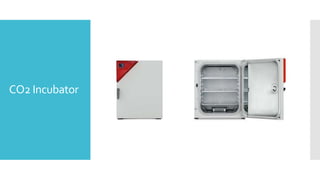
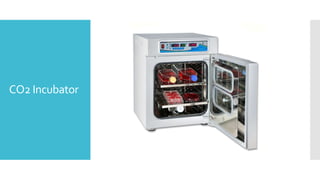
A CO2 incubator has an interior which is completely
sealed off from the environment to ensure the
atmosphere inside the unit cannot be affected by
external factors.
To enable laboratory technicians to still view the
samples during the growth phase, most CO2 incubators
feature a glass door as well as the regular door, which
provides additional protection against contamination.
The interior is made of rust-resistant materials such as
stainless steel and should have as few sharp edges and
grooves as possible to avoid any places where
contamination could be hidden
8.
In thesensitive field of cell cultivation in particular, just
one single germ can ruin weeks of work.
The air coming in flows through a sterile filter and must
be distributed evenly throughout the whole interior, as
the samples are usually positioned on shelves at
different heights.
The challenge lies in creating homogeneity through
the entire interior, to ensure a uniform supply of CO2
for all samples at constant climate and humidity
conditions.
Applications
ofCO2
incubators
CO2 incubatorshave innumerable applications in
applications in medical, pharmaceutical, and other
related industries
However, they also provide sterile conditions for
cultivation in other fields where cells must grow in a
completely germ-free environment.
They play an important role in medical research
wherever cell cultures have to be observed in as sterile
and meticulous a way as possible.
They keep unwanted microbes away from the cultures,
thus providing the ideal conditions for growth.
Different CO2 incubators offer different methods of
preventing contamination in the incubation chamber.
11.
CO2
incubators
create the
optimum
conditions for:
•Incubating human skin cells for life-saving skin grafts
Fighting diseases using stem cell research
•
Offering stem cell therapy as a viable alternative to
surgery
•
Plastic surgery, anti-aging therapies, tissue repair, and
dermatological treatments.
Multiplying human skin cells for healing processes in
regenerative medicine
12.
CO2
incubators for
tissue
engineered
products
Tissueengineered products are medical products
specifically developed for novel treatments.
With these new types of treatment, scientists hope to
cure previously incurable diseases such as serious
malignant tumors or cardiovascular failure.
CO2 incubators are used to cultivate cell and tissue
cultures in the research, development, and quality
assurance of these products.
13.
CO2
incubators for
in vitro
fertilization
In vitro fertilization (IVF) describes a method of
artificial fertilization used in human reproductive
medicine.
This application aims to fuse an egg and sperm cell
together in a petri dish along with a cell culture
medium.
The human embryos then start to fertilize and develop
in a CO2 incubator, before being transplanted into the
uterus after two to three days.
Optimal conditions in the incubator chamber are
approximately 37°C, 5 or 6 vol. % CO2, and humidity of
around 95%.
14.
Staff labelthe petri dishes very precisely to avoid mix-
ups. The inner glass doors of the CO2 incubators mean
the dishes can be monitored at all times too.
The process is similar in veterinary medicine, for
example with cattle. The oocytes are put into a petri
dish together with the sperm and, during an incubation
period of 21 hours, the sperm fertilize them.
On the eighth day after fertilization, the embryos are
transferred from the CO2 incubator into the recipient
animals.
15.
CO2
incubators in
diagnostics
Thestudy of cell cultures plays a crucial role in the
diagnostic analysis of pathogens.
The results obtained from such investigations enable
precise proof of hygiene levels to be formulated, and
the degree of biopharmaceutical resistance to viruses
to be evaluated.
One method often used in this context is the swipe
sample, where cell cultures which are susceptible to
viruses are exposed to them in order to test their
biological function.
16.
CO2 incubatorsare the right tool for the various
process steps involved, such as thawing and
transferring the cells, as well as infecting the cell lines
and dyeing the cell cultures. During this application,
conditions in the interior are usually set to 37°C and 5
vol. % CO2.
The samples are analyzed after 72 hours at the latest.
The blue coloration of the cell layer makes it possible to
characterize the plaque in more detail either with the
naked eye or under a microscope.
17.
CO2 for
developing
biosensors
Biosensorsare cropping up more and more in fields
such as medicine, fermentation monitoring, food
quality control, and environmental analysis.
A biosensor converts a biologically sensitive element
into a digital signal, which in turn can be used to
perform analyses by means of physical or chemical
stimulation.
Cellular in vitro systems combined with sensors are
used in the pharmaceutical industry, toxicology, and
basic research. One of the most well-known examples
are the enzyme sensors used to measure glucose.
18.
An impressiveexample: cardiomyocytes from
embryonic hens were reaggregated in a rotation
culture into spheroids (3D architecture) and connected
to microelectrodes.
Reference substances were used to test the extent to
which statements could be made about applying a
stimulus to a living system.
The spheroids were produced in petri dishes in CO2
incubators at 37°C, 5 vol. % CO2, and 72 rpm and 20 mm
orbit.
19.
CO2
incubators in
cancer
research
CO2incubators play an important role in preparing
samples and tests in all areas of cancer research such as
drug research and the development of 3D invasions,
assays, and biosensors – from a simple monolayer
through to the reproduction of patient tumors by
means of 3D cell culture models (drug research and
development of treatments).
20.
In thefields of immunology and tumor biology (how
malignant tumors develop), CO2 incubators are used at
37°C, 5 vol. % CO2, and 95% relative humidity under
normoxic conditions, as well as CO2/O2 incubators at
37°C, 5 vol. % CO2, and hypoxic 1 vol. % O2, depending
on the cell cultures involved.
In clinical research, for example, that into oncogenes
and tumor suppressors, CO2 incubators are used at 37°C
and 5 vol. % CO2 under normoxic conditions.

 Most read
 Most read
 Most read