
Genetics and
Evolution of lactose
(in)tolerance
By:Tracy Adkins
Topics to cover
 What is Lactose intolerance
 Causes
 Symptoms
 Diagnosis
 Lactose supplementation
 LCT gene
 Lactase
 Affect of MCM6
 Evolution
 2 hypotheses
 mutations based on locations
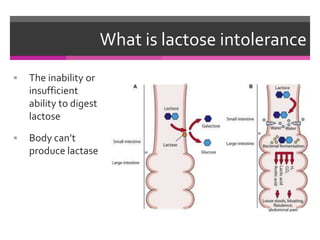
What is lactose intolerance
 The inability or
insufficient
ability to digest
lactose
 Body can’t
produce lactase
Causes
 Primary lactase deficiency
 Develops over time
 Body begins to produce less lactase.
 Inheritable
 Secondary lactase deficiency
 results from injury to the small intestine
 Severe diarrheal illness
 Celiac disease
 Crohn's disease
 Chemotherapy.
 Congenital lactase deficiency
 Autosomal recessive
 Rare
 Prevents lactase expression from birth
Symptoms of intolerance
 Can be mild or severe
 30 minutes – 2 hours
 Bloating
 Pain or cramps in lower belly
 Gas
 Loose stools or diarrhea
 Throwing up or nausea
Diagnosis
 Hydrogen BreathTest
 High levels of Hydrogen if lactose is undigested
 Stool AcidityTest
 Undigested lactose creates lactic acid and other
fatty acids that can be detected in a stool sample.
 Blood test
 Measures blood glucose levels
 Take blood every 10-15 minutes
 Higher levels means lactose is digested
Lactase supplementation
 Produced by fungi of the genus
Asoergillus
 Functions well in high-acid
environments
 Must reach small intestine before
food does
 Yeast from genus Kluyveromyces
 Takes longer to act
 Destroyed by mild acidic
environments
 Used in producing lactose free and
lactose reduced products
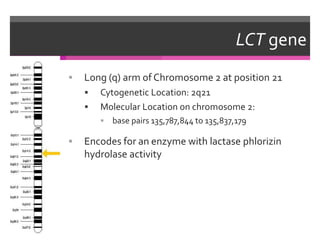
 Long (q) arm of Chromosome 2 at position 21
 Cytogenetic Location: 2q21
 Molecular Location on chromosome 2:
 base pairs 135,787,844 to 135,837,179
 Encodes for an enzyme with lactase phlorizin
hydrolase activity
LCT gene
Lactase
 LPH/Beta-galactosidase
 Enzyme that Digests lactose
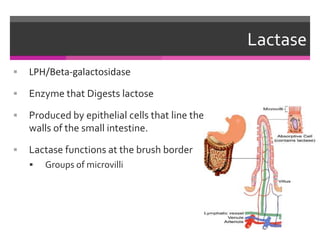
 Produced by epithelial cells that line the
walls of the small intestine.
 Lactase functions at the brush border
 Groups of microvilli
Break down of lactose
Mutation that causes persistence
 Lactase persistence is autosomal dominant
 Mutation is 14 kb chromosomally upstream in the
MCM6 gene
 97% in Adult cases
 Enhances the production of LPH mRNA
 There are six identified allelic variants of the MCM6
gene associated with lactase persistence
 C/T-13910 mutation
 Mutation G/A-22018 is in co-segregation with it
Evolution
 Lactose persistence (LP)
 European, African and Middle Eastern populations
 Highest in Northern Europe
 Frequencies of LP genotype range from 71-79.8%
 LP was low/absent in most European Neolithic
populations
 LP selection occurred between 3000 BC-AD 1200
2 hypothesis
 Genetic drift
 Culture-historical/ selection
 Genetic pressures
 Easily stored
 Milk as a source of water
 Increased calcium absorption
 Rickets and osteomalacia
Mutations based on location
 Mutations in Northern European population
 C→T-13910
 G/A-22018
 Mutations in Middle Eastern populations
 T/G-13915
 Mutations in African populations
 C/G-13907
 T/G-13915
 G/C-14010
Phenotype frequencies based on -13910 C/T allele
frequency
LP phenotype frequencies based on frequency data for the currently
known LP associated allelic variants, excluding the -13,910 C>T allele
Portugal
 Genotyped 13910 C>T in north, central and south and subjects with
gastrointestinal symptoms
 Frequencies
 Center- 0.393
 North-0.383
 South- 0.269
 Symptomatic group- 0.363
 NOT UNIFORM
 Found genotyping is a good diagnostic tool in the Portuguese
population
 self-reported gastrointestinal complaints are not good predictors
of the LP status
Fun facts
 Infants born prematurely are more
likely to have lactase deficiency
because an infant's lactase levels do
not increase until the third trimester of
pregnancy.
 Lactose can also be present in bread,
baked goods, salad dressings, candies,
potato and corn chips.
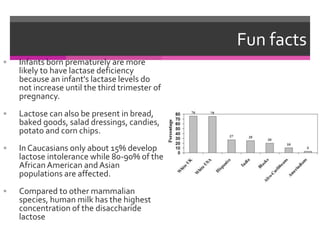
 In Caucasians only about 15% develop
lactose intolerance while 80-90% of the
African American andAsian
populations are affected.
 Compared to other mammalian
species, human milk has the highest
concentration of the disaccharide
lactose
Genetics and Evolution of lactose (in)tolerance

Genetics and Evolution of lactose (in)tolerance

  • 1.
     Genetics and Evolution oflactose (in)tolerance By:Tracy Adkins
  • 2.
    Topics to cover What is Lactose intolerance  Causes  Symptoms  Diagnosis  Lactose supplementation  LCT gene  Lactase  Affect of MCM6  Evolution  2 hypotheses  mutations based on locations
  • 3.
    What is lactoseintolerance  The inability or insufficient ability to digest lactose  Body can’t produce lactase
  • 4.
    Causes  Primary lactasedeficiency  Develops over time  Body begins to produce less lactase.  Inheritable  Secondary lactase deficiency  results from injury to the small intestine  Severe diarrheal illness  Celiac disease  Crohn's disease  Chemotherapy.  Congenital lactase deficiency  Autosomal recessive  Rare  Prevents lactase expression from birth
  • 5.
    Symptoms of intolerance Can be mild or severe  30 minutes – 2 hours  Bloating  Pain or cramps in lower belly  Gas  Loose stools or diarrhea  Throwing up or nausea
  • 6.
    Diagnosis  Hydrogen BreathTest High levels of Hydrogen if lactose is undigested  Stool AcidityTest  Undigested lactose creates lactic acid and other fatty acids that can be detected in a stool sample.  Blood test  Measures blood glucose levels  Take blood every 10-15 minutes  Higher levels means lactose is digested
  • 7.
    Lactase supplementation  Producedby fungi of the genus Asoergillus  Functions well in high-acid environments  Must reach small intestine before food does  Yeast from genus Kluyveromyces  Takes longer to act  Destroyed by mild acidic environments  Used in producing lactose free and lactose reduced products
  • 8.
     Long (q)arm of Chromosome 2 at position 21  Cytogenetic Location: 2q21  Molecular Location on chromosome 2:  base pairs 135,787,844 to 135,837,179  Encodes for an enzyme with lactase phlorizin hydrolase activity LCT gene
  • 9.
    Lactase  LPH/Beta-galactosidase  Enzymethat Digests lactose  Produced by epithelial cells that line the walls of the small intestine.  Lactase functions at the brush border  Groups of microvilli
  • 10.
  • 11.
    Mutation that causespersistence  Lactase persistence is autosomal dominant  Mutation is 14 kb chromosomally upstream in the MCM6 gene  97% in Adult cases  Enhances the production of LPH mRNA  There are six identified allelic variants of the MCM6 gene associated with lactase persistence  C/T-13910 mutation  Mutation G/A-22018 is in co-segregation with it
  • 14.
    Evolution  Lactose persistence(LP)  European, African and Middle Eastern populations  Highest in Northern Europe  Frequencies of LP genotype range from 71-79.8%  LP was low/absent in most European Neolithic populations  LP selection occurred between 3000 BC-AD 1200
  • 15.
    2 hypothesis  Geneticdrift  Culture-historical/ selection  Genetic pressures  Easily stored  Milk as a source of water  Increased calcium absorption  Rickets and osteomalacia
  • 17.
    Mutations based onlocation  Mutations in Northern European population  C→T-13910  G/A-22018  Mutations in Middle Eastern populations  T/G-13915  Mutations in African populations  C/G-13907  T/G-13915  G/C-14010
  • 18.
    Phenotype frequencies basedon -13910 C/T allele frequency
  • 19.
    LP phenotype frequenciesbased on frequency data for the currently known LP associated allelic variants, excluding the -13,910 C>T allele
  • 20.
    Portugal  Genotyped 13910C>T in north, central and south and subjects with gastrointestinal symptoms  Frequencies  Center- 0.393  North-0.383  South- 0.269  Symptomatic group- 0.363  NOT UNIFORM  Found genotyping is a good diagnostic tool in the Portuguese population  self-reported gastrointestinal complaints are not good predictors of the LP status
  • 21.
    Fun facts  Infantsborn prematurely are more likely to have lactase deficiency because an infant's lactase levels do not increase until the third trimester of pregnancy.  Lactose can also be present in bread, baked goods, salad dressings, candies, potato and corn chips.  In Caucasians only about 15% develop lactose intolerance while 80-90% of the African American andAsian populations are affected.  Compared to other mammalian species, human milk has the highest concentration of the disaccharide lactose

Editor's Notes

  • #4 Fundamentals of Biochemisty.C.W. Pratt, D.Voet, J.G. Voet. John Wiley and Sons,Inc, Fourth edition. Chapter 8, Carbohydrates pg 224.
  • #5 -Most children who have lactase deficiency do not experience symptoms of lactose intolerance until late adolescence or adulthood. -This type of lactase deficiency can occur at any age but is more common in infancy. -Common in finland
  • #6 Depends on the amount of lactase your body makes. Lactose molecules attract water molecules this causes bloating, abdominal discomforts as well as diarrhea. Symptoms of gas build-up and abdominal discomfort in the body are experience since intestinal bacteria feeds on undigested lactose producing acid and gas.
  • #7 he person drinks a lactose-loaded beverage and then the breath is analyzed at regular intervals to measure the amount of hydrogen. Normally, very little hydrogen is detectable in the breath, but undigested lactose produces high levels of hydrogen. Smoking and some foods and medications may affect the accuracy of the results. People should check with their doctor about foods and medications that may interfere with test results.
  • #9 http://ghr.nlm.nih.gov/gene/LCT for picture MGM6 is also located on the long arm of chrom 2 in region 21
  • #10 Lactase digest the sugars in milk and other dairy products It is essential for digestive hydrolysis of lactose in milk, as lactose itself cannot be directly absorbed into the bloodstream at any point along the gastro-intestinal tract. These cells, called intestinal epithelial cells, have finger-like projections called microvilli that absorb nutrients from food as it passes through the intestine so they can be absorbed into the bloodstream. Based on their appearance, groups of these microvilli are known collectively as the brush border. The lactase enzyme has two active sites which break down lactose. The first is at Glu1273 and the second is at Glu1749, which separately break down lactose into two separate kinds of molecules.
  • #11 Galactose and glucose are combined in b-linkage to yield the sugar lactose Lactase hydrolyses the disaccharide lactose into galactose and glucose monosaccharides. http://www.indiana.edu/~ensiweb/lessons/tp.milk3.html
  • #12 LPH is a protein that is encoded by the LCT This region is a regulatory enhancer that modulates LCT expression, and hence protein levels, and the quantitative difference might largely account for the trait of adult lactose tolerance. humans developed a mutation in the MCM6 gene that keeps the LCT gene turned on even after breast feeding is stopped. http://search.proquest.com.proxy1.cl.msu.edu/pqrl/docview/198998578/abstract/34DFBACCE77461CPQ/1?accountid=12598
  • #13 The box represents the region where the LPH and MCM6 genes are located on chromosome 2. Enlarged MCM6 and LPH gene regions. Structure and length of the MCM6 and LPH genes. Solid boxes represent coding regions. Location of LP-associated variants within introns 9 and 13 of the MCM6 gene in African and European populations.
  • #14 he T/C allelic variant 13910 bases upstream of LCT enhances LCT expression
  • #16 Additional: Additional genetic pressures may have existed in arid climates where milk is one of the only clean sources of water [27] or in northern latitudes where, in the absence of vitamin D, the presence of lactose facilitates the absorption of calcium by the intestinal mucosa and thus reduces the risk of rickets and osteomalacia [28]. Rickets and osteomalacia can cause deformation of the pelvis and are leading causes of obstructed labor and consequent maternal mortality and perinatal morbidity in traditional societies without access to modern medical care
  • #18 At specific loci LCT in intron 9 of the minichromosome maintenance 6 (MCM6) gene on chromosome 2 A thymine at this locus (T-13910) prevents down-regulation of lactase activity after weaning.
  • #19 EUROPEAN
  • #21 http://www.ncbi.nlm.nih.gov/pubmed/23327608
  • #22 -/- added to processed food to prolong their shelf life