GALACTOSEMIA
KAUSHIKI R
I MSC CLINICAL NUTRITION AND DIETETICS
ROLL NO.: 20MCN016
LESSON OUTCOMES
At the end of this session, one should know about:-
 What is Galactosemia and its Pathophysiology
 Different types of Galactosemia
 Causes, Signs and Symptoms, and Complications
 Medical Therapy
 Medical Nutrition Therapy
CONTENT
 Introduction
 Pathophysiology
 Cause of Galactosemia
 Signs and Symptoms
 Complications
 Diagnosis
 Types of Galactosemia
 Medical Therapy
 Medical Nutrition Therapy
 Nutrition Education and Counselling
GENETIC METABOLIC DISORDERS
 Genetic metabolic disorders are inherited traits that result in the
absence or reduced activity of a specific enzyme or cofactor necessary for
optimal metabolism.
 Inherited as autosomal-recessive traits.
 Can be treated through Medical Nutrition Therapy.
 Steps involve in treatment are:
- restricting the amount of substrate available
- supplementing the amount of product
- supplementing the enzymatic cofactor
- combining any or all of these approaches
CARBOHYDRATE METABOLISM DISORDERS
 A group of metabolic disorders that occur when the carbohydrates are not
broken down due to inadequate or lack of enzymes required for the
metabolic processes.
 Inherited.
 New born babies get screened for the disorders.
INTRODUCTION
 Galactose is a naturally occurring sugar present in human organs.
 It forms a part of lactose, a main sugar present in animal milks.
 Lactose is broken down into glucose and galactose by the enzyme lactase.
 When galactose is not metabolized by the body, it results in
GALACTOSEMIA.
GALACTOSEMIA
“Galactosemia is a genetic disorder that affects the ability of the human
body to metabolize the sugar, galactose properly.”
 Galactosemia implies galactose in the blood due to the fact that the
body cannot breakdown galactose and retains high levels of galactose
in the blood.
PATHOPHYSIOLOGY
 Galactosemia results from a disturbance in the conversion of galactose to
glucose because of the absence or inactivity of one of the enzymes.
 The enzyme deficiency causes an accumulation of galactose, or galactose
and galactose-1-phosphate, in body tissues.
 In addition, expanded newborn screening programs have identified many
newborns with Duarte galactosemia.
 These infants have one allele for galactosemia and one for Duarte
galactosemia and are often said to have “D/G galactosemia.”
 The Duarte allele produces approximately 5% to 20% of the GALT enzyme.
 Little is known about the natural history of D/G galactosemia; apparently
infants and children develop normally without medical complications.
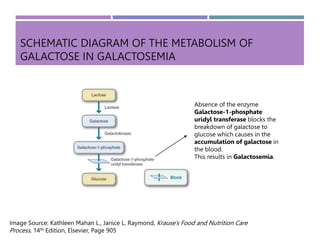
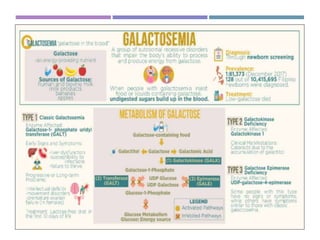
SCHEMATIC DIAGRAM OF THE METABOLISM OF
GALACTOSE IN GALACTOSEMIA
Image Source: Kathleen Mahan L., Janice L. Raymond, Krause’s Food and Nutrition Care
Process, 14th Edition, Elsevier, Page 905
Absence of the enzyme
Galactose-1-phosphate
uridyl transferase blocks the
breakdown of galactose to
glucose which causes in the
accumulation of galactose in
the blood.
This results in Galactosemia.
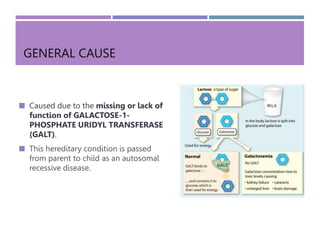
GENERAL CAUSE
 Caused due to the missing or lack of
function of GALACTOSE-1-
PHOSPHATE URIDYL TRANSFERASE
(GALT).
 This hereditary condition is passed
from parent to child as an autosomal
recessive disease.
SIGNS AND SYMPTOMS
At Early Stages
 A baby may develop signs of galactosemia within the first few days of life if the
consume lactose found in breast milk or baby formula.
 These initial signs include:
• Refusal to eat
• Spitting up or vomiting
• Yellowing of the skin (jaundice) Lethargy
• Cataracts
At Later Stages
Individuals affected with Galactosemia tend to have:
 Learning disabilities
 Neurological impairments
 Ovarian failure
COMPLICATIONS
 Cognitive development
 Speech and language
 Neurological complications
 Psychosocial development
 Endocrinology / Fertility
 Bone health
 Cataract
DIAGNOSIS
 Classic galactosemia and clinical variant galactosemia are diagnosed when
galactose-1-phosphate is elevated in red blood cells and GALT enzyme
activity is reduced.
 Molecular genetic testing is also available to identify mutations in
the GALT gene.
 New born Screening
TYPES OF GALACTOSEMIA
Three main types of galactosemia – based on genetic causes, signs and
symptoms, and severity
 Classic Galactosemia (type 1)
 Galactokinase deficiency (type 2)
 Galactose epimerase deficiency (type 3)
Variant of Classic Galactosemia (type 1) – Duarte Variant Galactosemia
CLASSIC GALACTOSEMIA (TYPE 1)
 The most common and severe type
 Caused by mutations in the GALT gene
 Characterized by a complete deficiency of an enzyme called galactose-1-
phosphate uridyl transferase (GALT)
 Early signs and symptoms - liver dysfunction, susceptibility to infections,
failure to thrive, and cataracts.
 Complications - intellectual deficits, movement disorders, and premature
ovarian failure (in females).
 These can usually be prevented or improved by early diagnosis and
treatment, but other progressive or long-term problems are common
despite treatment.
GALACTOKINASE DEFICIENCY (TYPE 2)
 Caused by mutations in the GALK1 gene.
 Characterized by a deficiency of the enzyme galactokinase 1.
 Normally causes only the development of cataracts.
 Rarely causes pseudotumor cerebri.
GALACTOSE EPIMERASE DEFICIENCY (TYPE 3)
 Caused by mutations in the GALE gene
 Characterized by a deficiency of the enzyme UDP-galactose-4-epimerase.
 Symptoms and severity of this type depend on whether the deficiency is
confined to certain types of blood cells or is present in all tissues.
 Some people with this type have no signs or symptoms
 Others have symptoms similar to those with classic galactosemia.
 Like in classic galactosemia, many symptoms can be prevented or
improved with treatment.
DUARTE VARIANT GALACTOSEMIA
 A "variant" of classic galactosemia
 A person has mutations in the GALT gene but has only partial deficiency of
the enzyme.
 Infants may have jaundice, which resolves when switched to a low-
galactose formula.
 Some studies have found that people with this form are at increased risk
for mild neurodevelopmental problems, but other studies have found
there is no increased risk.
 The risk may depend on the extent of the deficiency.
MEDICAL TREATMENT
 When diagnosis and therapy are delayed, intellectual disability can result
(Waisbren, 2006).
 With early diagnosis and treatment, physical and motor development
should proceed normally.
 However, intellectual achievement may be depressed.
 Patients often have IQs of 85 to 100, visual-perceptual and speech
difficulties, and problems with executive function (Doyle et al, 2010;
Kaufman et al, 1995).
 Ovarian failure affects approximately 75% to 95% of women with
galactosemia (Forges et al, 2006).
MEDICAL NUTRITION THERAPY
 Galactosemia is treated with lifelong galactose restriction.
 Galactose restriction mandates strict avoidance of all milk and milk
products and lactose containing foods.
 Effective galactose restriction requires careful reading of food product
labels.
 Infants with galactosemia are fed soy-based formula.
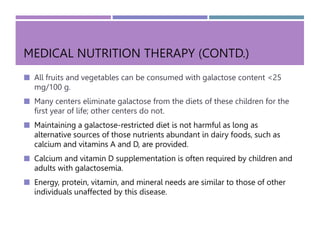
MEDICAL NUTRITION THERAPY (CONTD.)
 All fruits and vegetables can be consumed with galactose content <25
mg/100 g.
 Many centers eliminate galactose from the diets of these children for the
first year of life; other centers do not.
 Maintaining a galactose-restricted diet is not harmful as long as
alternative sources of those nutrients abundant in dairy foods, such as
calcium and vitamins A and D, are provided.
 Calcium and vitamin D supplementation is often required by children and
adults with galactosemia.
 Energy, protein, vitamin, and mineral needs are similar to those of other
individuals unaffected by this disease.
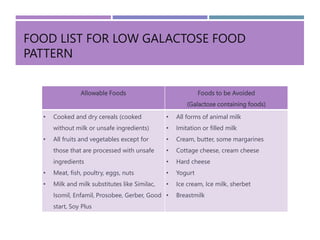
Allowable Foods Foods to be Avoided
(Galactose containing foods)
• Cooked and dry cereals (cooked
without milk or unsafe ingredients)
• All fruits and vegetables except for
those that are processed with unsafe
ingredients
• Meat, fish, poultry, eggs, nuts
• Milk and milk substitutes like Similac,
Isomil, Enfamil, Prosobee, Gerber, Good
start, Soy Plus
• All forms of animal milk
• Imitation or filled milk
• Cream, butter, some margarines
• Cottage cheese, cream cheese
• Hard cheese
• Yogurt
• Ice cream, Ice milk, sherbet
• Breastmilk
FOOD LIST FOR LOW GALACTOSE FOOD
PATTERN
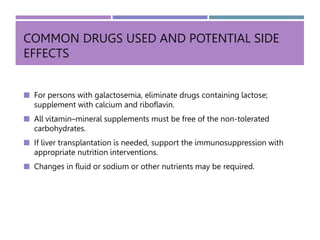
COMMON DRUGS USED AND POTENTIAL SIDE
EFFECTS
 For persons with galactosemia, eliminate drugs containing lactose;
supplement with calcium and riboflavin.
 All vitamin–mineral supplements must be free of the non-tolerated
carbohydrates.
 If liver transplantation is needed, support the immunosuppression with
appropriate nutrition interventions.
 Changes in fluid or sodium or other nutrients may be required.
NUTRITION EDUCATION AND COUNSELLING
Counselling should be given to the patients about
 Which sources of carbohydrate are allowed specific to the disorder.
 Reading the labels carefully. Many foods contain milk solids, galactose and
other sugars; omit according to the disorder.
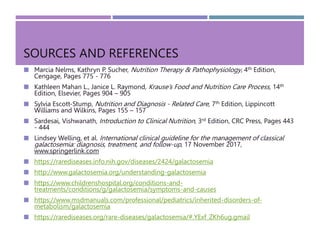
SOURCES AND REFERENCES
 Marcia Nelms, Kathryn P. Sucher, Nutrition Therapy & Pathophysiology, 4th Edition,
Cengage, Pages 775 - 776
 Kathleen Mahan L., Janice L. Raymond, Krause’s Food and Nutrition Care Process, 14th
Edition, Elsevier, Pages 904 – 905
 Sylvia Escott-Stump, Nutrition and Diagnosis - Related Care, 7th Edition, Lippincott
Williams and Wilkins, Pages 155 – 157
 Sardesai, Vishwanath, Introduction to Clinical Nutrition, 3rd Edition, CRC Press, Pages 443
- 444
 Lindsey Welling, et al. International clinical guideline for the management of classical
galactosemia: diagnosis, treatment, and follow-up, 17 November 2017,
www.springerlink.com
 https://rarediseases.info.nih.gov/diseases/2424/galactosemia
 http://www.galactosemia.org/understanding-galactosemia
 https://www.childrenshospital.org/conditions-and-
treatments/conditions/g/galactosemia/symptoms-and-causes
 https://www.msdmanuals.com/professional/pediatrics/inherited-disorders-of-
metabolism/galactosemia
 https://rarediseases.org/rare-diseases/galactosemia/#.YExf_ZKh6ug.gmail

GALACTOSEMIA - ITS NUTRITIONAL MANAGEMENT

  • 1.
    GALACTOSEMIA KAUSHIKI R I MSCCLINICAL NUTRITION AND DIETETICS ROLL NO.: 20MCN016
  • 2.
    LESSON OUTCOMES At theend of this session, one should know about:-  What is Galactosemia and its Pathophysiology  Different types of Galactosemia  Causes, Signs and Symptoms, and Complications  Medical Therapy  Medical Nutrition Therapy
  • 3.
    CONTENT  Introduction  Pathophysiology Cause of Galactosemia  Signs and Symptoms  Complications  Diagnosis  Types of Galactosemia  Medical Therapy  Medical Nutrition Therapy  Nutrition Education and Counselling
  • 4.
    GENETIC METABOLIC DISORDERS Genetic metabolic disorders are inherited traits that result in the absence or reduced activity of a specific enzyme or cofactor necessary for optimal metabolism.  Inherited as autosomal-recessive traits.  Can be treated through Medical Nutrition Therapy.  Steps involve in treatment are: - restricting the amount of substrate available - supplementing the amount of product - supplementing the enzymatic cofactor - combining any or all of these approaches
  • 5.
    CARBOHYDRATE METABOLISM DISORDERS A group of metabolic disorders that occur when the carbohydrates are not broken down due to inadequate or lack of enzymes required for the metabolic processes.  Inherited.  New born babies get screened for the disorders.
  • 6.
    INTRODUCTION  Galactose isa naturally occurring sugar present in human organs.  It forms a part of lactose, a main sugar present in animal milks.  Lactose is broken down into glucose and galactose by the enzyme lactase.  When galactose is not metabolized by the body, it results in GALACTOSEMIA.
  • 7.
    GALACTOSEMIA “Galactosemia is agenetic disorder that affects the ability of the human body to metabolize the sugar, galactose properly.”  Galactosemia implies galactose in the blood due to the fact that the body cannot breakdown galactose and retains high levels of galactose in the blood.
  • 8.
    PATHOPHYSIOLOGY  Galactosemia resultsfrom a disturbance in the conversion of galactose to glucose because of the absence or inactivity of one of the enzymes.  The enzyme deficiency causes an accumulation of galactose, or galactose and galactose-1-phosphate, in body tissues.  In addition, expanded newborn screening programs have identified many newborns with Duarte galactosemia.  These infants have one allele for galactosemia and one for Duarte galactosemia and are often said to have “D/G galactosemia.”  The Duarte allele produces approximately 5% to 20% of the GALT enzyme.  Little is known about the natural history of D/G galactosemia; apparently infants and children develop normally without medical complications.
  • 9.
    SCHEMATIC DIAGRAM OFTHE METABOLISM OF GALACTOSE IN GALACTOSEMIA Image Source: Kathleen Mahan L., Janice L. Raymond, Krause’s Food and Nutrition Care Process, 14th Edition, Elsevier, Page 905 Absence of the enzyme Galactose-1-phosphate uridyl transferase blocks the breakdown of galactose to glucose which causes in the accumulation of galactose in the blood. This results in Galactosemia.
  • 10.
    GENERAL CAUSE  Causeddue to the missing or lack of function of GALACTOSE-1- PHOSPHATE URIDYL TRANSFERASE (GALT).  This hereditary condition is passed from parent to child as an autosomal recessive disease.
  • 11.
    SIGNS AND SYMPTOMS AtEarly Stages  A baby may develop signs of galactosemia within the first few days of life if the consume lactose found in breast milk or baby formula.  These initial signs include: • Refusal to eat • Spitting up or vomiting • Yellowing of the skin (jaundice) Lethargy • Cataracts At Later Stages Individuals affected with Galactosemia tend to have:  Learning disabilities  Neurological impairments  Ovarian failure
  • 12.
    COMPLICATIONS  Cognitive development Speech and language  Neurological complications  Psychosocial development  Endocrinology / Fertility  Bone health  Cataract
  • 13.
    DIAGNOSIS  Classic galactosemiaand clinical variant galactosemia are diagnosed when galactose-1-phosphate is elevated in red blood cells and GALT enzyme activity is reduced.  Molecular genetic testing is also available to identify mutations in the GALT gene.  New born Screening
  • 14.
    TYPES OF GALACTOSEMIA Threemain types of galactosemia – based on genetic causes, signs and symptoms, and severity  Classic Galactosemia (type 1)  Galactokinase deficiency (type 2)  Galactose epimerase deficiency (type 3) Variant of Classic Galactosemia (type 1) – Duarte Variant Galactosemia
  • 15.
    CLASSIC GALACTOSEMIA (TYPE1)  The most common and severe type  Caused by mutations in the GALT gene  Characterized by a complete deficiency of an enzyme called galactose-1- phosphate uridyl transferase (GALT)  Early signs and symptoms - liver dysfunction, susceptibility to infections, failure to thrive, and cataracts.  Complications - intellectual deficits, movement disorders, and premature ovarian failure (in females).  These can usually be prevented or improved by early diagnosis and treatment, but other progressive or long-term problems are common despite treatment.
  • 16.
    GALACTOKINASE DEFICIENCY (TYPE2)  Caused by mutations in the GALK1 gene.  Characterized by a deficiency of the enzyme galactokinase 1.  Normally causes only the development of cataracts.  Rarely causes pseudotumor cerebri.
  • 17.
    GALACTOSE EPIMERASE DEFICIENCY(TYPE 3)  Caused by mutations in the GALE gene  Characterized by a deficiency of the enzyme UDP-galactose-4-epimerase.  Symptoms and severity of this type depend on whether the deficiency is confined to certain types of blood cells or is present in all tissues.  Some people with this type have no signs or symptoms  Others have symptoms similar to those with classic galactosemia.  Like in classic galactosemia, many symptoms can be prevented or improved with treatment.
  • 18.
    DUARTE VARIANT GALACTOSEMIA A "variant" of classic galactosemia  A person has mutations in the GALT gene but has only partial deficiency of the enzyme.  Infants may have jaundice, which resolves when switched to a low- galactose formula.  Some studies have found that people with this form are at increased risk for mild neurodevelopmental problems, but other studies have found there is no increased risk.  The risk may depend on the extent of the deficiency.
  • 19.
    MEDICAL TREATMENT  Whendiagnosis and therapy are delayed, intellectual disability can result (Waisbren, 2006).  With early diagnosis and treatment, physical and motor development should proceed normally.  However, intellectual achievement may be depressed.  Patients often have IQs of 85 to 100, visual-perceptual and speech difficulties, and problems with executive function (Doyle et al, 2010; Kaufman et al, 1995).  Ovarian failure affects approximately 75% to 95% of women with galactosemia (Forges et al, 2006).
  • 20.
    MEDICAL NUTRITION THERAPY Galactosemia is treated with lifelong galactose restriction.  Galactose restriction mandates strict avoidance of all milk and milk products and lactose containing foods.  Effective galactose restriction requires careful reading of food product labels.  Infants with galactosemia are fed soy-based formula.
  • 21.
    MEDICAL NUTRITION THERAPY(CONTD.)  All fruits and vegetables can be consumed with galactose content <25 mg/100 g.  Many centers eliminate galactose from the diets of these children for the first year of life; other centers do not.  Maintaining a galactose-restricted diet is not harmful as long as alternative sources of those nutrients abundant in dairy foods, such as calcium and vitamins A and D, are provided.  Calcium and vitamin D supplementation is often required by children and adults with galactosemia.  Energy, protein, vitamin, and mineral needs are similar to those of other individuals unaffected by this disease.
  • 22.
    Allowable Foods Foodsto be Avoided (Galactose containing foods) • Cooked and dry cereals (cooked without milk or unsafe ingredients) • All fruits and vegetables except for those that are processed with unsafe ingredients • Meat, fish, poultry, eggs, nuts • Milk and milk substitutes like Similac, Isomil, Enfamil, Prosobee, Gerber, Good start, Soy Plus • All forms of animal milk • Imitation or filled milk • Cream, butter, some margarines • Cottage cheese, cream cheese • Hard cheese • Yogurt • Ice cream, Ice milk, sherbet • Breastmilk FOOD LIST FOR LOW GALACTOSE FOOD PATTERN
  • 23.
    COMMON DRUGS USEDAND POTENTIAL SIDE EFFECTS  For persons with galactosemia, eliminate drugs containing lactose; supplement with calcium and riboflavin.  All vitamin–mineral supplements must be free of the non-tolerated carbohydrates.  If liver transplantation is needed, support the immunosuppression with appropriate nutrition interventions.  Changes in fluid or sodium or other nutrients may be required.
  • 24.
    NUTRITION EDUCATION ANDCOUNSELLING Counselling should be given to the patients about  Which sources of carbohydrate are allowed specific to the disorder.  Reading the labels carefully. Many foods contain milk solids, galactose and other sugars; omit according to the disorder.
  • 26.
    SOURCES AND REFERENCES Marcia Nelms, Kathryn P. Sucher, Nutrition Therapy & Pathophysiology, 4th Edition, Cengage, Pages 775 - 776  Kathleen Mahan L., Janice L. Raymond, Krause’s Food and Nutrition Care Process, 14th Edition, Elsevier, Pages 904 – 905  Sylvia Escott-Stump, Nutrition and Diagnosis - Related Care, 7th Edition, Lippincott Williams and Wilkins, Pages 155 – 157  Sardesai, Vishwanath, Introduction to Clinical Nutrition, 3rd Edition, CRC Press, Pages 443 - 444  Lindsey Welling, et al. International clinical guideline for the management of classical galactosemia: diagnosis, treatment, and follow-up, 17 November 2017, www.springerlink.com  https://rarediseases.info.nih.gov/diseases/2424/galactosemia  http://www.galactosemia.org/understanding-galactosemia  https://www.childrenshospital.org/conditions-and- treatments/conditions/g/galactosemia/symptoms-and-causes  https://www.msdmanuals.com/professional/pediatrics/inherited-disorders-of- metabolism/galactosemia  https://rarediseases.org/rare-diseases/galactosemia/#.YExf_ZKh6ug.gmail