Ethical Principles in
Dentistry
Dr. Aurlene, M.D.S.
Senior Lecturer
Department of Public Health Dentistry
Madha Dental College and Hospital
CONTENTS
 Origin and Definition
 History - Hippocratic Oath
 Nuremberg Code
 Ethical Principles
 Obligations of dentist to patients
 Obligation of dentists to colleagues
 Obligation of dentists to society
 Helsinki Declaration
 Conclusion
Origin and Definition
 The world ethics is derived from the Greek word ‘ethos’ meaning
custom or character.
 Ethics is the philosophy of human conduct.
 "the science of the ideal human character and behaviour in
situations where distinction must be made between right and
wrong, duty must be followed and good interpersonal relations
maintained".
3
History of Ethics
 Hippocratic Oath written by Hippocrates, the father of
medicine in 4th century BC.
 Highlights
“I will prescribe regimens for the good of my patients and never do harm to
anyone, I will not prescribe deadly drugs. I will not cut for stone; I will leave
operations to be performed by specialists. All that may come to my knowledge
in the exercise of my profession I will keep secret and not reveal.”
4
Nuremberg Code, 1947
 Set of research ethical principles for human
experimentation set as a result of Nuremberg Trials at
the end of the Second World War.
 They were created in response to the inhumane Nazi
experiments on prisoners during second world war.
Sulfonamide experiments
Subjects were deliberately wounded on the outer side of their
calves. Physicians then rubbed a mixture of bacteria into the open
wounds before sewing them shut.
Principles of Ethics
 Non-maleficence
 Beneficence
 Respect for persons
 Justice
 Veracity
 Confidentiality
To do no harm (Non-maleficence)
 Hippocrates, pioneer in Greek medicine has laid an emphasis on
non- maleficence or to do no harm.
 As per this, the first and foremost duty of the health care
professional is to ensure that his actions do not harm the patient
in any way.
 Use of unsterilized instruments, under filling or
overfilling, carelessness in handling hard and soft tissues
of the mouth are some of the instances, which can harm the
patients.
To do good (Beneficence)
 The health care professional, before instituting any
action or care should question himself whether such
actions will help the patient to recover or to perform
his functions better or not.
 He has to place the interest of the patient above his
own interest.
 He has to plan a treatment or order an investigation
only if it is necessary.
 In the process of treating a patient –weigh the
consequences of treatment Vs no treatment.
 E.g. in questionable dental caries - the attempts should
be to maximize the benefits and minimize the harm.
Respect forpersons
10
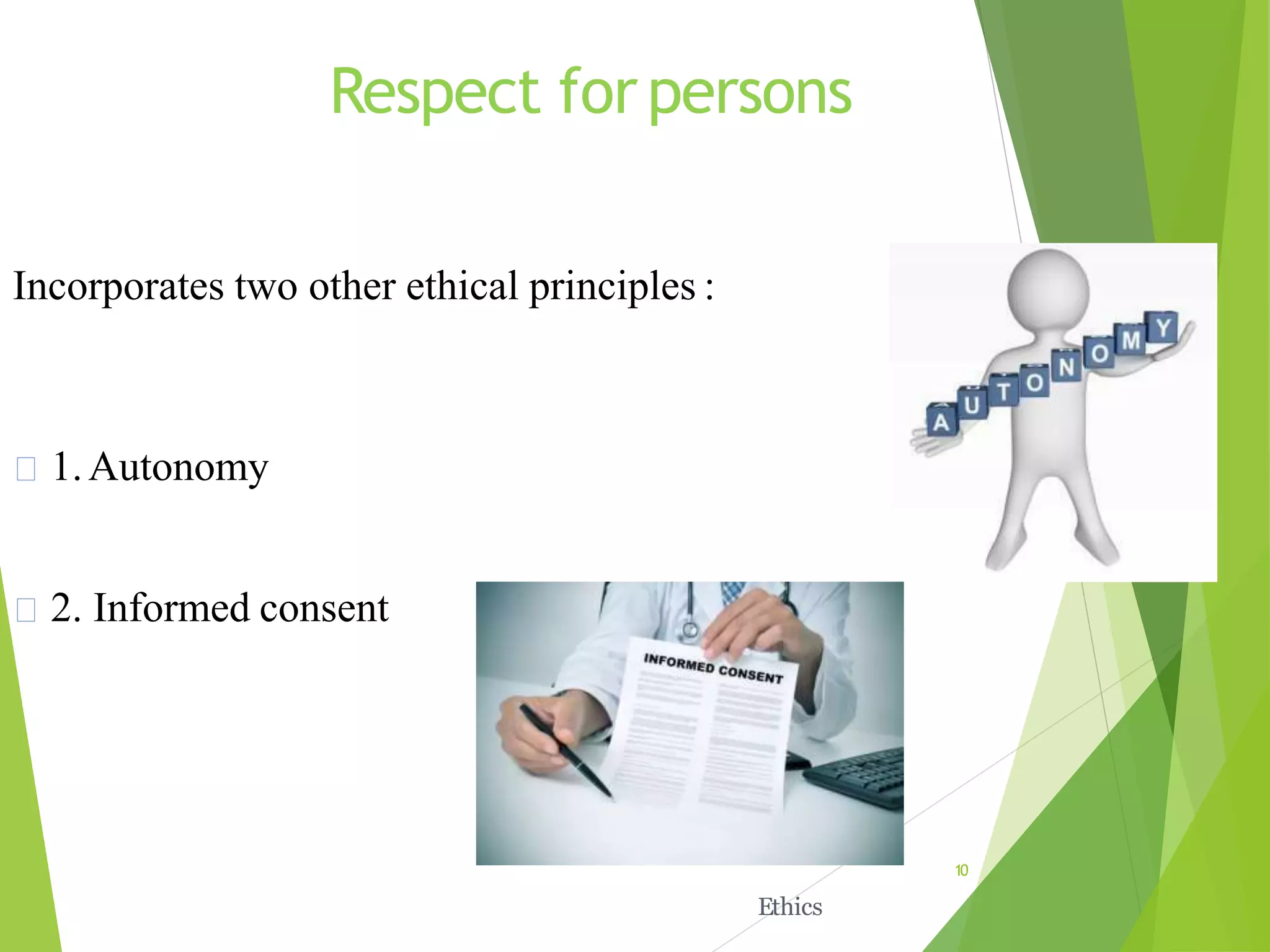
Incorporates two other ethical principles :
1.Autonomy
2. Informed consent
Ethics
Autonomy
 This principle is in line with interactive model of health
care wherein patient is the prominent member in the
process of decision making.
 This principle emphasizes the patient's right to make
decisions and is free to determine what will happen on
his/her body.
 A patient is diagnosed with dental caries in relation to
46 and 36. The treatment of choice which could be
given here are silver amalgam , GIC, composites.
However, the dentist attending the case insists on a
composite restoration.
Informed Consent
 The health care professional has to ensure that consent
is obtained before any care is instituted.
 Patients are provided with relevant information such
as different modes of treatment, their risks and
benefits consequences of not availing the treatment
etc.
 Information given should be easily understood
facilitating the patient to make a voluntary consent.
 In case of minors, parents or legal guardians can grant
the consent for the care.
Justice
 This principle directs health care professional to provide equal
treatment to all, giving to each patient what he/she needs.
 Dental practitioners are often found to be reluctant to treat the poor
because they cannot afford; treat the children or mentally retarded
because it takes longer time.
 Dentists also have responsibilities for such group of patients and
cannot shy away from the responsibilities bestowed on them by the
society.
 Dentists probably can provide care at a concessional rate or
designate certain time for the care of such patients or support
programmes for such patients conducted by local, regional or state
bodies.
Truthfulness (Veracity)
 Patient-doctor relationship is based on mutual trust.
 Patients expect the dentist to be truthful about the
information given, treatment rendered, and the prognosis.
 Even if the dentist believes lying or concealing or
manipulation of the information is required in the best
interest of the patient, the relationship is bound to suffer.
 The dentist may feel that it would be better if the patient
took certain course of action and therefore manipulates the
information that is given to the patient. Whatever the
reason, the relationship will suffer and the dentist will be
guilty of transgressing a major ethical principle.
 Mr. Y comes to the dental clinic complaining of pain in lower
right back tooth (46). The dentist tells the patient that an RCT
has to be done. And the patient agrees for the same. While
doing the RCT the dentist happens to breaks a file in the canal
which he is not able to retrieve. But he does not tell the
patient about it. After the treatment, the patient returns with
pain in the teeth after 6 months. The dentist says there is
infection in the canal and that the tooth cannot be saved and
that it has to be extracted.
Confidentiality
 Patients have the right to expect that all communications and
records pertaining to their care will be treated as
confidential.
 Gossiping/discussing about patient (some famous
patient/neighbor) would break a bond of trust between
dental professional and patient.
 Now, patients permission has to be sought to disclose
the confidentiality, even if it is beneficial to the patient.
 A patient named X comes to the dental clinic for
getting his teeth restored. The dentist suspects him of
HIV. He tells him to get various confirmatory tests
done. The patient comes back after a week with the
reports. It shows he is HIV positive. The dentist does
the treatment, but tells his attender that the patient is
HIV positive. The attender who stays near the
patients house tells about it to his neighbours.
DUTIES ANDOBLIGATIONS OF THE DENTIST
TOWARDSTHE
PATIENT/
POPULATION.
THE PROFESSION /
PROFESSIONAL
COLLEAGUES.
SOCIETY.
Ethics
Duties towards patients
 Every dentist should be courteous, sympathetic, friendly and helpful.
 He should observe punctuality in fulfilling his appointments.
 He should establish a well merited reputation for professional ability
and fidelity.
 The welfare of patient should be conserved to the utmost of the
practitioner’s ability.
 A dentist should not permit considerations of religion, nationality,
race, party politics or social standing to intervene between his duties
and his patients.
 Information of personal nature which may be learned about or directly
from a patient in the course of dental practice should be kept in utmost
confidence. It is also obligation of the dentist to see that his auxiliary
staff observed this rule.
Duties towards professional
colleagues
 Every dentist should cherish a proper pride in his/her colleagues
and should not disparage them either by act or word.
 Mutual arrangements should be made regarding remuneration,
when other dentist’s patient is taken care in his
sickness/absence.
 If a dentist is called for providing emergencies, he should retire
after it is over (in favor of the regular dentist), but is entitled to
charge the patient for his services.
 If a dentist is consulted by the patient of another dentist and the
former finds that the patient is suffering from previous faulty
treatment it is his duty to institute correct treatment at once
with as little comments as possible and in such a manner as to
avoid reflection on his predecessor.
Duties towards society
 The dentist has to assume leadership in the
community on matters pertaining to dental health.
 People should be urged to seek care without influencing
the choice of dentist.
Unethical Practices
 Unregistered persons
 Advertising
 Undercutting charges to solicit patients
 Accepting or paying commission
 Use of bogus diploma
 Unethical practices
 Not referring the patient to the consultant if the
planned treatment is beyond the skills of the dentist.
 Emergency consultation, not sending the patient back
to previous care provider
HELSINKI DECLARATION
 Recommendations guiding physicians in biomedical
research involving human subjects.
 Issued by World Medical Association in 1964 in Helsinki,
Finland
 Para 1-10 – Introduction
 Para 11-30 – Principles for all medical research
 Para 31-35 – Additional principles for research and
medical care
Basic Principles of Helsinki
Declaration
THANK YOU!

Ethics in dentistry

  • 1.
    Ethical Principles in Dentistry Dr.Aurlene, M.D.S. Senior Lecturer Department of Public Health Dentistry Madha Dental College and Hospital
  • 2.
    CONTENTS  Origin andDefinition  History - Hippocratic Oath  Nuremberg Code  Ethical Principles  Obligations of dentist to patients  Obligation of dentists to colleagues  Obligation of dentists to society  Helsinki Declaration  Conclusion
  • 3.
    Origin and Definition The world ethics is derived from the Greek word ‘ethos’ meaning custom or character.  Ethics is the philosophy of human conduct.  "the science of the ideal human character and behaviour in situations where distinction must be made between right and wrong, duty must be followed and good interpersonal relations maintained". 3
  • 4.
    History of Ethics Hippocratic Oath written by Hippocrates, the father of medicine in 4th century BC.  Highlights “I will prescribe regimens for the good of my patients and never do harm to anyone, I will not prescribe deadly drugs. I will not cut for stone; I will leave operations to be performed by specialists. All that may come to my knowledge in the exercise of my profession I will keep secret and not reveal.” 4
  • 5.
    Nuremberg Code, 1947 Set of research ethical principles for human experimentation set as a result of Nuremberg Trials at the end of the Second World War.  They were created in response to the inhumane Nazi experiments on prisoners during second world war. Sulfonamide experiments Subjects were deliberately wounded on the outer side of their calves. Physicians then rubbed a mixture of bacteria into the open wounds before sewing them shut.
  • 7.
    Principles of Ethics Non-maleficence  Beneficence  Respect for persons  Justice  Veracity  Confidentiality
  • 8.
    To do noharm (Non-maleficence)  Hippocrates, pioneer in Greek medicine has laid an emphasis on non- maleficence or to do no harm.  As per this, the first and foremost duty of the health care professional is to ensure that his actions do not harm the patient in any way.  Use of unsterilized instruments, under filling or overfilling, carelessness in handling hard and soft tissues of the mouth are some of the instances, which can harm the patients.
  • 9.
    To do good(Beneficence)  The health care professional, before instituting any action or care should question himself whether such actions will help the patient to recover or to perform his functions better or not.  He has to place the interest of the patient above his own interest.  He has to plan a treatment or order an investigation only if it is necessary.  In the process of treating a patient –weigh the consequences of treatment Vs no treatment.  E.g. in questionable dental caries - the attempts should be to maximize the benefits and minimize the harm.
  • 10.
    Respect forpersons 10 Incorporates twoother ethical principles : 1.Autonomy 2. Informed consent Ethics
  • 11.
    Autonomy  This principleis in line with interactive model of health care wherein patient is the prominent member in the process of decision making.  This principle emphasizes the patient's right to make decisions and is free to determine what will happen on his/her body.  A patient is diagnosed with dental caries in relation to 46 and 36. The treatment of choice which could be given here are silver amalgam , GIC, composites. However, the dentist attending the case insists on a composite restoration.
  • 12.
    Informed Consent  Thehealth care professional has to ensure that consent is obtained before any care is instituted.  Patients are provided with relevant information such as different modes of treatment, their risks and benefits consequences of not availing the treatment etc.  Information given should be easily understood facilitating the patient to make a voluntary consent.  In case of minors, parents or legal guardians can grant the consent for the care.
  • 14.
    Justice  This principledirects health care professional to provide equal treatment to all, giving to each patient what he/she needs.  Dental practitioners are often found to be reluctant to treat the poor because they cannot afford; treat the children or mentally retarded because it takes longer time.  Dentists also have responsibilities for such group of patients and cannot shy away from the responsibilities bestowed on them by the society.  Dentists probably can provide care at a concessional rate or designate certain time for the care of such patients or support programmes for such patients conducted by local, regional or state bodies.
  • 15.
    Truthfulness (Veracity)  Patient-doctorrelationship is based on mutual trust.  Patients expect the dentist to be truthful about the information given, treatment rendered, and the prognosis.  Even if the dentist believes lying or concealing or manipulation of the information is required in the best interest of the patient, the relationship is bound to suffer.  The dentist may feel that it would be better if the patient took certain course of action and therefore manipulates the information that is given to the patient. Whatever the reason, the relationship will suffer and the dentist will be guilty of transgressing a major ethical principle.
  • 16.
     Mr. Ycomes to the dental clinic complaining of pain in lower right back tooth (46). The dentist tells the patient that an RCT has to be done. And the patient agrees for the same. While doing the RCT the dentist happens to breaks a file in the canal which he is not able to retrieve. But he does not tell the patient about it. After the treatment, the patient returns with pain in the teeth after 6 months. The dentist says there is infection in the canal and that the tooth cannot be saved and that it has to be extracted.
  • 17.
    Confidentiality  Patients havethe right to expect that all communications and records pertaining to their care will be treated as confidential.  Gossiping/discussing about patient (some famous patient/neighbor) would break a bond of trust between dental professional and patient.  Now, patients permission has to be sought to disclose the confidentiality, even if it is beneficial to the patient.
  • 18.
     A patientnamed X comes to the dental clinic for getting his teeth restored. The dentist suspects him of HIV. He tells him to get various confirmatory tests done. The patient comes back after a week with the reports. It shows he is HIV positive. The dentist does the treatment, but tells his attender that the patient is HIV positive. The attender who stays near the patients house tells about it to his neighbours.
  • 19.
    DUTIES ANDOBLIGATIONS OFTHE DENTIST TOWARDSTHE PATIENT/ POPULATION. THE PROFESSION / PROFESSIONAL COLLEAGUES. SOCIETY. Ethics
  • 20.
    Duties towards patients Every dentist should be courteous, sympathetic, friendly and helpful.  He should observe punctuality in fulfilling his appointments.  He should establish a well merited reputation for professional ability and fidelity.  The welfare of patient should be conserved to the utmost of the practitioner’s ability.  A dentist should not permit considerations of religion, nationality, race, party politics or social standing to intervene between his duties and his patients.  Information of personal nature which may be learned about or directly from a patient in the course of dental practice should be kept in utmost confidence. It is also obligation of the dentist to see that his auxiliary staff observed this rule.
  • 21.
    Duties towards professional colleagues Every dentist should cherish a proper pride in his/her colleagues and should not disparage them either by act or word.  Mutual arrangements should be made regarding remuneration, when other dentist’s patient is taken care in his sickness/absence.  If a dentist is called for providing emergencies, he should retire after it is over (in favor of the regular dentist), but is entitled to charge the patient for his services.  If a dentist is consulted by the patient of another dentist and the former finds that the patient is suffering from previous faulty treatment it is his duty to institute correct treatment at once with as little comments as possible and in such a manner as to avoid reflection on his predecessor.
  • 22.
    Duties towards society The dentist has to assume leadership in the community on matters pertaining to dental health.  People should be urged to seek care without influencing the choice of dentist.
  • 23.
    Unethical Practices  Unregisteredpersons  Advertising  Undercutting charges to solicit patients  Accepting or paying commission  Use of bogus diploma  Unethical practices  Not referring the patient to the consultant if the planned treatment is beyond the skills of the dentist.  Emergency consultation, not sending the patient back to previous care provider
  • 24.
    HELSINKI DECLARATION  Recommendationsguiding physicians in biomedical research involving human subjects.  Issued by World Medical Association in 1964 in Helsinki, Finland  Para 1-10 – Introduction  Para 11-30 – Principles for all medical research  Para 31-35 – Additional principles for research and medical care
  • 25.
    Basic Principles ofHelsinki Declaration
  • 26.