Human Therapies- TPA
Interferon and Antisense
molecules.
Submitted By-
Shaista Khan.
MSc.MB.3rd Semester.
A07199319007.
Submitted To-
Dr. Gurjeet Kaur.
Assistant Professor.
AIB .
.
Tissue plasminogen
activator -
(tPA)
Introduction-
 Serine protease enzyme.
 one of the essential components of the
dissolution of blood clots.
 primary function includes catalyzing the
conversion of plasminogen to plasmin.
 Recombinant biotechnology has allowed tPA
to be manufactured in labs, and these
synthetic products are called recombinant
tissue plasminogen activator (rtPA).
 These drugs have undergone various
modifications to amplify their pharmacokinetic
and pharmacodynamic properties.
Some facts about tPA-
 Name:
 Tissue-type plasminogen activator
 Synonyms:
 t-PA, vascular activator, extrinsic plasminogen activator
 History:
 Discovered by Astrup et al 1947
 Synthesis:
 Endothelial cells, mesothelial cells, megacaryocyte
 Molecular weight
 68.000 Dalton
 Carbohydrate:
 7-13%
Contd..
 Gene:
 36.6 kb, 14 exons, located at chromosome 8.
 Amino acids:
 527 or 530
 Concentration:
 5 mg/l (antigen)
1 mg/l (activity)
 Half-life:
 4-5 min
 Importance:
 Decreased t-PA activity and elevated t-PA and
PAI-1 antigen may be a risk marker
for cardiovascular disease.
Use Of tPA -
 Ischemic stroke (most common).
 Myocardial Infarction.
 Pulmonary embolism.
 Thrombolysis (e.g., deep vein
thrombosis).
Sequences of the action of
tPA -
 tPA attaches to the fibrin on the clot
surface.
 It activates the fibrin-bound
plasminogen.
 Plasmin is subsequently cleaved from
the plasminogen affiliated with the
fibrin.
 The molecules of fibrin are broken up
by the plasmin, and the clot dissolves.
INTERFERONS
-
What are Interferons-
 In 1957, Isaac and Lindenmann
discovered a substance that interfered
with viral replication.
 Naturally occuring proteins and
glycoproteins.
 Structurally, they are the part of
cytokine family.
 Secreted by Eukaryotic cells in
response to viral infections, tumors
and other biological inducers.
Important Features-
 Part of non-specific immune system.
 Play an important role in the first line
of defense against viral infection.
 Itself is not an anti-viral agent.
 By inhibiting viral replication, it induces
antiviral state.
Types Of Interferon-
 Type 1 (Interferon alpha and beta)-
 Produced when the body recognizes a
virus that has invaded it.
 Produced by fibroblast and monocytes.
 These IFNs binds to specfic receptors on
target cells which lead prevent the virus
from replicating its genetic material.
 IFN-alpha used to treat hepatitis B and
C.
 IFN-beta can be used to treat multiple
sclerosis.
Contd..
 Type II (Interferon gamma)-
 Also known as immune Interferon and
activated by Interleukin-12.
 Released by cytotoxic Tcells and type-
1 T helper cells.
 Results in inhibition of Type-2 helper
cell’s immune response and induction
of Type-1 helper cell’s immune
response.
 These Interferons binds to Interferon
gamma receptor (IFNGR).
Contd..
 Type III-
 Signal through a receptor complex
consist of IL10R2 and IFNLR1.
 Although discovered more recently
than type I and type II IFNs.
 Information about these types of
Interferons are demonstrated in some
virus and fungal infections.
Functions Of Interferons-
1-Antiviral agents and modulate functions
of immune system:-
 In response to IFNS, cells produce large
amount of enzyme (protein kinase R).
 Phosphorylates elF-2 which further forms
an inactive complex with elF2B protein to
reduce protein synthesis within the cell.
 Also Interferons induce production of
hundreds of other proteins (Interferon-
stimulated genes).
Contd..
2- Up-regulate major histocompatibilty
complex molecules and increses
immunoproteosome activity:-
 Higher MHC I expression increases
presentation of viral and abnormal
peptides to cytotoxic T cells, where as
MHC II present these peptides to T
helper cells.
 Immunoproteosome processes peptides
to load on MHC I molecule.
 Thus, increases the recognition and
killing of infected cells.
Contd..
3- can suppress angiogenesis by down
regulation of angiogenic stimuli.
4- supresses the proliferation of
endothelial cells.
 Cause decrease in tumor
angiogenesis.
 Decreases its vascularization.
 IFN type III, activates other immune
cells, like macrophages and NK cells.
 Inhibits cell growth.
Viruses resistance to Interferons-
 Blocks the downstream signaling and
prevent further IFN production and also
inhibit the functions of proteins induced
by IFN.
 H5N1 influenza virus, has resistance to
interferon and other-viral cytokine.
 Encodes proteins that binds to dsRNA to
prevent the activity of RNA-dependent
protein kinase.
 Eg. JEV, dengue type 2 virus, SARS-
COV-2, etc.
Interferon Therapy-
 Therapy is used as a treatment for some
cancers.
 Treatment can be used in hematological
malignancy, such as leukemia and
lymphomas.
 Those treated with Interferon have a
sustained virological response and can
eliminate hepatitis virus.
 Biopsies of patients given the treatment
show reduction in liver damage and
cirrhosis.
 In systemic therapy, IFNs are
administered by an intramuscular
injection.
Antisense
Molecules-
Definition-
 The term antisense molecules comprises
several classes of oligonucleotide
molecules that contain sequence
complementary to target RNA molecules,
such as mRNA, viral RNA, or other RNA
species, and that inhibit the function of
their target RNA after sequence-specific
binding.
 4 major classes- antisense
oligodeoxyribonucleotide (ssDNA
molecules), ribozyme, small interfering
RNA molecules, and DNAzymes.
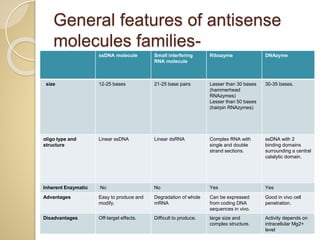
General features of antisense
molecules families-
ssDNA molecule Small interfering
RNA molecule
Ribozyme DNAzyme
size 12-25 bases 21-25 base pairs Lesser than 30 bases
(hammerhead
RNAzymes)
Lesser than 50 bases
(hairpin RNAzymes)
30-35 bases.
oligo type and
structure
Linear ssDNA Linear dsRNA Complex RNA with
single and double
strand sections.
ssDNA with 2
binding domains
surrounding a central
catalytic domain.
Inherent Enzymatic No No Yes Yes
Advantages Easy to produce and
modify.
Degradation of whole
mRNA
Can be expressed
from coding DNA
sequences in vivo.
Good in vivo cell
penetration.
Disadvantages Off-target effects. Difficult to produce. large size and
complex structure.
Activity depends on
intracellular Mg2+
level
Applications-
 Used application of therapeutic
antisense molecules is to reduce
expression levels of proteins associated
with central mechanisns of disease
development.
 Can also be developed to interfere with
other functional aspects of RNA
molecules.
 Mode of action of antisense molecules
revealed many of its structure involved
enzymatic activities to fully exert their
function.
Use in inflammatory
disorders-
 First antisense molecules applied in
clinical studies was alicaforsen (ISIS
2302).
 Combination of 2 antisense DNA
molecule called TPI ASM8 was
developed for the treatment of allergic
asthma.
 Most recently, a DNAzyme-based drug
was successfully applied in clinical study
for the first time.
 SB010 represents a DNAzyme directed
against GATA-3, the master transcription
factor of TH2-driven immune responses.
Thank you

Genetic engineering ppt

  • 1.
    Human Therapies- TPA Interferonand Antisense molecules. Submitted By- Shaista Khan. MSc.MB.3rd Semester. A07199319007. Submitted To- Dr. Gurjeet Kaur. Assistant Professor. AIB . .
  • 2.
  • 3.
    Introduction-  Serine proteaseenzyme.  one of the essential components of the dissolution of blood clots.  primary function includes catalyzing the conversion of plasminogen to plasmin.  Recombinant biotechnology has allowed tPA to be manufactured in labs, and these synthetic products are called recombinant tissue plasminogen activator (rtPA).  These drugs have undergone various modifications to amplify their pharmacokinetic and pharmacodynamic properties.
  • 4.
    Some facts abouttPA-  Name:  Tissue-type plasminogen activator  Synonyms:  t-PA, vascular activator, extrinsic plasminogen activator  History:  Discovered by Astrup et al 1947  Synthesis:  Endothelial cells, mesothelial cells, megacaryocyte  Molecular weight  68.000 Dalton  Carbohydrate:  7-13%
  • 5.
    Contd..  Gene:  36.6kb, 14 exons, located at chromosome 8.  Amino acids:  527 or 530  Concentration:  5 mg/l (antigen) 1 mg/l (activity)  Half-life:  4-5 min  Importance:  Decreased t-PA activity and elevated t-PA and PAI-1 antigen may be a risk marker for cardiovascular disease.
  • 6.
    Use Of tPA-  Ischemic stroke (most common).  Myocardial Infarction.  Pulmonary embolism.  Thrombolysis (e.g., deep vein thrombosis).
  • 7.
    Sequences of theaction of tPA -  tPA attaches to the fibrin on the clot surface.  It activates the fibrin-bound plasminogen.  Plasmin is subsequently cleaved from the plasminogen affiliated with the fibrin.  The molecules of fibrin are broken up by the plasmin, and the clot dissolves.
  • 8.
  • 9.
    What are Interferons- In 1957, Isaac and Lindenmann discovered a substance that interfered with viral replication.  Naturally occuring proteins and glycoproteins.  Structurally, they are the part of cytokine family.  Secreted by Eukaryotic cells in response to viral infections, tumors and other biological inducers.
  • 10.
    Important Features-  Partof non-specific immune system.  Play an important role in the first line of defense against viral infection.  Itself is not an anti-viral agent.  By inhibiting viral replication, it induces antiviral state.
  • 11.
    Types Of Interferon- Type 1 (Interferon alpha and beta)-  Produced when the body recognizes a virus that has invaded it.  Produced by fibroblast and monocytes.  These IFNs binds to specfic receptors on target cells which lead prevent the virus from replicating its genetic material.  IFN-alpha used to treat hepatitis B and C.  IFN-beta can be used to treat multiple sclerosis.
  • 12.
    Contd..  Type II(Interferon gamma)-  Also known as immune Interferon and activated by Interleukin-12.  Released by cytotoxic Tcells and type- 1 T helper cells.  Results in inhibition of Type-2 helper cell’s immune response and induction of Type-1 helper cell’s immune response.  These Interferons binds to Interferon gamma receptor (IFNGR).
  • 13.
    Contd..  Type III- Signal through a receptor complex consist of IL10R2 and IFNLR1.  Although discovered more recently than type I and type II IFNs.  Information about these types of Interferons are demonstrated in some virus and fungal infections.
  • 14.
    Functions Of Interferons- 1-Antiviralagents and modulate functions of immune system:-  In response to IFNS, cells produce large amount of enzyme (protein kinase R).  Phosphorylates elF-2 which further forms an inactive complex with elF2B protein to reduce protein synthesis within the cell.  Also Interferons induce production of hundreds of other proteins (Interferon- stimulated genes).
  • 15.
    Contd.. 2- Up-regulate majorhistocompatibilty complex molecules and increses immunoproteosome activity:-  Higher MHC I expression increases presentation of viral and abnormal peptides to cytotoxic T cells, where as MHC II present these peptides to T helper cells.  Immunoproteosome processes peptides to load on MHC I molecule.  Thus, increases the recognition and killing of infected cells.
  • 16.
    Contd.. 3- can suppressangiogenesis by down regulation of angiogenic stimuli. 4- supresses the proliferation of endothelial cells.  Cause decrease in tumor angiogenesis.  Decreases its vascularization.  IFN type III, activates other immune cells, like macrophages and NK cells.  Inhibits cell growth.
  • 17.
    Viruses resistance toInterferons-  Blocks the downstream signaling and prevent further IFN production and also inhibit the functions of proteins induced by IFN.  H5N1 influenza virus, has resistance to interferon and other-viral cytokine.  Encodes proteins that binds to dsRNA to prevent the activity of RNA-dependent protein kinase.  Eg. JEV, dengue type 2 virus, SARS- COV-2, etc.
  • 18.
    Interferon Therapy-  Therapyis used as a treatment for some cancers.  Treatment can be used in hematological malignancy, such as leukemia and lymphomas.  Those treated with Interferon have a sustained virological response and can eliminate hepatitis virus.  Biopsies of patients given the treatment show reduction in liver damage and cirrhosis.  In systemic therapy, IFNs are administered by an intramuscular injection.
  • 19.
  • 20.
    Definition-  The termantisense molecules comprises several classes of oligonucleotide molecules that contain sequence complementary to target RNA molecules, such as mRNA, viral RNA, or other RNA species, and that inhibit the function of their target RNA after sequence-specific binding.  4 major classes- antisense oligodeoxyribonucleotide (ssDNA molecules), ribozyme, small interfering RNA molecules, and DNAzymes.
  • 21.
    General features ofantisense molecules families- ssDNA molecule Small interfering RNA molecule Ribozyme DNAzyme size 12-25 bases 21-25 base pairs Lesser than 30 bases (hammerhead RNAzymes) Lesser than 50 bases (hairpin RNAzymes) 30-35 bases. oligo type and structure Linear ssDNA Linear dsRNA Complex RNA with single and double strand sections. ssDNA with 2 binding domains surrounding a central catalytic domain. Inherent Enzymatic No No Yes Yes Advantages Easy to produce and modify. Degradation of whole mRNA Can be expressed from coding DNA sequences in vivo. Good in vivo cell penetration. Disadvantages Off-target effects. Difficult to produce. large size and complex structure. Activity depends on intracellular Mg2+ level
  • 22.
    Applications-  Used applicationof therapeutic antisense molecules is to reduce expression levels of proteins associated with central mechanisns of disease development.  Can also be developed to interfere with other functional aspects of RNA molecules.  Mode of action of antisense molecules revealed many of its structure involved enzymatic activities to fully exert their function.
  • 23.
    Use in inflammatory disorders- First antisense molecules applied in clinical studies was alicaforsen (ISIS 2302).  Combination of 2 antisense DNA molecule called TPI ASM8 was developed for the treatment of allergic asthma.  Most recently, a DNAzyme-based drug was successfully applied in clinical study for the first time.  SB010 represents a DNAzyme directed against GATA-3, the master transcription factor of TH2-driven immune responses.
  • 24.