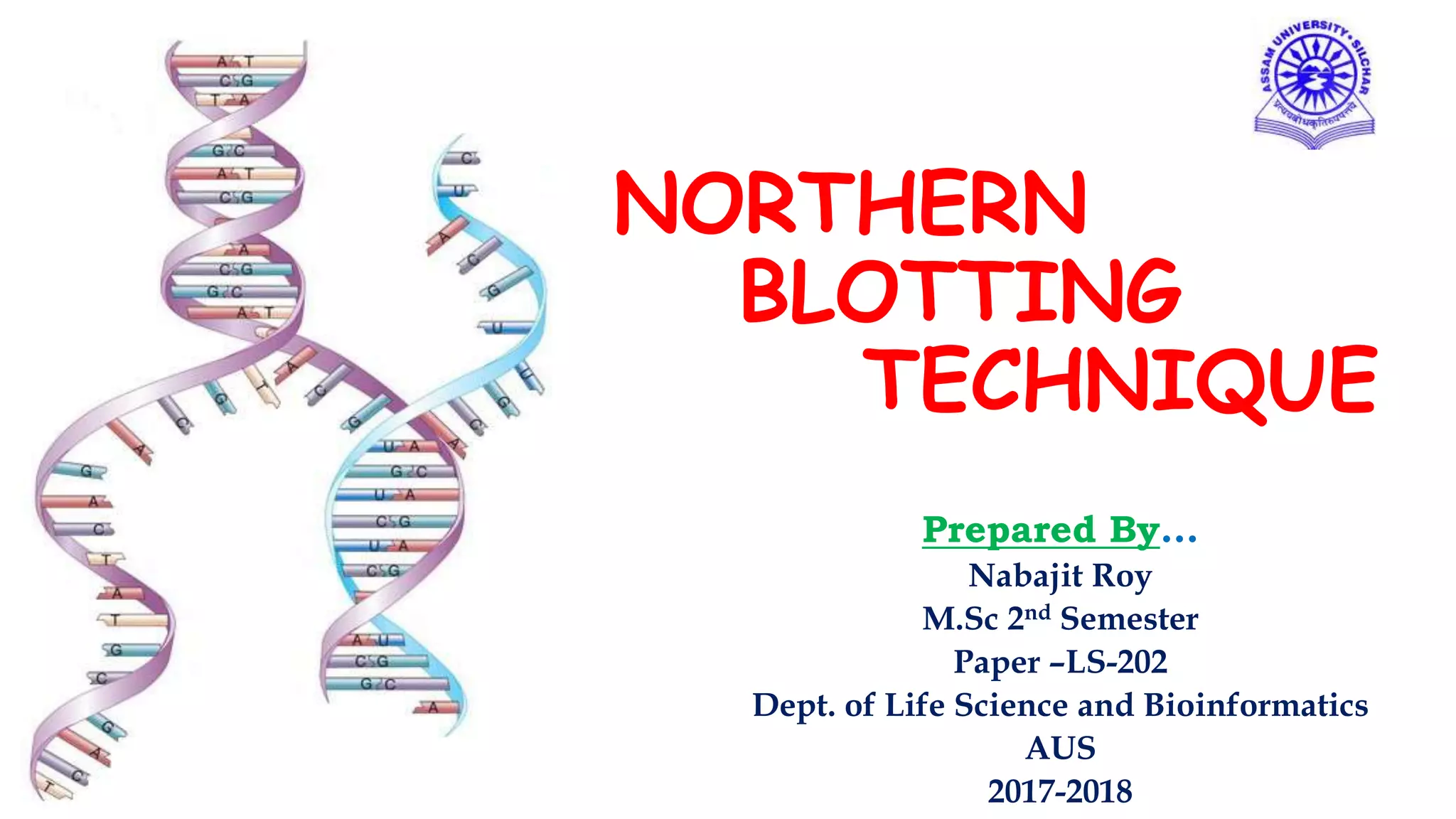
NORTHERN
BLOTTING
TECHNIQUE
Prepared By...
Nabajit Roy
M.Sc 2nd Semester
Paper –LS-202
Dept. of Life Science and Bioinformatics
AUS
2017-2018
CONTENTS
 What is blotting
 Types of blotting
 Principle
 Northern blotting
 Application
 Advantage & Disadvantage
 Summary
 References
11-Apr-20 Northern blotting technique 2
What is Blotting?
 In molecular biology blotting is a technique for transferring DNA , RNA
and proteins onto a carrier so they can be separated, and often follow
the use of gel electrophoresis.
11-Apr-20 Northern blotting technique 3
Types OF Blotting:
Types of blotting techniques are differentiated by the presence of the target molecules
that is being sought. The first of this techniques developed was Dr. Edwin Southern
(1975).
 Southern Blotting: Used For DNA Detection in a sample
 Northern Blotting : Used For RNA Detection in a sample
 Western Blotting : Used For Proteins in a sample
 Dot blotting technique: to detect the presence of a given sequence of
DNA/RNA
11-Apr-20 Northern blotting technique 4
PRINCIPLE
1. RNA are separated by size and detected on a membrane
using a hybridization probe with a base sequence
complementary to all, or a part, of the sequence of the
target mRNA
2. transfer of RNA from a gel to a membrane.
3. And then the membrane is queried with a probe directed
against the specific molecule of interest.
11-Apr-20 Northern blotting technique 5
NORTHERN BLOTTING
 The Northern blot is a technique used in molecular biology to study gene
expression by detection of RNA (or isolated mRNA) in a sample
developed by Alwnie and his colleagues in 1979. This method was named
for its similarity to the technique known as a Southern blot.
11-Apr-20 Northern blotting technique 6
11-Apr-20 Northern blotting technique 7
APPLICATION
 Detecting a specific mRNA in a sample
 Used in the screening of recombinants by detecting the mRNA produced
by the transgene.
 In disease diagnosis.
 In gene expression studies.
11-Apr-20 Northern blotting technique 8
ADVANTAGE
1. The strength of this technique is its
simplicity.
2. Specificity is relatively high.
3. mRNA transcript size can be detected.
4. The cost of running many Gels is low
once the equipment is setup.
5. Blots can be stored for several years and
reprobed if necessary.
6. Quantity and Quality of RNA can be
easily verified after electrophoresis and
before further processing is done.
DISADVANTAGE
1. Risk of mRNA degradation during
electrophoresis: Quality &
Quantification of expression are
negatively effected.
2. High doses of radioactivity and
formaldehyde are a risk for workers and
the environment.
3. The sensitivity of Northern blotting is
relatively low in comparison with that
of RT-PCR.
4. Detection with multiple probe is
difficult.
5. Use of Ethidium Bromide (EtBr), DEPC
& UV light needs special training and
attention
11-Apr-20 Northern blotting technique 9
SUMMARY
 Northern blotting is the main method for examining the expression of genes through
measurement of an mRNA. Or It is theoretically a good technique for determining the no. of
genes (through mRNA) present on a given DNA. Tissue specificity and the factors which
regulate expression can both be determined by Northern blotting. A cDNA radioactively
labelled with 32P is the most-commonly-used hybridization probe. Convenient, non-
radioactive detection protocols are, however, increasingly available. A combination of anti-
sense oligonucleotides as probes, together with chemo-luminescence-based detection
provides a rapid and simplified approach to Northern blotting, increasing the accessibility of
this important procedure for nutritional studies.
11-Apr-20 Northern blotting technique 10
REFERENCES
1. Wilson, K & Walker, J,(2010), Principles and techniques of biochemistry and molecular
biology.
2. Satyanarayan, U.(2015) biotechnology pp. 68-101
3. Goda, S.K. & Nigel, P.M., “A simple procedure for gel electrophoresis and northern
blotting of RNA”(1995) “Nucleic acid research 23.16:3357
4. Trayhurn, P.(1996). Northern Blotting Proceedings of the Nutrition society. Pp 55, 583-589.
11-Apr-20 Northern blotting technique 11
11-Apr-20 Northern blotting technique 12

Northern blotting

  • 1.
    NORTHERN BLOTTING TECHNIQUE Prepared By... Nabajit Roy M.Sc2nd Semester Paper –LS-202 Dept. of Life Science and Bioinformatics AUS 2017-2018
  • 2.
    CONTENTS  What isblotting  Types of blotting  Principle  Northern blotting  Application  Advantage & Disadvantage  Summary  References 11-Apr-20 Northern blotting technique 2
  • 3.
    What is Blotting? In molecular biology blotting is a technique for transferring DNA , RNA and proteins onto a carrier so they can be separated, and often follow the use of gel electrophoresis. 11-Apr-20 Northern blotting technique 3
  • 4.
    Types OF Blotting: Typesof blotting techniques are differentiated by the presence of the target molecules that is being sought. The first of this techniques developed was Dr. Edwin Southern (1975).  Southern Blotting: Used For DNA Detection in a sample  Northern Blotting : Used For RNA Detection in a sample  Western Blotting : Used For Proteins in a sample  Dot blotting technique: to detect the presence of a given sequence of DNA/RNA 11-Apr-20 Northern blotting technique 4
  • 5.
    PRINCIPLE 1. RNA areseparated by size and detected on a membrane using a hybridization probe with a base sequence complementary to all, or a part, of the sequence of the target mRNA 2. transfer of RNA from a gel to a membrane. 3. And then the membrane is queried with a probe directed against the specific molecule of interest. 11-Apr-20 Northern blotting technique 5
  • 6.
    NORTHERN BLOTTING  TheNorthern blot is a technique used in molecular biology to study gene expression by detection of RNA (or isolated mRNA) in a sample developed by Alwnie and his colleagues in 1979. This method was named for its similarity to the technique known as a Southern blot. 11-Apr-20 Northern blotting technique 6
  • 7.
  • 8.
    APPLICATION  Detecting aspecific mRNA in a sample  Used in the screening of recombinants by detecting the mRNA produced by the transgene.  In disease diagnosis.  In gene expression studies. 11-Apr-20 Northern blotting technique 8
  • 9.
    ADVANTAGE 1. The strengthof this technique is its simplicity. 2. Specificity is relatively high. 3. mRNA transcript size can be detected. 4. The cost of running many Gels is low once the equipment is setup. 5. Blots can be stored for several years and reprobed if necessary. 6. Quantity and Quality of RNA can be easily verified after electrophoresis and before further processing is done. DISADVANTAGE 1. Risk of mRNA degradation during electrophoresis: Quality & Quantification of expression are negatively effected. 2. High doses of radioactivity and formaldehyde are a risk for workers and the environment. 3. The sensitivity of Northern blotting is relatively low in comparison with that of RT-PCR. 4. Detection with multiple probe is difficult. 5. Use of Ethidium Bromide (EtBr), DEPC & UV light needs special training and attention 11-Apr-20 Northern blotting technique 9
  • 10.
    SUMMARY  Northern blottingis the main method for examining the expression of genes through measurement of an mRNA. Or It is theoretically a good technique for determining the no. of genes (through mRNA) present on a given DNA. Tissue specificity and the factors which regulate expression can both be determined by Northern blotting. A cDNA radioactively labelled with 32P is the most-commonly-used hybridization probe. Convenient, non- radioactive detection protocols are, however, increasingly available. A combination of anti- sense oligonucleotides as probes, together with chemo-luminescence-based detection provides a rapid and simplified approach to Northern blotting, increasing the accessibility of this important procedure for nutritional studies. 11-Apr-20 Northern blotting technique 10
  • 11.
    REFERENCES 1. Wilson, K& Walker, J,(2010), Principles and techniques of biochemistry and molecular biology. 2. Satyanarayan, U.(2015) biotechnology pp. 68-101 3. Goda, S.K. & Nigel, P.M., “A simple procedure for gel electrophoresis and northern blotting of RNA”(1995) “Nucleic acid research 23.16:3357 4. Trayhurn, P.(1996). Northern Blotting Proceedings of the Nutrition society. Pp 55, 583-589. 11-Apr-20 Northern blotting technique 11
  • 12.