
Gujarat Power Engineering
& Research Institute
By-
-Karan Thawani(58)Contents:-
- ATM FRAUDS
SUB: Cyber Security
ATM FRAUDS
o ATM FRAUDS In general
ATM fraud can include any
deliberate 'criminal' technique
which involves the use of an
ATM to obtain something of
value.
o Attacks against ATMs may be classified as ATM physical attacks
and ATM fraud.
o More than 70 percent of financial institutions experienced an
increase in ATM/debit card fraud claims in 2011.
o The U.S. Secret Service reports $8.5B in annual U.S. credit card
fraud losses, including ATM skimming.
o Ram raids are those threats when criminals physically break out
ATMs from the wall at the institution.
oCriminals go through the financial institution's telephone banking
service to change PIN numbers..
Types
• Fake Keypad
• PIN Compromise
Types
• Card Skimming
• Cash Trapping
Types
• Transaction Reversal
Types Of ATM Frauds
Fake Keypad
o This is a fabricated device that looks exactly the machine’s
keypad, it is placed beside it to capture the PIN of the
cardholder.
o ATM skimming Device card reader
which can be disguised to look like a
part of the machine.
o The card reader saves the users'
card number and pin code, which is
then replicated into a counterfeit copy
for theft.
o It help criminals in
a) Knowing Account information
b) Pin compromise
o ATM card entry slot skimmers have
various shapes and sizes
What is ATM Skimming
How PIN is Compromised
o It obtaining debit card information
by unauthorized individual.
o Shoulder surfing or using use of a
miniature camera.
oVideo surveillance
o Hidden video camera
oOverhead cell phone camera
oRemotely positioned cameras
o PIN pad overlay
oThe Ruler Gang uses a device that looks like
a ruler to trap cash in ATMs.
o A member of the group will install a “false
ATM presenter” or a fabricated ruler device
into the cash shutter of the ATM.
oA customer who will withdraw amount to said
ATM will not notice the device and when he
tries to get the money withdrawn, he will
have a hard time since the cash will be
trapped inside.
oWhen the disappointed customer leaves the
ATM to ask for assistance, a member of the
Ruler Gang will thereafter remove the device
including the cash still glued on it.
Cash Trapping
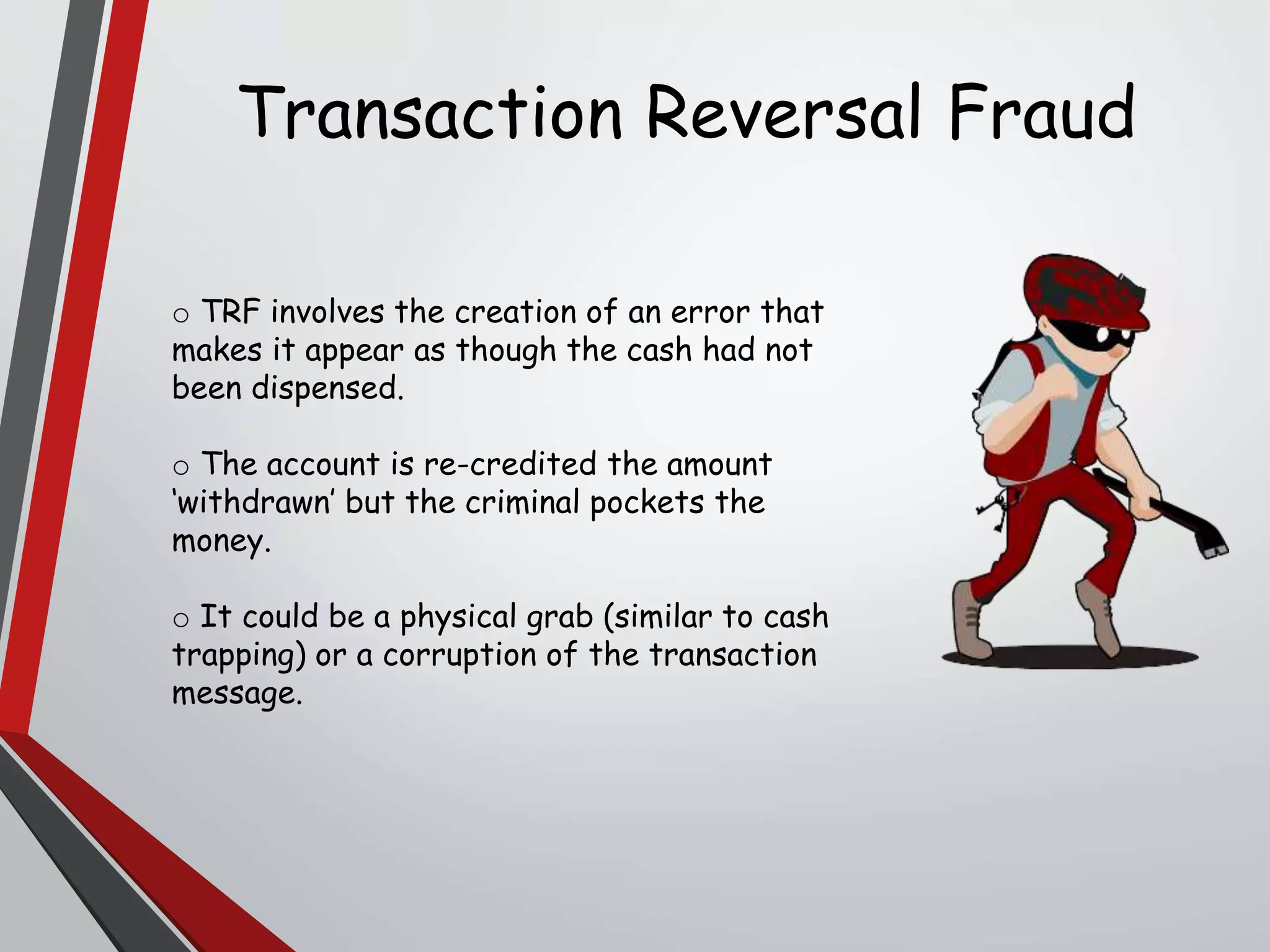
o TRF involves the creation of an error that
makes it appear as though the cash had not
been dispensed.
o The account is re-credited the amount
‘withdrawn’ but the criminal pockets the
money.
o It could be a physical grab (similar to cash
trapping) or a corruption of the transaction
message.
Transaction Reversal Fraud
o Cover up: Always cover your one hand with the other hand while
keying in the PIN number. By protecting your PIN, criminals do not
have access to your account when card information is compromised
(this method is useful when transacting at an ATM or Point of Sale).
o InContact: Ensure you have inContact activated on all your
transactional accounts (credit cards, cheque cards etc.) to ensure
that you always know when fraudulent activity takes place on your
account/s.
o Stand close to the ATM and use your body as a shield and extra
security to protect your Card and PIN.
o Do not accept assistance, guidance or allow anyone to interfere
with your transaction - fraudsters sometimes pose as bank officials
by offering assistance or interfering with your transaction.
o Only insert the card when the ATM prompts you to do so -
fraudsters jam ATMs to create confusion with customers.
Prevention
o Control your exposure in terms of daily ATM limits - lower your
daily ATM limits if the limit is set at a level unrealistic to what you
would usually spend.
o Use ATMs you are familiar with and do not use ATMs in
secluded areas or late at night.
o Report any suspicious activity/tampering at the ATM to your
bank immediately.
o Check the card scanner slot: Give it a wiggle. Often skimming
devices are false panels that can be detected and will come lose.
o Choose your ATM carefully: Use ATMs in high traffic areas
that are well lit.
oNever force your card into an ATM slot.
Atm frauds

Atm frauds

  • 1.
    Gujarat Power Engineering &Research Institute By- -Karan Thawani(58)Contents:- - ATM FRAUDS SUB: Cyber Security
  • 2.
    ATM FRAUDS o ATMFRAUDS In general ATM fraud can include any deliberate 'criminal' technique which involves the use of an ATM to obtain something of value. o Attacks against ATMs may be classified as ATM physical attacks and ATM fraud.
  • 3.
    o More than70 percent of financial institutions experienced an increase in ATM/debit card fraud claims in 2011. o The U.S. Secret Service reports $8.5B in annual U.S. credit card fraud losses, including ATM skimming. o Ram raids are those threats when criminals physically break out ATMs from the wall at the institution. oCriminals go through the financial institution's telephone banking service to change PIN numbers..
  • 4.
    Types • Fake Keypad •PIN Compromise Types • Card Skimming • Cash Trapping Types • Transaction Reversal Types Of ATM Frauds
  • 5.
    Fake Keypad o Thisis a fabricated device that looks exactly the machine’s keypad, it is placed beside it to capture the PIN of the cardholder.
  • 6.
    o ATM skimmingDevice card reader which can be disguised to look like a part of the machine. o The card reader saves the users' card number and pin code, which is then replicated into a counterfeit copy for theft. o It help criminals in a) Knowing Account information b) Pin compromise o ATM card entry slot skimmers have various shapes and sizes What is ATM Skimming
  • 7.
    How PIN isCompromised o It obtaining debit card information by unauthorized individual. o Shoulder surfing or using use of a miniature camera. oVideo surveillance o Hidden video camera oOverhead cell phone camera oRemotely positioned cameras o PIN pad overlay
  • 8.
    oThe Ruler Ganguses a device that looks like a ruler to trap cash in ATMs. o A member of the group will install a “false ATM presenter” or a fabricated ruler device into the cash shutter of the ATM. oA customer who will withdraw amount to said ATM will not notice the device and when he tries to get the money withdrawn, he will have a hard time since the cash will be trapped inside. oWhen the disappointed customer leaves the ATM to ask for assistance, a member of the Ruler Gang will thereafter remove the device including the cash still glued on it. Cash Trapping
  • 9.
    o TRF involvesthe creation of an error that makes it appear as though the cash had not been dispensed. o The account is re-credited the amount ‘withdrawn’ but the criminal pockets the money. o It could be a physical grab (similar to cash trapping) or a corruption of the transaction message. Transaction Reversal Fraud
  • 10.
    o Cover up:Always cover your one hand with the other hand while keying in the PIN number. By protecting your PIN, criminals do not have access to your account when card information is compromised (this method is useful when transacting at an ATM or Point of Sale). o InContact: Ensure you have inContact activated on all your transactional accounts (credit cards, cheque cards etc.) to ensure that you always know when fraudulent activity takes place on your account/s. o Stand close to the ATM and use your body as a shield and extra security to protect your Card and PIN. o Do not accept assistance, guidance or allow anyone to interfere with your transaction - fraudsters sometimes pose as bank officials by offering assistance or interfering with your transaction. o Only insert the card when the ATM prompts you to do so - fraudsters jam ATMs to create confusion with customers. Prevention
  • 11.
    o Control yourexposure in terms of daily ATM limits - lower your daily ATM limits if the limit is set at a level unrealistic to what you would usually spend. o Use ATMs you are familiar with and do not use ATMs in secluded areas or late at night. o Report any suspicious activity/tampering at the ATM to your bank immediately. o Check the card scanner slot: Give it a wiggle. Often skimming devices are false panels that can be detected and will come lose. o Choose your ATM carefully: Use ATMs in high traffic areas that are well lit. oNever force your card into an ATM slot.