Parent P.R.E.P.
  Fall 2009
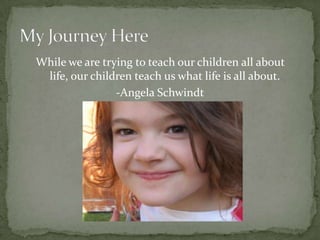
While we are trying to teach our children all about
 life, our children teach us what life is all about.
                -Angela Schwindt
If a child is to keep his inborn sense of wonder, he
needs the companionship of at least one adult who can
 share it, rediscovering with him the joy, excitement
           and mystery of the world we live in.
                     - Rachel Carson
 To empower parents to advocate, support, guide and
 best of all grow with and for their child.

 To provide information and understanding about
 development, education, and therapeutic options.

 To have the resources, support and courage to move
 ahead in the best direction for their child.
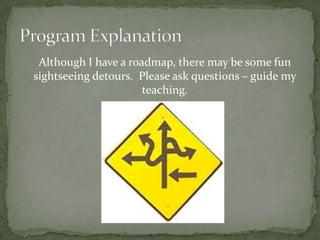
Although I have a roadmap, there may be some fun
sightseeing detours. Please ask questions – guide my
                      teaching.
 Week 1 and 2 = Training


 Week 3 = Home Visits


 Week 4 and 5 = Individualized Site Visits


 Week 6 = Wrap Up Training
 Complex neurobiological disorder
 Part of a group of disorders known as autism spectrum
    disorders (ASD)
   Occurs in all racial, ethnic, and social groups
   Impairs a person’s ability to communicate and relate to
    others
   Associated with rigid routines and repetitive
    behaviors, such as obsessively arranging objects or
    following very specific routines
   Symptoms can range from very mild to quite severe
                                                      Taken from:
                                                   Autism Speaks
                                                 autismspeaks.org
 1 in 150 children is diagnosed with autism
 1 in 94 boys is on the autism spectrum
 67 children are diagnosed per day
 A new case is diagnosed almost every 20 minutes
 More children will be diagnosed with autism this year than with AIDS, diabetes
    & cancer combined
   Autism is the fastest-growing serious developmental disability in the U.S.
   Autism costs the nation over $35 billion per year, a figure expected to
    significantly increase in the next decade
   Autism receives less than 5% of the research funding of many less prevalent
    childhood diseases
   Boys are four times more likely than girls to have autism
   There is no medical detection or cure for autism
                                                                          Taken from:
                                                                       Autism Speaks
                                                                    autismspeaks.org
 Sensory Integration Disorder
 Pervasive Development Disorder – Not Otherwise
    Specified (PDD-NOS)
   Asperger’s Disorder
   Language and Communication Disorders
   Seizure Disorders
   Fragile X Syndrome
   Developmental Delay
“If you’ve met one child with autism, you’ve met one
                    child with autism.”

 Your child is unique, interesting, wonderful, and one
  of a kind!
 This is why you must become the expert on your child
  – to then guide us experts in our brief time supporting
  your journey
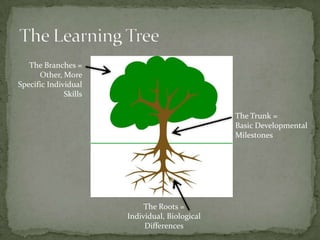
The Branches =
      Other, More
Specific Individual
              Skills

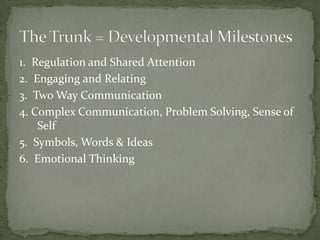
                                                The Trunk =
                                                Basic Developmental
                                                Milestones


                            The Roots =
                       Individual, Biological
                            Differences
 Sensory and Motor Processing
 Motor Planning/Control
 Specific Health or Physical Challenges
 Inherent Likes/Dislikes – Motivations
1. Regulation and Shared Attention
2. Engaging and Relating
3. Two Way Communication
4. Complex Communication, Problem Solving, Sense of
    Self
5. Symbols, Words & Ideas
6. Emotional Thinking
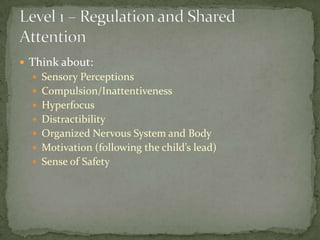
 Think about:
   Sensory Perceptions
   Compulsion/Inattentiveness
   Hyperfocus
   Distractibility
   Organized Nervous System and Body
   Motivation (following the child’s lead)
   Sense of Safety
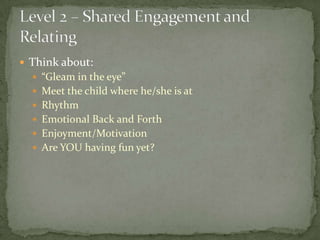
 Think about:
   “Gleam in the eye”
   Meet the child where he/she is at
   Rhythm
   Emotional Back and Forth
   Enjoyment/Motivation
   Are YOU having fun yet?
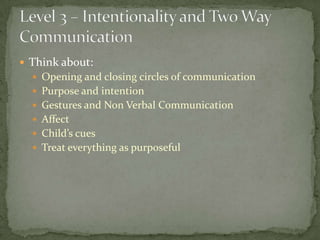
 Think about:
   Opening and closing circles of communication
   Purpose and intention
   Gestures and Non Verbal Communication
   Affect
   Child’s cues
   Treat everything as purposeful
 Think about:
   Power
   Choice
   Gestural Language Base
   Endurance
   Persistence
   Motivation
   Peers
   Problem Solving
   Expansion
 Think about:
   Becoming abstract
   Power of ideas
   Theory of mind
   Flexibility
   Pretend Play
   Imagination
   Creativity vs. Rigidity
 Think about:
   Building Bridges
   Peer Relationships
   Social Repair
   Social Cues
   Emotional Regulation
   The Role of Affect
   Theory of Mind
   Themes and Subjects – Staying on Topic
 Academic Development
 Complex Speech and Language Growth
 Complex and Creative Ideas
 Social Nuances
 Theory of Mind
 Motor Challenges
 Sensory Processing Challenges
 Ability to Engage in Back and Forth Interactions
 Speech, Language and Communication
 Attention
 Peer Play/Social Skills
 Pretend Play
 Academic Development
 Step 1 : Observe

 What’s going on in your child’s mind?
 What was your child trying to do?
 What was he/she thinking?
 Is this behavior typical for your child?
 What does this experience tell you about your child more generally?
 Does it tell you something about your child’s personality more
  generally?
 What were YOU feeling while you watched?
 Did anything surprise you, concern you, make you curious or happy?
 What did this tell you about your child’s strengths?
 Step 2: Learn


 What is common about behaviors?
 What is different?
 What can they mean?
 What services might be able to help or contribute?
 What information do I need to seek out?
 What can I do in daily life to support?
 Step 3: Celebrate


 What was better today than yesterday?
 Where are the strengths?
 How does my child make me laugh?
 How did I support my child in this moment?
 What did I enjoy doing today that I can do again
  tomorrow?
 What do I do for my child that no one else can?
 What should I write down to always remember?
 BE with the child...
 Sensory Motor Play
 Theme & Variation
 Taffy Pulling (Extend and Expand)
 Salient Language
 Rhythm & Music
 Sense of Humor, Suspense, Surprise
 One and Two step commands
 Making them work for it
 Rewarding and Reinforcing
 Playful Obstruction
 Making Random Behavior Purposeful
 Affect
 Vocal Tone
 Observation
   Following your child’s lead
   Affect!
   Extending and Expanding the Drama
   Observe
   Persist in your Pursuit
   Treat Everything as Intentional
   Position in Front of Child
   Don’t interrupt or change interaction if it’s working
   Insist on a response
   Avoid turning situation into a “learning experience”
   Sensory-Motor Play
   Cause and Effect
   Process over Product
“Listen to the mustn'ts, child. Listen to the don'ts. Listen
  to the shouldn'ts, the impossibles, the won'ts. Listen to
  the never haves, then listen close to me... Anything can
              happen, child. Anything can be.”
                      - Shel silverstein

General Training

  • 1.
  • 2.
    While we aretrying to teach our children all about life, our children teach us what life is all about. -Angela Schwindt
  • 4.
    If a childis to keep his inborn sense of wonder, he needs the companionship of at least one adult who can share it, rediscovering with him the joy, excitement and mystery of the world we live in. - Rachel Carson
  • 5.
     To empowerparents to advocate, support, guide and best of all grow with and for their child.  To provide information and understanding about development, education, and therapeutic options.  To have the resources, support and courage to move ahead in the best direction for their child.
  • 6.
    Although I havea roadmap, there may be some fun sightseeing detours. Please ask questions – guide my teaching.
  • 7.
     Week 1and 2 = Training  Week 3 = Home Visits  Week 4 and 5 = Individualized Site Visits  Week 6 = Wrap Up Training
  • 8.
     Complex neurobiologicaldisorder  Part of a group of disorders known as autism spectrum disorders (ASD)  Occurs in all racial, ethnic, and social groups  Impairs a person’s ability to communicate and relate to others  Associated with rigid routines and repetitive behaviors, such as obsessively arranging objects or following very specific routines  Symptoms can range from very mild to quite severe Taken from: Autism Speaks autismspeaks.org
  • 9.
     1 in150 children is diagnosed with autism  1 in 94 boys is on the autism spectrum  67 children are diagnosed per day  A new case is diagnosed almost every 20 minutes  More children will be diagnosed with autism this year than with AIDS, diabetes & cancer combined  Autism is the fastest-growing serious developmental disability in the U.S.  Autism costs the nation over $35 billion per year, a figure expected to significantly increase in the next decade  Autism receives less than 5% of the research funding of many less prevalent childhood diseases  Boys are four times more likely than girls to have autism  There is no medical detection or cure for autism Taken from: Autism Speaks autismspeaks.org
  • 10.
     Sensory IntegrationDisorder  Pervasive Development Disorder – Not Otherwise Specified (PDD-NOS)  Asperger’s Disorder  Language and Communication Disorders  Seizure Disorders  Fragile X Syndrome  Developmental Delay
  • 11.
    “If you’ve metone child with autism, you’ve met one child with autism.”  Your child is unique, interesting, wonderful, and one of a kind!  This is why you must become the expert on your child – to then guide us experts in our brief time supporting your journey
  • 12.
    The Branches = Other, More Specific Individual Skills The Trunk = Basic Developmental Milestones The Roots = Individual, Biological Differences
  • 13.
     Sensory andMotor Processing  Motor Planning/Control  Specific Health or Physical Challenges  Inherent Likes/Dislikes – Motivations
  • 14.
    1. Regulation andShared Attention 2. Engaging and Relating 3. Two Way Communication 4. Complex Communication, Problem Solving, Sense of Self 5. Symbols, Words & Ideas 6. Emotional Thinking
  • 15.
     Think about:  Sensory Perceptions  Compulsion/Inattentiveness  Hyperfocus  Distractibility  Organized Nervous System and Body  Motivation (following the child’s lead)  Sense of Safety
  • 16.
     Think about:  “Gleam in the eye”  Meet the child where he/she is at  Rhythm  Emotional Back and Forth  Enjoyment/Motivation  Are YOU having fun yet?
  • 17.
     Think about:  Opening and closing circles of communication  Purpose and intention  Gestures and Non Verbal Communication  Affect  Child’s cues  Treat everything as purposeful
  • 18.
     Think about:  Power  Choice  Gestural Language Base  Endurance  Persistence  Motivation  Peers  Problem Solving  Expansion
  • 19.
     Think about:  Becoming abstract  Power of ideas  Theory of mind  Flexibility  Pretend Play  Imagination  Creativity vs. Rigidity
  • 20.
     Think about:  Building Bridges  Peer Relationships  Social Repair  Social Cues  Emotional Regulation  The Role of Affect  Theory of Mind  Themes and Subjects – Staying on Topic
  • 21.
     Academic Development Complex Speech and Language Growth  Complex and Creative Ideas  Social Nuances  Theory of Mind
  • 22.
     Motor Challenges Sensory Processing Challenges  Ability to Engage in Back and Forth Interactions  Speech, Language and Communication  Attention  Peer Play/Social Skills  Pretend Play  Academic Development
  • 23.
     Step 1: Observe  What’s going on in your child’s mind?  What was your child trying to do?  What was he/she thinking?  Is this behavior typical for your child?  What does this experience tell you about your child more generally?  Does it tell you something about your child’s personality more generally?  What were YOU feeling while you watched?  Did anything surprise you, concern you, make you curious or happy?  What did this tell you about your child’s strengths?
  • 24.
     Step 2:Learn  What is common about behaviors?  What is different?  What can they mean?  What services might be able to help or contribute?  What information do I need to seek out?  What can I do in daily life to support?
  • 25.
     Step 3:Celebrate  What was better today than yesterday?  Where are the strengths?  How does my child make me laugh?  How did I support my child in this moment?  What did I enjoy doing today that I can do again tomorrow?  What do I do for my child that no one else can?  What should I write down to always remember?
  • 26.
     BE withthe child...  Sensory Motor Play  Theme & Variation  Taffy Pulling (Extend and Expand)  Salient Language  Rhythm & Music  Sense of Humor, Suspense, Surprise  One and Two step commands  Making them work for it  Rewarding and Reinforcing  Playful Obstruction  Making Random Behavior Purposeful  Affect  Vocal Tone  Observation
  • 27.
    Following your child’s lead  Affect!  Extending and Expanding the Drama  Observe  Persist in your Pursuit  Treat Everything as Intentional  Position in Front of Child  Don’t interrupt or change interaction if it’s working  Insist on a response  Avoid turning situation into a “learning experience”  Sensory-Motor Play  Cause and Effect  Process over Product
  • 28.
    “Listen to themustn'ts, child. Listen to the don'ts. Listen to the shouldn'ts, the impossibles, the won'ts. Listen to the never haves, then listen close to me... Anything can happen, child. Anything can be.” - Shel silverstein