AUTISM
Autism, or autism spectrum disorder,
refers to a range of conditions
characterized by challenges with social
skills, repetitive behaviors, speech and
nonverbal communication, as well as by
unique strengths and differences.
INTRODUC
TION
Autism is a complex neurobehavioral condition that includes
impairments in social interaction and developmental language
and communication skills combined with rigid, repetitive
behaviors. Because of the range of symptoms, this condition is
now called Autism Spectrum Disorder (ASD).
Autism the condition is the result of a neurological disorder
that has an effect on normal brain function, affecting
development of the person’s communication and social
interaction skills.
DEFINITION
ASD is a brain-based disorder that affects
behavior, communication skills and social skills. It
includes
a. Asperger’s Syndrome
b. Rett Syndrome
c. Childhood Disintegrative Disorder
d. Kanner’s Syndrome; and
e. Pervasive Development Disorder - Not
Otherwise Specified (PDDNOS)
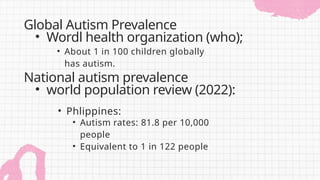
• Phlippines:
National autism prevalence
• world population review (2022):
Global Autism Prevalence
• Wordl health organization (who);
• About 1 in 100 children globally
has autism.
• Autism rates: 81.8 per 10,000
people
• Equivalent to 1 in 122 people
• inherited genetically
• result of environmental toxins (heavy metals,
chemicals, pesticides, viruses)
NEUROLOGICAL IMPLICATIONS
MRI studies have suggested - rapid overgrowth in
the first year and minimal growth after age 2 until
approx. age 4 and lack of overgrowth
• Frontal Cortex - rapid overgrowth until age 4
(cognitive language functions, social-emotional
processing)
• Visual Cortex - relatively intact.
CAUSE
• Avoids eye contact and prefers to be alone
• Struggles with understanding other people’s feelings
• Remains nonverbal or has delayed language
development
• Repeat words or phrases over and over (echolalia)
• Gets upset by minor changes in routine or surroundings
• Has highly restricted interests
• Performs repetitive behaviors such as flapping, rocking,
or spinning
• Has unusual and often intense reactions to sounds,
smells, tastes, textures, lights and/or colors
possible signs of autism at any
age:
• Developmental Pediatricians (doctors who
have special training in child development and
children with special needs)
• Child Neurologist (doctors who work on the
brain, spine, and nerves)
• Child Psychologists or Psychiatrists (doctors
who know about the human mind)
comprehensive diagnostic
evaluation
Problems with social interactions,
communication and behavior can lead to:
• Problems in school and with successful
learning
• Employment problems
• Inability to live independently
• Social isolation
• Stress within the family
• Victimization and being bullied
complications
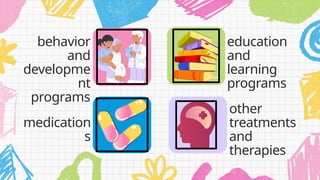
behavior
and
developme
nt
programs
medication
s
education
and
learning
programs
other
treatments
and
therapies
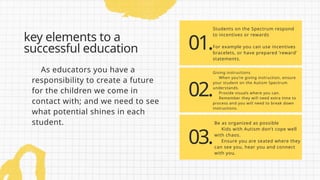
As educators you have a
responsibility to create a future
for the children we come in
contact with; and we need to see
what potential shines in each
student.
key elements to a
successful education 01.
02.
03.
Students on the Spectrum respond
to incentives or rewards
For example you can use incentives
bracelets, or have prepared ‘reward’
statements.
Giving instructions
When you’re giving instruction, ensure
your student on the Autism Spectrum
understands.
Provide visuals where you can.
Remember they will need extra time to
process and you will need to break down
instructions.
Be as organized as possible
Kids with Autism don’t cope well
with chaos.
Ensure you are seated where they
can see you, hear you and connect
with you.
• Allow for breaks (preventative) especially if you can
sense anxiety. Use a break card if necessary.
• Keep calm even approach. Try not to raise your voice.
• No matter how combative or problematic, don’t be
confrontational.
• Don’t alienate - connection with your student is vital.
• Do NOT insist your student look you in the eyes!
• Sit to the side whenever possible.
• Ask for permission to touch the child.
Kids on the Spectrum experience...
Anxiety as a result of
• Resistance to change
• Fear
• Feeling unsure
• Unfamiliarity
• Do they understand what you want?
• Do you need to clarify instruction?
• Do they need further reassurance?
• Are they feeling overloaded?
• Ask your self what the behaviour could be
telling you?
so you need to ask why the
behaviour?
• Stay calm
• Keen an even voice
• Wait for the meltdown to end before you
address it.
• Keep the student and other students safe
• Ask why the behaviour?
• Seek help from other teachers and aides.
if there are any behaviour
issues/meltdowns:
(This is written from the child
with autism’s perspective)
so what does
having special
needs mean to
the students?
• Change makes me anxious. This is because routine
helps me to feel safe and stable, so any disruption to
my routine will disrupt my sense of safety.
• However, if you give me a warning and help me to
understand the change that is about to occur, I will
cope with this change more effectively.
• I don’t want special privileges, but I want a chance to
be able to achieve success in the world.
• if I am having a ‘meltdown‘, I’m not being stubborn,
or naughty, or disruptive; I’m just anxious, frustrated
and scared because I can’t make you understand
what the world is like for me.
• If I cannot speak to you, or if I do not respond to
your questions, it does not mean I can’t hear you.
• Please don’t speak about me in front of me because
your comments hurt my feelings.
• I want people not just to see my disability, but I want
people to see me.
• I learn differently and see the world differently than
you.
• I may take longer to process information.
• The most important thing to consider is to develop a
connection with me.
• Come to my ‘space’ first because I don’t
understand yours; stepping outside of
my comfort zone will initially cause me
anxiety but once I get to know you and
trust you, I will gladly meet you half way.
• These kids can be delightful and
interesting and remember, YOU can make
an IMPACT!
• APPLIED BEHAVIOR ANALYSIS (ABA) - teaches play, communication,
self-care, academic and social living skills, and reduces problematic
behavior
• VERBAL BEHAVIOR THERAPY (VBT) - VBT seeks to move children
beyond labeling, a first step of learning language, and gesturing to
vocalizing their requests - “I want a cookie.”
• COGNITIVE BEHAVIORAL THERAPY (CBT) - focus more on developing
skills a child already has and working on their deficiencies
• DEVELOPMENTAL AND INDIVIDUAL DIFFERENCES RELATIONSHIP
(DIR) THERAPY (also called Floortime) - motivation to engage and
interact with others. The therapist follows a child’s lead in working
on new skills.
BEHAVIORAL
THERAPIES
• RELATIONSHIP DEVELOPMENT INTERVENTION (RDI) - RDI breaks its
various objectives down into step-by-step paths adults use to
prompt development, such as building eye contact or back-and-forth
communication.
• TREATMENT AND EDUCATION OF AUTISTIC AND RELATED
COMMUNICATION HANDICAPPED CHILDREN - is a classroom-based
program that customizes academic instruction and social
development to a child’s strengths.
• SOCIAL SKILLS GROUPS - help children engage in pragmatic
language and manage real-world difficulties with peers
BEHAVIORAL
THERAPIES
• RELATIONSHIP DEVELOPMENT INTERVENTION (RDI) - RDI breaks its
various objectives down into step-by-step paths adults use to
prompt development, such as building eye contact or back-and-forth
communication.
• TREATMENT AND EDUCATION OF AUTISTIC AND RELATED
COMMUNICATION HANDICAPPED CHILDREN - is a classroom-based
program that customizes academic instruction and social
development to a child’s strengths.
• SOCIAL SKILLS GROUPS - help children engage in pragmatic
language and manage real-world difficulties with peers
BEHAVIORAL
THERAPIES
• Music Therapy
• Auditory Therapy
• Vitamin/Mineral Therapy
• Holding Therapy
• Daily Life Therapy
• Picture Exchange Communication System (PECS)
• Speech - Language Therapy
• Occupational Therapy
• Swimming Therapy
• Animal Therapy
various other therapies
• Autism is still not recognized as a
separate form of disability in the
Persons with Disabilities (Equal
Opportunities, Protection of Rights and
Full Participation) Act 1995, the primary
piece of legislation that provides for
the rights of and benefits for persons
with disabilities in India.
• No way to prevent autism spectrum
disorder, but there are treatment options.
Early diagnosis and intervention is most
helpful and can improve behavior, skills
and language development. However,
intervention is helpful at any age. Though
children usually don’t outgrow autism
spectrum disorder symptoms, they may
learn to function well.
prevention
• Children who displays savant syndrome have
traditionally been referred to as idiot, retarded, or
autistic savants. The negative connotations of the
term “idiot” have led to the disuse of idiot savant.
Because the syndrome is often associated with
autism, the term autistic savant is more frequently
heard. The first known description of a person
displaying savant syndrome occured in a German
Psychology journal in 1751. The term savant was first
used in 1887 by J. Langdon Down
savant
syndrome
• Savant syndrome is exceedingly rare, but a
remarkable condition in which persons with
autism, or other serious mental handicaps, or
major mental illness, have astonishing islands
of ability or brilliance that stand out in stark
contrast to their overall disability.
• Savant syndrome occurs when a person with
below normal intelligence displays a special
talent or ability in a specific area.
Definition
• have an exceptional talent or skill in a particular
area, such as the ability to process mathematic
calculations at a phenomenal speed
• music, visual art common skill demonstrated by
savants is extraordinary memory
• Children with savant syndrome may be able to
memorize extensive amounts of data in such
areas as sports statistics, population figures, and
historical or biographical data.
symptoms
• Savant syndrome is diagnosed when a child’s
ability in one area is exceptionally higher than
would be expected given his or her IQ or
general level of functioning.
diagnosis
treatment
• making use of the special talent of the child
with savant syndrome may help treat the child’s
underlying developmental disorders.
• Engage the child in the therapeutic alliance beginning
with non-verbal play.
• Provide individualized care.
• Meet the basic needs - the child unable to express.
• Teach the child self - care activities.
• Motivate the child to express it needs.
• Encourage to vocalize with sound, games, and songs.
• Identify desired behaviour and reward it.
• Motivate the child express or communicate his needs.
nursing
interventions
“a child with autism is
not ignoring you,
they are simply
waiting for you to
enter their world”
AUTISM Basic information on autism spectrum disorder

  • 1.
  • 2.
    Autism, or autismspectrum disorder, refers to a range of conditions characterized by challenges with social skills, repetitive behaviors, speech and nonverbal communication, as well as by unique strengths and differences. INTRODUC TION
  • 3.
    Autism is acomplex neurobehavioral condition that includes impairments in social interaction and developmental language and communication skills combined with rigid, repetitive behaviors. Because of the range of symptoms, this condition is now called Autism Spectrum Disorder (ASD). Autism the condition is the result of a neurological disorder that has an effect on normal brain function, affecting development of the person’s communication and social interaction skills. DEFINITION
  • 4.
    ASD is abrain-based disorder that affects behavior, communication skills and social skills. It includes a. Asperger’s Syndrome b. Rett Syndrome c. Childhood Disintegrative Disorder d. Kanner’s Syndrome; and e. Pervasive Development Disorder - Not Otherwise Specified (PDDNOS)
  • 5.
    • Phlippines: National autismprevalence • world population review (2022): Global Autism Prevalence • Wordl health organization (who); • About 1 in 100 children globally has autism. • Autism rates: 81.8 per 10,000 people • Equivalent to 1 in 122 people
  • 6.
    • inherited genetically •result of environmental toxins (heavy metals, chemicals, pesticides, viruses) NEUROLOGICAL IMPLICATIONS MRI studies have suggested - rapid overgrowth in the first year and minimal growth after age 2 until approx. age 4 and lack of overgrowth • Frontal Cortex - rapid overgrowth until age 4 (cognitive language functions, social-emotional processing) • Visual Cortex - relatively intact. CAUSE
  • 7.
    • Avoids eyecontact and prefers to be alone • Struggles with understanding other people’s feelings • Remains nonverbal or has delayed language development • Repeat words or phrases over and over (echolalia) • Gets upset by minor changes in routine or surroundings • Has highly restricted interests • Performs repetitive behaviors such as flapping, rocking, or spinning • Has unusual and often intense reactions to sounds, smells, tastes, textures, lights and/or colors possible signs of autism at any age:
  • 8.
    • Developmental Pediatricians(doctors who have special training in child development and children with special needs) • Child Neurologist (doctors who work on the brain, spine, and nerves) • Child Psychologists or Psychiatrists (doctors who know about the human mind) comprehensive diagnostic evaluation
  • 9.
    Problems with socialinteractions, communication and behavior can lead to: • Problems in school and with successful learning • Employment problems • Inability to live independently • Social isolation • Stress within the family • Victimization and being bullied complications
  • 10.
  • 11.
    As educators youhave a responsibility to create a future for the children we come in contact with; and we need to see what potential shines in each student. key elements to a successful education 01. 02. 03. Students on the Spectrum respond to incentives or rewards For example you can use incentives bracelets, or have prepared ‘reward’ statements. Giving instructions When you’re giving instruction, ensure your student on the Autism Spectrum understands. Provide visuals where you can. Remember they will need extra time to process and you will need to break down instructions. Be as organized as possible Kids with Autism don’t cope well with chaos. Ensure you are seated where they can see you, hear you and connect with you.
  • 12.
    • Allow forbreaks (preventative) especially if you can sense anxiety. Use a break card if necessary. • Keep calm even approach. Try not to raise your voice. • No matter how combative or problematic, don’t be confrontational. • Don’t alienate - connection with your student is vital. • Do NOT insist your student look you in the eyes! • Sit to the side whenever possible. • Ask for permission to touch the child.
  • 13.
    Kids on theSpectrum experience... Anxiety as a result of • Resistance to change • Fear • Feeling unsure • Unfamiliarity
  • 14.
    • Do theyunderstand what you want? • Do you need to clarify instruction? • Do they need further reassurance? • Are they feeling overloaded? • Ask your self what the behaviour could be telling you? so you need to ask why the behaviour?
  • 15.
    • Stay calm •Keen an even voice • Wait for the meltdown to end before you address it. • Keep the student and other students safe • Ask why the behaviour? • Seek help from other teachers and aides. if there are any behaviour issues/meltdowns:
  • 16.
    (This is writtenfrom the child with autism’s perspective) so what does having special needs mean to the students?
  • 17.
    • Change makesme anxious. This is because routine helps me to feel safe and stable, so any disruption to my routine will disrupt my sense of safety. • However, if you give me a warning and help me to understand the change that is about to occur, I will cope with this change more effectively. • I don’t want special privileges, but I want a chance to be able to achieve success in the world. • if I am having a ‘meltdown‘, I’m not being stubborn, or naughty, or disruptive; I’m just anxious, frustrated and scared because I can’t make you understand what the world is like for me.
  • 18.
    • If Icannot speak to you, or if I do not respond to your questions, it does not mean I can’t hear you. • Please don’t speak about me in front of me because your comments hurt my feelings. • I want people not just to see my disability, but I want people to see me. • I learn differently and see the world differently than you. • I may take longer to process information. • The most important thing to consider is to develop a connection with me.
  • 19.
    • Come tomy ‘space’ first because I don’t understand yours; stepping outside of my comfort zone will initially cause me anxiety but once I get to know you and trust you, I will gladly meet you half way. • These kids can be delightful and interesting and remember, YOU can make an IMPACT!
  • 20.
    • APPLIED BEHAVIORANALYSIS (ABA) - teaches play, communication, self-care, academic and social living skills, and reduces problematic behavior • VERBAL BEHAVIOR THERAPY (VBT) - VBT seeks to move children beyond labeling, a first step of learning language, and gesturing to vocalizing their requests - “I want a cookie.” • COGNITIVE BEHAVIORAL THERAPY (CBT) - focus more on developing skills a child already has and working on their deficiencies • DEVELOPMENTAL AND INDIVIDUAL DIFFERENCES RELATIONSHIP (DIR) THERAPY (also called Floortime) - motivation to engage and interact with others. The therapist follows a child’s lead in working on new skills. BEHAVIORAL THERAPIES
  • 21.
    • RELATIONSHIP DEVELOPMENTINTERVENTION (RDI) - RDI breaks its various objectives down into step-by-step paths adults use to prompt development, such as building eye contact or back-and-forth communication. • TREATMENT AND EDUCATION OF AUTISTIC AND RELATED COMMUNICATION HANDICAPPED CHILDREN - is a classroom-based program that customizes academic instruction and social development to a child’s strengths. • SOCIAL SKILLS GROUPS - help children engage in pragmatic language and manage real-world difficulties with peers BEHAVIORAL THERAPIES
  • 22.
    • RELATIONSHIP DEVELOPMENTINTERVENTION (RDI) - RDI breaks its various objectives down into step-by-step paths adults use to prompt development, such as building eye contact or back-and-forth communication. • TREATMENT AND EDUCATION OF AUTISTIC AND RELATED COMMUNICATION HANDICAPPED CHILDREN - is a classroom-based program that customizes academic instruction and social development to a child’s strengths. • SOCIAL SKILLS GROUPS - help children engage in pragmatic language and manage real-world difficulties with peers BEHAVIORAL THERAPIES
  • 23.
    • Music Therapy •Auditory Therapy • Vitamin/Mineral Therapy • Holding Therapy • Daily Life Therapy • Picture Exchange Communication System (PECS) • Speech - Language Therapy • Occupational Therapy • Swimming Therapy • Animal Therapy various other therapies
  • 24.
    • Autism isstill not recognized as a separate form of disability in the Persons with Disabilities (Equal Opportunities, Protection of Rights and Full Participation) Act 1995, the primary piece of legislation that provides for the rights of and benefits for persons with disabilities in India.
  • 25.
    • No wayto prevent autism spectrum disorder, but there are treatment options. Early diagnosis and intervention is most helpful and can improve behavior, skills and language development. However, intervention is helpful at any age. Though children usually don’t outgrow autism spectrum disorder symptoms, they may learn to function well. prevention
  • 26.
    • Children whodisplays savant syndrome have traditionally been referred to as idiot, retarded, or autistic savants. The negative connotations of the term “idiot” have led to the disuse of idiot savant. Because the syndrome is often associated with autism, the term autistic savant is more frequently heard. The first known description of a person displaying savant syndrome occured in a German Psychology journal in 1751. The term savant was first used in 1887 by J. Langdon Down savant syndrome
  • 27.
    • Savant syndromeis exceedingly rare, but a remarkable condition in which persons with autism, or other serious mental handicaps, or major mental illness, have astonishing islands of ability or brilliance that stand out in stark contrast to their overall disability. • Savant syndrome occurs when a person with below normal intelligence displays a special talent or ability in a specific area. Definition
  • 28.
    • have anexceptional talent or skill in a particular area, such as the ability to process mathematic calculations at a phenomenal speed • music, visual art common skill demonstrated by savants is extraordinary memory • Children with savant syndrome may be able to memorize extensive amounts of data in such areas as sports statistics, population figures, and historical or biographical data. symptoms
  • 29.
    • Savant syndromeis diagnosed when a child’s ability in one area is exceptionally higher than would be expected given his or her IQ or general level of functioning. diagnosis treatment • making use of the special talent of the child with savant syndrome may help treat the child’s underlying developmental disorders.
  • 30.
    • Engage thechild in the therapeutic alliance beginning with non-verbal play. • Provide individualized care. • Meet the basic needs - the child unable to express. • Teach the child self - care activities. • Motivate the child to express it needs. • Encourage to vocalize with sound, games, and songs. • Identify desired behaviour and reward it. • Motivate the child express or communicate his needs. nursing interventions
  • 31.
    “a child withautism is not ignoring you, they are simply waiting for you to enter their world”