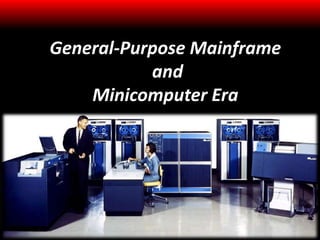
General-Purpose Mainframe
and
Minicomputer Era
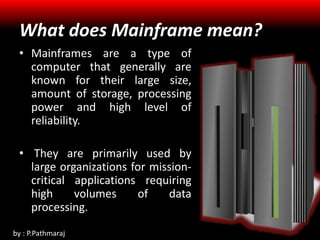
What does Mainframe mean?
• Mainframes are a type of
computer that generally are
known for their large size,
amount of storage, processing
power and high level of
reliability.
• They are primarily used by
large organizations for mission-
critical applications requiring
high volumes of data
processing.
by : P.Pathmaraj
Characteristics….
• In general, there are a few characteristics of
mainframes that are common among all mainframe
vendors:
– Nearly all mainframes have the ability to run (or host)
multiple operating systems.
– Mainframes can add or hot swap system capacity without
disruption.
– Mainframes are designed to handle very high volume input
and output (I/O) and emphasize throughput computing.
– A single mainframe can replace dozens or even hundreds
of smaller servers.
by : P.Pathmaraj
History ……
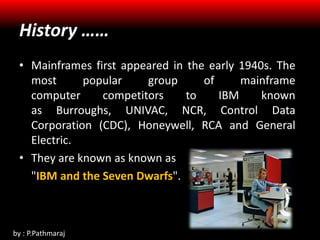
• Mainframes first appeared in the early 1940s. The
most popular group of mainframe
computer competitors to IBM known
as Burroughs, UNIVAC, NCR, Control Data
Corporation (CDC), Honeywell, RCA and General
Electric.
• They are known as known as
"IBM and the Seven Dwarfs".
by : P.Pathmaraj
• The description of IBM's competitors changed after
GE's 1970 sale of its computer business to
Honeywell and RCA's 1971 sale of its computer
business to Sperry, leaving only five "dwarves".
Fortunately, their initials lent themselves to a
new acronym, BUNCH.
(Burroughs, UNIVAC, NCR, Control Data
Corporation (CDC), and Honeywell)
History ……
by : P.Pathmaraj
The Mainframe Dawns the Computing Era
• By the 1950s, the first mainframes entered the scene,
with the Manchester Mark 1 cited as the first commercial
computer delivered to the University of Manchester in
1951.
• That same year, the first “mass produced” computer –
Remington Rand’s UNIVAC I – arrived at the U.S. Census
Bureau.
• Not to be outdone, however, IBM released its first fully
electronic data processing system, the IBM 701, the
following year.
by : P.Pathmaraj
The Mainframe Dawns the Computing Era
• Early mainframes (commonly referred to as “big iron”)
had no operating system and ran only a single, preloaded
program at a time.
• Data was stored on punched paper cards and magnetic
or paper tape.
• Reliability was always a bit questionable, as the machines
ran until the program completed or crashed. And due to
expense, the computers were extremely limited.
by : P.Pathmaraj
The Mainframe Dawns the Computing Era
• The mainframe era was a period of highly centralized
computing under the control of professional programmers
and systems operators (usually in a corporate data center),
with most elements of infrastructure provided by a single
vendor, the manufacturer of the hardware and the software.
• This pattern began to change with the introduction of
minicomputers produced by Digital Equipment Corporation
(DEC) in 1965.
• In recent years, the minicomputer has evolved into a
midrange computer or midrange server and is part of a
network.
by : P.Pathmaraj
General-Purpose Mainframe
• The introduction of the IBM 1401 and 7090 transistorized
machines in 1959 marked the beginning of widespread
commercial use of mainframe computers.
• In 1965 the mainframe computer truly came into its own
with the introduction of the IBM 360 series.
• The 360 was the first commercial computer with a
powerful operating system that could provide time
sharing, multitasking, and virtual memory in more
advanced models.
by : P.Pathmaraj
• Mainframe computers eventually became powerful
enough to support thousands of online remote terminals
connected to the centralized mainframe using
proprietary communication protocols and proprietary
data lines.
• The first airline reservation systems appeared in 1959
and became the prototypical online, real-time interactive
computing system that could scale up to service the
whole world.
General-Purpose Mainframe
by : P.Pathmaraj
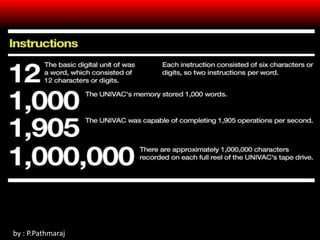
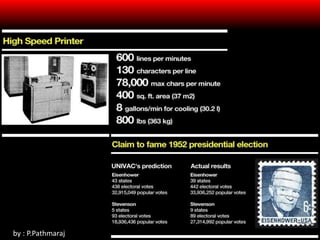
UNIVAC
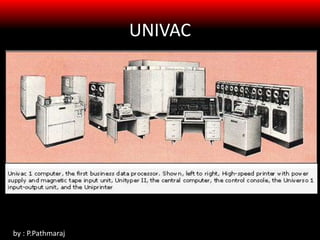
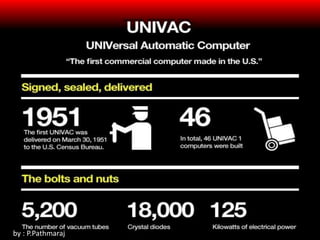
• The first mass-produced commercial computer,
which was called UNIVAC.
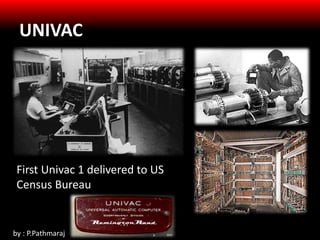
• The first model was delivered on March 30, 1951, to
the U.S. Census Bureau. As a brand name on
computers, UNIVAC survived until 1981.
• The UNIVAC has been called “the first commercial
computer in the United States,” as well as “the first
commercial computer to attract widespread
attention.”
by : P.Pathmaraj
UNIVAC
by : P.Pathmaraj
by : P.Pathmaraj
by : P.Pathmaraj
by : P.Pathmaraj
UNIVAC
First Univac 1 delivered to US
Census Bureau
by : P.Pathmaraj
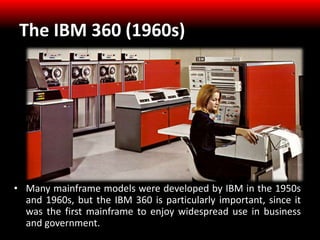
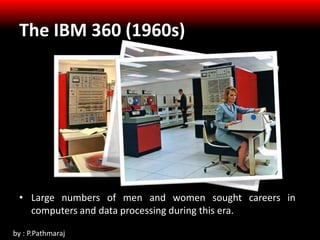
The IBM 360 (1960s)
• Many mainframe models were developed by IBM in the 1950s
and 1960s, but the IBM 360 is particularly important, since it
was the first mainframe to enjoy widespread use in business
and government.
The IBM 360 (1960s)
• Large numbers of men and women sought careers in
computers and data processing during this era.
by : P.Pathmaraj
What does Mini Computer mean?
• Minicomputers, as opposed to mainframes, were
small and inexpensive.
• The first of these, the PDP-1 came out in 1960. PDP
stood for Programmed Data Processor.
• The PDP-1 was followed by the 4, the 5, all the way
up to PDP-16 in 1972. Some of the PDPs, like the
PDP-10 were more mainframes than minis.
by : P.Pathmaraj
What does Mini Computer mean?
• In between, as the successor to PDP-11 came the VAX
(Virtual Address extension).
• Design work on the VAX started in 1975, and the first
VAX–the 11/780–was introduced in 1977.
• The VAX ran VMS and later OpenVMS as the operating
system. As the name indicates, the operating system
supported virtual memory. The 11/780 for example,
could address up to 4.3 GB of virtual memory.
by : P.Pathmaraj
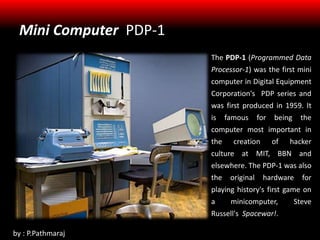
Mini Computer PDP-1
The PDP-1 (Programmed Data
Processor-1) was the first mini
computer in Digital Equipment
Corporation's PDP series and
was first produced in 1959. It
is famous for being the
computer most important in
the creation of hacker
culture at MIT, BBN and
elsewhere. The PDP-1 was also
the original hardware for
playing history's first game on
a minicomputer, Steve
Russell's Spacewar!.
by : P.Pathmaraj
Reference
• Cube Farm - By Reverend Bill Blunden
• Computer Architecture: Concepts And
Evolution -By Blaauw
by : P.Pathmaraj

General Purpose Mainframe and Minicomputer Era

  • 1.
  • 2.
    What does Mainframemean? • Mainframes are a type of computer that generally are known for their large size, amount of storage, processing power and high level of reliability. • They are primarily used by large organizations for mission- critical applications requiring high volumes of data processing. by : P.Pathmaraj
  • 3.
    Characteristics…. • In general,there are a few characteristics of mainframes that are common among all mainframe vendors: – Nearly all mainframes have the ability to run (or host) multiple operating systems. – Mainframes can add or hot swap system capacity without disruption. – Mainframes are designed to handle very high volume input and output (I/O) and emphasize throughput computing. – A single mainframe can replace dozens or even hundreds of smaller servers. by : P.Pathmaraj
  • 4.
    History …… • Mainframesfirst appeared in the early 1940s. The most popular group of mainframe computer competitors to IBM known as Burroughs, UNIVAC, NCR, Control Data Corporation (CDC), Honeywell, RCA and General Electric. • They are known as known as "IBM and the Seven Dwarfs". by : P.Pathmaraj
  • 5.
    • The descriptionof IBM's competitors changed after GE's 1970 sale of its computer business to Honeywell and RCA's 1971 sale of its computer business to Sperry, leaving only five "dwarves". Fortunately, their initials lent themselves to a new acronym, BUNCH. (Burroughs, UNIVAC, NCR, Control Data Corporation (CDC), and Honeywell) History …… by : P.Pathmaraj
  • 6.
    The Mainframe Dawnsthe Computing Era • By the 1950s, the first mainframes entered the scene, with the Manchester Mark 1 cited as the first commercial computer delivered to the University of Manchester in 1951. • That same year, the first “mass produced” computer – Remington Rand’s UNIVAC I – arrived at the U.S. Census Bureau. • Not to be outdone, however, IBM released its first fully electronic data processing system, the IBM 701, the following year. by : P.Pathmaraj
  • 7.
    The Mainframe Dawnsthe Computing Era • Early mainframes (commonly referred to as “big iron”) had no operating system and ran only a single, preloaded program at a time. • Data was stored on punched paper cards and magnetic or paper tape. • Reliability was always a bit questionable, as the machines ran until the program completed or crashed. And due to expense, the computers were extremely limited. by : P.Pathmaraj
  • 8.
    The Mainframe Dawnsthe Computing Era • The mainframe era was a period of highly centralized computing under the control of professional programmers and systems operators (usually in a corporate data center), with most elements of infrastructure provided by a single vendor, the manufacturer of the hardware and the software. • This pattern began to change with the introduction of minicomputers produced by Digital Equipment Corporation (DEC) in 1965. • In recent years, the minicomputer has evolved into a midrange computer or midrange server and is part of a network. by : P.Pathmaraj
  • 9.
    General-Purpose Mainframe • Theintroduction of the IBM 1401 and 7090 transistorized machines in 1959 marked the beginning of widespread commercial use of mainframe computers. • In 1965 the mainframe computer truly came into its own with the introduction of the IBM 360 series. • The 360 was the first commercial computer with a powerful operating system that could provide time sharing, multitasking, and virtual memory in more advanced models. by : P.Pathmaraj
  • 10.
    • Mainframe computerseventually became powerful enough to support thousands of online remote terminals connected to the centralized mainframe using proprietary communication protocols and proprietary data lines. • The first airline reservation systems appeared in 1959 and became the prototypical online, real-time interactive computing system that could scale up to service the whole world. General-Purpose Mainframe by : P.Pathmaraj
  • 11.
    UNIVAC • The firstmass-produced commercial computer, which was called UNIVAC. • The first model was delivered on March 30, 1951, to the U.S. Census Bureau. As a brand name on computers, UNIVAC survived until 1981. • The UNIVAC has been called “the first commercial computer in the United States,” as well as “the first commercial computer to attract widespread attention.” by : P.Pathmaraj
  • 12.
  • 13.
  • 14.
  • 15.
  • 16.
    UNIVAC First Univac 1delivered to US Census Bureau by : P.Pathmaraj
  • 17.
    The IBM 360(1960s) • Many mainframe models were developed by IBM in the 1950s and 1960s, but the IBM 360 is particularly important, since it was the first mainframe to enjoy widespread use in business and government.
  • 18.
    The IBM 360(1960s) • Large numbers of men and women sought careers in computers and data processing during this era. by : P.Pathmaraj
  • 19.
    What does MiniComputer mean? • Minicomputers, as opposed to mainframes, were small and inexpensive. • The first of these, the PDP-1 came out in 1960. PDP stood for Programmed Data Processor. • The PDP-1 was followed by the 4, the 5, all the way up to PDP-16 in 1972. Some of the PDPs, like the PDP-10 were more mainframes than minis. by : P.Pathmaraj
  • 20.
    What does MiniComputer mean? • In between, as the successor to PDP-11 came the VAX (Virtual Address extension). • Design work on the VAX started in 1975, and the first VAX–the 11/780–was introduced in 1977. • The VAX ran VMS and later OpenVMS as the operating system. As the name indicates, the operating system supported virtual memory. The 11/780 for example, could address up to 4.3 GB of virtual memory. by : P.Pathmaraj
  • 21.
    Mini Computer PDP-1 ThePDP-1 (Programmed Data Processor-1) was the first mini computer in Digital Equipment Corporation's PDP series and was first produced in 1959. It is famous for being the computer most important in the creation of hacker culture at MIT, BBN and elsewhere. The PDP-1 was also the original hardware for playing history's first game on a minicomputer, Steve Russell's Spacewar!. by : P.Pathmaraj
  • 22.
    Reference • Cube Farm- By Reverend Bill Blunden • Computer Architecture: Concepts And Evolution -By Blaauw by : P.Pathmaraj