WORLD CLASS FOAM
CONCENTRATE PUMPS
UL LISTED
FM APPROVED
ISO REGISTERED 9001:2015
FIRE LION - A VALUABLE PARTNER
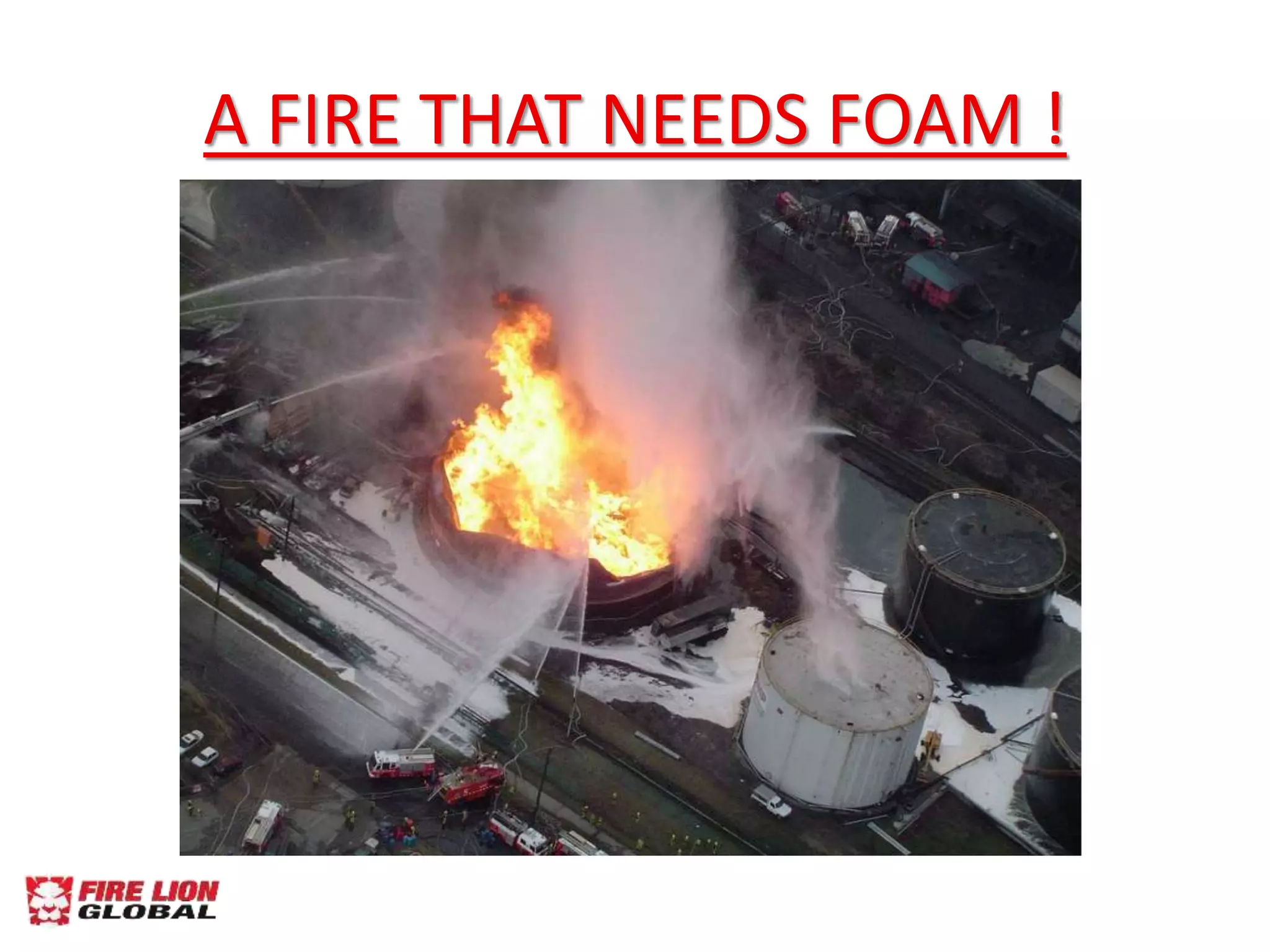
A FIRE THAT NEEDS FOAM !
Why use Foam?
Class “B” fires normally cannot be extinguished by
water alone and require foam:
• Fire Extinguishment – not just water
• Environmental damage containment
• Firefighter Safety
• Prevention of Fuel Ignition, or Re-Ignition
• Suppression of Flammable Vapors
• Post Fire Security
• Economical compared to lost value of stored
finished product.
What does foam do ?
Foam:
• Removes heat at a faster rate than it is released
• Separates the fuel from the oxidizing agent
• Dilutes the vapor-phase concentration of the fuel and/or oxidizing agent below
that necessary for combustion
• Terminates the chemical chain-reaction sequence
Applying foam on ground fire
INDUSTRIAL TANKAGE DIKE
PROTECTION
Foam Chamber for Tanks
Flowing foam chamber applying foam
solution on tank wall
Aircraft Hangar High Expansion Foam
Test
“SO I NEED A FOAM SYSTEM”
1. What is the size of the hazard ?
2. What is the fuel ? ( application density)
3. What is quantity of fuel ?
4. Portable or fixed system?
5. What is the least expensive way to get my foam system?
6. How long of discharge do I need?
7. What are the other risks / hazards present?
8. What are the foam system options?
Just a few of the key questions a foam system
designer must ask and know.
How a bladder tank works
Horizontal bladder Tank with pre-piped
proportioner
Bladder Tank Foam Proportioning
Limitations
• Mustbemountednear theproportionersolocationofbladdertankmustbe
nearthepipework /riser
• Cannotbequicklyrefilledafter discharge
• Difficulttotakefoamconcentratesampleor runtestwithoutflowingfoam
solution
• Ifhazard isnotcontainedor extinguishedafter dischargethereisno“2nd”
shot
• Bladdersare pronetotear /leakage anditisverydifficulttoreplacethe
bladderor knowthatitisleaking
• Bladder tanksizesof1,500gallonsor aboveare largeandtake significant
spaceAND BECOMEMOREEXPENSIVEBY A LARGE%
Why consider a foam pump system?
• Location of foam injection equipment cannot be
positioned near the hazard foam solution discharge
point.
• Discharge duration calculations or fuel type require a
long discharge and bladder tank becomes too large and
expensive.
• Size of hazard is large such as bulk storage tank farm,
aircraft hangars, marine flammable liquid piers,
refineries.
• End user preference and/or experience.
• Remote monitors on marine docks are far away from
foam/water system.
• Offers end user greater flexibility to quickly change foam
concentrate types or suppliers as fuel or chemical
inventory changes.
Typical Foam Pump System
Balanced Pressure Proportioning
Modified Venturi Device
Proportioners
How the foam concentrate gets into
the water stream – ILBP Module
NFPA 20 & Foam Pumps
Key foam pump aspects of NFPA 20 standard for the installation of
stationary pumps for fire protection
2016 EDITION – CHAPTER 8
1) PUMPS SHALL BE POSITIVE DISPLACEMENT TYPE – why?
Because foam concentrate viscosity ranges from 1cps to 6,000cps – Centrifugal
pumps are not will suited to high viscosity liquids & customer fuels may change
requiring a different type of foam concentrate.
2) PACKING SHALL NOT BE USED – LIP OR MECHANICAL SEAL ONLY – why?
Foam concentrate is corrosive and slippery and expensive – So packing leaks,
common for water pumps, are not a desirable feature
3) FOAM PUMPS SHALL BE CAPABLE OF DRY RUNNING FOR
10 MINUTES – why?
Foam concentrate supply tanks are limited in size and the risk of running out of
foam is very real. The pump will likely run dry for at least 10 minutes before
responders can either turn the pump off or commence foam tank refill.
Foam Pump Sizing Guide
NFPA recommends the following safety factors when sizing a foam pump:
1) Design foam solution flow rate x 3% or 1% = foam flow + 20% excess pump
capacity. This ensures adequate foam concentrate flow if solution flow rates
are slightly larger than calculations AND excess flow is required to allow the
balance valve to work properly. The balance valve requires flow to balance foam
pressure to water pressure at the ratio controller.
2) Design maximum water pressure + 15 psig (1 bar) = foam pump discharge
pressure selection. This ensures that foam concentrate is injected into the water
stream in low flow conditions (fire pump is backed up on the curve) or if water
supply pressures are, in fact, higher than expected.
3) Relief valve set pressure is maximum pump pressure + 15 psig (1 bar).
4) Foam pump suction strainer hole size must account for foam concentrate
viscosities to prevent pump cavitation.
Foam pump flow & power curve
PD Foam Pump Curve is Different than
a Centrifugal Fire pump curve
When selecting the foam pump it is critical to consider the following criteria:
1) Select foam pump discharge pressure for 1 bar higher than maximum water
pressure
2) Select the foam pump capacity to be 10-15% higher than actual demand
3) Calculate foam demand by water volume x .03% for a 3% foam system or x
.01% for a 1% foam system or x .06% for a 6% system.
4) Pump curves are for 1,500 rpm ( 50 Hz electric) or 1,800 rpm ( 60 Hz electric
or diesel engine)
5) Pump drives available are: Electric motor, Diesel engine, Hydraulic motor or
Water motor ( Pelton style )
6) When selecting the driver power – consider maximum water
pressure + 1 bar = use next size up motor to account for relief valve lift.
7) A pressure relief valve is required for all positive displacement foam pumps.
TECHNICAL FEATURE FIRE LION TRIDENT EDWARDS
Field Repairable Yes No No
Number of shaft seals 1 4 4
Seal type Double Lip Seal Mechanical Seal Double Lip Seal
Change seal w/o pump
disassembly ?
Yes
Remove front cover only
No
full disassembly
No
full disassembly
Maximum Pressure
PSIG
All pumps
rated to 300 psi
300 psi
200 for SDF
300 for HDF
Casing to end cover seal O-ring O-ring O-ring
Maximum RPM 1,800 1,800 1,800
Parts support Fast Fast Slow
Noise Low High High
Vibration Levels Low High High
Timing Gears No Yes Yes
Pump Delivery & Support Fast Medium Slow
Operate any Rotation ? Yes - no change
required for any
rotation
No - must be
ordered
proper rotation
No- must be
ordered
proper rotation
Easy retrofit capability Yes Ok Ok
Gear Type Herringbone Spur Spur
Pump connections 1 and 1.5" NPT and Groove Groove 1.5" to 3" NPT
* 2, 3 +4" Groove 4" Flanged
* 2,3 + 4" Flange
Standard Shaft Material Duplex SS 17-4ph SS 304 SS
Any viscosity or brand foam Yes Yes Yes
Dry Run Yes Yes Yes
Rotor Thrust Washers Yes No No
UL and FM UL & FM UL Only UL & FM
Requires Lubrication
(Grease or Oil) No Yes Yes
Pump warranty Life Time 5 Years 1 year
Casing Liners Needed ? No No Yes
Hard Surface under lip seal ? Yes N/A No
Foam Pump
Comparison
Edwards & Trident
4 Seals – Is this field repairable?
1 SEAL & FIELD REPAIRABLE!
FIRE LION Foam Pump Rotors
Exclusive Features of Fire Lion Foam Pump
• Groove or flange connection option – small pumps are groove or NPT
• Life Time foam pump warranty
• Field repairable – pump does not have to return to factory or have
specialized technician to repair
• No maintenance required – no bearings requiring grease or oil
• Bi directional – pumps either rotation
• Duplex Stainless shafts – no corrosion on any sea water or foam concentrate
(not true for 304 stainless steel used in Edwards & Trident pumps)
• UL Listed & FM Approved & ISO Registered
• Quiet operation – no timing gears
• 1 shaft seal – not 4 seals
• Standard pressure to 18 bar (261 PSIG)
• Flow range from 55 lpm to 1,300 lpm (15 GPM to 350 GPM)
Dual Electric Foam Pump
FOAM PUMPS w ATEX MOTORS
IEC 55 Motors - Export
DUAL DIESEL FOAM PUMP SKID
Water Powered Foam Proportioning
System
UL/FM DIESEL ENGINE with FOAM PUMP
Partial Customer Project List
• British Petroleum – Australia – Dual Diesel engine pump skid with controllers, fuel tank and foam pump
• Wilmar Petroleum – Indonesia– 3 Separate ILBP foam skids with electric foam pumps and controllers
• Daewoo – RDDP Project – Libya – Dual electric foam pumps with controllers
• Pertamina – Indonesia – Diesel engine driven foam pump with ILBP and Controller
• Petro Ecuador– Ecuador – Dual pump skid – One electric and one diesel with ILBP proportioner
• Sabic – Saudi Arabia – 2 electric foam pumps with controllers
• Exxon Mobile – Louisiana – Diesel engine driven foam pumps
• Kinder Morgan – Alberta – Dual electric foam pumps with controllers – Separate ILBP
• Star Refinery - Turkey – Foam pumps with Siemens ATEX motors & controllers with relief valves
• US Navy Aircraft Hangar – Hawaii, USA – MV-22 Project
• Kuwait National Petroleum Corp – LNG Plant – Zone 2 foam pumps and controllers
• Bell Helicopter – Arlington, Texas – Aircraft hangar Duplex foam pump skid
• PTT Suratthani Oil Depot – Thailand – Oil tank farm storage ILBP foam skid
• ENNPI – Egypt – Petroleum Storage Tank Farm
• Bahrain International Airport - Bahrain– Twin diesel foam pumps
• SW Airlines Aircraft Hangar– Texas, USA - Triplex Foam Pump Skid
Large Flow 4” x 4” Foam Pump with
Groove Connectors
Flange Connection
Popular in Export Markets
Small Flow 1” x 1” Foam Pump
Threaded Connections
Exclusive Fire Lion Features
• Life Time pump warranty
• Fast shipment – pumps in stock
• Will pump any viscosity of foam concentrate
• Edwards, Albany and others retro fit program
• Complete foam proportioning skid systems
• Standard pressure to 18 bar
• Flow range from 55 lpm to 1,300 lpm
THE SMART CHOICE
• Field Repairable without special skills or tools
• World Class customer support
• Fast response
• UL Listed
• FM Approved
• ISO 9001:2015 Certified

General Presentation- Fire Lion - 2018.pptx

  • 1.
    WORLD CLASS FOAM CONCENTRATEPUMPS UL LISTED FM APPROVED ISO REGISTERED 9001:2015 FIRE LION - A VALUABLE PARTNER
  • 4.
    A FIRE THATNEEDS FOAM !
  • 5.
    Why use Foam? Class“B” fires normally cannot be extinguished by water alone and require foam: • Fire Extinguishment – not just water • Environmental damage containment • Firefighter Safety • Prevention of Fuel Ignition, or Re-Ignition • Suppression of Flammable Vapors • Post Fire Security • Economical compared to lost value of stored finished product.
  • 6.
    What does foamdo ? Foam: • Removes heat at a faster rate than it is released • Separates the fuel from the oxidizing agent • Dilutes the vapor-phase concentration of the fuel and/or oxidizing agent below that necessary for combustion • Terminates the chemical chain-reaction sequence
  • 7.
    Applying foam onground fire
  • 8.
  • 9.
  • 10.
    Flowing foam chamberapplying foam solution on tank wall
  • 11.
    Aircraft Hangar HighExpansion Foam Test
  • 12.
    “SO I NEEDA FOAM SYSTEM” 1. What is the size of the hazard ? 2. What is the fuel ? ( application density) 3. What is quantity of fuel ? 4. Portable or fixed system? 5. What is the least expensive way to get my foam system? 6. How long of discharge do I need? 7. What are the other risks / hazards present? 8. What are the foam system options? Just a few of the key questions a foam system designer must ask and know.
  • 13.
    How a bladdertank works
  • 14.
    Horizontal bladder Tankwith pre-piped proportioner
  • 15.
    Bladder Tank FoamProportioning Limitations • Mustbemountednear theproportionersolocationofbladdertankmustbe nearthepipework /riser • Cannotbequicklyrefilledafter discharge • Difficulttotakefoamconcentratesampleor runtestwithoutflowingfoam solution • Ifhazard isnotcontainedor extinguishedafter dischargethereisno“2nd” shot • Bladdersare pronetotear /leakage anditisverydifficulttoreplacethe bladderor knowthatitisleaking • Bladder tanksizesof1,500gallonsor aboveare largeandtake significant spaceAND BECOMEMOREEXPENSIVEBY A LARGE%
  • 16.
    Why consider afoam pump system? • Location of foam injection equipment cannot be positioned near the hazard foam solution discharge point. • Discharge duration calculations or fuel type require a long discharge and bladder tank becomes too large and expensive. • Size of hazard is large such as bulk storage tank farm, aircraft hangars, marine flammable liquid piers, refineries. • End user preference and/or experience. • Remote monitors on marine docks are far away from foam/water system. • Offers end user greater flexibility to quickly change foam concentrate types or suppliers as fuel or chemical inventory changes.
  • 17.
  • 18.
  • 19.
  • 20.
    How the foamconcentrate gets into the water stream – ILBP Module
  • 21.
    NFPA 20 &Foam Pumps Key foam pump aspects of NFPA 20 standard for the installation of stationary pumps for fire protection 2016 EDITION – CHAPTER 8 1) PUMPS SHALL BE POSITIVE DISPLACEMENT TYPE – why? Because foam concentrate viscosity ranges from 1cps to 6,000cps – Centrifugal pumps are not will suited to high viscosity liquids & customer fuels may change requiring a different type of foam concentrate. 2) PACKING SHALL NOT BE USED – LIP OR MECHANICAL SEAL ONLY – why? Foam concentrate is corrosive and slippery and expensive – So packing leaks, common for water pumps, are not a desirable feature 3) FOAM PUMPS SHALL BE CAPABLE OF DRY RUNNING FOR 10 MINUTES – why? Foam concentrate supply tanks are limited in size and the risk of running out of foam is very real. The pump will likely run dry for at least 10 minutes before responders can either turn the pump off or commence foam tank refill.
  • 22.
    Foam Pump SizingGuide NFPA recommends the following safety factors when sizing a foam pump: 1) Design foam solution flow rate x 3% or 1% = foam flow + 20% excess pump capacity. This ensures adequate foam concentrate flow if solution flow rates are slightly larger than calculations AND excess flow is required to allow the balance valve to work properly. The balance valve requires flow to balance foam pressure to water pressure at the ratio controller. 2) Design maximum water pressure + 15 psig (1 bar) = foam pump discharge pressure selection. This ensures that foam concentrate is injected into the water stream in low flow conditions (fire pump is backed up on the curve) or if water supply pressures are, in fact, higher than expected. 3) Relief valve set pressure is maximum pump pressure + 15 psig (1 bar). 4) Foam pump suction strainer hole size must account for foam concentrate viscosities to prevent pump cavitation.
  • 23.
    Foam pump flow& power curve
  • 24.
    PD Foam PumpCurve is Different than a Centrifugal Fire pump curve When selecting the foam pump it is critical to consider the following criteria: 1) Select foam pump discharge pressure for 1 bar higher than maximum water pressure 2) Select the foam pump capacity to be 10-15% higher than actual demand 3) Calculate foam demand by water volume x .03% for a 3% foam system or x .01% for a 1% foam system or x .06% for a 6% system. 4) Pump curves are for 1,500 rpm ( 50 Hz electric) or 1,800 rpm ( 60 Hz electric or diesel engine) 5) Pump drives available are: Electric motor, Diesel engine, Hydraulic motor or Water motor ( Pelton style ) 6) When selecting the driver power – consider maximum water pressure + 1 bar = use next size up motor to account for relief valve lift. 7) A pressure relief valve is required for all positive displacement foam pumps.
  • 25.
    TECHNICAL FEATURE FIRELION TRIDENT EDWARDS Field Repairable Yes No No Number of shaft seals 1 4 4 Seal type Double Lip Seal Mechanical Seal Double Lip Seal Change seal w/o pump disassembly ? Yes Remove front cover only No full disassembly No full disassembly Maximum Pressure PSIG All pumps rated to 300 psi 300 psi 200 for SDF 300 for HDF Casing to end cover seal O-ring O-ring O-ring Maximum RPM 1,800 1,800 1,800 Parts support Fast Fast Slow Noise Low High High Vibration Levels Low High High Timing Gears No Yes Yes Pump Delivery & Support Fast Medium Slow Operate any Rotation ? Yes - no change required for any rotation No - must be ordered proper rotation No- must be ordered proper rotation Easy retrofit capability Yes Ok Ok Gear Type Herringbone Spur Spur Pump connections 1 and 1.5" NPT and Groove Groove 1.5" to 3" NPT * 2, 3 +4" Groove 4" Flanged * 2,3 + 4" Flange Standard Shaft Material Duplex SS 17-4ph SS 304 SS Any viscosity or brand foam Yes Yes Yes Dry Run Yes Yes Yes Rotor Thrust Washers Yes No No UL and FM UL & FM UL Only UL & FM Requires Lubrication (Grease or Oil) No Yes Yes Pump warranty Life Time 5 Years 1 year Casing Liners Needed ? No No Yes Hard Surface under lip seal ? Yes N/A No Foam Pump Comparison
  • 26.
    Edwards & Trident 4Seals – Is this field repairable?
  • 27.
    1 SEAL &FIELD REPAIRABLE!
  • 28.
    FIRE LION FoamPump Rotors
  • 30.
    Exclusive Features ofFire Lion Foam Pump • Groove or flange connection option – small pumps are groove or NPT • Life Time foam pump warranty • Field repairable – pump does not have to return to factory or have specialized technician to repair • No maintenance required – no bearings requiring grease or oil • Bi directional – pumps either rotation • Duplex Stainless shafts – no corrosion on any sea water or foam concentrate (not true for 304 stainless steel used in Edwards & Trident pumps) • UL Listed & FM Approved & ISO Registered • Quiet operation – no timing gears • 1 shaft seal – not 4 seals • Standard pressure to 18 bar (261 PSIG) • Flow range from 55 lpm to 1,300 lpm (15 GPM to 350 GPM)
  • 31.
  • 32.
    FOAM PUMPS wATEX MOTORS
  • 33.
    IEC 55 Motors- Export
  • 34.
  • 35.
    Water Powered FoamProportioning System
  • 36.
    UL/FM DIESEL ENGINEwith FOAM PUMP
  • 37.
    Partial Customer ProjectList • British Petroleum – Australia – Dual Diesel engine pump skid with controllers, fuel tank and foam pump • Wilmar Petroleum – Indonesia– 3 Separate ILBP foam skids with electric foam pumps and controllers • Daewoo – RDDP Project – Libya – Dual electric foam pumps with controllers • Pertamina – Indonesia – Diesel engine driven foam pump with ILBP and Controller • Petro Ecuador– Ecuador – Dual pump skid – One electric and one diesel with ILBP proportioner • Sabic – Saudi Arabia – 2 electric foam pumps with controllers • Exxon Mobile – Louisiana – Diesel engine driven foam pumps • Kinder Morgan – Alberta – Dual electric foam pumps with controllers – Separate ILBP • Star Refinery - Turkey – Foam pumps with Siemens ATEX motors & controllers with relief valves • US Navy Aircraft Hangar – Hawaii, USA – MV-22 Project • Kuwait National Petroleum Corp – LNG Plant – Zone 2 foam pumps and controllers • Bell Helicopter – Arlington, Texas – Aircraft hangar Duplex foam pump skid • PTT Suratthani Oil Depot – Thailand – Oil tank farm storage ILBP foam skid • ENNPI – Egypt – Petroleum Storage Tank Farm • Bahrain International Airport - Bahrain– Twin diesel foam pumps • SW Airlines Aircraft Hangar– Texas, USA - Triplex Foam Pump Skid
  • 38.
    Large Flow 4”x 4” Foam Pump with Groove Connectors
  • 39.
  • 40.
    Small Flow 1”x 1” Foam Pump Threaded Connections
  • 41.
    Exclusive Fire LionFeatures • Life Time pump warranty • Fast shipment – pumps in stock • Will pump any viscosity of foam concentrate • Edwards, Albany and others retro fit program • Complete foam proportioning skid systems • Standard pressure to 18 bar • Flow range from 55 lpm to 1,300 lpm
  • 42.
    THE SMART CHOICE •Field Repairable without special skills or tools • World Class customer support • Fast response • UL Listed • FM Approved • ISO 9001:2015 Certified