What is Cargo?
Goods or produce being conveyed generally for
commercial gain.
By,
 Ships
 Aircrafts
 Trains
Vans
 Trucks
 International container.
Cargo / shipment:
Cargo handling facilities:
Container:
Containers are used to send heavy weight goods
from one place to another.
Huge metal boxes through which the heavy products are
transferred from one place to another is called as
containerisation.
Cargo with cold storage facilities:
Cold storage:
The practice of keeping perishable produce in a
refrigerated room or container, before moving it to
market or to a retailer. The low temperature inhibits
bacterial and fungal activity.
Cargo is also used in case of goods in the
cold-chain, because the perishable inventory is always
in transit towards a final end-use, even when it is hold
in cold storage or other similar climate controlled
facilities.
Types of Cargo:
1. Dry bulk
 2. Tanker
 3. support ships
 4. wet bulk cargo
 5. perishable cargo
 6. General cargo
1.Dry cargo:
Barge:
A barge is a flat-
bottomed boat, built mainly
for river and canal transport of heavy
goods. Some barges are not self-
propelled and need to be towed or
pushed by towboats.
Bulk carrier
A bulk carrier, bulk freighter, or bulker is
a merchant ship specially designed to
transport unpackaged bulk cargo, such as
grains, coal, ore, and cement in its cargo
holds. Since the first specialized bulk carrier
was built in 1852, economic forces have
fuelled the development of these ships,
causing them to grow in size and
sophistication. Today's bulkers are specially
designed to maximize capacity, safety,
efficiency, and durability.
Chain boats
 A chain boat, chain tugor chain-ship was a type
of river craft, used in the second half of the 19th
century and first half of the 20th century on many
European rivers, that made use of a steel chain laid
along the riverbed for its propulsion.
Coastal trading vessels:
 Coastal trading vessels, also known as coasters, are
shallow-hulled ships used for trade between locations
on the same island or continent. Their shallow hulls
mean that they can get through reefs where deeper-
hulled seagoing ships usually cannot.
Container ships
 container ships are cargo ships that that carry all of
their load in truck- size intermodal containers, in a
called containerization. They are a means of
commercial intermodal freight transport and now
carry most seagoing non-bulk cargo.
Heavy lift ship
 A heavy-lift ship is a vessel designed to move very
large loads that cannot be handled by normal ships.
They are of two types:
 Semi-submerging vessels capable of lifting another
ship out of the water and transporting it;
 Vessels that augment unloading facilities at
inadequately equipped ports.
Hopper barge
 A hopper barge is a kind of non-mechanical ship or
vessel that cannot move around by itself, unlike some
other types of barges, that is designed to carry
materials, like rocks, sand, soil and rubbish, for
dumping into the ocean, a river or lake for land
reclamation.
 Hopper barges are seen in two distinctive types; raked
hopper or box hopper barges.
collier
 A collier is a bulk cargo ship designed to carry coal,
especially for naval use by coal-fired warships.
Lake freight
 Lake freighters, or Lakers, are bulk carrier vessels
that ply the Great Lakes. These vessels are traditionally
called boats, although classified as ships.
Lighter aboard ship
 The lighter aboard ship (LASH) system refers to the
practice of loading barges (lighters) aboard a
larger vessel for transport.
RO – RO
Ro-Ro is an acronym for Roll-on/roll-off. Roll-
on/roll-off ships are vessels that are used to carry
wheeled cargo. The Ro-Ro ship is different from lo-lo
(lift on-lift off) ship that uses a crane to load the cargo.
The vehicles in the ship are loaded and unloaded by
means of built-in ramps. Normally these ramps are
made towards the stern (backside) of the ship.
2.Tanker -
 A chemical tanker is a type of tanker ship designed
to transport chemicals in bulk.
 A gas carrier (or gas tanker) is a ship designed to
transport LPG, LNG or liquefied chemical gases
in bulk.
 An oil tanker, also known as a petroleum tanker, is
a merchant ship designed for the bulk transport of oil.
There are two basic types of oil tankers: the crude
tanker and the product tanker.
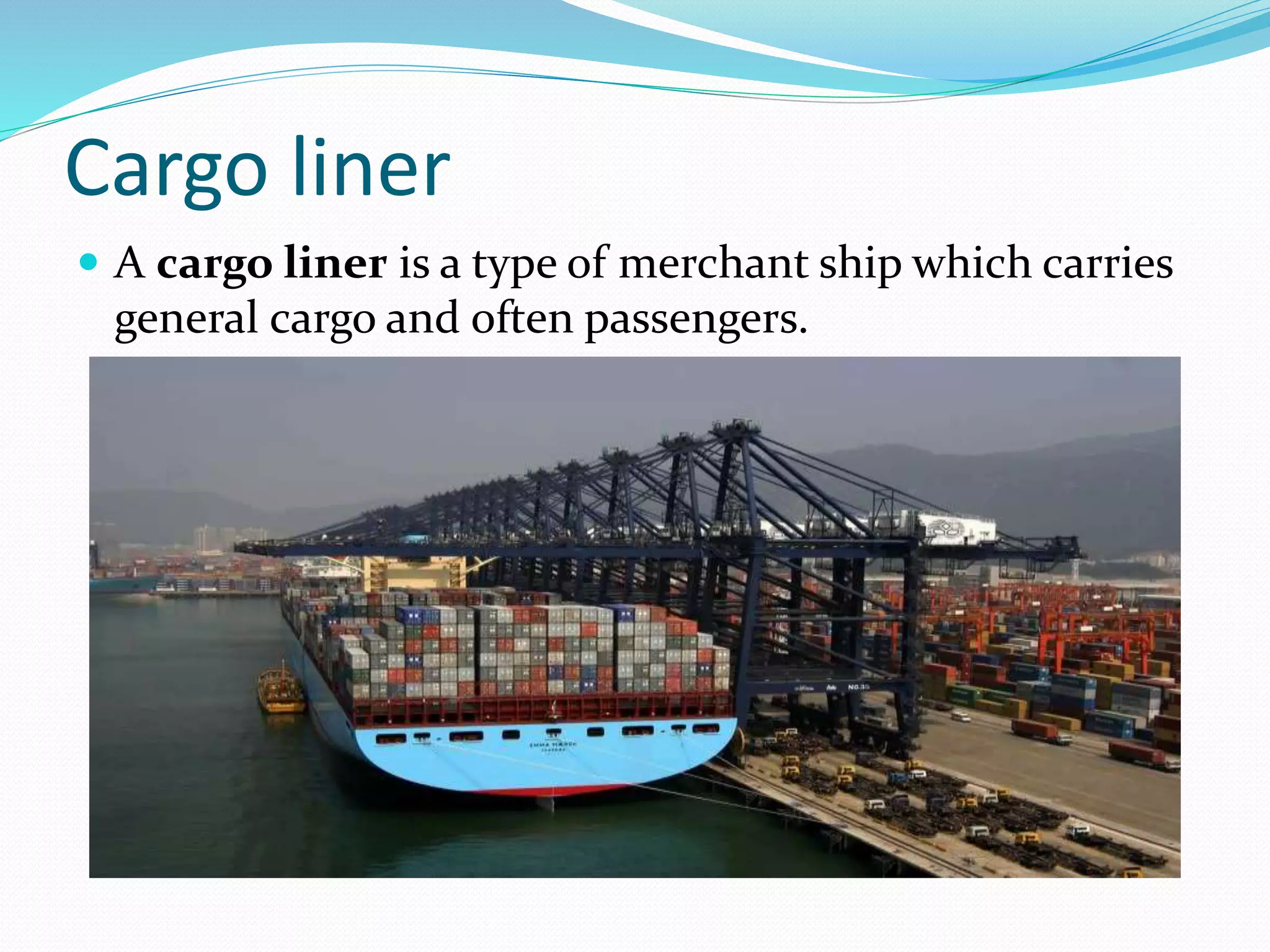
Cargo liner
 A cargo liner is a type of merchant ship which carries
general cargo and often passengers.
3. Support vessels
 A diving support vessel is a ship that is used as a
floating base for professional diving projects.
Fire boats
 A fireboat is a specialized watercraft with pumps and
nozzles designed for fighting shoreline and shipboard
fires. The first fireboats, dating to the late 18th century,
were tugboats, retrofitted with freighting equipment.
Platform supply vessels:
 A Platform supply vessel (often abbreviated as PSV)
is a ship specially designed to supply offshore oil
platforms. These ships range from 50 to 100 meters in
length and accomplish a variety of tasks.
Cable ferry:
 A cable ferry (also called chain ferry, swing
ferry, floating bridge, or punt) is a ferry that is
guided (and in many cases propelled) across a river or
large body of water by cables connected to both
shores. Early cable ferries often used
either rope or steel chains, with the latter resulting in
the alternate nameof chain ferry.
4. Support ships
 A cable layer or cable ship is a deep-
sea vessel designed and used to lay underwater
cables for telecommunications, electric power
transmission, or other purposes
Crane ship:
 A crane vessel, crane ship or floating crane is
a ship with a crane specialized in lifting heavy loads.
The largest crane vessels are used for offshore
construction.
Drill ships
 A drillship is a merchant vessel designed for use in
exploratory offshore drilling of new oil and gas wells or
for scientific drilling purposes.
Pipe laying ship:
A pipe laying ship is a maritime vessel used in
the construction of subsea infrastructure. It
serves to connect oil production platforms with
refineries on shore.
PERISHABLE CARGO
 Cargo requiring refrigeration, such as meat, fruit, fresh
vegetables, and medical department biological.
GENERAL CARGO
 Cargo that is susceptible for loading in general, nonspe
cialized stowage areas or standard shipping containers;
e.g., boxes, barrels, bales,crates, packages, bundles, an
d pallets.
 General cargo vessels carry packaged items like
chemicals, foods, furniture, machinery, motor- and
military vehicles, footwear, garments, etc.
DRY BULK
 A dry bulk cargo barge is a barge designed to carry fr
eight such as coal, finished steel or its
ingredients, grain, sand or gravel, or similar materials.
 Dry bulk carriers carry coal, grain, ore and other
similar products in loose form.
OIL AND GAS
Tankers carry petroleum products or other liquid.
cargo.
PAX FERRY
 A ferry (or ferryboat) is a boat or ship (a merchant
vessel) used to carry (or ferry) primarily passengers,
and sometimes vehicles and cargo as well, across a
body of water.
Live stocks cargo:
Overall cost of distribution:
Warehouse expenses:
Security:
Transportation expenses:
Promotional expenses:
Shipment of goods
The export of consignment can be sent either by sea,
post or air.
Shipping documents play an important role in the export
trade.
Consignment:
.The action of consigning goods.
2.A Specific shipment of goods sent by a consignor to a
named
consignee.
Consignee:
 A party(usually a buyer) named by the consignor (usually a
seller) in transportation documents as the party to
whose order a consignment will be delivered at the port of
destination.
consigner
 Person or firm (usually the seller) who delivers
a consignment to a carrier for transporting it to
a consignee (usually the buyer) named in
the transportation documents. Ownership of
the goods remains with the consignor until the
consignee pays for them in full. Also spelled as
consigner.
Documents of shipping
 Lading slip:
Lading slip is prepared by a consignor and
countersigned by the carrier as
a proof of receipt of consignment for delivery at the
destination.
Shipping bill:
Customs document used where drawback is
claimed, such as on goods exported or on dutiable
goods re-exported from a bonded warehouse.
 Mate’s receipt
Document signed by an officer of a vessel
evidencing receipt of a shipment onboard the vessel. It
is not a document of title and is issued as an
interim measure until a proper bill of lading can be
issued.
Advantages of containerisation:
Door to Door service
 No intermediate handling at terminal transhipment
points.
 Less risk of cargo damage
 Less packing needs for containerised shipments.
 Quicker cargo handling
 Encourages trade development and trade expansions.
Disadvantages of Containerisation:
 Capital intensive project
 Beyond the ability of many ship owners.
 Govt. Restrictions regarding internal movement
Sea and air freight :
 Sea freight is the normal method of transportation to
overseas countries.
A charge paid for carriage or transportation of goods by
air, land, or sea.
Port- commissioner’s charges:
 These charges are meant to loading and unloading of
cargo.
Port commissioner charges may vary from port to port.
It includes: shipping bill, unloading, river dues,
surcharge, rents(if any).
 Credit:
 SHOBHA K. B.


Cargo handling facilities (sea ways)

  • 2.
    What is Cargo? Goodsor produce being conveyed generally for commercial gain. By,  Ships  Aircrafts  Trains Vans  Trucks  International container.
  • 3.
  • 4.
    Cargo handling facilities: Container: Containersare used to send heavy weight goods from one place to another. Huge metal boxes through which the heavy products are transferred from one place to another is called as containerisation.
  • 5.
    Cargo with coldstorage facilities: Cold storage: The practice of keeping perishable produce in a refrigerated room or container, before moving it to market or to a retailer. The low temperature inhibits bacterial and fungal activity.
  • 6.
    Cargo is alsoused in case of goods in the cold-chain, because the perishable inventory is always in transit towards a final end-use, even when it is hold in cold storage or other similar climate controlled facilities.
  • 7.
    Types of Cargo: 1.Dry bulk  2. Tanker  3. support ships  4. wet bulk cargo  5. perishable cargo  6. General cargo
  • 8.
    1.Dry cargo: Barge: A bargeis a flat- bottomed boat, built mainly for river and canal transport of heavy goods. Some barges are not self- propelled and need to be towed or pushed by towboats.
  • 10.
    Bulk carrier A bulkcarrier, bulk freighter, or bulker is a merchant ship specially designed to transport unpackaged bulk cargo, such as grains, coal, ore, and cement in its cargo holds. Since the first specialized bulk carrier was built in 1852, economic forces have fuelled the development of these ships, causing them to grow in size and sophistication. Today's bulkers are specially designed to maximize capacity, safety, efficiency, and durability.
  • 12.
    Chain boats  Achain boat, chain tugor chain-ship was a type of river craft, used in the second half of the 19th century and first half of the 20th century on many European rivers, that made use of a steel chain laid along the riverbed for its propulsion.
  • 14.
    Coastal trading vessels: Coastal trading vessels, also known as coasters, are shallow-hulled ships used for trade between locations on the same island or continent. Their shallow hulls mean that they can get through reefs where deeper- hulled seagoing ships usually cannot.
  • 16.
    Container ships  containerships are cargo ships that that carry all of their load in truck- size intermodal containers, in a called containerization. They are a means of commercial intermodal freight transport and now carry most seagoing non-bulk cargo.
  • 18.
    Heavy lift ship A heavy-lift ship is a vessel designed to move very large loads that cannot be handled by normal ships. They are of two types:  Semi-submerging vessels capable of lifting another ship out of the water and transporting it;  Vessels that augment unloading facilities at inadequately equipped ports.
  • 20.
    Hopper barge  Ahopper barge is a kind of non-mechanical ship or vessel that cannot move around by itself, unlike some other types of barges, that is designed to carry materials, like rocks, sand, soil and rubbish, for dumping into the ocean, a river or lake for land reclamation.  Hopper barges are seen in two distinctive types; raked hopper or box hopper barges.
  • 22.
    collier  A collieris a bulk cargo ship designed to carry coal, especially for naval use by coal-fired warships.
  • 23.
    Lake freight  Lakefreighters, or Lakers, are bulk carrier vessels that ply the Great Lakes. These vessels are traditionally called boats, although classified as ships.
  • 25.
    Lighter aboard ship The lighter aboard ship (LASH) system refers to the practice of loading barges (lighters) aboard a larger vessel for transport.
  • 27.
    RO – RO Ro-Rois an acronym for Roll-on/roll-off. Roll- on/roll-off ships are vessels that are used to carry wheeled cargo. The Ro-Ro ship is different from lo-lo (lift on-lift off) ship that uses a crane to load the cargo. The vehicles in the ship are loaded and unloaded by means of built-in ramps. Normally these ramps are made towards the stern (backside) of the ship.
  • 29.
    2.Tanker -  Achemical tanker is a type of tanker ship designed to transport chemicals in bulk.  A gas carrier (or gas tanker) is a ship designed to transport LPG, LNG or liquefied chemical gases in bulk.  An oil tanker, also known as a petroleum tanker, is a merchant ship designed for the bulk transport of oil. There are two basic types of oil tankers: the crude tanker and the product tanker.
  • 31.
    Cargo liner  Acargo liner is a type of merchant ship which carries general cargo and often passengers.
  • 32.
    3. Support vessels A diving support vessel is a ship that is used as a floating base for professional diving projects.
  • 34.
    Fire boats  Afireboat is a specialized watercraft with pumps and nozzles designed for fighting shoreline and shipboard fires. The first fireboats, dating to the late 18th century, were tugboats, retrofitted with freighting equipment.
  • 36.
    Platform supply vessels: A Platform supply vessel (often abbreviated as PSV) is a ship specially designed to supply offshore oil platforms. These ships range from 50 to 100 meters in length and accomplish a variety of tasks.
  • 38.
    Cable ferry:  Acable ferry (also called chain ferry, swing ferry, floating bridge, or punt) is a ferry that is guided (and in many cases propelled) across a river or large body of water by cables connected to both shores. Early cable ferries often used either rope or steel chains, with the latter resulting in the alternate nameof chain ferry.
  • 40.
    4. Support ships A cable layer or cable ship is a deep- sea vessel designed and used to lay underwater cables for telecommunications, electric power transmission, or other purposes
  • 41.
    Crane ship:  Acrane vessel, crane ship or floating crane is a ship with a crane specialized in lifting heavy loads. The largest crane vessels are used for offshore construction.
  • 42.
    Drill ships  Adrillship is a merchant vessel designed for use in exploratory offshore drilling of new oil and gas wells or for scientific drilling purposes.
  • 43.
    Pipe laying ship: Apipe laying ship is a maritime vessel used in the construction of subsea infrastructure. It serves to connect oil production platforms with refineries on shore.
  • 44.
    PERISHABLE CARGO  Cargorequiring refrigeration, such as meat, fruit, fresh vegetables, and medical department biological.
  • 45.
    GENERAL CARGO  Cargothat is susceptible for loading in general, nonspe cialized stowage areas or standard shipping containers; e.g., boxes, barrels, bales,crates, packages, bundles, an d pallets.  General cargo vessels carry packaged items like chemicals, foods, furniture, machinery, motor- and military vehicles, footwear, garments, etc.
  • 46.
    DRY BULK  Adry bulk cargo barge is a barge designed to carry fr eight such as coal, finished steel or its ingredients, grain, sand or gravel, or similar materials.  Dry bulk carriers carry coal, grain, ore and other similar products in loose form.
  • 48.
    OIL AND GAS Tankerscarry petroleum products or other liquid. cargo.
  • 49.
    PAX FERRY  Aferry (or ferryboat) is a boat or ship (a merchant vessel) used to carry (or ferry) primarily passengers, and sometimes vehicles and cargo as well, across a body of water.
  • 50.
  • 51.
    Overall cost ofdistribution:
  • 52.
  • 53.
  • 54.
  • 55.
  • 56.
    Shipment of goods Theexport of consignment can be sent either by sea, post or air. Shipping documents play an important role in the export trade.
  • 57.
    Consignment: .The action ofconsigning goods. 2.A Specific shipment of goods sent by a consignor to a named consignee. Consignee:  A party(usually a buyer) named by the consignor (usually a seller) in transportation documents as the party to whose order a consignment will be delivered at the port of destination.
  • 58.
    consigner  Person orfirm (usually the seller) who delivers a consignment to a carrier for transporting it to a consignee (usually the buyer) named in the transportation documents. Ownership of the goods remains with the consignor until the consignee pays for them in full. Also spelled as consigner.
  • 59.
    Documents of shipping Lading slip: Lading slip is prepared by a consignor and countersigned by the carrier as a proof of receipt of consignment for delivery at the destination. Shipping bill: Customs document used where drawback is claimed, such as on goods exported or on dutiable goods re-exported from a bonded warehouse.
  • 62.
     Mate’s receipt Documentsigned by an officer of a vessel evidencing receipt of a shipment onboard the vessel. It is not a document of title and is issued as an interim measure until a proper bill of lading can be issued.
  • 63.
    Advantages of containerisation: Doorto Door service  No intermediate handling at terminal transhipment points.  Less risk of cargo damage  Less packing needs for containerised shipments.  Quicker cargo handling  Encourages trade development and trade expansions.
  • 64.
    Disadvantages of Containerisation: Capital intensive project  Beyond the ability of many ship owners.  Govt. Restrictions regarding internal movement
  • 65.
    Sea and airfreight :  Sea freight is the normal method of transportation to overseas countries. A charge paid for carriage or transportation of goods by air, land, or sea.
  • 66.
    Port- commissioner’s charges: These charges are meant to loading and unloading of cargo. Port commissioner charges may vary from port to port. It includes: shipping bill, unloading, river dues, surcharge, rents(if any).
  • 67.