The fiber volume and weight fraction had been estimated
experimentally and theoretically.
Experimental Method
The fiber volume fraction in the specimens was
determined experimentally, using the ignition technique
according to BS3691
For different volume fractions, three samples were taken
from different places of the composite plate. Their volumes
were determined (Vc).
Put the test specimens in a dried container (of
weight M0) in a furnace at 575±25°C for 5min in order
to completely burn off the resin (the matrix) keeping
the furnace’s door open. Then close the door of the
furnace and heat for a further 30 min.
Remove the test specimens and the container from
the furnace and cool them then the mass of the test
specimen plus container was determined to the
nearest 0.001 g, (M1).
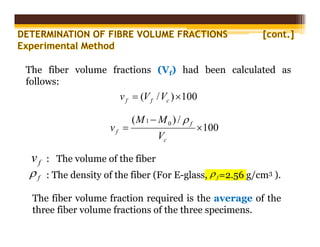
The fiber volume fractions (Vf) had been calculated as
follows:
100
/
)
( 0
1



c
f
f
V
M
M
v

: The density of the fiber (For E-glass, =2.56 g/cm3 ).
The fiber volume fraction required is the average of the
three fiber volume fractions of the three specimens.
f
 f

100
)
/
( 
 c
f
f V
V
v
: The volume of the fiber
f
v
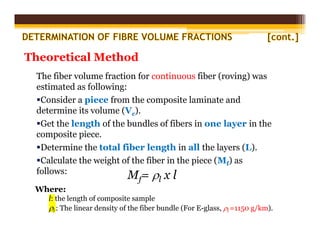
The fiber volume fraction for continuous fiber (roving) was
estimated as following:
Consider a piece from the composite laminate and
determine its volume (Vc).
Get the length of the bundles of fibers in one layer in the
composite piece.
Determine the total fiber length in all the layers (L).
Calculate the weight of the fiber in the piece (Mf) as
follows:
Theoretical Method
Where:
l: the length of composite sample
l : The linear density of the fiber bundle (For E-glass, l =1150 g/km).
Mf= l x l
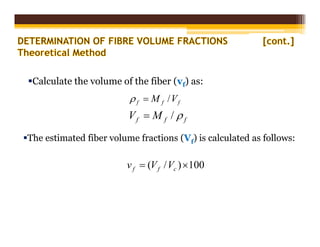
Calculate the volume of the fiber (vf) as:
f
f
f M
V 
/

The estimated fiber volume fractions (Vf) is calculated as follows:
100
)
/
( 
 c
f
f V
V
v
f
f
f V
M /


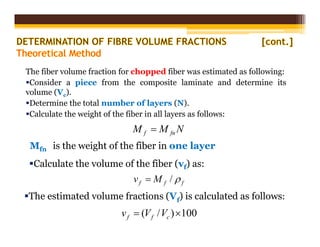
The fiber volume fraction for chopped fiber was estimated as following:
Consider a piece from the composite laminate and determine its
volume (Vc).
Determine the total number of layers (N).
Calculate the weight of the fiber in all layers as follows:
N
M
M fn
f 
Calculate the volume of the fiber (vf) as:
f
f
f M
v 
/

The estimated volume fractions (Vf) is calculated as follows:
100
)
/
( 
 c
f
f V
V
v
one layer
is the weight of the fiber in
fn
M
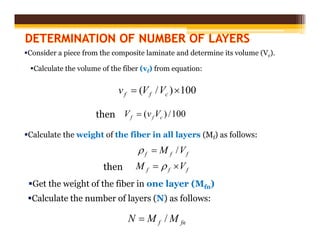
Calculate the volume of the fiber (vf) from equation:
100
)
/
( 
 c
f
f V
V
v
100
/
)
( c
f
f V
v
V 
Calculate the weight of the fiber in all layers (Mf) as follows:
Consider a piece from the composite laminate and determine its volume (Vc).
then
fn
f M
M
N /

f
f
f V
M /


then f
f
f V
M 
 
Calculate the number of layers (N) as follows:
Get the weight of the fiber in one layer (Mfn)
A plate of glass/epoxy composite is manufactured using
hand lay-up technique. The dimensions of the manufactured
laminate are (60 cm x60 cmx0.4 cm). The fiber volume
fractions is 30%. A 300 g/m2 chopped glass fiber was used
and the density of the fiber is 2.56 g/cm3. Determine the
number of layers of glass fiber in the laminate?
3
432
100
/
)
1440
30
(
100
/
)
( cm
V
v
V c
f
f 



The volume of the composite laminate (Vc) from
equation:
Solution:
The volume of the fiber (vf) from equation:
3
1440
4
.
0
60
60 cm
Vc 



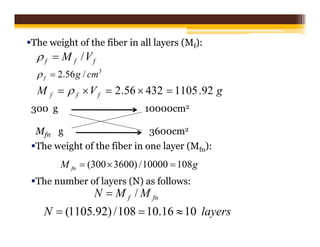
The number of layers (N) as follows:
fn
f M
M
N /

3
/
56
.
2 cm
g
f 

300 g 10000cm2
Mfn g 3600cm2
g
M fn 108
10000
/
)
3600
300
( 


The weight of the fiber in one layer (Mfn):
layers
N 10
16
.
10
108
/
)
92
.
1105
( 


f
f
f V
M /


g
V
M f
f
f 92
.
1105
432
56
.
2 



 
The weight of the fiber in all layers (Mf):
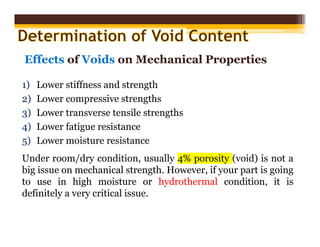
Effects of Voids on Mechanical Properties
1) Lower stiffness and strength
2) Lower compressive strengths
3) Lower transverse tensile strengths
4) Lower fatigue resistance
5) Lower moisture resistance
Under room/dry condition, usually 4% porosity (void) is not a
big issue on mechanical strength. However, if your part is going
to use in high moisture or hydrothermal condition, it is
definitely a very critical issue.
The knowledge of void content is desirable for estimation of
quality of composites.
The void content of the composites was calculated
according to the ASTM D2734-94 standard:
V=[(Td –Md )/ Td]x100
Where:
 V is the void content (vol.%),
 Td the theoretical density (g/cm3)
 Md is the measured density (g/cm3).
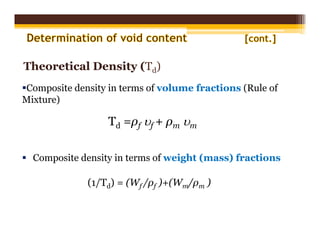
Theoretical Density (Td)
Composite density in terms of volume fractions (Rule of
Mixture)
 Composite density in terms of weight (mass) fractions
)
m
ρ
/
m
W
)+(
f
ρ
/
f
W
= (
)
d
T
/
1
(
Td =ρf f + ρm m
Determine the experimental density of a composite using liquid
displacement method:
Md = Wc ρw /(Wc–Wi )
Where
ρw : density of water ( 1 g/cm3 )
Wc : weight of composite
Wi : weight of composite when immersed in water
Experimental Density (Md )
A laminate of Kelvar49/polyester composite is
manufactured using spray-up technique. The density of
Kelvar49 is 1.45 g/cm3 . The fiber volume fractions is
40%. The density of polyester is 1.3 g/cm3. A specimen
of 36 g was taken from the laminate and immersed in
water to become 8 g.
1) Compare between the theoretical (Td) and the
measured density (Md) of the composite laminate.
2) The void content in this laminate.
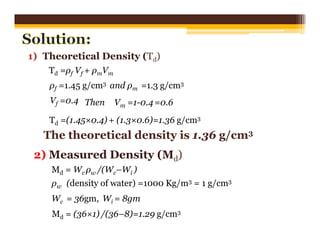
1) Theoretical Density (Td)
Td =ρf Vf + ρmVm
ρf =1.45 g/cm3 and ρm =1.3 g/cm3
Vf =0.4 Vm =1-0.4 =0.6
Then
Td =(1.45×0.4) + (1.3×0.6)=1.36 g/cm3
3
cm
g/
1.36
The theoretical density is
2) Measured Density (Md)
)
i
W
–
c
W
/(
w
ρ
c
W
=
d
M
ρw (density of water) =1000 Kg/m3 = 1 g/cm3
gm
8
=
i
W
gm,
36
=
c
W
Md = (36×1) /(36–8)=1.29 g/cm3
The measured density (Md) is 1.29 g/cm3
2) The void content of the composites was
calculated as:
V=[(Td–Md)/Td]x100=[(1.36-1.29)/1.36]
x100=5.15%
The void content is 5%
V=[(Td –Md )/ Td]x100

volume fraction

  • 1.
    The fiber volumeand weight fraction had been estimated experimentally and theoretically. Experimental Method The fiber volume fraction in the specimens was determined experimentally, using the ignition technique according to BS3691 For different volume fractions, three samples were taken from different places of the composite plate. Their volumes were determined (Vc).
  • 2.
    Put the testspecimens in a dried container (of weight M0) in a furnace at 575±25°C for 5min in order to completely burn off the resin (the matrix) keeping the furnace’s door open. Then close the door of the furnace and heat for a further 30 min. Remove the test specimens and the container from the furnace and cool them then the mass of the test specimen plus container was determined to the nearest 0.001 g, (M1).
  • 3.
    The fiber volumefractions (Vf) had been calculated as follows: 100 / ) ( 0 1    c f f V M M v  : The density of the fiber (For E-glass, =2.56 g/cm3 ). The fiber volume fraction required is the average of the three fiber volume fractions of the three specimens. f  f  100 ) / (   c f f V V v : The volume of the fiber f v
  • 4.
    The fiber volumefraction for continuous fiber (roving) was estimated as following: Consider a piece from the composite laminate and determine its volume (Vc). Get the length of the bundles of fibers in one layer in the composite piece. Determine the total fiber length in all the layers (L). Calculate the weight of the fiber in the piece (Mf) as follows: Theoretical Method Where: l: the length of composite sample l : The linear density of the fiber bundle (For E-glass, l =1150 g/km). Mf= l x l
  • 5.
    Calculate the volumeof the fiber (vf) as: f f f M V  /  The estimated fiber volume fractions (Vf) is calculated as follows: 100 ) / (   c f f V V v f f f V M /  
  • 6.
    The fiber volumefraction for chopped fiber was estimated as following: Consider a piece from the composite laminate and determine its volume (Vc). Determine the total number of layers (N). Calculate the weight of the fiber in all layers as follows: N M M fn f  Calculate the volume of the fiber (vf) as: f f f M v  /  The estimated volume fractions (Vf) is calculated as follows: 100 ) / (   c f f V V v one layer is the weight of the fiber in fn M
  • 7.
    Calculate the volumeof the fiber (vf) from equation: 100 ) / (   c f f V V v 100 / ) ( c f f V v V  Calculate the weight of the fiber in all layers (Mf) as follows: Consider a piece from the composite laminate and determine its volume (Vc). then fn f M M N /  f f f V M /   then f f f V M    Calculate the number of layers (N) as follows: Get the weight of the fiber in one layer (Mfn)
  • 8.
    A plate ofglass/epoxy composite is manufactured using hand lay-up technique. The dimensions of the manufactured laminate are (60 cm x60 cmx0.4 cm). The fiber volume fractions is 30%. A 300 g/m2 chopped glass fiber was used and the density of the fiber is 2.56 g/cm3. Determine the number of layers of glass fiber in the laminate? 3 432 100 / ) 1440 30 ( 100 / ) ( cm V v V c f f     The volume of the composite laminate (Vc) from equation: Solution: The volume of the fiber (vf) from equation: 3 1440 4 . 0 60 60 cm Vc    
  • 9.
    The number oflayers (N) as follows: fn f M M N /  3 / 56 . 2 cm g f   300 g 10000cm2 Mfn g 3600cm2 g M fn 108 10000 / ) 3600 300 (    The weight of the fiber in one layer (Mfn): layers N 10 16 . 10 108 / ) 92 . 1105 (    f f f V M /   g V M f f f 92 . 1105 432 56 . 2       The weight of the fiber in all layers (Mf):
  • 10.
    Effects of Voidson Mechanical Properties 1) Lower stiffness and strength 2) Lower compressive strengths 3) Lower transverse tensile strengths 4) Lower fatigue resistance 5) Lower moisture resistance Under room/dry condition, usually 4% porosity (void) is not a big issue on mechanical strength. However, if your part is going to use in high moisture or hydrothermal condition, it is definitely a very critical issue.
  • 11.
    The knowledge ofvoid content is desirable for estimation of quality of composites. The void content of the composites was calculated according to the ASTM D2734-94 standard: V=[(Td –Md )/ Td]x100 Where:  V is the void content (vol.%),  Td the theoretical density (g/cm3)  Md is the measured density (g/cm3).
  • 12.
    Theoretical Density (Td) Compositedensity in terms of volume fractions (Rule of Mixture)  Composite density in terms of weight (mass) fractions ) m ρ / m W )+( f ρ / f W = ( ) d T / 1 ( Td =ρf f + ρm m
  • 13.
    Determine the experimentaldensity of a composite using liquid displacement method: Md = Wc ρw /(Wc–Wi ) Where ρw : density of water ( 1 g/cm3 ) Wc : weight of composite Wi : weight of composite when immersed in water Experimental Density (Md )
  • 14.
    A laminate ofKelvar49/polyester composite is manufactured using spray-up technique. The density of Kelvar49 is 1.45 g/cm3 . The fiber volume fractions is 40%. The density of polyester is 1.3 g/cm3. A specimen of 36 g was taken from the laminate and immersed in water to become 8 g. 1) Compare between the theoretical (Td) and the measured density (Md) of the composite laminate. 2) The void content in this laminate.
  • 15.
    1) Theoretical Density(Td) Td =ρf Vf + ρmVm ρf =1.45 g/cm3 and ρm =1.3 g/cm3 Vf =0.4 Vm =1-0.4 =0.6 Then Td =(1.45×0.4) + (1.3×0.6)=1.36 g/cm3 3 cm g/ 1.36 The theoretical density is 2) Measured Density (Md) ) i W – c W /( w ρ c W = d M ρw (density of water) =1000 Kg/m3 = 1 g/cm3 gm 8 = i W gm, 36 = c W Md = (36×1) /(36–8)=1.29 g/cm3
  • 16.
    The measured density(Md) is 1.29 g/cm3 2) The void content of the composites was calculated as: V=[(Td–Md)/Td]x100=[(1.36-1.29)/1.36] x100=5.15% The void content is 5% V=[(Td –Md )/ Td]x100