General Anesthesia
Madan Baral
B. Pharmacy
Pokhara University
Contents
 Introduction and History of General anesthesia
 Properties of ideal General anesthetic
 Classification of General anesthetic agents
 Mechanism of Anesthesia
 Stages of Anesthesia
 Inhalation anesthetic agents
 Intravenous anesthetic agents
 Complications of General anesthesia
 Conclusion


Introduction
• General anesthetics (GAs) are drugs which
produce reversible loss of all sensations and
consciousness.
Goal of anesthesia
• To create a reversible condition of comfort
quiescence, and physiological stability in a patient
before during and after performance of a
procedure that would otherwise be painful
frightening or hazardous.
Purpose
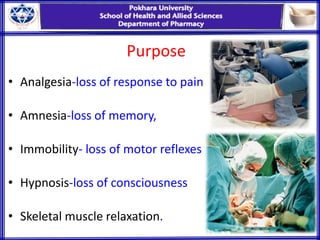
• Analgesia-loss of response to pain
• Amnesia-loss of memory,
• Immobility- loss of motor reflexes
• Hypnosis-loss of consciousness
• Skeletal muscle relaxation.
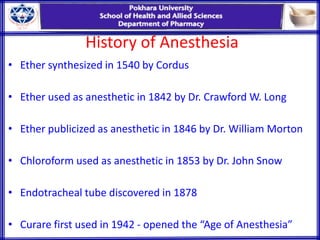
History of Anesthesia
• Ether synthesized in 1540 by Cordus
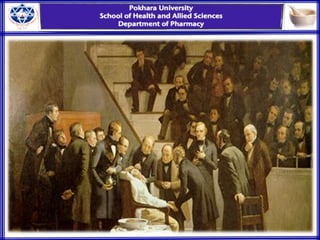
• Ether used as anesthetic in 1842 by Dr. Crawford W. Long
• Ether publicized as anesthetic in 1846 by Dr. William Morton
• Chloroform used as anesthetic in 1853 by Dr. John Snow
• Endotracheal tube discovered in 1878
• Curare first used in 1942 - opened the “Age of Anesthesia”
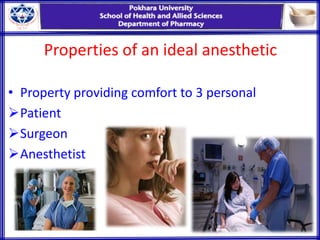
Properties of an ideal anesthetic
• Property providing comfort to 3 personal
Patient
Surgeon
Anesthetist
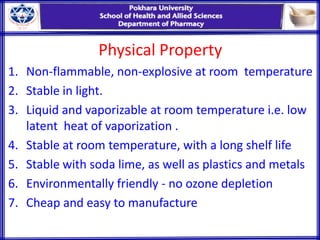
Physical Property
1. Non-flammable, non-explosive at room temperature
2. Stable in light.
3. Liquid and vaporizable at room temperature i.e. low
latent heat of vaporization .
4. Stable at room temperature, with a long shelf life
5. Stable with soda lime, as well as plastics and metals
6. Environmentally friendly - no ozone depletion
7. Cheap and easy to manufacture
Biological Properties
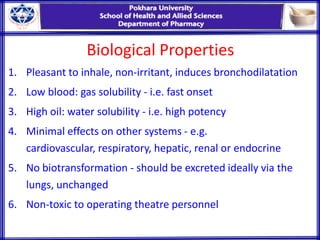
1. Pleasant to inhale, non-irritant, induces bronchodilatation
2. Low blood: gas solubility - i.e. fast onset
3. High oil: water solubility - i.e. high potency
4. Minimal effects on other systems - e.g.
cardiovascular, respiratory, hepatic, renal or endocrine
5. No biotransformation - should be excreted ideally via the
lungs, unchanged
6. Non-toxic to operating theatre personnel
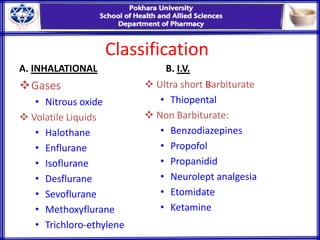
Classification
A. INHALATIONAL
Gases
• Nitrous oxide
 Volatile Liquids
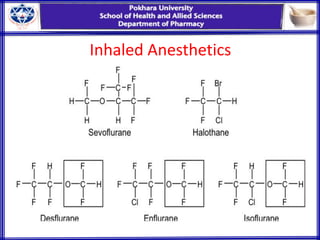
• Halothane
• Enflurane
• Isoflurane
• Desflurane
• Sevoflurane
• Methoxyflurane
• Trichloro-ethylene
B. I.V.
 Ultra short Barbiturate
• Thiopental
 Non Barbiturate:
• Benzodiazepines
• Propofol
• Propanidid
• Neurolept analgesia
• Etomidate
• Ketamine
Inhaled Anesthetics
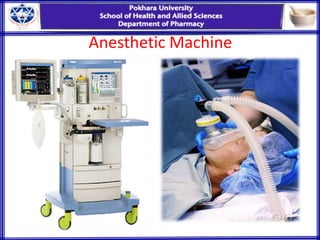
Anesthetic Machine
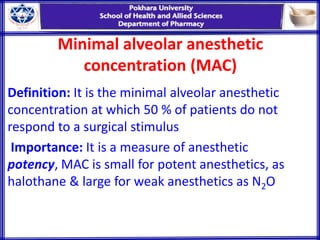
Minimal alveolar anesthetic
concentration (MAC)
Definition: It is the minimal alveolar anesthetic
concentration at which 50 % of patients do not
respond to a surgical stimulus
Importance: It is a measure of anesthetic
potency, MAC is small for potent anesthetics, as
halothane & large for weak anesthetics as N2O
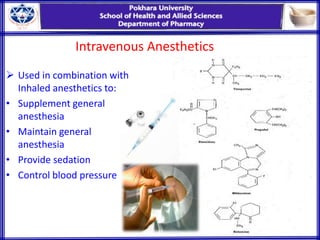
Intravenous Anesthetics
 Used in combination with
Inhaled anesthetics to:
• Supplement general
anesthesia
• Maintain general
anesthesia
• Provide sedation
• Control blood pressure
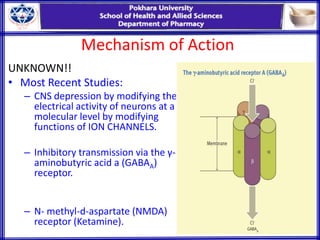
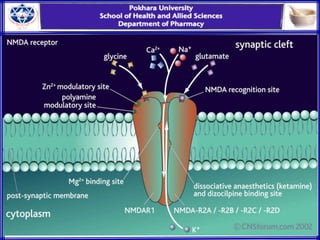
Mechanism of Action
UNKNOWN!!
• Most Recent Studies:
– CNS depression by modifying the
electrical activity of neurons at a
molecular level by modifying
functions of ION CHANNELS.
– Inhibitory transmission via the γ-
aminobutyric acid a (GABAA)
receptor.
– N- methyl-d-aspartate (NMDA)
receptor (Ketamine).
Signs And Stages of Anesthesia
• GAs cause an irregularly descending depression of
CNS
• The four stages of anesthesia were described in
1937
I. Stage of Analgesia
• also known as the "induction”
• period between the initial administration of the
induction agents and loss of consciousness.
Activities
• The patient progresses from analgesia without
amnesia to analgesia with amnesia.
• Conversation possible
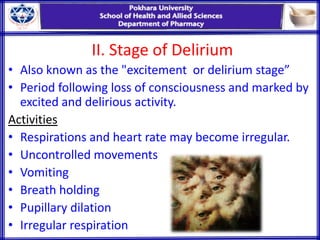
II. Stage of Delirium
• Also known as the "excitement or delirium stage”
• Period following loss of consciousness and marked by
excited and delirious activity.
Activities
• Respirations and heart rate may become irregular.
• Uncontrolled movements
• Vomiting
• Breath holding
• Pupillary dilation
• Irregular respiration
III. Stage of Surgical Anesthesia
Activities
• The skeletal muscles relax
• Patient's breathing becomes regular.
• Eye movements slow, then stop, and surgery can
begin. And divided into 4 planes:
1. Eyes initially rolling, then becoming fixed
2. Loss of corneal and laryngeal reflexes
3. Pupils dilate and loss of light reflex
4. Intercostal paralysis, shallow abdominal
respiration, dilated
IV. Medullary paralysis
• Also known as "overdose”
• Cessation of respiration
• Potential cardiovascular collapse
• Lethal without cardiovascular and respiratory
support.
Complication of General Anesthesia
A. During anesthesia
• Respiratory depression and hypercapnea
• Salivation, respiratory secretions -less now as non-
irritant anesthetics are mostly used.
• Cardiac arrhythmias
• Fall in BP
• Laryngospasm and asphyxia
• Delirium convulsions. Excitatory effects are
generally
seen with I.V.
B. After anesthesia
• Nausea and vomiting.
• Persisting sedation: impaired psychomotor
function
• Pneumonia, atelectasis
• Organ toxicities: liver, kidney damage.
• Nerve palsies - due to faulty positioning.
• Emergence delirium.
To Sum Up
• The modern day surgery would be impossible with
out GAs.
• Surge for Research:
Most convincing mechanism of action
Discover ideal anesthetics with least side effects
References
1. Fardman, Limbird, Gilman(2001), The Pharmacological Basis of
Therapeutics(10th Ed.), McGraw Hill, New Delhi, pp 321-333,337-343
1. Koda-Kimble Young (2000) Applied Therapeutics: The Clinical Use of
Drugs (7th Ed.), Lipincott Williams & Wilkins, Baltimore, pp 8.6-8.13
1. URL1-http://en.wikipedia.org/wiki/General_anaesthesia
General Anesthesia

General Anesthesia

  • 1.
    General Anesthesia Madan Baral B.Pharmacy Pokhara University
  • 2.
    Contents  Introduction andHistory of General anesthesia  Properties of ideal General anesthetic  Classification of General anesthetic agents  Mechanism of Anesthesia  Stages of Anesthesia  Inhalation anesthetic agents  Intravenous anesthetic agents  Complications of General anesthesia  Conclusion


  • 3.
    Introduction • General anesthetics(GAs) are drugs which produce reversible loss of all sensations and consciousness. Goal of anesthesia • To create a reversible condition of comfort quiescence, and physiological stability in a patient before during and after performance of a procedure that would otherwise be painful frightening or hazardous.
  • 4.
    Purpose • Analgesia-loss ofresponse to pain • Amnesia-loss of memory, • Immobility- loss of motor reflexes • Hypnosis-loss of consciousness • Skeletal muscle relaxation.
  • 5.
    History of Anesthesia •Ether synthesized in 1540 by Cordus • Ether used as anesthetic in 1842 by Dr. Crawford W. Long • Ether publicized as anesthetic in 1846 by Dr. William Morton • Chloroform used as anesthetic in 1853 by Dr. John Snow • Endotracheal tube discovered in 1878 • Curare first used in 1942 - opened the “Age of Anesthesia”
  • 7.
    Properties of anideal anesthetic • Property providing comfort to 3 personal Patient Surgeon Anesthetist
  • 8.
    Physical Property 1. Non-flammable,non-explosive at room temperature 2. Stable in light. 3. Liquid and vaporizable at room temperature i.e. low latent heat of vaporization . 4. Stable at room temperature, with a long shelf life 5. Stable with soda lime, as well as plastics and metals 6. Environmentally friendly - no ozone depletion 7. Cheap and easy to manufacture
  • 9.
    Biological Properties 1. Pleasantto inhale, non-irritant, induces bronchodilatation 2. Low blood: gas solubility - i.e. fast onset 3. High oil: water solubility - i.e. high potency 4. Minimal effects on other systems - e.g. cardiovascular, respiratory, hepatic, renal or endocrine 5. No biotransformation - should be excreted ideally via the lungs, unchanged 6. Non-toxic to operating theatre personnel
  • 10.
    Classification A. INHALATIONAL Gases • Nitrousoxide  Volatile Liquids • Halothane • Enflurane • Isoflurane • Desflurane • Sevoflurane • Methoxyflurane • Trichloro-ethylene B. I.V.  Ultra short Barbiturate • Thiopental  Non Barbiturate: • Benzodiazepines • Propofol • Propanidid • Neurolept analgesia • Etomidate • Ketamine
  • 11.
  • 12.
  • 13.
    Minimal alveolar anesthetic concentration(MAC) Definition: It is the minimal alveolar anesthetic concentration at which 50 % of patients do not respond to a surgical stimulus Importance: It is a measure of anesthetic potency, MAC is small for potent anesthetics, as halothane & large for weak anesthetics as N2O
  • 14.
    Intravenous Anesthetics  Usedin combination with Inhaled anesthetics to: • Supplement general anesthesia • Maintain general anesthesia • Provide sedation • Control blood pressure
  • 15.
    Mechanism of Action UNKNOWN!! •Most Recent Studies: – CNS depression by modifying the electrical activity of neurons at a molecular level by modifying functions of ION CHANNELS. – Inhibitory transmission via the γ- aminobutyric acid a (GABAA) receptor. – N- methyl-d-aspartate (NMDA) receptor (Ketamine).
  • 17.
    Signs And Stagesof Anesthesia • GAs cause an irregularly descending depression of CNS • The four stages of anesthesia were described in 1937
  • 18.
    I. Stage ofAnalgesia • also known as the "induction” • period between the initial administration of the induction agents and loss of consciousness. Activities • The patient progresses from analgesia without amnesia to analgesia with amnesia. • Conversation possible
  • 19.
    II. Stage ofDelirium • Also known as the "excitement or delirium stage” • Period following loss of consciousness and marked by excited and delirious activity. Activities • Respirations and heart rate may become irregular. • Uncontrolled movements • Vomiting • Breath holding • Pupillary dilation • Irregular respiration
  • 20.
    III. Stage ofSurgical Anesthesia Activities • The skeletal muscles relax • Patient's breathing becomes regular. • Eye movements slow, then stop, and surgery can begin. And divided into 4 planes: 1. Eyes initially rolling, then becoming fixed 2. Loss of corneal and laryngeal reflexes 3. Pupils dilate and loss of light reflex 4. Intercostal paralysis, shallow abdominal respiration, dilated
  • 21.
    IV. Medullary paralysis •Also known as "overdose” • Cessation of respiration • Potential cardiovascular collapse • Lethal without cardiovascular and respiratory support.
  • 22.
    Complication of GeneralAnesthesia A. During anesthesia • Respiratory depression and hypercapnea • Salivation, respiratory secretions -less now as non- irritant anesthetics are mostly used. • Cardiac arrhythmias • Fall in BP • Laryngospasm and asphyxia • Delirium convulsions. Excitatory effects are generally
seen with I.V.
  • 23.
    B. After anesthesia •Nausea and vomiting. • Persisting sedation: impaired psychomotor function • Pneumonia, atelectasis • Organ toxicities: liver, kidney damage. • Nerve palsies - due to faulty positioning. • Emergence delirium.
  • 24.
    To Sum Up •The modern day surgery would be impossible with out GAs. • Surge for Research: Most convincing mechanism of action Discover ideal anesthetics with least side effects
  • 25.
    References 1. Fardman, Limbird,Gilman(2001), The Pharmacological Basis of Therapeutics(10th Ed.), McGraw Hill, New Delhi, pp 321-333,337-343 1. Koda-Kimble Young (2000) Applied Therapeutics: The Clinical Use of Drugs (7th Ed.), Lipincott Williams & Wilkins, Baltimore, pp 8.6-8.13 1. URL1-http://en.wikipedia.org/wiki/General_anaesthesia

Editor's Notes

  • #8 A. For the patient pleasant, nonirritating,should not cause nausea or vomiting.Fast induction and recovery with no after effects.B. For the surgeon –Provide adequate analgesia, immobility and muscle relaxation.Noninflammable and nonexclusive so that cautery may be used.C. For the anesthetist- Administration ;easy, controllable and versatile.Margin of safety is wide - no fall in BP.Heart, liver and other organs should not be affected.Less potent so that low concentrations are needed and oxygenation of the patient does not suffer.Rapid adjustments in depth of anesthesia should be possible.cheap, stable and easily stored.
  • #12 Halogenations of hydrocarbons and ethers increase anesthetic potency, it also increase the potential for inducing cardiac arrhythmias in the following order F<Cl<Br.1Ethers having asymmetric halogenated carbon tend to be good anesthetics (such as Enflurane).Halogenated methyl ethyl ethers (Enflurane and Isoflurane) are more stable, are more potent, and have better clinical profile than halogenated diethyl ethers. Fluorination decrease flammibity and increase stability of adjacent halogenated carbons.Complete halogenations of alkane and ethers or full halogenations of end methyl groups decrease potency and enhances convulsant activity. Flurorthyl (CF3CH2OCH2CF3) is a potent convulsant, with a median effective dose (ED50) for convulsions in mice of 0.00122 atm.The presence of double bonds tends to increase chemical reactivity and toxicity.
  • #20 Since these effects can lead to respiratory obstruction fast acting drug are used to lessen the time of this stage.
  • #22 Stage where too much medication has been given relative to the amount of surgical stimulation and the patient has severe brain stem or medullary depression.