REPRESENTATION THEORIES
Dyer, Gramsci, Levi-Strauss, Mulvey v Clover,
& the 3 B’s: Berger, Butler, Baudrillard
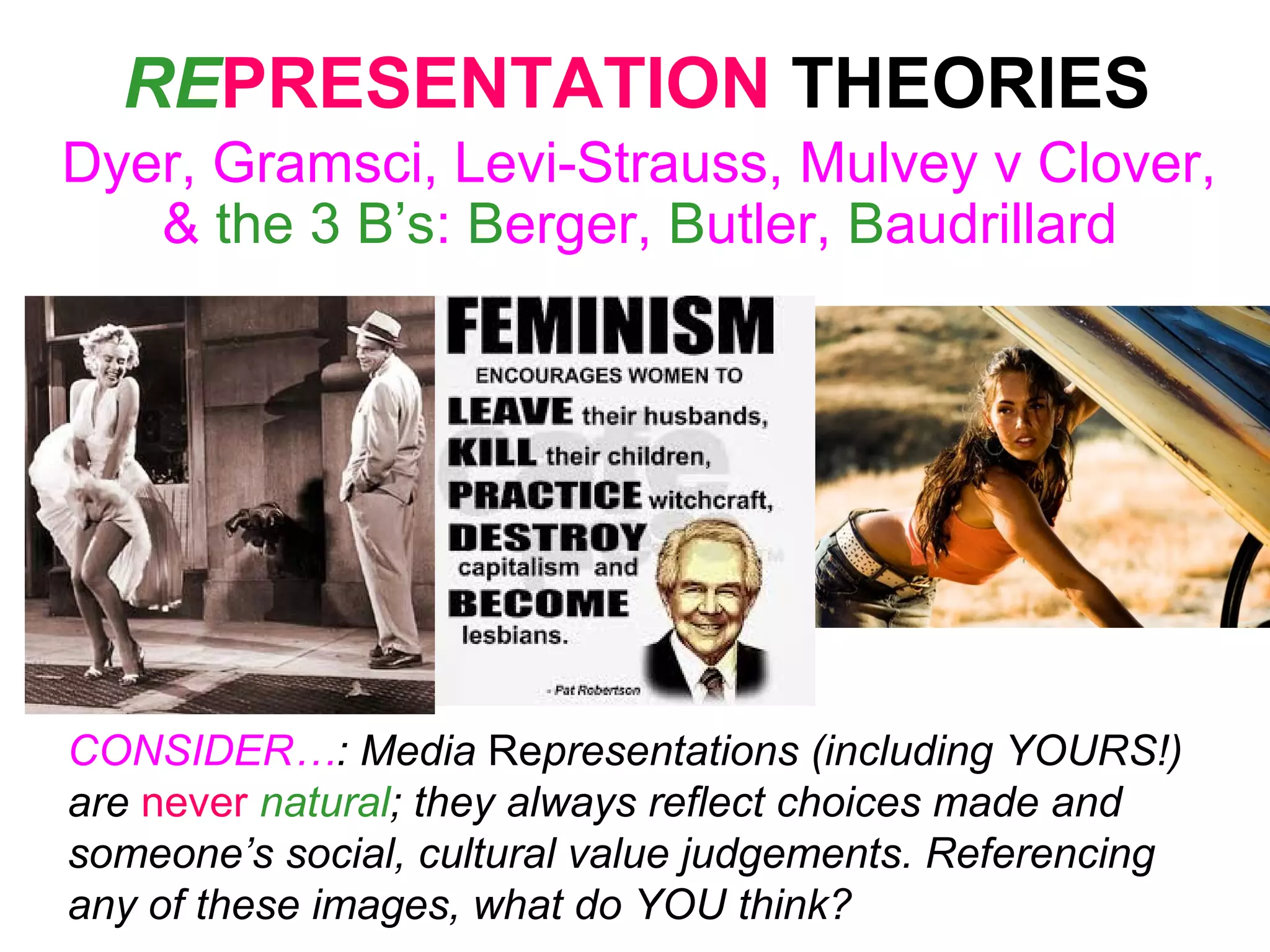
CONSIDER…: Media Representations (including YOURS!)
are never natural; they always reflect choices made and
someone’s social, cultural value judgements. Referencing
any of these images, what do YOU think?
Dyer, Gramsci, Levi-Strauss
DYER: Stereotypes are a way of reinforcing
differences, and representing these
differences as natural.
GRAMSCI: When a cultural value is accepted as ‘common sense’ and
unquestionable it has attained hegemonic status. Gramsci saw ‘soft power’ as
important as ‘hard power’ – society can be controlled through culture as much
as through military or police repression!
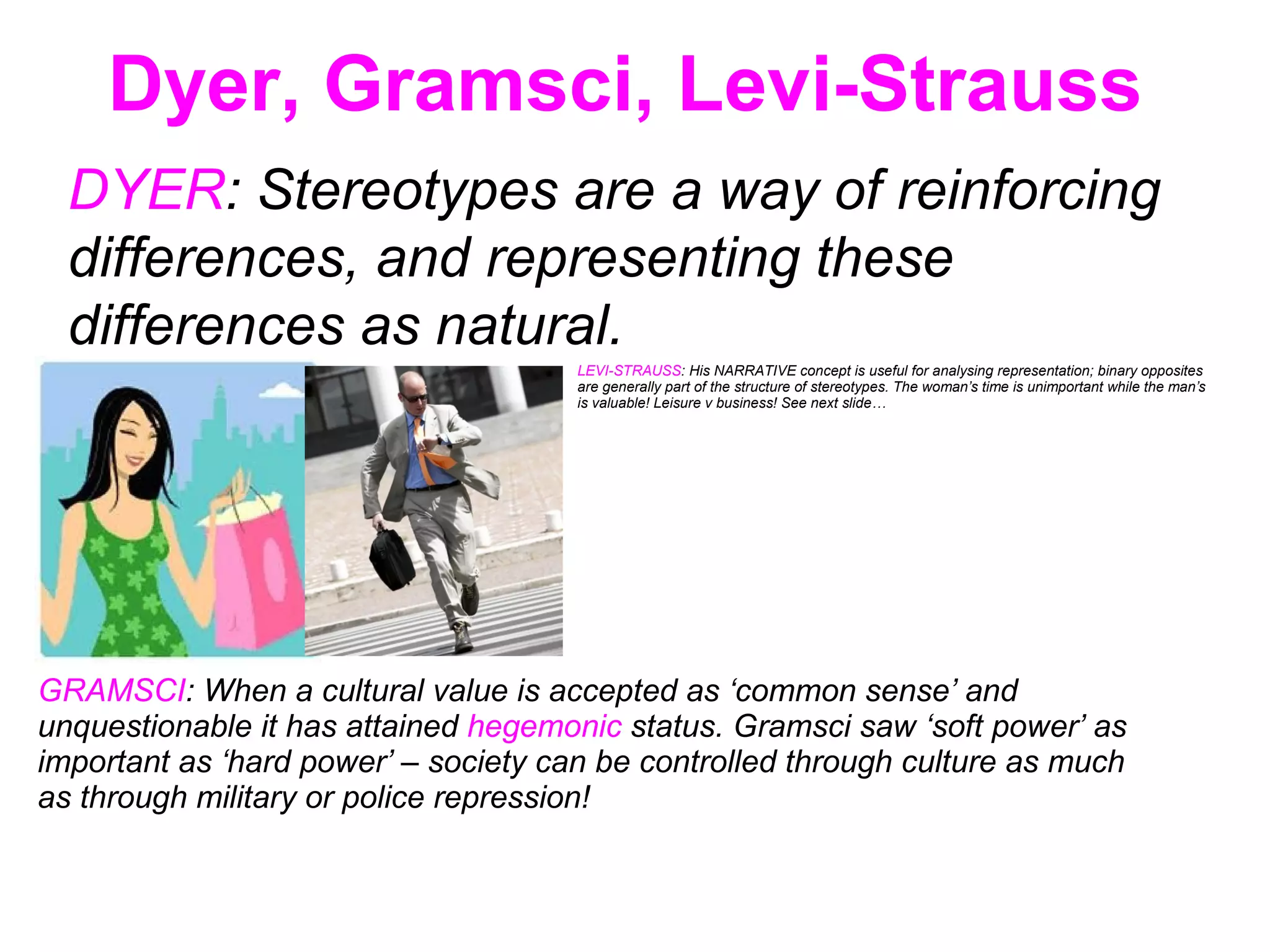
LEVI-STRAUSS: His NARRATIVE concept is useful for analysing representation; binary opposites
are generally part of the structure of stereotypes. The woman’s time is unimportant while the man’s
is valuable! Leisure v business! See next slide…
Dyer, Gramsci, Levi-Strauss
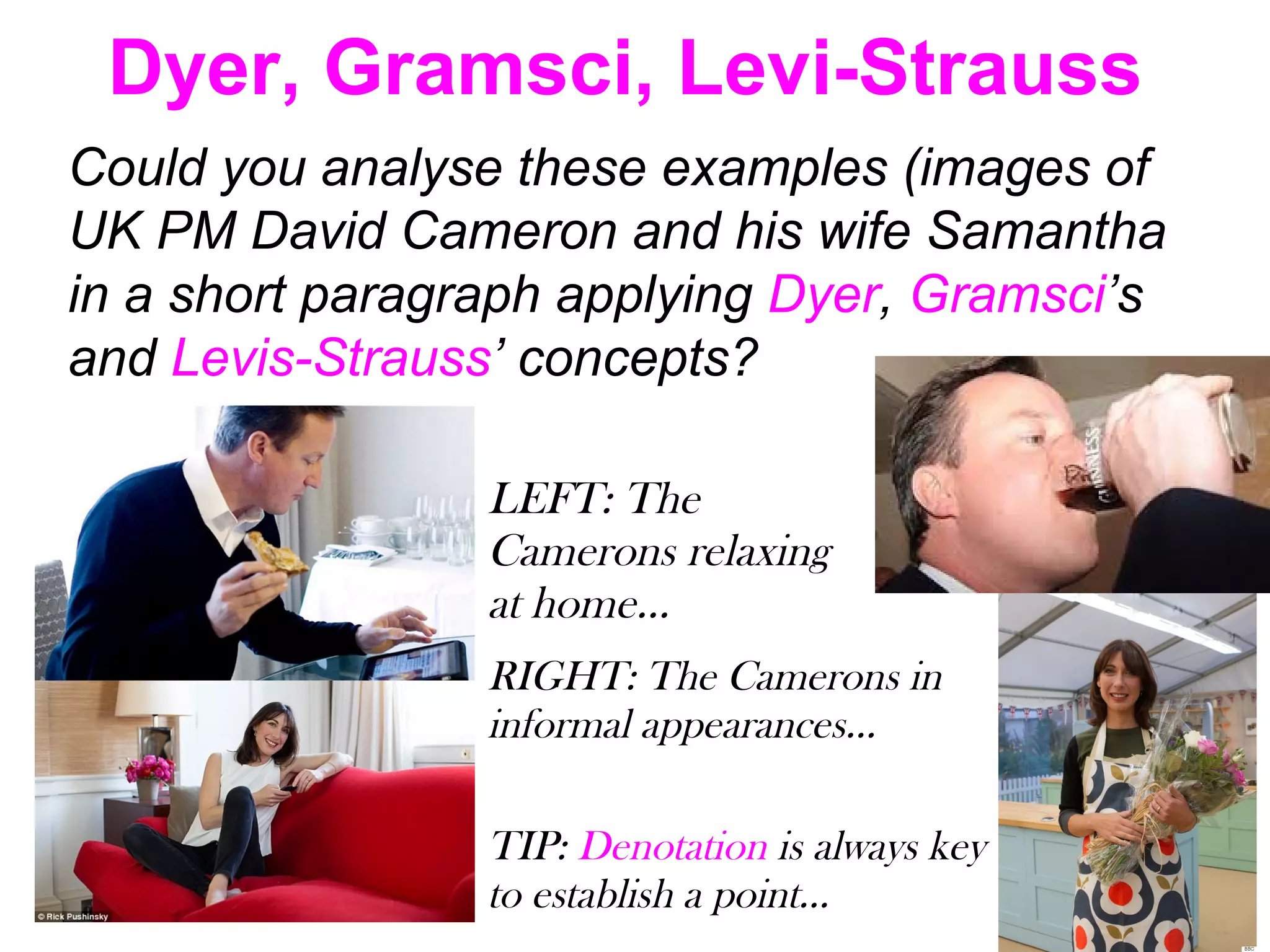
Could you analyse these examples (images of
UK PM David Cameron and his wife Samantha
in a short paragraph applying Dyer, Gramsci’s
and Levis-Strauss’ concepts?
LEFT: The
Camerons relaxing
at home…
RIGHT: The Camerons in
informal appearances…
TIP: Denotation is always key
to establish a point…
Dyer, Gramsci, Levi-Strauss APPLIED
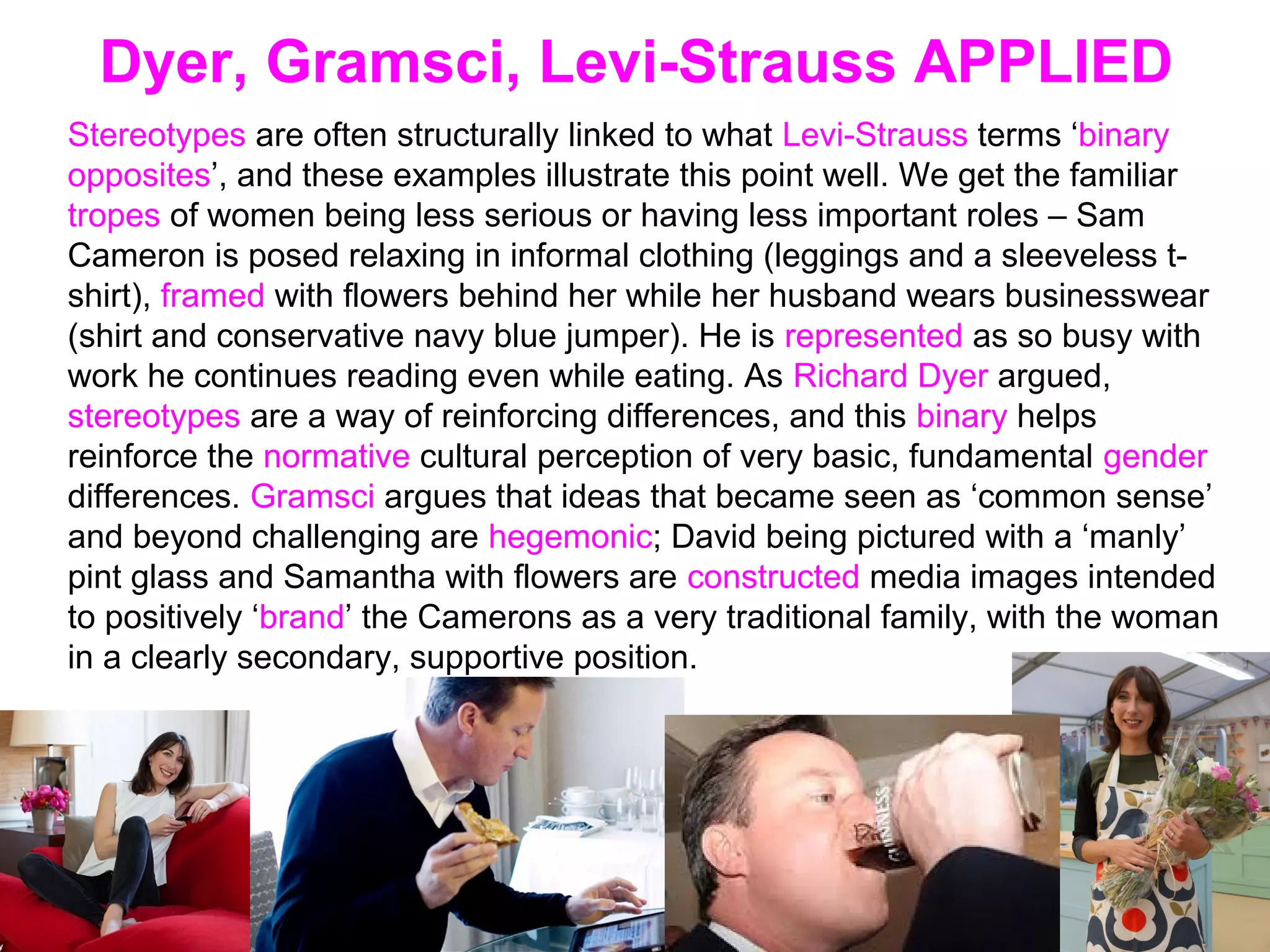
Stereotypes are often structurally linked to what Levi-Strauss terms ‘binary
opposites’, and these examples illustrate this point well. We get the familiar
tropes of women being less serious or having less important roles – Sam
Cameron is posed relaxing in informal clothing (leggings and a sleeveless t-
shirt), framed with flowers behind her while her husband wears businesswear
(shirt and conservative navy blue jumper). He is represented as so busy with
work he continues reading even while eating. As Richard Dyer argued,
stereotypes are a way of reinforcing differences, and this binary helps
reinforce the normative cultural perception of very basic, fundamental gender
differences. Gramsci argues that ideas that became seen as ‘common sense’
and beyond challenging are hegemonic; David being pictured with a ‘manly’
pint glass and Samantha with flowers are constructed media images intended
to positively ‘brand’ the Camerons as a very traditional family, with the woman
in a clearly secondary, supportive position.
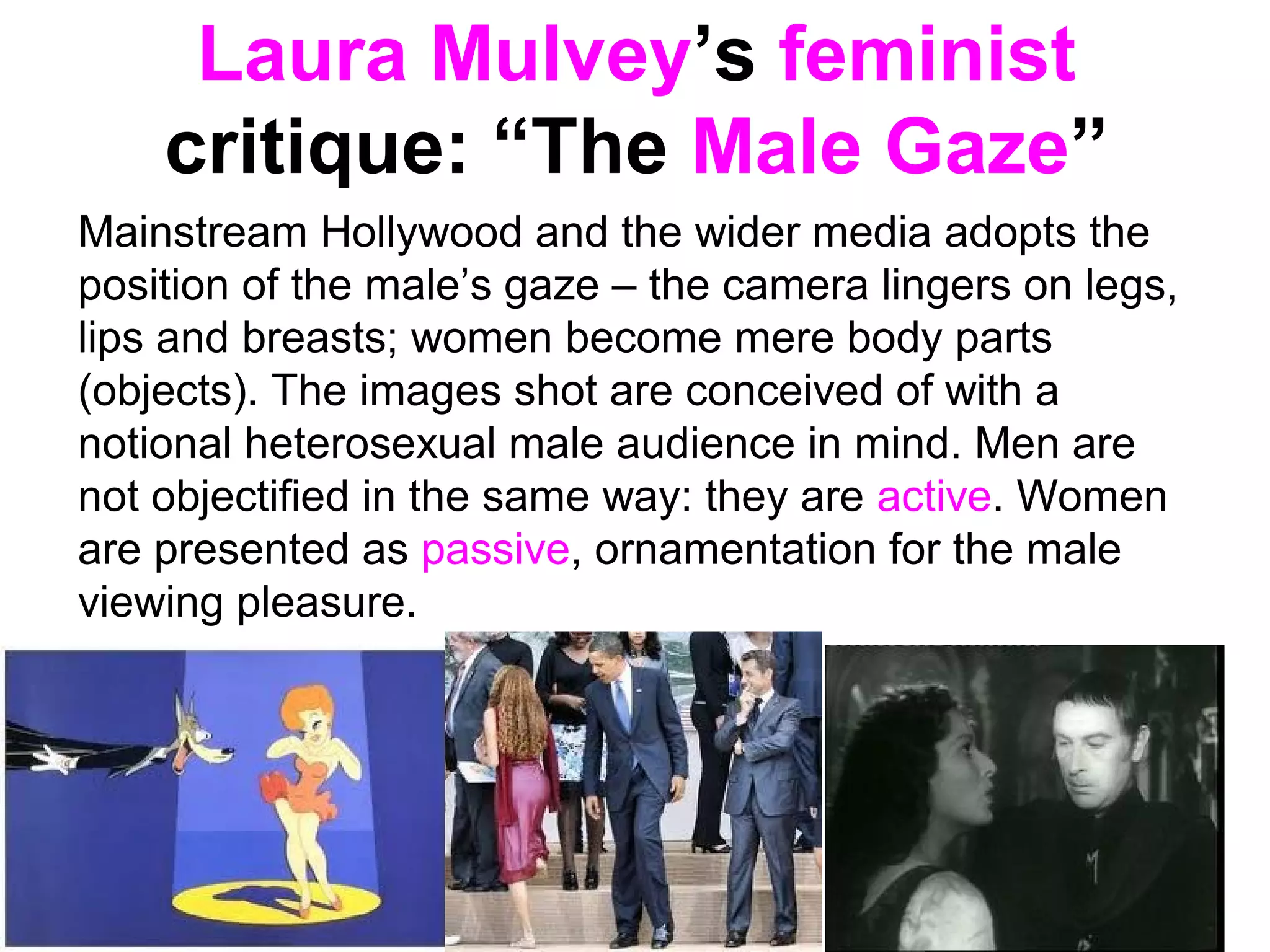
Laura Mulvey’s feminist
critique: “The Male Gaze”
Mainstream Hollywood and the wider media adopts the
position of the male’s gaze – the camera lingers on legs,
lips and breasts; women become mere body parts
(objects). The images shot are conceived of with a
notional heterosexual male audience in mind. Men are
not objectified in the same way: they are active. Women
are presented as passive, ornamentation for the male
viewing pleasure.
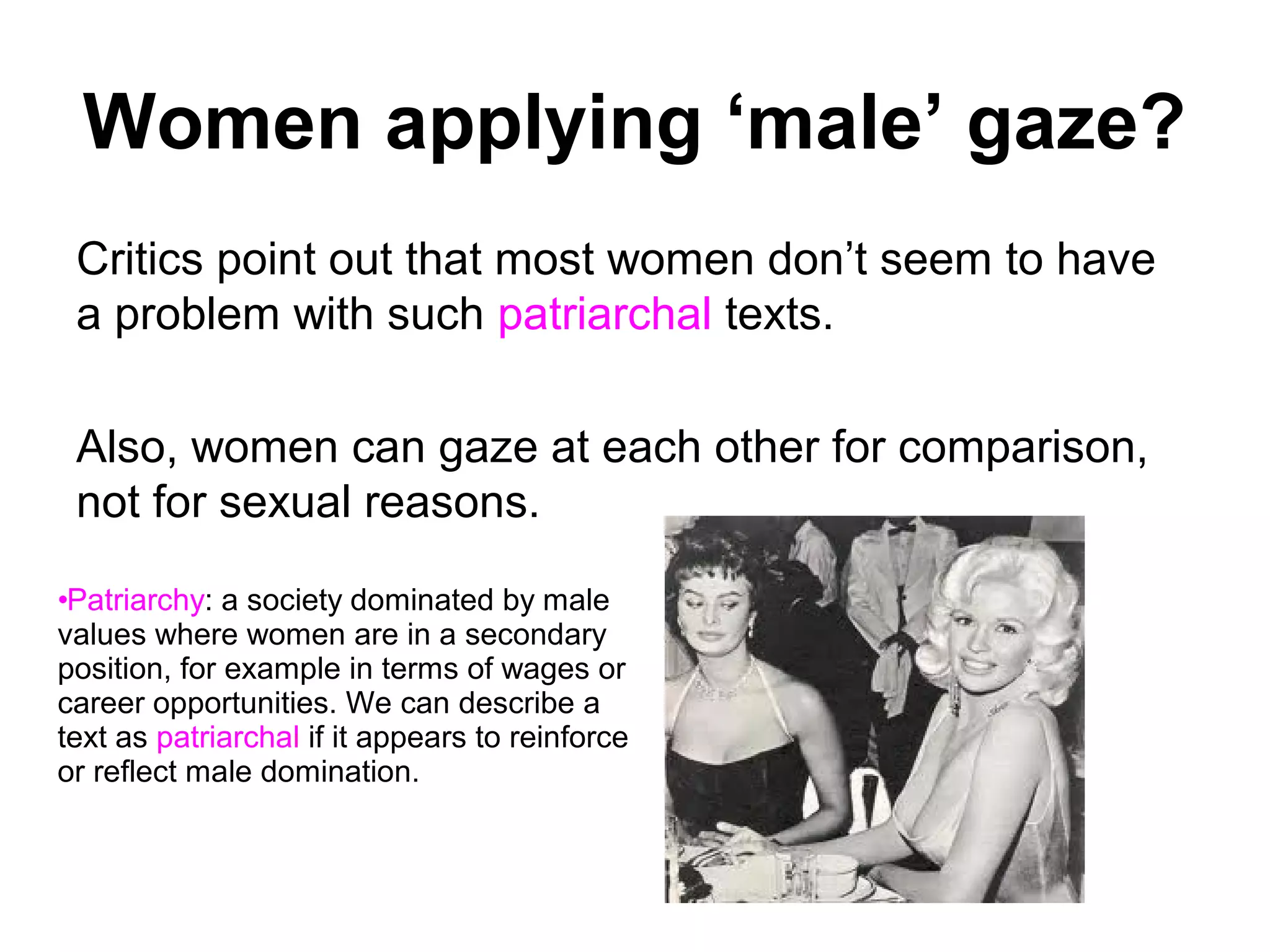
Women applying ‘male’ gaze?
Critics point out that most women don’t seem to have
a problem with such patriarchal texts.
Also, women can gaze at each other for comparison,
not for sexual reasons.
•Patriarchy: a society dominated by male
values where women are in a secondary
position, for example in terms of wages or
career opportunities. We can describe a
text as patriarchal if it appears to reinforce
or reflect male domination.
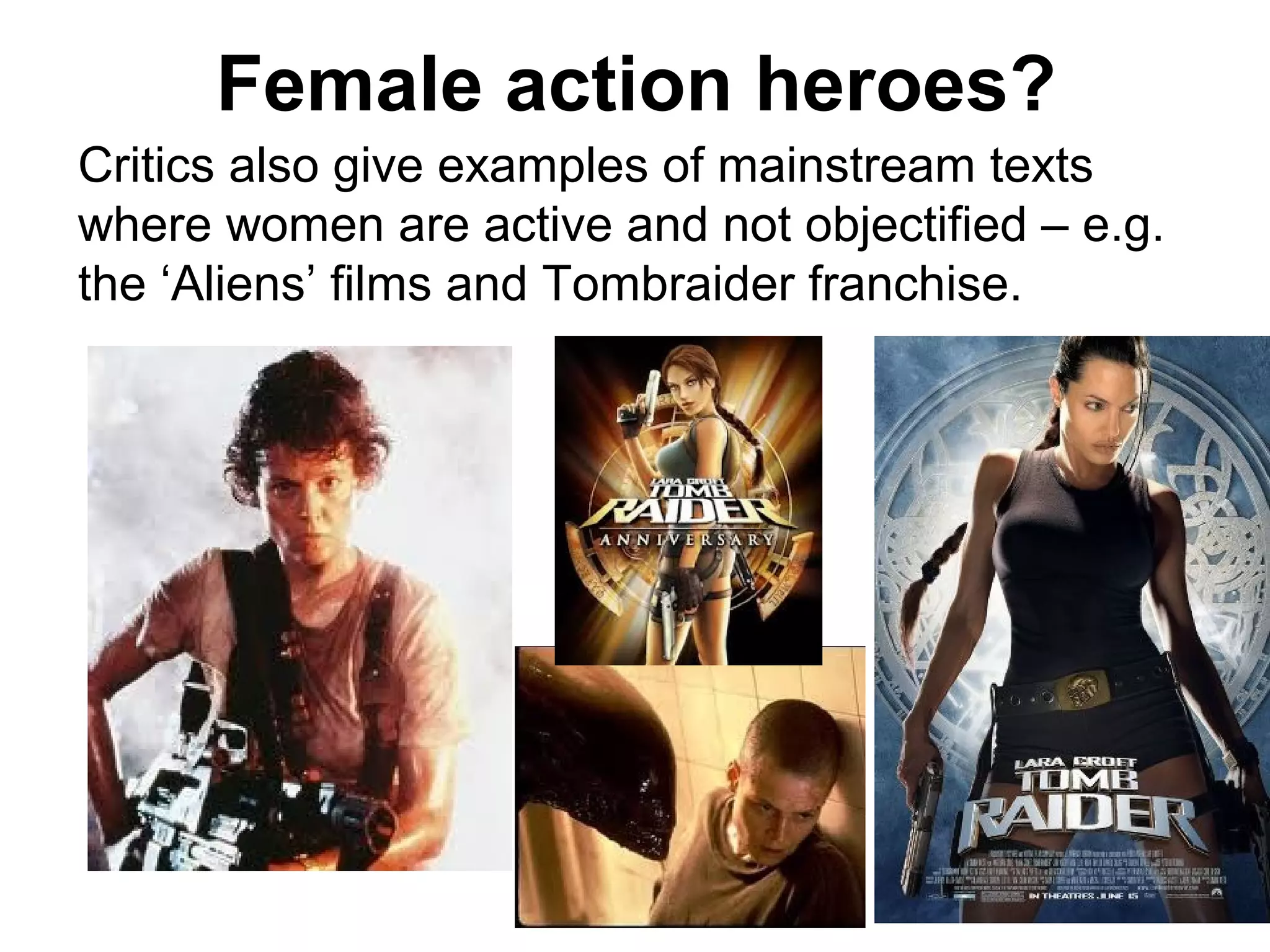
Female action heroes?
Critics also give examples of mainstream texts
where women are active and not objectified – e.g.
the ‘Aliens’ films and Tombraider franchise.
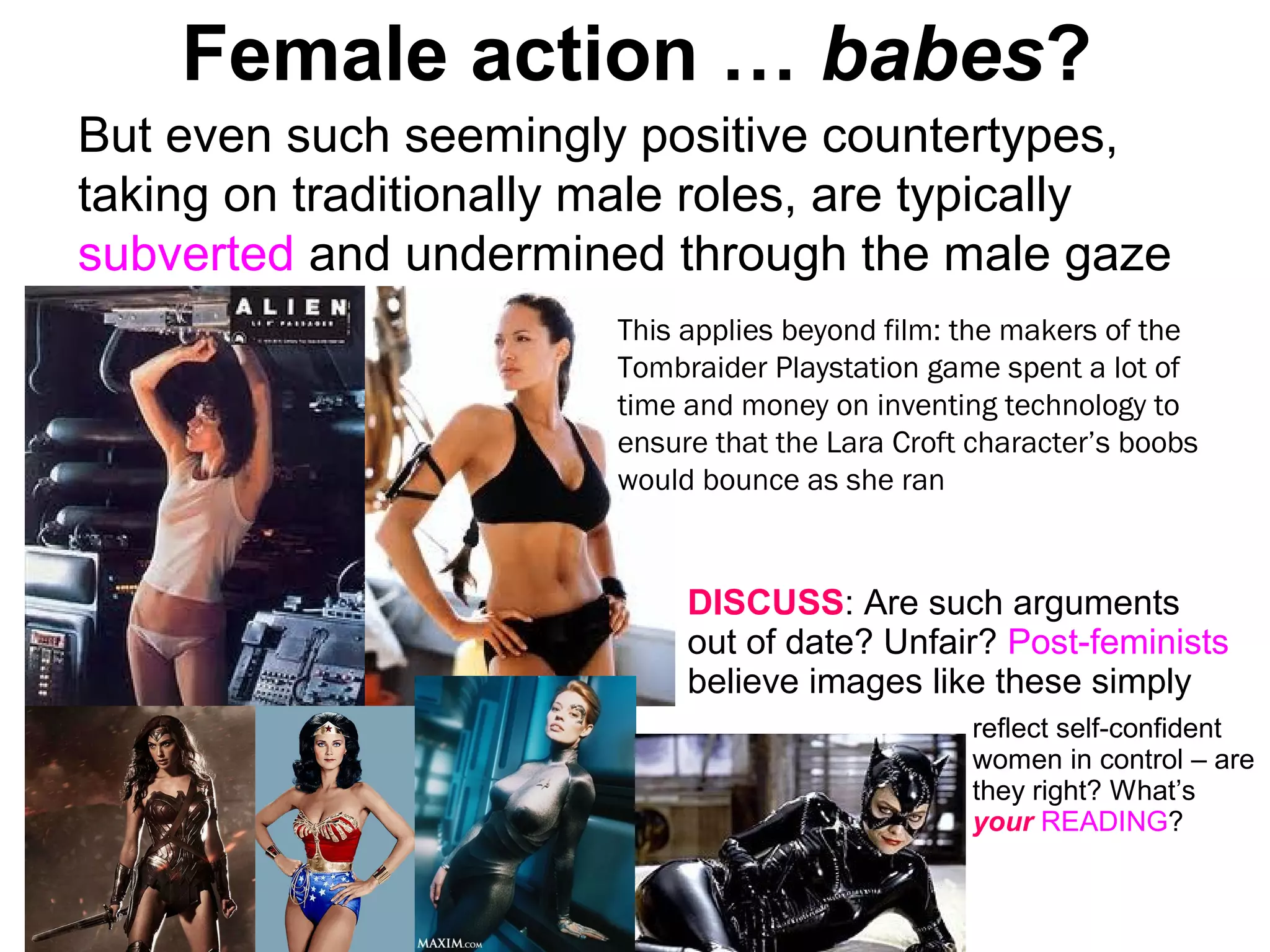
Female action … babes?
But even such seemingly positive countertypes,
taking on traditionally male roles, are typically
subverted and undermined through the male gaze
This applies beyond film: the makers of the
Tombraider Playstation game spent a lot of
time and money on inventing technology to
ensure that the Lara Croft character’s boobs
would bounce as she ran
DISCUSS: Are such arguments
out of date? Unfair? Post-feminists
believe images like these simply
reflect self-confident
women in control – are
they right? What’s
your READING?
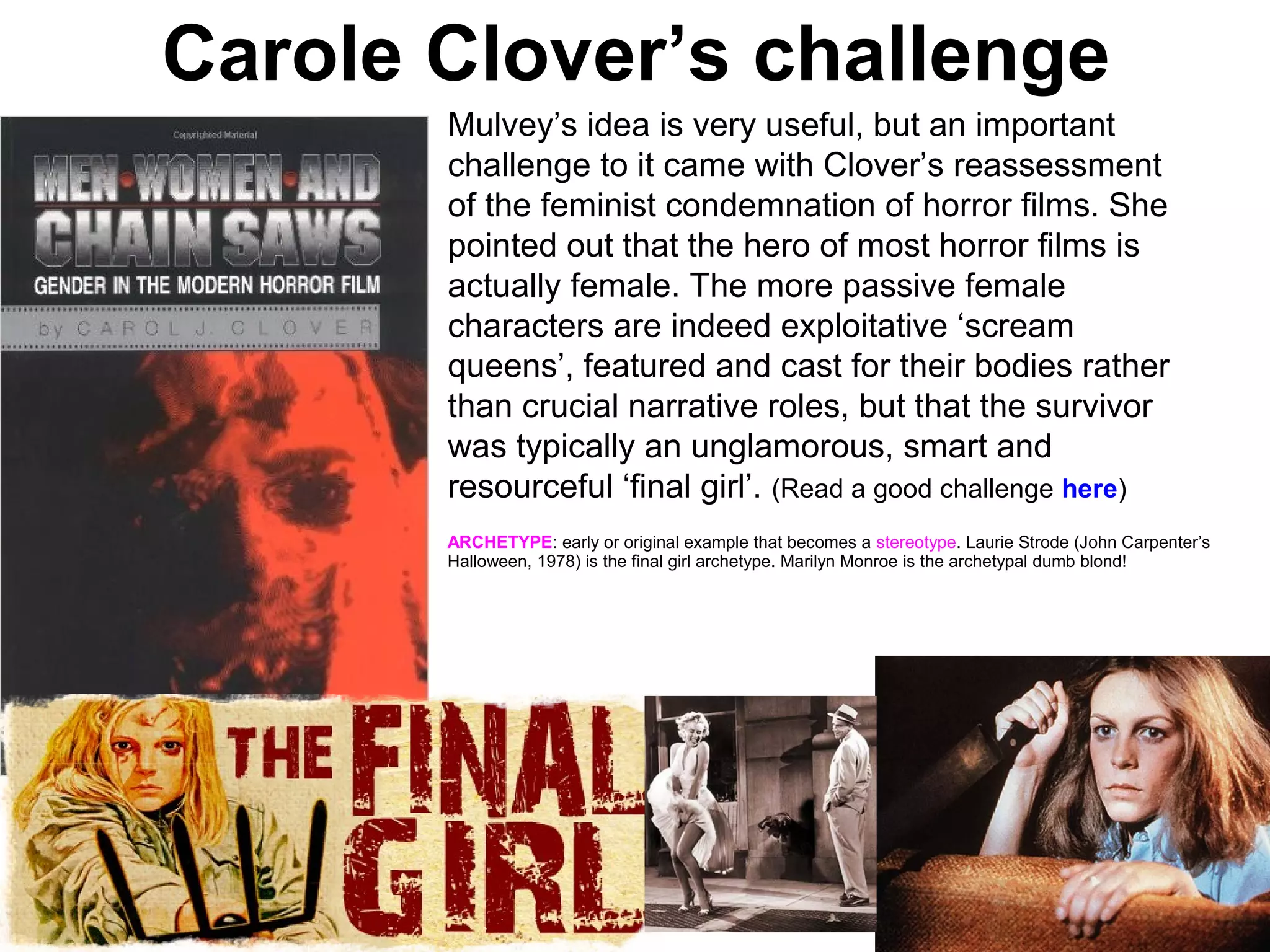
Carole Clover’s challenge
Mulvey’s idea is very useful, but an important
challenge to it came with Clover’s reassessment
of the feminist condemnation of horror films. She
pointed out that the hero of most horror films is
actually female. The more passive female
characters are indeed exploitative ‘scream
queens’, featured and cast for their bodies rather
than crucial narrative roles, but that the survivor
was typically an unglamorous, smart and
resourceful ‘final girl’. (Read a good challenge here)
ARCHETYPE: early or original example that becomes a stereotype. Laurie Strode (John Carpenter’s
Halloween, 1978) is the final girl archetype. Marilyn Monroe is the archetypal dumb blond!
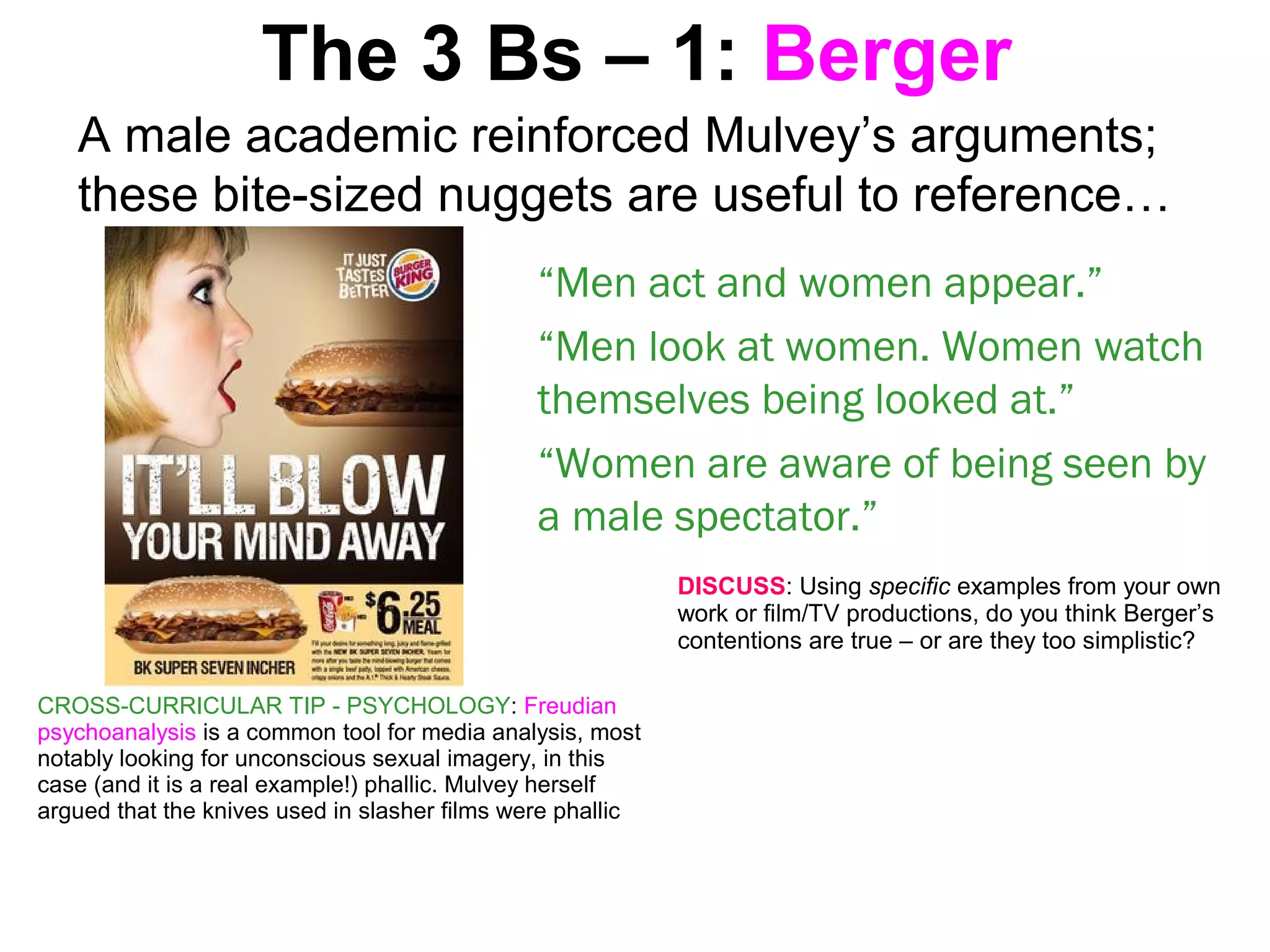
The 3 Bs – 1: Berger
A male academic reinforced Mulvey’s arguments;
these bite-sized nuggets are useful to reference…
“Men act and women appear.”
“Men look at women. Women watch
themselves being looked at.”
“Women are aware of being seen by
a male spectator.”
DISCUSS: Using specific examples from your own
work or film/TV productions, do you think Berger’s
contentions are true – or are they too simplistic?
CROSS-CURRICULAR TIP - PSYCHOLOGY: Freudian
psychoanalysis is a common tool for media analysis, most
notably looking for unconscious sexual imagery, in this
case (and it is a real example!) phallic. Mulvey herself
argued that the knives used in slasher films were phallic
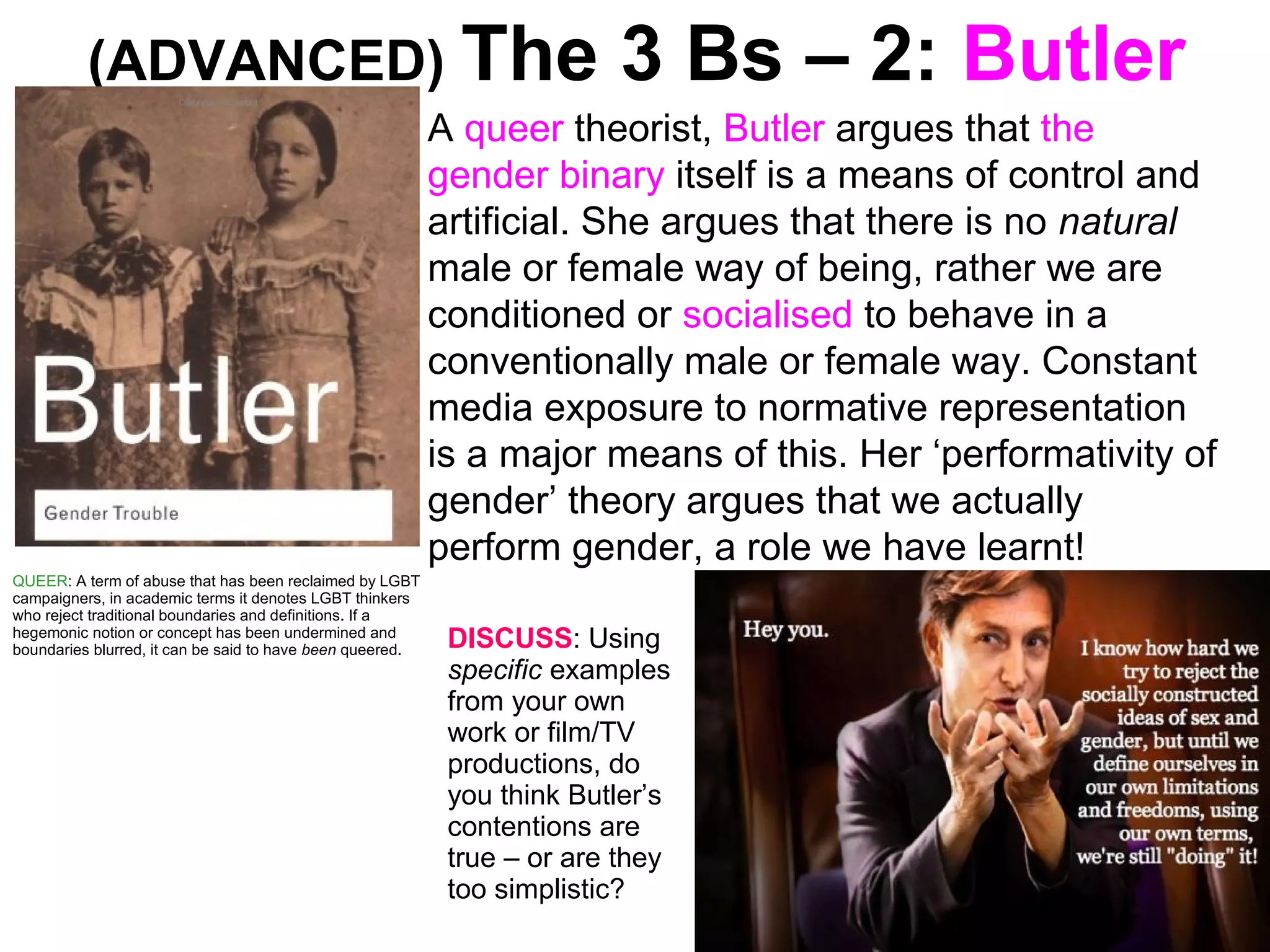
(ADVANCED) The 3 Bs – 2: Butler
A queer theorist, Butler argues that the
gender binary itself is a means of control and
artificial. She argues that there is no natural
male or female way of being, rather we are
conditioned or socialised to behave in a
conventionally male or female way. Constant
media exposure to normative representation
is a major means of this. Her ‘performativity of
gender’ theory argues that we actually
perform gender, a role we have learnt!
QUEER: A term of abuse that has been reclaimed by LGBT
campaigners, in academic terms it denotes LGBT thinkers
who reject traditional boundaries and definitions. If a
hegemonic notion or concept has been undermined and
boundaries blurred, it can be said to have been queered. DISCUSS: Using
specific examples
from your own
work or film/TV
productions, do
you think Butler’s
contentions are
true – or are they
too simplistic?
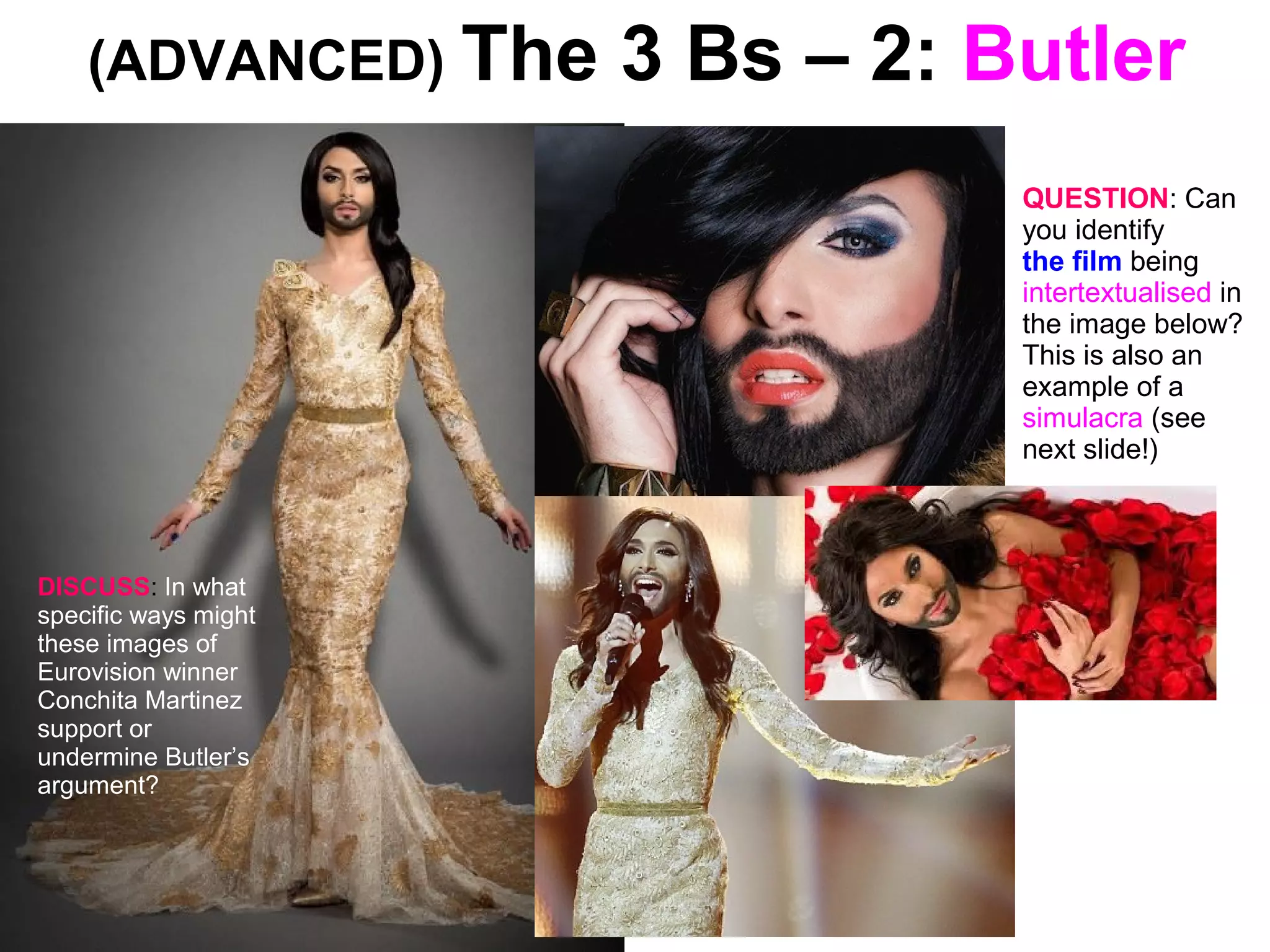
(ADVANCED) The 3 Bs – 2: Butler
DISCUSS: In what
specific ways might
these images of
Eurovision winner
Conchita Martinez
support or
undermine Butler’s
argument?
QUESTION: Can
you identify
the film being
intertextualised in
the image below?
This is also an
example of a
simulacra (see
next slide!)
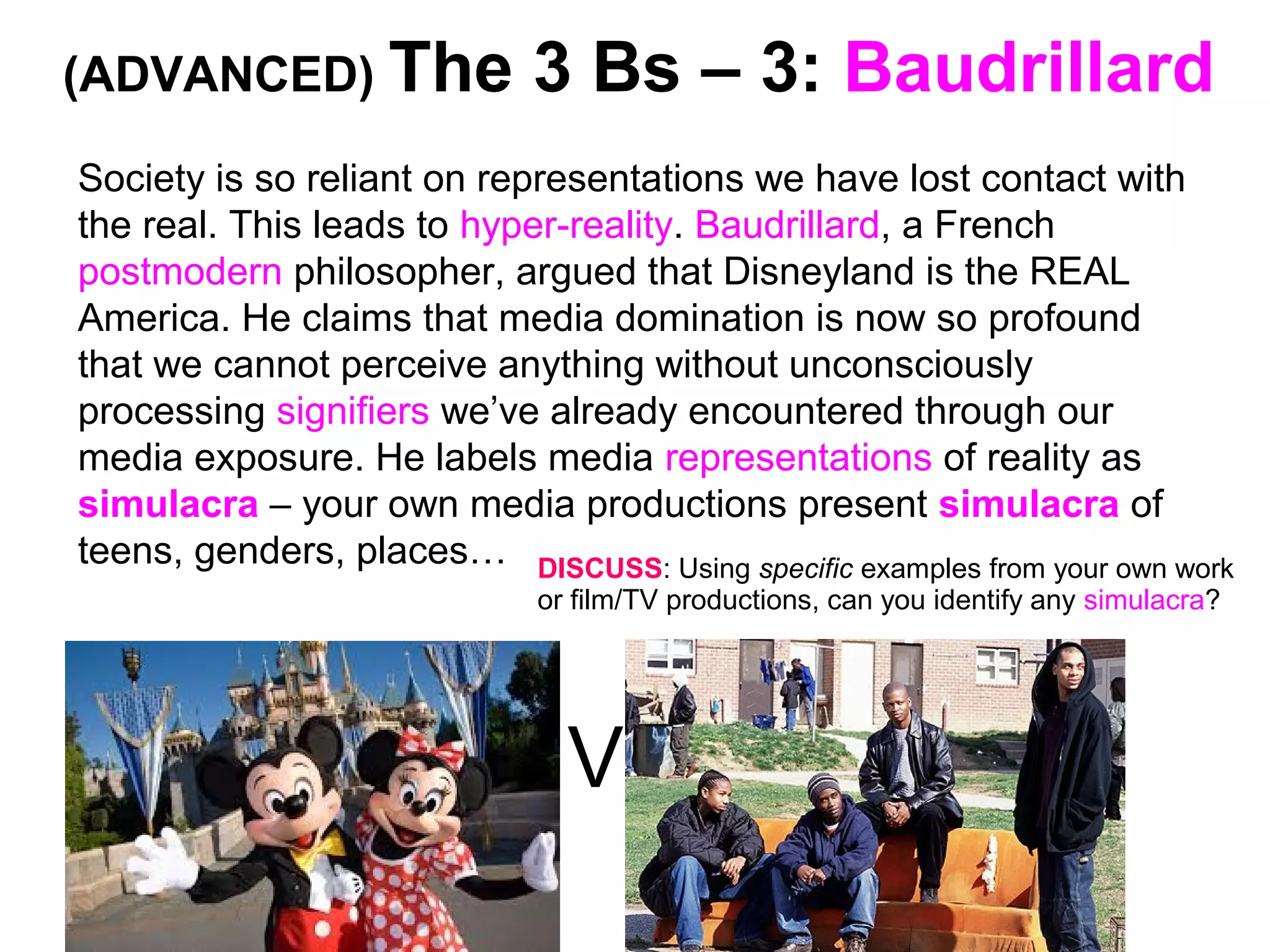
(ADVANCED) The 3 Bs – 3: Baudrillard
Society is so reliant on representations we have lost contact with
the real. This leads to hyper-reality. Baudrillard, a French
postmodern philosopher, argued that Disneyland is the REAL
America. He claims that media domination is now so profound
that we cannot perceive anything without unconsciously
processing signifiers we’ve already encountered through our
media exposure. He labels media representations of reality as
simulacra – your own media productions present simulacra of
teens, genders, places…
V
DISCUSS: Using specific examples from your own work
or film/TV productions, can you identify any simulacra?
Representation: Questions
• Identify characters, events or issues within the
production to discuss.
• How does your production represent different social
groups/ people/ places/ lifestyles? What values/
ideologies are you representing/ promoting?
• Discuss the specific elements of character
representation, i.e. modes of address, facial
expression, costume, behaviour etc.
• Have any stereotypical representations been
generated?
• Does the production conform to, or subvert, any
dominant ideologies?
• What would Laura Mulvey say about your
production?
• In what ways has your identity (age, gender,
nationality etc) influenced your production choices?
Sample Question
“Representations in media texts are often
simplistic and reinforce dominant
ideologies so that audiences can make
sense of them.”
Evaluate the ways that you have used/
challenged simplistic representations in
one of the media products you have
produced.

DB adapted representation theories

  • 1.
    REPRESENTATION THEORIES Dyer, Gramsci,Levi-Strauss, Mulvey v Clover, & the 3 B’s: Berger, Butler, Baudrillard CONSIDER…: Media Representations (including YOURS!) are never natural; they always reflect choices made and someone’s social, cultural value judgements. Referencing any of these images, what do YOU think?
  • 2.
    Dyer, Gramsci, Levi-Strauss DYER:Stereotypes are a way of reinforcing differences, and representing these differences as natural. GRAMSCI: When a cultural value is accepted as ‘common sense’ and unquestionable it has attained hegemonic status. Gramsci saw ‘soft power’ as important as ‘hard power’ – society can be controlled through culture as much as through military or police repression! LEVI-STRAUSS: His NARRATIVE concept is useful for analysing representation; binary opposites are generally part of the structure of stereotypes. The woman’s time is unimportant while the man’s is valuable! Leisure v business! See next slide…
  • 3.
    Dyer, Gramsci, Levi-Strauss Couldyou analyse these examples (images of UK PM David Cameron and his wife Samantha in a short paragraph applying Dyer, Gramsci’s and Levis-Strauss’ concepts? LEFT: The Camerons relaxing at home… RIGHT: The Camerons in informal appearances… TIP: Denotation is always key to establish a point…
  • 4.
    Dyer, Gramsci, Levi-StraussAPPLIED Stereotypes are often structurally linked to what Levi-Strauss terms ‘binary opposites’, and these examples illustrate this point well. We get the familiar tropes of women being less serious or having less important roles – Sam Cameron is posed relaxing in informal clothing (leggings and a sleeveless t- shirt), framed with flowers behind her while her husband wears businesswear (shirt and conservative navy blue jumper). He is represented as so busy with work he continues reading even while eating. As Richard Dyer argued, stereotypes are a way of reinforcing differences, and this binary helps reinforce the normative cultural perception of very basic, fundamental gender differences. Gramsci argues that ideas that became seen as ‘common sense’ and beyond challenging are hegemonic; David being pictured with a ‘manly’ pint glass and Samantha with flowers are constructed media images intended to positively ‘brand’ the Camerons as a very traditional family, with the woman in a clearly secondary, supportive position.
  • 5.
    Laura Mulvey’s feminist critique:“The Male Gaze” Mainstream Hollywood and the wider media adopts the position of the male’s gaze – the camera lingers on legs, lips and breasts; women become mere body parts (objects). The images shot are conceived of with a notional heterosexual male audience in mind. Men are not objectified in the same way: they are active. Women are presented as passive, ornamentation for the male viewing pleasure.
  • 6.
    Women applying ‘male’gaze? Critics point out that most women don’t seem to have a problem with such patriarchal texts. Also, women can gaze at each other for comparison, not for sexual reasons. •Patriarchy: a society dominated by male values where women are in a secondary position, for example in terms of wages or career opportunities. We can describe a text as patriarchal if it appears to reinforce or reflect male domination.
  • 7.
    Female action heroes? Criticsalso give examples of mainstream texts where women are active and not objectified – e.g. the ‘Aliens’ films and Tombraider franchise.
  • 8.
    Female action …babes? But even such seemingly positive countertypes, taking on traditionally male roles, are typically subverted and undermined through the male gaze This applies beyond film: the makers of the Tombraider Playstation game spent a lot of time and money on inventing technology to ensure that the Lara Croft character’s boobs would bounce as she ran DISCUSS: Are such arguments out of date? Unfair? Post-feminists believe images like these simply reflect self-confident women in control – are they right? What’s your READING?
  • 9.
    Carole Clover’s challenge Mulvey’sidea is very useful, but an important challenge to it came with Clover’s reassessment of the feminist condemnation of horror films. She pointed out that the hero of most horror films is actually female. The more passive female characters are indeed exploitative ‘scream queens’, featured and cast for their bodies rather than crucial narrative roles, but that the survivor was typically an unglamorous, smart and resourceful ‘final girl’. (Read a good challenge here) ARCHETYPE: early or original example that becomes a stereotype. Laurie Strode (John Carpenter’s Halloween, 1978) is the final girl archetype. Marilyn Monroe is the archetypal dumb blond!
  • 10.
    The 3 Bs– 1: Berger A male academic reinforced Mulvey’s arguments; these bite-sized nuggets are useful to reference… “Men act and women appear.” “Men look at women. Women watch themselves being looked at.” “Women are aware of being seen by a male spectator.” DISCUSS: Using specific examples from your own work or film/TV productions, do you think Berger’s contentions are true – or are they too simplistic? CROSS-CURRICULAR TIP - PSYCHOLOGY: Freudian psychoanalysis is a common tool for media analysis, most notably looking for unconscious sexual imagery, in this case (and it is a real example!) phallic. Mulvey herself argued that the knives used in slasher films were phallic
  • 11.
    (ADVANCED) The 3Bs – 2: Butler A queer theorist, Butler argues that the gender binary itself is a means of control and artificial. She argues that there is no natural male or female way of being, rather we are conditioned or socialised to behave in a conventionally male or female way. Constant media exposure to normative representation is a major means of this. Her ‘performativity of gender’ theory argues that we actually perform gender, a role we have learnt! QUEER: A term of abuse that has been reclaimed by LGBT campaigners, in academic terms it denotes LGBT thinkers who reject traditional boundaries and definitions. If a hegemonic notion or concept has been undermined and boundaries blurred, it can be said to have been queered. DISCUSS: Using specific examples from your own work or film/TV productions, do you think Butler’s contentions are true – or are they too simplistic?
  • 12.
    (ADVANCED) The 3Bs – 2: Butler DISCUSS: In what specific ways might these images of Eurovision winner Conchita Martinez support or undermine Butler’s argument? QUESTION: Can you identify the film being intertextualised in the image below? This is also an example of a simulacra (see next slide!)
  • 13.
    (ADVANCED) The 3Bs – 3: Baudrillard Society is so reliant on representations we have lost contact with the real. This leads to hyper-reality. Baudrillard, a French postmodern philosopher, argued that Disneyland is the REAL America. He claims that media domination is now so profound that we cannot perceive anything without unconsciously processing signifiers we’ve already encountered through our media exposure. He labels media representations of reality as simulacra – your own media productions present simulacra of teens, genders, places… V DISCUSS: Using specific examples from your own work or film/TV productions, can you identify any simulacra?
  • 14.
    Representation: Questions • Identifycharacters, events or issues within the production to discuss. • How does your production represent different social groups/ people/ places/ lifestyles? What values/ ideologies are you representing/ promoting? • Discuss the specific elements of character representation, i.e. modes of address, facial expression, costume, behaviour etc. • Have any stereotypical representations been generated? • Does the production conform to, or subvert, any dominant ideologies? • What would Laura Mulvey say about your production? • In what ways has your identity (age, gender, nationality etc) influenced your production choices?
  • 15.
    Sample Question “Representations inmedia texts are often simplistic and reinforce dominant ideologies so that audiences can make sense of them.” Evaluate the ways that you have used/ challenged simplistic representations in one of the media products you have produced.