mediating gender
Rosemary Overell (@muzaken)
Department of Media, Film &
Communications
The University of Otago
rosemary.overell@otago.ac.nz
mediating gender
KEYWORDS: feminism;
performativity; social
construction
Mediating Gender Outline
• Key concept: gender is socially
constructed
• Key questions:
– How does the media work to
construct and maintain gender?
– What sort of things are taken for
granted (‘ideological’)?
– How is gender made / constructed?
• Key thinker: Judith Butler
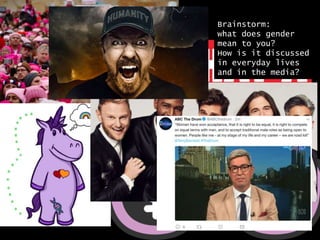
Feminism Brainstorm:
what does gender
mean to you?
How is it discussed
in everyday lives
and in the media?
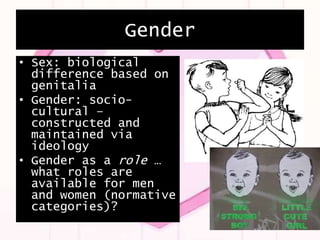
Gender
• Sex: biological
difference based on
genitalia
• Gender: socio-
cultural –
constructed and
maintained via
ideology
• Gender as a role …
what roles are
available for men
and women (normative
categories)?
Gender
• Gender as a sign – it
signifies and
communicates
• “It is not simply
that the sign [‘girl’
or ‘woman’] denotes
something. What
matters is who
addresses you through
the sign how you
receive it”
• Sara Ahmed. 2017.
Living a Feminist
Life. Durham: Duke UP
Gender
• Brainstorm:
• What are some of the ways
young people might be
‘girled’ or ‘boyed’ when
they are young?
• Think about commodities
(things we buy / consume),
but also institutions like
school and the family
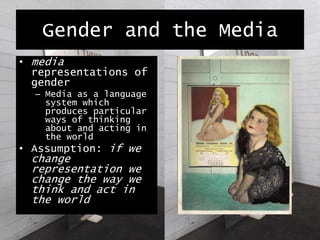
Gender and the Media
• media
representations of
gender
– Media as a language
system which
produces particular
ways of thinking
about and acting in
the world
• Assumption: if we
change
representation we
change the way we
think and act in
the world
Hasbro’s Rose Petal Cottage Commercial – For Moms
(2016)
https://www.youtube.com/watch?v=2dXlAjCU8G4
Gender and the Media
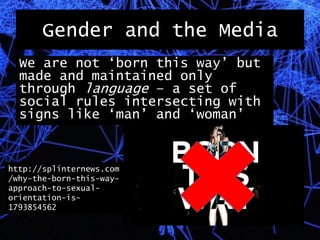
We are not ‘born this way’ but
made and maintained only
through language – a set of
social rules intersecting with
signs like ‘man’ and ‘woman’
http://splinternews.com
/why-the-born-this-way-
approach-to-sexual-
orientation-is-
1793854562
Gender and the Media
“One is not born a woman, but
rather one becomes a woman”
(12) – through one’s
engagement with the world …
Simone de Beauvoir. The
Second Sex. New York,
Vintage: 1984 [1949].
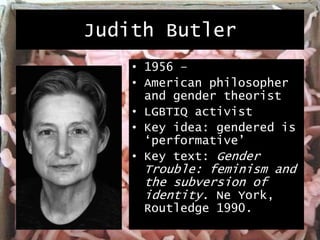
Judith Butler
• 1956 –
• American philosopher
and gender theorist
• LGBTIQ activist
• Key idea: gendered is
‘performative’
• Key text: Gender
Trouble: feminism and
the subversion of
identity. Ne York,
Routledge 1990.
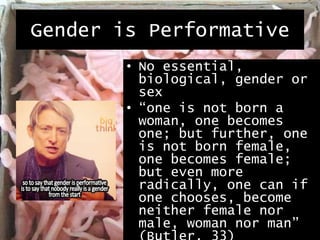
Gender is Performative
• No essential,
biological, gender or
sex
• “one is not born a
woman, one becomes
one; but further, one
is not born female,
one becomes female;
but even more
radically, one can if
one chooses, become
neither female nor
male, woman nor man”
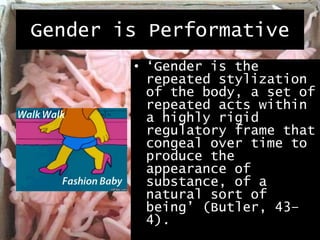
Gender is Performative
• ‘Gender is the
repeated stylization
of the body, a set of
repeated acts within
a highly rigid
regulatory frame that
congeal over time to
produce the
appearance of
substance, of a
natural sort of
being’ (Butler, 43–
4).
Activity
• What types of
‘repeated
stylisations’
or activities
have you
performed
today?
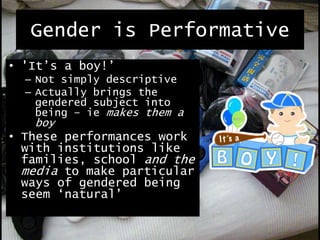
Gender is Performative
• 'It’s a boy!’
– Not simply descriptive
– Actually brings the
gendered subject into
being – ie makes them a
boy
• These performances work
with institutions like
families, school and the
media to make particular
ways of gendered being
seem ‘natural’
Gender and Drag
• Gender is not a closed system
• Moments which draw attention to
its performativity draw attention
to how gender is socially produced
(that it is not natural)
• Butler’s eg: drag
• ‘it dramatize[s] the signifying
gestures through which gender
itself is established’ (Butler,
xxviii)
Gender and Drag
• ‘it dramatize[s] the signifying gestures
through which gender itself is established’
(Butler, xxviii)
• There is no ‘real’ gender behind the
performance
Ru Paul’s Drag Race
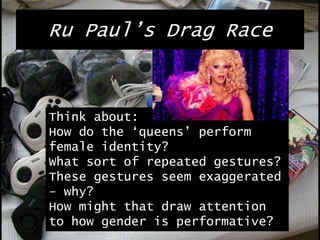
Ru Paul’s Drag Race
Think about:
How do the ‘queens’ perform
female identity?
What sort of repeated gestures?
These gestures seem exaggerated
– why?
How might that draw attention
to how gender is performative?
Mediating Gender Summary
• Key concept: the way we think
about gender is intertwined
with particular social contexts
• intersections with media
representations
• Gender as a performance (Judith
Butler

Rmit guest lecture april 2018

  • 1.
    mediating gender Rosemary Overell(@muzaken) Department of Media, Film & Communications The University of Otago rosemary.overell@otago.ac.nz
  • 2.
  • 3.
    Mediating Gender Outline •Key concept: gender is socially constructed • Key questions: – How does the media work to construct and maintain gender? – What sort of things are taken for granted (‘ideological’)? – How is gender made / constructed? • Key thinker: Judith Butler
  • 4.
    Feminism Brainstorm: what doesgender mean to you? How is it discussed in everyday lives and in the media?
  • 5.
    Gender • Sex: biological differencebased on genitalia • Gender: socio- cultural – constructed and maintained via ideology • Gender as a role … what roles are available for men and women (normative categories)?
  • 6.
    Gender • Gender asa sign – it signifies and communicates • “It is not simply that the sign [‘girl’ or ‘woman’] denotes something. What matters is who addresses you through the sign how you receive it” • Sara Ahmed. 2017. Living a Feminist Life. Durham: Duke UP
  • 7.
    Gender • Brainstorm: • Whatare some of the ways young people might be ‘girled’ or ‘boyed’ when they are young? • Think about commodities (things we buy / consume), but also institutions like school and the family
  • 8.
    Gender and theMedia • media representations of gender – Media as a language system which produces particular ways of thinking about and acting in the world • Assumption: if we change representation we change the way we think and act in the world
  • 9.
    Hasbro’s Rose PetalCottage Commercial – For Moms (2016) https://www.youtube.com/watch?v=2dXlAjCU8G4
  • 10.
    Gender and theMedia We are not ‘born this way’ but made and maintained only through language – a set of social rules intersecting with signs like ‘man’ and ‘woman’ http://splinternews.com /why-the-born-this-way- approach-to-sexual- orientation-is- 1793854562
  • 11.
    Gender and theMedia “One is not born a woman, but rather one becomes a woman” (12) – through one’s engagement with the world … Simone de Beauvoir. The Second Sex. New York, Vintage: 1984 [1949].
  • 12.
    Judith Butler • 1956– • American philosopher and gender theorist • LGBTIQ activist • Key idea: gendered is ‘performative’ • Key text: Gender Trouble: feminism and the subversion of identity. Ne York, Routledge 1990.
  • 13.
    Gender is Performative •No essential, biological, gender or sex • “one is not born a woman, one becomes one; but further, one is not born female, one becomes female; but even more radically, one can if one chooses, become neither female nor male, woman nor man”
  • 14.
    Gender is Performative •‘Gender is the repeated stylization of the body, a set of repeated acts within a highly rigid regulatory frame that congeal over time to produce the appearance of substance, of a natural sort of being’ (Butler, 43– 4).
  • 15.
    Activity • What typesof ‘repeated stylisations’ or activities have you performed today?
  • 16.
    Gender is Performative •'It’s a boy!’ – Not simply descriptive – Actually brings the gendered subject into being – ie makes them a boy • These performances work with institutions like families, school and the media to make particular ways of gendered being seem ‘natural’
  • 17.
    Gender and Drag •Gender is not a closed system • Moments which draw attention to its performativity draw attention to how gender is socially produced (that it is not natural) • Butler’s eg: drag • ‘it dramatize[s] the signifying gestures through which gender itself is established’ (Butler, xxviii)
  • 18.
    Gender and Drag •‘it dramatize[s] the signifying gestures through which gender itself is established’ (Butler, xxviii) • There is no ‘real’ gender behind the performance
  • 19.
  • 20.
    Ru Paul’s DragRace Think about: How do the ‘queens’ perform female identity? What sort of repeated gestures? These gestures seem exaggerated – why? How might that draw attention to how gender is performative?
  • 22.
    Mediating Gender Summary •Key concept: the way we think about gender is intertwined with particular social contexts • intersections with media representations • Gender as a performance (Judith Butler

Editor's Notes

  • #3 Builds on last week’s discussion of Marx’s method of dialectical materialism – this descent into thinking about things as processes as social and masses of contradictions – of questioning and critically engaging with things beyond the surface appearance to unpack their broader politics and social meaning. The broad ‘takeaway point’ I wanted to make last week was about thinking about the world as interrelated and entangled – in particular to consider taken for granted ideas – or dominant ideologies – as not eternal Truths but as socially constructed by and between people!
  • #4 FEMINISM OUTLINE AND REVIEW cont/n of the ‘isms’ block in 102 Follows on well from MARXISM as, like Karl Marx’s theories, Feminism is about looking at how our world works – like marxism it is broadly about questioning particular ways of thinking about the world as ‘natural’ and ‘eternal’ That is, we want to think about gender – and how we imagine ‘men’ and ‘women’ as contingent on particular social and cultural formations – like capitalism which – recall – has not always existed, but is the product of specific historical, political and economic events (which Marx then critiqued in Capital) So these two lectures will Outline what feminism means – where it came from what circumstances constituted it – Track feminism in terms of its intersections with mediated communications and particularly REPRESENTATION which you have come across earlier in the course Account for issues with ‘feminism’ as an effective political critique of contemporary culture and media (more on Wednesday)
  • #5 GENDER BRAINSTORM A word you’ve heard? What does it mean to you? Women’s march / pussy hats … We hear it used in multiple ways – at uni – but also in contemporary media – who does it describe? Who doesn’t it describe? Is it only about women? Think about … Miley Cyrus Beyonce Lorde Kesha What about TV? We hear about feminist critiques of GoT as well as Orange is the New Black The Bachelor etc. Might come across it on SNS; on blogs like feministing; I’m Feminist Because; Jezebel … or other spaces?
  • #6 Gender is socio-cultural and is about what is deemed ‘normal’ / natural / real or authentic behaviour for men and women – gender studies unpacks these norms. Feminist media studies looks at how the media works to help produce and maintain normative gender and how we might challenge these norms
  • #7 Gender as socio-cultural – a sign in the sense that it can be broken down to tell us something about how we think through gendered identities – it connotes something. Gender is ideological. This cartoon shows how young women might be ‘girled’ in Ahmed’s terms
  • #8 ‘even if we never know the word’ – it seems natural / normal and ideological – ‘how can we organise to challenge and change a system that cannot be named?’ Patriarchy – according to bh – is like a script which assigns men and women into particular roles and positions and assigns them particular ‘normal’ / ‘natural’ actions this script “insists that males are inherently dominating, superior to everything and everyone deemed weak, especially females and endowed with the right to dominate and rule over the weak and to maintain that dominance through various forms of psychological terror and violence” Men are positioned and oppressed by patriarchy too – their behaviour is just as produced and policed by institutions such as the family, school and homo-normative groups like sports teams and even simply groups of friends (recall the story of the boy playing with Barbie in the hooks article)
  • #9 FEMINISM 2 AND THE MEDIA Both liberal and radical feminists believed that patriarchy was ideological – that it worked systematically to produce a way of thinking about gender which granted power of men over women This was anchored in language – the words we use – but also more broadly the signifying (meaning making) systems which make up how we view the world – images, clothing, ways of being in space (how our bodies move and take up or don’t take up space) They believed that such signifying systems construct how we understand and how we take our place in the world So A key concern was how women and gender relations were REPRESENTED in mass media – recall that Representation is not the simple presentation of an eternal truth but a particular mediated presentation which works ideologically to frame how we think and approach the world around us 2nd wave feminists believed that representations of women as feminine – submissive, quiet, ‘beautiful’ and objectified – produced and maintained patriarchy Therefore, if we change representation we change how we think and act in the world … E.g. Mulvey – the woman as object in cinema a collection of bits and parts
  • #10 https://www.youtube.com/watch?v=19wtF-mxIyk
  • #11 This might be a difficult idea to accept – we are told constantly that we are ‘essentially’ (at our core) individuals – particular by the media and advertisers. Burr and others are not saying that subjectivity is not experienced as individual just that there is no essential core – or soul – or brain glitch – that gives us a natural ‘born this way’ personality – instead our sense of Self is made, produced and maintained only through discourse that is, through language …“the things people say and write, from the perspective of … social constructionism: these things are not a route of access to a person’s private world, they are valid descriptions of [netural] things called ‘beliefs’ or ‘opinions’, and they cannot be taken to be manifestations of some inner, essential condition such as temperament, personality or attitude. [Rather] they are manifestations of discourses, outcrops of representations of events upon the terrain of social life. They have their origin not in the person’s private experience, but in the discursive culture people inhabit”
  • #12 This might be a difficult idea to accept – we are told constantly that we are ‘essentially’ (at our core) individuals – particular by the media and advertisers. Burr and others are not saying that subjectivity is not experienced as individual just that there is no essential core – or soul – or brain glitch – that gives us a natural ‘born this way’ personality – instead our sense of Self is made, produced and maintained only through discourse that is, through language …“the things people say and write, from the perspective of … social constructionism: these things are not a route of access to a person’s private world, they are valid descriptions of [netural] things called ‘beliefs’ or ‘opinions’, and they cannot be taken to be manifestations of some inner, essential condition such as temperament, personality or attitude. [Rather] they are manifestations of discourses, outcrops of representations of events upon the terrain of social life. They have their origin not in the person’s private experience, but in the discursive culture people inhabit”
  • #23 FEMINISM SUMMARY