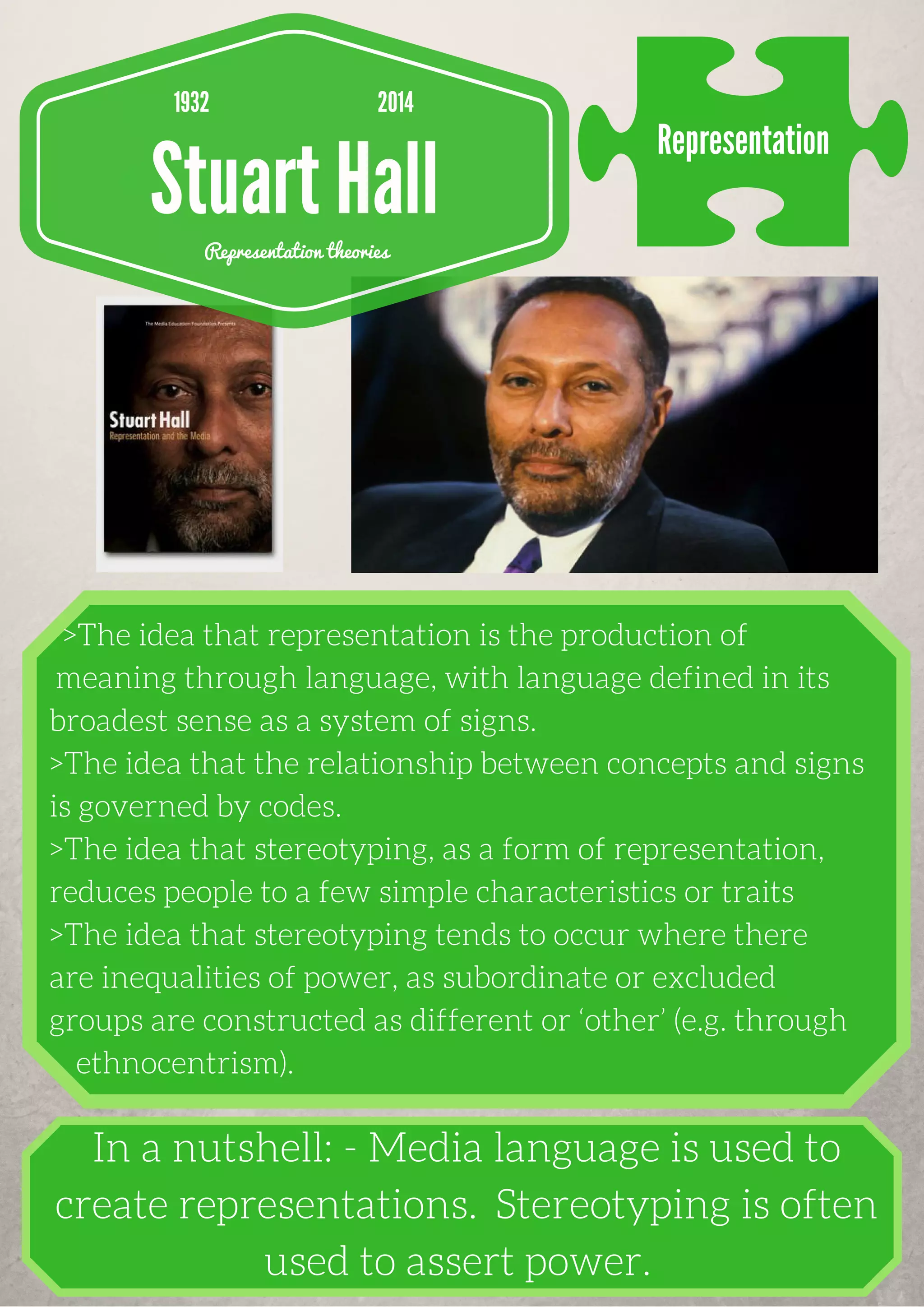
>The idea that representation is the production of  
 meaning through language, with language defined in its
broadest sense as a system of signs.
>The idea that the relationship between concepts and signs
is governed by codes.
>The idea that stereotyping, as a form of representation,
reduces people to a few simple characteristics or traits
>The idea that stereotyping tends to occur where there
are inequalities of power, as subordinate or excluded
groups are constructed as different or ‘other’ (e.g. through
    ethnocentrism).
Representation
In a nutshell: - Media language is used to
create representations.  Stereotyping is often
used to assert power.  
Stuart Hall
Representation theories
1932 2014
  >The idea that the media provide us with ‘tools’ or
resources that we use to construct our identities.
>The idea that whilst in the past the media tended to
convey singular, straightforward messages about ideal
types of male and female identities, the media today offer
us a more diverse range of stars, icons and characters
from whom we may pick and mix different ideas.
Representation
In a nutshell: - We use the Internet and
other media texts to help us to create our
identity.  We now have more of a variety of
representations to identify with.
David Gauntlett
Theories of Identity
1971
>The idea that gender is constructed through discourse,  
and that its meaning varies according to cultural and
historical context.
>The idea that the display of women’s bodies as objects to be
looked at is a core element of western patriarchal culture.
>The idea that in mainstream culture the visual and
narrative codes that are used to construct the male body as  
  spectacle differ from those used to objectify the female.
Representation
In a nutshell: -men and women are
represented differently in the media.
Women are objectified as a result of
Western culture.
Liesbet van Zoonen
Feminist Theory
1959
  >The idea that feminism is a struggle to end
sexist/patriarchal oppression and the ideology of
domination.
>The idea that feminism is a political commitment rather
than a lifestyle choice.
>The idea that race and class as well as sex determine the
extent to which individuals are exploited, discriminated          
     against or oppressed.
Representation
In a nutshell: - feminism is a political
struggle to end patriarchal domination and
other factors affect this domination,
including race and class.  
bell hooks
Feminist Theory
1952
  >The idea that identity is performatively constructed by
the very ‘expressions’ that are said to be its results (it is
manufactured through a set of acts).
> The idea that there is no gender identity behind the
expressions of gender.
>The idea that performativity is not a singular act, but a
repetition and a ritual.
Representation
In a nutshell: - Gender is a social construct -
'masculine' and 'feminine' are created
through repetition.  
Judith Butler
Gender Performativity
1956
 > The idea that colonial discourses continue to inform
contemporary attitudes to race and ethnicity in the
postcolonial era.
>The idea that civilisationism constructs racial hierarchies
and sets up binary oppositions based on notions of
otherness.
Representation
In a nutshell: - Even though we no longer
have colonies, the representation of these
groups is still affected by that time.  
Paul Gilroy
Ethnicity &
Postcolonialism
1956

Representation theories

  • 1.
      >The ideathat representation is the production of    meaning through language, with language defined in its broadest sense as a system of signs. >The idea that the relationship between concepts and signs is governed by codes. >The idea that stereotyping, as a form of representation, reduces people to a few simple characteristics or traits >The idea that stereotyping tends to occur where there are inequalities of power, as subordinate or excluded groups are constructed as different or ‘other’ (e.g. through     ethnocentrism). Representation In a nutshell: - Media language is used to create representations.  Stereotyping is often used to assert power.   Stuart Hall Representation theories 1932 2014
  • 2.
      >The ideathat the media provide us with ‘tools’ or resources that we use to construct our identities. >The idea that whilst in the past the media tended to convey singular, straightforward messages about ideal types of male and female identities, the media today offer us a more diverse range of stars, icons and characters from whom we may pick and mix different ideas. Representation In a nutshell: - We use the Internet and other media texts to help us to create our identity.  We now have more of a variety of representations to identify with. David Gauntlett Theories of Identity 1971
  • 3.
    >The idea thatgender is constructed through discourse,   and that its meaning varies according to cultural and historical context. >The idea that the display of women’s bodies as objects to be looked at is a core element of western patriarchal culture. >The idea that in mainstream culture the visual and narrative codes that are used to construct the male body as     spectacle differ from those used to objectify the female. Representation In a nutshell: -men and women are represented differently in the media. Women are objectified as a result of Western culture. Liesbet van Zoonen Feminist Theory 1959
  • 4.
      >The ideathat feminism is a struggle to end sexist/patriarchal oppression and the ideology of domination. >The idea that feminism is a political commitment rather than a lifestyle choice. >The idea that race and class as well as sex determine the extent to which individuals are exploited, discriminated                against or oppressed. Representation In a nutshell: - feminism is a political struggle to end patriarchal domination and other factors affect this domination, including race and class.   bell hooks Feminist Theory 1952
  • 5.
      >The ideathat identity is performatively constructed by the very ‘expressions’ that are said to be its results (it is manufactured through a set of acts). > The idea that there is no gender identity behind the expressions of gender. >The idea that performativity is not a singular act, but a repetition and a ritual. Representation In a nutshell: - Gender is a social construct - 'masculine' and 'feminine' are created through repetition.   Judith Butler Gender Performativity 1956
  • 6.
     > The idea thatcolonial discourses continue to inform contemporary attitudes to race and ethnicity in the postcolonial era. >The idea that civilisationism constructs racial hierarchies and sets up binary oppositions based on notions of otherness. Representation In a nutshell: - Even though we no longer have colonies, the representation of these groups is still affected by that time.   Paul Gilroy Ethnicity & Postcolonialism 1956