UNESCO Asia-Pacific
Education Thematic Brief
AUGUST 2016
Closingthe
gendergapinSTEM:
Background
A growing demand for professionals in Science,
Technology, Mathematics and Engineering (STEM) is met
with a significant labour shortage in these fields. Women
are often underrepresented in STEM, and their low levels
of participation can be traced back all the way to their
school years, where a number of influences from society
and culture, education and the labour market are all at
play. Based on the findings of UNESCO Bangkok’s 2015
publication - A Complex Formula: Girls and Women in
Science, Technology, Engineering and Mathematics
in Asia. Girls and Women in Science, Technology,
Engineering and Mathematics in Asia – this brief
highlights the importance of stimulating, encouraging
and supporting fair and equal opportunities for girls to
engage in STEM-related subjects at school, and to draw
more girls and women into STEM fields of study and
professions.
Why do we need more girls and women
in STEM?
STEM fields are crucial for sustainable development
as they enable us to find solutions to threats posed by
global challenges such as climate change, global health
epidemics, and increased income inequality.
The Sustainable Development Goals highlight both
the importance of STEM fields for a more peaceful and
prosperous world, as well as gender equality in terms of
ensuringequalaccesstohighereducationforwomenand
men alike. Despite rising demand for STEM professionals,
women, who represent over half the world population,
are often underrepresented in these fields. According to
a survey conducted by ManpowerGroup in 2015, there is
a global“talent shortage”of 38 per cent, with the top ten
hardest jobs to fill including a number of STEM-related
professions1
. At the same time, the UNESCO Institute for
Statistics (UIS) estimates that women make up just 28 per
cent of scientific researchers worldwide2
.
Where do we stand?
The low participation of girls and women in STEM
fields can be observed at all levels of education, with a
tendency for female participation to decrease as the level
of education rises. This is mirrored in the labour market
where their participation further decreases throughout
their career path, and women are largely absent in higher
level managerial and decision-making positions.
However, gender differences in STEM do not start in the
labour market, nor even in higher education – they begin
in the performance of students as young as 15 years
old in STEM-related subjects such as mathematics and
science. In countries where the gender gap in student
performance at the secondary education level is at the
expense of girls, women tend to be underrepresented
in STEM fields of study in higher education and in the
labour market. Girls also tend to do relatively better in
science as opposed to mathematics, which may explain
why they tend to choose science-related fields of study
in higher education such as biology, chemistry and
medicine as opposed to more mathematics-oriented
fields of such as physics and engineering, a tendency
which is then reflected in the labour market. The Asia-
Pacific region is incredibly diverse when it comes to
gender equality in education, and this can be observed
across various indicators such as gender differences in
learning achievement in mathematics and science, the
gender parity index (GPI) in tertiary education across
all fields, female participation in tertiary education
specifically within STEM fields, as well as the proportion
of female scientific researchers in the labour market.
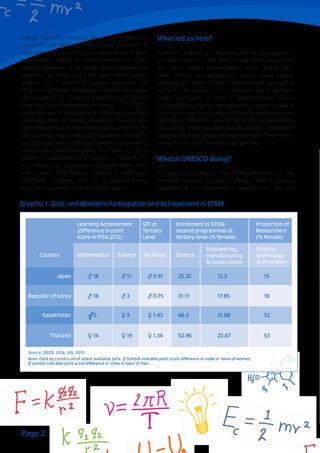
Graphic 1 illustrates different cases from selected
countries in the region.
The cases of Japan and the
Republic of Korea
DrawingmoregirlsandwomenintoScience, Technology,EngineeringandMathematics
Page 2
indicate that boys outscored girls in mathematics and
science in PISA 20123
, and that a higher proportion of
males are enrolled in tertiary education across all fields
than females. Looking at student enrolment in STEM-
related programmes at the tertiary level, a relatively low
proportion are female, and in the labour market women
make up only 15 percent of Japanese researchers and
18 per cent of Korean researchers in science, technology
and innovation. By contrast, in Kazakhstan and Thailand
more than half of researchers are female. In PISA 2012,
Kazakhstan saw an equal score in mathematics and girls
outscoring boys in science, whereas in Thailand girls
outscoredboysinbothmathematicsandscience.Inthese
two countries, more than half of students enrolled in
science programmes are female; however in engineering,
manufacturing and construction, they make up just 32
percent in Kazakhstan and 24 percent in Thailand. This
may indicate the concentration of women within more
science-based STEM fields as opposed to math-based
STEM fields – a pattern which can be observed among
many other countries in the Asia-Pacific region.
What led us here?
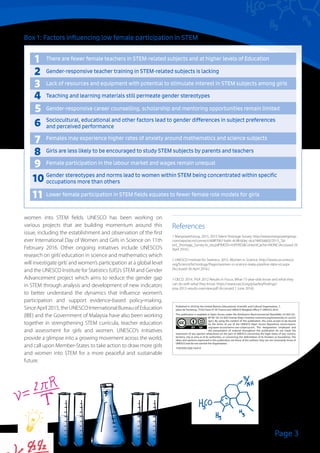
A number of factors are influencing the low participation of
girls and women in STEM. These include wider sociocultural
and labour market preconceptions which greatly affect
career choices and perspectives among young people,
especially with regard to which professions are perceived as
well-suited for women or men. Education has a significant
impact, particularly in terms of gender-sensitive policies
and frameworks, teacher training and recruitment, as well as
ensuringthatlearningmaterialsarefreeofgenderstereotypes.
Psychosocial influences are also not to be underestimated,
particularlyinshapingstudentattitudestowardsSTEM-related
subjects, which can greatly influence levels of achievement as
well as future career choices and perspectives.
What is UNESCO doing?
As today’s world requires more STEM professionals to find
innovative solutions to global challenges, there is growing
awareness of the importance of drawing more girls and
Graphic 1: Girls’ and Women’s Participation and Achievement in STEM
Country
Japan
Republic of Korea
Kazakhstan
Thailand
Learning Achievement
(difference in point
score in PISA 2012)
GPI at
Tertiary
Level
Enrollment in STEM-
related programmes at
tertiary level (% female)
Proportion of
Researchers
(% female)
Science,
technology
& innovation
♀ 1.43 52
♀ 1.34 53
♂ 0.91 15
♂ 0.75 18
Engineering,
manufacturing
& construction
66.3 31.88
52.96 23.67
25.32 12.2
31.11 17.85
Mathematics Science All fields Science
♂ 18 ♂ 11
♂ 3
♀ 9
♀ 19
♂ 18
0
♀ 14
Source: OECD, 2014; UIS, 2015
Note: Data by country as of latest available data. ♀ Symbol indicates point score difference or index in favor of women;
♂ symbol indicates point score difference or index in favor of men.
♂
♀
Page 3
Box 1: Factors influencing low female participation in STEM
women into STEM fields. UNESCO has been working on
various projects that are building momentum around this
issue, including the establishment and observation of the first
ever International Day of Women and Girls in Science on 11th
February 2016. Other ongoing initiatives include UNESCO’s
research on girls’education in science and mathematics which
will investigate girls’and women’s participation at a global level
and the UNESCO Institute for Statistics (UIS)’s STEM and Gender
Advancement project which aims to reduce the gender gap
in STEM through analysis and development of new indicators
to better understand the dynamics that influence women’s
participation and support evidence-based policy-making.
SinceApril2015,theUNESCOInternationalBureauofEducation
(IBE) and the Government of Malaysia have also been working
together in strengthening STEM curricula, teacher education
and assessment for girls and women. UNESCO’s initiatives
provide a glimpse into a growing movement across the world,
and call upon Member-States to take action to draw more girls
and women into STEM for a more peaceful and sustainable
future.
There are fewer female teachers in STEM-related subjects and at higher levels of Education
Gender-responsive teacher training in STEM-related subjects is lacking
Lack of resources and equipment with potential to stimulate interest in STEM subjects among girls
Teaching and learning materials still permeate gender stereotypes
Gender-responsive career counselling, scholarship and mentoring opportunities remain limited
Sociocultural, educational and other factors lead to gender differences in subject preferences
and perceived performance
Females may experience higher rates of anxiety around mathematics and science subjects
Girls are less likely to be encouraged to study STEM subjects by parents and teachers
Female participation in the labour market and wages remain unequal
Gender stereotypes and norms lead to women within STEM being concentrated within specific
occupations more than others
Lower female participation in STEM fields equates to fewer female role models for girls
1
3
5
7
9
11
2
4
6
8
10
References
1 ManpowerGroup. 2015. 2015 Talent Shortage Survey. http://www.manpowergroup.
com/wps/wcm/connect/408f7067-ba9c-4c98-b0ec-dca74403a802/2015_Tal-
ent_Shortage_Survey-lo_res.pdf?MOD=AJPERES&ContentCache=NONE (Accessed 26
April 2016.)
2 UNESCO Institute for Statistics. 2015. Women in Science. http://www.uis.unesco.
org/ScienceTechnology/Pages/women-in-science-leaky-pipeline-data-viz.aspx
(Accessed 26 April 2016.)
3 OECD. 2014. PISA 2012 Results in Focus. What 15-year-olds know and what they
can do with what they know. https://www.oecd.org/pisa/keyfindings/
pisa-2012-results-overview.pdf (Accessed 1 June 2016)
Published in 2016 by the United Nations Educational, Scientific and Cultural Organization, 7,
place de Fontenoy, 75352 Paris 07 SP, France and UNESCO Bangkok Office © UNESCO 2016
This publication is available in Open Access under the Attribution-NonCommercial-ShareAlike 3.0 IGO (CC-
BY-NC-SA 3.0 IGO) license (http://creative­commons.org/licenses/by-nc-sa/3.0/
igo/). By using the content of this publication, the users accept to be bound
by the terms of use of the UNESCO Open Access Repository (www.unesco.
org/open-access/terms-use-ccbyncsa-en). The designations employed and
the presentation of material throughout this publication do not imply the
expression of any opinion whatsoever on the part of UNESCO concerning the legal status of any country,
territory, city or area or of its authorities, or concerning the delimitation of its frontiers or boundaries. The
ideas and opinions expressed in this publication are those of the authors; they are not necessarily those of
UNESCO and do not commit the Organization.
THA/DOC/IQE/16/010
Page 4
Policy recommendations
The Way Forward:
Data disaggregated by sex is needed to conduct in-depth analysis
at country level and help provide a clearer picture of women and
girls’ participation within STEM. This data helps to inform policies
and programmes for increased participation of women in STEM-
related education and employment sectors. Curricula and learning
materials should undergo
further rigorous review from a
gender perspective to ensure
that they do not perpetuate
gender stereotypes. This
involves a representative group
of stakeholders with male and
female experts in order to
ensure different perspectives.
Structured and formalized gender responsive career counselling
programmes should be considered in order for both female and
male students to have support and objective guidance as they begin
to shape their career choices.
Appropriate funding for
equipment and resources
should be allocated in order to
stimulate student interest in
STEM, particularly among female
students. Allowing students to
practically apply their learning
in real-life situations as well as
creative and hands-on experiments
will not only contribute to
enhancing the quality of learning
but also increasing student
interest in learning these subjects.
Gender-responsive action
from governments, through
education and labour market
policies, enforcement of
gender-related laws, as well
as specific initiatives for
advocacy and awareness
raising, is needed to attract
more women and girls into
STEM fields.
Scholarship programmes targeted at women and girls in STEM
would also contribute to increased opportunities for young women
to pursue further study and eventually careers in STEM fields.
For the effective
implementation of gender-
sensitive STEM policies,
coordination between
ministries must be
strengthened. This may
involve joint programmes
across various government
sectors such as ministries of
education, women’s affairs
or gender equality, science,
technology and innovation,
and labour.
Teacher education, be they pre-and
in-service programmes, should
ensure that teachers are trained
in gender responsive teaching
strategies so that female and male
students can develop their full
potential in STEM-related subjects.
Promoting more female
role models in STEM fields,
whether female teachers
in mathematics and
science at the secondary
level, female students
and faculty members in
higher education, and
more broadly more women
working in STEM fields, is
an important strategy to
attract women and girls
into STEM fields.
Support programmes and initiatives
for female STEM professionals would
help to address some of the factors
which can cause them to discontinue
their careers, including family
responsibilities. This will equip them
with the most up-to-date knowledge
and skills in fields which experience
fast-paced change and innovation.
Teacher education and policies
on recruitment must ensure a fair
representation of both male and
female teachers in all subjects,
especially In STEM and at all levels of
education.
There are a number of implications for policymakers that could be considered
in order to increase female participation in STEM fields of study and work.These
include gender-responsive action across Ministries in order to create more
opportunities for girls and women to study and pursue careers in STEM, as well
as investment and review of education policies and frameworks to stimulate
interest in STEM-related subjects among girls.
Recommendations extracted from A Complex Formula:
Girls and Women in Science, Technology, Engineering and
Mathematics in Asia. (UNESCO Bangkok and KWDI, 2015).
Download the publication here:

Closing the gender gap eng

  • 1.
    UNESCO Asia-Pacific Education ThematicBrief AUGUST 2016 Closingthe gendergapinSTEM: Background A growing demand for professionals in Science, Technology, Mathematics and Engineering (STEM) is met with a significant labour shortage in these fields. Women are often underrepresented in STEM, and their low levels of participation can be traced back all the way to their school years, where a number of influences from society and culture, education and the labour market are all at play. Based on the findings of UNESCO Bangkok’s 2015 publication - A Complex Formula: Girls and Women in Science, Technology, Engineering and Mathematics in Asia. Girls and Women in Science, Technology, Engineering and Mathematics in Asia – this brief highlights the importance of stimulating, encouraging and supporting fair and equal opportunities for girls to engage in STEM-related subjects at school, and to draw more girls and women into STEM fields of study and professions. Why do we need more girls and women in STEM? STEM fields are crucial for sustainable development as they enable us to find solutions to threats posed by global challenges such as climate change, global health epidemics, and increased income inequality. The Sustainable Development Goals highlight both the importance of STEM fields for a more peaceful and prosperous world, as well as gender equality in terms of ensuringequalaccesstohighereducationforwomenand men alike. Despite rising demand for STEM professionals, women, who represent over half the world population, are often underrepresented in these fields. According to a survey conducted by ManpowerGroup in 2015, there is a global“talent shortage”of 38 per cent, with the top ten hardest jobs to fill including a number of STEM-related professions1 . At the same time, the UNESCO Institute for Statistics (UIS) estimates that women make up just 28 per cent of scientific researchers worldwide2 . Where do we stand? The low participation of girls and women in STEM fields can be observed at all levels of education, with a tendency for female participation to decrease as the level of education rises. This is mirrored in the labour market where their participation further decreases throughout their career path, and women are largely absent in higher level managerial and decision-making positions. However, gender differences in STEM do not start in the labour market, nor even in higher education – they begin in the performance of students as young as 15 years old in STEM-related subjects such as mathematics and science. In countries where the gender gap in student performance at the secondary education level is at the expense of girls, women tend to be underrepresented in STEM fields of study in higher education and in the labour market. Girls also tend to do relatively better in science as opposed to mathematics, which may explain why they tend to choose science-related fields of study in higher education such as biology, chemistry and medicine as opposed to more mathematics-oriented fields of such as physics and engineering, a tendency which is then reflected in the labour market. The Asia- Pacific region is incredibly diverse when it comes to gender equality in education, and this can be observed across various indicators such as gender differences in learning achievement in mathematics and science, the gender parity index (GPI) in tertiary education across all fields, female participation in tertiary education specifically within STEM fields, as well as the proportion of female scientific researchers in the labour market. Graphic 1 illustrates different cases from selected countries in the region. The cases of Japan and the Republic of Korea DrawingmoregirlsandwomenintoScience, Technology,EngineeringandMathematics
  • 2.
    Page 2 indicate thatboys outscored girls in mathematics and science in PISA 20123 , and that a higher proportion of males are enrolled in tertiary education across all fields than females. Looking at student enrolment in STEM- related programmes at the tertiary level, a relatively low proportion are female, and in the labour market women make up only 15 percent of Japanese researchers and 18 per cent of Korean researchers in science, technology and innovation. By contrast, in Kazakhstan and Thailand more than half of researchers are female. In PISA 2012, Kazakhstan saw an equal score in mathematics and girls outscoring boys in science, whereas in Thailand girls outscoredboysinbothmathematicsandscience.Inthese two countries, more than half of students enrolled in science programmes are female; however in engineering, manufacturing and construction, they make up just 32 percent in Kazakhstan and 24 percent in Thailand. This may indicate the concentration of women within more science-based STEM fields as opposed to math-based STEM fields – a pattern which can be observed among many other countries in the Asia-Pacific region. What led us here? A number of factors are influencing the low participation of girls and women in STEM. These include wider sociocultural and labour market preconceptions which greatly affect career choices and perspectives among young people, especially with regard to which professions are perceived as well-suited for women or men. Education has a significant impact, particularly in terms of gender-sensitive policies and frameworks, teacher training and recruitment, as well as ensuringthatlearningmaterialsarefreeofgenderstereotypes. Psychosocial influences are also not to be underestimated, particularlyinshapingstudentattitudestowardsSTEM-related subjects, which can greatly influence levels of achievement as well as future career choices and perspectives. What is UNESCO doing? As today’s world requires more STEM professionals to find innovative solutions to global challenges, there is growing awareness of the importance of drawing more girls and Graphic 1: Girls’ and Women’s Participation and Achievement in STEM Country Japan Republic of Korea Kazakhstan Thailand Learning Achievement (difference in point score in PISA 2012) GPI at Tertiary Level Enrollment in STEM- related programmes at tertiary level (% female) Proportion of Researchers (% female) Science, technology & innovation ♀ 1.43 52 ♀ 1.34 53 ♂ 0.91 15 ♂ 0.75 18 Engineering, manufacturing & construction 66.3 31.88 52.96 23.67 25.32 12.2 31.11 17.85 Mathematics Science All fields Science ♂ 18 ♂ 11 ♂ 3 ♀ 9 ♀ 19 ♂ 18 0 ♀ 14 Source: OECD, 2014; UIS, 2015 Note: Data by country as of latest available data. ♀ Symbol indicates point score difference or index in favor of women; ♂ symbol indicates point score difference or index in favor of men. ♂ ♀
  • 3.
    Page 3 Box 1:Factors influencing low female participation in STEM women into STEM fields. UNESCO has been working on various projects that are building momentum around this issue, including the establishment and observation of the first ever International Day of Women and Girls in Science on 11th February 2016. Other ongoing initiatives include UNESCO’s research on girls’education in science and mathematics which will investigate girls’and women’s participation at a global level and the UNESCO Institute for Statistics (UIS)’s STEM and Gender Advancement project which aims to reduce the gender gap in STEM through analysis and development of new indicators to better understand the dynamics that influence women’s participation and support evidence-based policy-making. SinceApril2015,theUNESCOInternationalBureauofEducation (IBE) and the Government of Malaysia have also been working together in strengthening STEM curricula, teacher education and assessment for girls and women. UNESCO’s initiatives provide a glimpse into a growing movement across the world, and call upon Member-States to take action to draw more girls and women into STEM for a more peaceful and sustainable future. There are fewer female teachers in STEM-related subjects and at higher levels of Education Gender-responsive teacher training in STEM-related subjects is lacking Lack of resources and equipment with potential to stimulate interest in STEM subjects among girls Teaching and learning materials still permeate gender stereotypes Gender-responsive career counselling, scholarship and mentoring opportunities remain limited Sociocultural, educational and other factors lead to gender differences in subject preferences and perceived performance Females may experience higher rates of anxiety around mathematics and science subjects Girls are less likely to be encouraged to study STEM subjects by parents and teachers Female participation in the labour market and wages remain unequal Gender stereotypes and norms lead to women within STEM being concentrated within specific occupations more than others Lower female participation in STEM fields equates to fewer female role models for girls 1 3 5 7 9 11 2 4 6 8 10 References 1 ManpowerGroup. 2015. 2015 Talent Shortage Survey. http://www.manpowergroup. com/wps/wcm/connect/408f7067-ba9c-4c98-b0ec-dca74403a802/2015_Tal- ent_Shortage_Survey-lo_res.pdf?MOD=AJPERES&ContentCache=NONE (Accessed 26 April 2016.) 2 UNESCO Institute for Statistics. 2015. Women in Science. http://www.uis.unesco. org/ScienceTechnology/Pages/women-in-science-leaky-pipeline-data-viz.aspx (Accessed 26 April 2016.) 3 OECD. 2014. PISA 2012 Results in Focus. What 15-year-olds know and what they can do with what they know. https://www.oecd.org/pisa/keyfindings/ pisa-2012-results-overview.pdf (Accessed 1 June 2016) Published in 2016 by the United Nations Educational, Scientific and Cultural Organization, 7, place de Fontenoy, 75352 Paris 07 SP, France and UNESCO Bangkok Office © UNESCO 2016 This publication is available in Open Access under the Attribution-NonCommercial-ShareAlike 3.0 IGO (CC- BY-NC-SA 3.0 IGO) license (http://creative­commons.org/licenses/by-nc-sa/3.0/ igo/). By using the content of this publication, the users accept to be bound by the terms of use of the UNESCO Open Access Repository (www.unesco. org/open-access/terms-use-ccbyncsa-en). The designations employed and the presentation of material throughout this publication do not imply the expression of any opinion whatsoever on the part of UNESCO concerning the legal status of any country, territory, city or area or of its authorities, or concerning the delimitation of its frontiers or boundaries. The ideas and opinions expressed in this publication are those of the authors; they are not necessarily those of UNESCO and do not commit the Organization. THA/DOC/IQE/16/010
  • 4.
    Page 4 Policy recommendations TheWay Forward: Data disaggregated by sex is needed to conduct in-depth analysis at country level and help provide a clearer picture of women and girls’ participation within STEM. This data helps to inform policies and programmes for increased participation of women in STEM- related education and employment sectors. Curricula and learning materials should undergo further rigorous review from a gender perspective to ensure that they do not perpetuate gender stereotypes. This involves a representative group of stakeholders with male and female experts in order to ensure different perspectives. Structured and formalized gender responsive career counselling programmes should be considered in order for both female and male students to have support and objective guidance as they begin to shape their career choices. Appropriate funding for equipment and resources should be allocated in order to stimulate student interest in STEM, particularly among female students. Allowing students to practically apply their learning in real-life situations as well as creative and hands-on experiments will not only contribute to enhancing the quality of learning but also increasing student interest in learning these subjects. Gender-responsive action from governments, through education and labour market policies, enforcement of gender-related laws, as well as specific initiatives for advocacy and awareness raising, is needed to attract more women and girls into STEM fields. Scholarship programmes targeted at women and girls in STEM would also contribute to increased opportunities for young women to pursue further study and eventually careers in STEM fields. For the effective implementation of gender- sensitive STEM policies, coordination between ministries must be strengthened. This may involve joint programmes across various government sectors such as ministries of education, women’s affairs or gender equality, science, technology and innovation, and labour. Teacher education, be they pre-and in-service programmes, should ensure that teachers are trained in gender responsive teaching strategies so that female and male students can develop their full potential in STEM-related subjects. Promoting more female role models in STEM fields, whether female teachers in mathematics and science at the secondary level, female students and faculty members in higher education, and more broadly more women working in STEM fields, is an important strategy to attract women and girls into STEM fields. Support programmes and initiatives for female STEM professionals would help to address some of the factors which can cause them to discontinue their careers, including family responsibilities. This will equip them with the most up-to-date knowledge and skills in fields which experience fast-paced change and innovation. Teacher education and policies on recruitment must ensure a fair representation of both male and female teachers in all subjects, especially In STEM and at all levels of education. There are a number of implications for policymakers that could be considered in order to increase female participation in STEM fields of study and work.These include gender-responsive action across Ministries in order to create more opportunities for girls and women to study and pursue careers in STEM, as well as investment and review of education policies and frameworks to stimulate interest in STEM-related subjects among girls. Recommendations extracted from A Complex Formula: Girls and Women in Science, Technology, Engineering and Mathematics in Asia. (UNESCO Bangkok and KWDI, 2015). Download the publication here: