Restricted Use - À usage restreint
How to design and deliver higher technical education to develop in-demand skills
OECD Education and Skills Today webinar
3 June 2025
Restricted Use - À usage restreint
What is higher technical education?
ISCED level 5
Sitting between
upper-secondary
and bachelor’s
level programmes
Practically oriented/
occupationally
specific/ vocational
For the purpose of this webinar, higher technical education is defined as vocational short-cycle
tertiary education programmes, at Level 5 of the International Standard Classification of Education
(ISCED)
ISCED level 5 typically has a minimum duration of two years and is typically but not always
shorter than three years. The content of programmes at this level is more complex than in
secondary (ISCED level 3) or post-secondary non-tertiary education (ISCED level 4), but less than
in ISCED level 6 (Bachelor’s or equivalent level) programmes.
«Designed for learners to acquire the knowledge, skills and competencies specific to a particular
occupation, trade, or class of occupations or trades.»
«Successful completion leads to labour market-relevant vocational qualifications acknowledged as
occupationally oriented by the relevant national authorities and/or the labour market.»
(ISCED 2011 definition)
Countries differ in how to define and refer to « higher technical education ».
In many cases it aligns most closely with programmes that fall under ISCED level 5.
Restricted Use - À usage restreint
What is higher technical education? – a few examples
Ontario
(Canada)
Diploma programmes, certificate programmes and advanced diplomas - delivered predominantly
through the 24 public colleges of applied arts and technology.
Denmark Academy profession programmes delivered by eight business academies, full-time and part-time
(for learners with relevant labour market experience).
England (UK)
Certificates, diplomas and foundation degrees, provided by Further Education (FE) providers,
universities and independent training providers. Also apprenticeships at ISCED level 5, but treated
seperately from HTE in England.
France 2-year Brevet de Technicien Supérieur (BTS) programmes, offered in high schools, apprentice
training centres, continuing vocational training centres and distance-learning establishments.
Sweden One-to-two year higher vocational education (HVE) programmes delivered by a variety of
providers.
Austria Vocational colleges programmes (BHS – Berufsbildende Höhere Schulen), combining ISCED level
3 and 5 training typically for students aged 15-19.
Restricted Use - À usage restreint
Short-cycle tertiary programmes come in many shapes and forms
Typically 2 years (but ranging from 1 to 3 years)
Provided across different fields,
but sometimes only available in a narrow set of fields (e.g. performing arts in Czech
Republic)
Delivered in different types of institutions:
e.g. upper-secondary schools, colleges/universities of applied sciences; universities; adult
learning centres
Commonly including mandatory or optional work-based learning periods
Often providing articulation with bachelor programmes, in many cases with shorter duration
(sometimes only in the same field or institution)
Various target audiences, but often attractive to adult learners
Restricted Use - À usage restreint
The importance of higher technical education in the broader VET system differs strongly between countries
Italy
Bulgaria
Luxembourg
Netherlands
Slovenia
Croatia
Poland
Iceland
Estonia
Israel
Hungary
United Kingdom
Greece
Germany
Mexico
Brazil
Australia
New
Zealand
Korea
0
10
20
30
40
50
60
70
80
90
100
Lower secondary Upper secondary Post-secondary non-tertiary Shorty-cycle tertiary
Distribution of vocational/professional students over education levels (ISCED 2-5, 2021)
Source: OECD Education at a Glance 2023
Restricted Use - À usage restreint
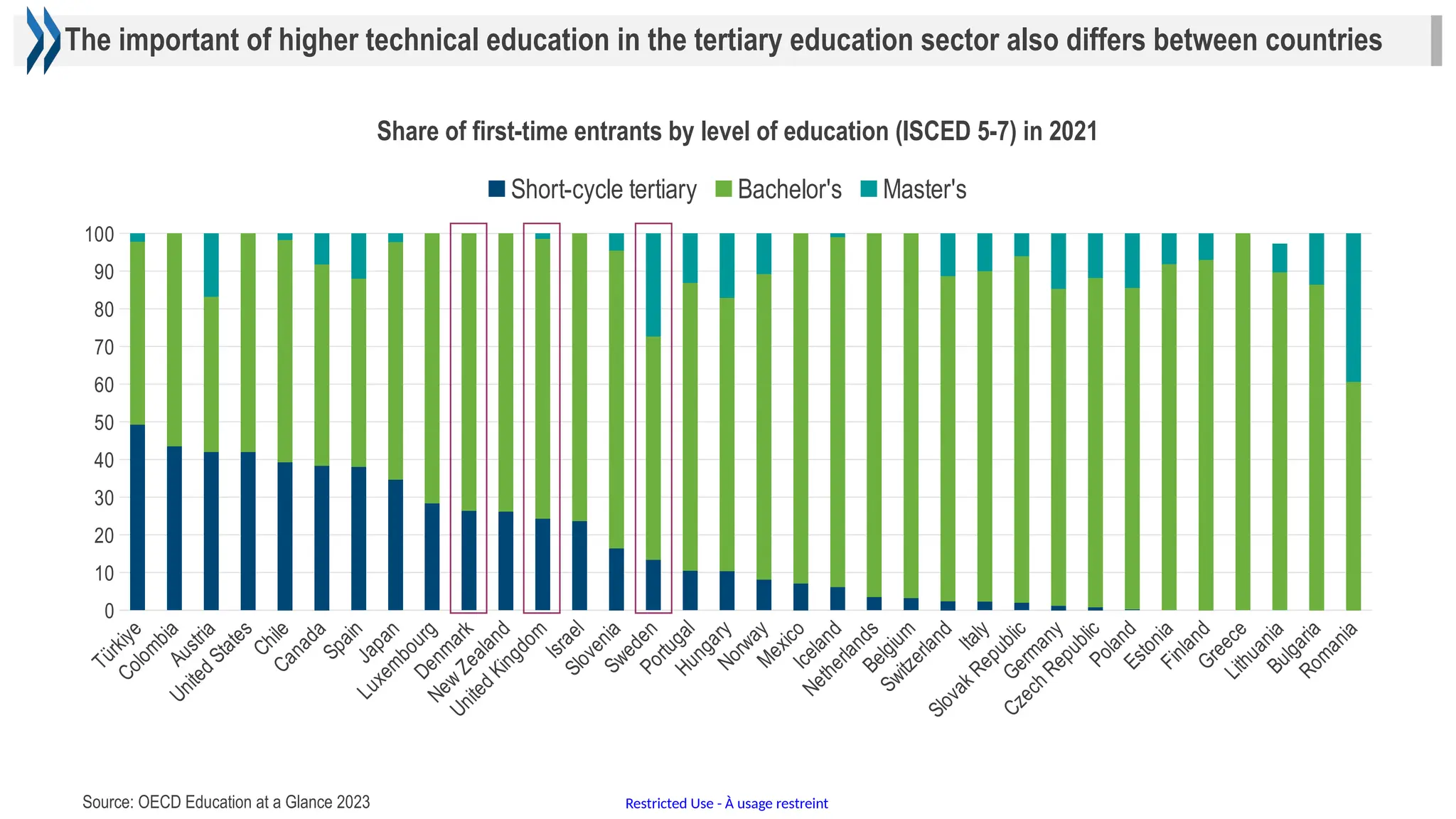
The important of higher technical education in the tertiary education sector also differs between countries
Source: OECD Education at a Glance 2023
Türkiye
Colombia
Austria
United States
Chile
Canada
Spain
Japan
Luxem
bourg
Denmark
New
Zealand
United Kingdom
Israel
Slovenia
Sweden
Portugal
Hungary
Norway
Mexico
Iceland
Netherlands
Belgium
Switzerland
Italy
Slovak Republic
Germany
Czech Republic
Poland
Estonia
Finland
Greece
Lithuania
Bulgaria
Romania
0
10
20
30
40
50
60
70
80
90
100
Short-cycle tertiary Bachelor's Master's
Share of first-time entrants by level of education (ISCED 5-7) in 2021
Restricted Use - À usage restreint
Distribution of short-cycle tertiary graduates by field of study (2018)
There is considerable variation in the breadth of the fields covered by higher technical programmes
Source: OECD (2020[10]) Education at a Glance”, Education and Training – Education at a Glance
(database), https://stats.oecd.org/.
Restricted Use - À usage restreint
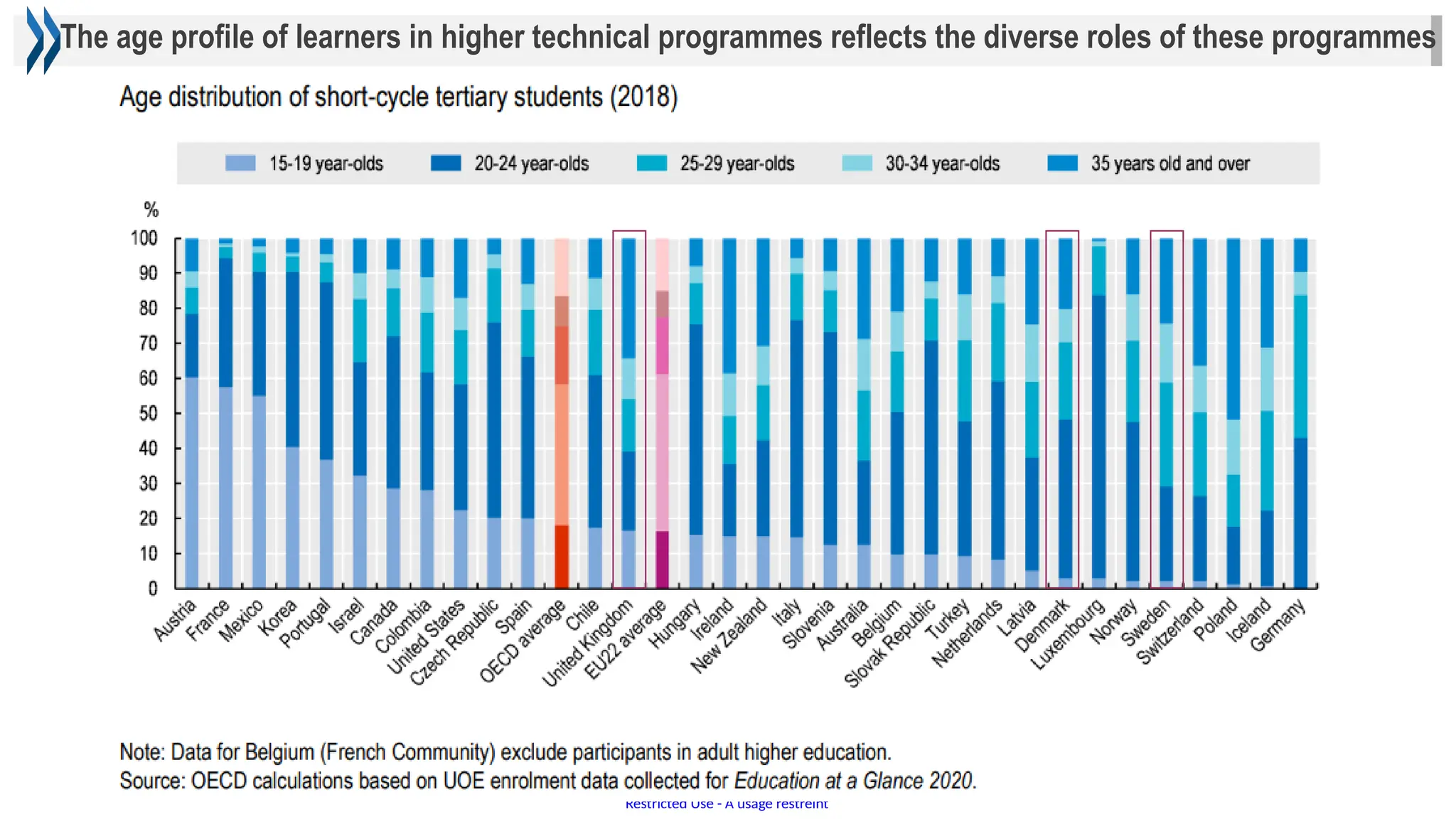
The age profile of learners in higher technical programmes reflects the diverse roles of these programmes
Restricted Use - À usage restreint
Higher technical programmes welcome learners from diverse education backgrounds
* 1. Note by Türkiye: The information in this document with reference to “Cyprus” relates to the southern part of the Island. There is no single authority representing both Turkish and Greek Cypriot people on the Island. Türkiye
recognises the Turkish Republic of Northern Cyprus (TRNC). Until a lasting and equitable solution is found within the context of the United Nations, Türkiye shall preserve its position concerning the “Cyprus issue”.
2. Note by all the European Union Member States of the OECD and the European Union: The Republic of Cyprus is recognised by all members of the United Nations with the exception of Türkiye. The information in this document
relates to the area under the effective control of the Government of the Republic of Cyprus.
Restricted Use - À usage restreint
Find out more
Supported by the Gatsby Charitable Foundation
Contact: oecdcentre4skills@oecd.org
https://www.oecd.org/en/topics/sub-issues/
vocational-education-and-training-vet.html
@OECD_Social
@OECDEduSkills

Stewart Butler - OECD - How to design and deliver higher technical education to develop in-demand skills.pptx

  • 1.
    Restricted Use -À usage restreint How to design and deliver higher technical education to develop in-demand skills OECD Education and Skills Today webinar 3 June 2025
  • 2.
    Restricted Use -À usage restreint What is higher technical education? ISCED level 5 Sitting between upper-secondary and bachelor’s level programmes Practically oriented/ occupationally specific/ vocational For the purpose of this webinar, higher technical education is defined as vocational short-cycle tertiary education programmes, at Level 5 of the International Standard Classification of Education (ISCED) ISCED level 5 typically has a minimum duration of two years and is typically but not always shorter than three years. The content of programmes at this level is more complex than in secondary (ISCED level 3) or post-secondary non-tertiary education (ISCED level 4), but less than in ISCED level 6 (Bachelor’s or equivalent level) programmes. «Designed for learners to acquire the knowledge, skills and competencies specific to a particular occupation, trade, or class of occupations or trades.» «Successful completion leads to labour market-relevant vocational qualifications acknowledged as occupationally oriented by the relevant national authorities and/or the labour market.» (ISCED 2011 definition) Countries differ in how to define and refer to « higher technical education ». In many cases it aligns most closely with programmes that fall under ISCED level 5.
  • 3.
    Restricted Use -À usage restreint What is higher technical education? – a few examples Ontario (Canada) Diploma programmes, certificate programmes and advanced diplomas - delivered predominantly through the 24 public colleges of applied arts and technology. Denmark Academy profession programmes delivered by eight business academies, full-time and part-time (for learners with relevant labour market experience). England (UK) Certificates, diplomas and foundation degrees, provided by Further Education (FE) providers, universities and independent training providers. Also apprenticeships at ISCED level 5, but treated seperately from HTE in England. France 2-year Brevet de Technicien Supérieur (BTS) programmes, offered in high schools, apprentice training centres, continuing vocational training centres and distance-learning establishments. Sweden One-to-two year higher vocational education (HVE) programmes delivered by a variety of providers. Austria Vocational colleges programmes (BHS – Berufsbildende Höhere Schulen), combining ISCED level 3 and 5 training typically for students aged 15-19.
  • 4.
    Restricted Use -À usage restreint Short-cycle tertiary programmes come in many shapes and forms Typically 2 years (but ranging from 1 to 3 years) Provided across different fields, but sometimes only available in a narrow set of fields (e.g. performing arts in Czech Republic) Delivered in different types of institutions: e.g. upper-secondary schools, colleges/universities of applied sciences; universities; adult learning centres Commonly including mandatory or optional work-based learning periods Often providing articulation with bachelor programmes, in many cases with shorter duration (sometimes only in the same field or institution) Various target audiences, but often attractive to adult learners
  • 5.
    Restricted Use -À usage restreint The importance of higher technical education in the broader VET system differs strongly between countries Italy Bulgaria Luxembourg Netherlands Slovenia Croatia Poland Iceland Estonia Israel Hungary United Kingdom Greece Germany Mexico Brazil Australia New Zealand Korea 0 10 20 30 40 50 60 70 80 90 100 Lower secondary Upper secondary Post-secondary non-tertiary Shorty-cycle tertiary Distribution of vocational/professional students over education levels (ISCED 2-5, 2021) Source: OECD Education at a Glance 2023
  • 6.
    Restricted Use -À usage restreint The important of higher technical education in the tertiary education sector also differs between countries Source: OECD Education at a Glance 2023 Türkiye Colombia Austria United States Chile Canada Spain Japan Luxem bourg Denmark New Zealand United Kingdom Israel Slovenia Sweden Portugal Hungary Norway Mexico Iceland Netherlands Belgium Switzerland Italy Slovak Republic Germany Czech Republic Poland Estonia Finland Greece Lithuania Bulgaria Romania 0 10 20 30 40 50 60 70 80 90 100 Short-cycle tertiary Bachelor's Master's Share of first-time entrants by level of education (ISCED 5-7) in 2021
  • 7.
    Restricted Use -À usage restreint Distribution of short-cycle tertiary graduates by field of study (2018) There is considerable variation in the breadth of the fields covered by higher technical programmes Source: OECD (2020[10]) Education at a Glance”, Education and Training – Education at a Glance (database), https://stats.oecd.org/.
  • 8.
    Restricted Use -À usage restreint The age profile of learners in higher technical programmes reflects the diverse roles of these programmes
  • 9.
    Restricted Use -À usage restreint Higher technical programmes welcome learners from diverse education backgrounds * 1. Note by Türkiye: The information in this document with reference to “Cyprus” relates to the southern part of the Island. There is no single authority representing both Turkish and Greek Cypriot people on the Island. Türkiye recognises the Turkish Republic of Northern Cyprus (TRNC). Until a lasting and equitable solution is found within the context of the United Nations, Türkiye shall preserve its position concerning the “Cyprus issue”. 2. Note by all the European Union Member States of the OECD and the European Union: The Republic of Cyprus is recognised by all members of the United Nations with the exception of Türkiye. The information in this document relates to the area under the effective control of the Government of the Republic of Cyprus.
  • 10.
    Restricted Use -À usage restreint Find out more Supported by the Gatsby Charitable Foundation Contact: oecdcentre4skills@oecd.org https://www.oecd.org/en/topics/sub-issues/ vocational-education-and-training-vet.html @OECD_Social @OECDEduSkills