TRENDS SHAPING
EDUCATION 2016
Trends Shaping Education
• Intention and purpose
– Inform strategic thinking
– Stimulate reflection
about the future of
education
─ NOT a statistical
compendium nor a
prescription for policy
2
Trends Shaping Education 2016
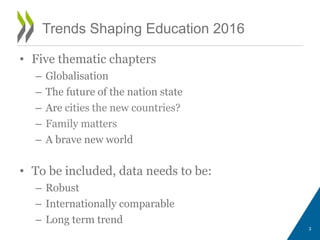
• Five thematic chapters
– Globalisation
– The future of the nation state
– Are cities the new countries?
– Family matters
– A brave new world
• To be included, data needs to be:
– Robust
– Internationally comparable
– Long term trend
3
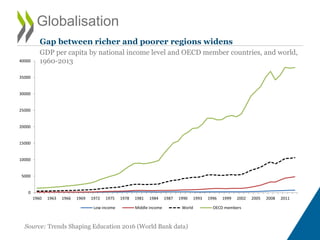
Source: Trends Shaping Education 2016 (World Bank data)
0
5000
10000
15000
20000
25000
30000
35000
40000
1960 1963 1966 1969 1972 1975 1978 1981 1984 1987 1990 1993 1996 1999 2002 2005 2008 2011
Low income Middle income World OECD members
Gap between richer and poorer regions widens
GDP per capita by national income level and OECD member countries, and world,
1960-2013
Globalisation
4% 4% 4% 4%
5%
5%
6%
7%
8%
8%
9%
0%
1%
2%
3%
4%
5%
6%
7%
8%
9%
10%
1960 1965 1970 1975 1980 1985 1990 1995 2000 2005 2010
Middle income Low income World OECD members
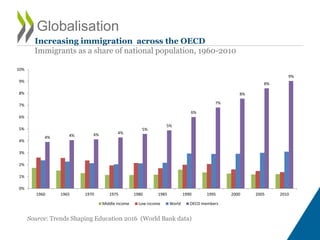
Source: Trends Shaping Education 2016 (World Bank data)
Increasing immigration across the OECD
Immigrants as a share of national population, 1960-2010
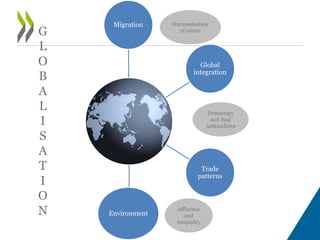
Globalisation
Migration
Global
integration
Trade
patterns
Environment
Harmonisation
of values
Affluence
and
inequality
Democracy
and dual
nationalities
G
L
O
B
A
L
I
S
A
T
I
O
N
Source: Trends Shaping Education 2016 (OECD data)
55
60
65
70
75
80
85
90
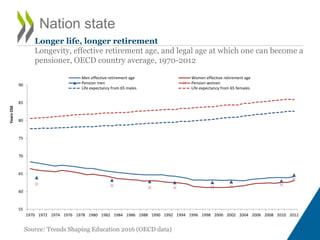
1970 1972 1974 1976 1978 1980 1982 1984 1986 1988 1990 1992 1994 1996 1998 2000 2002 2004 2006 2008 2010 2012
Men effective retirement age Women effective retirement age
Pension men Pension women
Life expectancy from 65 males Life expectancy from 65 females
YearsOld
Longer life, longer retirement
Longevity, effective retirement age, and legal age at which one can become a
pensioner, OECD country average, 1970-2012
Nation state
Nation state
Source: Trends Shaping Education 2016 (OECD data)
8
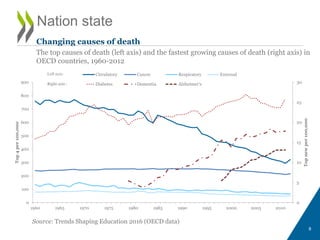
Changing causes of death
The top causes of death (left axis) and the fastest growing causes of death (right axis) in
OECD countries, 1960-2012
0
5
10
15
20
25
30
0
100
200
300
400
500
600
700
800
900
1960 1965 1970 1975 1980 1985 1990 1995 2000 2005 2010
Topnewper100,000
Top4per100,000
Circulatory Cancer Respiratory External
Diabetes Dementia Alzheimer'sRight axis :
Left axis:
9
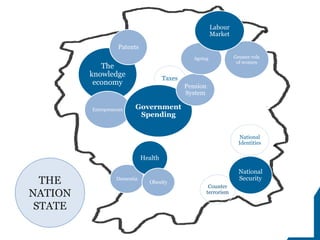
Taxes
Dementia
National
Identities
Counter
terrorism
The
knowledge
economy
Greater role
of women
National
Security
Entrepreneurs Government
Spending
Health
Pension
System
Ageing
Patents
Obesity
Labour
Market
THE
NATION
STATE
Cities
Source: Trends Shaping Education 2016 (OECD data)
10
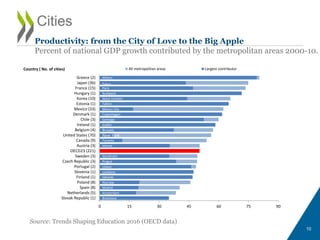
Productivity: from the City of Love to the Big Apple
Percent of national GDP growth contributed by the metropolitan areas 2000-10.
Bratislava
Amsterdam
Madrid
Warsaw
Helsinki
Ljubljana
Lisbon
Prague
Stockholm
Vienna
Toronto
New York
Brussels
Dublin
Santiago
Copenhagen
Mexico City
Tallinn
Seoul Incheon
Budapest
Paris
Tokyo
Athens
0 15 30 45 60 75 90
Slovak Republic (1)
Netherlands (5)
Spain (8)
Poland (8)
Finland (1)
Slovenia (1)
Portugal (2)
Czech Republic (3)
Sweden (3)
OECD23 (221)
Austria (3)
Canada (9)
United States (70)
Belgium (4)
Ireland (1)
Chile (3)
Denmark (1)
Mexico (33)
Estonia (1)
Korea (10)
Hungary (1)
France (15)
Japan (36)
Greece (2)
All metropolitan areas Largest contributorCountry ( No. of cities)
Cities
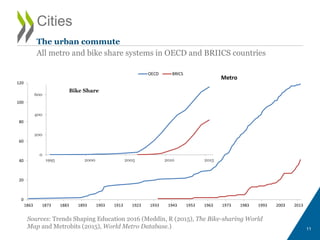
Sources: Trends Shaping Education 2016 (Meddin, R (2015), The Bike-sharing World
Map and Metrobits (2015), World Metro Database.) 11
The urban commute
All metro and bike share systems in OECD and BRIICS countries
0
20
40
60
80
100
120
1863 1873 1883 1893 1903 1913 1923 1933 1943 1953 1963 1973 1983 1993 2003 2013
Metro
OECD BRICS
0
200
400
600
1995 2000 2005 2010 2015
Bike Share
C
o
s
t
s
House prices
B
e
n
e
f
i
t
s
Congestion
Contagion
Pollution
Crime
Citizen Engagement
Productivity
Wages
Culture
Innovation
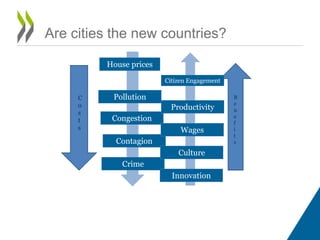
Are cities the new countries?
Families
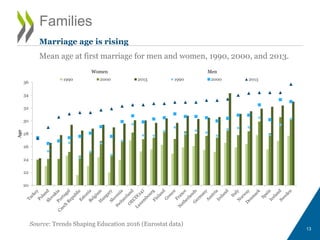
Source: Trends Shaping Education 2016 (Eurostat data)
Marriage age is rising
Mean age at first marriage for men and women, 1990, 2000, and 2013.
13
20
22
24
26
28
30
32
34
36
Age
1990 2000 2013 1990 2000 2013
Women Men
0
2
4
6
8
10
12
14
16
18
2001 2003 2005 2007 2009 2011 2013 2015
Numberofcountries
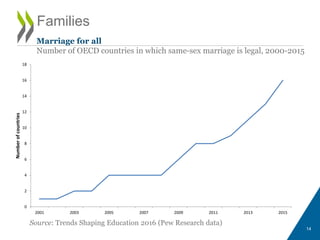
Source: Trends Shaping Education 2016 (Pew Research data)
14
Families
Marriage for all
Number of OECD countries in which same-sex marriage is legal, 2000-2015
15
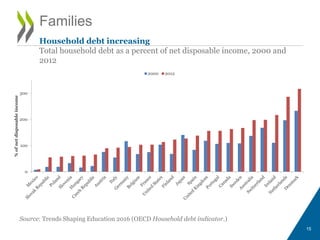
Source: Trends Shaping Education 2016 (OECD Household debt indicator.)
Families
Household debt increasing
Total household debt as a percent of net disposable income, 2000 and
2012
0
100
200
300
%ofnetdisposableincome
2000 2012
16
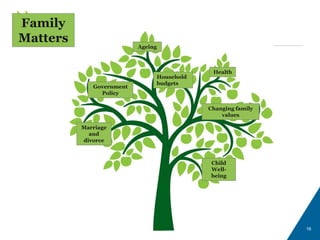
Government
Policy
Changing family
values
Ageing
Child
Well-
being
Marriage
and
divorce
Health
Household
budgets
Family
Matters
Technology
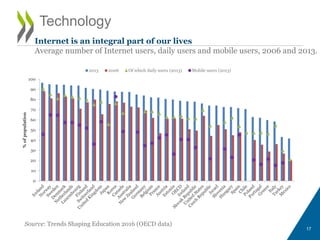
Source: Trends Shaping Education 2016 (OECD data)
17
Internet is an integral part of our lives
Average number of Internet users, daily users and mobile users, 2006 and 2013.
0
10
20
30
40
50
60
70
80
90
100
%ofpopulation
2013 2006 Of which daily users (2013) Mobile users (2013)
Technology
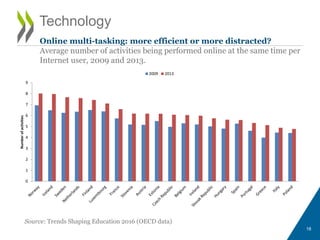
Source: Trends Shaping Education 2016 (OECD data)
18
Online multi-tasking: more efficient or more distracted?
Average number of activities being performed online at the same time per
Internet user, 2009 and 2013.
0
1
2
3
4
5
6
7
8
9
Numberofactivities
2009 2013
19
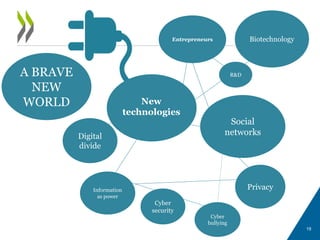
New
technologies
Social
networksDigital
divide
Information
as power
Entrepreneurs
Cyber
bullying
Cyber
security
Biotechnology
Privacy
R&DA BRAVE
NEW
WORLD
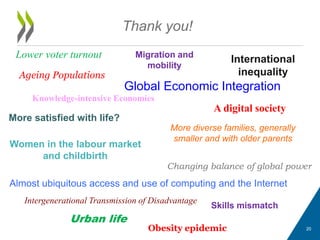
Thank you!
20
Ageing Populations
Global Economic Integration
International
inequality
Intergenerational Transmission of Disadvantage
Changing balance of global power
More satisfied with life?
Lower voter turnout
Skills mismatch
Women in the labour market
and childbirth
More diverse families, generally
smaller and with older parents
Almost ubiquitous access and use of computing and the Internet
A digital society
Knowledge-intensive Economies
Migration and
mobility
Urban life
Obesity epidemic

Trends Shaping Education 2016

  • 1.
  • 2.
    Trends Shaping Education •Intention and purpose – Inform strategic thinking – Stimulate reflection about the future of education ─ NOT a statistical compendium nor a prescription for policy 2
  • 3.
    Trends Shaping Education2016 • Five thematic chapters – Globalisation – The future of the nation state – Are cities the new countries? – Family matters – A brave new world • To be included, data needs to be: – Robust – Internationally comparable – Long term trend 3
  • 4.
    Source: Trends ShapingEducation 2016 (World Bank data) 0 5000 10000 15000 20000 25000 30000 35000 40000 1960 1963 1966 1969 1972 1975 1978 1981 1984 1987 1990 1993 1996 1999 2002 2005 2008 2011 Low income Middle income World OECD members Gap between richer and poorer regions widens GDP per capita by national income level and OECD member countries, and world, 1960-2013 Globalisation
  • 5.
    4% 4% 4%4% 5% 5% 6% 7% 8% 8% 9% 0% 1% 2% 3% 4% 5% 6% 7% 8% 9% 10% 1960 1965 1970 1975 1980 1985 1990 1995 2000 2005 2010 Middle income Low income World OECD members Source: Trends Shaping Education 2016 (World Bank data) Increasing immigration across the OECD Immigrants as a share of national population, 1960-2010 Globalisation
  • 6.
  • 7.
    Source: Trends ShapingEducation 2016 (OECD data) 55 60 65 70 75 80 85 90 1970 1972 1974 1976 1978 1980 1982 1984 1986 1988 1990 1992 1994 1996 1998 2000 2002 2004 2006 2008 2010 2012 Men effective retirement age Women effective retirement age Pension men Pension women Life expectancy from 65 males Life expectancy from 65 females YearsOld Longer life, longer retirement Longevity, effective retirement age, and legal age at which one can become a pensioner, OECD country average, 1970-2012 Nation state
  • 8.
    Nation state Source: TrendsShaping Education 2016 (OECD data) 8 Changing causes of death The top causes of death (left axis) and the fastest growing causes of death (right axis) in OECD countries, 1960-2012 0 5 10 15 20 25 30 0 100 200 300 400 500 600 700 800 900 1960 1965 1970 1975 1980 1985 1990 1995 2000 2005 2010 Topnewper100,000 Top4per100,000 Circulatory Cancer Respiratory External Diabetes Dementia Alzheimer'sRight axis : Left axis:
  • 9.
    9 Taxes Dementia National Identities Counter terrorism The knowledge economy Greater role of women National Security EntrepreneursGovernment Spending Health Pension System Ageing Patents Obesity Labour Market THE NATION STATE
  • 10.
    Cities Source: Trends ShapingEducation 2016 (OECD data) 10 Productivity: from the City of Love to the Big Apple Percent of national GDP growth contributed by the metropolitan areas 2000-10. Bratislava Amsterdam Madrid Warsaw Helsinki Ljubljana Lisbon Prague Stockholm Vienna Toronto New York Brussels Dublin Santiago Copenhagen Mexico City Tallinn Seoul Incheon Budapest Paris Tokyo Athens 0 15 30 45 60 75 90 Slovak Republic (1) Netherlands (5) Spain (8) Poland (8) Finland (1) Slovenia (1) Portugal (2) Czech Republic (3) Sweden (3) OECD23 (221) Austria (3) Canada (9) United States (70) Belgium (4) Ireland (1) Chile (3) Denmark (1) Mexico (33) Estonia (1) Korea (10) Hungary (1) France (15) Japan (36) Greece (2) All metropolitan areas Largest contributorCountry ( No. of cities)
  • 11.
    Cities Sources: Trends ShapingEducation 2016 (Meddin, R (2015), The Bike-sharing World Map and Metrobits (2015), World Metro Database.) 11 The urban commute All metro and bike share systems in OECD and BRIICS countries 0 20 40 60 80 100 120 1863 1873 1883 1893 1903 1913 1923 1933 1943 1953 1963 1973 1983 1993 2003 2013 Metro OECD BRICS 0 200 400 600 1995 2000 2005 2010 2015 Bike Share
  • 12.
  • 13.
    Families Source: Trends ShapingEducation 2016 (Eurostat data) Marriage age is rising Mean age at first marriage for men and women, 1990, 2000, and 2013. 13 20 22 24 26 28 30 32 34 36 Age 1990 2000 2013 1990 2000 2013 Women Men
  • 14.
    0 2 4 6 8 10 12 14 16 18 2001 2003 20052007 2009 2011 2013 2015 Numberofcountries Source: Trends Shaping Education 2016 (Pew Research data) 14 Families Marriage for all Number of OECD countries in which same-sex marriage is legal, 2000-2015
  • 15.
    15 Source: Trends ShapingEducation 2016 (OECD Household debt indicator.) Families Household debt increasing Total household debt as a percent of net disposable income, 2000 and 2012 0 100 200 300 %ofnetdisposableincome 2000 2012
  • 16.
  • 17.
    Technology Source: Trends ShapingEducation 2016 (OECD data) 17 Internet is an integral part of our lives Average number of Internet users, daily users and mobile users, 2006 and 2013. 0 10 20 30 40 50 60 70 80 90 100 %ofpopulation 2013 2006 Of which daily users (2013) Mobile users (2013)
  • 18.
    Technology Source: Trends ShapingEducation 2016 (OECD data) 18 Online multi-tasking: more efficient or more distracted? Average number of activities being performed online at the same time per Internet user, 2009 and 2013. 0 1 2 3 4 5 6 7 8 9 Numberofactivities 2009 2013
  • 19.
  • 20.
    Thank you! 20 Ageing Populations GlobalEconomic Integration International inequality Intergenerational Transmission of Disadvantage Changing balance of global power More satisfied with life? Lower voter turnout Skills mismatch Women in the labour market and childbirth More diverse families, generally smaller and with older parents Almost ubiquitous access and use of computing and the Internet A digital society Knowledge-intensive Economies Migration and mobility Urban life Obesity epidemic

Editor's Notes