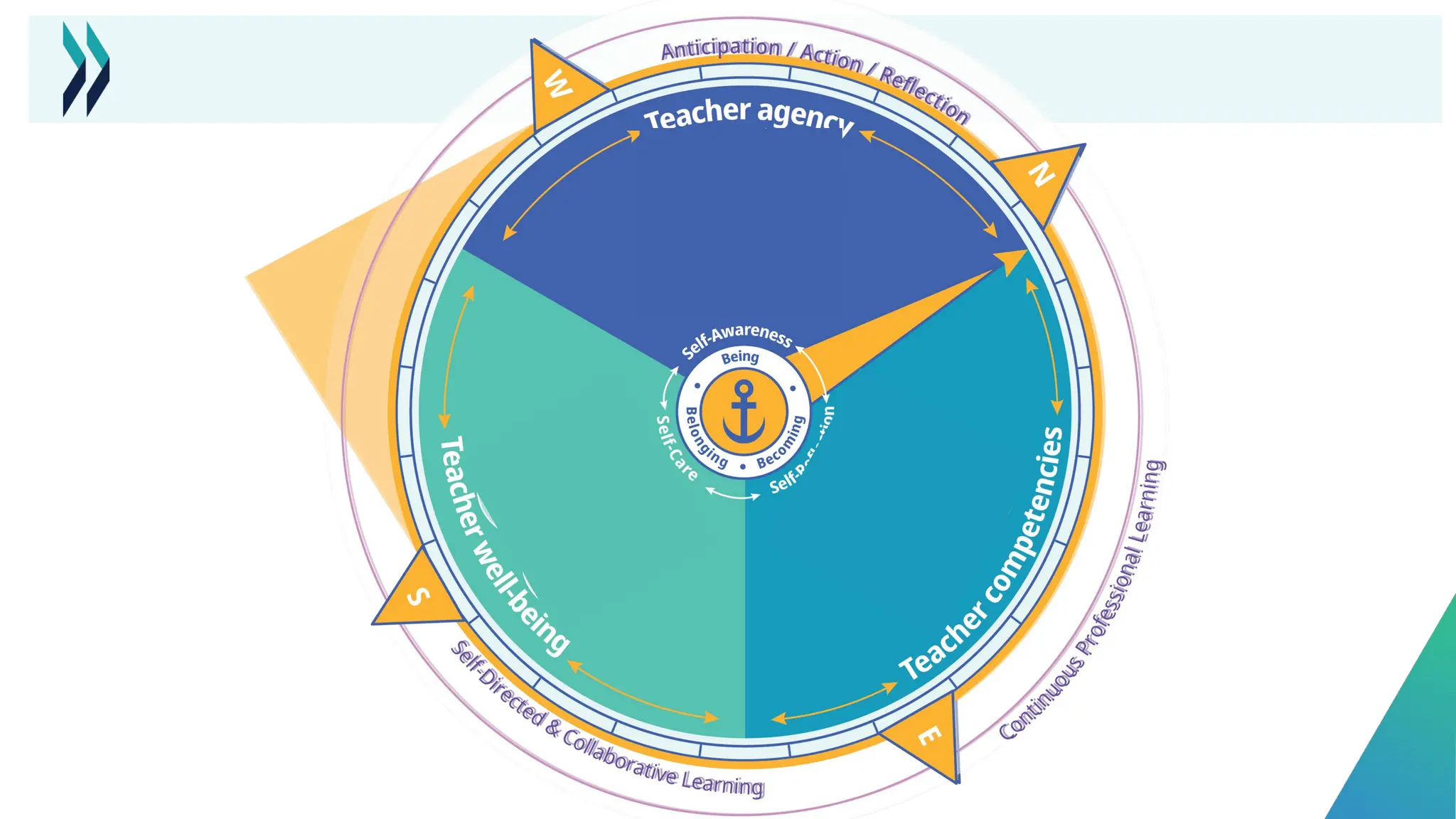
OECD Teaching Compass
Reimagining the Teaching Profession as Change
Agents for Curriculum Renewal
Andreas Schleicher
24 June 2025
Director of Education and Skills
Teacher agency is the key to successful curriculum renewal
Learning time ≠ learning outcomes
0
5
10
15
20
25
30
35
40
45
50
0
2
4
6
8
10
12
14
16
18
20
Morocco
Argentina
Colombia
Costa
Rica
Uzbekistan
Mongolia
Peru
Albania
Cambodia
United
Arab
Emirates
Kosovo
Paraguay
Chile
Italy
Jordan
Malta
Palestinian
Authority
Thailand
Kazakhstan
North
Macedonia
Israel
Brazil
Uruguay
Malaysia
Georgia
El
Salvador
Panama*
Viet
Nam
Guatemala
Dominican
Republic
Baku
(Azerbaijan)
Jamaica*
Philippines
Moldova
Saudi
Arabia
Singapore
Spain
Indonesia
Bulgaria
Greece
Brunei
Darussalam
Portugal
Lithuania
Germany
Belgium
Mexico
United
Kingdom*
Poland
Ireland*
France
OECD
average
Serbia
Latvia*
Croatia
Qatar
Ukrainian
regions
(18
of
27)
Chinese
Taipei
Türkiye
Iceland
Hungary
Austria
Hong
Kong
(China)*
Montenegro
Macao
(China)
Romania
Japan
Estonia
Australia*
Slovenia
Sweden
Norway
Denmark*
Korea
Netherlands*
Canada*
Slovak
Republic
New
Zealand*
Finland
Czech
Republic
United
States*
Switzerland
Score
points
in
mathematics
per
hour
of
total
learning
time
Hours
Based on students' reports
Hours learning in school
Hours learning out of school
PISA 2022, Figure II.5.11
Learning time ≠ learning outcomes
0
5
10
15
20
25
30
35
40
45
50
0
2
4
6
8
10
12
14
16
18
20
Morocco
Argentina
Colombia
Costa
Rica
Uzbekistan
Mongolia
Peru
Albania
Cambodia
United
Arab
Emirates
Kosovo
Paraguay
Chile
Italy
Jordan
Malta
Palestinian
Authority
Thailand
Kazakhstan
North
Macedonia
Israel
Brazil
Uruguay
Malaysia
Georgia
El
Salvador
Panama*
Viet
Nam
Guatemala
Dominican
Republic
Baku
(Azerbaijan)
Jamaica*
Philippines
Moldova
Saudi
Arabia
Singapore
Spain
Indonesia
Bulgaria
Greece
Brunei
Darussalam
Portugal
Lithuania
Germany
Belgium
Mexico
United
Kingdom*
Poland
Ireland*
France
OECD
average
Serbia
Latvia*
Croatia
Qatar
Ukrainian
regions
(18
of
27)
Chinese
Taipei
Türkiye
Iceland
Hungary
Austria
Hong
Kong
(China)*
Montenegro
Macao
(China)
Romania
Japan
Estonia
Australia*
Slovenia
Sweden
Norway
Denmark*
Korea
Netherlands*
Canada*
Slovak
Republic
New
Zealand*
Finland
Czech
Republic
United
States*
Switzerland
Score
points
in
mathematics
per
hour
of
total
learning
time
Hours
Based on students' reports
Figure II.5.11
Hours learning in school
Hours learning out of school
Productivity
PISA 2022, Figure II.5.11
Co-agency matters.
Students learn best from teachers they love
Remote learning, mathematics performance and confidence in self-directed learning
Change in the index of confidence in students' capacity for self-directed learning/in mathematics performance, when students agreed or disagreed with the
following statements about the time when their school building was closed because of COVID-19; OECD average
PISA 2022,
Figure II.2.12
-10
-5
0
5
10
15
20
25
(Agree)
I was well prepared to
learn on my own
(Agree)
My teachers were
available when I
needed help
(Disagree)
I felt anxious about
school work
(Disagree)
I felt lonely
Score-point
difference
in
mathematics
performance
Students agreed or strongly agreed/disagreed or strongly disagreed
with the statements above
Before accounting
After accounting for students' and schools' socio-economic profile
Students
scored
lower
Students
scored
higher
0.00
0.10
0.20
0.30
0.40
0.50
0.60
0.70
0.80
(Agree)
I was well prepared
to learn on my own
(Agree)
My teachers were
available when I
needed help
(Disagree)
I felt anxious about
school work
(Disagree)
I felt lonely
Students agreed or strongly agreed/disagreed or strongly disagreed
with the statements above
Before accounting
After accounting for students' and schools' socio-economic profile, and mathematics performance
Students with more positive learning
experiences are more confident
in their ability to learn autonomously
and remotely
Students
are
more
confident
(Change
in
the
index
of
confidence
in
capacity
for
self-directed
learning)
Teacher collective agency also matters.
Feeling effective as a teacher is linked to collaborating with colleagues
11.40
11.60
11.80
12.00
12.20
12.40
12.60
12.80
13.00
13.20
13.40
Never
Once
a
year
or
less
2-4
times
a
year
5-10
times
a
year
1-3
times
a
month
Once
a
week
or
more
Teacher
self-efficacy
(level)
Teach jointly as a team in
the same class
Observe other teachers’
classes and provide
feedback
Engage in joint activities
across different classes
and age groups
Take part in collaborative
professional learning
Preparing teachers in a changing world is hard
The kinds of things that are easy to teach…have now become easy to digitise and automate
Non-routine tasks
Routine tasks
Technology-intensive
tasks
Low-technology
use
Non-routine tasks
Routine tasks
Technology-intensive tasks
Low-technology
use
Preparing teachers in a changing world is hard
The kinds of things that are easy to teach…have now become easy to digitise and automate
Many teachers leave initial teacher education feeling unprepared for the
realities of the classroom
0
10
20
30
40
50
60
Pedagogy of some or all subjects taught (%) Classroom practice in some or all subjects taught (%)
Teachers' sense of preparedness for different elements of teaching (ISCED 2), 2018
Percentage of teachers who felt "not at all" or "somewhat prepared" for the following elements
Source: OECD (2019), Working and Learning Together, Figure 4.1, based on TALIS 2018
Opportunities to learn and update knowledge and skills are important
Social-emotional learning is underrepresented in teacher training
0
10
20
30
40
50
60
70
Kudus
(Indonesia)
2
Delhi
(India)
Jinan
(China)
4
Peru
9
Ukraine
(19
of
27
reg.)
12
Dubai
(UAE)
12
Sobral
(Brazil)
19
Bogotá
(Colombia)
20
Average
21
Bulgaria
23
Chile
26
Emilia-Romagna
(Italy)
29
Spain
32
Turin
(Italy)
37
Helsinki
(Finland)
37
Gunma
(Japan)
46
Classroom praxis, pedagogy
and content of some or all
subject(s)
Incorporating social and
emotional learning in the
classroom
Difference
%
Source: OECD (2024), Survey of Social-Emotional Skills
Percentage of 15-year-olds’ teachers without training in the following topics, by sites
Example of Singaporean model: National Institute of Education
Unlocking the potential of different teaching profiles
0%
10%
20%
30%
40%
50%
60%
Teachers having two or more years of experience outside of education
Note: based on secondary analysis of TALIS 2018 data.
Source : Spruyt, B. et al. (2023), Het lerarentekort kritisch bekeken vanuit internationaal vergelijkend perspectief, Tijdschrift voor Onderwijsrecht en Onderwijsbeleid [Teacher shortage critically examined from international
comparative perspective], Vol. 79, pp. 19-27, https://torvub.be/torwebdat/publications/t2023_1.pdf
Australia
Austria
Chile
Czech Republic
Denmark
England (UK)
Finland
Flemish Comm. (Belgium)
France
French Comm. (Belgium)
Hungary
Israel
Italy
Korea
Lithuania
Netherlands
New Zealand
Norway
Portugal
Slovak Republic
Slovenia
Spain
Sweden
Türkiye
United States
0.4
0.6
0.8
1.0
1.2
1.4
50 55 60 65 70 75 80 85 90 95 100
Ratio
%
Relative salaries of teachers and teachers’ job satisfaction
% of teachers who agree that the advantages of being a teacher clearly outweigh the disadvantages
Relative
Teacher
salaries
The drivers of teachers’ stress
10
12
14
16
18
20
22
24
26
28
1 2 3 4 5 6 7 8 9 10 11 12 13 14 15 16 17 18 19 20 21 22 23 24 25 26 27 28 29 30
Teachers
experiencing
stress
in
their
work
“a
lot”
(Estimated
%)
Hours spent during the most recent week doing a specific task (task intensity)
Teaching
Planning
Marking
Admin
Aspect Human Intelligence
Human teachers
Artificial Intelligence
AI agents
Professional Identity &
Ethical Reasoning
Self-reflective, value-driven, ethically
accountable
Task-oriented, lacks self-awareness & moral
agency
Interaction with
Students
Authentic dialogue, mentorship, emotional
connection
Structured support and automated feedback
Processing &
Knowledge
Slower, deeper reasoning, limited by
individual experience
Rapid, consistent, vast knowledge access
Creativity & Empathy Original insight, intuitive leaps, genuine
emotional connection
Pattern-based generation, simulated empathy
Optimal Integration "AI-enhanced human innovation"
Complementary strengths, not replacement. Teachers focus on human elements, AI on
routine tasks.
Broader Social Context AI as both epistemic and cultural technology.
Transforms work, social interaction, entertainment, politics. Education must prepare
E2040 Exploration - Flourishing Together: Human Teachers and AI Agents
in Future Classrooms (currently under discussion with AI experts).
Thank you

Andreas Schleicher_Teaching Compass_Education 2040.pdf

  • 1.
    OECD Teaching Compass Reimaginingthe Teaching Profession as Change Agents for Curriculum Renewal Andreas Schleicher 24 June 2025 Director of Education and Skills
  • 5.
    Teacher agency isthe key to successful curriculum renewal
  • 6.
    Learning time ≠learning outcomes 0 5 10 15 20 25 30 35 40 45 50 0 2 4 6 8 10 12 14 16 18 20 Morocco Argentina Colombia Costa Rica Uzbekistan Mongolia Peru Albania Cambodia United Arab Emirates Kosovo Paraguay Chile Italy Jordan Malta Palestinian Authority Thailand Kazakhstan North Macedonia Israel Brazil Uruguay Malaysia Georgia El Salvador Panama* Viet Nam Guatemala Dominican Republic Baku (Azerbaijan) Jamaica* Philippines Moldova Saudi Arabia Singapore Spain Indonesia Bulgaria Greece Brunei Darussalam Portugal Lithuania Germany Belgium Mexico United Kingdom* Poland Ireland* France OECD average Serbia Latvia* Croatia Qatar Ukrainian regions (18 of 27) Chinese Taipei Türkiye Iceland Hungary Austria Hong Kong (China)* Montenegro Macao (China) Romania Japan Estonia Australia* Slovenia Sweden Norway Denmark* Korea Netherlands* Canada* Slovak Republic New Zealand* Finland Czech Republic United States* Switzerland Score points in mathematics per hour of total learning time Hours Based on students' reports Hours learning in school Hours learning out of school PISA 2022, Figure II.5.11
  • 7.
    Learning time ≠learning outcomes 0 5 10 15 20 25 30 35 40 45 50 0 2 4 6 8 10 12 14 16 18 20 Morocco Argentina Colombia Costa Rica Uzbekistan Mongolia Peru Albania Cambodia United Arab Emirates Kosovo Paraguay Chile Italy Jordan Malta Palestinian Authority Thailand Kazakhstan North Macedonia Israel Brazil Uruguay Malaysia Georgia El Salvador Panama* Viet Nam Guatemala Dominican Republic Baku (Azerbaijan) Jamaica* Philippines Moldova Saudi Arabia Singapore Spain Indonesia Bulgaria Greece Brunei Darussalam Portugal Lithuania Germany Belgium Mexico United Kingdom* Poland Ireland* France OECD average Serbia Latvia* Croatia Qatar Ukrainian regions (18 of 27) Chinese Taipei Türkiye Iceland Hungary Austria Hong Kong (China)* Montenegro Macao (China) Romania Japan Estonia Australia* Slovenia Sweden Norway Denmark* Korea Netherlands* Canada* Slovak Republic New Zealand* Finland Czech Republic United States* Switzerland Score points in mathematics per hour of total learning time Hours Based on students' reports Figure II.5.11 Hours learning in school Hours learning out of school Productivity PISA 2022, Figure II.5.11
  • 8.
    Co-agency matters. Students learnbest from teachers they love Remote learning, mathematics performance and confidence in self-directed learning Change in the index of confidence in students' capacity for self-directed learning/in mathematics performance, when students agreed or disagreed with the following statements about the time when their school building was closed because of COVID-19; OECD average PISA 2022, Figure II.2.12 -10 -5 0 5 10 15 20 25 (Agree) I was well prepared to learn on my own (Agree) My teachers were available when I needed help (Disagree) I felt anxious about school work (Disagree) I felt lonely Score-point difference in mathematics performance Students agreed or strongly agreed/disagreed or strongly disagreed with the statements above Before accounting After accounting for students' and schools' socio-economic profile Students scored lower Students scored higher 0.00 0.10 0.20 0.30 0.40 0.50 0.60 0.70 0.80 (Agree) I was well prepared to learn on my own (Agree) My teachers were available when I needed help (Disagree) I felt anxious about school work (Disagree) I felt lonely Students agreed or strongly agreed/disagreed or strongly disagreed with the statements above Before accounting After accounting for students' and schools' socio-economic profile, and mathematics performance Students with more positive learning experiences are more confident in their ability to learn autonomously and remotely Students are more confident (Change in the index of confidence in capacity for self-directed learning)
  • 9.
    Teacher collective agencyalso matters. Feeling effective as a teacher is linked to collaborating with colleagues 11.40 11.60 11.80 12.00 12.20 12.40 12.60 12.80 13.00 13.20 13.40 Never Once a year or less 2-4 times a year 5-10 times a year 1-3 times a month Once a week or more Teacher self-efficacy (level) Teach jointly as a team in the same class Observe other teachers’ classes and provide feedback Engage in joint activities across different classes and age groups Take part in collaborative professional learning
  • 12.
    Preparing teachers ina changing world is hard The kinds of things that are easy to teach…have now become easy to digitise and automate Non-routine tasks Routine tasks Technology-intensive tasks Low-technology use
  • 13.
    Non-routine tasks Routine tasks Technology-intensivetasks Low-technology use Preparing teachers in a changing world is hard The kinds of things that are easy to teach…have now become easy to digitise and automate
  • 14.
    Many teachers leaveinitial teacher education feeling unprepared for the realities of the classroom 0 10 20 30 40 50 60 Pedagogy of some or all subjects taught (%) Classroom practice in some or all subjects taught (%) Teachers' sense of preparedness for different elements of teaching (ISCED 2), 2018 Percentage of teachers who felt "not at all" or "somewhat prepared" for the following elements Source: OECD (2019), Working and Learning Together, Figure 4.1, based on TALIS 2018
  • 15.
    Opportunities to learnand update knowledge and skills are important Social-emotional learning is underrepresented in teacher training 0 10 20 30 40 50 60 70 Kudus (Indonesia) 2 Delhi (India) Jinan (China) 4 Peru 9 Ukraine (19 of 27 reg.) 12 Dubai (UAE) 12 Sobral (Brazil) 19 Bogotá (Colombia) 20 Average 21 Bulgaria 23 Chile 26 Emilia-Romagna (Italy) 29 Spain 32 Turin (Italy) 37 Helsinki (Finland) 37 Gunma (Japan) 46 Classroom praxis, pedagogy and content of some or all subject(s) Incorporating social and emotional learning in the classroom Difference % Source: OECD (2024), Survey of Social-Emotional Skills Percentage of 15-year-olds’ teachers without training in the following topics, by sites
  • 16.
    Example of Singaporeanmodel: National Institute of Education
  • 17.
    Unlocking the potentialof different teaching profiles 0% 10% 20% 30% 40% 50% 60% Teachers having two or more years of experience outside of education Note: based on secondary analysis of TALIS 2018 data. Source : Spruyt, B. et al. (2023), Het lerarentekort kritisch bekeken vanuit internationaal vergelijkend perspectief, Tijdschrift voor Onderwijsrecht en Onderwijsbeleid [Teacher shortage critically examined from international comparative perspective], Vol. 79, pp. 19-27, https://torvub.be/torwebdat/publications/t2023_1.pdf
  • 20.
    Australia Austria Chile Czech Republic Denmark England (UK) Finland FlemishComm. (Belgium) France French Comm. (Belgium) Hungary Israel Italy Korea Lithuania Netherlands New Zealand Norway Portugal Slovak Republic Slovenia Spain Sweden Türkiye United States 0.4 0.6 0.8 1.0 1.2 1.4 50 55 60 65 70 75 80 85 90 95 100 Ratio % Relative salaries of teachers and teachers’ job satisfaction % of teachers who agree that the advantages of being a teacher clearly outweigh the disadvantages Relative Teacher salaries
  • 21.
    The drivers ofteachers’ stress 10 12 14 16 18 20 22 24 26 28 1 2 3 4 5 6 7 8 9 10 11 12 13 14 15 16 17 18 19 20 21 22 23 24 25 26 27 28 29 30 Teachers experiencing stress in their work “a lot” (Estimated %) Hours spent during the most recent week doing a specific task (task intensity) Teaching Planning Marking Admin
  • 23.
    Aspect Human Intelligence Humanteachers Artificial Intelligence AI agents Professional Identity & Ethical Reasoning Self-reflective, value-driven, ethically accountable Task-oriented, lacks self-awareness & moral agency Interaction with Students Authentic dialogue, mentorship, emotional connection Structured support and automated feedback Processing & Knowledge Slower, deeper reasoning, limited by individual experience Rapid, consistent, vast knowledge access Creativity & Empathy Original insight, intuitive leaps, genuine emotional connection Pattern-based generation, simulated empathy Optimal Integration "AI-enhanced human innovation" Complementary strengths, not replacement. Teachers focus on human elements, AI on routine tasks. Broader Social Context AI as both epistemic and cultural technology. Transforms work, social interaction, entertainment, politics. Education must prepare E2040 Exploration - Flourishing Together: Human Teachers and AI Agents in Future Classrooms (currently under discussion with AI experts).
  • 24.