Gender, Communication, and CultureJulia T. Wood                                 “Men and Women:                Can we get along? Should we even try?”
The social- symbolic construction of genderDistinction between GENDER and SEX.SEX= determines by biologic codesGENDER= social term for sex. Talking about sex we will use “man” and “women”.Talking about gender we will use “masculine” and “feminine”
GENDERGenderis the social construction of sex. It is the construction of gender by culture.Culture attributes certain characteristics to eachsex. Eg: Blue clothes for baby boys/ Pink for girls.The identification to masculinity or feminity is A PROCESS that started at the moment of birth. It’s is not in our gene (different from sex).
RESULT= This process of identification to one gender or the otherconvinceyou to adopt « codes » that correspond to yoursex.Gender= social beliefs and values IN A PARTICULAR SOCIETY and AT A SPECIFIC TIME.Genderis not fixed, stableGenderis not universal	In fact the values and beliefs of the society are not the sametodaythatitwere 60 yearsago.Moreover  in each part of the world feminity and masculinitywill not have the samemeaning.
http://www.youtube.com/watch?v=AUBazW1nQtY&feature=related
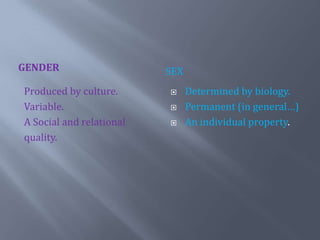
GENDERsexProduced by culture.Variable.A Social and relationalquality.Determined by biology.Permanent (in general…)An individualproperty.
Relation shipbetweenGender, Culture and CommunicationGendercreated by the culture webelong to and his content (beliefs and values) isspreadthroughmeans of communication               -interaction between people               -medias…ToysGI Joe Commercial:http://www.youtube.com/watch?v=C89tCN8l35o&feature=relatedToy’r’Us Commercial:http://www.youtube.com/watch?v=l1dqCWIjUsE&feature=related
Communication constructsGender CulturesThe process of human communication createsgender culture.How do welearnwhat correspond to ourgender? By the interactions we have with people duringourchildhood.Two types of interaction thatemphasziesthisprocess of identification to a gender:   Family communication   interactions amongchildren
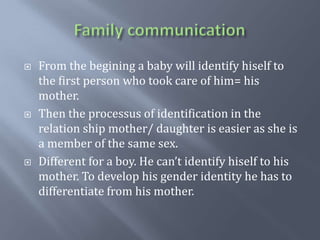
Family communicationFrom the begining a baby willidentifyhiself to the first personwhotook care of him= hismother.Then the processus of identification in the relation shipmother/ daughteriseasier as sheis a member of the samesex.Different for a boy. He can’tidentifyhiself to hismother. To develophisgenderidentityhe has to differentiatefromhismother.
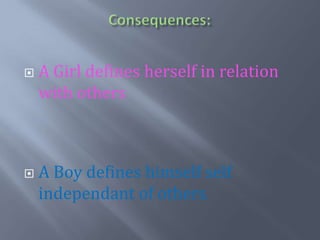
Consequences:A Girl definesherself in relation withothersA Boy defineshimself self independant of others.
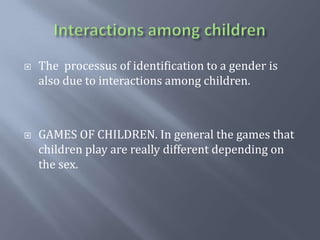
Interactions amongchildrenThe  processus of identification to a genderisalso due to interactions amongchildren.GAMES OF CHILDREN. In general the gamesthatchildrenplay are reallydifferentdepending on the sex.
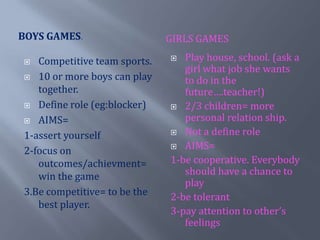
Boys games.Girls gamesPlay house, school. (ask a  girl what job shewants to do in the future….teacher!)2/3 children= more personal relation ship. Not a defineroleAIMS=1-becooperative. Everybodyshould have a chance to play2-betolerant3-pay attention to other’s feelingsCompetitive team sports. 10 or more boys canplaytogether.Definerole (eg:blocker)AIMS=1-assertyourself2-focus on outcomes/achievment=win the game3.Be competitive= to be the best player.
Boys games are supposed to have an achievment. The end of the game, the winner.Girls games. The  gameendswhen the parents come to pickthem up atschool or when the playtimeis over. a girl whowouldplay sport team during the playtime (and so not « respecting » codes of gendercorresponding to hersex)  will, in general, have to suffermockingremarksfromherclassmates.
So thesetwoways of communication influencedourcharacter. Eachgender has specific values and beliefs in a specific culture.Femininesocializationisbased on relationshipssensitivity.Masculine socializationisbased on independance and power.
Men and Women in Conversation. Cross cultural communicationMen and womenidentified to a differentgender= differentrules.It affects communications betweenthemIt createsmisunderstandings-
Feminine and Masculine Communication Cultures.Groups of people whoshare practices not common to other cultures. Eg: older people/ young…Alsotrue for men and women.The waywewereassociated to a gendercomplicates the relation shipswe have. Different speech.Everyday life situation: (in general, not true for everyone)
Showing affection in a coupleMENWOMENClosness in doingBy sharing activities (going to the restaurant, sharing the same flat…)Closness in speech.By saying «I love you »By showing affection.
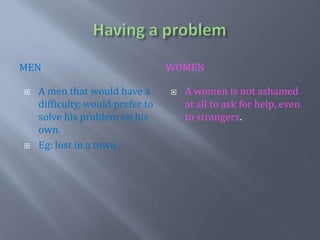
Having a problemMENWomenA men thatwould have a difficulty, wouldprefer to solvehisproblem on hisown.Eg: lost in a town.A womenis not ashamedat all to ask for help, even to strangers.
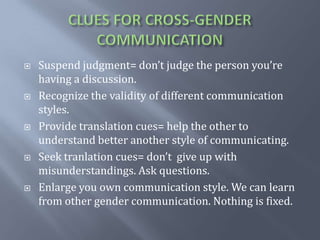
CLUES FOR CROSS-GENDER COMMUNICATIONSuspend judgment= don’tjudge the personyou’rehaving a discussion. Recognize the validity of different communication styles.Provide translation cues= help the other to understandbetteranother style of communicating.Seektranlationcues= don’tgive up withmisunderstandings. Ask questions.Enlargeyouown communication style. Wecanlearnfromothergender communication. Nothingisfixed.
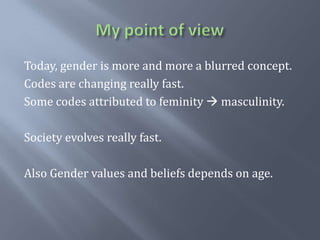
My point of viewToday, genderis more and more a blurred concept.Codes are changingreallyfast.Some codes attributed to feminity masculinity.Society evolvesreallyfast.AlsoGender values and beliefsdepends on age.

Gender, communication, and culture

  • 1.
    Gender, Communication, andCultureJulia T. Wood “Men and Women: Can we get along? Should we even try?”
  • 2.
    The social- symbolicconstruction of genderDistinction between GENDER and SEX.SEX= determines by biologic codesGENDER= social term for sex. Talking about sex we will use “man” and “women”.Talking about gender we will use “masculine” and “feminine”
  • 3.
    GENDERGenderis the socialconstruction of sex. It is the construction of gender by culture.Culture attributes certain characteristics to eachsex. Eg: Blue clothes for baby boys/ Pink for girls.The identification to masculinity or feminity is A PROCESS that started at the moment of birth. It’s is not in our gene (different from sex).
  • 4.
    RESULT= This processof identification to one gender or the otherconvinceyou to adopt « codes » that correspond to yoursex.Gender= social beliefs and values IN A PARTICULAR SOCIETY and AT A SPECIFIC TIME.Genderis not fixed, stableGenderis not universal In fact the values and beliefs of the society are not the sametodaythatitwere 60 yearsago.Moreover in each part of the world feminity and masculinitywill not have the samemeaning.
  • 5.
  • 6.
    GENDERsexProduced by culture.Variable.ASocial and relationalquality.Determined by biology.Permanent (in general…)An individualproperty.
  • 7.
    Relation shipbetweenGender, Cultureand CommunicationGendercreated by the culture webelong to and his content (beliefs and values) isspreadthroughmeans of communication -interaction between people -medias…ToysGI Joe Commercial:http://www.youtube.com/watch?v=C89tCN8l35o&feature=relatedToy’r’Us Commercial:http://www.youtube.com/watch?v=l1dqCWIjUsE&feature=related
  • 8.
    Communication constructsGender CulturesTheprocess of human communication createsgender culture.How do welearnwhat correspond to ourgender? By the interactions we have with people duringourchildhood.Two types of interaction thatemphasziesthisprocess of identification to a gender: Family communication interactions amongchildren
  • 9.
    Family communicationFrom thebegining a baby willidentifyhiself to the first personwhotook care of him= hismother.Then the processus of identification in the relation shipmother/ daughteriseasier as sheis a member of the samesex.Different for a boy. He can’tidentifyhiself to hismother. To develophisgenderidentityhe has to differentiatefromhismother.
  • 10.
    Consequences:A Girl definesherselfin relation withothersA Boy defineshimself self independant of others.
  • 11.
    Interactions amongchildrenThe processus of identification to a genderisalso due to interactions amongchildren.GAMES OF CHILDREN. In general the gamesthatchildrenplay are reallydifferentdepending on the sex.
  • 12.
    Boys games.Girls gamesPlayhouse, school. (ask a girl what job shewants to do in the future….teacher!)2/3 children= more personal relation ship. Not a defineroleAIMS=1-becooperative. Everybodyshould have a chance to play2-betolerant3-pay attention to other’s feelingsCompetitive team sports. 10 or more boys canplaytogether.Definerole (eg:blocker)AIMS=1-assertyourself2-focus on outcomes/achievment=win the game3.Be competitive= to be the best player.
  • 13.
    Boys games aresupposed to have an achievment. The end of the game, the winner.Girls games. The gameendswhen the parents come to pickthem up atschool or when the playtimeis over. a girl whowouldplay sport team during the playtime (and so not « respecting » codes of gendercorresponding to hersex) will, in general, have to suffermockingremarksfromherclassmates.
  • 14.
    So thesetwoways ofcommunication influencedourcharacter. Eachgender has specific values and beliefs in a specific culture.Femininesocializationisbased on relationshipssensitivity.Masculine socializationisbased on independance and power.
  • 15.
    Men and Womenin Conversation. Cross cultural communicationMen and womenidentified to a differentgender= differentrules.It affects communications betweenthemIt createsmisunderstandings-
  • 16.
    Feminine and MasculineCommunication Cultures.Groups of people whoshare practices not common to other cultures. Eg: older people/ young…Alsotrue for men and women.The waywewereassociated to a gendercomplicates the relation shipswe have. Different speech.Everyday life situation: (in general, not true for everyone)
  • 17.
    Showing affection ina coupleMENWOMENClosness in doingBy sharing activities (going to the restaurant, sharing the same flat…)Closness in speech.By saying «I love you »By showing affection.
  • 18.
    Having a problemMENWomenAmen thatwould have a difficulty, wouldprefer to solvehisproblem on hisown.Eg: lost in a town.A womenis not ashamedat all to ask for help, even to strangers.
  • 19.
    CLUES FOR CROSS-GENDERCOMMUNICATIONSuspend judgment= don’tjudge the personyou’rehaving a discussion. Recognize the validity of different communication styles.Provide translation cues= help the other to understandbetteranother style of communicating.Seektranlationcues= don’tgive up withmisunderstandings. Ask questions.Enlargeyouown communication style. Wecanlearnfromothergender communication. Nothingisfixed.
  • 20.
    My point ofviewToday, genderis more and more a blurred concept.Codes are changingreallyfast.Some codes attributed to feminity masculinity.Society evolvesreallyfast.AlsoGender values and beliefsdepends on age.