
SOCRATES
COMMUNICATION    AND GENDER Is there a difference? Teenagerz*
Objectives… Identify differences and uniqueness in the expression of thoughts and feelings across gender. Improve communication between male and female
Where is the difference? Biological (left hemisphere and right hemisphere)  mum* Culture.  Upbringing. Based on research,
Ladies, averagely Speak about 25,500 words in a day.  Talk more about people, relationships and feelings. Talk more in private While men….. Averagely speak about 12,500 words in a given day Talk more about things and facts Talk more in public
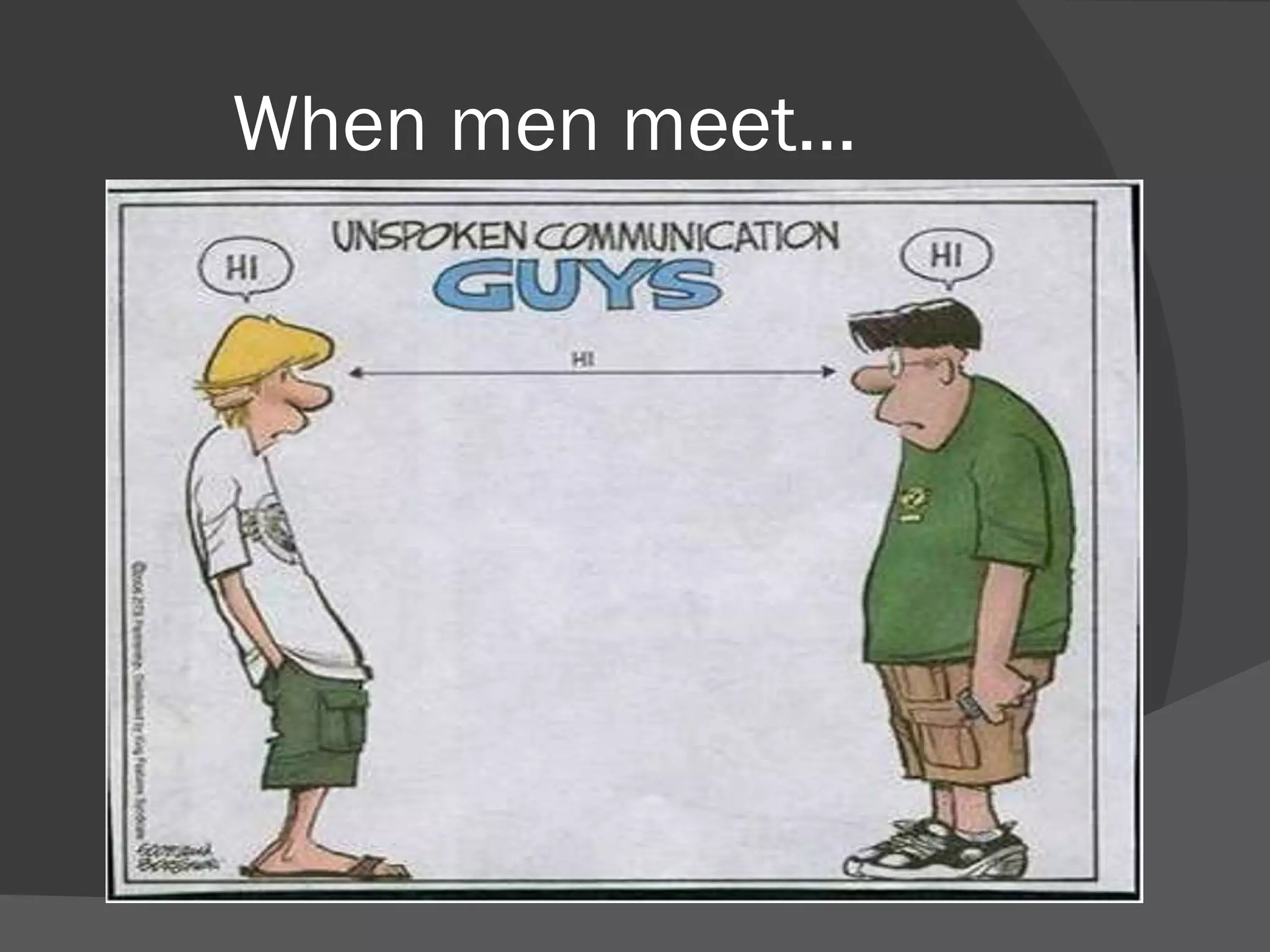
When men meet…
When ladies meet...
Expression of Emotions Ladies Men Women express most of their emotions more than men, with the exception of anger.  use more emotion in their writing  Wives disclose more hostile emotions than husbands  Less able to inhibit facial expressions of emotions when asked to.  Rarely express emotions show more facial reactivity than women when viewing an angry facial expression
Feedback Due to being more sensitive towards the impact of the message are more tactful and sensitive in their choice of words.  “ Listening noises” give verbal signals such as, “Uh Huh“, “Really?”, “Are you kidding me?”,
Information processing   Women- Think out aloud  Men- Process internally until they arrive at a solution.
  Men Women Managing up and down More careful when offering criticism the boss More careful with the subordinates Indirectness Indirect when admitting fouls/mistakes When telling others what to do Equality Emphasize ‘pecking order’ to status Value relationships and not who is in charge of who Body language Holds distance, less eye contact, fewer gestures Stand closer, maintain eye contact and makes use of more gestures Requests Makes commands/directs Makes use of polite requests Changing subjects Complete a subject then move to the next May veer off subject Problem solving Think about it and demand a solution Articulate thoughts then discuss the problem Feedback Direct and blunt Tact and sensitive Talking Use more of report talk, express facts, make use of stories and jokes to negotiate status, and could easily initiate conflicts. Use more of rapport talk, share experiences, tell stories to downplay them selves, and avoid conflicts because it threatens relationships.
In management Men and ladies request action and advice differently. Their verbal responses and timing are different.  The result can be miscues and misunderstandings. In other words, lots of cross talk.
Deborah Tanen in  ‘You Just Don’t Understand’. Differences in communication begin early. E.g.  Little girls talk to be liked; little boys often talk to boast.  Little girls make requests; little boys make demands.
Little girls speak to create harmony; little boys prolong conflict. Little girls talk more indirectly; little boys talk directly.  Little girls talk more with words; little boys use more actions.
Both Boys and Girls use language  differently to get their way. These differences grow and are noted in college and further in the working environment.  e.g. Power plays- Her way: ladies tend to ask lots of questions before beginning work.  His way: Men simply roll up their sleeves. The result: Men assume ladies aren't up to the job.
Lady: What shall we present? Man: Anything. The Best team on earth. Gor  Mahia! Lady: I think we should come up with  different topics then we eliminate… Man: What’s wrong with my topic?
These differences are in  Style  Content  Structure
style ladies tend to ‘read between the lines’, while men communicate to establish status. Whether conscious or unconscious, men often talk to establish status from others.
A presupposed challenge (joke) on status therefore can cause  friction  amongst team members. ladies use words to connect themselves emotionally, to express feelings, or build rapport. Men often share facts and figures as in a report.
Females are more inclined to face each other and make eye contact when talking, while males are more likely to look away from each other.   Girls and ladies tend to talk at length about one topic, but boys and men tend to jump from topic to topic.
Body language is also used differently. Ladies stand in close proximity to each other, maintain eye contact, and gesture more frequently.  Men tend to stand apart from one another, avoid eye contact, and gesture less than ladies.
Content What do men and ladies talk about?  Men often talk about sports, money, and business;  ladies most often discuss feelings, relationships and people.
Why? Men express themselves to fix a problem, converse for competition, and talk to resolve problems.  ladies most often express themselves to understand, converse to support, and talk to connect.
Structure Men typically use precise words, to the point, without descriptive details. ladies are more detailed, apologetic, and vivid.  Men and ladies impose authority differently. E.g. men routinely challenge and expect to be challenged.
Consequently... T here are differences in a class setting such as this, home etc.
Can we  improve?
Understand your own communication style. Listen to your own speech.  Evaluate your words, your tone of voice, and your body language. Compare your own communication style with that of individuals whom you judge to be effective communicators.
E.g. for men Remember names, show an interest in detail, learn to  listen keenly !
Understand the Communication style of the opposite gender.
Observe how they talk, express ideas, content of these ideas etc. Engage in discussion and try to understand what is important to the other gender. See if your perceptions are accurate. e.g. Some people NEVER talk during group work. Find out why then see how this can be improved.
Adjust to the conversational styles Communication is a learned behavior- and behavior can be unlearned! * Work on areas we are not good at.
WHAT ARE NOT SO GOOD AT?
Ladies- jumping into conclusions too fast? Seek clarification. Men- Too much report talk. Try and listen a little and empathise.
Ladies- confusing body language?  Consciously work on body language that clarifies your spoken word.
4. Don’t make assumptions Consult! E.g. during group work- the men assume the ladies will definitely want a presentation on Cars or Arsenal*.
Instead………… Use gender neutral images. Something that both men and ladies can identify with.
Avoid the temptation to criticize those who communicate differently from us.
Steps must be taken to improve communication without assigning blame.
‘ The definition of a diverse work force, of course, is an environment where people  ACCEPT DIFFERENCES RATHER THAN DENY THEM.  If we pay attention to gender differences, we just might untangle the gender communications knots .’ Joanna Crotz
WORKS CITED Gender Communication  Presented by: Deborah Snellen – President 2006 CACUBO Annual Meeting Denver, Colorado   Communication between Men and Women in the Context of the Christian Community Rhonda H. Kelley. http://www.cbmw.org/Articles/   Tingley, Judith C.  Genderflex: Men and Women Speaking Each Other's Language at Work . New York: AMACOM, 1993, p.16. Jeff Harlig,  Effective Workplace Communication? It’s More Than Just Talk (appeared in the Facilitator, newsletter of the  American Association for Training and Development,  Central Indiana, May/June 1999,  pp. 4-5), http://www.words-at-work.com/ effective workplace communication Beatrice M. de Oca,  Women, men and the communication of emotion: are there physiological differences underlying the expressive differences?  Western New Mexico University
Winston Churchill. “Courage is what it takes to stand up and listen; courage is also what it takes to sit down and listen” "If you must speak ill of another, do not speak it, write it in the sand near the water's edge." - Napoleon Hill
SOCRATES "Be who you are and say what you feel because those who mind don't matter and those who matter don't mind.“  Dr. Seuss

Communication and gender[1]

  • 1.
  • 2.
    COMMUNICATION AND GENDER Is there a difference? Teenagerz*
  • 3.
    Objectives… Identify differencesand uniqueness in the expression of thoughts and feelings across gender. Improve communication between male and female
  • 4.
    Where is thedifference? Biological (left hemisphere and right hemisphere) mum* Culture. Upbringing. Based on research,
  • 5.
    Ladies, averagely Speakabout 25,500 words in a day. Talk more about people, relationships and feelings. Talk more in private While men….. Averagely speak about 12,500 words in a given day Talk more about things and facts Talk more in public
  • 6.
  • 7.
  • 8.
    Expression of EmotionsLadies Men Women express most of their emotions more than men, with the exception of anger. use more emotion in their writing Wives disclose more hostile emotions than husbands Less able to inhibit facial expressions of emotions when asked to. Rarely express emotions show more facial reactivity than women when viewing an angry facial expression
  • 9.
    Feedback Due tobeing more sensitive towards the impact of the message are more tactful and sensitive in their choice of words. “ Listening noises” give verbal signals such as, “Uh Huh“, “Really?”, “Are you kidding me?”,
  • 10.
    Information processing Women- Think out aloud Men- Process internally until they arrive at a solution.
  • 11.
      Men WomenManaging up and down More careful when offering criticism the boss More careful with the subordinates Indirectness Indirect when admitting fouls/mistakes When telling others what to do Equality Emphasize ‘pecking order’ to status Value relationships and not who is in charge of who Body language Holds distance, less eye contact, fewer gestures Stand closer, maintain eye contact and makes use of more gestures Requests Makes commands/directs Makes use of polite requests Changing subjects Complete a subject then move to the next May veer off subject Problem solving Think about it and demand a solution Articulate thoughts then discuss the problem Feedback Direct and blunt Tact and sensitive Talking Use more of report talk, express facts, make use of stories and jokes to negotiate status, and could easily initiate conflicts. Use more of rapport talk, share experiences, tell stories to downplay them selves, and avoid conflicts because it threatens relationships.
  • 12.
    In management Menand ladies request action and advice differently. Their verbal responses and timing are different. The result can be miscues and misunderstandings. In other words, lots of cross talk.
  • 13.
    Deborah Tanen in ‘You Just Don’t Understand’. Differences in communication begin early. E.g. Little girls talk to be liked; little boys often talk to boast. Little girls make requests; little boys make demands.
  • 14.
    Little girls speakto create harmony; little boys prolong conflict. Little girls talk more indirectly; little boys talk directly. Little girls talk more with words; little boys use more actions.
  • 15.
    Both Boys andGirls use language differently to get their way. These differences grow and are noted in college and further in the working environment. e.g. Power plays- Her way: ladies tend to ask lots of questions before beginning work. His way: Men simply roll up their sleeves. The result: Men assume ladies aren't up to the job.
  • 16.
    Lady: What shallwe present? Man: Anything. The Best team on earth. Gor Mahia! Lady: I think we should come up with different topics then we eliminate… Man: What’s wrong with my topic?
  • 17.
    These differences arein Style Content Structure
  • 18.
    style ladies tendto ‘read between the lines’, while men communicate to establish status. Whether conscious or unconscious, men often talk to establish status from others.
  • 19.
    A presupposed challenge(joke) on status therefore can cause friction amongst team members. ladies use words to connect themselves emotionally, to express feelings, or build rapport. Men often share facts and figures as in a report.
  • 20.
    Females are moreinclined to face each other and make eye contact when talking, while males are more likely to look away from each other. Girls and ladies tend to talk at length about one topic, but boys and men tend to jump from topic to topic.
  • 21.
    Body language isalso used differently. Ladies stand in close proximity to each other, maintain eye contact, and gesture more frequently. Men tend to stand apart from one another, avoid eye contact, and gesture less than ladies.
  • 22.
    Content What domen and ladies talk about? Men often talk about sports, money, and business; ladies most often discuss feelings, relationships and people.
  • 23.
    Why? Men expressthemselves to fix a problem, converse for competition, and talk to resolve problems. ladies most often express themselves to understand, converse to support, and talk to connect.
  • 24.
    Structure Men typicallyuse precise words, to the point, without descriptive details. ladies are more detailed, apologetic, and vivid. Men and ladies impose authority differently. E.g. men routinely challenge and expect to be challenged.
  • 25.
    Consequently... T hereare differences in a class setting such as this, home etc.
  • 26.
    Can we improve?
  • 27.
    Understand your owncommunication style. Listen to your own speech. Evaluate your words, your tone of voice, and your body language. Compare your own communication style with that of individuals whom you judge to be effective communicators.
  • 28.
    E.g. for menRemember names, show an interest in detail, learn to listen keenly !
  • 29.
    Understand the Communicationstyle of the opposite gender.
  • 30.
    Observe how theytalk, express ideas, content of these ideas etc. Engage in discussion and try to understand what is important to the other gender. See if your perceptions are accurate. e.g. Some people NEVER talk during group work. Find out why then see how this can be improved.
  • 31.
    Adjust to theconversational styles Communication is a learned behavior- and behavior can be unlearned! * Work on areas we are not good at.
  • 32.
    WHAT ARE NOTSO GOOD AT?
  • 33.
    Ladies- jumping intoconclusions too fast? Seek clarification. Men- Too much report talk. Try and listen a little and empathise.
  • 34.
    Ladies- confusing bodylanguage? Consciously work on body language that clarifies your spoken word.
  • 35.
    4. Don’t makeassumptions Consult! E.g. during group work- the men assume the ladies will definitely want a presentation on Cars or Arsenal*.
  • 36.
    Instead………… Use genderneutral images. Something that both men and ladies can identify with.
  • 37.
    Avoid the temptationto criticize those who communicate differently from us.
  • 38.
    Steps must betaken to improve communication without assigning blame.
  • 39.
    ‘ The definitionof a diverse work force, of course, is an environment where people ACCEPT DIFFERENCES RATHER THAN DENY THEM. If we pay attention to gender differences, we just might untangle the gender communications knots .’ Joanna Crotz
  • 40.
    WORKS CITED GenderCommunication Presented by: Deborah Snellen – President 2006 CACUBO Annual Meeting Denver, Colorado   Communication between Men and Women in the Context of the Christian Community Rhonda H. Kelley. http://www.cbmw.org/Articles/   Tingley, Judith C. Genderflex: Men and Women Speaking Each Other's Language at Work . New York: AMACOM, 1993, p.16. Jeff Harlig, Effective Workplace Communication? It’s More Than Just Talk (appeared in the Facilitator, newsletter of the American Association for Training and Development, Central Indiana, May/June 1999,  pp. 4-5), http://www.words-at-work.com/ effective workplace communication Beatrice M. de Oca, Women, men and the communication of emotion: are there physiological differences underlying the expressive differences? Western New Mexico University
  • 41.
    Winston Churchill. “Courageis what it takes to stand up and listen; courage is also what it takes to sit down and listen” "If you must speak ill of another, do not speak it, write it in the sand near the water's edge." - Napoleon Hill
  • 42.
    SOCRATES "Be whoyou are and say what you feel because those who mind don't matter and those who matter don't mind.“ Dr. Seuss