FEMINISM A Level Media Studies
FEMINISM Feminists seek to challenge the unfair and unequal distribution of power and wealth in patriarchal society. A  patriarchal  society is one based on male rule and domination. Feminists are particularly interested in the contribution made by the media to society’s dominant ideas about gender roles.
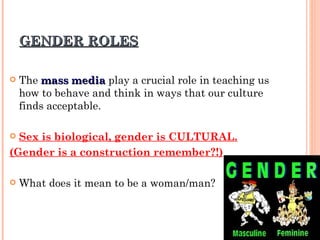
GENDER ROLES The  mass media  play a crucial role in teaching us how to behave and think in ways that our culture finds acceptable. Sex is biological, gender is CULTURAL. (Gender is a construction remember?!) What does it mean to be a woman/man?
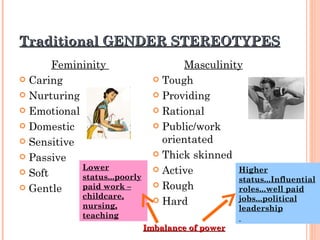
Traditional GENDER STEREOTYPES Femininity  Caring Nurturing Emotional Domestic Sensitive Passive Soft  Gentle Masculinity Tough Providing Rational Public/work orientated Thick skinned Active Rough Hard Lower status...poorly paid work – childcare, nursing, teaching Higher status...Influential roles...well paid jobs...political leadership Imbalance of power
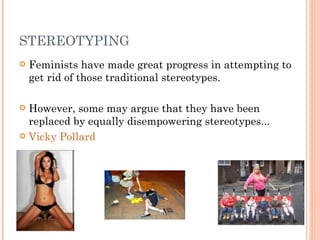
STEREOTYPING Feminists have made great progress in attempting to get rid of those traditional stereotypes. However, some may argue that they have been replaced by equally disempowering stereotypes... Vicky Pollard
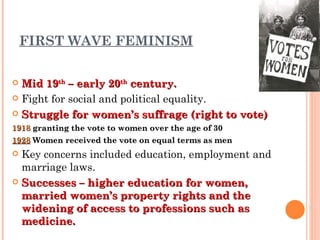
FIRST WAVE FEMINISM Mid 19 th  – early 20 th  century. Fight for social and political equality. Struggle for women’s suffrage (right to vote) 1918  granting the vote to women over the age of 30   1928   Women received the vote on equal terms as men  Key concerns included education, employment and marriage laws. Successes – higher education for women, married women’s property rights and the widening of access to professions such as medicine.
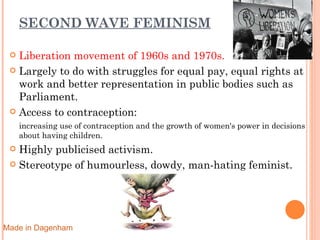
SECOND WAVE FEMINISM Liberation movement of 1960s and 1970s. Largely to do with struggles for equal pay, equal rights at work and better representation in public bodies such as Parliament. Access to contraception: increasing use of contraception and the growth of women's power in decisions about having children. Highly publicised activism. Stereotype of humourless, dowdy, man-hating feminist. Made in Dagenham
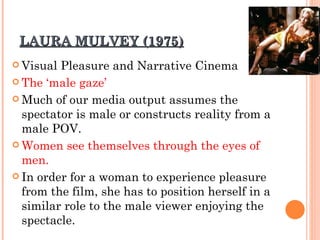
LAURA MULVEY (1975) Visual Pleasure and Narrative Cinema The ‘male gaze’ Much of our media output assumes the spectator is male or constructs reality from a male POV. Women see themselves through the eyes of men. In order for a woman to experience pleasure from the film, she has to position herself in a similar role to the male viewer enjoying the spectacle.
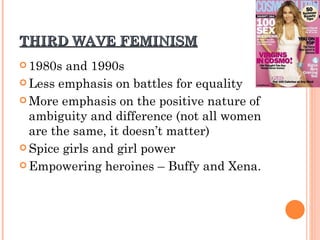
THIRD WAVE FEMINISM 1980s and 1990s Less emphasis on battles for equality More emphasis on the positive nature of ambiguity and difference (not all women are the same, it doesn’t matter) Spice girls and girl power Empowering heroines – Buffy and Xena.
 
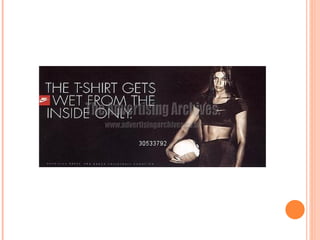
2003 – Kill Bill Nike ad “the tshirt gets wet from the inside only” Triumph – “New hair, new bra and if he don’t like it, new boyfriend” A new aggressive form of sexuality
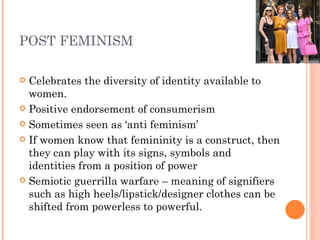
POST FEMINISM Celebrates the diversity of identity available to women. Positive endorsement of consumerism  Sometimes seen as ‘anti feminism’ If women know that femininity is a construct, then they can play with its signs, symbols and identities from a position of power Semiotic guerrilla warfare – meaning of signifiers such as high heels/lipstick/designer clothes can be shifted from powerless to powerful.
GAUNTLETT (2002) “ Men and women are seen working side by side, as equals, in the hospitals, schools and police stations of television land. Movie producers are wary of having women as screaming victims, and have realised that kick ass heroines do better business. Advertisers have now realised that audiences will only laugh at images of the pretty housewife, and have reacted by showing women how to be sexy at work instead.” CNN clip
Classic weak-woman scenes in the films and TV:   Man grabs woman by upper arm. Woman exclaims, "You're hurting me!"  Man suddenly appears from around corner. Woman gasps and exclaims, "You scared me!"  Man and woman are arguing. Man's voice raises and he steps towards her. Woman backs up. Man continues slowly moving towards her (no weapons, by the way, not even a raised fist) and woman continues backing away.  Man and woman are running away from gunmen in a forest. Man's hand is always grabbed onto woman's wrist and she slows man down. (A woman cannot run beyond her natural speed if a man has her wrist; A woman's, or man's, fastest sprint can only be accomplished with BOTH arms pumping freely!) Woman is running from man in woods. Woman trips and falls, and man catches up.  Woman is hit by man's backhand and falls to floor. Whimpering, she then slithers across floor away from man.
Can you find examples of these in your main text?!

Feminism

  • 1.
    FEMINISM A LevelMedia Studies
  • 2.
    FEMINISM Feminists seekto challenge the unfair and unequal distribution of power and wealth in patriarchal society. A patriarchal society is one based on male rule and domination. Feminists are particularly interested in the contribution made by the media to society’s dominant ideas about gender roles.
  • 3.
    GENDER ROLES The mass media play a crucial role in teaching us how to behave and think in ways that our culture finds acceptable. Sex is biological, gender is CULTURAL. (Gender is a construction remember?!) What does it mean to be a woman/man?
  • 4.
    Traditional GENDER STEREOTYPESFemininity Caring Nurturing Emotional Domestic Sensitive Passive Soft Gentle Masculinity Tough Providing Rational Public/work orientated Thick skinned Active Rough Hard Lower status...poorly paid work – childcare, nursing, teaching Higher status...Influential roles...well paid jobs...political leadership Imbalance of power
  • 5.
    STEREOTYPING Feminists havemade great progress in attempting to get rid of those traditional stereotypes. However, some may argue that they have been replaced by equally disempowering stereotypes... Vicky Pollard
  • 6.
    FIRST WAVE FEMINISMMid 19 th – early 20 th century. Fight for social and political equality. Struggle for women’s suffrage (right to vote) 1918 granting the vote to women over the age of 30 1928 Women received the vote on equal terms as men Key concerns included education, employment and marriage laws. Successes – higher education for women, married women’s property rights and the widening of access to professions such as medicine.
  • 7.
    SECOND WAVE FEMINISMLiberation movement of 1960s and 1970s. Largely to do with struggles for equal pay, equal rights at work and better representation in public bodies such as Parliament. Access to contraception: increasing use of contraception and the growth of women's power in decisions about having children. Highly publicised activism. Stereotype of humourless, dowdy, man-hating feminist. Made in Dagenham
  • 8.
    LAURA MULVEY (1975)Visual Pleasure and Narrative Cinema The ‘male gaze’ Much of our media output assumes the spectator is male or constructs reality from a male POV. Women see themselves through the eyes of men. In order for a woman to experience pleasure from the film, she has to position herself in a similar role to the male viewer enjoying the spectacle.
  • 9.
    THIRD WAVE FEMINISM1980s and 1990s Less emphasis on battles for equality More emphasis on the positive nature of ambiguity and difference (not all women are the same, it doesn’t matter) Spice girls and girl power Empowering heroines – Buffy and Xena.
  • 10.
  • 11.
    2003 – KillBill Nike ad “the tshirt gets wet from the inside only” Triumph – “New hair, new bra and if he don’t like it, new boyfriend” A new aggressive form of sexuality
  • 12.
    POST FEMINISM Celebratesthe diversity of identity available to women. Positive endorsement of consumerism Sometimes seen as ‘anti feminism’ If women know that femininity is a construct, then they can play with its signs, symbols and identities from a position of power Semiotic guerrilla warfare – meaning of signifiers such as high heels/lipstick/designer clothes can be shifted from powerless to powerful.
  • 13.
    GAUNTLETT (2002) “Men and women are seen working side by side, as equals, in the hospitals, schools and police stations of television land. Movie producers are wary of having women as screaming victims, and have realised that kick ass heroines do better business. Advertisers have now realised that audiences will only laugh at images of the pretty housewife, and have reacted by showing women how to be sexy at work instead.” CNN clip
  • 14.
    Classic weak-woman scenesin the films and TV: Man grabs woman by upper arm. Woman exclaims, "You're hurting me!" Man suddenly appears from around corner. Woman gasps and exclaims, "You scared me!" Man and woman are arguing. Man's voice raises and he steps towards her. Woman backs up. Man continues slowly moving towards her (no weapons, by the way, not even a raised fist) and woman continues backing away. Man and woman are running away from gunmen in a forest. Man's hand is always grabbed onto woman's wrist and she slows man down. (A woman cannot run beyond her natural speed if a man has her wrist; A woman's, or man's, fastest sprint can only be accomplished with BOTH arms pumping freely!) Woman is running from man in woods. Woman trips and falls, and man catches up. Woman is hit by man's backhand and falls to floor. Whimpering, she then slithers across floor away from man.
  • 15.
    Can you findexamples of these in your main text?!