GENDER BUDGET ANALYSIS B R SIWAL NIPCCD  NEW DELHI
Why Budget Analysis? Budgets are crucial:  determine how governments mobilize and allocate public resources  shape policies, set priorities an economic process: deals with allocation and mobilization of resources  articulates the macro economic policies of the state  political instrument: voted on and mediates competition between people and interests  instrument for fulfilling obligations of the state in respecting, protecting,promoting  human rights
Gap between promise and expectation in post Beijing period: Outcome Document adopted by all states at the UNGA in 2000 lists 3 main reasons: Lack of resources  lack of innovative approaches to allocation of existing resources Lack of gender perspective in macroeconomic policy framework .
RATIONALE OF GENDER BUDGETING Gender Budgeting is a strategy for ensuring  Gender Sensitive Resource Allocation  and a tool for engendering macro economic policy. Not a separate budget for women. Dissects the Government Budget to establish its gender differential impact. Enables  Tracking and Allocating resources for women empowerment.
What are Gender Budgets? they are not separate budgets for women they are general budgets analyzed or constructed from a gender perspective they involve analysis of actual government expenditure and revenue on women and  girls in comparison to that on men and boys and in comparison to the need.
help governments to decide how policies need to be adjusted and reprioritized:  how available money is used to target those most in need. tool for effective policy implementation where Governments can check if the allocations are in line with the policy commitments made to their citizens;  tool for contributing to a public debate and to effective use of public funding
The Current Interest in Gender Budgets the political drive for accountability : “putting the money where the mouth is” need to measure/monitor accountability :budget allocations vs actual expenditures: efficiency : gender inequality leads to major losses in economic efficiency and  human development : gender budget initiatives can reconcile the objectives of gender equality, human development and economic efficiency transparency:gender budget initiatives can contribute towards demystification of the budget and greater public participation
equality :budgets unresponsive to the need of those in poverty and marginalized  particularly women and children will fail to lead to equality in distribution and  equity in the output and will fail to address gender-specific discrimination important step in deepening democracy need for recognizing women’s unpaid work as economic work:to look at not just  private and public sectors but also domestic sector including the domestic unpaid  work (the care economy) and the work of the NGOsector, both formal paid and  unpaid volunteer work and flows between them
The Concept and its Tools Three levels: Inputs : financial appropriations vs.. need: appropriations vs. actual  expenditure: sector wise shares of expenditure and real per capita: revenue side Activities  supported by appropriations: public services, delivery costs, income transfers Outcomes  expected from appropriations vs. actual outcomes including unintended ones: whether the money is being used in a manner that  effectively achieves planned outcomes and where it is failing
Tool 1: Gender-Aware Policy Appraisal-Linking Budgets to Policies 3 steps: 1. examine position of women and men, boys and girls in each area of economic and social life addressed by the budget, taking into account age, ethnic group,location and class; 2. examine whether government policy adequately addresses inequalities which have been identified; 3. examine whether resources are being allocated in ways that are likely to reduce inequalities.
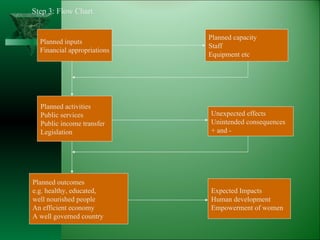
Step 3: Flow Chart Planned outcomes e.g. healthy, educated,  well nourished people An efficient economy A well governed country Planned activities Public services  Public income transfer Legislation Planned inputs Financial appropriations Planned capacity Staff Equipment etc Unexpected effects Unintended consequences + and -  Expected Impacts Human development Empowerment of women
Tools 2: Beneficiary Assessments Techniques include: Opinion polls, attitude surveys, focus groups, interviews, role  play
Tool 3: Public Expenditure Incidence Analysis Gives a sense of how gender-inclusive expenditures actually are by comparing the distribution of public spending among women and men, girls and boys.  Three steps: 1. Estimate unit cost of providing a service. e.g., 1 primary school place for 1 year 2. Estimate use of service by men and women, boys and girls e.g., number of primary school places occupied by girls and boys 3. Calculate amount spent per year on girls and boys.
Tool 4: Revenue Incidence Analysis Shows proportion of income paid in taxes and user charges  by different categories of individuals or households.
Tool 7: Gender-aware Budget Statement Any government can issue a gender-aware budget statement utilizing one or more of the above tools to analyze its programmes and budgets. Some key indicators for a gender-aware budget statement. -share of expenditure targeted to gender equality -women’s participation in the public-sector employment relative to men. -the share of prioritized expenditures towards women -
share of expenditure devoted to official gender units - share of expenditure devoted to women’s priority income transfer -gender balance in business support -gender balance in public sector contracts -gender balance in decision making bodies, forums and committees -gender balance in training
Tool 5: Sex-Disaggregated Analysis of the Impact of the Budget on Time Use Similar to tool 1- but focuses in particular on the outcome for the amount of unpaid care work done by women and men Whenever expenditure cuts are proposed, the question should be asked: Is this likely to increase the time that men and women spend on unpaid care work?
Tool 6: Gender-Aware Medium-Term Economic Policy Framework Incorporation of gender variables into the models used for medium-term public expenditure planning are based.  For example, inclusion of: sex-disaggregated variables in the labour market component new variables to represent the unpaid care economy
Global Approaches Two main approaches : Sectoral analysis say of the education, agricultural, health sectors etc. and within each sector examining the implications of the expenditure  (and sometimes revenue) on women and men. Within each sector this  involves looking at inputs, activities and outcomes within each of the four categories explained above, viz., gender targeted, employment   equity and mainstream  expenditures and revenue: Australia, Sri Lanka
Analysis of the overall allocation of resources among sectors, drawing on the  macroeconomic framework as a whole; South Africa Location of analysis : Government: Women’s Machinery or Finance Ministry led  Non Government: civil society led
Gender Budget in India: Current Scenario Government  led process at national level:  Analyzing the entire budget resulting in: Gender aware budget statement by FM: Economic Survey(2001)  Section on Gender Inequality: based on gender budget analysis Analysis of annual budgets: dissemination amongst parliamentarians during debates on demand for grants
Supplementary  state level work by feminists/NGOs analyzing state budgets, specific sectors and specific large  programmes impact of specific expenditure increase/compression measures on households (gender disaggregated) impact of labour market changes on women and how budgets are/are  not dealing with them Building budgets from below involving the panchayats
CLUSTERS Protective & Welfare Services which are aimed at directly benefiting the women mitigating the consequences of women’s social and economic subordination. Social Services which contribute significantly to women’s empowerment, either directly by building their capacities and ensuring their material well being or indirectly through reducing domestic drudgery. Economic Services which are critical to women’s economic independence and autonomy. Regulatory Services & Awareness Generation which provide institutional spaces and opportunities for women’s empowerment.
CONSTRAINTS Non availability of authentic documents. Data sets not available as per format Figures related to Actual Expenditure not available (even for previous financial years)
Cont. Constraints Attempts to analyse and collate the data were constrained: - Wide discrepancies in terms of units  such as thousands or lakhs - Inconsistencies in figures/data (totals) - Allocations to Pro and targeted  categories of schemes were mixed up  due to lack of understanding - Clusterwise distribution of schemes  done by names was misleading.
SOLUTIONS Need to coordinate field efforts of data collection-Training & Workshops Ensuring validated & reliable information Diverse nomenclature of schemes and programmes across states. Revision of formats
ISSUES IN GENDER BUDGETING Non-availability of gender disaggregated data Isolating women component in local level resource allocation Reliability and validity of data Need for uniformity in concept & definitions
TASKS AHEAD Promoting   - A nalysis of public expenditure from a  gender perspective   - S tandardize techniques, sectoral definitions,  nomenclature of various schemes, etc. so  that future research is facilitated. - Monitoring of regular collection of physical  and financial targets and achievements.  Streamlining of this process by use of MIS
Cont. Task Ahead Organise workshops and studies on refining methodology for gender analysis of budgets. Formulate and disseminate uniform guidelines on gender budgeting and develop appropriate software Formulation and adoption of schedules and formats for working out women’s share in all public expenditure. Promote capacity building of research organisations.
ACTIONS FOR THE FUTURE Coverage of the approach has to be expanded to all States/UTs & percolate down to District levels The methodology to be refined.  Analysis to go beyond allocations & expenditure to benefit incidence & outcomes Institutionalized gender disaggregated data sets.
Formulation & dissemination of uniform guidelines for gender accounting, auditing & for physical and formal targets/documents Extend the nature & scope of gender analysis of budgets to include benefit incidence analysis in specific geographical & sectoral areas and over a larger time frame.
Institutionalize the process of gender budgeting. Capacity building within the Government & amongst research organisations . Impact analysis of public expenditure, to get comprehensive picture of household expenditure only on children and women Analyse investment and expenditure ratios. Taking stock of expenditure on other related infrastructure including rail/road access, electrification, water resources etc. to get clear picture of expenditure for well being of women and children.  Cont. Actions for Future
Global context  of gender budgeting Global consensus to “Sustainable Human Development [SHD] Approach”  -  a fundamental rethinking in macroeconomic policies. Tool for enhancing the SHD paradigm: “ People-mattered budget initiative” Pro-poor, gender and green budgets”
Gender budgeting: country experiences AUSTRALIA was the pioneer in developing a gender-sensitive budget in 1984. COMMONWEALTH’S GENDER BUDGET INITIATIVE in 1996, piloted in five countries; South Africa, Sri Lanka, Barbados,St.Kitts and Nevis and Fiji.
Indian Context for Gender Budgeting    Special  Reference in Budget Speech, 2000  pertaining to the “access of women to national resources”.    National Development Council adopted “Empowerment of Women” as specific objective of  9th FYP on February 19,1999.  ” Women’s Component Plan” to ensure that not less than 30 % of funds and benefits flow to women from developmental sectors.    Gender equality recognized  in Indian Constitution .
Gender Budgeting in Indian Context Economic Survey, 2000-01  An entire section on gender equality. Highlights of Union Budget 2001-02 Strengthening of microfinance facility for women. Integrated Scheme for Women Empowerment  with a new scheme for women in difficult circumstances.
Gender sensitive budget Budgetary resource allocation through gender lens. Are not separate budgets for women. Dissection of budget to establish its gender-specific impacts. Gendered  incidence of budgetary policies for the effective targeting of public spending Stress r epriotisation  rather an overall increase in public spending. Thrust to ensure a greater visibility to  care economy .
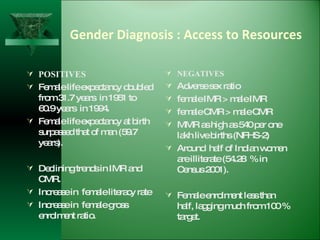
Gender Diagnosis : Access to Resources POSITIVES Female life expectancy doubled from 31.7 years  in 1951 to 60.9 years  in 1994.  Female life expectancy at birth surpassed that of man (59.7 years). Declining trends in IMR and CMR. Increase in  female literacy rate Increase in  female gross enrolment ratio. NEGATIVES Adverse sex ratio female IMR > male IMR female CMR > male CMR MMR as high as 540 per one lakh live births (NFHS-2) Around  half of Indian women are illiterate (54.28  % in Census 2001). Female enrolment less than half, lagging much from 100 % target.
Preparing gender-sensitive budget Category   i.  Specifically targeted expenditure to women Category ii . Public Expenditure with pro-women allocation Category iii : Mainstream expenditure that make gender-differential impacts .
Categorization of Specifically targeted expenditure > Protective and Welfare Services  to prevent atrocities viz. domestic violence, kidnapping, rape, dowry deaths > Social Services education, health, nutrition > Economic Services self employment  & training programs > Regulatory Services & Awareness Generation Programs Maternal benefit schemes
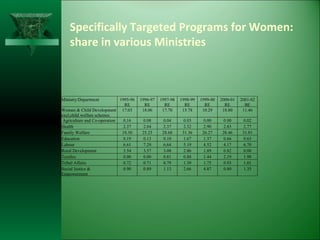
Category I: Specifically targeted expenditure.   contd Direct allocations specially targeted to women and girls under various Ministries in Union Budget 2001-02 amounted to Rs. 3260 crores  0.87 per cent of total expenditure Significant deviation of revised estimates from the budget estimates [ Rs 2970 crores in BE 2000-01 and Rs 2543 in RE 2000-01]
BE-RE: Significant Deviation Non-approval of Schemes/ Revised Norms. Late approval of additional corpus of funds. Failure to take into account the unspent balances of previous years. Slack on the part of implementing agency to implement the scheme. [Report No.1 of CAG of India, 1999, page No. 165-172]
Specifically Targeted Programs for Women: share in various Ministries
Public Expenditure with Pro-women allocations Certain public expenditure have pro-women allocations; though they are not exclusively targeted for women.  Eg., poverty alleviation  & employment generation schemes; provision for drinking water, fuel, housing, improved energy resources etc.
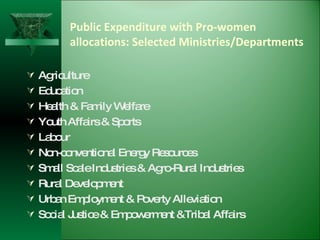
Public Expenditure with Pro-women allocations: Selected Ministries/Departments Agriculture Education Health & Family Welfare Youth Affairs & Sports Labour Non-conventional Energy Resources Small Scale Industries & Agro-Rural Industries Rural Development Urban Employment & Poverty Alleviation Social Justice & Empowerment &Tribal Affairs
Public Expenditure with Pro-women allocations: In gender-intensive Ministries: Pro-women Allocation = [TE-WSP]*WC other Ministries with few gender-intensive schemes: Pro-women allocation=    [SCS * WC] Share declined from 3.89 percent in 1995-96 to 2.82 per cent in 2001-02 in total expenditure.
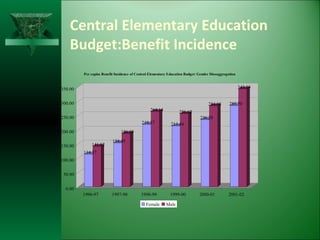
Gender Disaggregated Benefit Incidence   Aims to analyze the extent to which men and women benefit from expenditure on publicly provided services. Assessing the distribution of public spending by gender.  how gender-inclusive the mainstream expenditure can be sensed.  BENEFIT INCIDENCE = [UNIT COSTS] * [No. of UNITS UTILISED]
Central Elementary Education Budget:Benefit Incidence
Priority Actions Collate the gender disaggregated data from relevant Departments to obtain gender-wise relevant statistical database. Segregate the provisions for women in the composite schemes. Protect the provisions by placing restrictions on their reappropriation for other purposes.
THANK YOU

Gender Budget Analysis Tools

  • 1.
    GENDER BUDGET ANALYSISB R SIWAL NIPCCD NEW DELHI
  • 2.
    Why Budget Analysis?Budgets are crucial: determine how governments mobilize and allocate public resources shape policies, set priorities an economic process: deals with allocation and mobilization of resources articulates the macro economic policies of the state political instrument: voted on and mediates competition between people and interests instrument for fulfilling obligations of the state in respecting, protecting,promoting human rights
  • 3.
    Gap between promiseand expectation in post Beijing period: Outcome Document adopted by all states at the UNGA in 2000 lists 3 main reasons: Lack of resources lack of innovative approaches to allocation of existing resources Lack of gender perspective in macroeconomic policy framework .
  • 4.
    RATIONALE OF GENDERBUDGETING Gender Budgeting is a strategy for ensuring Gender Sensitive Resource Allocation and a tool for engendering macro economic policy. Not a separate budget for women. Dissects the Government Budget to establish its gender differential impact. Enables Tracking and Allocating resources for women empowerment.
  • 5.
    What are GenderBudgets? they are not separate budgets for women they are general budgets analyzed or constructed from a gender perspective they involve analysis of actual government expenditure and revenue on women and girls in comparison to that on men and boys and in comparison to the need.
  • 6.
    help governments todecide how policies need to be adjusted and reprioritized: how available money is used to target those most in need. tool for effective policy implementation where Governments can check if the allocations are in line with the policy commitments made to their citizens; tool for contributing to a public debate and to effective use of public funding
  • 7.
    The Current Interestin Gender Budgets the political drive for accountability : “putting the money where the mouth is” need to measure/monitor accountability :budget allocations vs actual expenditures: efficiency : gender inequality leads to major losses in economic efficiency and human development : gender budget initiatives can reconcile the objectives of gender equality, human development and economic efficiency transparency:gender budget initiatives can contribute towards demystification of the budget and greater public participation
  • 8.
    equality :budgets unresponsiveto the need of those in poverty and marginalized particularly women and children will fail to lead to equality in distribution and equity in the output and will fail to address gender-specific discrimination important step in deepening democracy need for recognizing women’s unpaid work as economic work:to look at not just private and public sectors but also domestic sector including the domestic unpaid work (the care economy) and the work of the NGOsector, both formal paid and unpaid volunteer work and flows between them
  • 9.
    The Concept andits Tools Three levels: Inputs : financial appropriations vs.. need: appropriations vs. actual expenditure: sector wise shares of expenditure and real per capita: revenue side Activities supported by appropriations: public services, delivery costs, income transfers Outcomes expected from appropriations vs. actual outcomes including unintended ones: whether the money is being used in a manner that effectively achieves planned outcomes and where it is failing
  • 10.
    Tool 1: Gender-AwarePolicy Appraisal-Linking Budgets to Policies 3 steps: 1. examine position of women and men, boys and girls in each area of economic and social life addressed by the budget, taking into account age, ethnic group,location and class; 2. examine whether government policy adequately addresses inequalities which have been identified; 3. examine whether resources are being allocated in ways that are likely to reduce inequalities.
  • 11.
    Step 3: FlowChart Planned outcomes e.g. healthy, educated, well nourished people An efficient economy A well governed country Planned activities Public services Public income transfer Legislation Planned inputs Financial appropriations Planned capacity Staff Equipment etc Unexpected effects Unintended consequences + and - Expected Impacts Human development Empowerment of women
  • 12.
    Tools 2: BeneficiaryAssessments Techniques include: Opinion polls, attitude surveys, focus groups, interviews, role play
  • 13.
    Tool 3: PublicExpenditure Incidence Analysis Gives a sense of how gender-inclusive expenditures actually are by comparing the distribution of public spending among women and men, girls and boys. Three steps: 1. Estimate unit cost of providing a service. e.g., 1 primary school place for 1 year 2. Estimate use of service by men and women, boys and girls e.g., number of primary school places occupied by girls and boys 3. Calculate amount spent per year on girls and boys.
  • 14.
    Tool 4: RevenueIncidence Analysis Shows proportion of income paid in taxes and user charges by different categories of individuals or households.
  • 15.
    Tool 7: Gender-awareBudget Statement Any government can issue a gender-aware budget statement utilizing one or more of the above tools to analyze its programmes and budgets. Some key indicators for a gender-aware budget statement. -share of expenditure targeted to gender equality -women’s participation in the public-sector employment relative to men. -the share of prioritized expenditures towards women -
  • 16.
    share of expendituredevoted to official gender units - share of expenditure devoted to women’s priority income transfer -gender balance in business support -gender balance in public sector contracts -gender balance in decision making bodies, forums and committees -gender balance in training
  • 17.
    Tool 5: Sex-DisaggregatedAnalysis of the Impact of the Budget on Time Use Similar to tool 1- but focuses in particular on the outcome for the amount of unpaid care work done by women and men Whenever expenditure cuts are proposed, the question should be asked: Is this likely to increase the time that men and women spend on unpaid care work?
  • 18.
    Tool 6: Gender-AwareMedium-Term Economic Policy Framework Incorporation of gender variables into the models used for medium-term public expenditure planning are based. For example, inclusion of: sex-disaggregated variables in the labour market component new variables to represent the unpaid care economy
  • 19.
    Global Approaches Twomain approaches : Sectoral analysis say of the education, agricultural, health sectors etc. and within each sector examining the implications of the expenditure (and sometimes revenue) on women and men. Within each sector this involves looking at inputs, activities and outcomes within each of the four categories explained above, viz., gender targeted, employment equity and mainstream expenditures and revenue: Australia, Sri Lanka
  • 20.
    Analysis of theoverall allocation of resources among sectors, drawing on the macroeconomic framework as a whole; South Africa Location of analysis : Government: Women’s Machinery or Finance Ministry led Non Government: civil society led
  • 21.
    Gender Budget inIndia: Current Scenario Government led process at national level: Analyzing the entire budget resulting in: Gender aware budget statement by FM: Economic Survey(2001) Section on Gender Inequality: based on gender budget analysis Analysis of annual budgets: dissemination amongst parliamentarians during debates on demand for grants
  • 22.
    Supplementary statelevel work by feminists/NGOs analyzing state budgets, specific sectors and specific large programmes impact of specific expenditure increase/compression measures on households (gender disaggregated) impact of labour market changes on women and how budgets are/are not dealing with them Building budgets from below involving the panchayats
  • 23.
    CLUSTERS Protective &Welfare Services which are aimed at directly benefiting the women mitigating the consequences of women’s social and economic subordination. Social Services which contribute significantly to women’s empowerment, either directly by building their capacities and ensuring their material well being or indirectly through reducing domestic drudgery. Economic Services which are critical to women’s economic independence and autonomy. Regulatory Services & Awareness Generation which provide institutional spaces and opportunities for women’s empowerment.
  • 24.
    CONSTRAINTS Non availabilityof authentic documents. Data sets not available as per format Figures related to Actual Expenditure not available (even for previous financial years)
  • 25.
    Cont. Constraints Attemptsto analyse and collate the data were constrained: - Wide discrepancies in terms of units such as thousands or lakhs - Inconsistencies in figures/data (totals) - Allocations to Pro and targeted categories of schemes were mixed up due to lack of understanding - Clusterwise distribution of schemes done by names was misleading.
  • 26.
    SOLUTIONS Need tocoordinate field efforts of data collection-Training & Workshops Ensuring validated & reliable information Diverse nomenclature of schemes and programmes across states. Revision of formats
  • 27.
    ISSUES IN GENDERBUDGETING Non-availability of gender disaggregated data Isolating women component in local level resource allocation Reliability and validity of data Need for uniformity in concept & definitions
  • 28.
    TASKS AHEAD Promoting - A nalysis of public expenditure from a gender perspective - S tandardize techniques, sectoral definitions, nomenclature of various schemes, etc. so that future research is facilitated. - Monitoring of regular collection of physical and financial targets and achievements. Streamlining of this process by use of MIS
  • 29.
    Cont. Task AheadOrganise workshops and studies on refining methodology for gender analysis of budgets. Formulate and disseminate uniform guidelines on gender budgeting and develop appropriate software Formulation and adoption of schedules and formats for working out women’s share in all public expenditure. Promote capacity building of research organisations.
  • 30.
    ACTIONS FOR THEFUTURE Coverage of the approach has to be expanded to all States/UTs & percolate down to District levels The methodology to be refined. Analysis to go beyond allocations & expenditure to benefit incidence & outcomes Institutionalized gender disaggregated data sets.
  • 31.
    Formulation & disseminationof uniform guidelines for gender accounting, auditing & for physical and formal targets/documents Extend the nature & scope of gender analysis of budgets to include benefit incidence analysis in specific geographical & sectoral areas and over a larger time frame.
  • 32.
    Institutionalize the processof gender budgeting. Capacity building within the Government & amongst research organisations . Impact analysis of public expenditure, to get comprehensive picture of household expenditure only on children and women Analyse investment and expenditure ratios. Taking stock of expenditure on other related infrastructure including rail/road access, electrification, water resources etc. to get clear picture of expenditure for well being of women and children. Cont. Actions for Future
  • 33.
    Global context of gender budgeting Global consensus to “Sustainable Human Development [SHD] Approach” - a fundamental rethinking in macroeconomic policies. Tool for enhancing the SHD paradigm: “ People-mattered budget initiative” Pro-poor, gender and green budgets”
  • 34.
    Gender budgeting: countryexperiences AUSTRALIA was the pioneer in developing a gender-sensitive budget in 1984. COMMONWEALTH’S GENDER BUDGET INITIATIVE in 1996, piloted in five countries; South Africa, Sri Lanka, Barbados,St.Kitts and Nevis and Fiji.
  • 35.
    Indian Context forGender Budgeting  Special Reference in Budget Speech, 2000 pertaining to the “access of women to national resources”.  National Development Council adopted “Empowerment of Women” as specific objective of 9th FYP on February 19,1999.  ” Women’s Component Plan” to ensure that not less than 30 % of funds and benefits flow to women from developmental sectors.  Gender equality recognized in Indian Constitution .
  • 36.
    Gender Budgeting inIndian Context Economic Survey, 2000-01 An entire section on gender equality. Highlights of Union Budget 2001-02 Strengthening of microfinance facility for women. Integrated Scheme for Women Empowerment with a new scheme for women in difficult circumstances.
  • 37.
    Gender sensitive budgetBudgetary resource allocation through gender lens. Are not separate budgets for women. Dissection of budget to establish its gender-specific impacts. Gendered incidence of budgetary policies for the effective targeting of public spending Stress r epriotisation rather an overall increase in public spending. Thrust to ensure a greater visibility to care economy .
  • 38.
    Gender Diagnosis :Access to Resources POSITIVES Female life expectancy doubled from 31.7 years in 1951 to 60.9 years in 1994. Female life expectancy at birth surpassed that of man (59.7 years). Declining trends in IMR and CMR. Increase in female literacy rate Increase in female gross enrolment ratio. NEGATIVES Adverse sex ratio female IMR > male IMR female CMR > male CMR MMR as high as 540 per one lakh live births (NFHS-2) Around half of Indian women are illiterate (54.28 % in Census 2001). Female enrolment less than half, lagging much from 100 % target.
  • 39.
    Preparing gender-sensitive budgetCategory i. Specifically targeted expenditure to women Category ii . Public Expenditure with pro-women allocation Category iii : Mainstream expenditure that make gender-differential impacts .
  • 40.
    Categorization of Specificallytargeted expenditure > Protective and Welfare Services to prevent atrocities viz. domestic violence, kidnapping, rape, dowry deaths > Social Services education, health, nutrition > Economic Services self employment & training programs > Regulatory Services & Awareness Generation Programs Maternal benefit schemes
  • 41.
    Category I: Specificallytargeted expenditure. contd Direct allocations specially targeted to women and girls under various Ministries in Union Budget 2001-02 amounted to Rs. 3260 crores 0.87 per cent of total expenditure Significant deviation of revised estimates from the budget estimates [ Rs 2970 crores in BE 2000-01 and Rs 2543 in RE 2000-01]
  • 42.
    BE-RE: Significant DeviationNon-approval of Schemes/ Revised Norms. Late approval of additional corpus of funds. Failure to take into account the unspent balances of previous years. Slack on the part of implementing agency to implement the scheme. [Report No.1 of CAG of India, 1999, page No. 165-172]
  • 43.
    Specifically Targeted Programsfor Women: share in various Ministries
  • 44.
    Public Expenditure withPro-women allocations Certain public expenditure have pro-women allocations; though they are not exclusively targeted for women. Eg., poverty alleviation & employment generation schemes; provision for drinking water, fuel, housing, improved energy resources etc.
  • 45.
    Public Expenditure withPro-women allocations: Selected Ministries/Departments Agriculture Education Health & Family Welfare Youth Affairs & Sports Labour Non-conventional Energy Resources Small Scale Industries & Agro-Rural Industries Rural Development Urban Employment & Poverty Alleviation Social Justice & Empowerment &Tribal Affairs
  • 46.
    Public Expenditure withPro-women allocations: In gender-intensive Ministries: Pro-women Allocation = [TE-WSP]*WC other Ministries with few gender-intensive schemes: Pro-women allocation=  [SCS * WC] Share declined from 3.89 percent in 1995-96 to 2.82 per cent in 2001-02 in total expenditure.
  • 47.
    Gender Disaggregated BenefitIncidence Aims to analyze the extent to which men and women benefit from expenditure on publicly provided services. Assessing the distribution of public spending by gender. how gender-inclusive the mainstream expenditure can be sensed. BENEFIT INCIDENCE = [UNIT COSTS] * [No. of UNITS UTILISED]
  • 48.
    Central Elementary EducationBudget:Benefit Incidence
  • 49.
    Priority Actions Collatethe gender disaggregated data from relevant Departments to obtain gender-wise relevant statistical database. Segregate the provisions for women in the composite schemes. Protect the provisions by placing restrictions on their reappropriation for other purposes.
  • 50.