JOHN FLORENTINO E. ECHON
DISCUSSANT
Bataan Peninsula State University, Main Campus
OVERVIEW
 GAD Related Laws
 PLAN FRAMEWORK of the Philippine Plan for
Gender-Responsive Development 1995-2025
 PPGD Key Objectives for the Education Sector
GAD RELATED LAWS
 RA 7192 “Women in Development and
Nation-Building Act”
 RA 9710 The Magna Carta of Women
 RA10354 “The Responsible Parenthood
and Reproductive Health Act of 2012″
Republic Act (RA) No. 7192, or the “Women in
Development and Nation-Building Act”
Set into motion the allocation of a certain
percentage of official development assistance for
gender concerns. The law has likewise been the
starting point of what is now known as the
Gender and Development (GAD) Budget Policy.
Republic Act (RA) No. 7192, or the “Women in
Development and Nation-Building Act”
The Development (GAD) Budget Policy, which
was initiated in the 1995 General Appropriations
Act, specifically mandates all government
departments, bureaus, offices and agencies to set
aside at least 5 percent of their total budget.
RA No. 7192 was signed into law by then
President Corazon C. Aquino on 12 February
1992.
THE BUDGET
The government allotted P105.75 billion for
its 2015 Gender and Development (GAD)
budget, the Philippine Commission on
Women (PCW) boasted.
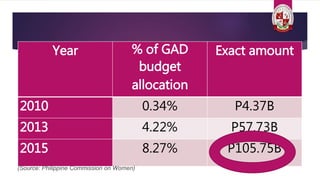
Year % of GAD
budget
allocation
Exact amount
2010 0.34% P4.37B
2013 4.22% P57.73B
2015 8.27% P105.75B
(Source: Philippine Commission on Women)
“A review of the Philippine GAD budgeting
process noted that while the Philippines is the
only country that authorizes a specific budgetary
allocation to implement the GAD Budget Policy,
compliance with the policy has been very low,
and there is no operational mechanism to
actively promote compliance and performance,”
Source: rappler.com
In 1999, the media uncovered how certain
government agencies were misusing GAD
budgets.
Funds were used for flowers, jewelry, aerobics
classes, ballroom dancing, personal
transportation and accommodation of
government officials, among other unnecessary
expenses.
 Since then, the PCW has pushed agencies to
maintaining stricter and more productive GAD
implementations.
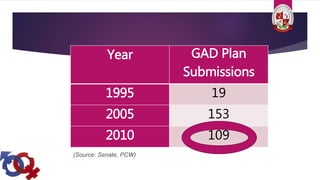
 All government agencies are required to submit an
annual GAD plan, budget, and accomplishment
report. "While submissions have generally increased
through the years, compliance with the said
requirement remains low," the Senate reported
Year GAD Plan
Submissions
1995 19
2005 153
2010 109
(Source: Senate, PCW)
RA 9710 The Magna Carta of Women
Magna Carta of Women (MCW, or RA 9710), a
watershed legislation signed into law on 14 August
2009, reiterates the Constitutional policy declaring:
“the State affirms the role of women in nation
building and ensures the substantive equality of
women and men.”
“The Responsible Parenthood and
Reproductive Health Act of 2012″
Known as the Reproductive Health Law or
RH Law, is a law in the Philippines, which
guarantees universal access to methods on
contraception, fertility control, sexual
education, and maternal care.
REPUBLIC ACT NO. 10354
RH LAW
RH, the UN Women stressed, is closely linked to
development: "Sustainable development cannot
be achieved unless all women and girls enjoy
universal access to sexual and reproductive health
and rights over the life cycle, enabling them to
make free and informed decisions about sex and
reproduction."
With the RH law in full swing, much is to be
expected of the Philippines in achieving women
empowerment in the coming years, according to
advocates. Results, however, are yet to be seen.
The Philippine Plan for Gender-
Responsive Development 1995-
2025
The PPGD 1995−2025 is the thirty-year long-
term perspective plan that carries the
country’s long-term vision of women’s
empowerment and gender equality.
The PPGD aims to alter the traditional concept of
a woman's self-worth as being subordinate to
men.
 Improved women's participation in government projects
 Improved access to resources distributed through projects (i.e.,
water supply, agriculture)
 Reduced sexism in school learning materials
 Increased rescue of trafficked victims
 Improved transporation facilities
 Safer workplaces for women
 Improved women's access to jobs
PPGD Key Objectives
for the Education
Sector
PPGD Key Objectives for the Education
Sector
1.Elimination of all forms of gender bias and
acceleration of the responsiveness of
education and training
2. Upgrading of the internal efficiency and
enhancement of the capacity of the
educational system
PPGD Key Objectives for the Education
Sector
3. Provision for equitable access of women to
services and opportunities
4. Raising of the general consciousness
regarding women’s gender concerns
In responding to a Gender
Responsive Society, it is not the
Government alone, but our
COLLECTIVE effort as a nation.
THANK YOU FOR
LISTENING!

Gad programs (echon)

  • 1.
    JOHN FLORENTINO E.ECHON DISCUSSANT Bataan Peninsula State University, Main Campus
  • 2.
    OVERVIEW  GAD RelatedLaws  PLAN FRAMEWORK of the Philippine Plan for Gender-Responsive Development 1995-2025  PPGD Key Objectives for the Education Sector
  • 3.
    GAD RELATED LAWS RA 7192 “Women in Development and Nation-Building Act”  RA 9710 The Magna Carta of Women  RA10354 “The Responsible Parenthood and Reproductive Health Act of 2012″
  • 4.
    Republic Act (RA)No. 7192, or the “Women in Development and Nation-Building Act” Set into motion the allocation of a certain percentage of official development assistance for gender concerns. The law has likewise been the starting point of what is now known as the Gender and Development (GAD) Budget Policy.
  • 5.
    Republic Act (RA)No. 7192, or the “Women in Development and Nation-Building Act” The Development (GAD) Budget Policy, which was initiated in the 1995 General Appropriations Act, specifically mandates all government departments, bureaus, offices and agencies to set aside at least 5 percent of their total budget.
  • 6.
    RA No. 7192was signed into law by then President Corazon C. Aquino on 12 February 1992.
  • 7.
    THE BUDGET The governmentallotted P105.75 billion for its 2015 Gender and Development (GAD) budget, the Philippine Commission on Women (PCW) boasted.
  • 8.
    Year % ofGAD budget allocation Exact amount 2010 0.34% P4.37B 2013 4.22% P57.73B 2015 8.27% P105.75B (Source: Philippine Commission on Women)
  • 9.
    “A review ofthe Philippine GAD budgeting process noted that while the Philippines is the only country that authorizes a specific budgetary allocation to implement the GAD Budget Policy, compliance with the policy has been very low, and there is no operational mechanism to actively promote compliance and performance,” Source: rappler.com
  • 10.
    In 1999, themedia uncovered how certain government agencies were misusing GAD budgets. Funds were used for flowers, jewelry, aerobics classes, ballroom dancing, personal transportation and accommodation of government officials, among other unnecessary expenses.
  • 11.
     Since then,the PCW has pushed agencies to maintaining stricter and more productive GAD implementations.  All government agencies are required to submit an annual GAD plan, budget, and accomplishment report. "While submissions have generally increased through the years, compliance with the said requirement remains low," the Senate reported
  • 12.
    Year GAD Plan Submissions 199519 2005 153 2010 109 (Source: Senate, PCW)
  • 13.
    RA 9710 TheMagna Carta of Women Magna Carta of Women (MCW, or RA 9710), a watershed legislation signed into law on 14 August 2009, reiterates the Constitutional policy declaring: “the State affirms the role of women in nation building and ensures the substantive equality of women and men.”
  • 14.
    “The Responsible Parenthoodand Reproductive Health Act of 2012″ Known as the Reproductive Health Law or RH Law, is a law in the Philippines, which guarantees universal access to methods on contraception, fertility control, sexual education, and maternal care. REPUBLIC ACT NO. 10354
  • 15.
    RH LAW RH, theUN Women stressed, is closely linked to development: "Sustainable development cannot be achieved unless all women and girls enjoy universal access to sexual and reproductive health and rights over the life cycle, enabling them to make free and informed decisions about sex and reproduction."
  • 16.
    With the RHlaw in full swing, much is to be expected of the Philippines in achieving women empowerment in the coming years, according to advocates. Results, however, are yet to be seen.
  • 17.
    The Philippine Planfor Gender- Responsive Development 1995- 2025
  • 19.
    The PPGD 1995−2025is the thirty-year long- term perspective plan that carries the country’s long-term vision of women’s empowerment and gender equality.
  • 20.
    The PPGD aimsto alter the traditional concept of a woman's self-worth as being subordinate to men.
  • 21.
     Improved women'sparticipation in government projects  Improved access to resources distributed through projects (i.e., water supply, agriculture)  Reduced sexism in school learning materials  Increased rescue of trafficked victims  Improved transporation facilities  Safer workplaces for women  Improved women's access to jobs
  • 22.
    PPGD Key Objectives forthe Education Sector
  • 23.
    PPGD Key Objectivesfor the Education Sector 1.Elimination of all forms of gender bias and acceleration of the responsiveness of education and training 2. Upgrading of the internal efficiency and enhancement of the capacity of the educational system
  • 24.
    PPGD Key Objectivesfor the Education Sector 3. Provision for equitable access of women to services and opportunities 4. Raising of the general consciousness regarding women’s gender concerns
  • 27.
    In responding toa Gender Responsive Society, it is not the Government alone, but our COLLECTIVE effort as a nation.
  • 28.