PRESENTATION BY:
PRATEEK SHARMA
RAJAT SINGH
NAFEES ANZAR
GHULAM MOHAMMED
PAWAN SINGH
COLLEGE NAME:
J.P INSTITUTE OF ENGINEERING & TECHNOLOGY
MEERUT
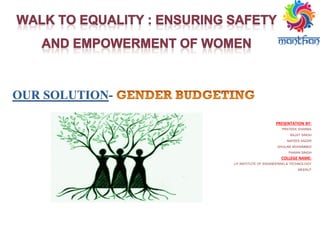
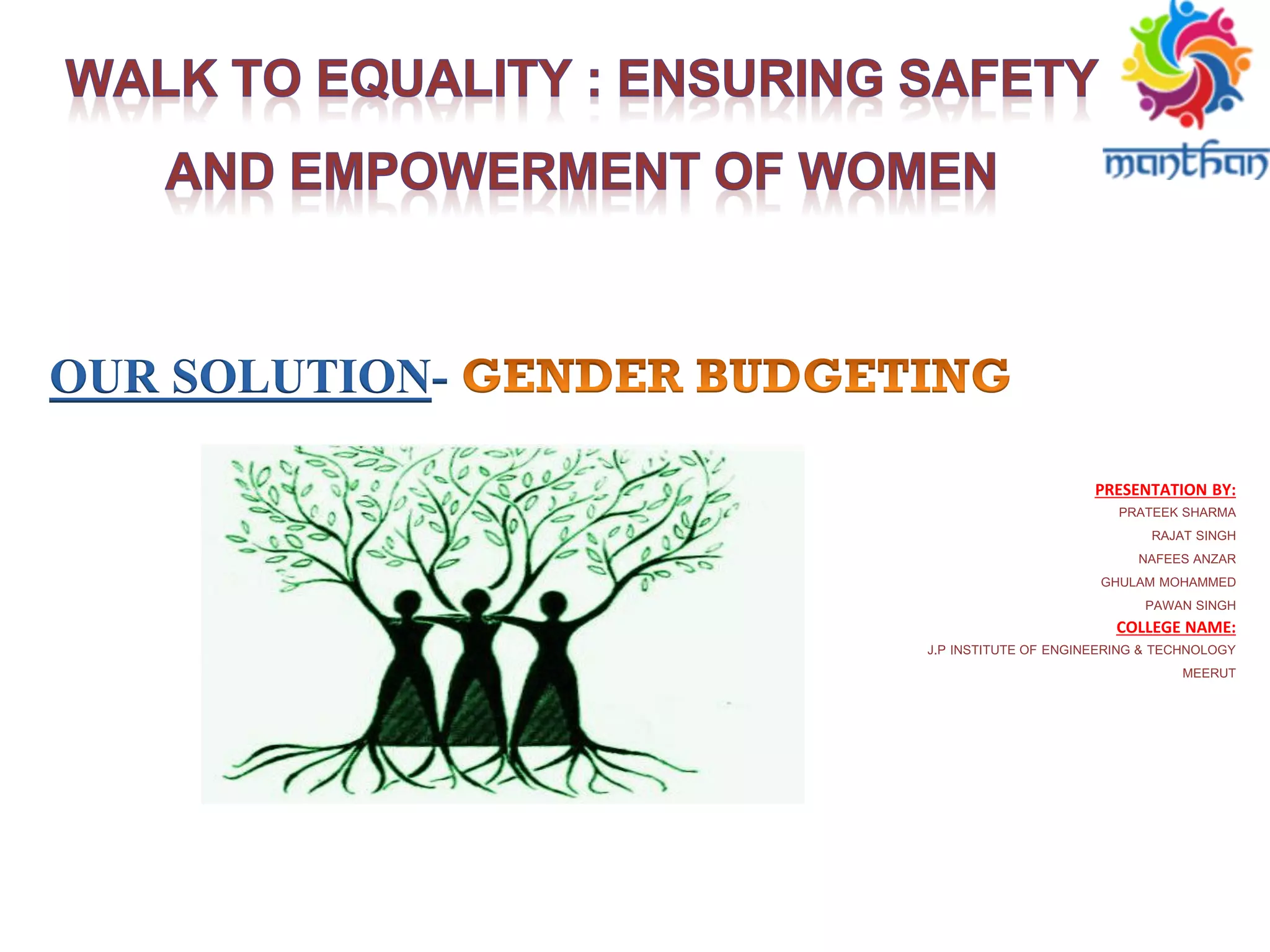
OUR SOLUTION-
Gender Budgeting- a definition
• “Gender budget initiatives analyse how
governments raise and spend public
money, with the aim of securing gender
equality in decision-making about public
resource allocation; and gender equality in
the distribution of the impact of
government budgets, both in their benefits
and in their burdens. The impact of
government budgets on the most
disadvantaged groups of women is a focus
of special attention.”
What is Gender Budgeting ?
• An exercise to translate stated gender commitments of
the Government into budgetary commitments.
– Strategy for ensuring Gender Sensitive Resource Allocation
and a tool for engendering macro economic policy
• Entails affirmative action for empowering women
• Covers assessment of gender differential impact of
Government Budgets and policies (Revenue and
Expenditure).
– Enables Tracking and Allocating resources for women
empowerment
– Opportunity to determine real value of resources allocated
to women
What are gender commitments in
the Indian context ?
• Constitutional Provisions
• Legal Framework
–Women Specific Laws
–Laws affecting Women
• Policies
• Public Expenditure Programmes
Indian Experience
• Women’s Component Plan-Earmarking
resources for women
• Implementing Women Specific Schemes
• Monitoring macro indicators like MMR
Literacy rates, work participation
• Quantum and Trend analysis of resources
allocated and spent on women
• Gender Audit of schemes and programmes-
implementation and impact analysis
Framework of Gender Budgeting
• Quantification of allocation of resources for
women
• Gender Audit of policies of the Government
• Impact assessment of various schemes in
the Union and State budgets
• Analyzing schematic and policy initiatives
and link with impact on status of women
related Macro Indicators
Framework of Gender Budgeting
• Institutionalizing the generation and
collection of gender dis-aggregated
data
• Consultations and Capacity building
• Promote gender equity in
participation in decision making
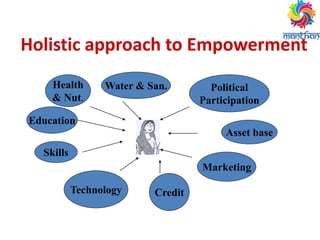
Holistic approach to Empowerment
Health
& Nut.
Education
Water & San.
Skills
Technology Credit
Political
Participation
Marketing
Asset base
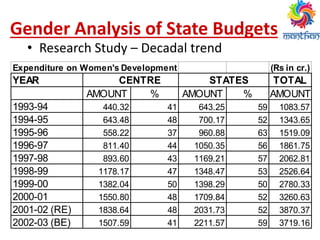
Gender Analysis of State Budgets
• Research Study – Decadal trend
Expenditure on Women's Development (Rs in cr.)
YEAR CENTRE STATES TOTAL
AMOUNT % AMOUNT % AMOUNT
1993-94 440.32 41 643.25 59 1083.57
1994-95 643.48 48 700.17 52 1343.65
1995-96 558.22 37 960.88 63 1519.09
1996-97 811.40 44 1050.35 56 1861.75
1997-98 893.60 43 1169.21 57 2062.81
1998-99 1178.17 47 1348.47 53 2526.64
1999-00 1382.04 50 1398.29 50 2780.33
2000-01 1550.80 48 1709.84 52 3260.63
2001-02 (RE) 1838.64 48 2031.73 52 3870.37
2002-03 (BE) 1507.59 41 2211.57 59 3719.16
To Conclude
• “It is more important to create a general
awareness’ and understanding of the problems
of women’s employment in all the top policy and
decision making and executive personnel. There
is also the special problem facing women like the
preference for male children for social and
cultural reasons. This will require awareness,
understanding and action. The best way to do so
is to educate the children, orient the teachers,
examine the text books and teaching-aids and
ensure that the next generation grows up with
new thinking.”
(6th Five Year Plan )

MECHAMINDS5

  • 1.
    PRESENTATION BY: PRATEEK SHARMA RAJATSINGH NAFEES ANZAR GHULAM MOHAMMED PAWAN SINGH COLLEGE NAME: J.P INSTITUTE OF ENGINEERING & TECHNOLOGY MEERUT OUR SOLUTION-
  • 2.
    Gender Budgeting- adefinition • “Gender budget initiatives analyse how governments raise and spend public money, with the aim of securing gender equality in decision-making about public resource allocation; and gender equality in the distribution of the impact of government budgets, both in their benefits and in their burdens. The impact of government budgets on the most disadvantaged groups of women is a focus of special attention.”
  • 3.
    What is GenderBudgeting ? • An exercise to translate stated gender commitments of the Government into budgetary commitments. – Strategy for ensuring Gender Sensitive Resource Allocation and a tool for engendering macro economic policy • Entails affirmative action for empowering women • Covers assessment of gender differential impact of Government Budgets and policies (Revenue and Expenditure). – Enables Tracking and Allocating resources for women empowerment – Opportunity to determine real value of resources allocated to women
  • 4.
    What are gendercommitments in the Indian context ? • Constitutional Provisions • Legal Framework –Women Specific Laws –Laws affecting Women • Policies • Public Expenditure Programmes
  • 5.
    Indian Experience • Women’sComponent Plan-Earmarking resources for women • Implementing Women Specific Schemes • Monitoring macro indicators like MMR Literacy rates, work participation • Quantum and Trend analysis of resources allocated and spent on women • Gender Audit of schemes and programmes- implementation and impact analysis
  • 6.
    Framework of GenderBudgeting • Quantification of allocation of resources for women • Gender Audit of policies of the Government • Impact assessment of various schemes in the Union and State budgets • Analyzing schematic and policy initiatives and link with impact on status of women related Macro Indicators
  • 7.
    Framework of GenderBudgeting • Institutionalizing the generation and collection of gender dis-aggregated data • Consultations and Capacity building • Promote gender equity in participation in decision making
  • 8.
    Holistic approach toEmpowerment Health & Nut. Education Water & San. Skills Technology Credit Political Participation Marketing Asset base
  • 9.
    Gender Analysis ofState Budgets • Research Study – Decadal trend Expenditure on Women's Development (Rs in cr.) YEAR CENTRE STATES TOTAL AMOUNT % AMOUNT % AMOUNT 1993-94 440.32 41 643.25 59 1083.57 1994-95 643.48 48 700.17 52 1343.65 1995-96 558.22 37 960.88 63 1519.09 1996-97 811.40 44 1050.35 56 1861.75 1997-98 893.60 43 1169.21 57 2062.81 1998-99 1178.17 47 1348.47 53 2526.64 1999-00 1382.04 50 1398.29 50 2780.33 2000-01 1550.80 48 1709.84 52 3260.63 2001-02 (RE) 1838.64 48 2031.73 52 3870.37 2002-03 (BE) 1507.59 41 2211.57 59 3719.16
  • 10.
    To Conclude • “Itis more important to create a general awareness’ and understanding of the problems of women’s employment in all the top policy and decision making and executive personnel. There is also the special problem facing women like the preference for male children for social and cultural reasons. This will require awareness, understanding and action. The best way to do so is to educate the children, orient the teachers, examine the text books and teaching-aids and ensure that the next generation grows up with new thinking.” (6th Five Year Plan )