Chapter VII
Gender &
Development
by
Dr. Joseline Manuel-Santos
Gender
-one of the universal
dimensions on which
status differences are
based.
-is a social construct
specifying the socially and
culturally prescribed roles
that men and women are
to follow.
Sex
is a biological
concept.
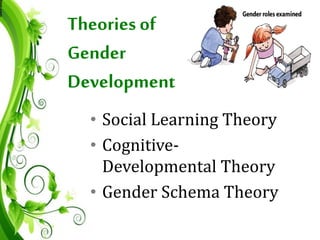
Theories of
Gender
Development
• Social Learning Theory
• Cognitive-
Developmental Theory
• Gender Schema Theory
Social
Learning
Theory
• Proponents of this
theory believe that
parents, as
distributors of
reinforcement,
reinforce appropriate
gender role behavior.
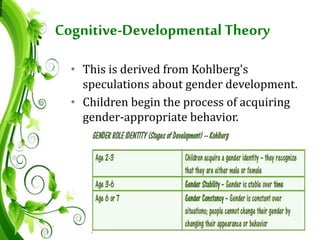
Cognitive-Developmental Theory
• This is derived from Kohlberg's
speculations about gender development.
• Children begin the process of acquiring
gender-appropriate behavior.
STAGES Characterized by:
Sensori-motor
(Birth - 2 years)
• Differentiates self from objects
• Recognizes self as agent of action and
begins to act intentionally.
Pre-operational
(2-7 years)
• Learns to use language and to represent
objects by images and words.
Concrete operational
(7-11 years)
• Can think logically about objects and
events
• Classifies objects according to several
features and can order them in series
along a single dimension such as size.
•
Formal operational
(11 years and up)
• Becomes concerned with the hypothetical,
the future, and ideological problems
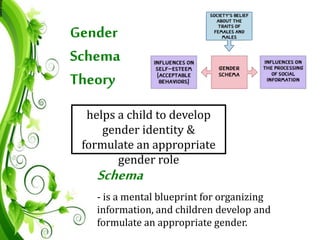
Gender
Schema
Theory
Schema
- is a mental blueprint for organizing
information, and children develop and
formulate an appropriate gender.
helps a child to develop
gender identity &
formulate an appropriate
gender role
Gender Stereotyping
-is defined as the beliefs humans
hold about the characteristics
associated with males and females.
Problems in Gender
Stereotyping
• When characteristics associated
with a particular gender have a
negative image.
• When a unique individual is
assumed to have all the
characteristics associated with
his/her gender.
Gender Ideologies
• Traditional Gender Ideology
• Egalitarian Gender Ideology
• Transitional
attitude toward men & women role.
Traditional
Gender Ideology
• Maintains that men sphere is
work and women sphere is the
home.
• The implicit assumption is that
men have greater power than
women.
Egalitarian
Gender Ideology
• Maintains that power is
distributed equally between men
and women and that each group
identifies equally with the same
spheres.
Transitional
• It is acceptable for women to
devote energy to both work and
family domains but women
should proportionally more
responsibility for the home and
men should focus proportionally
more their energy on work.
Gender
and
Equality
GenderEquality
between women and
men
is a worthy goal that is
central to progress in
human development.
“The Creation of Patriarchy”
by Gerda Lerner
-gender is the “costume, a mask, a
straitjacket in which men & women
dance their unequal dance.”
“The GenderQuestion”
by Alan Wolfe
-”of all the ways that one rooted than the
way men have subordinated women.”
Gender
Inequality
4 themesthat characterize
feminist theorizing of
gender inequality:
• Men & Women are situated in society
unequally.
• Organization of society.
• No significant pattern of natural
variation distinguishes the sexes.
• All inequality theories assume fairly
easily & naturally to more egalitarian
social structures.
Gender andPower
Gender
-refers to the different ways men &
women play in society, & to the relative
power they wield.
Power
-is a basic fabric of society & is
possessed in varying degrees by social
actors in diverse social categories.
“Essays inSociology”
by Max Weber
-he defined power as the
likelihood a person may
achieve personal ends
despite possible resistance
from others.
 Status resources
 Experience
 Self-confidence
Determinants
of POWER:
Gender
andEducation
Investing in Education is seen as
one of the fundamental ways in
which a state and its citizens can
move toward long-term
development goals and improve
both social and economic
standards of living.
Project byGroup(4members)
• Interview women from various sectors and
get their opinions regarding women
empowerment.
– Education
– Government
– Business
– Religion
Question: How are you being
empowered in your
organization?
• Short typewriting
• Arial; 12pt.; 1.5 spacing
• L-1.5”; R-1”; T-1”; B-1”
• Take photos of your
interviewee with you
12pt
12pt
35pt
29pt

Gender and Development

  • 1.
  • 2.
    Gender -one of theuniversal dimensions on which status differences are based. -is a social construct specifying the socially and culturally prescribed roles that men and women are to follow.
  • 3.
  • 4.
    Theories of Gender Development • SocialLearning Theory • Cognitive- Developmental Theory • Gender Schema Theory
  • 5.
    Social Learning Theory • Proponents ofthis theory believe that parents, as distributors of reinforcement, reinforce appropriate gender role behavior.
  • 6.
    Cognitive-Developmental Theory • Thisis derived from Kohlberg's speculations about gender development. • Children begin the process of acquiring gender-appropriate behavior.
  • 7.
    STAGES Characterized by: Sensori-motor (Birth- 2 years) • Differentiates self from objects • Recognizes self as agent of action and begins to act intentionally. Pre-operational (2-7 years) • Learns to use language and to represent objects by images and words. Concrete operational (7-11 years) • Can think logically about objects and events • Classifies objects according to several features and can order them in series along a single dimension such as size. • Formal operational (11 years and up) • Becomes concerned with the hypothetical, the future, and ideological problems
  • 8.
    Gender Schema Theory Schema - is amental blueprint for organizing information, and children develop and formulate an appropriate gender. helps a child to develop gender identity & formulate an appropriate gender role
  • 9.
    Gender Stereotyping -is definedas the beliefs humans hold about the characteristics associated with males and females.
  • 10.
    Problems in Gender Stereotyping •When characteristics associated with a particular gender have a negative image. • When a unique individual is assumed to have all the characteristics associated with his/her gender.
  • 11.
    Gender Ideologies • TraditionalGender Ideology • Egalitarian Gender Ideology • Transitional attitude toward men & women role.
  • 12.
    Traditional Gender Ideology • Maintainsthat men sphere is work and women sphere is the home. • The implicit assumption is that men have greater power than women.
  • 13.
    Egalitarian Gender Ideology • Maintainsthat power is distributed equally between men and women and that each group identifies equally with the same spheres.
  • 14.
    Transitional • It isacceptable for women to devote energy to both work and family domains but women should proportionally more responsibility for the home and men should focus proportionally more their energy on work.
  • 15.
  • 16.
    GenderEquality between women and men isa worthy goal that is central to progress in human development.
  • 17.
    “The Creation ofPatriarchy” by Gerda Lerner -gender is the “costume, a mask, a straitjacket in which men & women dance their unequal dance.” “The GenderQuestion” by Alan Wolfe -”of all the ways that one rooted than the way men have subordinated women.”
  • 18.
  • 19.
    4 themesthat characterize feministtheorizing of gender inequality: • Men & Women are situated in society unequally. • Organization of society. • No significant pattern of natural variation distinguishes the sexes. • All inequality theories assume fairly easily & naturally to more egalitarian social structures.
  • 20.
    Gender andPower Gender -refers tothe different ways men & women play in society, & to the relative power they wield. Power -is a basic fabric of society & is possessed in varying degrees by social actors in diverse social categories.
  • 21.
    “Essays inSociology” by MaxWeber -he defined power as the likelihood a person may achieve personal ends despite possible resistance from others.
  • 22.
     Status resources Experience  Self-confidence Determinants of POWER:
  • 23.
    Gender andEducation Investing in Educationis seen as one of the fundamental ways in which a state and its citizens can move toward long-term development goals and improve both social and economic standards of living.
  • 24.
    Project byGroup(4members) • Interviewwomen from various sectors and get their opinions regarding women empowerment. – Education – Government – Business – Religion Question: How are you being empowered in your organization? • Short typewriting • Arial; 12pt.; 1.5 spacing • L-1.5”; R-1”; T-1”; B-1” • Take photos of your interviewee with you
  • 25.