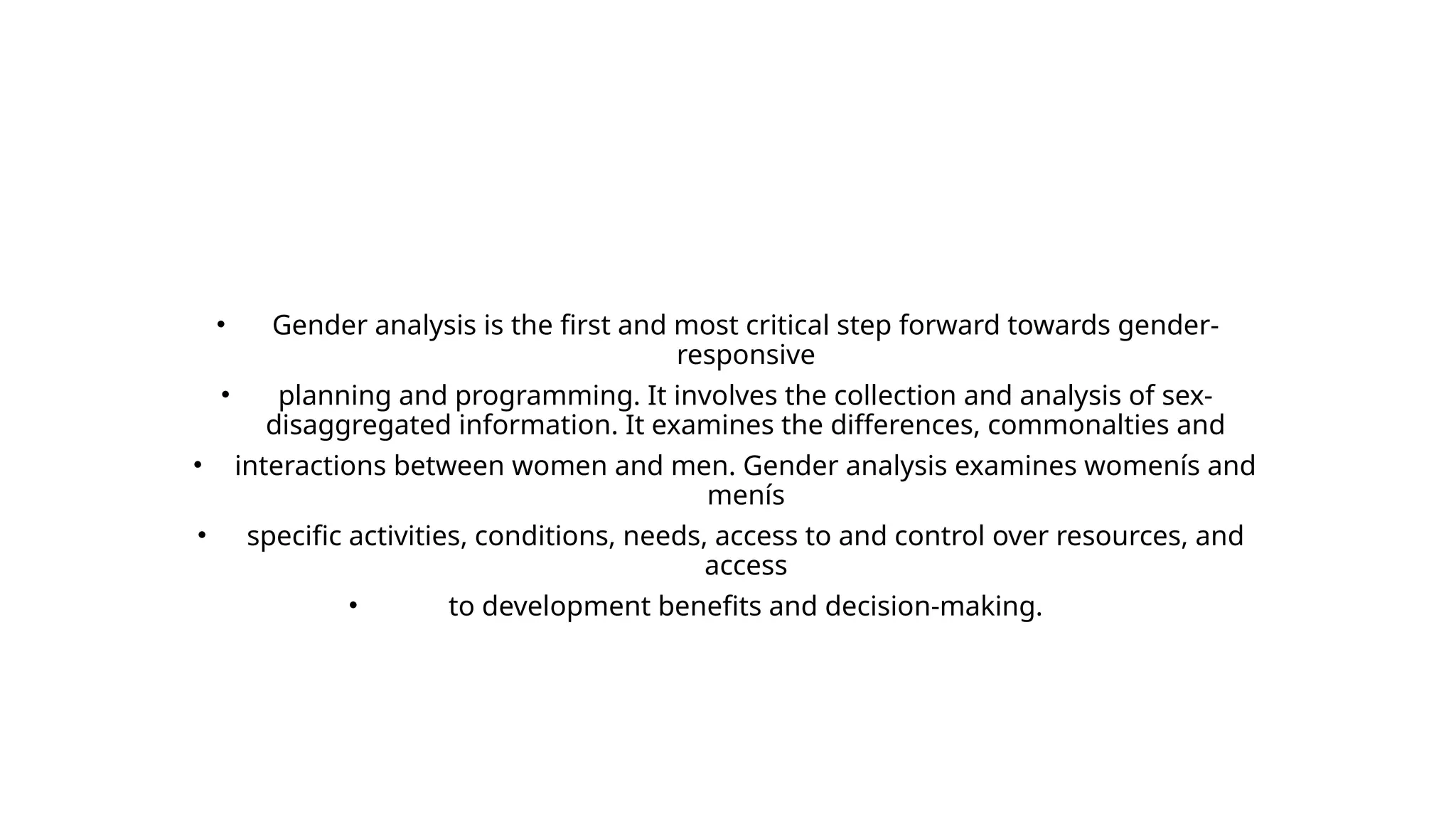
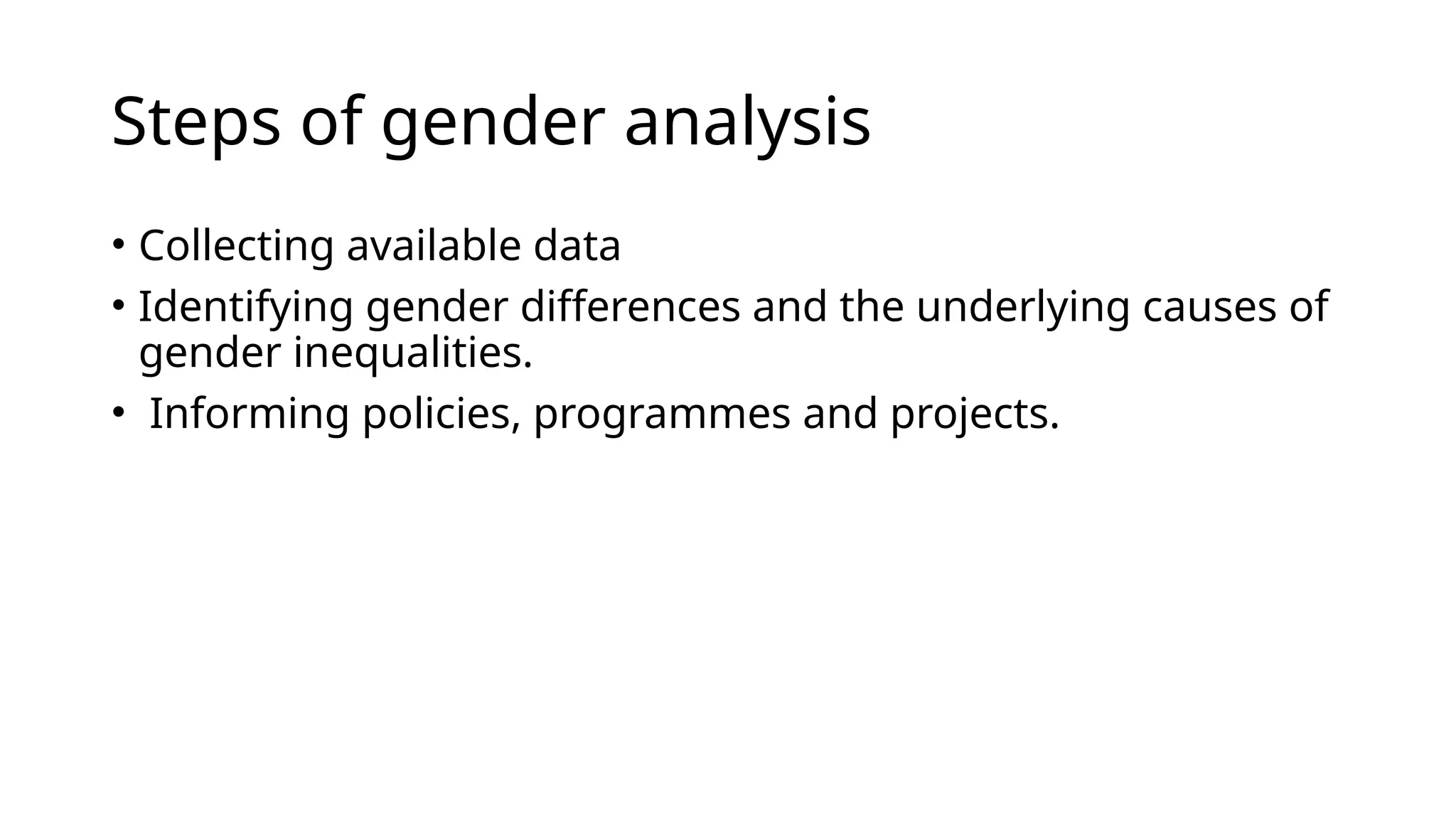
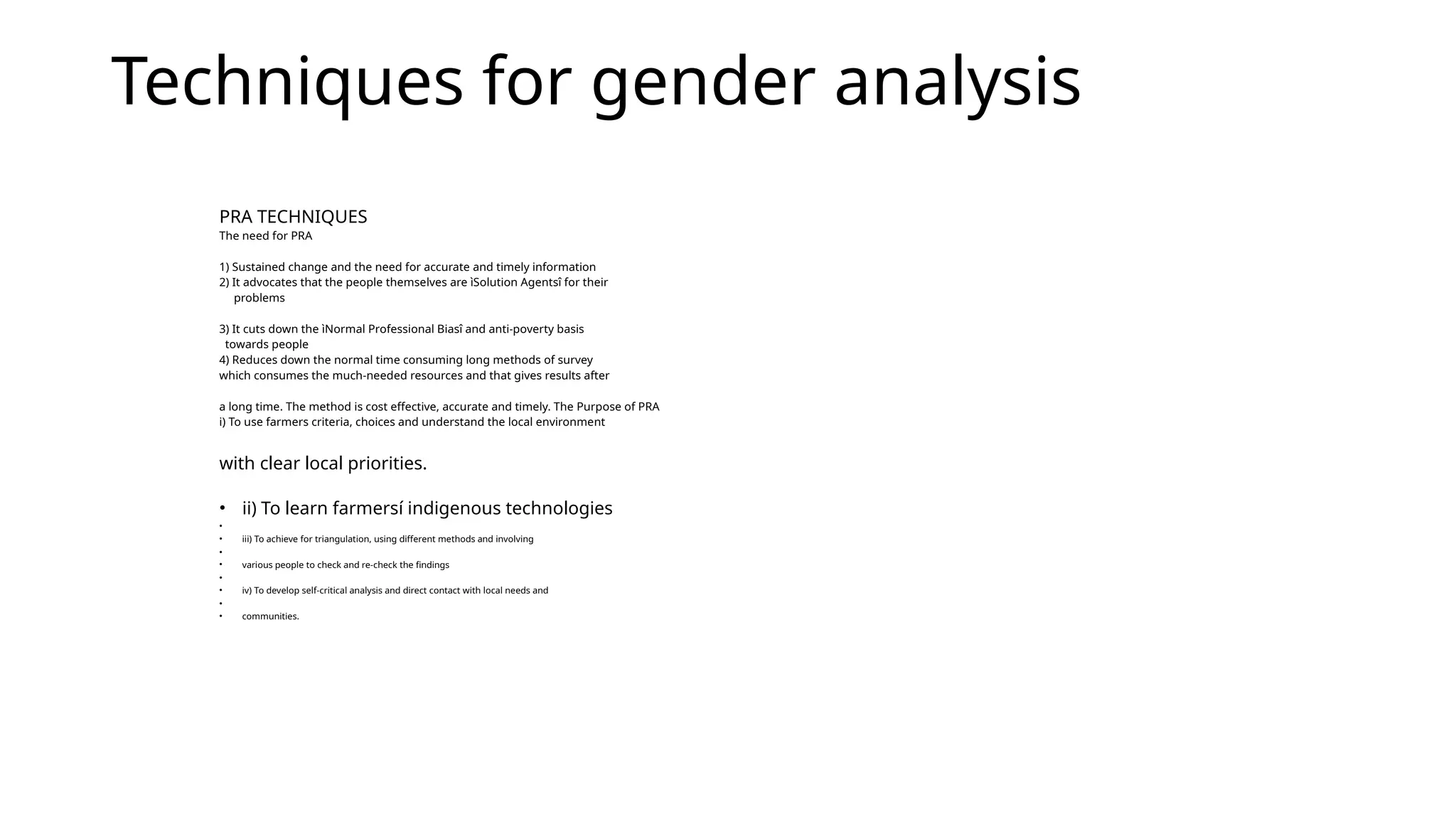
Gender analysis is essential for responsive planning and programming, focusing on sex-disaggregated information to identify differences in access to resources and decision-making between women and men. It aims to address gender inequalities by analyzing underlying causes and helping shape policies that consider the needs of all citizens. Participatory Rural Appraisal (PRA) techniques are highlighted as a cost-effective method for gathering timely data and understanding local priorities.
![Importance and uses
The European Commission defines gender analysis as ‘the study of differences in the
conditions, needs, participation rates, access to resources and development, control of
assets, decision-making powers, etc., between women and men in their assigned gender
roles’ [1].
• The purpose of gender analysis is to identify and address gender inequalities, by
[2]:Looking at the underlying causes of gender inequalities and discrimination can assist in
setting relevant and targeted objectives and measures to eliminate gender inequalities [4].
• In this way, gender analysis contributes to the improved gender responsiveness of
policies and legislation as it provides the basis for ensuring that the needs of all citizens —
women and men — are adequately addressed [5].
• When focused on organisations and institutions, gender analysis is also important in
determining how the nature of their service delivery may affect women and men, or how
institutions themselves are also ‘gendered’, for example, in the workplace in terms of
recruitment practices, the gendered divisions of labour and women’s access to decision-
making positions](https://image.slidesharecdn.com/presentation-250121132552-eb185237/75/Presentation-on-data-collection-of-nrlm-2-2048.jpg)



![[DSC Europe 25] Jon Dajci - Bridging TradFi and DeFi: Building the Future of ...](https://cdn.slidesharecdn.com/ss_thumbnails/fqmhfvlbqhkihjvqvhmu-7-251211083849-6af7e325-thumbnail.jpg?width=640&height=640&fit=bounds)
![[DSC Europe 25] Branko Dzakula - From Defense to Attack: How AI Redefines Cyb...](https://cdn.slidesharecdn.com/ss_thumbnails/80bdzdxpr3ky2g0qvyk9-8-251211083048-ce5fc1ee-thumbnail.jpg?width=640&height=640&fit=bounds)
![[DSC Europe 25] Danica Soc - The Science Behind Marketing: Experimentation me...](https://cdn.slidesharecdn.com/ss_thumbnails/c0nofsggs9gw5ucmallr-3-251216103155-56bd64d1-thumbnail.jpg?width=640&height=640&fit=bounds)


![[DSC Europe 25] Bassam Maharmeh - Artificial Intelligence: Opportunities and ...](https://cdn.slidesharecdn.com/ss_thumbnails/thhfmr2fqpawzj7hsjpg-5-251211083048-2c23204f-thumbnail.jpg?width=640&height=640&fit=bounds)
![[DSC Europe 25] Tatevik Maytesyan - How to actually use AI in marketing: gett...](https://cdn.slidesharecdn.com/ss_thumbnails/tjo626lsqdgfntbgl2mw-4-251216103155-e36cd239-thumbnail.jpg?width=640&height=640&fit=bounds)


